Historian’s Debate on Origins
and Aims of Imperialism
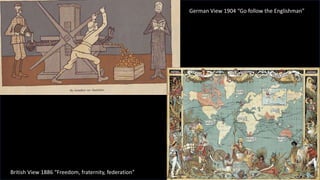
British View 1886 “Freedom, fraternity, federation”
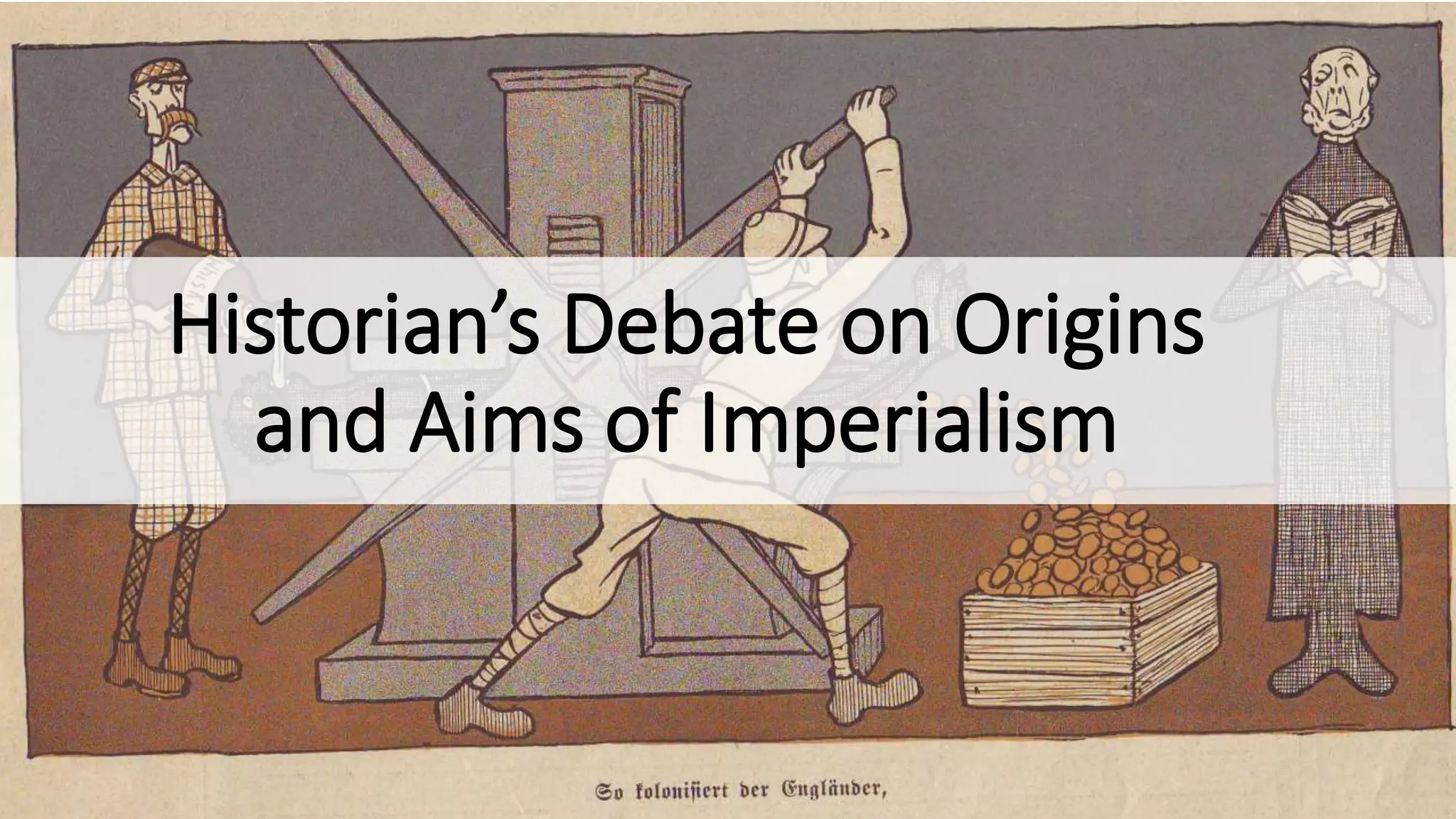
German View 1904 “Go follow the Englishman”
Historian’s Debate on Origins and Aims of
Imperialism
• Economic versus strategic
• Accidental versus planned
• Civilising mission versus brutal self-
interest
What is Imperialism?
British imperialism can thus be defined as the exercise of power over the domains
Britain controlled, but any definition must take account of the degree of influence
it had beyond the imperial borders. The term ‘imperialism’ might describe political
domination, economic exploitation and military subjugation. It might also include
aggrandisement of a policy through the colonisation of a territory by settlers or
invaders. The term can describe the process of how an empire grows; it might
also refer to the method by which an empire maintained itself and the influence
it exercised.
Johnston British Imperialism Chapter One
POWER, DOMINATION AND CONTROL
How do colonisation and imperialism differ?
“The practice of colonialism usually involved the transfer of
population to a new territory, where the arrivals lived as permanent
settlers while maintaining political allegiance to their country of
origin. Imperialism, on the other hand, comes from the Latin
term imperium, meaning to command. Thus, the term imperialism
draws attention to the way that one country exercises power over
another, whether through settlement, sovereignty, or indirect
mechanisms of control.”
Stanford Encyclopedia of Philosophy
Imperialism can exist without
colonisation but colonisation
can’t exist without imperialism.
Is this correct?
Sir John Seeley: “England’s Historical Tendency”
1883
Imperialism developed in three stages: unification of UK, early
colonisation, loss of US and expansion into Africa
• This involved the development of colonies
• Trade led to political control and supported by
strategic/military concerns
• Expansion inherent in English due to Christian/superior
culture
• Imperialism allowed GB to minimise its inevitable decline in
the face of the rise of the US and USSR
Absent minded imperialists
“There is something very characteristic in the indifference which
we show towards this mighty phenomenon of the diffusion of our
race and the expansion of our state. We seem, as it were, to have
conquered and peopled half the world in a fit of absence of
mind…We constantly betray by our modes of speech that we do
not reckon our colonies as really belonging to us; thus if we are
asked what the English population, is, it does not occur to us to
reckon-in the population of Canada and Australia. This fixed way
of thinking has influenced our historians. It causes them, I think,
to miss the true point of view in describing the eighteenth
century. They make too much of the mere parliamentary wrangle
and the agitations about liberty, in all which matters the
eighteenth century of England was but a pale reflexion of the
seventeenth. They do not perceive that in that century the
history of England is not in England but in America and
Asia.” John Seeley
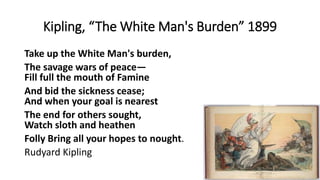
Kipling, “The White Man's Burden” 1899
Take up the White Man's burden,
The savage wars of peace—
Fill full the mouth of Famine
And bid the sickness cease;
And when your goal is nearest
The end for others sought,
Watch sloth and heathen
Folly Bring all your hopes to nought.
Rudyard Kipling
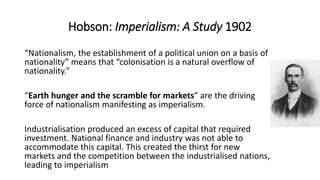
Hobson: Imperialism: A Study 1902
“Nationalism, the establishment of a political union on a basis of
nationality” means that “colonisation is a natural overflow of
nationality.”
“Earth hunger and the scramble for markets” are the driving
force of nationalism manifesting as imperialism.
Industrialisation produced an excess of capital that required
investment. National finance and industry was not able to
accommodate this capital. This created the thirst for new
markets and the competition between the industrialised nations,
leading to imperialism
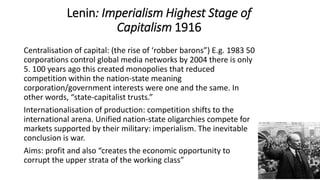
Lenin: Imperialism Highest Stage of
Capitalism 1916
Centralisation of capital: (the rise of ‘robber barons”) E.g. 1983 50
corporations control global media networks by 2004 there is only
5. 100 years ago this created monopolies that reduced
competition within the nation-state meaning
corporation/government interests were one and the same. In
other words, “state-capitalist trusts.”
Internationalisation of production: competition shifts to the
international arena. Unified nation-state oligarchies compete for
markets supported by their military: imperialism. The inevitable
conclusion is war.
Aims: profit and also “creates the economic opportunity to
corrupt the upper strata of the working class”
Robinson and Gallagher, “The Imperialism of Free
Trade” 1953
1. “The urge to imperialism in Europe is one factor”
2. Non-European politics and economics play a bigger role
3. “Imperialism did not conform to chronological periods of policy and
opinion,” e.g. it was driven by concerns in the periphery and European
policy was varied between reaction, pragmatism, protection of trade
and strategy.
4. “Trade followed the flag.”
5. Free Trade played an important role in the expansion of GB
imperialism
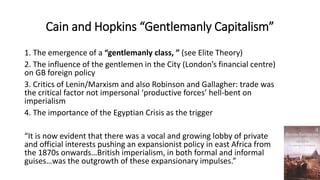
Cain and Hopkins “Gentlemanly Capitalism”
1. The emergence of a “gentlemanly class, ” (see Elite Theory)
2. The influence of the gentlemen in the City (London’s financial centre)
on GB foreign policy
3. Critics of Lenin/Marxism and also Robinson and Gallagher: trade was
the critical factor not impersonal ‘productive forces’ hell-bent on
imperialism
4. The importance of the Egyptian Crisis as the trigger
“It is now evident that there was a vocal and growing lobby of private
and official interests pushing an expansionist policy in east Africa from
the 1870s onwards…British imperialism, in both formal and informal
guises…was the outgrowth of these expansionary impulses.”
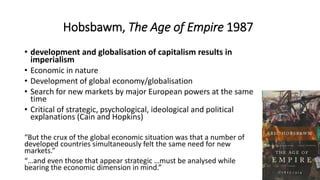
Hobsbawm, The Age of Empire 1987
• development and globalisation of capitalism results in
imperialism
• Economic in nature
• Development of global economy/globalisation
• Search for new markets by major European powers at the same
time
• Critical of strategic, psychological, ideological and political
explanations (Cain and Hopkins)
“But the crux of the global economic situation was that a number of
developed countries simultaneously felt the same need for new
markets.”
“…and even those that appear strategic …must be analysed while
bearing the economic dimension in mind.”
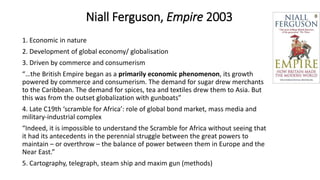
Niall Ferguson, Empire 2003
1. Economic in nature
2. Development of global economy/ globalisation
3. Driven by commerce and consumerism
“…the British Empire began as a primarily economic phenomenon, its growth
powered by commerce and consumerism. The demand for sugar drew merchants
to the Caribbean. The demand for spices, tea and textiles drew them to Asia. But
this was from the outset globalization with gunboats”
4. Late C19th ‘scramble for Africa’: role of global bond market, mass media and
military-industrial complex
“Indeed, it is impossible to understand the Scramble for Africa without seeing that
it had its antecedents in the perennial struggle between the great powers to
maintain – or overthrow – the balance of power between them in Europe and the
Near East.”
5. Cartography, telegraph, steam ship and maxim gun (methods)
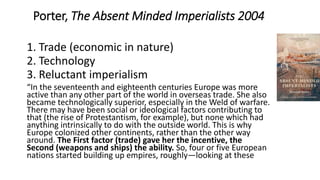
Porter, The Absent Minded Imperialists 2004
1. Trade (economic in nature)
2. Technology
3. Reluctant imperialism
“In the seventeenth and eighteenth centuries Europe was more
active than any other part of the world in overseas trade. She also
became technologically superior, especially in the Weld of warfare.
There may have been social or ideological factors contributing to
that (the rise of Protestantism, for example), but none which had
anything intrinsically to do with the outside world. This is why
Europe colonized other continents, rather than the other way
around. The First factor (trade) gave her the incentive, the
Second (weapons and ships) the ability. So, four or five European
nations started building up empires, roughly—looking at these
Porter (contd)
Two…Towards the end of the eighteenth century what is called the
Industrial Revolution really took off, and—for reasons that cannot
be gone into here, but which include the capital amassed from her
Indian and Atlantic trades—in Britain ahead of the rest of Europe.
That boosted the ‘incentive’ part of the equation in her particular
case. Modern factory production increased the demand for
materials to manufacture things out of (cotton, rubber, vegetable
oils . . . ), and the amount of goods the factories then had to sell.
Both domestic and foreign factors—limited markets at home,
demand abroad—pushed many British manufactures into exports.
So Britain became the leading commercial power in the world, by
a factor of at least two over France, and many more over her
other leading rivals. It was this that accounts for what looks to be
the quite amazing expansion of British economic influence in the
wider world in the eighteenth and nineteenth centuries.”

Imperialism Historian's Debate

  • 1.
    Historian’s Debate onOrigins and Aims of Imperialism
  • 4.
    British View 1886“Freedom, fraternity, federation” German View 1904 “Go follow the Englishman”
  • 5.
    Historian’s Debate onOrigins and Aims of Imperialism • Economic versus strategic • Accidental versus planned • Civilising mission versus brutal self- interest
  • 6.
    What is Imperialism? Britishimperialism can thus be defined as the exercise of power over the domains Britain controlled, but any definition must take account of the degree of influence it had beyond the imperial borders. The term ‘imperialism’ might describe political domination, economic exploitation and military subjugation. It might also include aggrandisement of a policy through the colonisation of a territory by settlers or invaders. The term can describe the process of how an empire grows; it might also refer to the method by which an empire maintained itself and the influence it exercised. Johnston British Imperialism Chapter One POWER, DOMINATION AND CONTROL
  • 7.
    How do colonisationand imperialism differ? “The practice of colonialism usually involved the transfer of population to a new territory, where the arrivals lived as permanent settlers while maintaining political allegiance to their country of origin. Imperialism, on the other hand, comes from the Latin term imperium, meaning to command. Thus, the term imperialism draws attention to the way that one country exercises power over another, whether through settlement, sovereignty, or indirect mechanisms of control.” Stanford Encyclopedia of Philosophy
  • 8.
    Imperialism can existwithout colonisation but colonisation can’t exist without imperialism. Is this correct?
  • 9.
    Sir John Seeley:“England’s Historical Tendency” 1883 Imperialism developed in three stages: unification of UK, early colonisation, loss of US and expansion into Africa • This involved the development of colonies • Trade led to political control and supported by strategic/military concerns • Expansion inherent in English due to Christian/superior culture • Imperialism allowed GB to minimise its inevitable decline in the face of the rise of the US and USSR
  • 10.
    Absent minded imperialists “Thereis something very characteristic in the indifference which we show towards this mighty phenomenon of the diffusion of our race and the expansion of our state. We seem, as it were, to have conquered and peopled half the world in a fit of absence of mind…We constantly betray by our modes of speech that we do not reckon our colonies as really belonging to us; thus if we are asked what the English population, is, it does not occur to us to reckon-in the population of Canada and Australia. This fixed way of thinking has influenced our historians. It causes them, I think, to miss the true point of view in describing the eighteenth century. They make too much of the mere parliamentary wrangle and the agitations about liberty, in all which matters the eighteenth century of England was but a pale reflexion of the seventeenth. They do not perceive that in that century the history of England is not in England but in America and Asia.” John Seeley
  • 11.
    Kipling, “The WhiteMan's Burden” 1899 Take up the White Man's burden, The savage wars of peace— Fill full the mouth of Famine And bid the sickness cease; And when your goal is nearest The end for others sought, Watch sloth and heathen Folly Bring all your hopes to nought. Rudyard Kipling
  • 12.
    Hobson: Imperialism: AStudy 1902 “Nationalism, the establishment of a political union on a basis of nationality” means that “colonisation is a natural overflow of nationality.” “Earth hunger and the scramble for markets” are the driving force of nationalism manifesting as imperialism. Industrialisation produced an excess of capital that required investment. National finance and industry was not able to accommodate this capital. This created the thirst for new markets and the competition between the industrialised nations, leading to imperialism
  • 13.
    Lenin: Imperialism HighestStage of Capitalism 1916 Centralisation of capital: (the rise of ‘robber barons”) E.g. 1983 50 corporations control global media networks by 2004 there is only 5. 100 years ago this created monopolies that reduced competition within the nation-state meaning corporation/government interests were one and the same. In other words, “state-capitalist trusts.” Internationalisation of production: competition shifts to the international arena. Unified nation-state oligarchies compete for markets supported by their military: imperialism. The inevitable conclusion is war. Aims: profit and also “creates the economic opportunity to corrupt the upper strata of the working class”
  • 14.
    Robinson and Gallagher,“The Imperialism of Free Trade” 1953 1. “The urge to imperialism in Europe is one factor” 2. Non-European politics and economics play a bigger role 3. “Imperialism did not conform to chronological periods of policy and opinion,” e.g. it was driven by concerns in the periphery and European policy was varied between reaction, pragmatism, protection of trade and strategy. 4. “Trade followed the flag.” 5. Free Trade played an important role in the expansion of GB imperialism
  • 15.
    Cain and Hopkins“Gentlemanly Capitalism” 1. The emergence of a “gentlemanly class, ” (see Elite Theory) 2. The influence of the gentlemen in the City (London’s financial centre) on GB foreign policy 3. Critics of Lenin/Marxism and also Robinson and Gallagher: trade was the critical factor not impersonal ‘productive forces’ hell-bent on imperialism 4. The importance of the Egyptian Crisis as the trigger “It is now evident that there was a vocal and growing lobby of private and official interests pushing an expansionist policy in east Africa from the 1870s onwards…British imperialism, in both formal and informal guises…was the outgrowth of these expansionary impulses.”
  • 16.
    Hobsbawm, The Ageof Empire 1987 • development and globalisation of capitalism results in imperialism • Economic in nature • Development of global economy/globalisation • Search for new markets by major European powers at the same time • Critical of strategic, psychological, ideological and political explanations (Cain and Hopkins) “But the crux of the global economic situation was that a number of developed countries simultaneously felt the same need for new markets.” “…and even those that appear strategic …must be analysed while bearing the economic dimension in mind.”
  • 17.
    Niall Ferguson, Empire2003 1. Economic in nature 2. Development of global economy/ globalisation 3. Driven by commerce and consumerism “…the British Empire began as a primarily economic phenomenon, its growth powered by commerce and consumerism. The demand for sugar drew merchants to the Caribbean. The demand for spices, tea and textiles drew them to Asia. But this was from the outset globalization with gunboats” 4. Late C19th ‘scramble for Africa’: role of global bond market, mass media and military-industrial complex “Indeed, it is impossible to understand the Scramble for Africa without seeing that it had its antecedents in the perennial struggle between the great powers to maintain – or overthrow – the balance of power between them in Europe and the Near East.” 5. Cartography, telegraph, steam ship and maxim gun (methods)
  • 18.
    Porter, The AbsentMinded Imperialists 2004 1. Trade (economic in nature) 2. Technology 3. Reluctant imperialism “In the seventeenth and eighteenth centuries Europe was more active than any other part of the world in overseas trade. She also became technologically superior, especially in the Weld of warfare. There may have been social or ideological factors contributing to that (the rise of Protestantism, for example), but none which had anything intrinsically to do with the outside world. This is why Europe colonized other continents, rather than the other way around. The First factor (trade) gave her the incentive, the Second (weapons and ships) the ability. So, four or five European nations started building up empires, roughly—looking at these
  • 19.
    Porter (contd) Two…Towards theend of the eighteenth century what is called the Industrial Revolution really took off, and—for reasons that cannot be gone into here, but which include the capital amassed from her Indian and Atlantic trades—in Britain ahead of the rest of Europe. That boosted the ‘incentive’ part of the equation in her particular case. Modern factory production increased the demand for materials to manufacture things out of (cotton, rubber, vegetable oils . . . ), and the amount of goods the factories then had to sell. Both domestic and foreign factors—limited markets at home, demand abroad—pushed many British manufactures into exports. So Britain became the leading commercial power in the world, by a factor of at least two over France, and many more over her other leading rivals. It was this that accounts for what looks to be the quite amazing expansion of British economic influence in the wider world in the eighteenth and nineteenth centuries.”