Group “1”
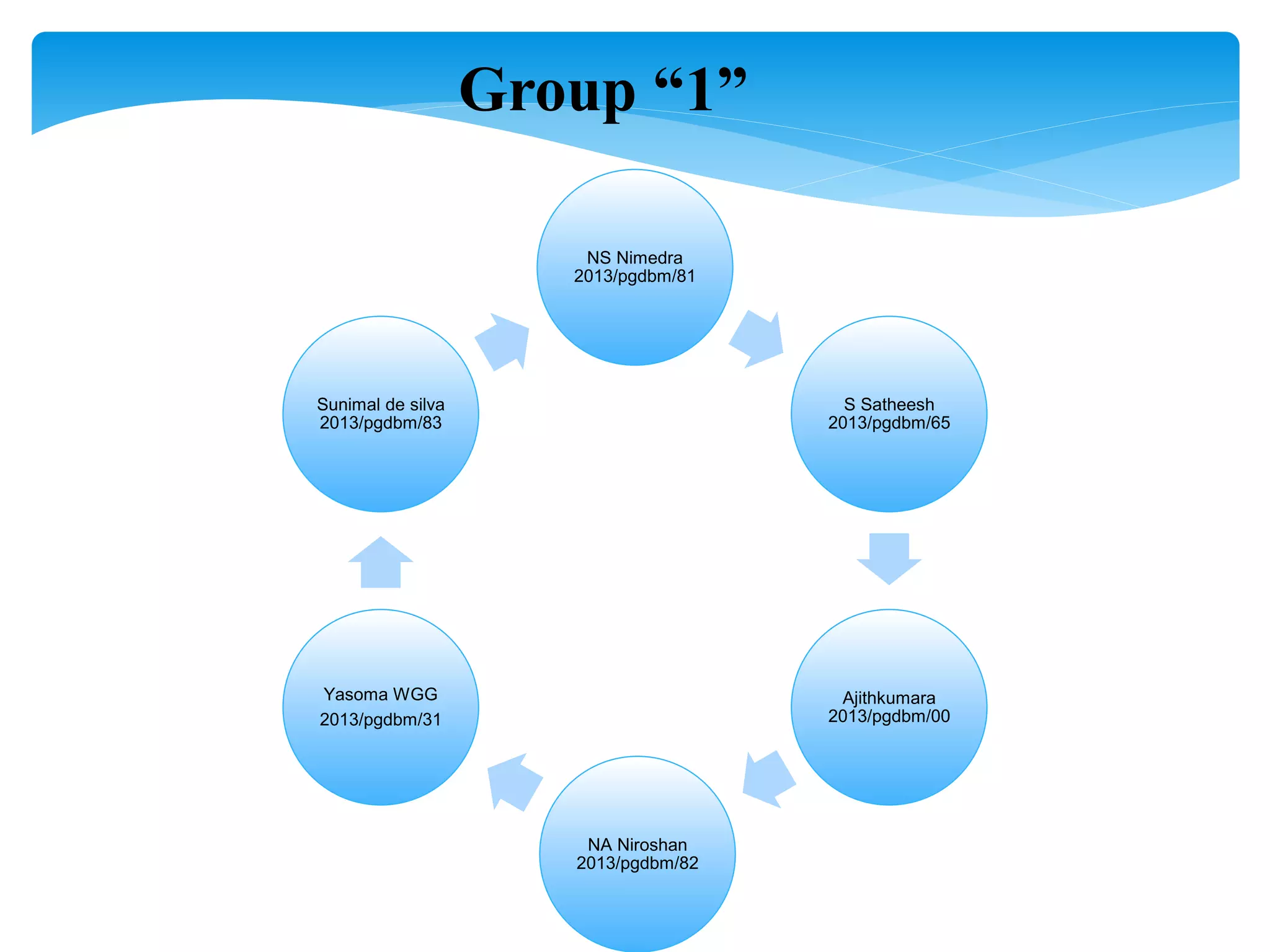
NS Nimedra
2013/pgdbm/81
S Satheesh
2013/pgdbm/65
Ajithkumara
2013/pgdbm/00
NA Niroshan
2013/pgdbm/82
Yasoma WGG
2013/pgdbm/31
Sunimal de silva
2013/pgdbm/83
Business Environment & Strategic Analysis
Case Study
On
Maruti Udyog Limited
Case Introduction
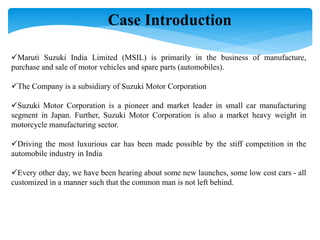
Maruti Suzuki India Limited (MSIL) is primarily in the business of manufacture,
purchase and sale of motor vehicles and spare parts (automobiles).
The Company is a subsidiary of Suzuki Motor Corporation
Suzuki Motor Corporation is a pioneer and market leader in small car manufacturing
segment in Japan. Further, Suzuki Motor Corporation is also a market heavy weight in
motorcycle manufacturing sector.
Driving the most luxurious car has been made possible by the stiff competition in the
automobile industry in India
Every other day, we have been hearing about some new launches, some low cost cars - all
customized in a manner such that the common man is not left behind.
History of Maruti
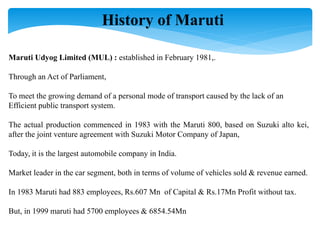
Maruti Udyog Limited (MUL) : established in February 1981,.
Through an Act of Parliament,
To meet the growing demand of a personal mode of transport caused by the lack of an
Efficient public transport system.
The actual production commenced in 1983 with the Maruti 800, based on Suzuki alto kei,
after the joint venture agreement with Suzuki Motor Company of Japan,
Today, it is the largest automobile company in India.
Market leader in the car segment, both in terms of volume of vehicles sold & revenue earned.
In 1983 Maruti had 883 employees, Rs.607 Mn of Capital & Rs.17Mn Profit without tax.
But, in 1999 maruti had 5700 employees & 6854.54Mn
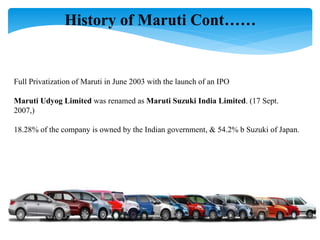
Full Privatization of Maruti in June 2003 with the launch of an IPO
Maruti Udyog Limited was renamed as Maruti Suzuki India Limited. (17 Sept.
2007,)
18.28% of the company is owned by the Indian government, & 54.2% b Suzuki of Japan.
History of Maruti Cont……
The Path to Success of Maruti
Team Work & Recognition that each employee’s future growth & prosperity is totally
dependent on the company’s growth & prosperity
Strict Work Discipline for Individuals & Organization
Constant efforts to increase the productivity of labour and capital
Steady improvement in quality and reduction in cost
Customer orientation
Long term objectives and policies with the confidence to realize the goals
Respect of law, ethics & human beings
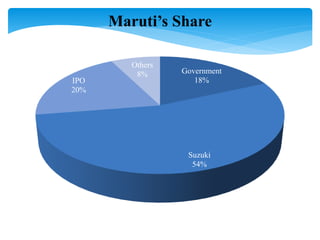
Government
18%
Suzuki
54%
IPO
20%
Others
8%
Maruti’s Share
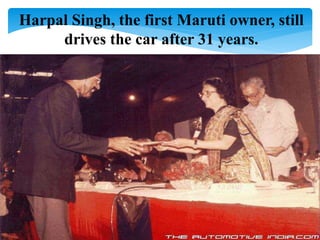
Harpal Singh, the first Maruti owner, still
drives the car after 31 years.
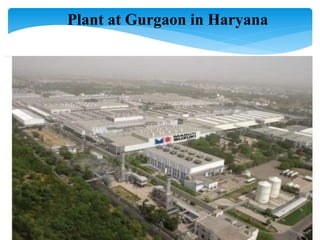
Plant at Gurgaon in Haryana
Industry Analysis
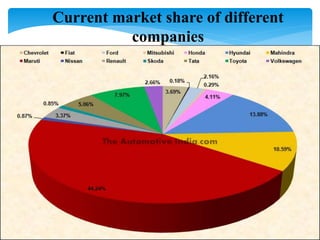
Current market share of different
companies
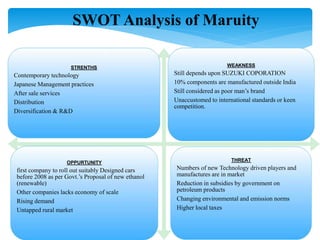
SWOT Analysis of Maruity
STRENTHS
Contemporary technology
Japanese Management practices
After sale services
Distribution
Diversification & R&D
WEAKNESS
Still depends upon SUZUKI COPORATION
10% components are manufactured outside India
Still considered as poor man’s brand
Unaccustomed to international standards or keen
competition.
OPPURTUNITY
first company to roll out suitably Designed cars
before 2008 as per Govt.’s Proposal of new ethanol
(renewable)
Other companies lacks economy of scale
Rising demand
Untapped rural market
THREAT
Numbers of new Technology driven players and
manufactures are in market
Reduction in subsidies by government on
petroleum products
Changing environmental and emission norms
Higher local taxes
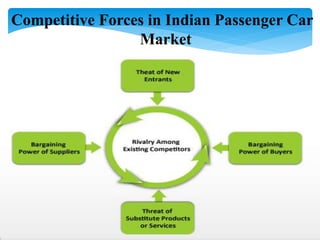
Competitive Forces in Indian Passenger Car
Market
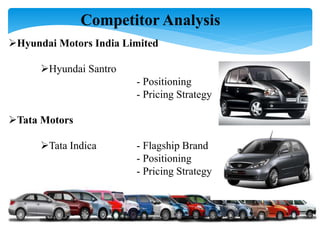
Competitor Analysis
Hyundai Motors India Limited
Hyundai Santro
- Positioning
- Pricing Strategy
Tata Motors
Tata Indica - Flagship Brand
- Positioning
- Pricing Strategy
Key Strategic Initiatives by Maruti
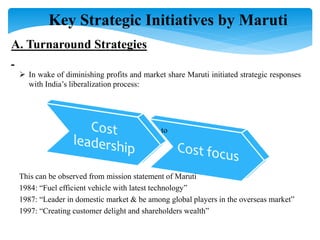
A. Turnaround Strategies
 In wake of diminishing profits and market share Maruti initiated strategic responses
with India’s liberalization process:
to
This can be observed from mission statement of Maruti
1984: “Fuel efficient vehicle with latest technology”
1987: “Leader in domestic market & be among global players in the overseas market”
1997: “Creating customer delight and shareholders wealth”
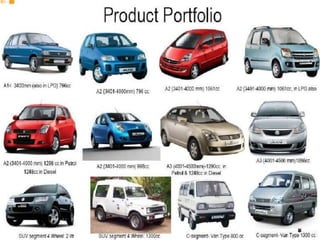
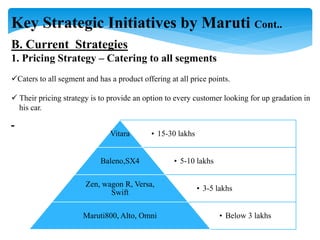
• 15-30 lakhsVitara
• 5-10 lakhsBaleno,SX4
• 3-5 lakhs
Zen, wagon R, Versa,
Swift
• Below 3 lakhsMaruti800, Alto, Omni
B. Current Strategies
1. Pricing Strategy – Catering to all segments
Caters to all segment and has a product offering at all price points.
 Their pricing strategy is to provide an option to every customer looking for up gradation in
his car.
Key Strategic Initiatives by Maruti Cont..
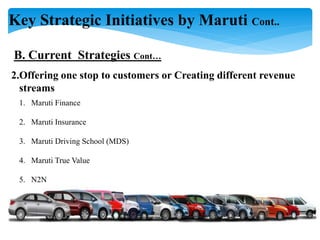
2.Offering one stop to customers or Creating different revenue
streams
Key Strategic Initiatives by Maruti Cont..
B. Current Strategies Cont…
1. Maruti Finance
2. Maruti Insurance
3. Maruti Driving School (MDS)
4. Maruti True Value
5. N2N
Key Strategic Initiatives by Maruti Cont..
B. Current Strategies Cont…
3. Repositioning of Maruti products
 Whenever Maruti’s brand grew old or its sales started dipping ,it made the following
efforts in the same field:
Omni – interiors & exteriors, Omni cargo,& CNG Omni
Versa – slashed prices by decreasing engine power
Esteem – new look to boost sales
Baleno – price slash from 1999 (7.2lacs) to 2003 (5.46) WagonR –
modifications in engine and sporty look
Zen - Modified 4 times and special editions
Maruti 800 - Introduced modified accessories .
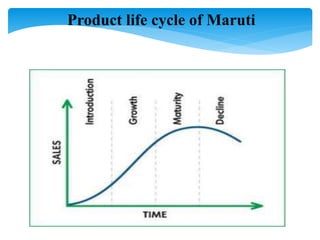
Product life cycle of Maruti
Key Strategic Initiatives by Maruti Cont..
B. Current Strategies Cont…
4. Customer Centric Approach
Maruti has successfully shed off the public sector laid back attitude image & has inculcated
the customer-friendly approach in its organization culture.
Maruti employees & dealers are answerable to even a single complain
There are instances of cancellation of dealership based on customer feedback
Changed their showroom layout
Trained Sales Executives
Customer complain handling cell under CRM department
Maruti Call center brings Maruti closer to its customer
Loyalty Programmes
Key Strategic Initiatives by Maruti Cont..
B. Current Strategies Cont…
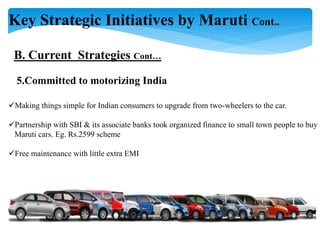
5.Committed to motorizing India
Making things simple for Indian consumers to upgrade from two-wheelers to the car.
Partnership with SBI & its associate banks took organized finance to small town people to buy
Maruti cars. Eg. Rs.2599 scheme
Free maintenance with little extra EMI
Key Strategic Initiatives by Maruti Cont..
B. Current Strategies Cont…
6. Disinvestment & IPO of Maruti Udyog Limited
Biggest privatization in India till date worth of Rs. 2,424 Crore, on the investment of Rs 66 Crore
The best part of the deal is the Rs.1,000 Crore control premium the government extract from SMC
No interference of Ministers & Bureaucrats
Suzuki became the Decision maker of MUL
Two Mega investment plans. Eg. A new car plant & an engine & transmission manufacturing plan
Suzuki proposed two-wheelers facility in India, 51% Stake of Maruti
IPO
Key Strategic Initiatives by Maruti Cont..
B. Current Strategies Cont…
7. Realization of Importance of Vehicle Maintenance Services Market
Old days simple three-box flowchart – Vendor, Factory & Dealer
New scheme began in 1999 revolves around the total lifetime value of the car
Only catering approximately 20000 vehicles through its service stations everyday
Conducting free service workshops to encourage consumers to come to their Service stations
Increased the service stations to 1567 across 1036 cities
Every regional office is having separate service & maintenance department
Key Strategic Initiatives by Maruti Cont..
B. Current Strategies Cont…
8. Playing on Cost Leadership
Price dictator in Indian automobile industry
Low cost provider of Car
Lowest car on road is Maruti 800
Maruti achieves this through continuous improvement in operational efficiency & productivity
 50% improvement in productivity & 30% reduction in cost in three years
Impressive Sales & profits via productivity & cost cuttings
Increased focus on vendor management
Encouraging vendors to develop R&D
Appling IT to manufacturing
• Vehicle Tracking System
• e Nagare System
Key Strategic Initiatives by Maruti Cont..
C. Major Future Strategies
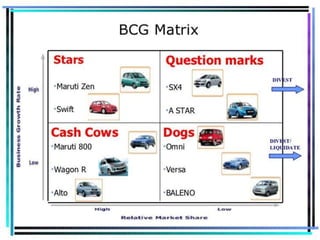
1.Phasing out Zen in 2007
Alto launched to take over Maruti 800 in future
Phasing out of Maruti 800 faced lots of resistance from dealers all over
Another reason not phasing out was the fear of brand shift of customers to competitors’ product
Swift launched in May, 2005 to phase out Zen, since it had already two modifications
Major reason behind this was cannibalization of Wagon R & Swift due to overlapping of price
Band
Rational decision to kill a product before it starts facing the decline stage in PLC
Key Strategic Initiatives by Maruti Cont..
C. Major Future Strategies Cont….
2. Maruti plans for a Big Diesel Foray
3. Maruti plans for a new engine & transmission plant
Key Strategic Initiatives by Maruti Cont..
C. Major Future Strategies Cont….
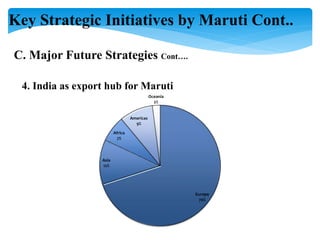
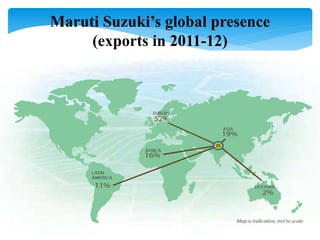
4. India as export hub for Maruti
Europe
70%
Asia
12%
Africa
7%
Americas
9%
Oceania
2%
Key Strategic Initiatives by Maruti Cont..
C. Major Future Strategies Cont….
5. Maruti Emerging as R&D Hub for Suzuki Motors Corporation
Low cost in India for infrastructure & R&D
India growing as an export hub
Suzuki’s investment in India
Key Success Factors of Maruti
1. The quality advantage
2. A buying experience like no other
3. Quality service across 1036 cities
4. One stop shop
5. The low cost maintenance advantage
6. Lowest cost of ownership
7. Technological advantage
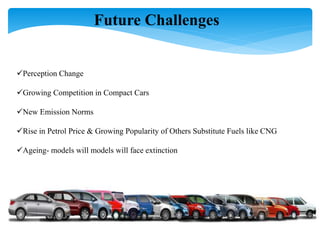
Future Challenges
Perception Change
Growing Competition in Compact Cars
New Emission Norms
Rise in Petrol Price & Growing Popularity of Others Substitute Fuels like CNG
Ageing- models will models will face extinction
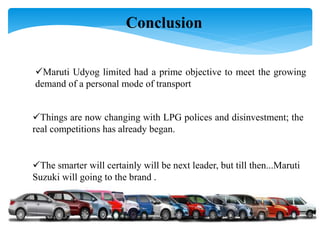
Conclusion
Maruti Udyog limited had a prime objective to meet the growing
demand of a personal mode of transport
Things are now changing with LPG polices and disinvestment; the
real competitions has already began.
The smarter will certainly will be next leader, but till then...Maruti
Suzuki will going to the brand .
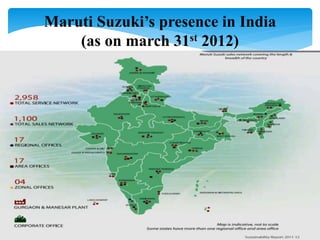
Maruti Suzuki’s presence in India
(as on march 31st 2012)
Maruti Suzuki’s global presence
(exports in 2011-12)
 Maruti should improve it’s after sale service because its hits badly car market
share.
Show room demonstration should be given at frequent time interval and feed back
should be considered positively.
The marketing managers should make better relations with dealers and reputation
of the company.
Customer considers quality as their first preference, so the company should give
more stress on this.
Suggestion
Thank You

Maruti Strategy

  • 1.
    Group “1” NS Nimedra 2013/pgdbm/81 SSatheesh 2013/pgdbm/65 Ajithkumara 2013/pgdbm/00 NA Niroshan 2013/pgdbm/82 Yasoma WGG 2013/pgdbm/31 Sunimal de silva 2013/pgdbm/83
  • 2.
    Business Environment &Strategic Analysis Case Study On Maruti Udyog Limited
  • 3.
    Case Introduction Maruti SuzukiIndia Limited (MSIL) is primarily in the business of manufacture, purchase and sale of motor vehicles and spare parts (automobiles). The Company is a subsidiary of Suzuki Motor Corporation Suzuki Motor Corporation is a pioneer and market leader in small car manufacturing segment in Japan. Further, Suzuki Motor Corporation is also a market heavy weight in motorcycle manufacturing sector. Driving the most luxurious car has been made possible by the stiff competition in the automobile industry in India Every other day, we have been hearing about some new launches, some low cost cars - all customized in a manner such that the common man is not left behind.
  • 4.
    History of Maruti MarutiUdyog Limited (MUL) : established in February 1981,. Through an Act of Parliament, To meet the growing demand of a personal mode of transport caused by the lack of an Efficient public transport system. The actual production commenced in 1983 with the Maruti 800, based on Suzuki alto kei, after the joint venture agreement with Suzuki Motor Company of Japan, Today, it is the largest automobile company in India. Market leader in the car segment, both in terms of volume of vehicles sold & revenue earned. In 1983 Maruti had 883 employees, Rs.607 Mn of Capital & Rs.17Mn Profit without tax. But, in 1999 maruti had 5700 employees & 6854.54Mn
  • 5.
    Full Privatization ofMaruti in June 2003 with the launch of an IPO Maruti Udyog Limited was renamed as Maruti Suzuki India Limited. (17 Sept. 2007,) 18.28% of the company is owned by the Indian government, & 54.2% b Suzuki of Japan. History of Maruti Cont……
  • 6.
    The Path toSuccess of Maruti Team Work & Recognition that each employee’s future growth & prosperity is totally dependent on the company’s growth & prosperity Strict Work Discipline for Individuals & Organization Constant efforts to increase the productivity of labour and capital Steady improvement in quality and reduction in cost Customer orientation Long term objectives and policies with the confidence to realize the goals Respect of law, ethics & human beings
  • 7.
  • 8.
    Harpal Singh, thefirst Maruti owner, still drives the car after 31 years.
  • 9.
    Plant at Gurgaonin Haryana
  • 11.
  • 12.
    Current market shareof different companies
  • 13.
    SWOT Analysis ofMaruity STRENTHS Contemporary technology Japanese Management practices After sale services Distribution Diversification & R&D WEAKNESS Still depends upon SUZUKI COPORATION 10% components are manufactured outside India Still considered as poor man’s brand Unaccustomed to international standards or keen competition. OPPURTUNITY first company to roll out suitably Designed cars before 2008 as per Govt.’s Proposal of new ethanol (renewable) Other companies lacks economy of scale Rising demand Untapped rural market THREAT Numbers of new Technology driven players and manufactures are in market Reduction in subsidies by government on petroleum products Changing environmental and emission norms Higher local taxes
  • 14.
    Competitive Forces inIndian Passenger Car Market
  • 15.
    Competitor Analysis Hyundai MotorsIndia Limited Hyundai Santro - Positioning - Pricing Strategy Tata Motors Tata Indica - Flagship Brand - Positioning - Pricing Strategy
  • 16.
    Key Strategic Initiativesby Maruti A. Turnaround Strategies  In wake of diminishing profits and market share Maruti initiated strategic responses with India’s liberalization process: to This can be observed from mission statement of Maruti 1984: “Fuel efficient vehicle with latest technology” 1987: “Leader in domestic market & be among global players in the overseas market” 1997: “Creating customer delight and shareholders wealth”
  • 17.
    • 15-30 lakhsVitara •5-10 lakhsBaleno,SX4 • 3-5 lakhs Zen, wagon R, Versa, Swift • Below 3 lakhsMaruti800, Alto, Omni B. Current Strategies 1. Pricing Strategy – Catering to all segments Caters to all segment and has a product offering at all price points.  Their pricing strategy is to provide an option to every customer looking for up gradation in his car. Key Strategic Initiatives by Maruti Cont..
  • 18.
    2.Offering one stopto customers or Creating different revenue streams Key Strategic Initiatives by Maruti Cont.. B. Current Strategies Cont… 1. Maruti Finance 2. Maruti Insurance 3. Maruti Driving School (MDS) 4. Maruti True Value 5. N2N
  • 19.
    Key Strategic Initiativesby Maruti Cont.. B. Current Strategies Cont… 3. Repositioning of Maruti products  Whenever Maruti’s brand grew old or its sales started dipping ,it made the following efforts in the same field: Omni – interiors & exteriors, Omni cargo,& CNG Omni Versa – slashed prices by decreasing engine power Esteem – new look to boost sales Baleno – price slash from 1999 (7.2lacs) to 2003 (5.46) WagonR – modifications in engine and sporty look Zen - Modified 4 times and special editions Maruti 800 - Introduced modified accessories .
  • 20.
  • 22.
    Key Strategic Initiativesby Maruti Cont.. B. Current Strategies Cont… 4. Customer Centric Approach Maruti has successfully shed off the public sector laid back attitude image & has inculcated the customer-friendly approach in its organization culture. Maruti employees & dealers are answerable to even a single complain There are instances of cancellation of dealership based on customer feedback Changed their showroom layout Trained Sales Executives Customer complain handling cell under CRM department Maruti Call center brings Maruti closer to its customer Loyalty Programmes
  • 23.
    Key Strategic Initiativesby Maruti Cont.. B. Current Strategies Cont… 5.Committed to motorizing India Making things simple for Indian consumers to upgrade from two-wheelers to the car. Partnership with SBI & its associate banks took organized finance to small town people to buy Maruti cars. Eg. Rs.2599 scheme Free maintenance with little extra EMI

  • 24.
    Key Strategic Initiativesby Maruti Cont.. B. Current Strategies Cont… 6. Disinvestment & IPO of Maruti Udyog Limited Biggest privatization in India till date worth of Rs. 2,424 Crore, on the investment of Rs 66 Crore The best part of the deal is the Rs.1,000 Crore control premium the government extract from SMC No interference of Ministers & Bureaucrats Suzuki became the Decision maker of MUL Two Mega investment plans. Eg. A new car plant & an engine & transmission manufacturing plan Suzuki proposed two-wheelers facility in India, 51% Stake of Maruti IPO
  • 25.
    Key Strategic Initiativesby Maruti Cont.. B. Current Strategies Cont… 7. Realization of Importance of Vehicle Maintenance Services Market Old days simple three-box flowchart – Vendor, Factory & Dealer New scheme began in 1999 revolves around the total lifetime value of the car Only catering approximately 20000 vehicles through its service stations everyday Conducting free service workshops to encourage consumers to come to their Service stations Increased the service stations to 1567 across 1036 cities Every regional office is having separate service & maintenance department
  • 26.
    Key Strategic Initiativesby Maruti Cont.. B. Current Strategies Cont… 8. Playing on Cost Leadership Price dictator in Indian automobile industry Low cost provider of Car Lowest car on road is Maruti 800 Maruti achieves this through continuous improvement in operational efficiency & productivity  50% improvement in productivity & 30% reduction in cost in three years Impressive Sales & profits via productivity & cost cuttings Increased focus on vendor management Encouraging vendors to develop R&D Appling IT to manufacturing • Vehicle Tracking System • e Nagare System
  • 27.
    Key Strategic Initiativesby Maruti Cont.. C. Major Future Strategies 1.Phasing out Zen in 2007 Alto launched to take over Maruti 800 in future Phasing out of Maruti 800 faced lots of resistance from dealers all over Another reason not phasing out was the fear of brand shift of customers to competitors’ product Swift launched in May, 2005 to phase out Zen, since it had already two modifications Major reason behind this was cannibalization of Wagon R & Swift due to overlapping of price Band Rational decision to kill a product before it starts facing the decline stage in PLC
  • 28.
    Key Strategic Initiativesby Maruti Cont.. C. Major Future Strategies Cont…. 2. Maruti plans for a Big Diesel Foray 3. Maruti plans for a new engine & transmission plant
  • 29.
    Key Strategic Initiativesby Maruti Cont.. C. Major Future Strategies Cont…. 4. India as export hub for Maruti Europe 70% Asia 12% Africa 7% Americas 9% Oceania 2%
  • 30.
    Key Strategic Initiativesby Maruti Cont.. C. Major Future Strategies Cont…. 5. Maruti Emerging as R&D Hub for Suzuki Motors Corporation Low cost in India for infrastructure & R&D India growing as an export hub Suzuki’s investment in India
  • 31.
    Key Success Factorsof Maruti 1. The quality advantage 2. A buying experience like no other 3. Quality service across 1036 cities 4. One stop shop 5. The low cost maintenance advantage 6. Lowest cost of ownership 7. Technological advantage
  • 32.
    Future Challenges Perception Change GrowingCompetition in Compact Cars New Emission Norms Rise in Petrol Price & Growing Popularity of Others Substitute Fuels like CNG Ageing- models will models will face extinction
  • 33.
    Conclusion Maruti Udyog limitedhad a prime objective to meet the growing demand of a personal mode of transport Things are now changing with LPG polices and disinvestment; the real competitions has already began. The smarter will certainly will be next leader, but till then...Maruti Suzuki will going to the brand .
  • 34.
    Maruti Suzuki’s presencein India (as on march 31st 2012)
  • 35.
    Maruti Suzuki’s globalpresence (exports in 2011-12)
  • 36.
     Maruti shouldimprove it’s after sale service because its hits badly car market share. Show room demonstration should be given at frequent time interval and feed back should be considered positively. The marketing managers should make better relations with dealers and reputation of the company. Customer considers quality as their first preference, so the company should give more stress on this. Suggestion
  • 37.