MARSH CONE TEST 
BY 
BY: 
AKSHAY R MANOHAR 
1 sem MTech(Construction Technology) 
CIVIL ENGINEERING DEPT. 
NMAMIT-NITTE.
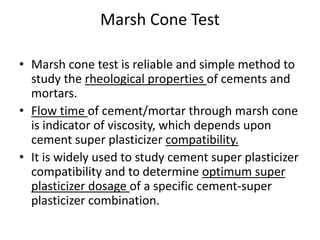
• Marsh cone
Marsh Cone Test 
• Marsh cone test is reliable and simple method to 
study the rheological properties of cements and 
mortars. 
• Flow time of cement/mortar through marsh cone 
is indicator of viscosity, which depends upon 
cement super plasticizer compatibility. 
• It is widely used to study cement super plasticizer 
compatibility and to determine optimum super 
plasticizer dosage of a specific cement-super 
plasticizer combination.
Apparatus 
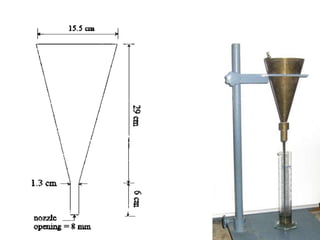
• It’s consist of a conical brass vessel held on a 
wooden stand with an orifice of 8mm at its 
bottom. 
• A stop watch is needed to measure the time 
taken by 1 litre of cement or mortar to pass 
through the vessel. 
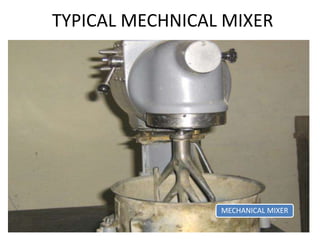
• A mortar mixer is also needed to prepare the 
cement paste with desired w/c ratio.
PROCEDURE 
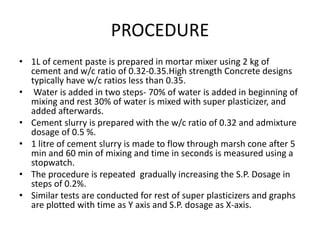
• 1L of cement paste is prepared in mortar mixer using 2 kg of 
cement and w/c ratio of 0.32-0.35.High strength Concrete designs 
typically have w/c ratios less than 0.35. 
• Water is added in two steps- 70% of water is added in beginning of 
mixing and rest 30% of water is mixed with super plasticizer, and 
added afterwards. 
• Cement slurry is prepared with the w/c ratio of 0.32 and admixture 
dosage of 0.5 %. 
• 1 litre of cement slurry is made to flow through marsh cone after 5 
min and 60 min of mixing and time in seconds is measured using a 
stopwatch. 
• The procedure is repeated gradually increasing the S.P. Dosage in 
steps of 0.2%. 
• Similar tests are conducted for rest of super plasticizers and graphs 
are plotted with time as Y axis and S.P. dosage as X-axis.
TYPICAL MECHNICAL MIXER 
MECHANICAL MIXER
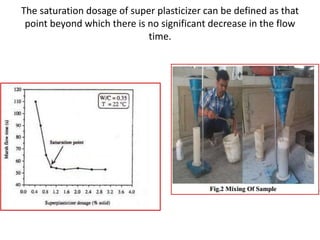
The saturation dosage of super plasticizer can be defined as that 
point beyond which there is no significant decrease in the flow 
time.
Variable parameters 
• W/c ratio 
• Temperature(5-45 ‘C) 
• Admixtures 
(super plasticizer, retarder, accelerator, Air-entraining 
admixtures, new generation super 
plasticizer.)
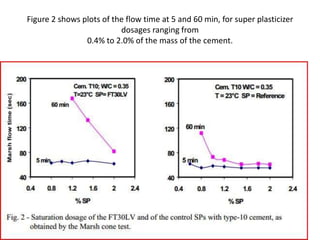
Figure 2 shows plots of the flow time at 5 and 60 min, for super plasticizer 
dosages ranging from 
0.4% to 2.0% of the mass of the cement.
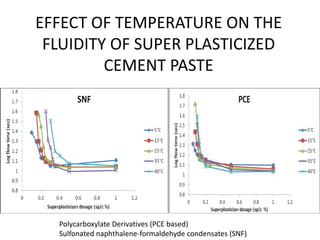
EFFECT OF TEMPERATURE ON THE 
FLUIDITY OF SUPER PLASTICIZED 
CEMENT PASTE 
Polycarboxylate Derivatives (PCE based) 
Sulfonated naphthalene-formaldehyde condensates (SNF)
Significance 
• The saturation dosage of super plasticizer can 
be defined as that point beyond which there is 
no significant decrease in the flow time. 
• Saturation point can be taken as the maximum 
super plasticizer content to be used in 
concrete. 
• We can implement to use specially 
recommended admixtures at recommended 
dosages for given mix design.
ADMIXTURES 
• SUPER PLASTICIZER 
• RETARDER 
• ACCELERATOR 
• AIR-ENTRAINING ADMIXTURES 
• For the above all admixtures marsh cone test 
can be adopted.
THANK YOU.

Marsh cone test

  • 1.
    MARSH CONE TEST BY BY: AKSHAY R MANOHAR 1 sem MTech(Construction Technology) CIVIL ENGINEERING DEPT. NMAMIT-NITTE.
  • 2.
  • 3.
    Marsh Cone Test • Marsh cone test is reliable and simple method to study the rheological properties of cements and mortars. • Flow time of cement/mortar through marsh cone is indicator of viscosity, which depends upon cement super plasticizer compatibility. • It is widely used to study cement super plasticizer compatibility and to determine optimum super plasticizer dosage of a specific cement-super plasticizer combination.
  • 4.
    Apparatus • It’sconsist of a conical brass vessel held on a wooden stand with an orifice of 8mm at its bottom. • A stop watch is needed to measure the time taken by 1 litre of cement or mortar to pass through the vessel. • A mortar mixer is also needed to prepare the cement paste with desired w/c ratio.
  • 6.
    PROCEDURE • 1Lof cement paste is prepared in mortar mixer using 2 kg of cement and w/c ratio of 0.32-0.35.High strength Concrete designs typically have w/c ratios less than 0.35. • Water is added in two steps- 70% of water is added in beginning of mixing and rest 30% of water is mixed with super plasticizer, and added afterwards. • Cement slurry is prepared with the w/c ratio of 0.32 and admixture dosage of 0.5 %. • 1 litre of cement slurry is made to flow through marsh cone after 5 min and 60 min of mixing and time in seconds is measured using a stopwatch. • The procedure is repeated gradually increasing the S.P. Dosage in steps of 0.2%. • Similar tests are conducted for rest of super plasticizers and graphs are plotted with time as Y axis and S.P. dosage as X-axis.
  • 7.
    TYPICAL MECHNICAL MIXER MECHANICAL MIXER
  • 8.
    The saturation dosageof super plasticizer can be defined as that point beyond which there is no significant decrease in the flow time.
  • 9.
    Variable parameters •W/c ratio • Temperature(5-45 ‘C) • Admixtures (super plasticizer, retarder, accelerator, Air-entraining admixtures, new generation super plasticizer.)
  • 10.
    Figure 2 showsplots of the flow time at 5 and 60 min, for super plasticizer dosages ranging from 0.4% to 2.0% of the mass of the cement.
  • 11.
    EFFECT OF TEMPERATUREON THE FLUIDITY OF SUPER PLASTICIZED CEMENT PASTE Polycarboxylate Derivatives (PCE based) Sulfonated naphthalene-formaldehyde condensates (SNF)
  • 12.
    Significance • Thesaturation dosage of super plasticizer can be defined as that point beyond which there is no significant decrease in the flow time. • Saturation point can be taken as the maximum super plasticizer content to be used in concrete. • We can implement to use specially recommended admixtures at recommended dosages for given mix design.
  • 13.
    ADMIXTURES • SUPERPLASTICIZER • RETARDER • ACCELERATOR • AIR-ENTRAINING ADMIXTURES • For the above all admixtures marsh cone test can be adopted.
  • 14.

Editor's Notes

  • #8 MEHANICAL MIXER
  • #12  Sulfonated naphthalene-formaldehyde condensates (SNF) Polycarboxylate Derivatives (PCE based)