SOC 111
Introduction to
Anthropology
MARRIAGE
MARRIAGE
 How is marriage defined and regulated?
 What role does marriage play in creating
and maintaining group alliances?
 What forms of marriage exist cross-
culturally and what are their social
correlates?
MARRIAGE
 Marriage is an institution with significant roles and
functions in addition to reproduction.
 However, no definition of marriage is broad enough to
apply easily to all societies and situations.
 In many nonindustrial societies, a person’s social world
includes two main categories: kin and strangers.
 Marriage is one of the primary ways of converting
strangers into kin and creating and maintaining
personal an political alliances.
MARRIAGE
 Exogamy: having a husband or wife outside one’s own
group.
 Incest: sexual relations with someone considered to be a
close relative.
 Cross Cousins: the children of a brother and a sister. (hala
ve dayı cocuklari)
 Parallel Cousins: the children of two brothers or two
sisters. (teyze ve amca cocuklari)
 In many societies, parallel cousins are tabood as sex or
marriage partners. They fall within the incest taboo but
cross cousins do not.
MARRIAGE
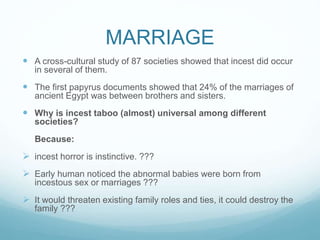
 A cross-cultural study of 87 societies showed that incest did occur
in several of them.
 The first papyrus documents showed that 24% of the marriages of
ancient Egypt was between brothers and sisters.
 Why is incest taboo (almost) universal among different
societies?
Because:
 incest horror is instinctive. ???
 Early human noticed the abnormal babies were born from
incestous sex or marriages ???
 It would threaten existing family roles and ties, it could destroy the
family ???
MARRIAGE
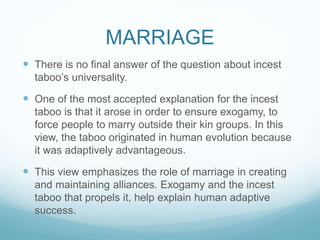
 There is no final answer of the question about incest
taboo’s universality.
 One of the most accepted explanation for the incest
taboo is that it arose in order to ensure exogamy, to
force people to marry outside their kin groups. In this
view, the taboo originated in human evolution because
it was adaptively advantageous.
 This view emphasizes the role of marriage in creating
and maintaining alliances. Exogamy and the incest
taboo that propels it, help explain human adaptive
success.
MARRIAGE
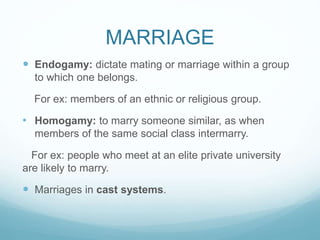
 Endogamy: dictate mating or marriage within a group
to which one belongs.
For ex: members of an ethnic or religious group.
‱ Homogamy: to marry someone similar, as when
members of the same social class intermarry.
For ex: people who meet at an elite private university
are likely to marry.
 Marriages in cast systems.
MARRIAGE as group alliance
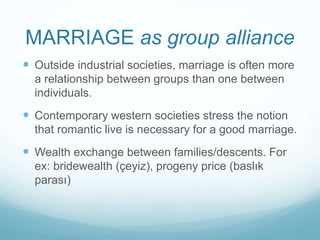
 Outside industrial societies, marriage is often more
a relationship between groups than one between
individuals.
 Contemporary western societies stress the notion
that romantic live is necessary for a good marriage.
 Wealth exchange between families/descents. For
ex: bridewealth (çeyiz), progeny price (baslık
parası)
DIVORCE
 Ease of divorce varies across cultures.
 Marriages that are political alliances between
groups are more difficult to dissolve than the
marriages that are more individual affairs.
 Divorce is harder in patrilineal societies.
 In contemporary Western societies, when romance
fails, so may the marriage.
MARRIAGE
 Polygamy: marriage to more than one spouse at
the same time.
 2 forms of polygamy: polygyny and polyandry.
 Polygyny: Man has more than one wife at the
same time.
 Polyandry: Woman has more than one husband
at the same time.

Marriage

  • 1.
  • 2.
    MARRIAGE  How ismarriage defined and regulated?  What role does marriage play in creating and maintaining group alliances?  What forms of marriage exist cross- culturally and what are their social correlates?
  • 3.
    MARRIAGE  Marriage isan institution with significant roles and functions in addition to reproduction.  However, no definition of marriage is broad enough to apply easily to all societies and situations.  In many nonindustrial societies, a person’s social world includes two main categories: kin and strangers.  Marriage is one of the primary ways of converting strangers into kin and creating and maintaining personal an political alliances.
  • 4.
    MARRIAGE  Exogamy: havinga husband or wife outside one’s own group.  Incest: sexual relations with someone considered to be a close relative.  Cross Cousins: the children of a brother and a sister. (hala ve dayı cocuklari)  Parallel Cousins: the children of two brothers or two sisters. (teyze ve amca cocuklari)  In many societies, parallel cousins are tabood as sex or marriage partners. They fall within the incest taboo but cross cousins do not.
  • 5.
    MARRIAGE  A cross-culturalstudy of 87 societies showed that incest did occur in several of them.  The first papyrus documents showed that 24% of the marriages of ancient Egypt was between brothers and sisters.  Why is incest taboo (almost) universal among different societies? Because:  incest horror is instinctive. ???  Early human noticed the abnormal babies were born from incestous sex or marriages ???  It would threaten existing family roles and ties, it could destroy the family ???
  • 6.
    MARRIAGE  There isno final answer of the question about incest taboo’s universality.  One of the most accepted explanation for the incest taboo is that it arose in order to ensure exogamy, to force people to marry outside their kin groups. In this view, the taboo originated in human evolution because it was adaptively advantageous.  This view emphasizes the role of marriage in creating and maintaining alliances. Exogamy and the incest taboo that propels it, help explain human adaptive success.
  • 7.
    MARRIAGE  Endogamy: dictatemating or marriage within a group to which one belongs. For ex: members of an ethnic or religious group. ‱ Homogamy: to marry someone similar, as when members of the same social class intermarry. For ex: people who meet at an elite private university are likely to marry.  Marriages in cast systems.
  • 8.
    MARRIAGE as groupalliance  Outside industrial societies, marriage is often more a relationship between groups than one between individuals.  Contemporary western societies stress the notion that romantic live is necessary for a good marriage.  Wealth exchange between families/descents. For ex: bridewealth (çeyiz), progeny price (baslık parası)
  • 9.
    DIVORCE  Ease ofdivorce varies across cultures.  Marriages that are political alliances between groups are more difficult to dissolve than the marriages that are more individual affairs.  Divorce is harder in patrilineal societies.  In contemporary Western societies, when romance fails, so may the marriage.
  • 10.
    MARRIAGE  Polygamy: marriageto more than one spouse at the same time.  2 forms of polygamy: polygyny and polyandry.  Polygyny: Man has more than one wife at the same time.  Polyandry: Woman has more than one husband at the same time.