MARRIAGE SYSTEMS


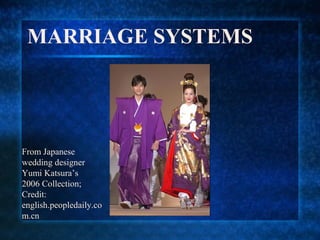
From Japanese
wedding designer
Yumi Katsura’s
2006 Collection;
Credit:
english.peopledaily.co
m.cn
Definitions
                                   Marriage is an
                                   economic and
                                   sexual union,
                                   usually between a
                                   man and a woman


Sami couple with their daughter
Who is a Father?
 • We know the biological mother, but the
   father is sometimes unknown...

    Establishes legal parentage of children
    Genitor – biological father of a child
    Pater – socially recognized father of a child
MARRIAGE Exceptions

The Nayar & The Na of SW China
Rare Types of Marriage
 Berdaches
 Christian Nuns
 Male-Male/Female-Female
  marriage
 Berdache
 “Two-spirits”
WHY IS MARRIAGE
UNIVERSAL?
 GENDER DIVISION OF LABOR
 PROLONGED INFANT DEPENDENCY
 SEXUAL COMPETITION
 POSTPARTUM PROBLEMS
Incest and Exogamy
 • Exogamy – practice of seeking a
   spouse outside one’s own group
    Forcespeople to create and maintain a
    wide social network
  Incest – sexual relations with a close
  relative
    The  incest taboo is a cultural universal
    What constitutes incest varies widely from
     culture to culture
Explaining the Taboo
                 No universally
                 accepted
                 explanation for fact
                 that all cultures ban
                 incest
                  –Cross cultural finding
                  show rules of incest
                  avoidance shaped by
                  kinship structures
RESTRICTIONS ON MARRIAGE,
Including incest Taboo
Instinctive Horror Theory
Childhood-Familiarity Theory
Freud’s Psychoanalytic Theory
Family-Disruption Theory
Cooperation Theory
Inbreeding Theory (Biological
Degeneration Theory)
Instinctive Horror Theory
 Homo sapiens are genetically
 programmed to avoid incest
  –This theory has been refuted
•Specific kin types included within the
incest taboo have a cultural rather than a
biological basis
Biological Degeneration Theory
 • Incest taboo developed in response to
   abnormal offspring born from
   incestuous unions
  –Decline in fertility and survival accompanies
  brother-sister mating across several
  generations
  –Human marriage patterns based on specific
  cultural beliefs rather than universal concerns
  about biological degeneration several
  generations in the future
Attempt and Contempt

 • Malinowski (and Freud) argued incest
   taboo originated to direct sexual
   feelings away from one’s family to
   avoid disrupting the family structure
   and relations
    Opposite   theory argues that people are
     less likely to be sexually attracted to those
     with whom they have grown up
Explaining the Taboo
 • Marry Out or Die Out
    More  accepted argument is that taboo
     originated to ensure exogamy
    Incest taboos force people to create and
     maintain wide social networks
    Incest taboos are seen as an adaptively
     advantageous cultural construct
Royal Incest
 Royalfamilies in widely diverse cultures
 engaged in what would be called incest,
 even in their own cultures
  –Manifest function – reason given for a
  custom by its natives
  –Latent function – effect custom was not
  explicitly recognized by the natives
  –Royal incest, generally, had latent
  economic function
WHO ONE MARRIES
        Arranged Marriages
        vs. Love Marriages
        Exogamy &
        Endogamy
        Cousin Marriages
          Cross-cousins
          Parallel cousins
        Levirate & Sororate
Parallel and Cross Cousins and Patrilineal
Moiety Organization
Sororate and Levirate
Divorce
 • Divorce found in many different
   societies
    Marriages  that are political alliances
     between groups harder to break up than
     marriages that are more individual affairs
    Bridewealth discourages divorce
    Divorce is more common in matrilineal
     societies as well as societies in which
     postmarital residence is matrilocal
HOW DOES ONE MARRY?

Bridewealth (Bride
price, progeny
price)
Bride Service
Exchange of
Females
Gift Exchange
Dowry
Indirect Dowry
Marriage Arrangements


 Ember & Ember “Cultural Anthropology” 2006
HOW MANY DOES
ONE MARRY?
   MONOGAMY
   POLYGYNY
      Sororal
      Nonsororal
   POLYANDRY
      Fraternal
      Nonfraternal


                      Shah family (polygyny) - Photo
                      By J. Fortier
Plural Marriages
 • Polygyny
    Even  in cultures that approve of polygamy,
     monogamy tends to be the norm
    Polygyny more common than polyandry
     because, where sex ratios are not equal,
     there tend to be more women than men
     Multiple wives tend to be associated with
       wealth and prestige
Plural Marriages
 • Polyandry
    Polyandry rare, but practiced almost
    exclusively in South Asia
     Polyandry   usually practiced in response to
      specific circumstances, and in conjunction with
      other marriage formats
     Among Paharis of India, polyandry associated
      with relatively low female population, due to
      covert female infanticide
     In other cultures, polyandry resulted from the
      fact that men traveled a great deal
THE FAMILY
                            Variation in
                             Family Form
                              Matrifocal
                              Nuclear
                              Extended
Karki Family - Matrifocal
- Photo by J. Fortier
Post-Marital Residence Patterns

 Percentage of Societies
 in the Ethnographic
 Record with Various
 Marital Residence
 Patterns
Main Predictors of Marital Residence Patterns

Anth1marriage 090420183517-phpapp02

  • 1.
    MARRIAGE SYSTEMS From Japanese weddingdesigner Yumi Katsura’s 2006 Collection; Credit: english.peopledaily.co m.cn
  • 2.
    Definitions  Marriage is an economic and sexual union, usually between a man and a woman Sami couple with their daughter
  • 3.
    Who is aFather? • We know the biological mother, but the father is sometimes unknown...  Establishes legal parentage of children  Genitor – biological father of a child  Pater – socially recognized father of a child
  • 4.
    MARRIAGE Exceptions The Nayar& The Na of SW China Rare Types of Marriage Berdaches Christian Nuns Male-Male/Female-Female marriage
  • 5.
  • 6.
    WHY IS MARRIAGE UNIVERSAL? GENDER DIVISION OF LABOR  PROLONGED INFANT DEPENDENCY  SEXUAL COMPETITION  POSTPARTUM PROBLEMS
  • 7.
    Incest and Exogamy • Exogamy – practice of seeking a spouse outside one’s own group  Forcespeople to create and maintain a wide social network  Incest – sexual relations with a close relative  The incest taboo is a cultural universal  What constitutes incest varies widely from culture to culture
  • 8.
    Explaining the Taboo  No universally accepted explanation for fact that all cultures ban incest –Cross cultural finding show rules of incest avoidance shaped by kinship structures
  • 9.
    RESTRICTIONS ON MARRIAGE, Includingincest Taboo Instinctive Horror Theory Childhood-Familiarity Theory Freud’s Psychoanalytic Theory Family-Disruption Theory Cooperation Theory Inbreeding Theory (Biological Degeneration Theory)
  • 10.
    Instinctive Horror Theory Homo sapiens are genetically programmed to avoid incest –This theory has been refuted •Specific kin types included within the incest taboo have a cultural rather than a biological basis
  • 11.
    Biological Degeneration Theory • Incest taboo developed in response to abnormal offspring born from incestuous unions –Decline in fertility and survival accompanies brother-sister mating across several generations –Human marriage patterns based on specific cultural beliefs rather than universal concerns about biological degeneration several generations in the future
  • 12.
    Attempt and Contempt • Malinowski (and Freud) argued incest taboo originated to direct sexual feelings away from one’s family to avoid disrupting the family structure and relations  Opposite theory argues that people are less likely to be sexually attracted to those with whom they have grown up
  • 13.
    Explaining the Taboo • Marry Out or Die Out  More accepted argument is that taboo originated to ensure exogamy  Incest taboos force people to create and maintain wide social networks  Incest taboos are seen as an adaptively advantageous cultural construct
  • 14.
    Royal Incest  Royalfamiliesin widely diverse cultures engaged in what would be called incest, even in their own cultures –Manifest function – reason given for a custom by its natives –Latent function – effect custom was not explicitly recognized by the natives –Royal incest, generally, had latent economic function
  • 15.
    WHO ONE MARRIES Arranged Marriages vs. Love Marriages Exogamy & Endogamy Cousin Marriages  Cross-cousins  Parallel cousins Levirate & Sororate
  • 16.
    Parallel and CrossCousins and Patrilineal Moiety Organization
  • 17.
  • 18.
    Divorce • Divorcefound in many different societies  Marriages that are political alliances between groups harder to break up than marriages that are more individual affairs  Bridewealth discourages divorce  Divorce is more common in matrilineal societies as well as societies in which postmarital residence is matrilocal
  • 19.
    HOW DOES ONEMARRY? Bridewealth (Bride price, progeny price) Bride Service Exchange of Females Gift Exchange Dowry Indirect Dowry
  • 20.
    Marriage Arrangements Ember& Ember “Cultural Anthropology” 2006
  • 21.
    HOW MANY DOES ONEMARRY?  MONOGAMY  POLYGYNY  Sororal  Nonsororal  POLYANDRY  Fraternal  Nonfraternal Shah family (polygyny) - Photo By J. Fortier
  • 23.
    Plural Marriages •Polygyny  Even in cultures that approve of polygamy, monogamy tends to be the norm  Polygyny more common than polyandry because, where sex ratios are not equal, there tend to be more women than men Multiple wives tend to be associated with wealth and prestige
  • 24.
    Plural Marriages •Polyandry  Polyandry rare, but practiced almost exclusively in South Asia Polyandry usually practiced in response to specific circumstances, and in conjunction with other marriage formats Among Paharis of India, polyandry associated with relatively low female population, due to covert female infanticide In other cultures, polyandry resulted from the fact that men traveled a great deal
  • 25.
    THE FAMILY Variation in Family Form Matrifocal Nuclear Extended Karki Family - Matrifocal - Photo by J. Fortier
  • 26.
    Post-Marital Residence Patterns Percentage of Societies in the Ethnographic Record with Various Marital Residence Patterns
  • 27.
    Main Predictors ofMarital Residence Patterns