© 2008 The McGraw-Hill Companies, Inc.
1
©2008 The McGraw-Hill Companies, Inc. All rights reserved.
Marriage
• What Is Marriage?
• Incest and Exogamy
• Explaining the Taboo
• Endogamy
• Marital Rights and Same-Sex Marriage
• Marriage As a Group Alliance
• Divorce
• Plural Marriages
© 2008 The McGraw-Hill Companies, Inc.
2
©2008 The McGraw-Hill Companies, Inc. All rights reserved.
What Is Marriage?
– Establishes legal parentage of children
– Gives spouses rights
– Genitor – biological father of a child
– Pater – socially recognized father of a child
• No definition of marriage broad enough
to apply easily to all societies and
situations
© 2008 The McGraw-Hill Companies, Inc.
3
©2008 The McGraw-Hill Companies, Inc. All rights reserved.
Incest and Exogamy
– Forces people to create and maintain a
wide social network
• Incest – sexual relations with a close
relative
– The incest taboo is a cultural universal
– What constitutes incest varies widely from
culture to culture
• Exogamy – practice of seeking a
spouse outside one’s own group
© 2008 The McGraw-Hill Companies, Inc.
4
©2008 The McGraw-Hill Companies, Inc. All rights reserved.
Incest and Exogamy
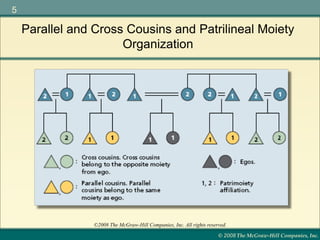
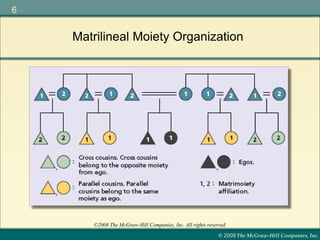
• In societies with unilineal descent
systems (patrilineal or matrilineal), the
incest taboo is often defined based on
the distinction between two kinds of first
cousins
• In societies with unilineal descent
systems (patrilineal or matrilineal), the
incest taboo is often defined based on
the distinction between two kinds of first
cousins
– Parallel cousins – children of two brothers
or two sisters
– Cross cousins – children of a brother and
a sister
© 2008 The McGraw-Hill Companies, Inc.
5
©2008 The McGraw-Hill Companies, Inc. All rights reserved.
Parallel and Cross Cousins and Patrilineal Moiety
Organization
© 2008 The McGraw-Hill Companies, Inc.
6
©2008 The McGraw-Hill Companies, Inc. All rights reserved.
Matrilineal Moiety Organization
© 2008 The McGraw-Hill Companies, Inc.
7
©2008 The McGraw-Hill Companies, Inc. All rights reserved.
– Cross cultural finding show incest and its
avoidance shaped by kinship structures
– Focus on risks and avoidance of father-
daughter incest correlates with a patriarchal
nuclear family structure
Explaining the Taboo
No universally accepted explanation for fact
that all cultures ban incest
© 2008 The McGraw-Hill Companies, Inc.
8
©2008 The McGraw-Hill Companies, Inc. All rights reserved.
• incest taboos
• A prohibition against incest exists in all
current societies but the
particular relationships prohibited varies
with place and time. The
most commonly prohibited relationships
are a child and a parent such
as father and daughter or two siblings such
as a brother and sister.
A marriage between cousins—
© 2008 The McGraw-Hill Companies, Inc.
9
©2008 The McGraw-Hill Companies, Inc. All rights reserved.
– This theory has been refuted
• Specific kin types included within the
incest taboo have a cultural rather than a
biological basis
Instinctive Horror Theory
• Homo sapiens are genetically programmed
to avoid incest
© 2008 The McGraw-Hill Companies, Inc.
10
©2008 The McGraw-Hill Companies, Inc. All rights reserved.
– Decline in fertility and survival accompanies
brother-sister mating across several
generations
– Human marriage patterns based on specific
cultural beliefs rather than universal
concerns about biological degeneration
several generations in the future
Biological Degeneration Theory
• Incest taboo developed in response to
abnormal offspring born from
incestuous unions
© 2008 The McGraw-Hill Companies, Inc.
11
©2008 The McGraw-Hill Companies, Inc. All rights reserved.
• Malinowski (and Freud) argued incest
taboo originated to direct sexual
feelings away from one’s family to
avoid disrupting the family structure
and relations
Attempt and Contempt
– Opposite theory argues that people are
less likely to be sexually attracted to those
with whom they have grown up
© 2008 The McGraw-Hill Companies, Inc.
12
©2008 The McGraw-Hill Companies, Inc. All rights reserved.
Explaining the Taboo
– More accepted argument is that taboo
originated to ensure exogamy
– Incest taboos force people to create and
maintain wide social networks
– Incest taboos are seen as an adaptively
advantageous cultural construct
• Marry Out or Die Out
© 2008 The McGraw-Hill Companies, Inc.
13
©2008 The McGraw-Hill Companies, Inc. All rights reserved.
Endogamy
• Endogamy can be seen as functioning
to express and maintain social
difference, particularly in stratified
societies
• Endogamy and exogamy may operate
in a single society, but do not apply to
same social unit
© 2008 The McGraw-Hill Companies, Inc.
14
©2008 The McGraw-Hill Companies, Inc. All rights reserved.
Endogamy
• Homogamy – practice of marrying
someone similar to you in terms of
background, social status, aspirations,
and interests
• Caste
– India’s caste system is extreme endogamy
– Although India’s varna and America’s
“races” historically distinct, they share
caste-like ideology of endogamy
© 2008 The McGraw-Hill Companies, Inc.
15
©2008 The McGraw-Hill Companies, Inc. All rights reserved.
Royal Incest
• Royal families in widely diverse cultures
engaged in what would be called incest,
even in their own cultures
– Manifest function – reason given for a
custom by its natives
– Latent function – effect of custom that
was not explicitly recognized by the natives
– Royal incest, generally, had latent
economic function
© 2008 The McGraw-Hill Companies, Inc.
16
©2008 The McGraw-Hill Companies, Inc. All rights reserved.
Marital Rights and Same-Sex
Marriage
– Establish legal father and legal mother
– Give monopoly in sexuality of the other
– Give rights to labor of the other
– Give rights over the other’s property
– Establish joint fund of property
– Establish socially significant “relationship
of affinity
• Edmund Leach argued that rights
allocated by marriage include
© 2008 The McGraw-Hill Companies, Inc.
17
©2008 The McGraw-Hill Companies, Inc. All rights reserved.
– This does not mean same-sex marriages,
like any other cultural construction, are not
capable of meeting these needs, only that
in U.S. laws prevent them from doing so
– There are many examples in which same-
sex marriages are culturally sanctioned
• In U.S., since same-sex marriage is
illegal, same-sex couples denied many
of these rights
Marital Rights and Same-Sex
Marriage
© 2008 The McGraw-Hill Companies, Inc.
18
©2008 The McGraw-Hill Companies, Inc. All rights reserved.
Bridewealth and Dowry
– Bridewealth – gift from husband’s kin to
the wife’s
– Dowry – marital exchange in which the
wife’s group provides substantial gifts to
the husband’s family
• Particularly in descent-based societies,
marriage partners represent an alliance
of larger social units
© 2008 The McGraw-Hill Companies, Inc.
19
©2008 The McGraw-Hill Companies, Inc. All rights reserved.
Durable alliances
• Continuation of marital alliances when
one spouse dies
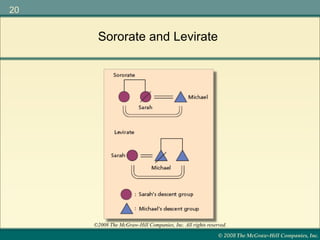
– Sororate – may marry wife’s sister if wife
dies
– Levirate – right to marry husband’s brother
if husband dies
© 2008 The McGraw-Hill Companies, Inc.
20
©2008 The McGraw-Hill Companies, Inc. All rights reserved.
Sororate and Levirate
© 2008 The McGraw-Hill Companies, Inc.
21
©2008 The McGraw-Hill Companies, Inc. All rights reserved.
Divorce
– Marriages that are political alliances
between groups harder to break up than
marriages that are more individual affairs
– Bridewealth discourages divorce
– Divorce is more common in matrilineal
societies as well as societies in which
postmarital residence is matrilocal
• Divorce found in many different
societies
© 2008 The McGraw-Hill Companies, Inc.
22
©2008 The McGraw-Hill Companies, Inc. All rights reserved.
Divorce
• Divorce is harder in patrilocal societies
as the woman may be less inclined to
leave her children who, as members of
their father’s lineage, would need to
stay with him
• Divorce is harder in patrilocal societies
as the woman may be less inclined to
leave her children who, as members of
their father’s lineage, would need to
stay with him
– Contemporary Western societies
stress romantic love as necessary for
good marriage
© 2008 The McGraw-Hill Companies, Inc.
23
©2008 The McGraw-Hill Companies, Inc. All rights reserved.
Divorce
– Very large percentage of gainfully
employed women
– Americans value independence
• U.S. has one of world’s highest divorce
rates
© 2008 The McGraw-Hill Companies, Inc.
24
©2008 The McGraw-Hill Companies, Inc. All rights reserved.
Plural Marriages
– Even in cultures that approve of polygamy,
monogamy tends to be the norm
– Polygyny more common than polyandry
because, where sex ratios are not equal,
there tend to be more women than men
• Multiple wives tend to be associated with
wealth and prestige
• No single explanation for polygyny
• Polygyny
© 2008 The McGraw-Hill Companies, Inc.
25
©2008 The McGraw-Hill Companies, Inc. All rights reserved.
Plural Marriages
– Polyandry quite rare, being practiced
almost exclusively in South Asia
• Polyandry usually practiced in response to
specific circumstances, and in conjunction with
other marriage formats
• Among Paharis of India, polyandry associated
with relatively low female population, due to
covert female infanticide
• In other cultures, polyandry resulted from the
fact that men traveled a great deal
• Polyandry

INCESThhhhhhhhhhhhhhhhhhhhhhhh Taboo.ppt

  • 1.
    © 2008 TheMcGraw-Hill Companies, Inc. 1 ©2008 The McGraw-Hill Companies, Inc. All rights reserved. Marriage • What Is Marriage? • Incest and Exogamy • Explaining the Taboo • Endogamy • Marital Rights and Same-Sex Marriage • Marriage As a Group Alliance • Divorce • Plural Marriages
  • 2.
    © 2008 TheMcGraw-Hill Companies, Inc. 2 ©2008 The McGraw-Hill Companies, Inc. All rights reserved. What Is Marriage? – Establishes legal parentage of children – Gives spouses rights – Genitor – biological father of a child – Pater – socially recognized father of a child • No definition of marriage broad enough to apply easily to all societies and situations
  • 3.
    © 2008 TheMcGraw-Hill Companies, Inc. 3 ©2008 The McGraw-Hill Companies, Inc. All rights reserved. Incest and Exogamy – Forces people to create and maintain a wide social network • Incest – sexual relations with a close relative – The incest taboo is a cultural universal – What constitutes incest varies widely from culture to culture • Exogamy – practice of seeking a spouse outside one’s own group
  • 4.
    © 2008 TheMcGraw-Hill Companies, Inc. 4 ©2008 The McGraw-Hill Companies, Inc. All rights reserved. Incest and Exogamy • In societies with unilineal descent systems (patrilineal or matrilineal), the incest taboo is often defined based on the distinction between two kinds of first cousins • In societies with unilineal descent systems (patrilineal or matrilineal), the incest taboo is often defined based on the distinction between two kinds of first cousins – Parallel cousins – children of two brothers or two sisters – Cross cousins – children of a brother and a sister
  • 5.
    © 2008 TheMcGraw-Hill Companies, Inc. 5 ©2008 The McGraw-Hill Companies, Inc. All rights reserved. Parallel and Cross Cousins and Patrilineal Moiety Organization
  • 6.
    © 2008 TheMcGraw-Hill Companies, Inc. 6 ©2008 The McGraw-Hill Companies, Inc. All rights reserved. Matrilineal Moiety Organization
  • 7.
    © 2008 TheMcGraw-Hill Companies, Inc. 7 ©2008 The McGraw-Hill Companies, Inc. All rights reserved. – Cross cultural finding show incest and its avoidance shaped by kinship structures – Focus on risks and avoidance of father- daughter incest correlates with a patriarchal nuclear family structure Explaining the Taboo No universally accepted explanation for fact that all cultures ban incest
  • 8.
    © 2008 TheMcGraw-Hill Companies, Inc. 8 ©2008 The McGraw-Hill Companies, Inc. All rights reserved. • incest taboos • A prohibition against incest exists in all current societies but the particular relationships prohibited varies with place and time. The most commonly prohibited relationships are a child and a parent such as father and daughter or two siblings such as a brother and sister. A marriage between cousins—
  • 9.
    © 2008 TheMcGraw-Hill Companies, Inc. 9 ©2008 The McGraw-Hill Companies, Inc. All rights reserved. – This theory has been refuted • Specific kin types included within the incest taboo have a cultural rather than a biological basis Instinctive Horror Theory • Homo sapiens are genetically programmed to avoid incest
  • 10.
    © 2008 TheMcGraw-Hill Companies, Inc. 10 ©2008 The McGraw-Hill Companies, Inc. All rights reserved. – Decline in fertility and survival accompanies brother-sister mating across several generations – Human marriage patterns based on specific cultural beliefs rather than universal concerns about biological degeneration several generations in the future Biological Degeneration Theory • Incest taboo developed in response to abnormal offspring born from incestuous unions
  • 11.
    © 2008 TheMcGraw-Hill Companies, Inc. 11 ©2008 The McGraw-Hill Companies, Inc. All rights reserved. • Malinowski (and Freud) argued incest taboo originated to direct sexual feelings away from one’s family to avoid disrupting the family structure and relations Attempt and Contempt – Opposite theory argues that people are less likely to be sexually attracted to those with whom they have grown up
  • 12.
    © 2008 TheMcGraw-Hill Companies, Inc. 12 ©2008 The McGraw-Hill Companies, Inc. All rights reserved. Explaining the Taboo – More accepted argument is that taboo originated to ensure exogamy – Incest taboos force people to create and maintain wide social networks – Incest taboos are seen as an adaptively advantageous cultural construct • Marry Out or Die Out
  • 13.
    © 2008 TheMcGraw-Hill Companies, Inc. 13 ©2008 The McGraw-Hill Companies, Inc. All rights reserved. Endogamy • Endogamy can be seen as functioning to express and maintain social difference, particularly in stratified societies • Endogamy and exogamy may operate in a single society, but do not apply to same social unit
  • 14.
    © 2008 TheMcGraw-Hill Companies, Inc. 14 ©2008 The McGraw-Hill Companies, Inc. All rights reserved. Endogamy • Homogamy – practice of marrying someone similar to you in terms of background, social status, aspirations, and interests • Caste – India’s caste system is extreme endogamy – Although India’s varna and America’s “races” historically distinct, they share caste-like ideology of endogamy
  • 15.
    © 2008 TheMcGraw-Hill Companies, Inc. 15 ©2008 The McGraw-Hill Companies, Inc. All rights reserved. Royal Incest • Royal families in widely diverse cultures engaged in what would be called incest, even in their own cultures – Manifest function – reason given for a custom by its natives – Latent function – effect of custom that was not explicitly recognized by the natives – Royal incest, generally, had latent economic function
  • 16.
    © 2008 TheMcGraw-Hill Companies, Inc. 16 ©2008 The McGraw-Hill Companies, Inc. All rights reserved. Marital Rights and Same-Sex Marriage – Establish legal father and legal mother – Give monopoly in sexuality of the other – Give rights to labor of the other – Give rights over the other’s property – Establish joint fund of property – Establish socially significant “relationship of affinity • Edmund Leach argued that rights allocated by marriage include
  • 17.
    © 2008 TheMcGraw-Hill Companies, Inc. 17 ©2008 The McGraw-Hill Companies, Inc. All rights reserved. – This does not mean same-sex marriages, like any other cultural construction, are not capable of meeting these needs, only that in U.S. laws prevent them from doing so – There are many examples in which same- sex marriages are culturally sanctioned • In U.S., since same-sex marriage is illegal, same-sex couples denied many of these rights Marital Rights and Same-Sex Marriage
  • 18.
    © 2008 TheMcGraw-Hill Companies, Inc. 18 ©2008 The McGraw-Hill Companies, Inc. All rights reserved. Bridewealth and Dowry – Bridewealth – gift from husband’s kin to the wife’s – Dowry – marital exchange in which the wife’s group provides substantial gifts to the husband’s family • Particularly in descent-based societies, marriage partners represent an alliance of larger social units
  • 19.
    © 2008 TheMcGraw-Hill Companies, Inc. 19 ©2008 The McGraw-Hill Companies, Inc. All rights reserved. Durable alliances • Continuation of marital alliances when one spouse dies – Sororate – may marry wife’s sister if wife dies – Levirate – right to marry husband’s brother if husband dies
  • 20.
    © 2008 TheMcGraw-Hill Companies, Inc. 20 ©2008 The McGraw-Hill Companies, Inc. All rights reserved. Sororate and Levirate
  • 21.
    © 2008 TheMcGraw-Hill Companies, Inc. 21 ©2008 The McGraw-Hill Companies, Inc. All rights reserved. Divorce – Marriages that are political alliances between groups harder to break up than marriages that are more individual affairs – Bridewealth discourages divorce – Divorce is more common in matrilineal societies as well as societies in which postmarital residence is matrilocal • Divorce found in many different societies
  • 22.
    © 2008 TheMcGraw-Hill Companies, Inc. 22 ©2008 The McGraw-Hill Companies, Inc. All rights reserved. Divorce • Divorce is harder in patrilocal societies as the woman may be less inclined to leave her children who, as members of their father’s lineage, would need to stay with him • Divorce is harder in patrilocal societies as the woman may be less inclined to leave her children who, as members of their father’s lineage, would need to stay with him – Contemporary Western societies stress romantic love as necessary for good marriage
  • 23.
    © 2008 TheMcGraw-Hill Companies, Inc. 23 ©2008 The McGraw-Hill Companies, Inc. All rights reserved. Divorce – Very large percentage of gainfully employed women – Americans value independence • U.S. has one of world’s highest divorce rates
  • 24.
    © 2008 TheMcGraw-Hill Companies, Inc. 24 ©2008 The McGraw-Hill Companies, Inc. All rights reserved. Plural Marriages – Even in cultures that approve of polygamy, monogamy tends to be the norm – Polygyny more common than polyandry because, where sex ratios are not equal, there tend to be more women than men • Multiple wives tend to be associated with wealth and prestige • No single explanation for polygyny • Polygyny
  • 25.
    © 2008 TheMcGraw-Hill Companies, Inc. 25 ©2008 The McGraw-Hill Companies, Inc. All rights reserved. Plural Marriages – Polyandry quite rare, being practiced almost exclusively in South Asia • Polyandry usually practiced in response to specific circumstances, and in conjunction with other marriage formats • Among Paharis of India, polyandry associated with relatively low female population, due to covert female infanticide • In other cultures, polyandry resulted from the fact that men traveled a great deal • Polyandry