Search Analytics For the Content Strategist Using Search Data To Improve Your Content Content Strategy NYC Sep. 2009 Keynote: Marko Hurst
Me Book:  Search Analytics -  Conversations With Your visitors Anticipated release:  December 2009   Book website:   RosenfeldMedia.com/books/SearchAnalytics  Co-Author:  Lou Rosenfeld Consultant, Author, & Speaker Enterprise websites & applications Web & Search Analytics  User Experience Machine Learning Principal:  MDH  Studios Blog:   MarkoHurst.com   “Insightful Analytics” Twitter:   MarkoHurst Contact:   [email_address]
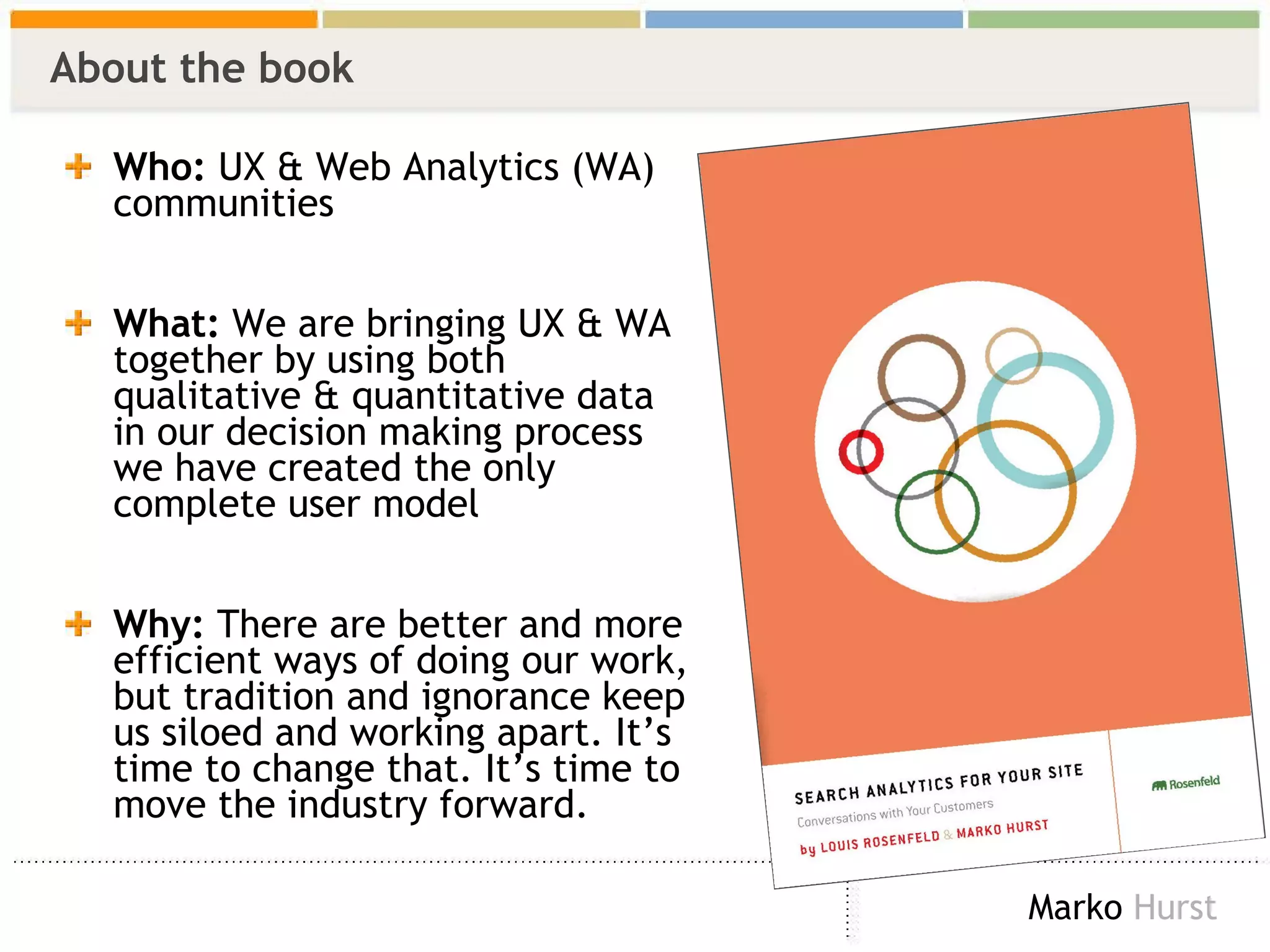
About the book Who:  UX & Web Analytics (WA) communities What:  We are bringing UX & WA together by using both qualitative & quantitative data in our decision making process we have created the only complete user model  Why:  There are better and more efficient ways of doing our work, but tradition and ignorance keep us siloed and working apart. It’s time to change that. It’s time to move the industry forward.
Before We Begin Establishing a baseline
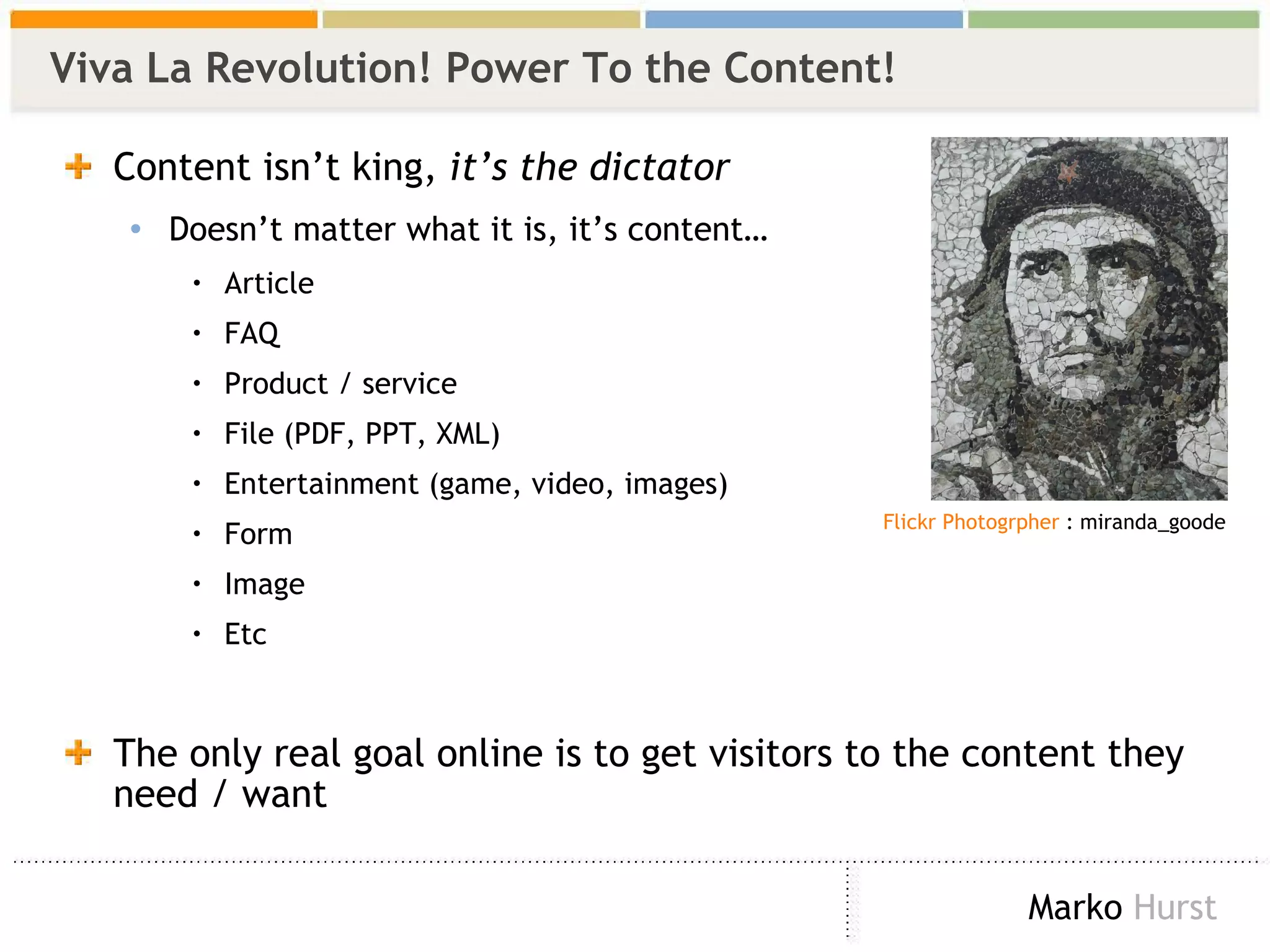
Viva La Revolution! Power To the Content! Content isn’t king,  it’s the dictator  Doesn’t matter what it is, it’s content… Article FAQ Product / service File (PDF, PPT, XML) Entertainment (game, video, images) Form Image Etc The only real goal online is to get visitors to the content they need / want Flickr Photogrpher   : miranda_goode
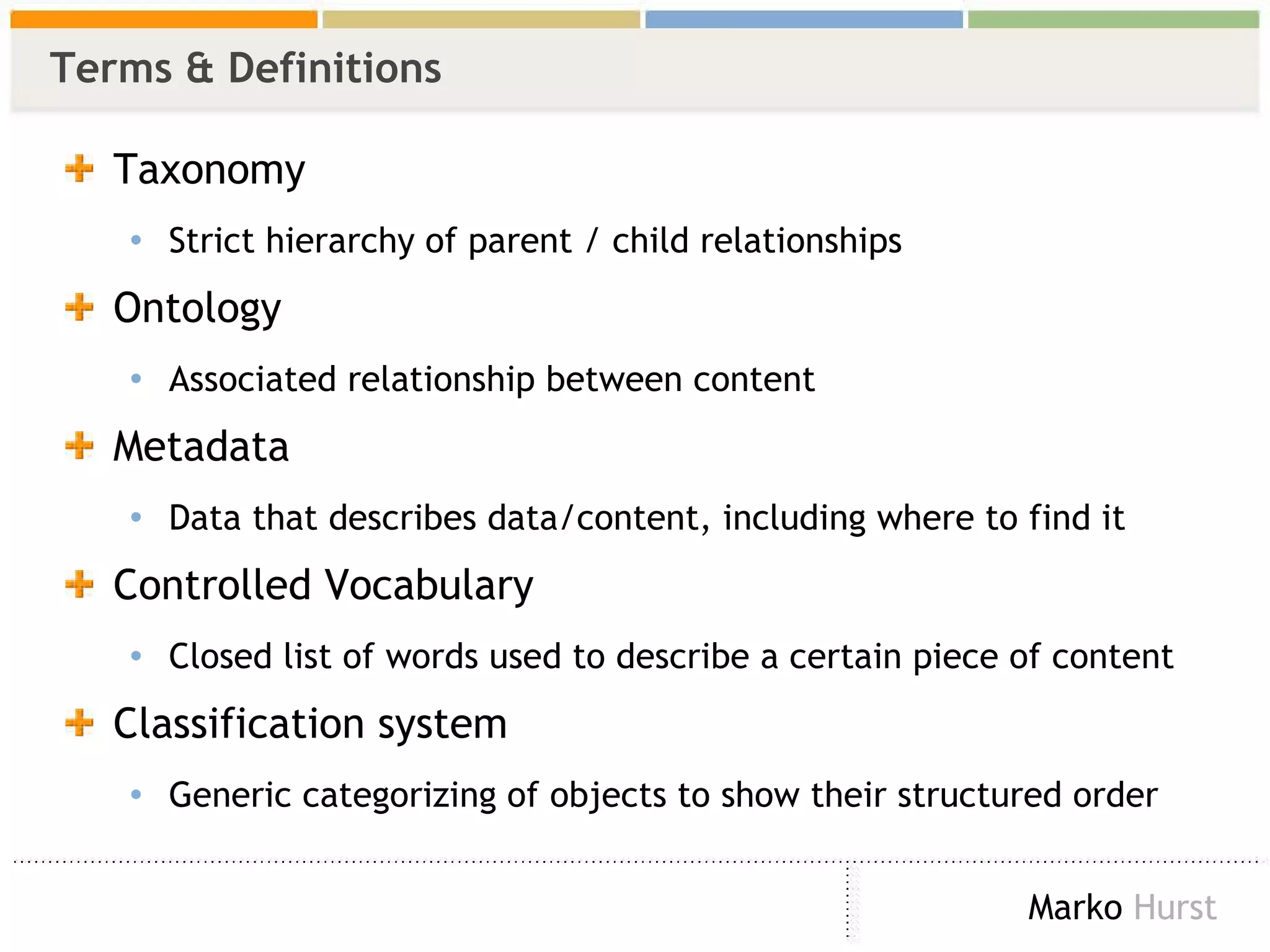
Terms & Definitions Taxonomy Strict hierarchy of parent / child relationships Ontology Associated relationship between content  Metadata Data that describes data/content, including where to find it Controlled Vocabulary  Closed list of words used to describe a certain piece of content Classification system Generic categorizing of objects to show their structured order
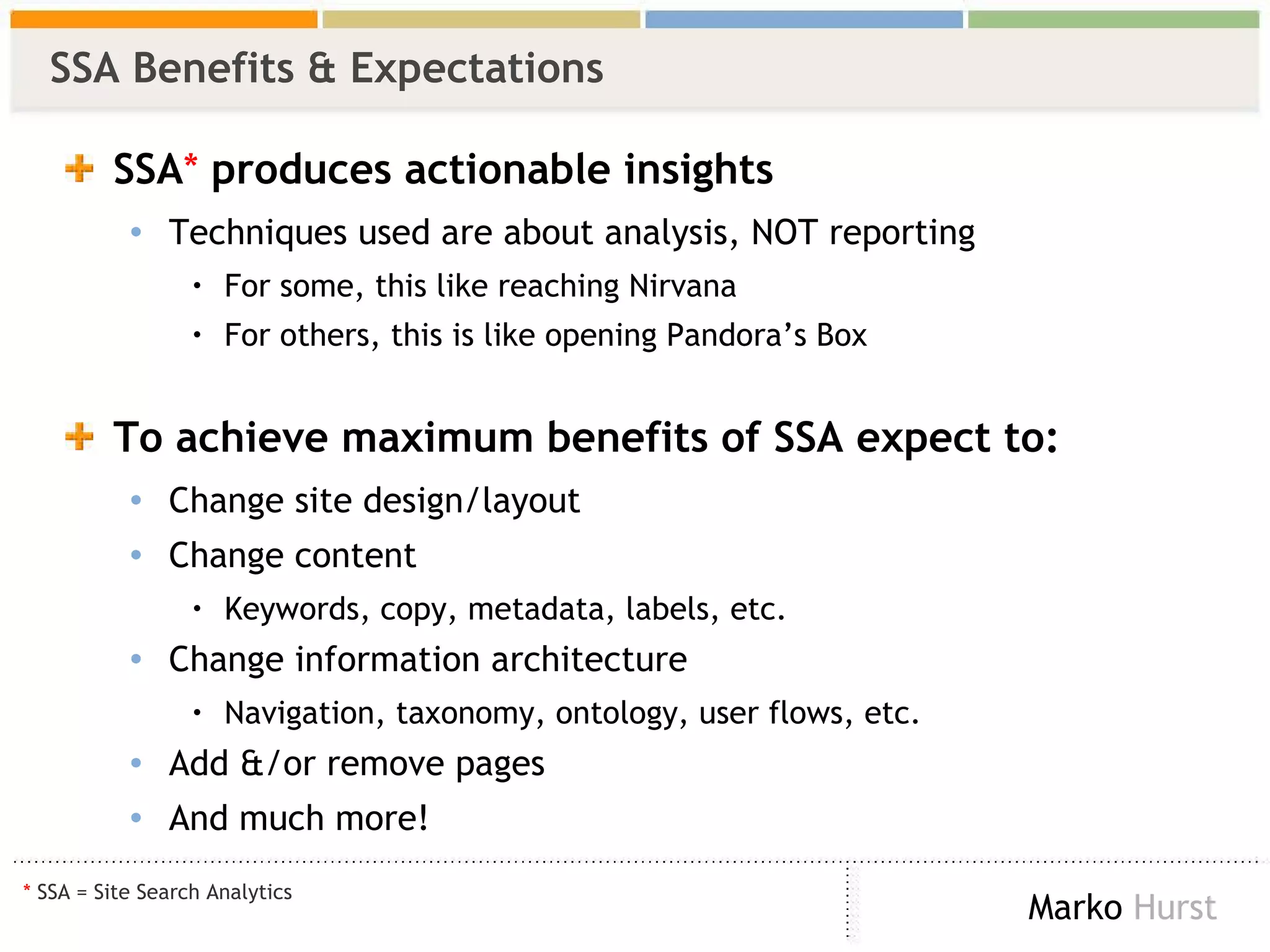
SSA Benefits & Expectations  SSA *  produces   actionable insights Techniques used are about analysis, NOT reporting For some, this like reaching Nirvana For others, this is like opening Pandora’s Box To achieve maximum benefits of SSA expect to: Change site design/layout Change content Keywords, copy, metadata, labels, etc. Change information architecture Navigation, taxonomy, ontology, user flows, etc. Add &/or remove pages And much more! *  SSA = Site Search Analytics
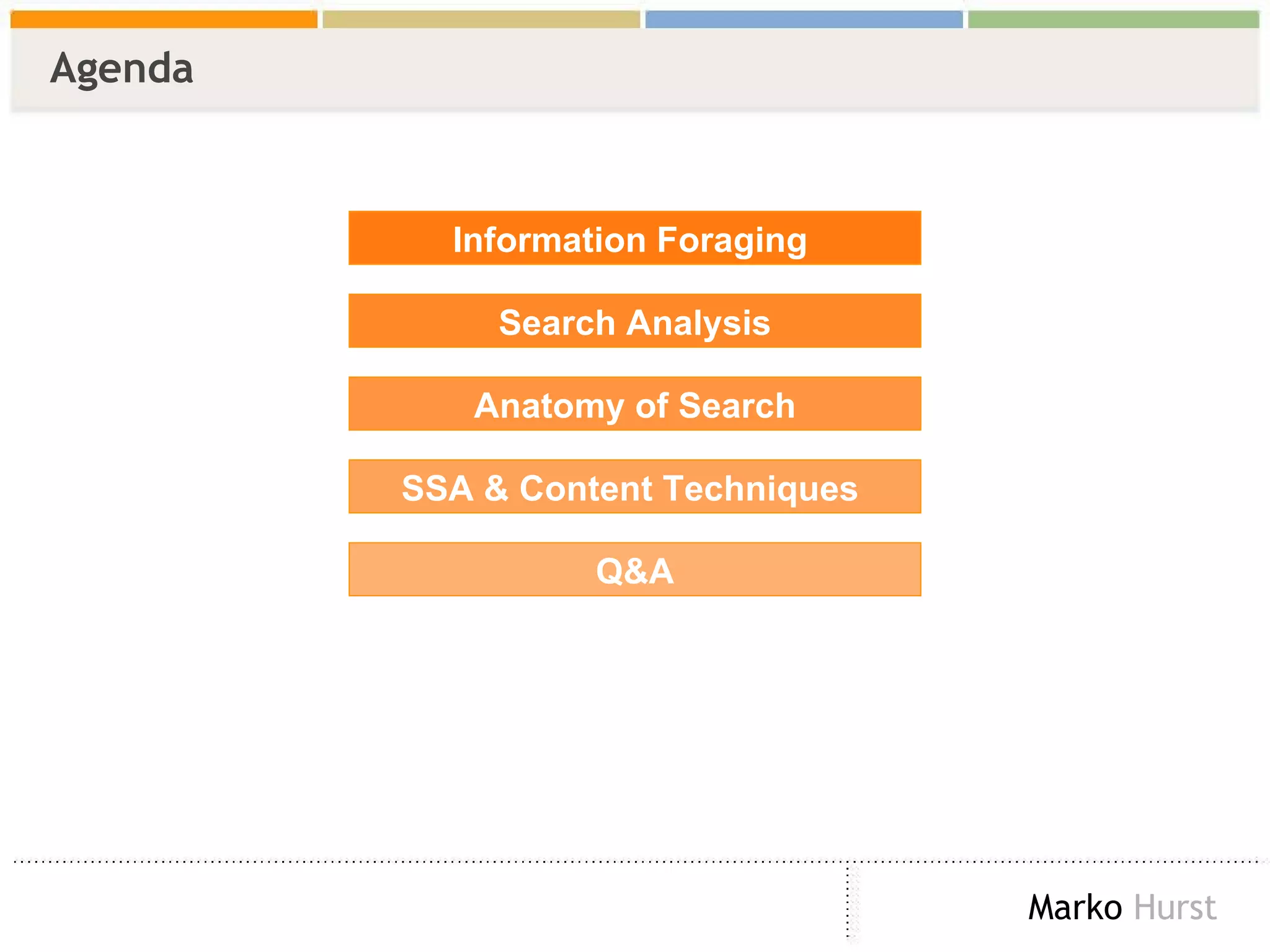
Agenda Information Foraging  Search Analysis Anatomy of Search SSA & Content Techniques  Q&A
How We Find Information Information Foraging
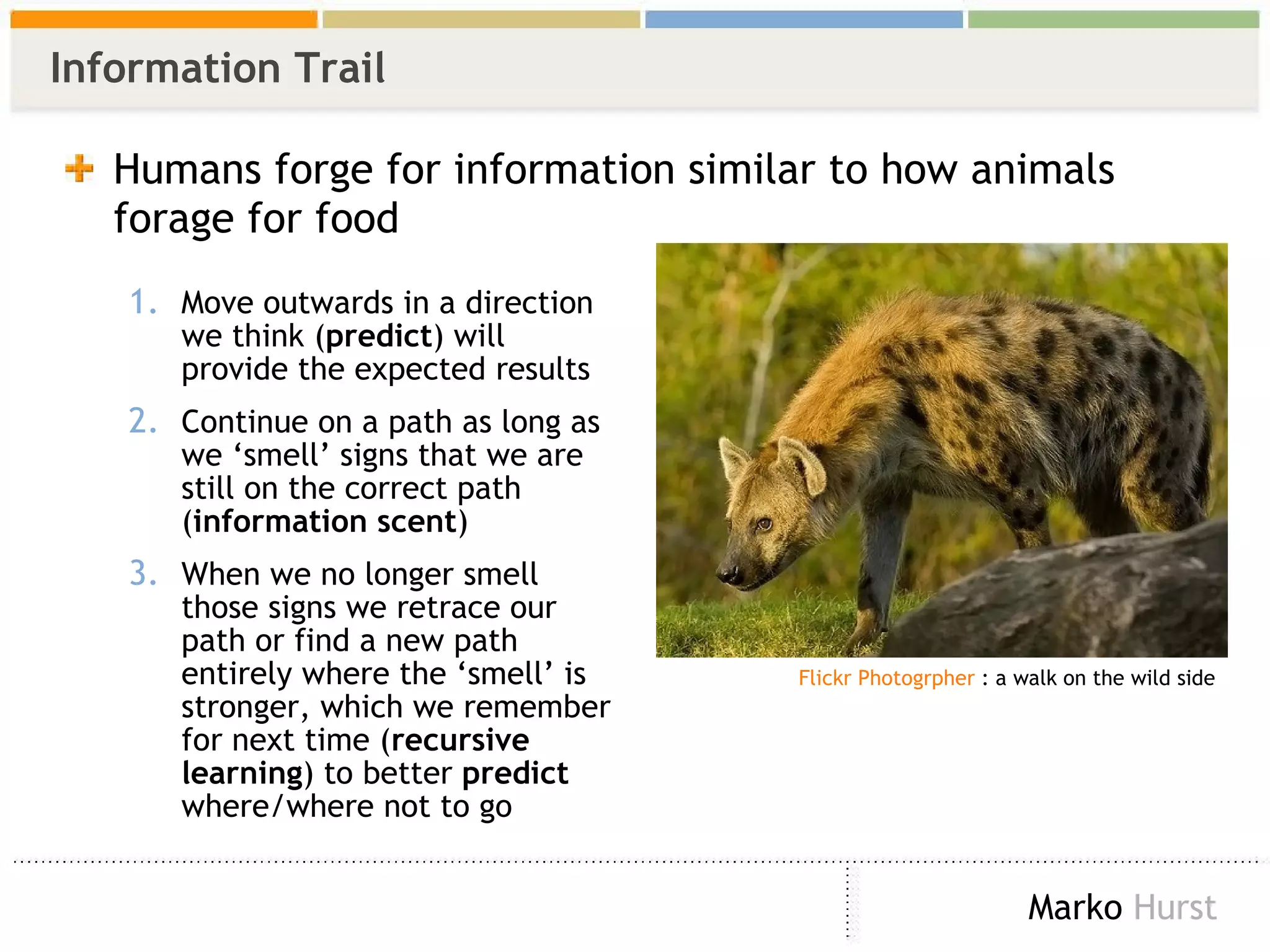
Information Trail Humans forge for information similar to how animals forage for food Move outwards in a direction we think ( predict ) will provide the expected results  Continue on a path as long as we ‘smell’ signs that we are still on the correct path ( information scent ) When we no longer smell those signs we retrace our path or find a new path entirely where the ‘smell’ is stronger, which we remember for next time ( recursive learning ) to better  predict  where/where not to go Flickr Photogrpher  : a walk on the wild side
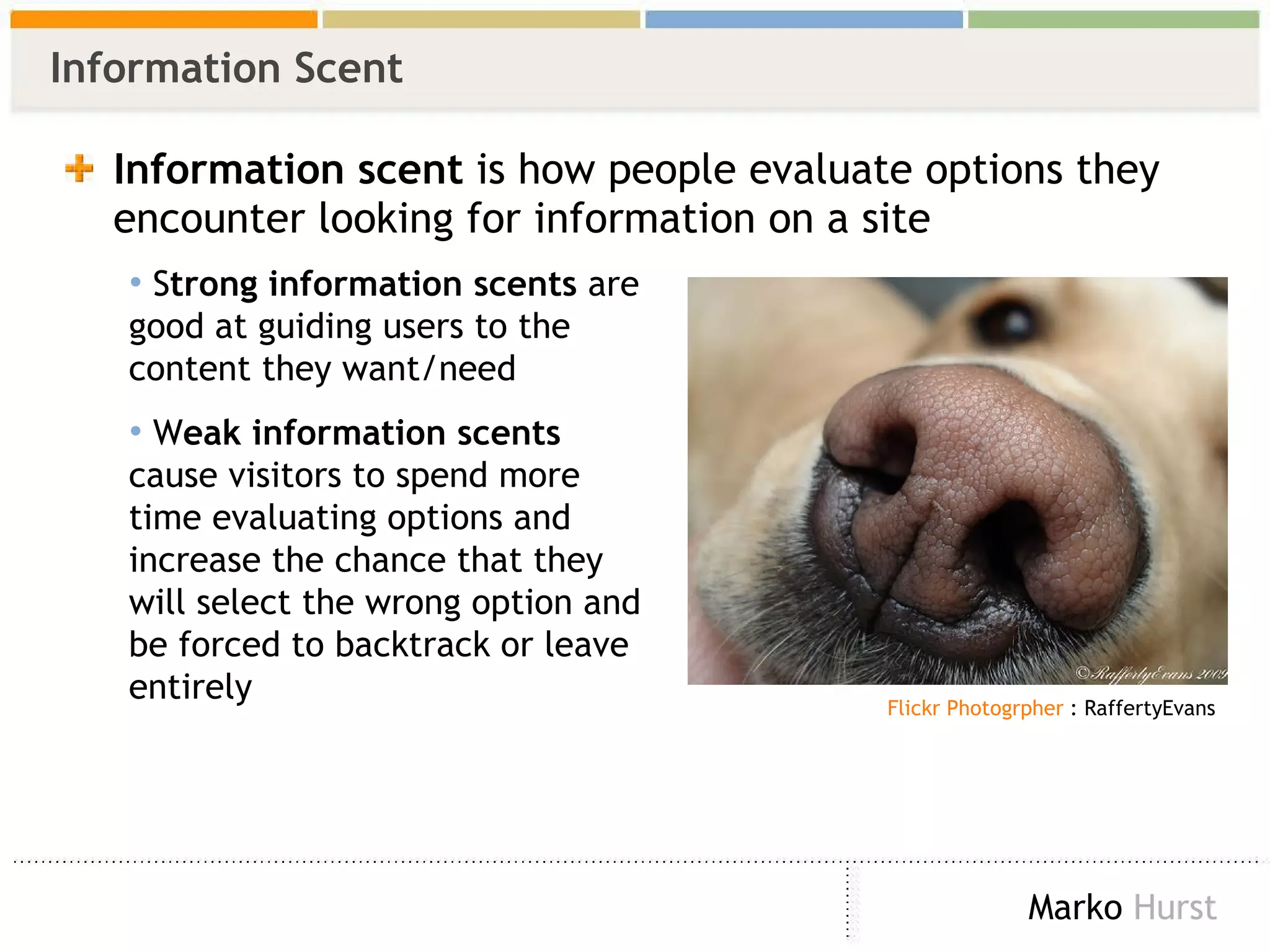
Information Scent Information scent  is how people evaluate options they encounter looking for information on a site S trong information scents  are good at guiding users to the content they want/need W eak information scents  cause visitors to spend more time evaluating options and increase the chance that they will select the wrong option and be forced to backtrack or leave entirely   Flickr Photogrpher  : RaffertyEvans
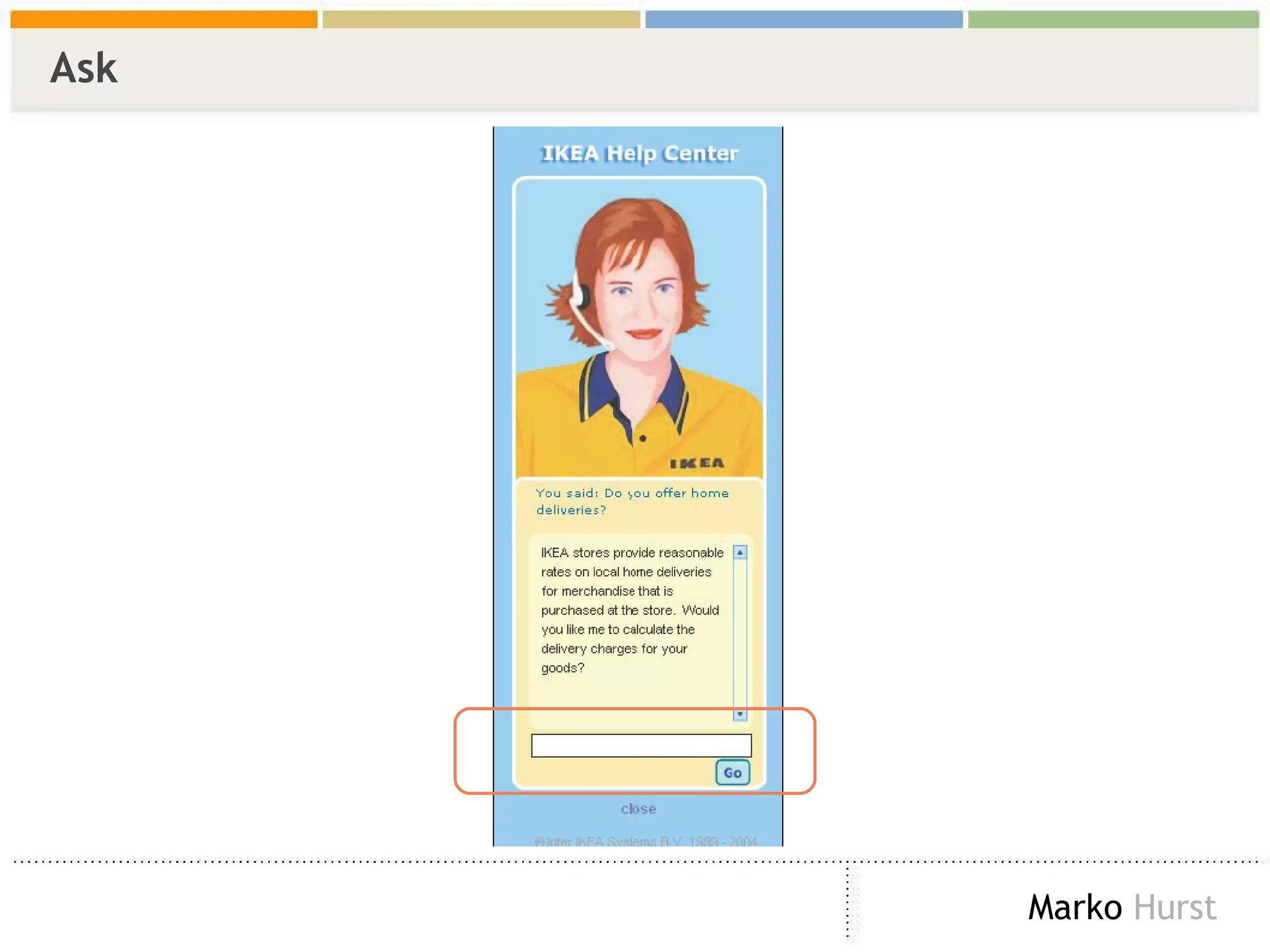
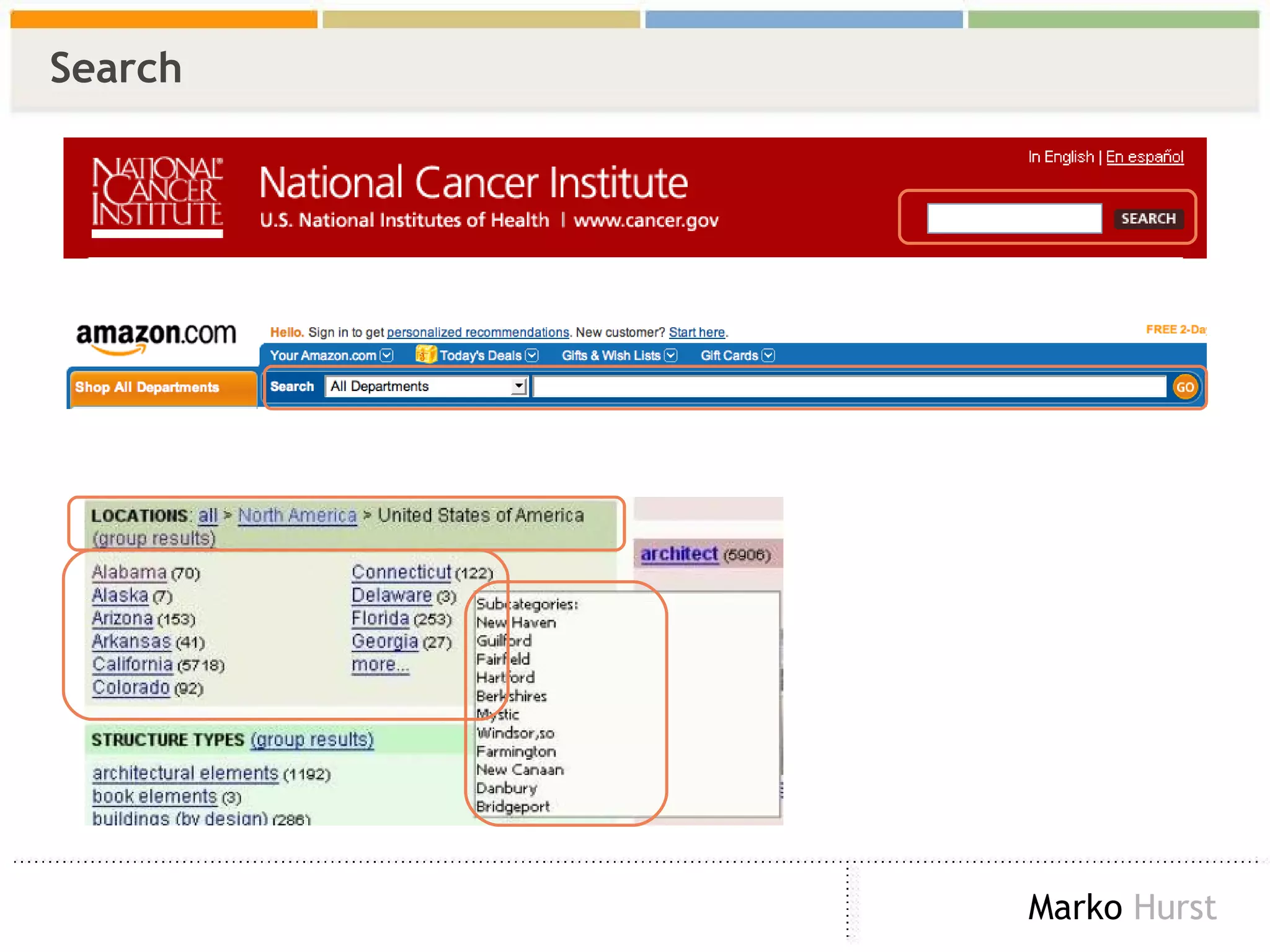
How Humans Find Content Online  Three ways of finding content Browse Ask  Search
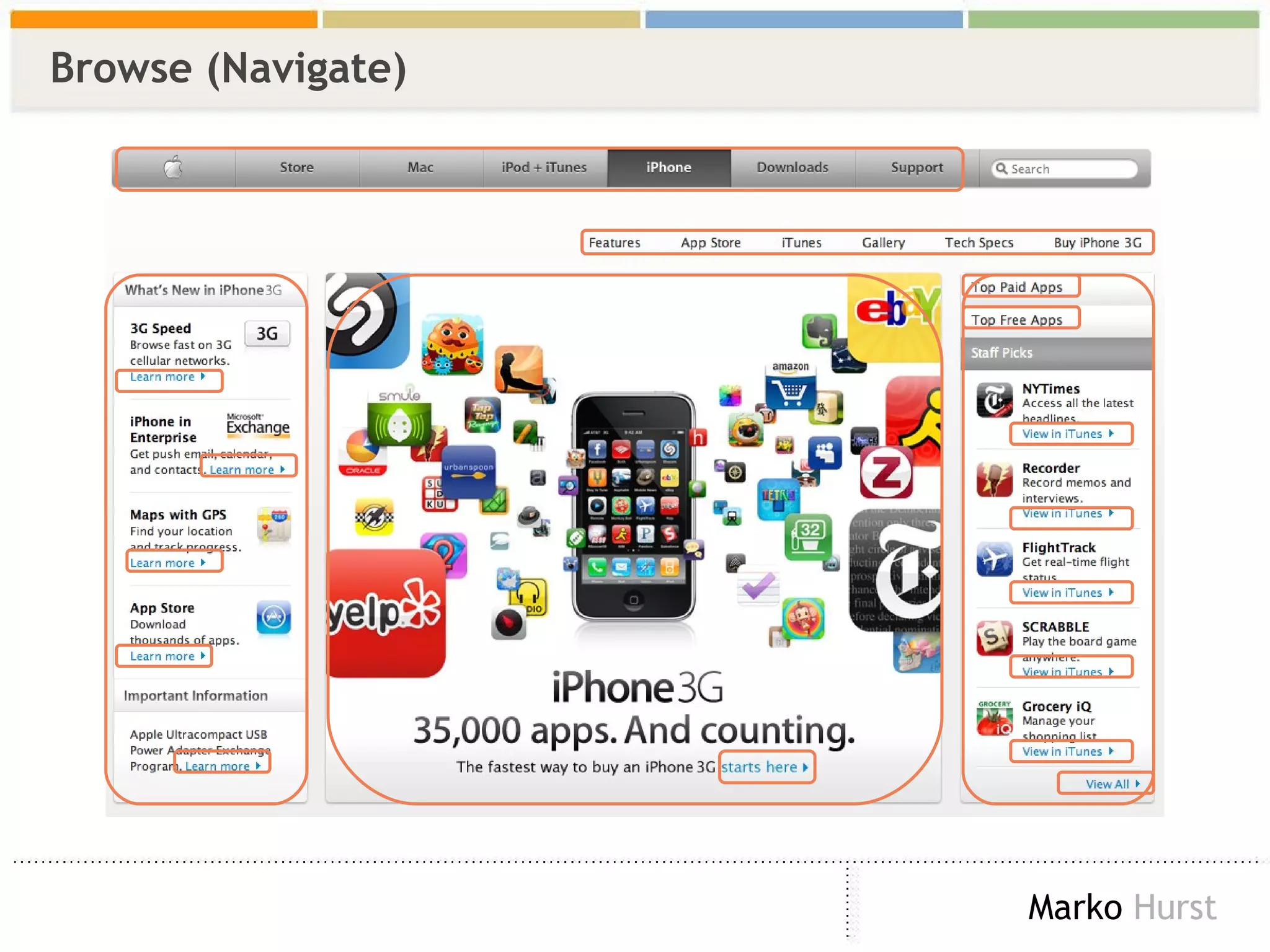
Browse (Navigate)
Ask
Search
Search Analysis Getting Started
Getting Started: Basics - Overview Business Model Data  Log files Search Engine / Web Analytics Analyzing data Data analysis tools Zipf Distribution (long-tail) Excel (spreadsheet) skills Low / no budget software No need for code or higher mathematics  NOTE: everything I show you is 100% technology agnostic
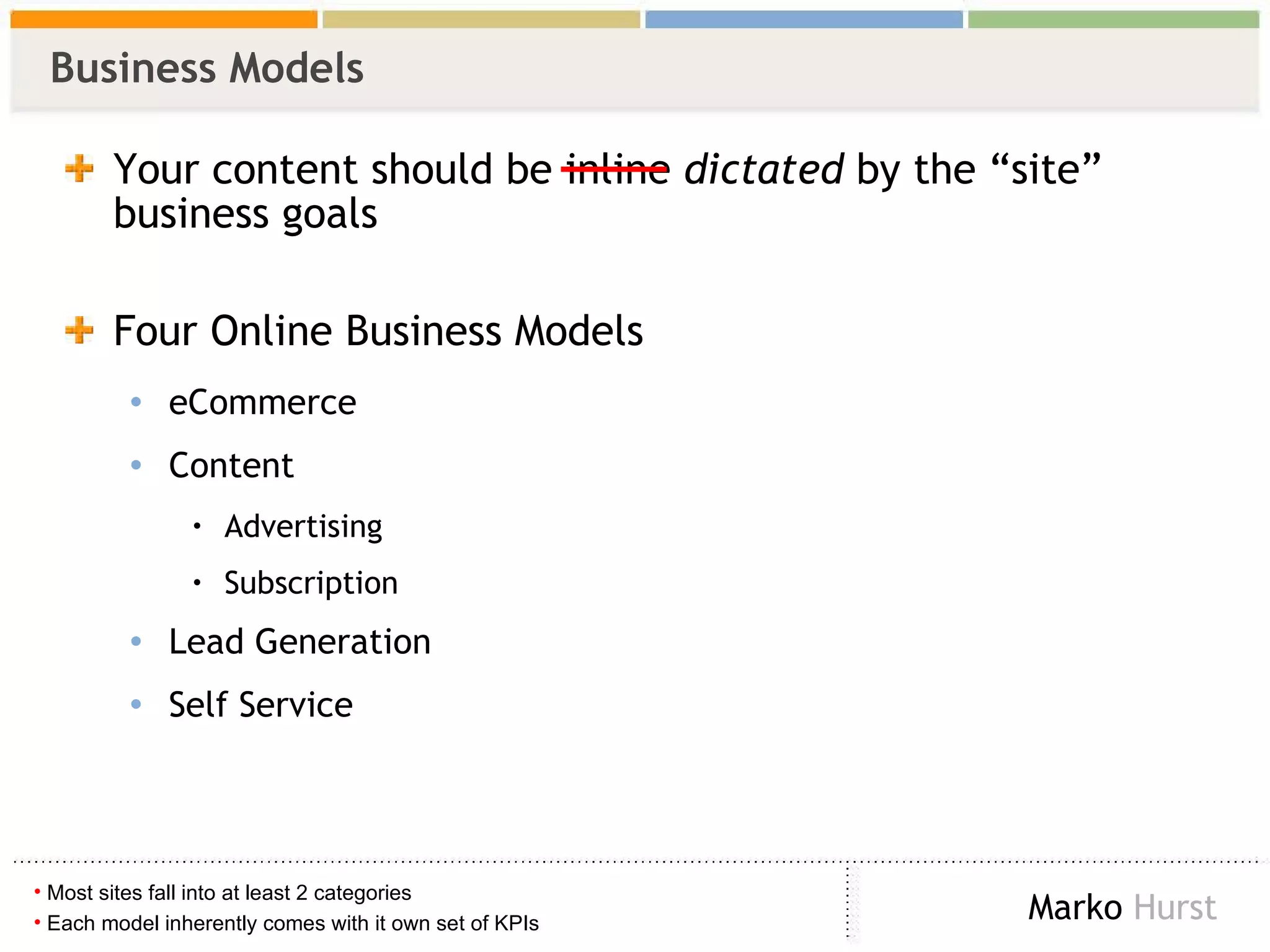
Business Models Your content should be inline  dictated  by the “site” business goals Four Online Business Models eCommerce Content Advertising  Subscription Lead Generation Self Service Most sites fall into at least 2 categories Each model inherently comes with it own set of KPIs
Where Data Comes From: Search Logs  (Google Search Appliance) Critical elements in  red IP address, time/date stamp, query, and # of results XXX.XXX.XX.130  - - [ 10/Jul/2006:10:24:38 -0800 ] "GET /search? access=p&entqr=0&output=xml_no_dtd&sort=date%3AD%3AL %3Ad1&ud=1&site=AllSites&ie=UTF-8&client=www&oe=UTF-8&proxystyleshe et=www&q= regional+transportation+governance +commission&ip=XXX.XXX.X.130 HTTP/1.1" 200 9718  62  0.17 XXX.XXX.X.104  - - [ 10/Jul/2006:10:25:46 -0800 ] "GET /search? access=p&entqr=0&output=xml_no_dtd&sort=date%3AD%3AL %3Ad1&ud=1&site=AllSites&ie=UTF-8&client=www&oe=UTF-8&proxystyleshe et=www&q= lincense+plate &ip=XXX.XXX.X.104 HTTP/1.1" 200 971  0  0.02 XXX.XXX.X.104  - - [ 10/Jul/2006:10:25:48 -0800 ] "GET /search? access=p&entqr=0&output=xml_no_dtd&sort=date%3AD%3AL %3Ad1&ie=UTF-8&client=www&q= license+plate &ud=1&site=AllSites&spell=1&oe=UTF-8&proxystylesheet=www&ip=XXX.XXX. X.104 HTTP/1.1" 200 8283  146  0.16
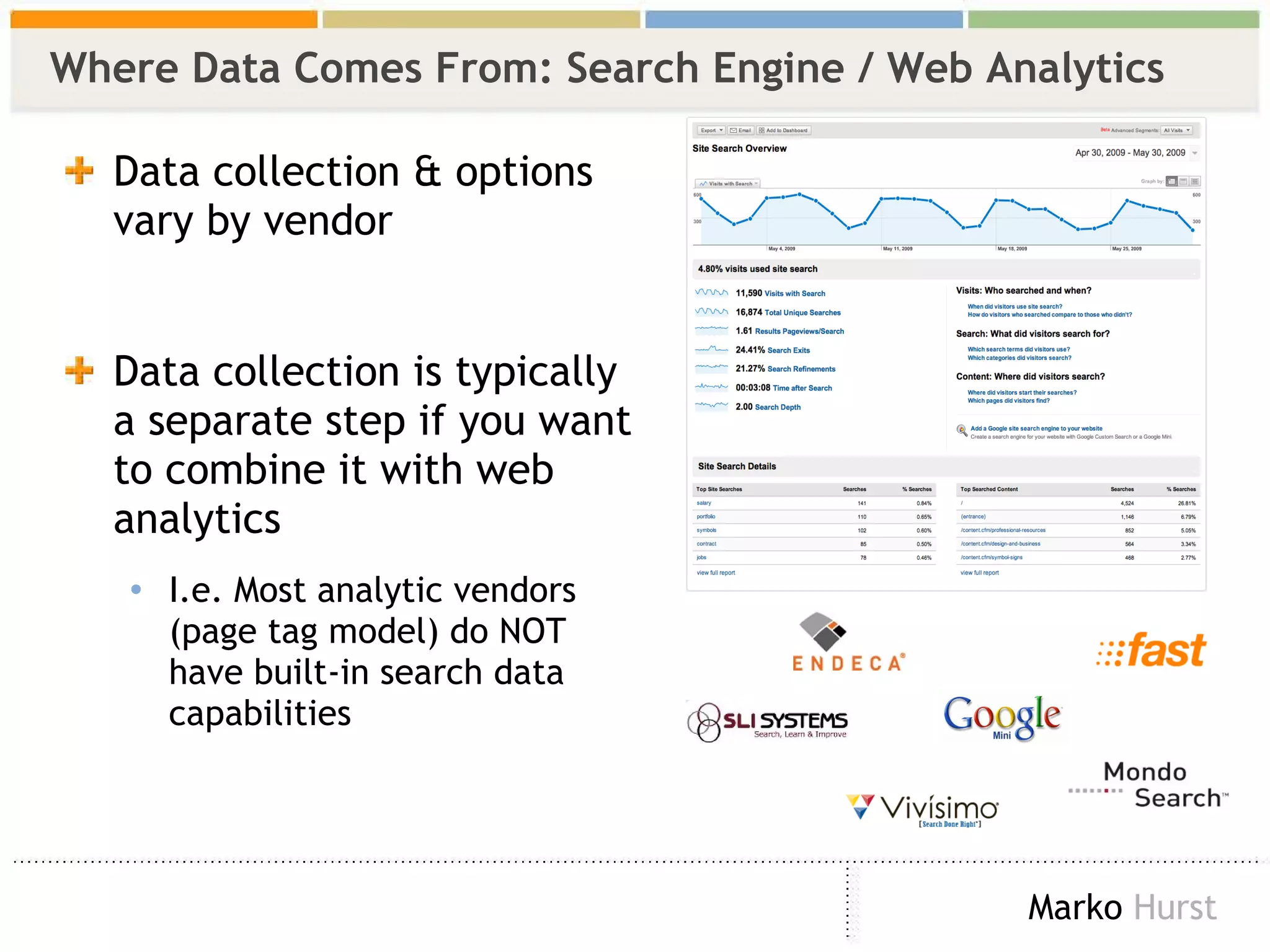
Where Data Comes From: Search Engine / Web Analytics  Data collection & options vary by vendor Data collection is typically a separate step if you want to combine it with web analytics I.e. Most analytic vendors (page tag model) do NOT have built-in search data capabilities
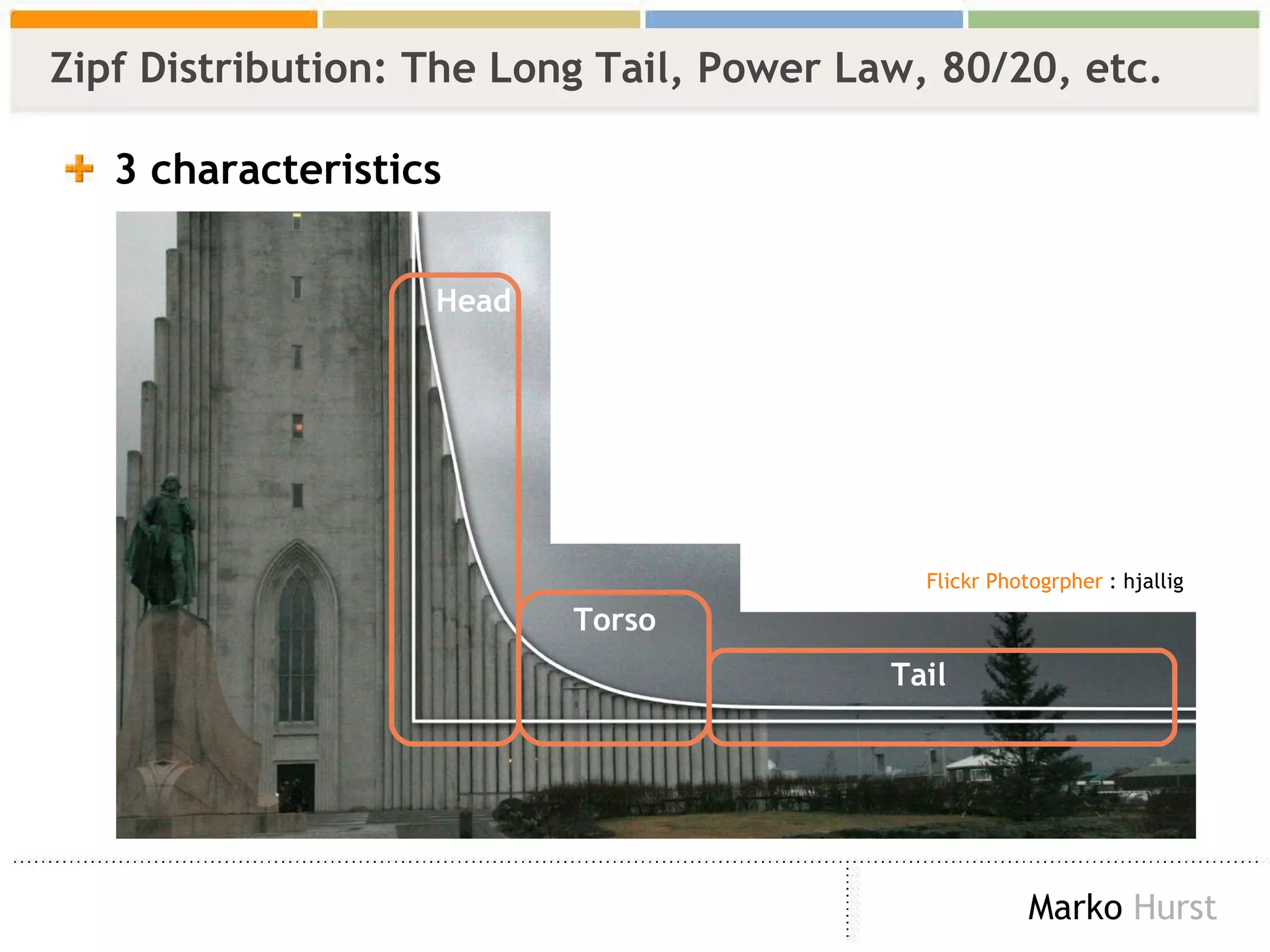
Zipf Distribution: The Long Tail, Power Law, 80/20, etc. 3 characteristics Head Torso Tail Flickr Photogrpher  : hjallig
Improving Your Content SSA Techniques & Search Behavior
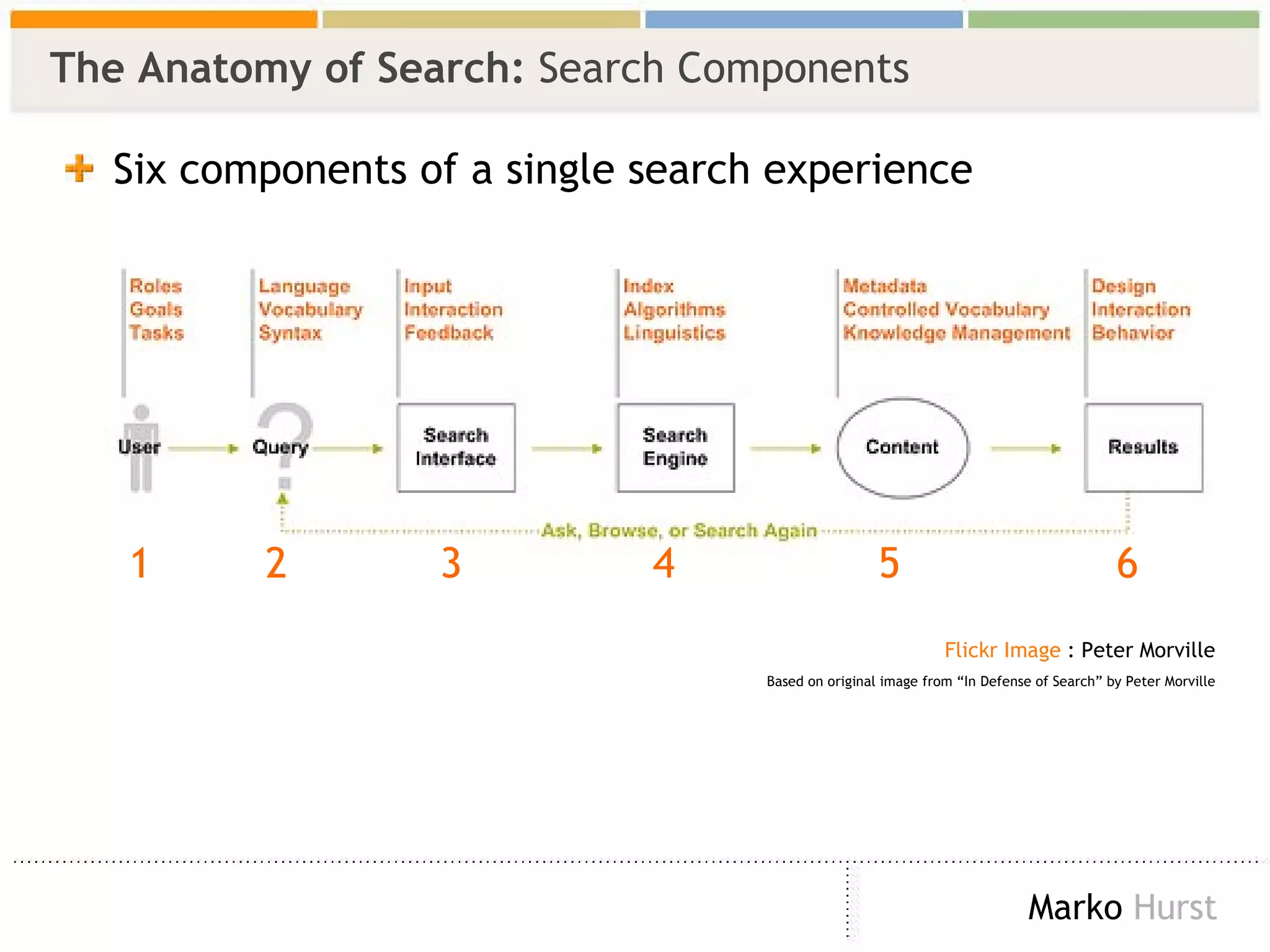
The Anatomy of Search:  Search Components   Six components of a single search experience  Flickr Image  : Peter Morville Based on original image from “In Defense of Search” by Peter Morville 1  2  3  4  5  6
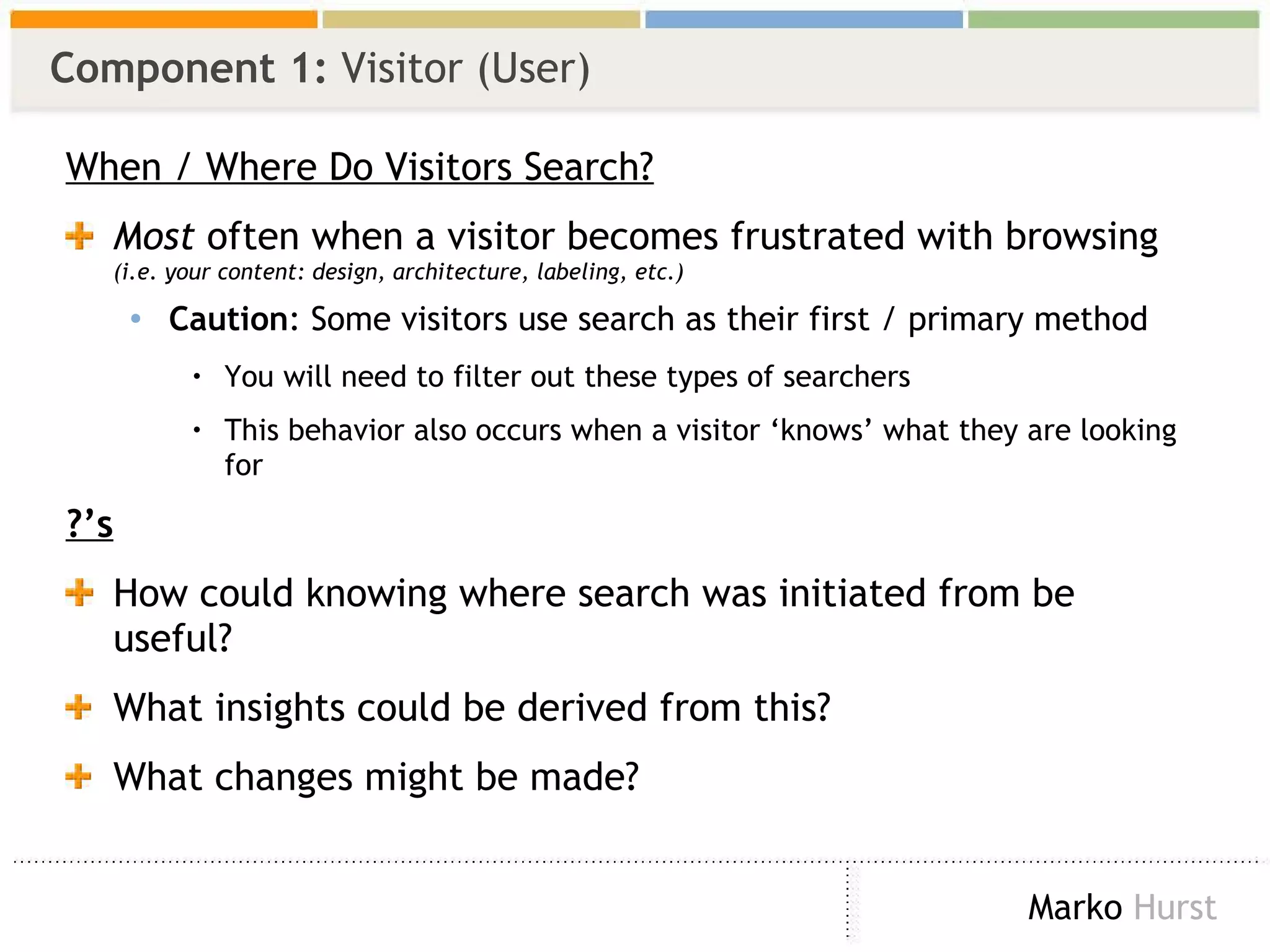
Component 1:  Visitor (User) When / Where Do Visitors Search? Most  often when a visitor becomes frustrated with browsing  (i.e. your content: design, architecture, labeling, etc.) Caution : Some visitors use search as their first / primary method You will need to filter out these types of searchers  This behavior also occurs when a visitor ‘knows’ what they are looking for ?’s How could knowing where search was initiated from be useful? What insights could be derived from this? What changes might be made?
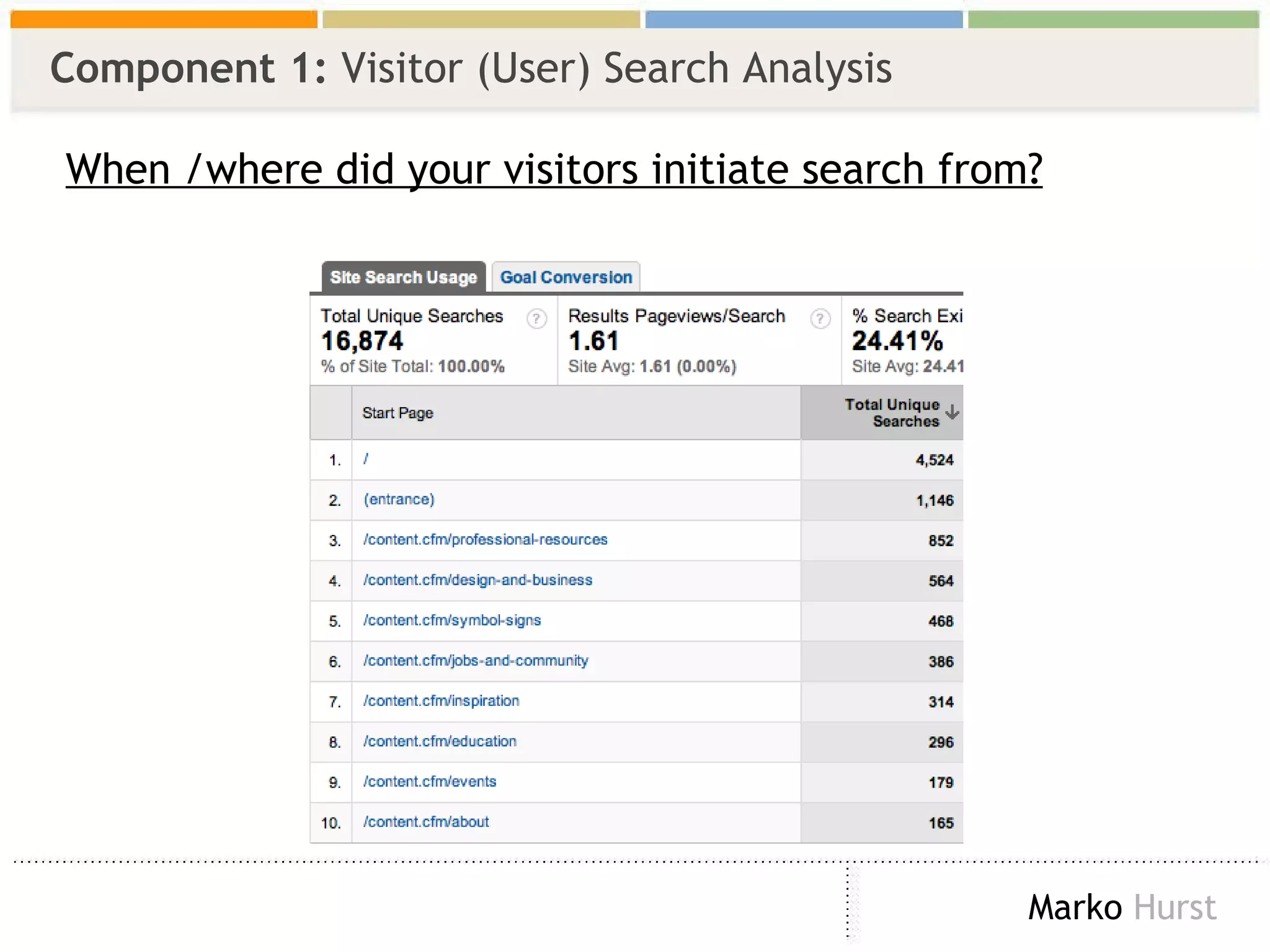
Component 1:  Visitor (User) Search Analysis When /where did your visitors initiate search from?
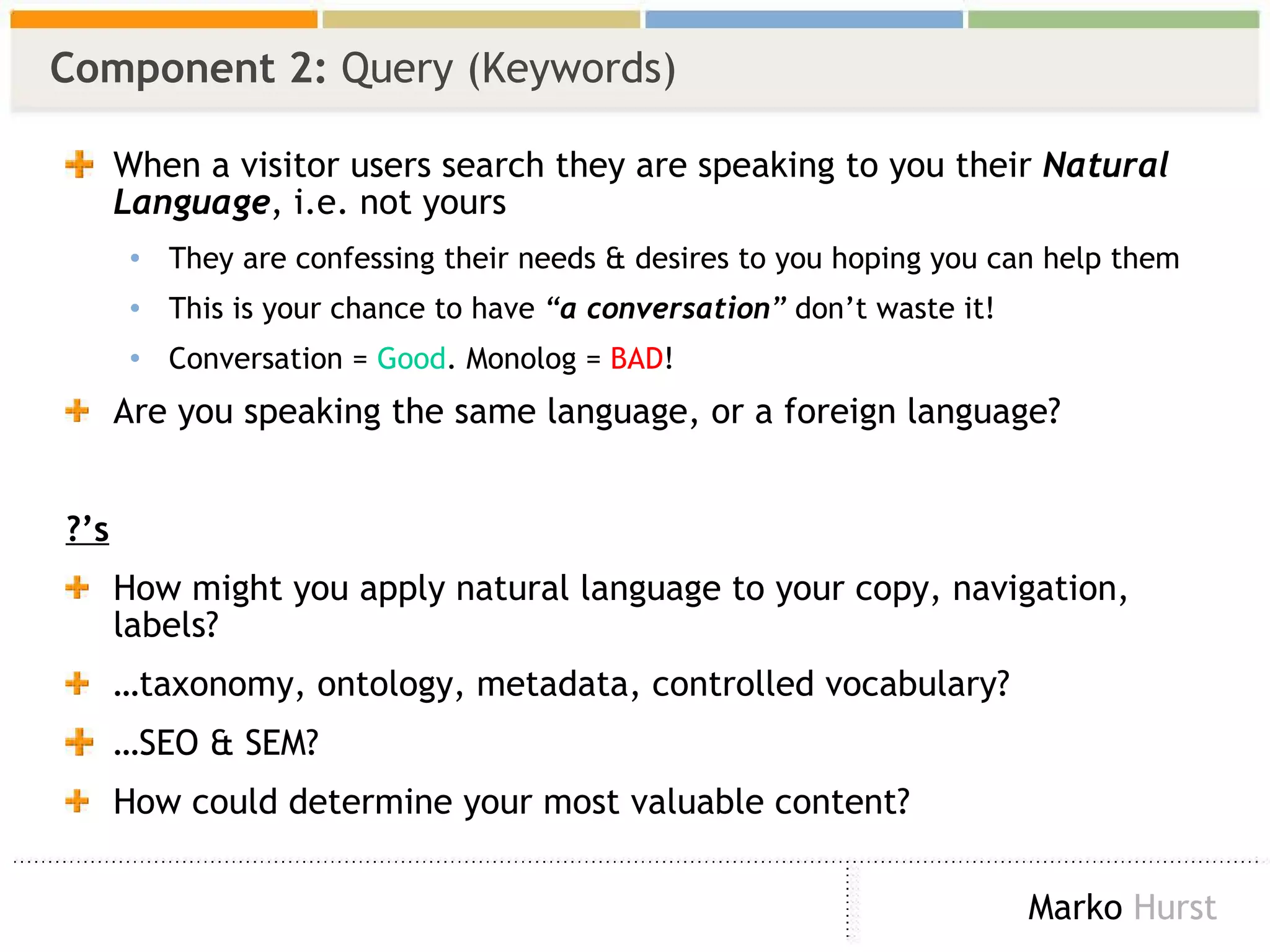
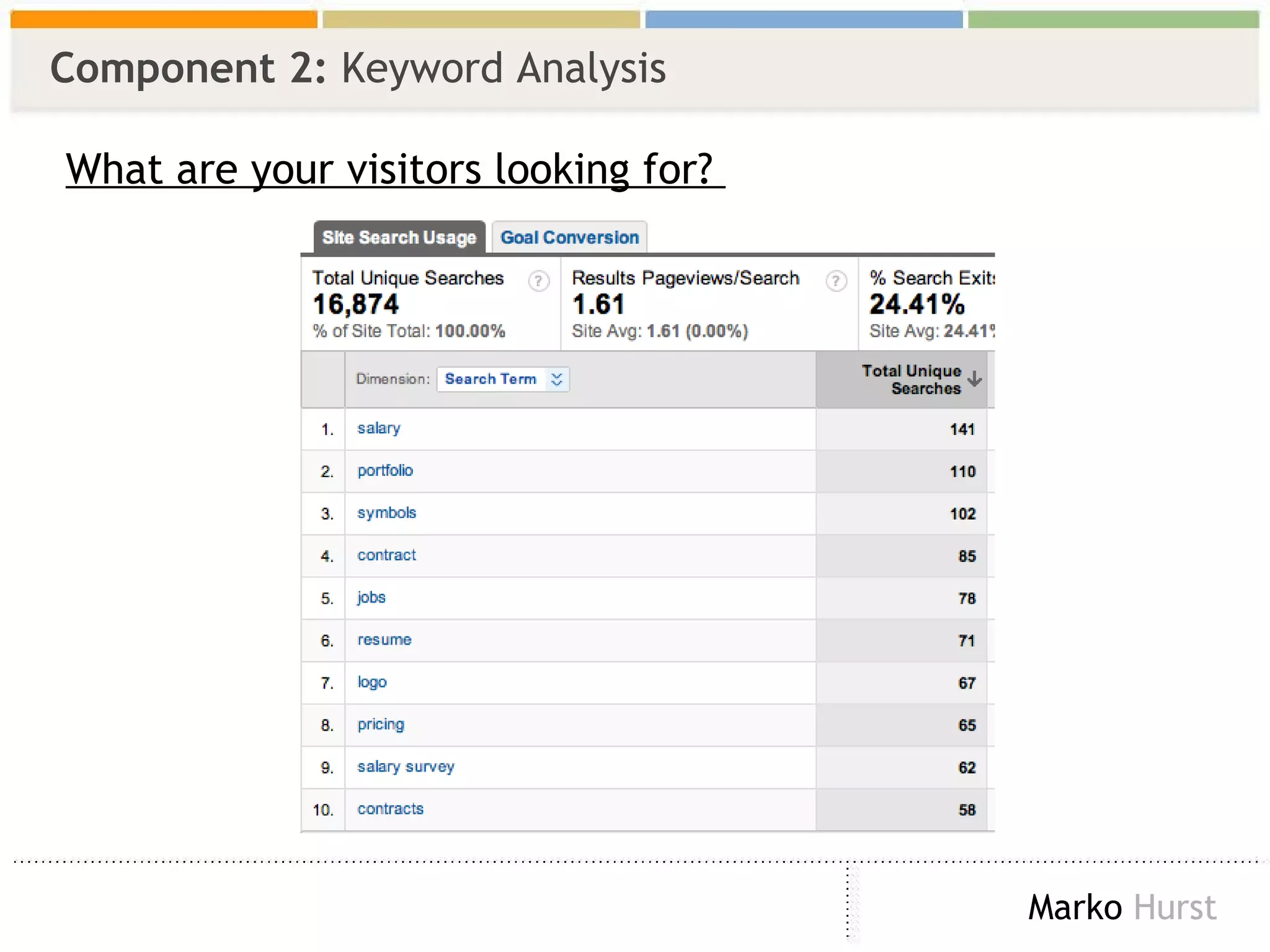
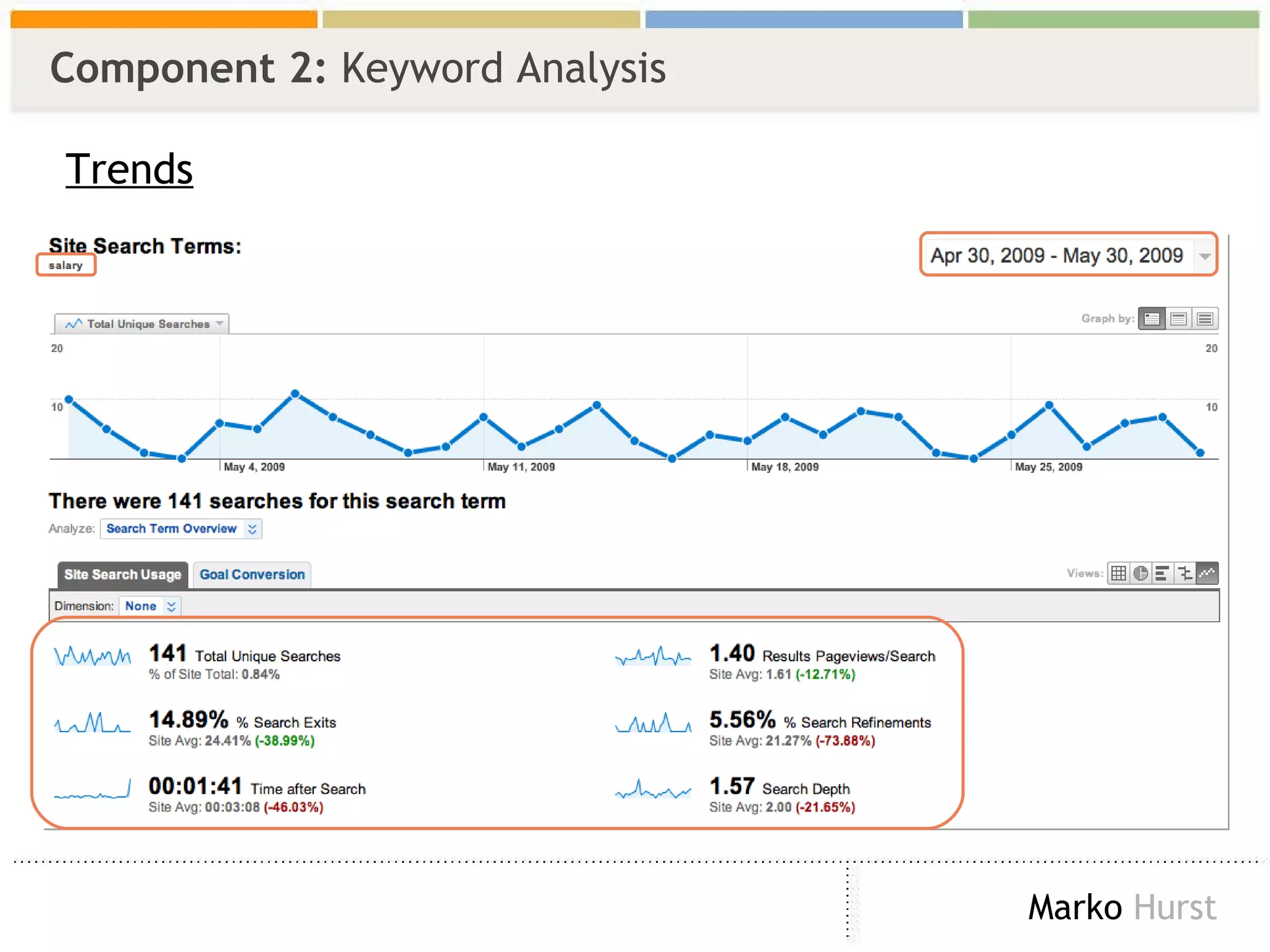
Component 2:  Query (Keywords) When a visitor users search they are speaking to you their  Natural Language , i.e. not yours They are confessing their needs & desires to you hoping you can help them This is your chance to have  “ a conversation ”  don’t waste it! Conversation =  Good . Monolog =  BAD ! Are you speaking the same language, or a foreign language? ?’s How might you apply natural language to your copy, navigation, labels? … taxonomy, ontology, metadata, controlled vocabulary? … SEO & SEM? How could determine your most valuable content?
Component 2:  Keyword Analysis What are your visitors looking for?
Component 2:  Keyword Analysis Trends
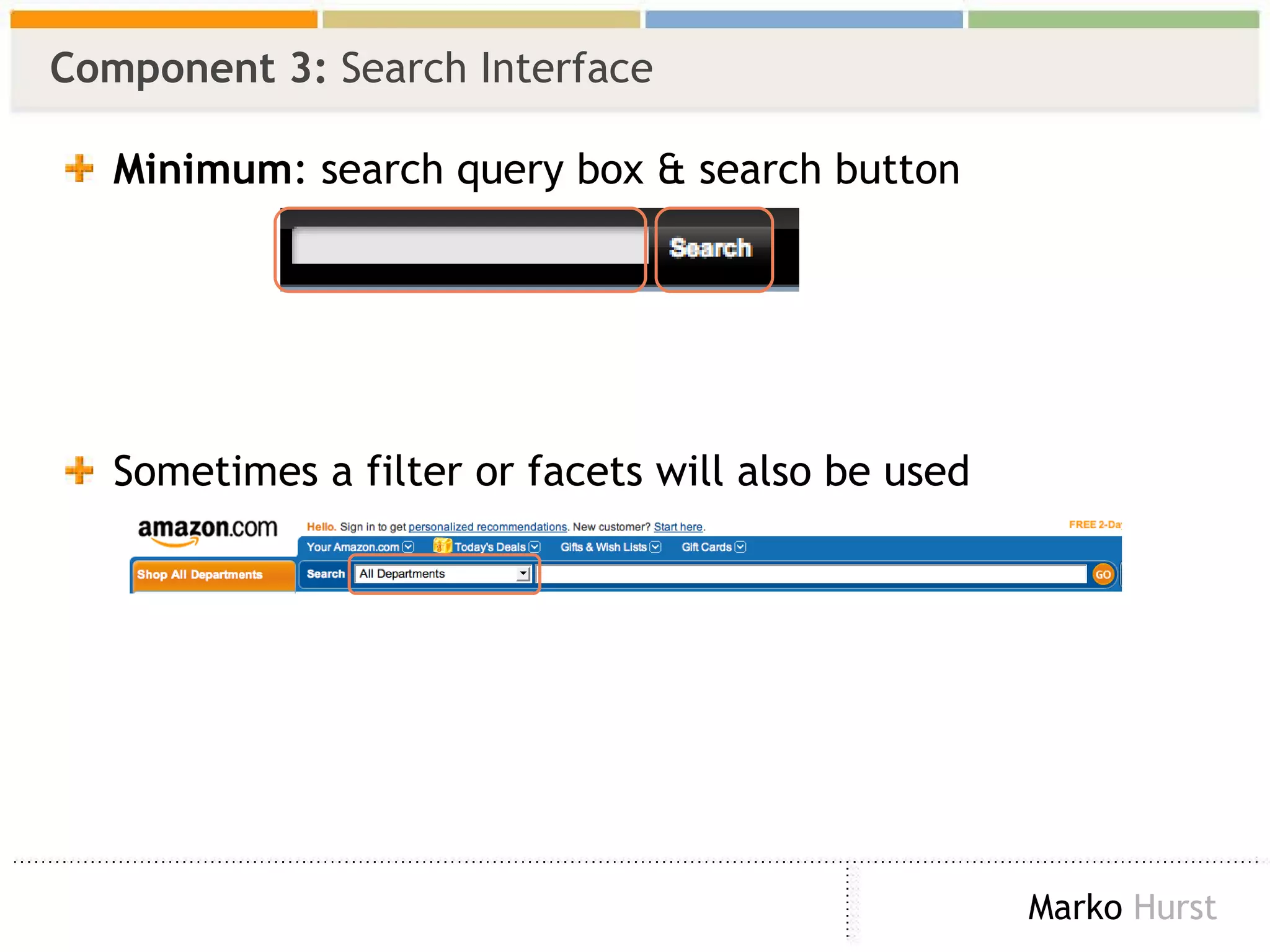
Component 3:  Search Interface Minimum : search query box & search button Sometimes a filter or facets will also be used
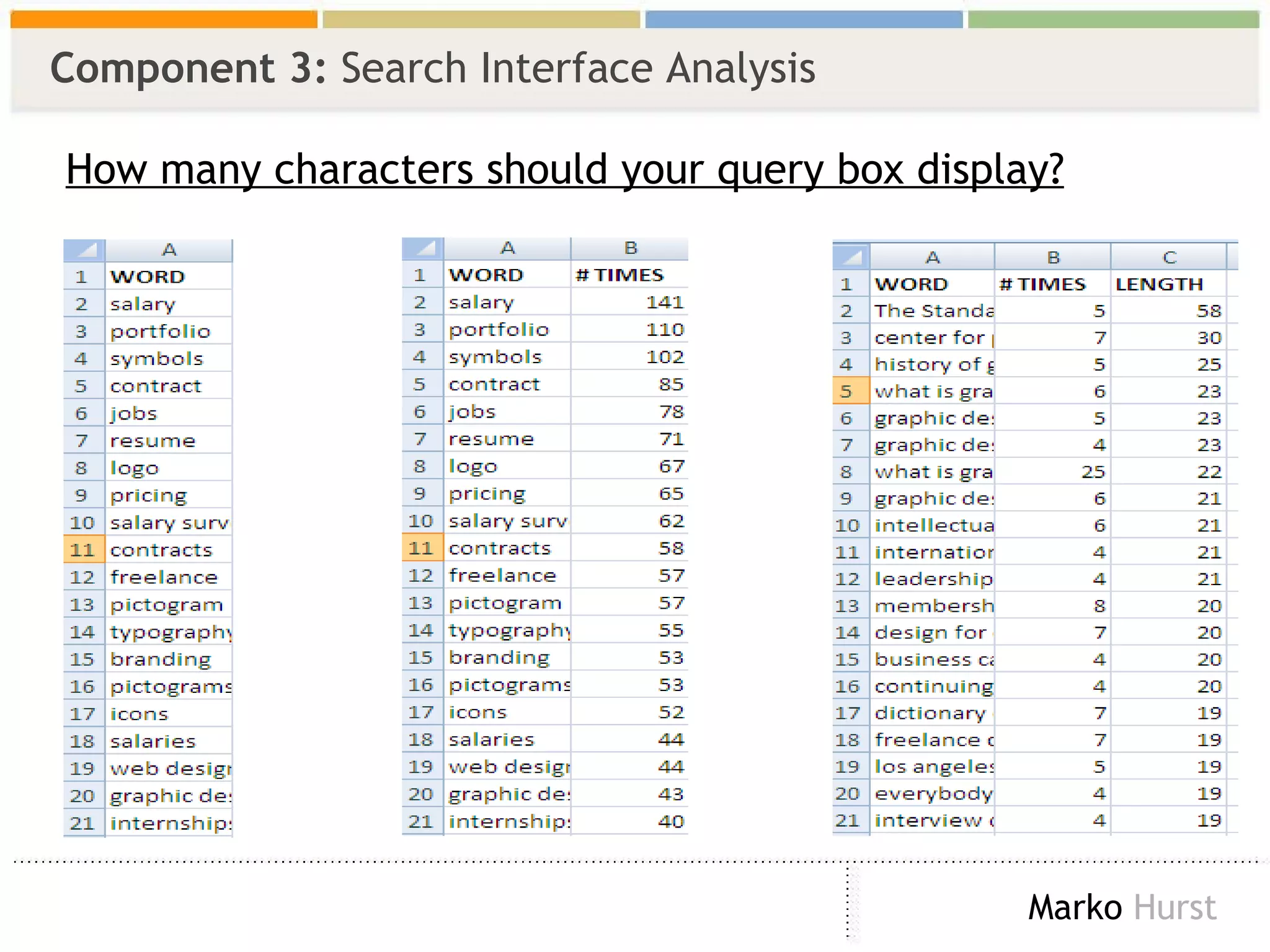
Component 3:  Search Interface Analysis How many characters should your query box display?
Component 4:  Search Engine While the Search Engine is an/the essential component… Opening the ‘black box’ is beyond scope of book & this talk Things to remember…  options and details vary by vendor Common features:  reporting, ranking, best bets, did you mean…, stemming, faceting, weighting, most frequent, clustering, etc.
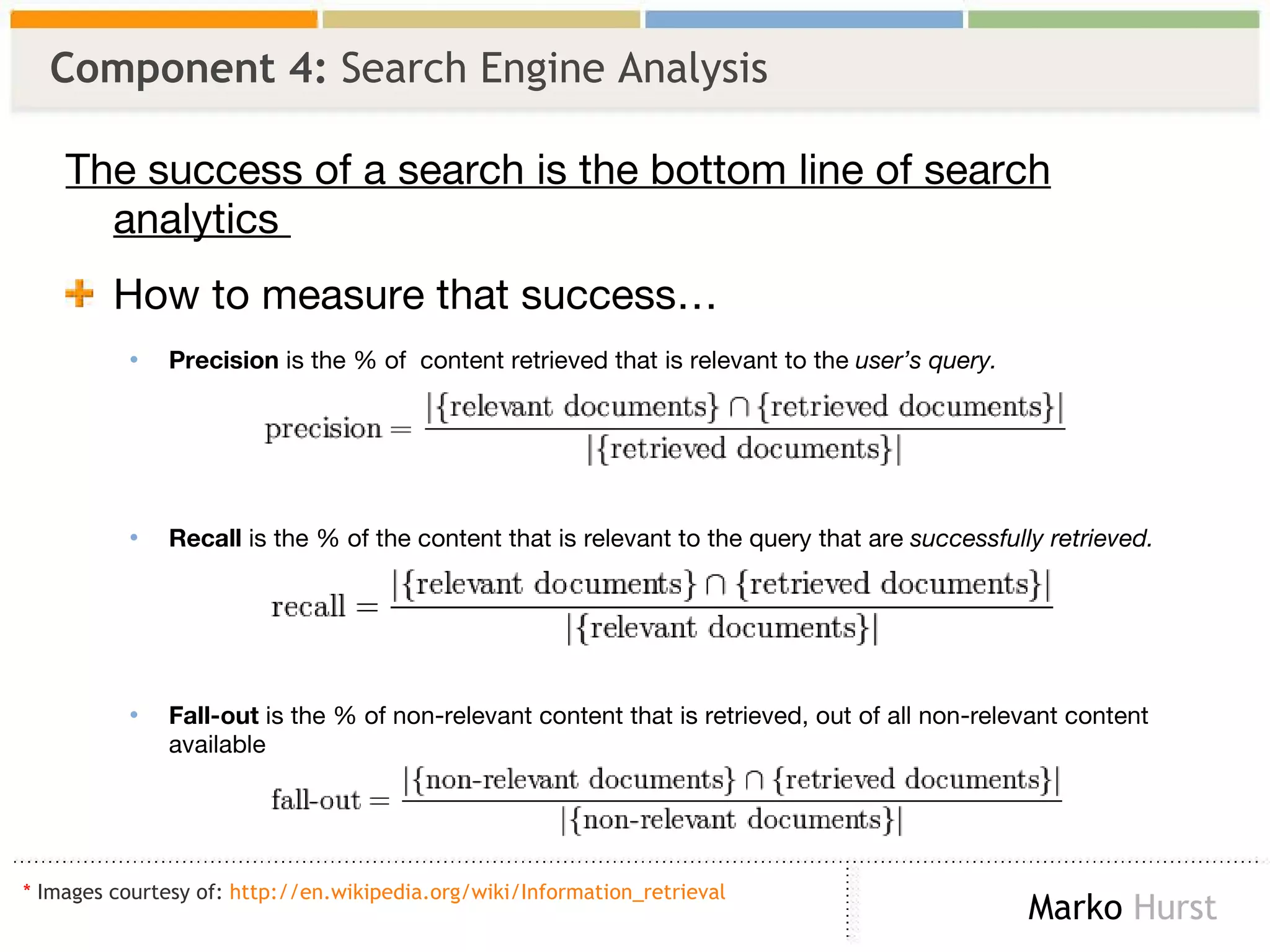
Component 4:  Search Engine Analysis  The success of a search is the bottom line of search analytics  How to measure that success… Precision  is the % of  content retrieved that is relevant to the  user’s query. Recall  is the % of the content that is relevant to the query that are  successfully retrieved. Fall-out  is the % of non-relevant content that is retrieved, out of all non-relevant content available *  Images courtesy of:  http://en.wikipedia.org/wiki/Information_retrieval
Component 5:  Content Search is about getting visitors to relevant content A part of your contents success can be determined by how your visitor’s behave and act with your content ?’s What type of content can you improve via search data? * Someone try and walk us through how this could be done *  Hint - all of it
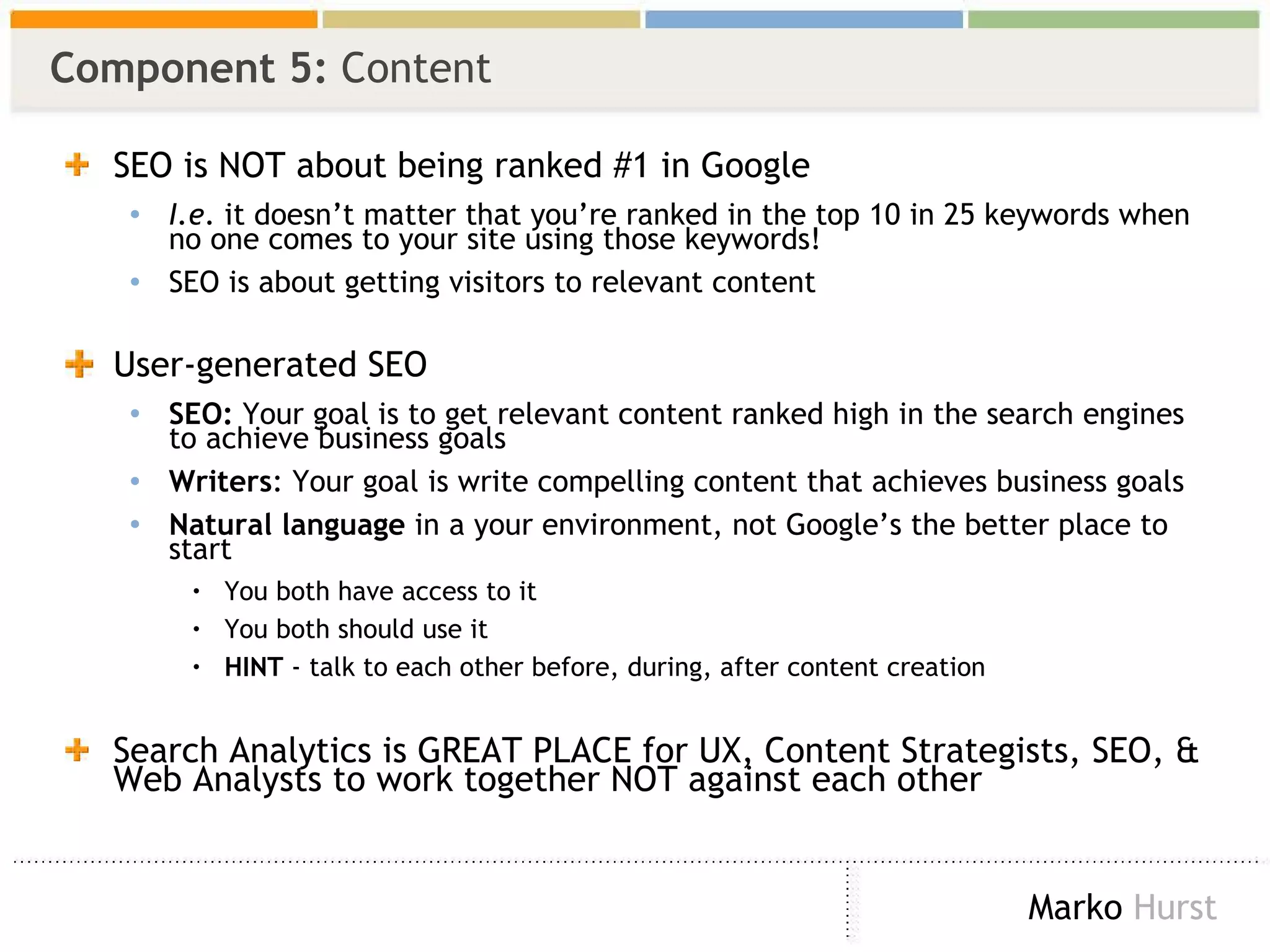
Component 5:  Content SEO is NOT about being ranked #1 in Google I.e . it doesn’t matter that you’re ranked in the top 10 in 25 keywords when no one comes to your site using those keywords! SEO is about getting visitors to relevant content User-generated SEO SEO:  Your goal is to get relevant content ranked high in the search engines to achieve business goals Writers : Your goal is write compelling content that achieves business goals Natural language  in a your environment, not Google’s the better place to start You both have access to it You both should use it HINT  - talk to each other before, during, after content creation Search Analytics is GREAT PLACE for UX, Content Strategists, SEO, & Web Analysts to work together NOT against each other
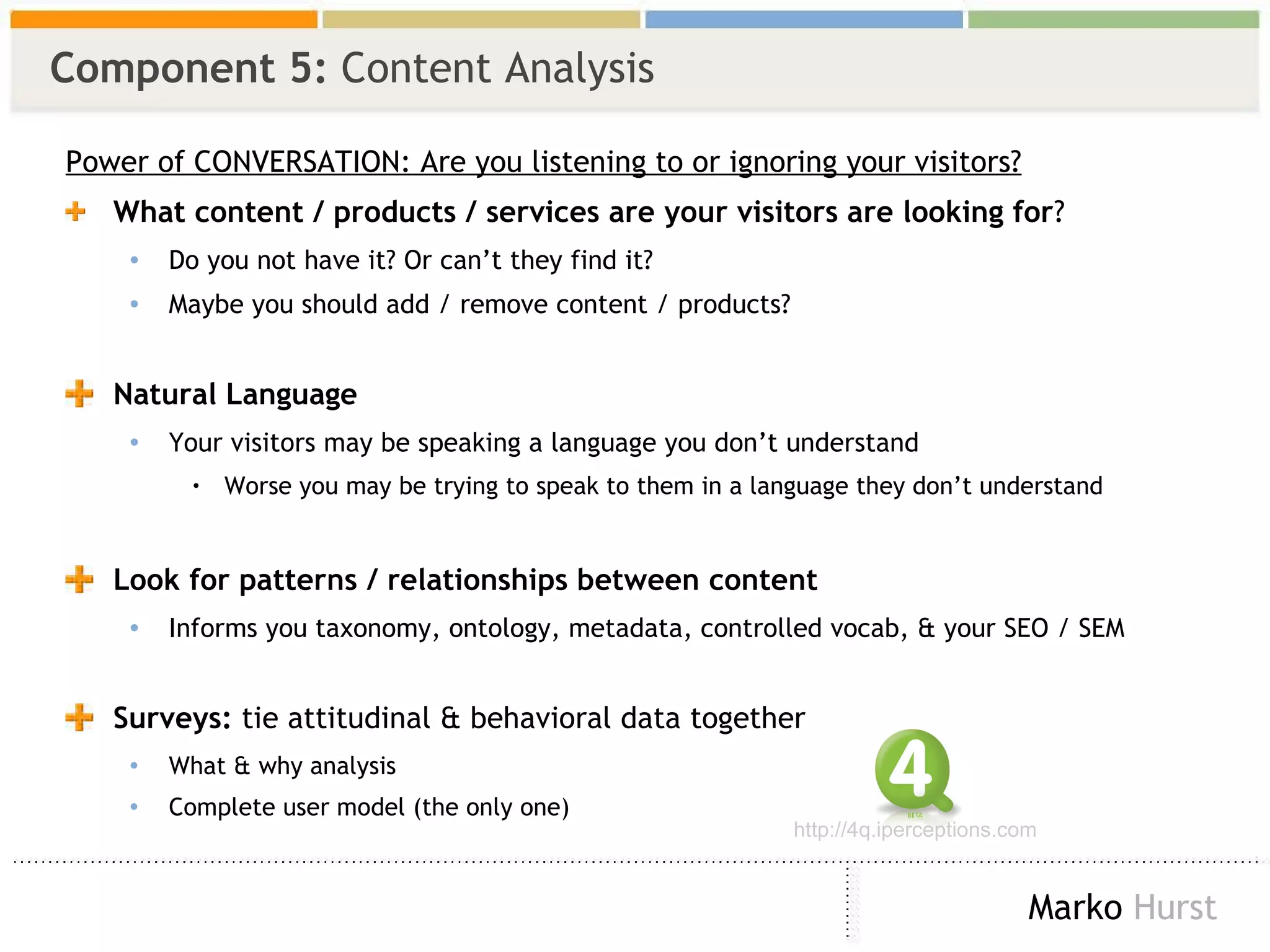
Component 5:  Content Analysis Power of CONVERSATION: Are you listening to or ignoring your visitors? What content / products / services are your visitors are looking for ? Do you not have it? Or can’t they find it? Maybe you should add / remove content / products? Natural Language Your visitors may be speaking a language you don’t understand Worse you may be trying to speak to them in a language they don’t understand  Look for patterns / relationships between content Informs you taxonomy, ontology, metadata, controlled vocab, & your SEO / SEM Surveys:  tie attitudinal & behavioral data together  What & why analysis Complete user model (the only one) http://4q.iperceptions.com
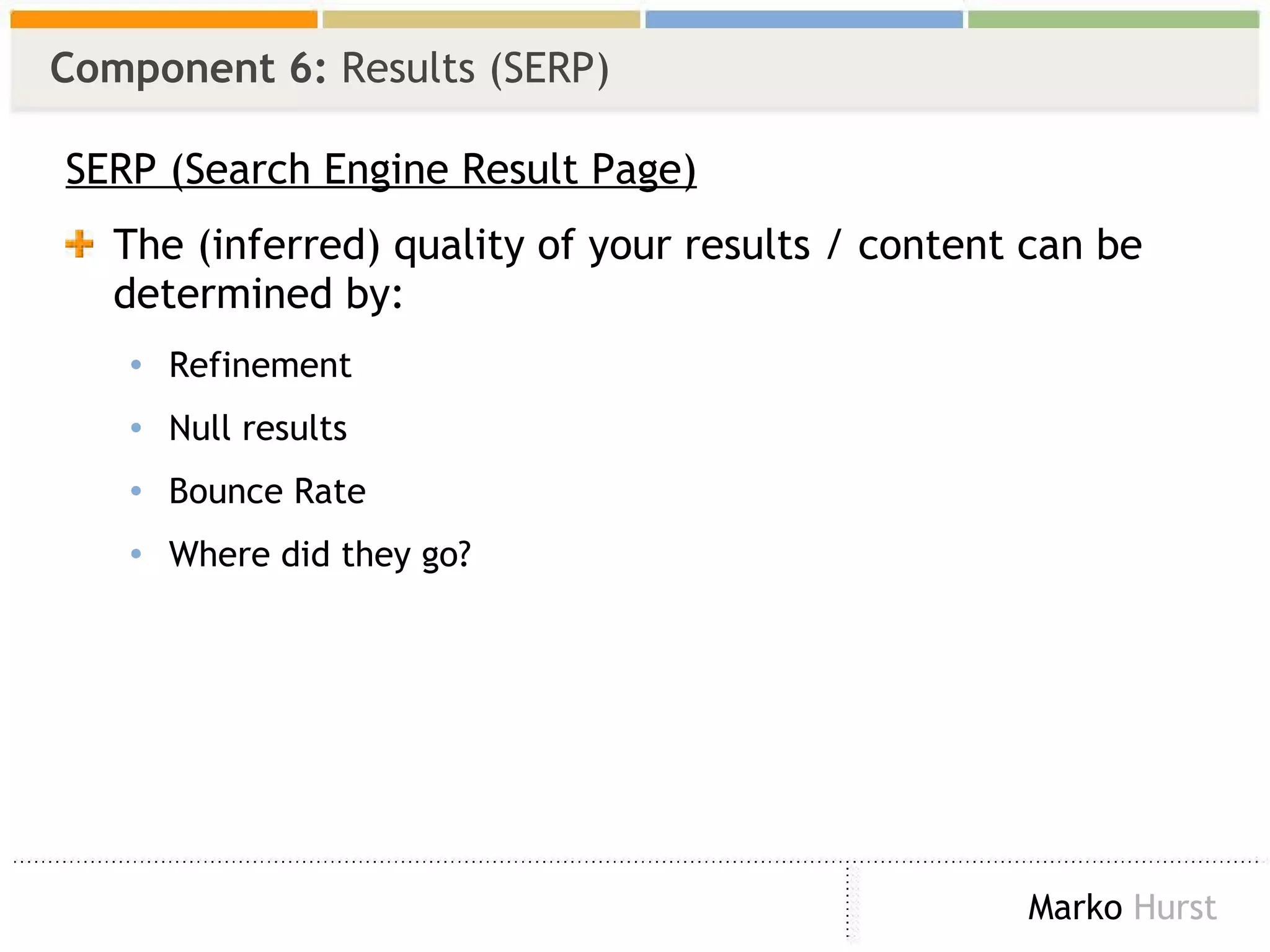
Component 6:  Results (SERP) SERP (Search Engine Result Page) The (inferred) quality of your results / content can be determined by: Refinement Null results Bounce Rate Where did they go?
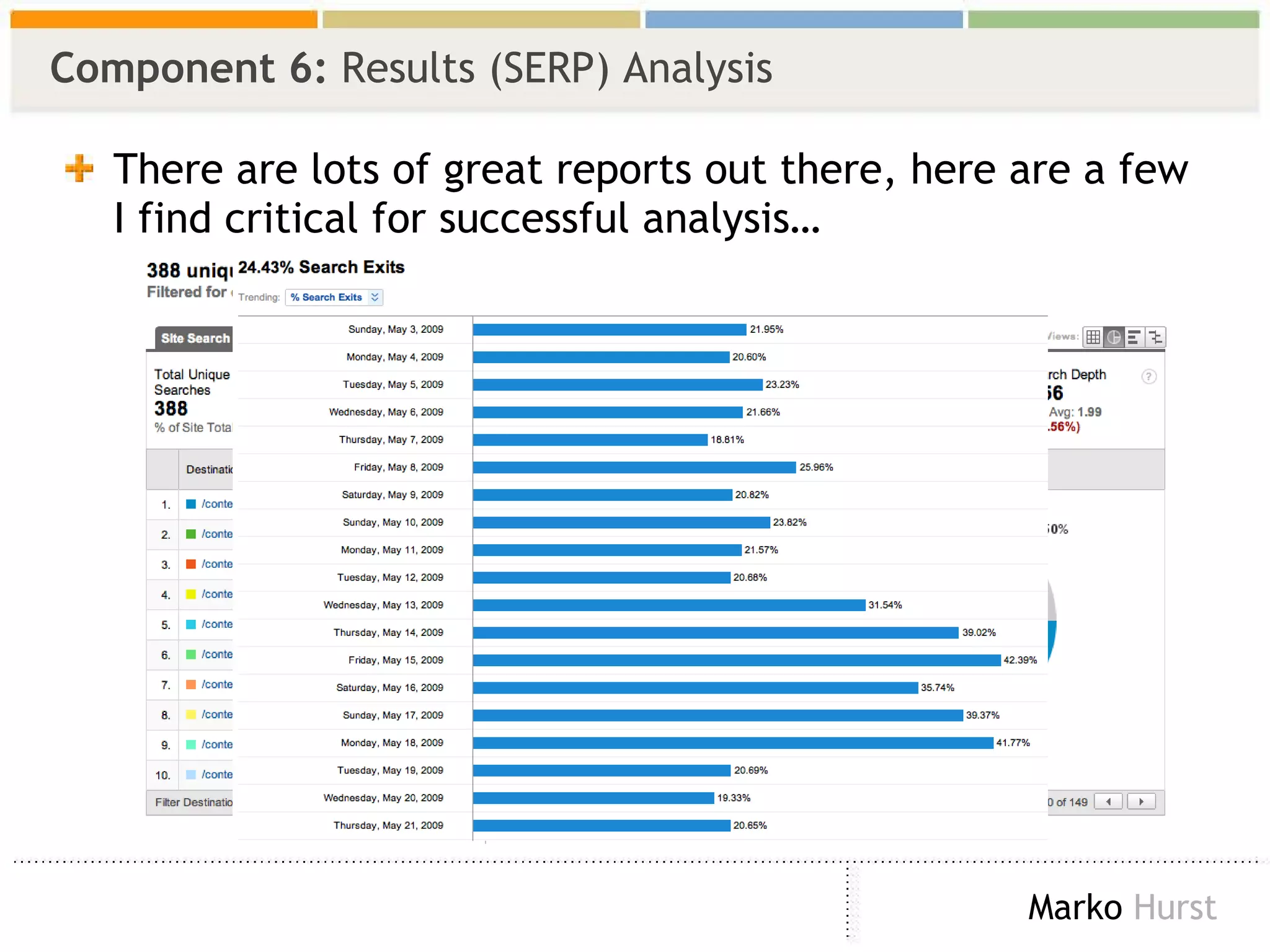
There are lots of great reports out there, here are a few I find critical for successful analysis… Component 6:  Results (SERP) Analysis
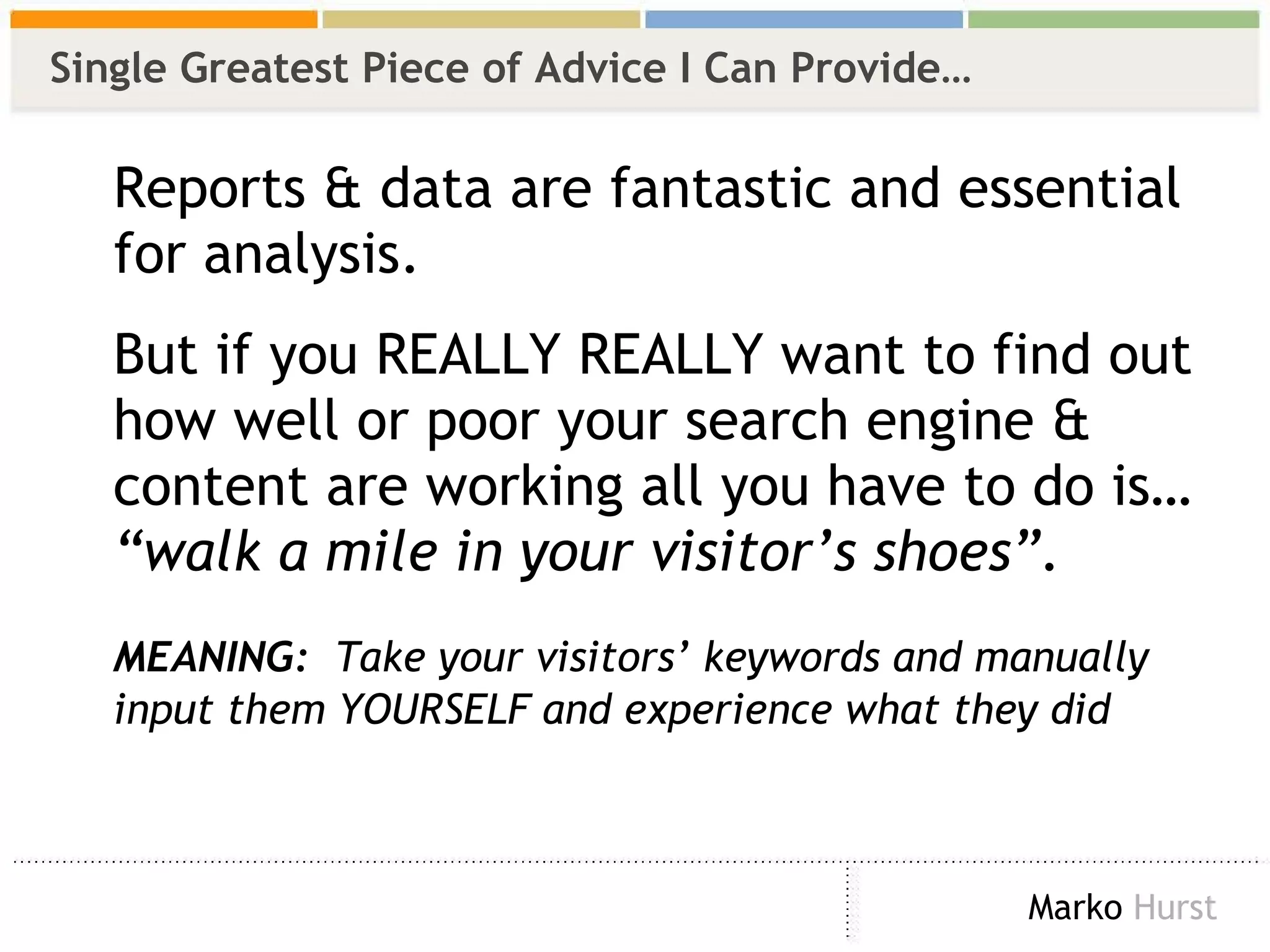
Single Greatest Piece of Advice I Can Provide… Reports & data are fantastic and essential for analysis.  But if you REALLY REALLY want to find out how well or poor your search engine & content are working all you have to do is…  “walk a mile in your visitor’s shoes”. MEANING:   Take your visitors’ keywords and manually input them YOURSELF and experience what they did
Summary Pay attention! Especially you in the back row
Summary All content can be optimized via data Improving search improves your… visitor satisfaction, site usability, SEO, SEM, ROI, design, content, overall user experience, and more Tear down the traditional walls around data & ownership that hold us back Combine qualitative & quantitative (what & why) data for analysis and decision making Provides the only complete user model We actually might work together as a team It’s good for the soul and gives you the warm & fuzzies when your done 6 components to search Visitor Keywords Search interface Search engine Content SERP (results) My book “Search Analytics” will be out in December ’ish
Thank You! Book:  RosenfeldMedia.com/books/SearchAnalytics   Blog:  MarkoHurst.com Contact:  [email_address] Twitter:  MarkoHurst

Search Analytics For Content Strategists @CSofNYC

  • 1.
    Search Analytics Forthe Content Strategist Using Search Data To Improve Your Content Content Strategy NYC Sep. 2009 Keynote: Marko Hurst
  • 2.
    Me Book: Search Analytics - Conversations With Your visitors Anticipated release: December 2009 Book website: RosenfeldMedia.com/books/SearchAnalytics Co-Author: Lou Rosenfeld Consultant, Author, & Speaker Enterprise websites & applications Web & Search Analytics User Experience Machine Learning Principal: MDH Studios Blog: MarkoHurst.com “Insightful Analytics” Twitter: MarkoHurst Contact: [email_address]
  • 3.
    About the bookWho: UX & Web Analytics (WA) communities What: We are bringing UX & WA together by using both qualitative & quantitative data in our decision making process we have created the only complete user model Why: There are better and more efficient ways of doing our work, but tradition and ignorance keep us siloed and working apart. It’s time to change that. It’s time to move the industry forward.
  • 4.
    Before We BeginEstablishing a baseline
  • 5.
    Viva La Revolution!Power To the Content! Content isn’t king, it’s the dictator Doesn’t matter what it is, it’s content… Article FAQ Product / service File (PDF, PPT, XML) Entertainment (game, video, images) Form Image Etc The only real goal online is to get visitors to the content they need / want Flickr Photogrpher : miranda_goode
  • 6.
    Terms & DefinitionsTaxonomy Strict hierarchy of parent / child relationships Ontology Associated relationship between content Metadata Data that describes data/content, including where to find it Controlled Vocabulary Closed list of words used to describe a certain piece of content Classification system Generic categorizing of objects to show their structured order
  • 7.
    SSA Benefits &Expectations SSA * produces actionable insights Techniques used are about analysis, NOT reporting For some, this like reaching Nirvana For others, this is like opening Pandora’s Box To achieve maximum benefits of SSA expect to: Change site design/layout Change content Keywords, copy, metadata, labels, etc. Change information architecture Navigation, taxonomy, ontology, user flows, etc. Add &/or remove pages And much more! * SSA = Site Search Analytics
  • 8.
    Agenda Information Foraging Search Analysis Anatomy of Search SSA & Content Techniques Q&A
  • 9.
    How We FindInformation Information Foraging
  • 10.
    Information Trail Humansforge for information similar to how animals forage for food Move outwards in a direction we think ( predict ) will provide the expected results Continue on a path as long as we ‘smell’ signs that we are still on the correct path ( information scent ) When we no longer smell those signs we retrace our path or find a new path entirely where the ‘smell’ is stronger, which we remember for next time ( recursive learning ) to better predict where/where not to go Flickr Photogrpher : a walk on the wild side
  • 11.
    Information Scent Informationscent is how people evaluate options they encounter looking for information on a site S trong information scents are good at guiding users to the content they want/need W eak information scents cause visitors to spend more time evaluating options and increase the chance that they will select the wrong option and be forced to backtrack or leave entirely Flickr Photogrpher : RaffertyEvans
  • 12.
    How Humans FindContent Online Three ways of finding content Browse Ask Search
  • 13.
  • 14.
  • 15.
  • 16.
  • 17.
    Getting Started: Basics- Overview Business Model Data Log files Search Engine / Web Analytics Analyzing data Data analysis tools Zipf Distribution (long-tail) Excel (spreadsheet) skills Low / no budget software No need for code or higher mathematics NOTE: everything I show you is 100% technology agnostic
  • 18.
    Business Models Yourcontent should be inline dictated by the “site” business goals Four Online Business Models eCommerce Content Advertising Subscription Lead Generation Self Service Most sites fall into at least 2 categories Each model inherently comes with it own set of KPIs
  • 19.
    Where Data ComesFrom: Search Logs (Google Search Appliance) Critical elements in red IP address, time/date stamp, query, and # of results XXX.XXX.XX.130 - - [ 10/Jul/2006:10:24:38 -0800 ] "GET /search? access=p&entqr=0&output=xml_no_dtd&sort=date%3AD%3AL %3Ad1&ud=1&site=AllSites&ie=UTF-8&client=www&oe=UTF-8&proxystyleshe et=www&q= regional+transportation+governance +commission&ip=XXX.XXX.X.130 HTTP/1.1" 200 9718 62 0.17 XXX.XXX.X.104 - - [ 10/Jul/2006:10:25:46 -0800 ] "GET /search? access=p&entqr=0&output=xml_no_dtd&sort=date%3AD%3AL %3Ad1&ud=1&site=AllSites&ie=UTF-8&client=www&oe=UTF-8&proxystyleshe et=www&q= lincense+plate &ip=XXX.XXX.X.104 HTTP/1.1" 200 971 0 0.02 XXX.XXX.X.104 - - [ 10/Jul/2006:10:25:48 -0800 ] "GET /search? access=p&entqr=0&output=xml_no_dtd&sort=date%3AD%3AL %3Ad1&ie=UTF-8&client=www&q= license+plate &ud=1&site=AllSites&spell=1&oe=UTF-8&proxystylesheet=www&ip=XXX.XXX. X.104 HTTP/1.1" 200 8283 146 0.16
  • 20.
    Where Data ComesFrom: Search Engine / Web Analytics Data collection & options vary by vendor Data collection is typically a separate step if you want to combine it with web analytics I.e. Most analytic vendors (page tag model) do NOT have built-in search data capabilities
  • 21.
    Zipf Distribution: TheLong Tail, Power Law, 80/20, etc. 3 characteristics Head Torso Tail Flickr Photogrpher : hjallig
  • 22.
    Improving Your ContentSSA Techniques & Search Behavior
  • 23.
    The Anatomy ofSearch: Search Components Six components of a single search experience Flickr Image : Peter Morville Based on original image from “In Defense of Search” by Peter Morville 1 2 3 4 5 6
  • 24.
    Component 1: Visitor (User) When / Where Do Visitors Search? Most often when a visitor becomes frustrated with browsing (i.e. your content: design, architecture, labeling, etc.) Caution : Some visitors use search as their first / primary method You will need to filter out these types of searchers This behavior also occurs when a visitor ‘knows’ what they are looking for ?’s How could knowing where search was initiated from be useful? What insights could be derived from this? What changes might be made?
  • 25.
    Component 1: Visitor (User) Search Analysis When /where did your visitors initiate search from?
  • 26.
    Component 2: Query (Keywords) When a visitor users search they are speaking to you their Natural Language , i.e. not yours They are confessing their needs & desires to you hoping you can help them This is your chance to have “ a conversation ” don’t waste it! Conversation = Good . Monolog = BAD ! Are you speaking the same language, or a foreign language? ?’s How might you apply natural language to your copy, navigation, labels? … taxonomy, ontology, metadata, controlled vocabulary? … SEO & SEM? How could determine your most valuable content?
  • 27.
    Component 2: Keyword Analysis What are your visitors looking for?
  • 28.
    Component 2: Keyword Analysis Trends
  • 29.
    Component 3: Search Interface Minimum : search query box & search button Sometimes a filter or facets will also be used
  • 30.
    Component 3: Search Interface Analysis How many characters should your query box display?
  • 31.
    Component 4: Search Engine While the Search Engine is an/the essential component… Opening the ‘black box’ is beyond scope of book & this talk Things to remember… options and details vary by vendor Common features: reporting, ranking, best bets, did you mean…, stemming, faceting, weighting, most frequent, clustering, etc.
  • 32.
    Component 4: Search Engine Analysis The success of a search is the bottom line of search analytics How to measure that success… Precision is the % of content retrieved that is relevant to the user’s query. Recall is the % of the content that is relevant to the query that are successfully retrieved. Fall-out is the % of non-relevant content that is retrieved, out of all non-relevant content available * Images courtesy of: http://en.wikipedia.org/wiki/Information_retrieval
  • 33.
    Component 5: Content Search is about getting visitors to relevant content A part of your contents success can be determined by how your visitor’s behave and act with your content ?’s What type of content can you improve via search data? * Someone try and walk us through how this could be done * Hint - all of it
  • 34.
    Component 5: Content SEO is NOT about being ranked #1 in Google I.e . it doesn’t matter that you’re ranked in the top 10 in 25 keywords when no one comes to your site using those keywords! SEO is about getting visitors to relevant content User-generated SEO SEO: Your goal is to get relevant content ranked high in the search engines to achieve business goals Writers : Your goal is write compelling content that achieves business goals Natural language in a your environment, not Google’s the better place to start You both have access to it You both should use it HINT - talk to each other before, during, after content creation Search Analytics is GREAT PLACE for UX, Content Strategists, SEO, & Web Analysts to work together NOT against each other
  • 35.
    Component 5: Content Analysis Power of CONVERSATION: Are you listening to or ignoring your visitors? What content / products / services are your visitors are looking for ? Do you not have it? Or can’t they find it? Maybe you should add / remove content / products? Natural Language Your visitors may be speaking a language you don’t understand Worse you may be trying to speak to them in a language they don’t understand Look for patterns / relationships between content Informs you taxonomy, ontology, metadata, controlled vocab, & your SEO / SEM Surveys: tie attitudinal & behavioral data together What & why analysis Complete user model (the only one) http://4q.iperceptions.com
  • 36.
    Component 6: Results (SERP) SERP (Search Engine Result Page) The (inferred) quality of your results / content can be determined by: Refinement Null results Bounce Rate Where did they go?
  • 37.
    There are lotsof great reports out there, here are a few I find critical for successful analysis… Component 6: Results (SERP) Analysis
  • 38.
    Single Greatest Pieceof Advice I Can Provide… Reports & data are fantastic and essential for analysis. But if you REALLY REALLY want to find out how well or poor your search engine & content are working all you have to do is… “walk a mile in your visitor’s shoes”. MEANING: Take your visitors’ keywords and manually input them YOURSELF and experience what they did
  • 39.
    Summary Pay attention!Especially you in the back row
  • 40.
    Summary All contentcan be optimized via data Improving search improves your… visitor satisfaction, site usability, SEO, SEM, ROI, design, content, overall user experience, and more Tear down the traditional walls around data & ownership that hold us back Combine qualitative & quantitative (what & why) data for analysis and decision making Provides the only complete user model We actually might work together as a team It’s good for the soul and gives you the warm & fuzzies when your done 6 components to search Visitor Keywords Search interface Search engine Content SERP (results) My book “Search Analytics” will be out in December ’ish
  • 41.
    Thank You! Book: RosenfeldMedia.com/books/SearchAnalytics Blog: MarkoHurst.com Contact: [email_address] Twitter: MarkoHurst