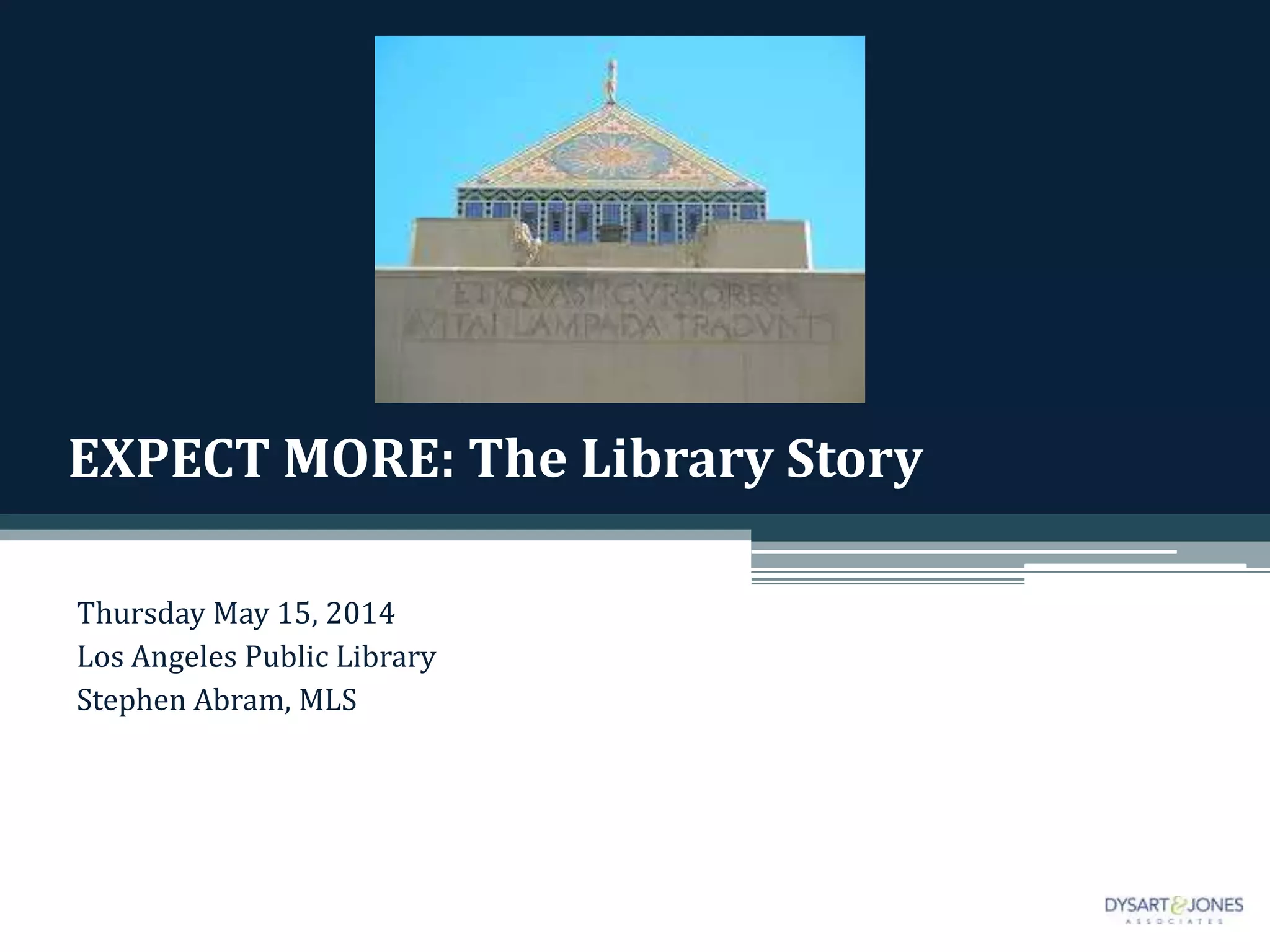








EXPECT MORE: The Library Story
Thursday May 15, 2014
Los Angeles Public Library
Stephen Abram, MLS
Stop the Insanity
Tech is a tool
Tech is an opportunity
Innovation involves risk
The biggest risk is not taking any.
2
3
Stop Having and Engaging in BS Discussions
• Libraries are more relevant than ever
• We have no good reason to be on the defence
• Reading is UP
• E-Books aren’t replacing p-Books - the dynamic is a new hybrid
marketplace
• E-Books have benefits that p-Books don’t
• Librarians are being hired and doing well
• Change is our tradition
• This new normal requires specialized professionals like us.
4
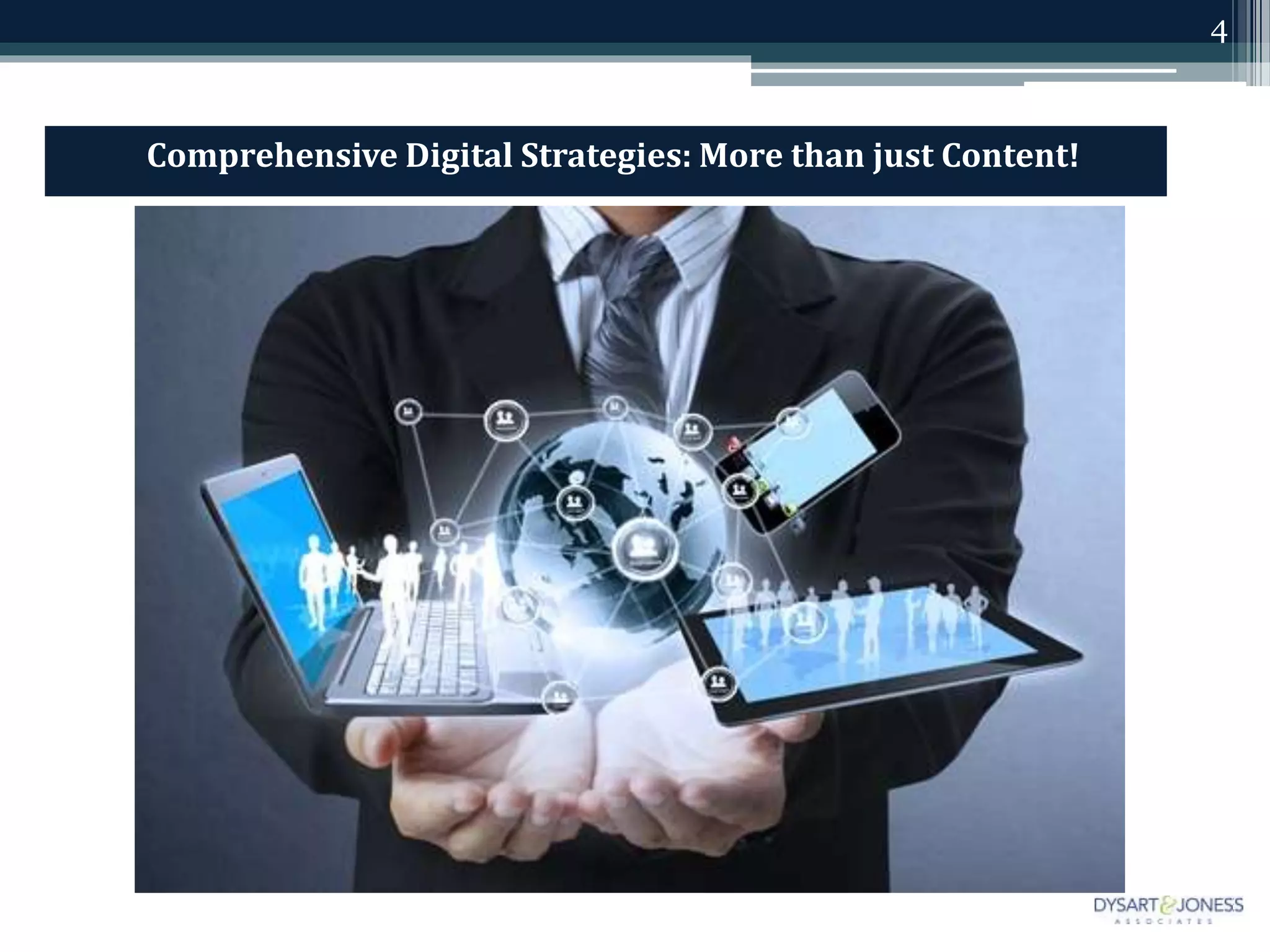
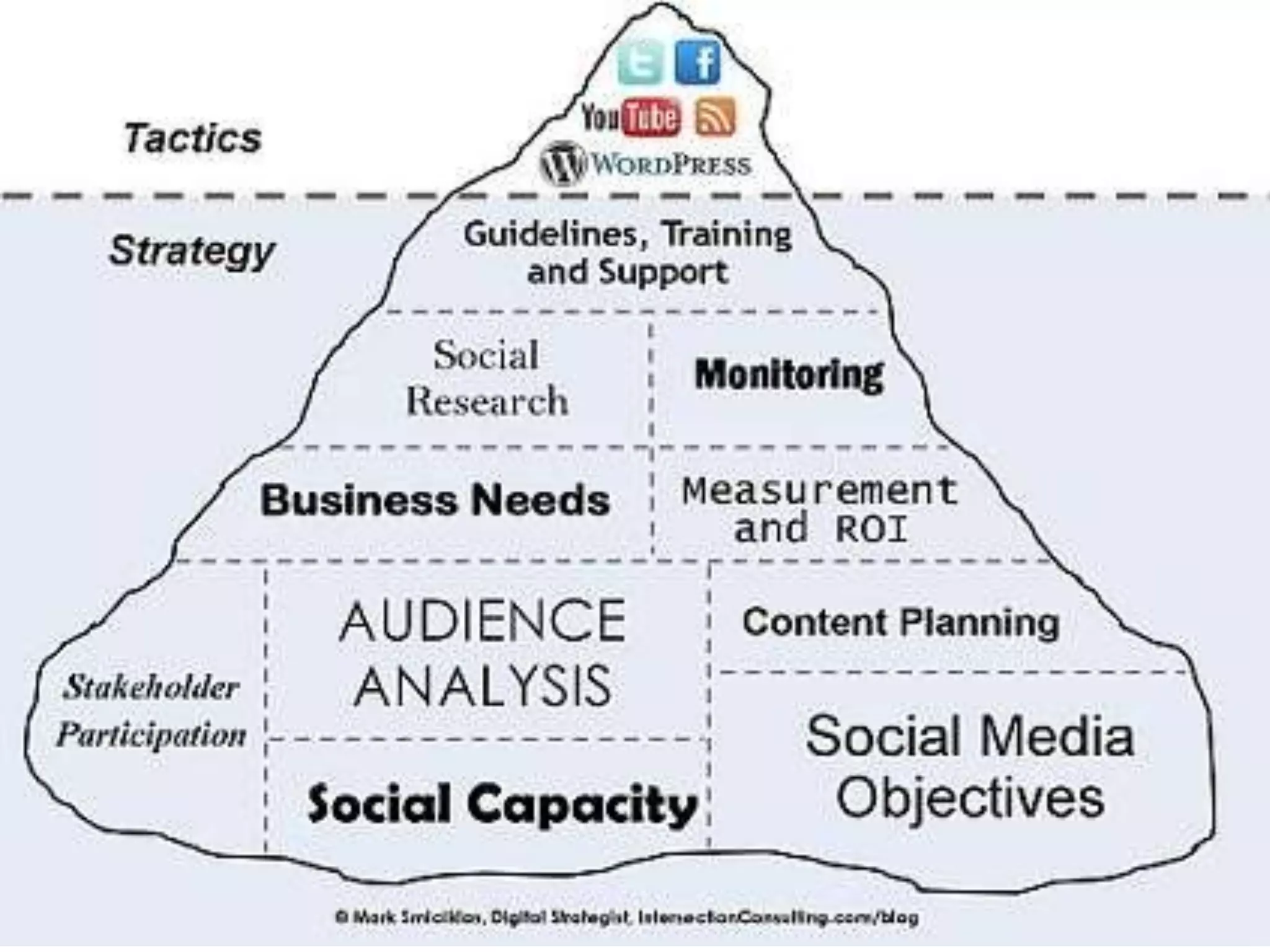
Comprehensive Digital Strategies: More than just Content!
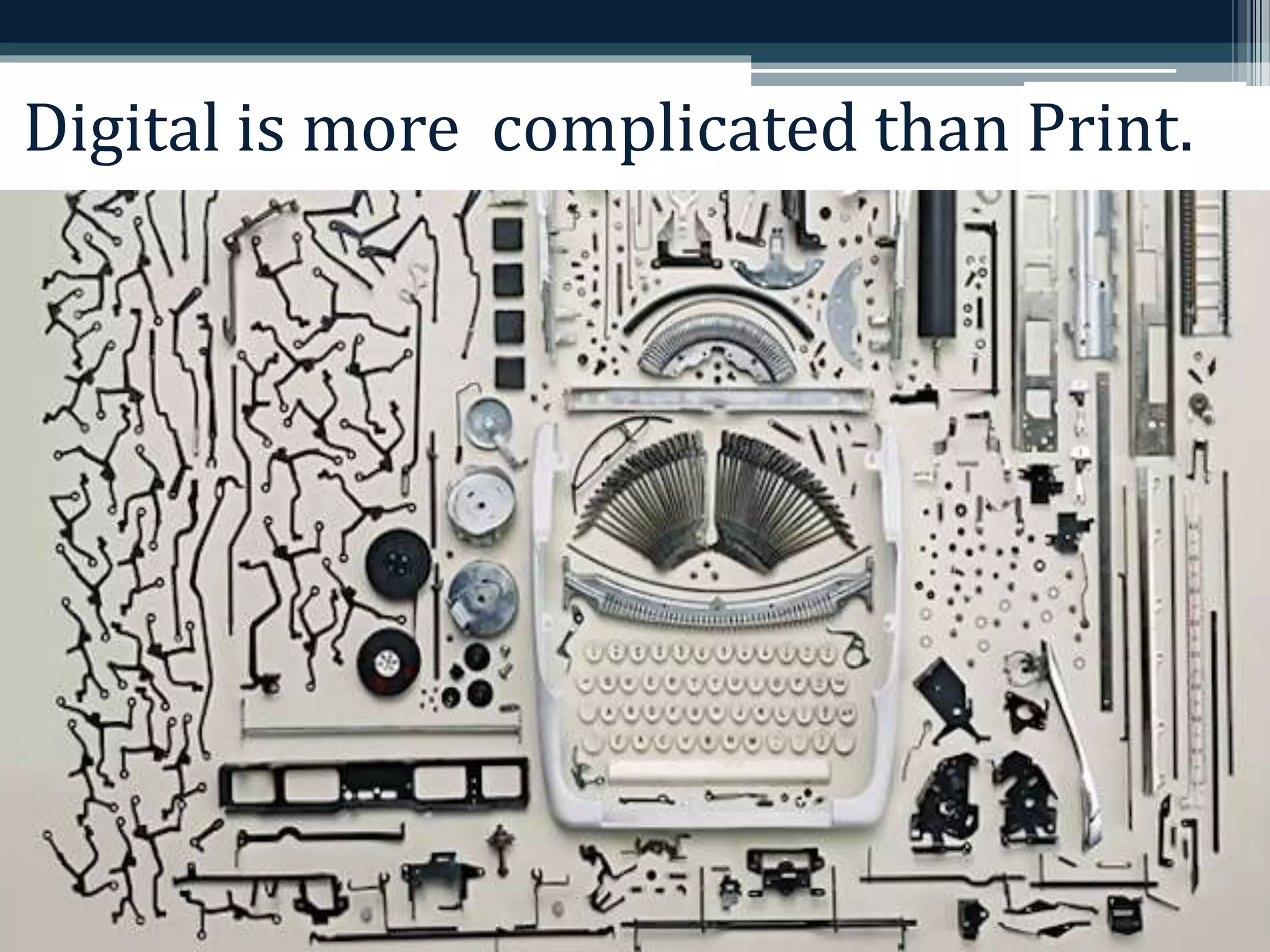
Digital is more complicated than Print.
6
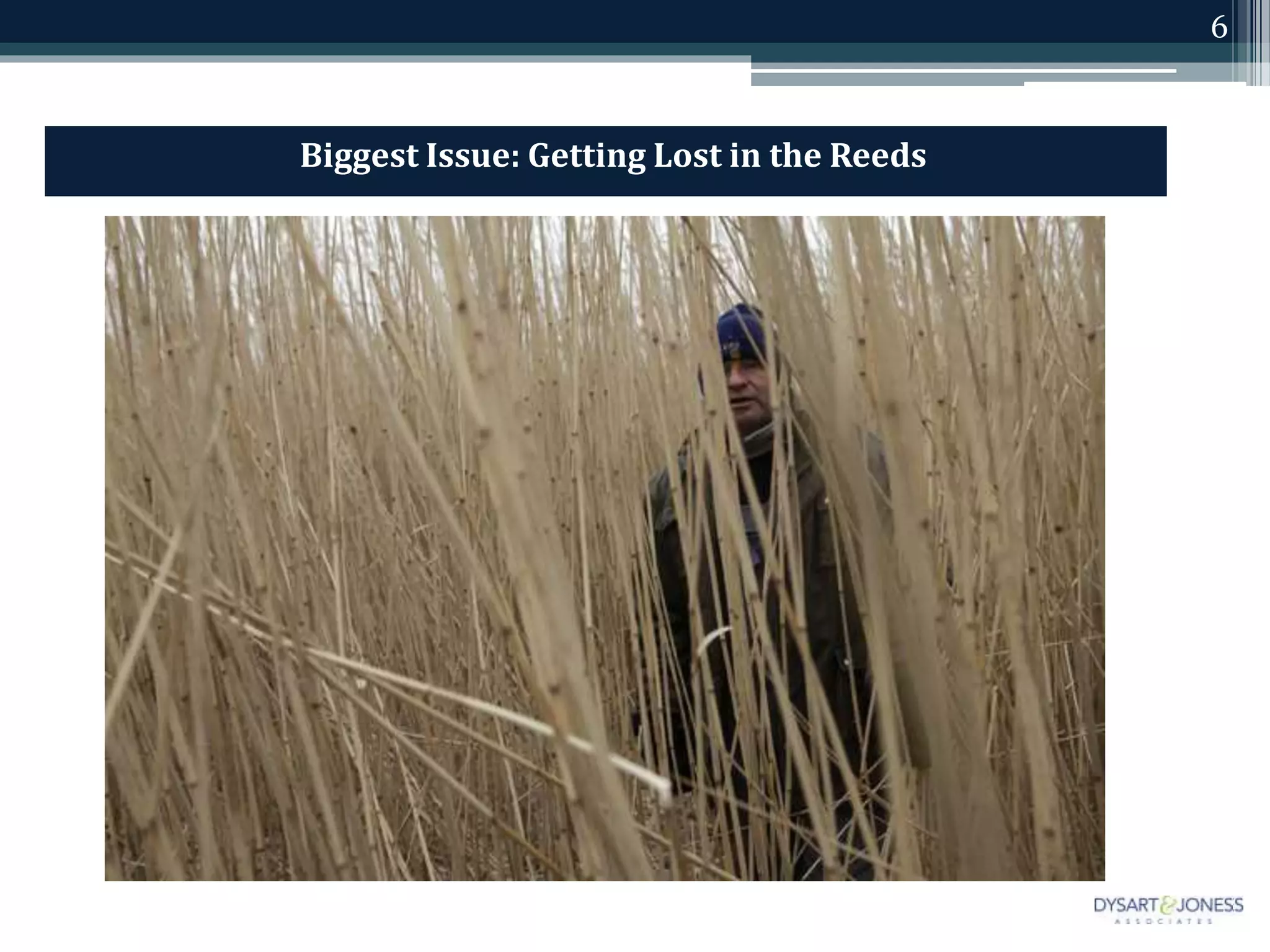
Biggest Issue: Getting Lost in the Reeds
Understand the difference
between Search and Find
• Roy Tennant and I have been saying for years: “Users want to find not
search”.
• Librarians enjoy the challenge of search and try to create mini-
librarians.
• Information literacy is different than contextual information fluency.
•The user experience is mostly “elsewhere”.
• Learning, research and decision-making processes trump search.
Understand the difference between
the roles of discovery services and
native search
• Search is the identification of potential objects to read or view in
either a known item retrieval scenario or – more importantly – an
immersion environment where choices are made.
• Until recently, we handled immersion environments in the context of
defined subsets of content (a single database or small group).
• Discovery services are one step before search – the identification and
discovery of the resources (databases) that are worth searching.
The Field Mapping Failure
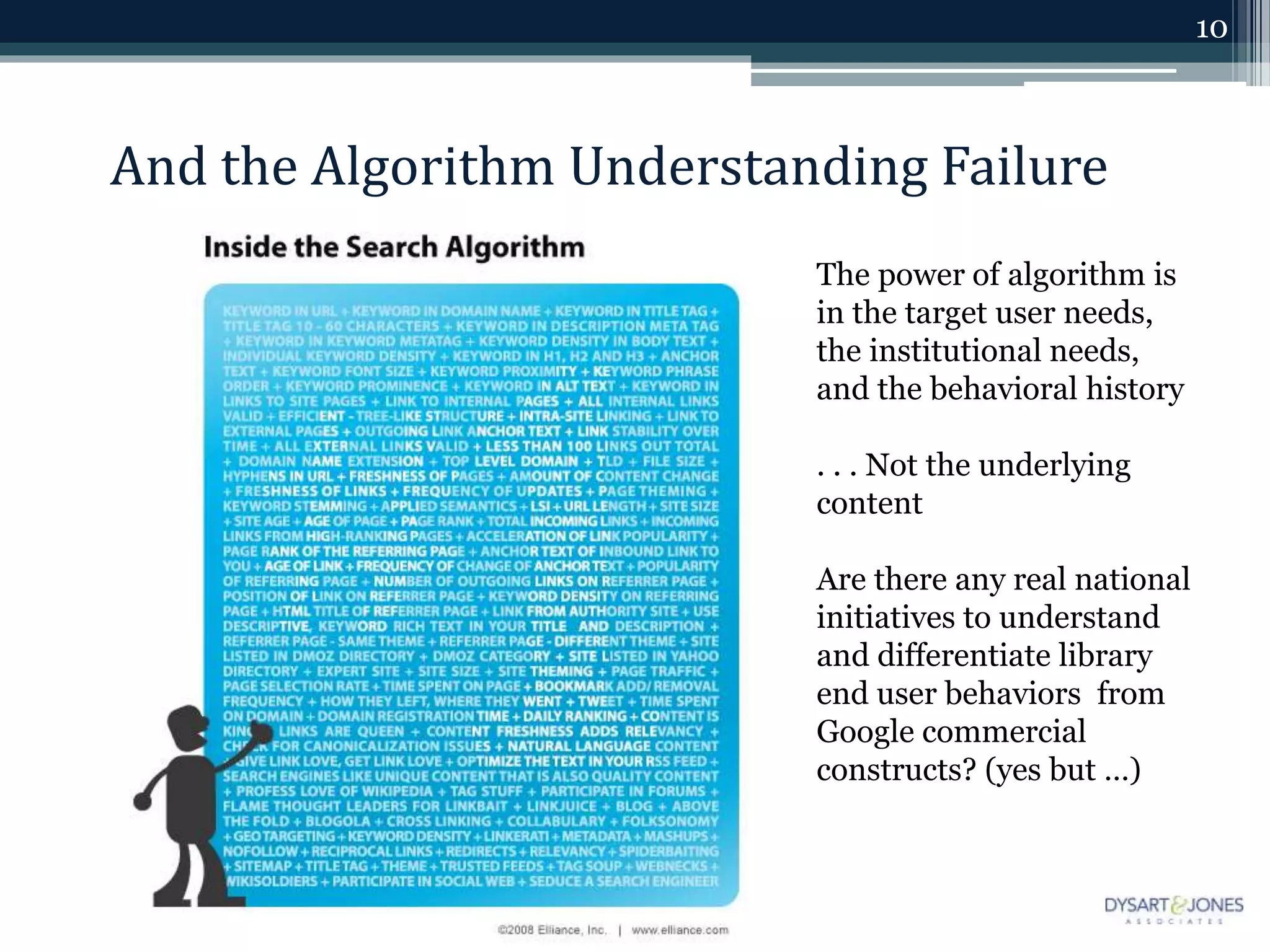
And the Algorithm Understanding Failure
10
The power of algorithm is
in the target user needs,
the institutional needs,
and the behavioral history
. . . Not the underlying
content
Are there any real national
initiatives to understand
and differentiate library
end user behaviors from
Google commercial
constructs? (yes but …)
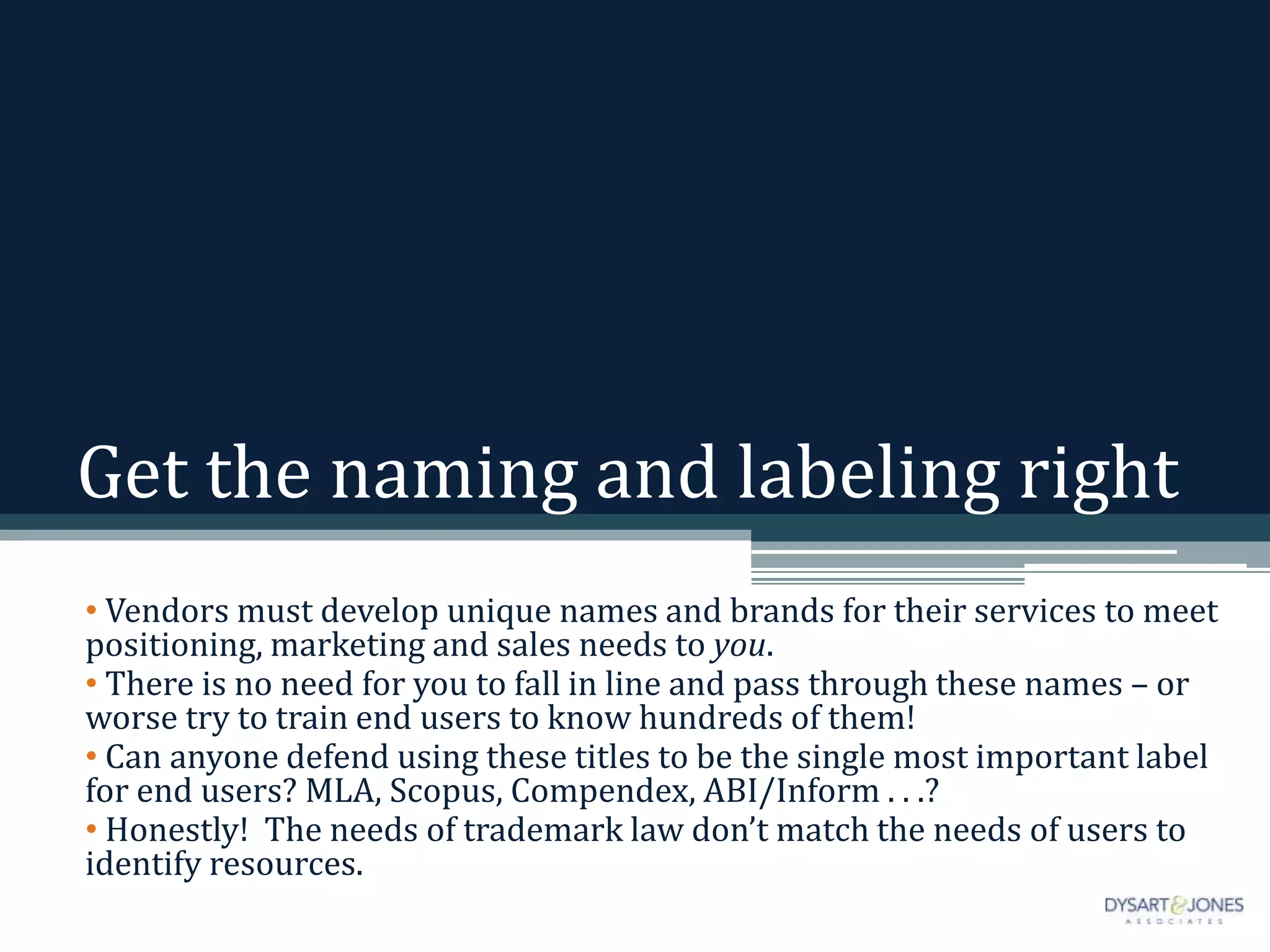
Get the naming and labeling right
• Vendors must develop unique names and brands for their services to meet
positioning, marketing and sales needs to you.
• There is no need for you to fall in line and pass through these names – or
worse try to train end users to know hundreds of them!
• Can anyone defend using these titles to be the single most important label
for end users? MLA, Scopus, Compendex, ABI/Inform . . .?
• Honestly! The needs of trademark law don’t match the needs of users to
identify resources.
Are you using numbers strategically?
• Statistics versus measurements
• Satisfaction and Impact
• Visual versus data
• Stories build on data springboards
• Are your numbers showing customer satisfaction or just
activity?
• Do you trust your numbers (It’s easy to mess with an
interface and increase hits or whatever statistics you’re
using.)
• How can the vendor help your numbers issues and insights?
13
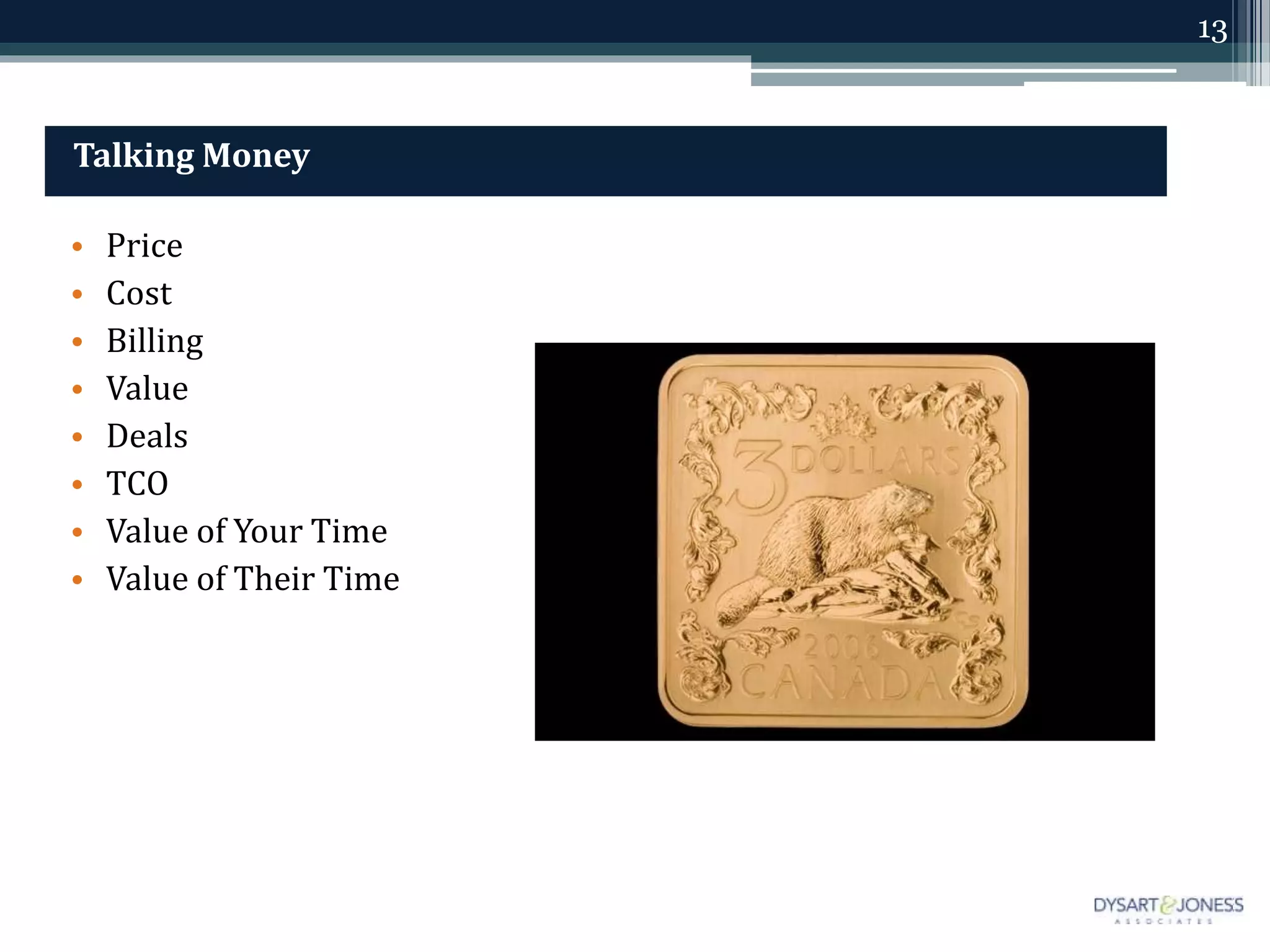
Talking Money
• Price
• Cost
• Billing
• Value
• Deals
• TCO
• Value of Your Time
• Value of Their Time
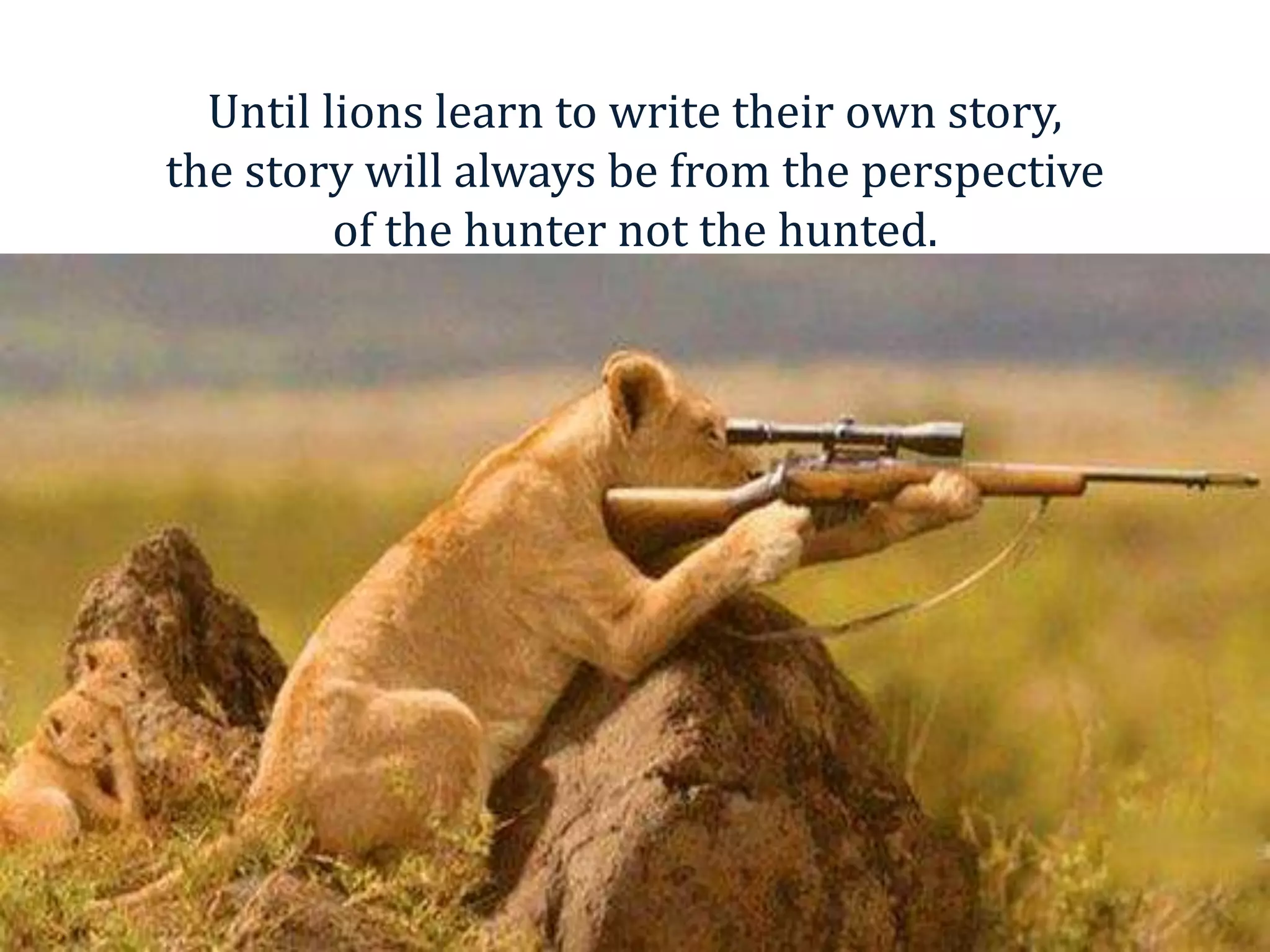
Until lions learn to write their own story,
the story will always be from the perspective
of the hunter not the hunted.
15
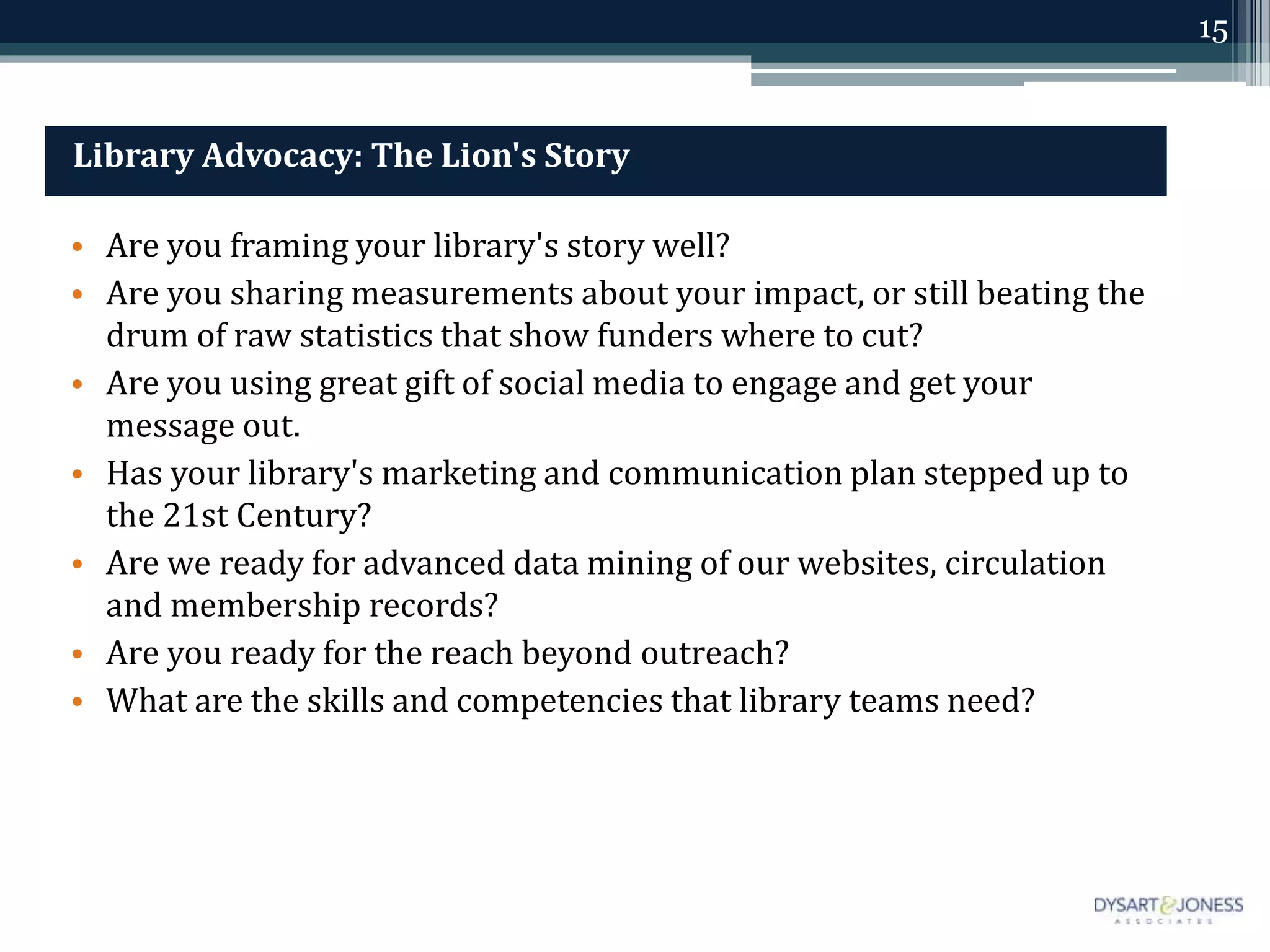
Library Advocacy: The Lion's Story
• Are you framing your library's story well?
• Are you sharing measurements about your impact, or still beating the
drum of raw statistics that show funders where to cut?
• Are you using great gift of social media to engage and get your
message out.
• Has your library's marketing and communication plan stepped up to
the 21st Century?
• Are we ready for advanced data mining of our websites, circulation
and membership records?
• Are you ready for the reach beyond outreach?
• What are the skills and competencies that library teams need?
First . . .
Let’s stop using the word advocacy
Let’s discuss influence and being
influential . . .
Second . . .
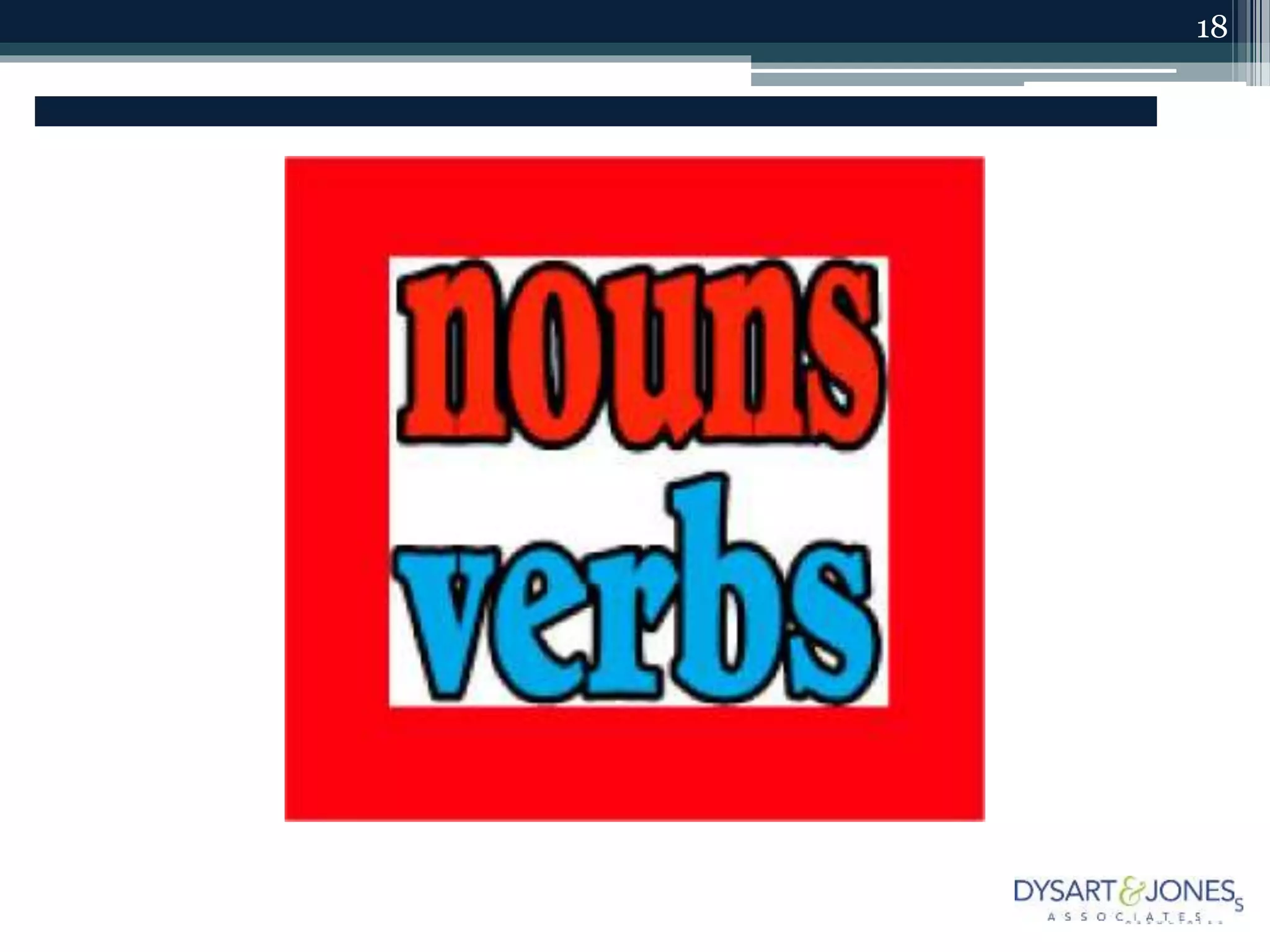
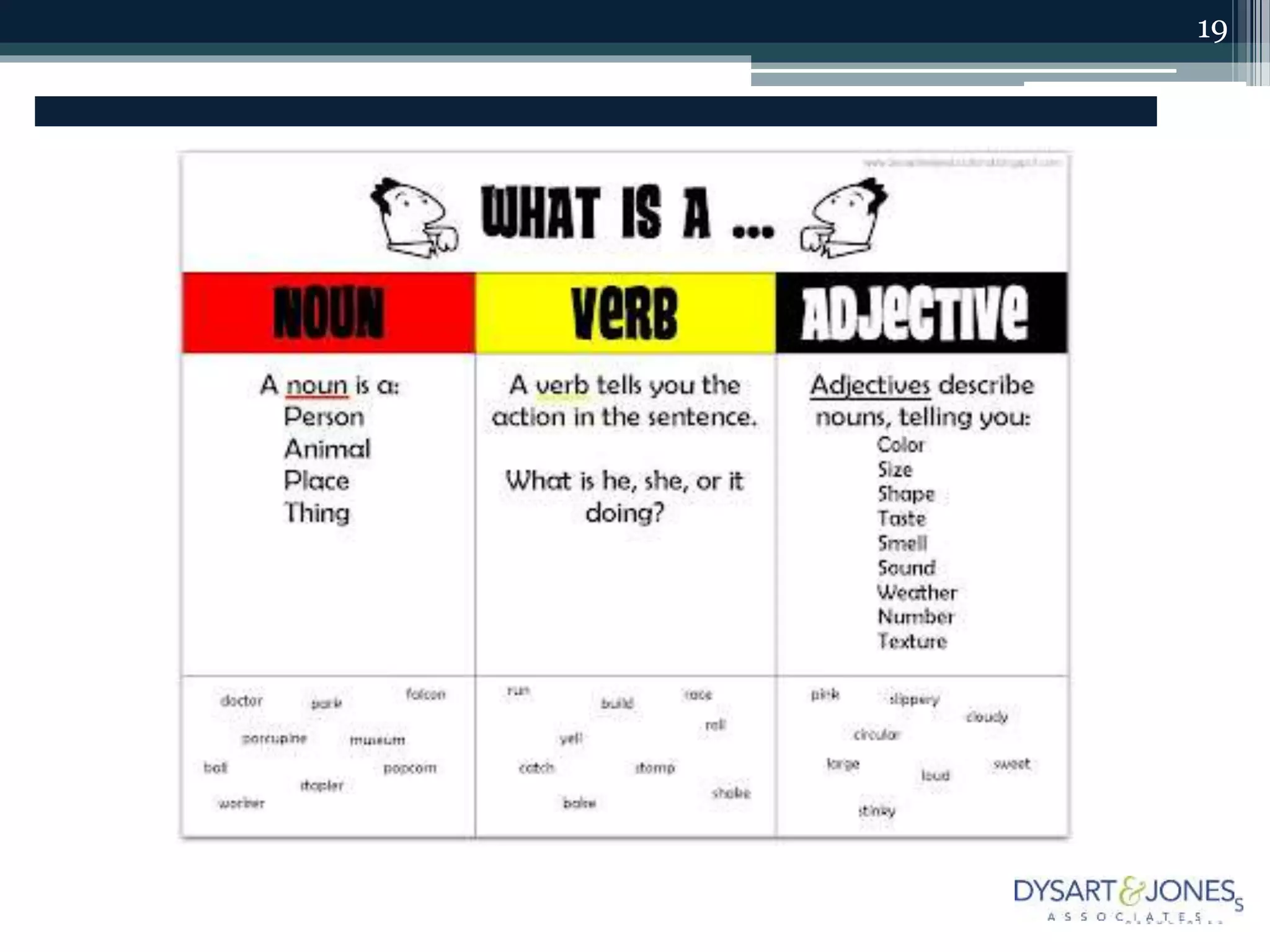
Let’s start using verbs to describe
ourselves in the context(s) of our
members, audiences and
communities.
17
18
19
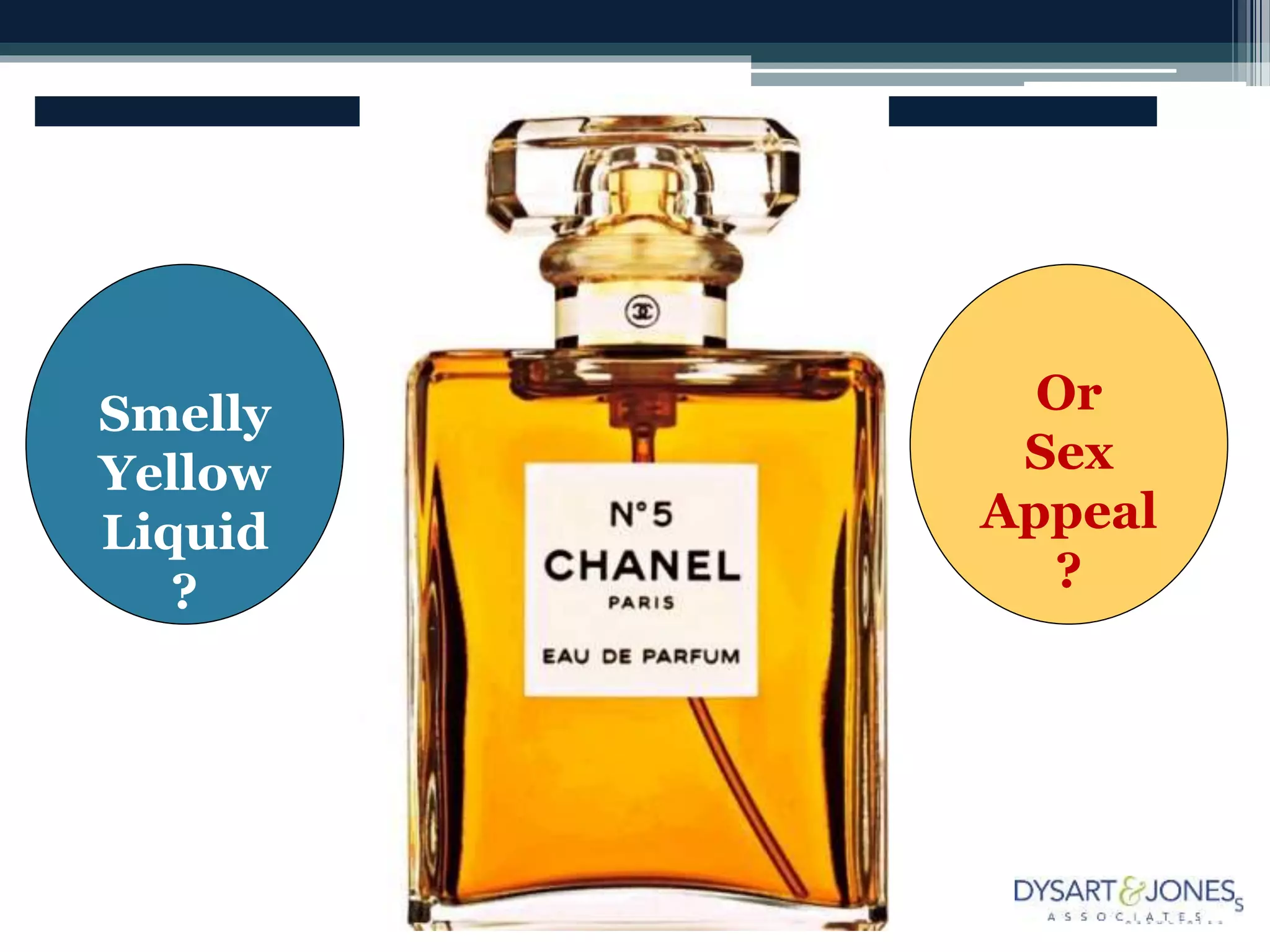
Smelly
Yellow
Liquid
?
Or
Sex
Appeal
?
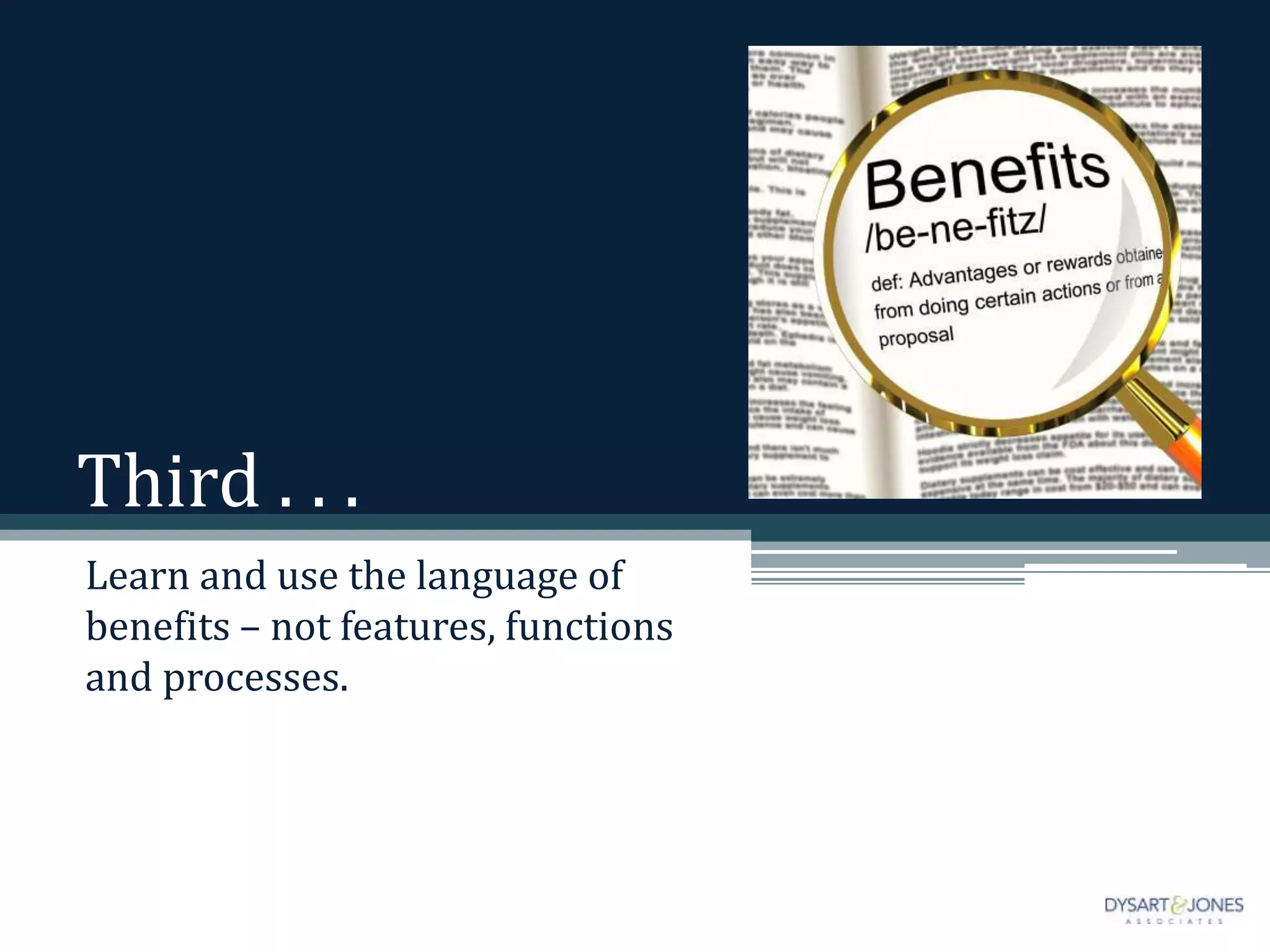
Third . . .
Learn and use the language of
benefits – not features, functions
and processes.
Fourth . . .
Let’s build on our legacy of trust
and respect and our foundation of
collections and places to shine
23
Foundations
24
House
25
Home
Fifth . . .
Let’s emphasize the humans that
make the magic happen . . . Library
staff
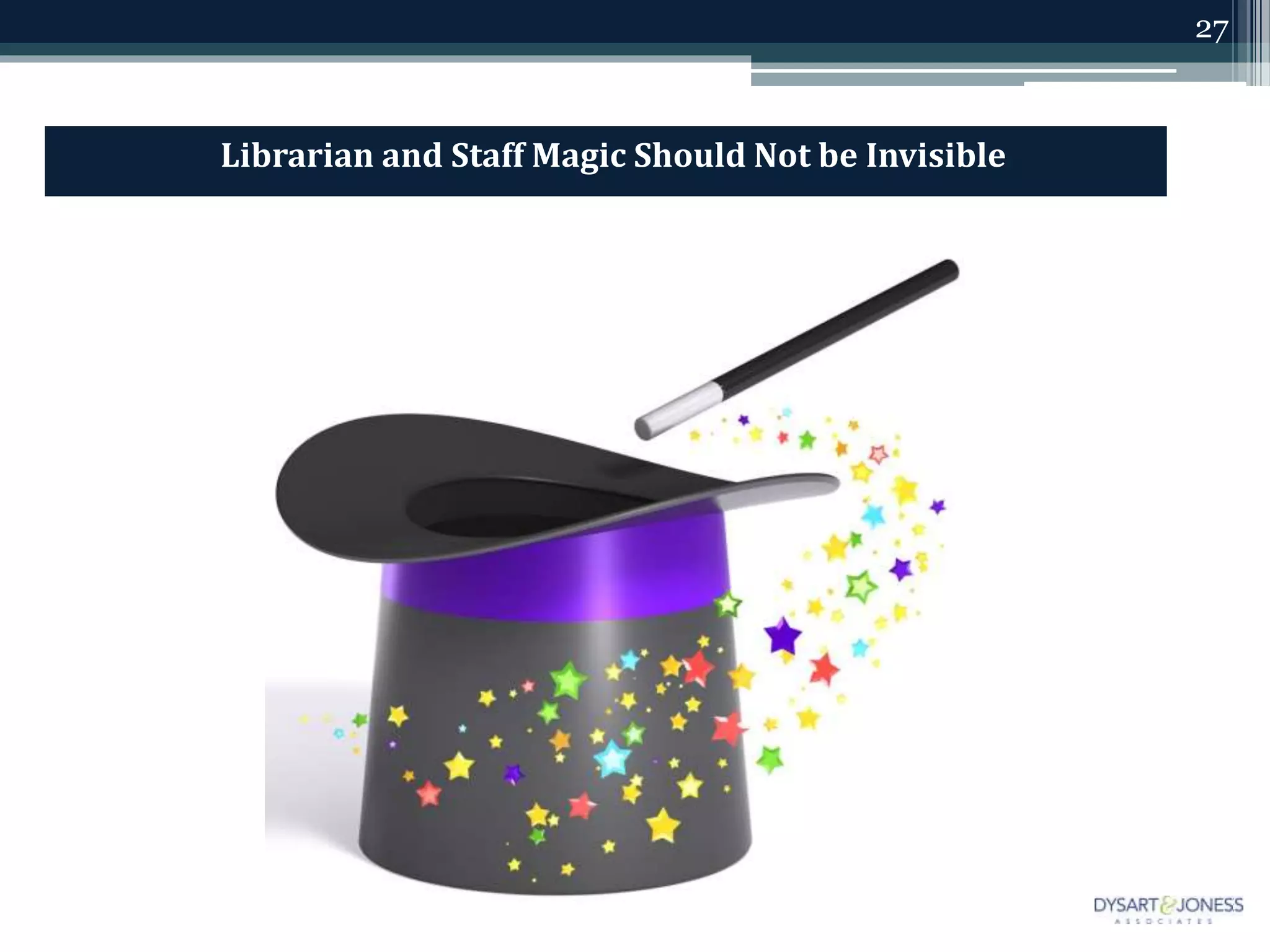
27
Librarian and Staff Magic Should Not be Invisible
Grocery Stores
Grocery Stores
Grocery Stores
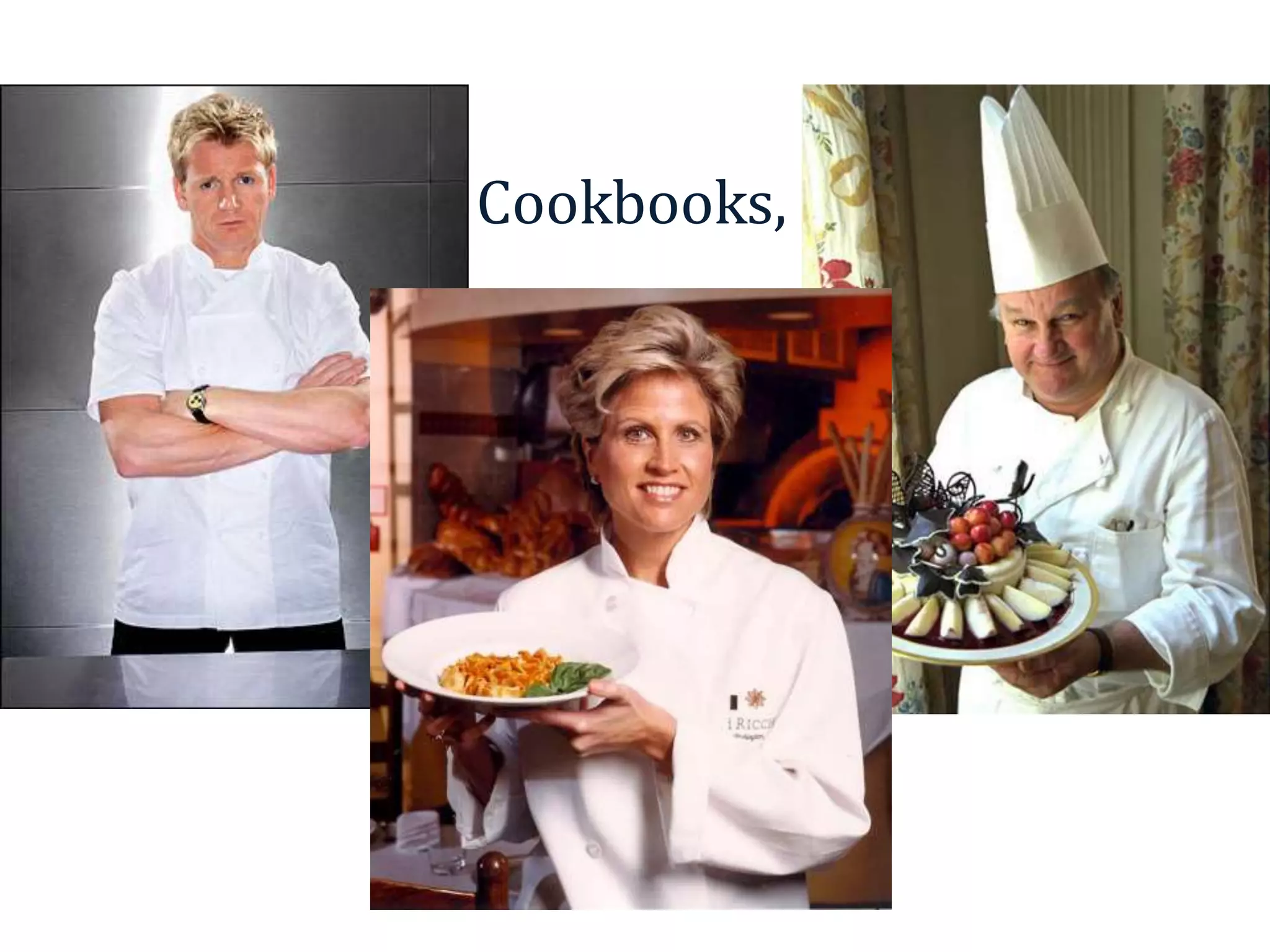
Cookbooks, Chefs . . .
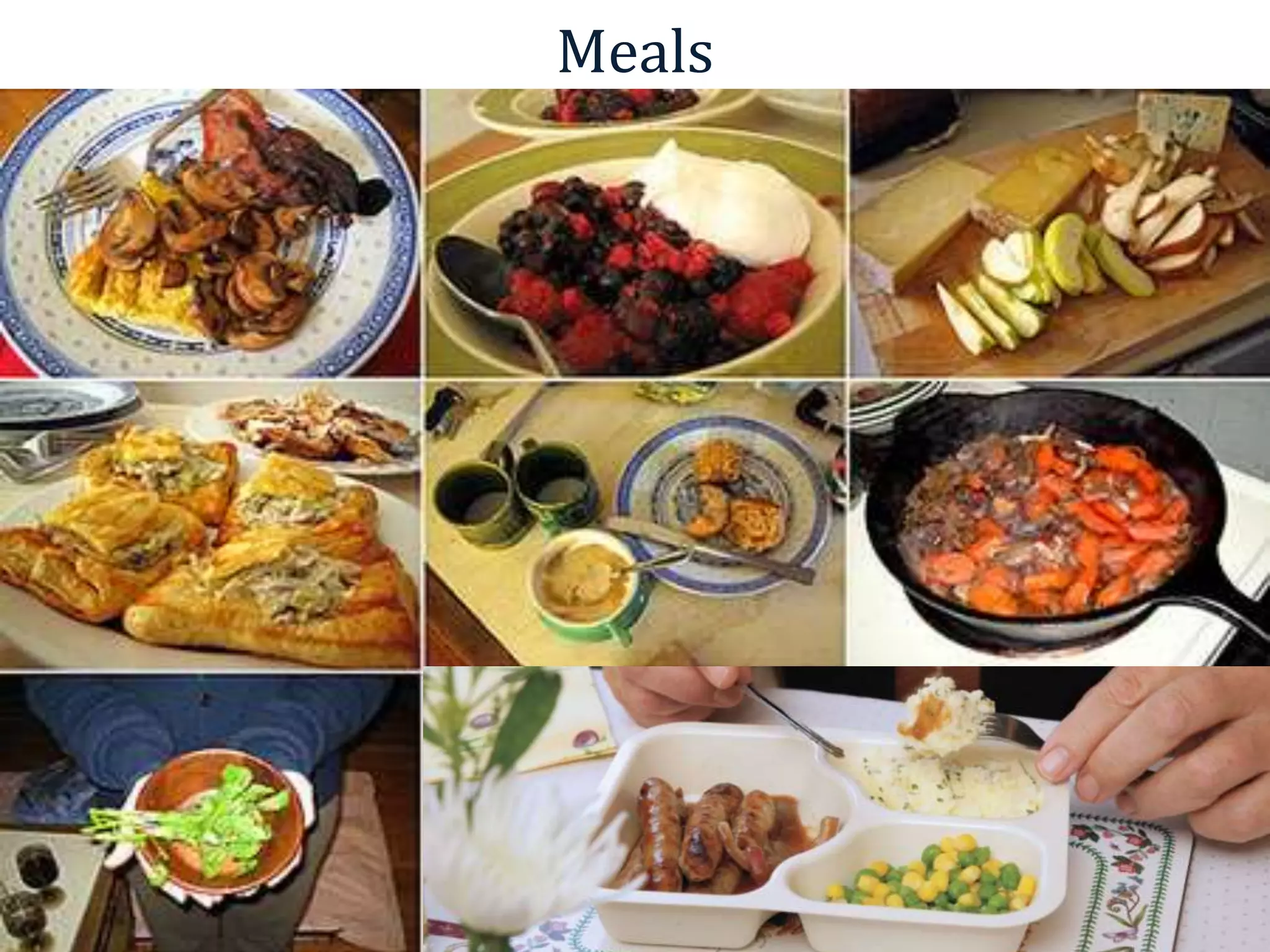
Meals
Sixth . . .
Let’s focus on VALUE, IMPACT, and
POSITIONING (VIP)
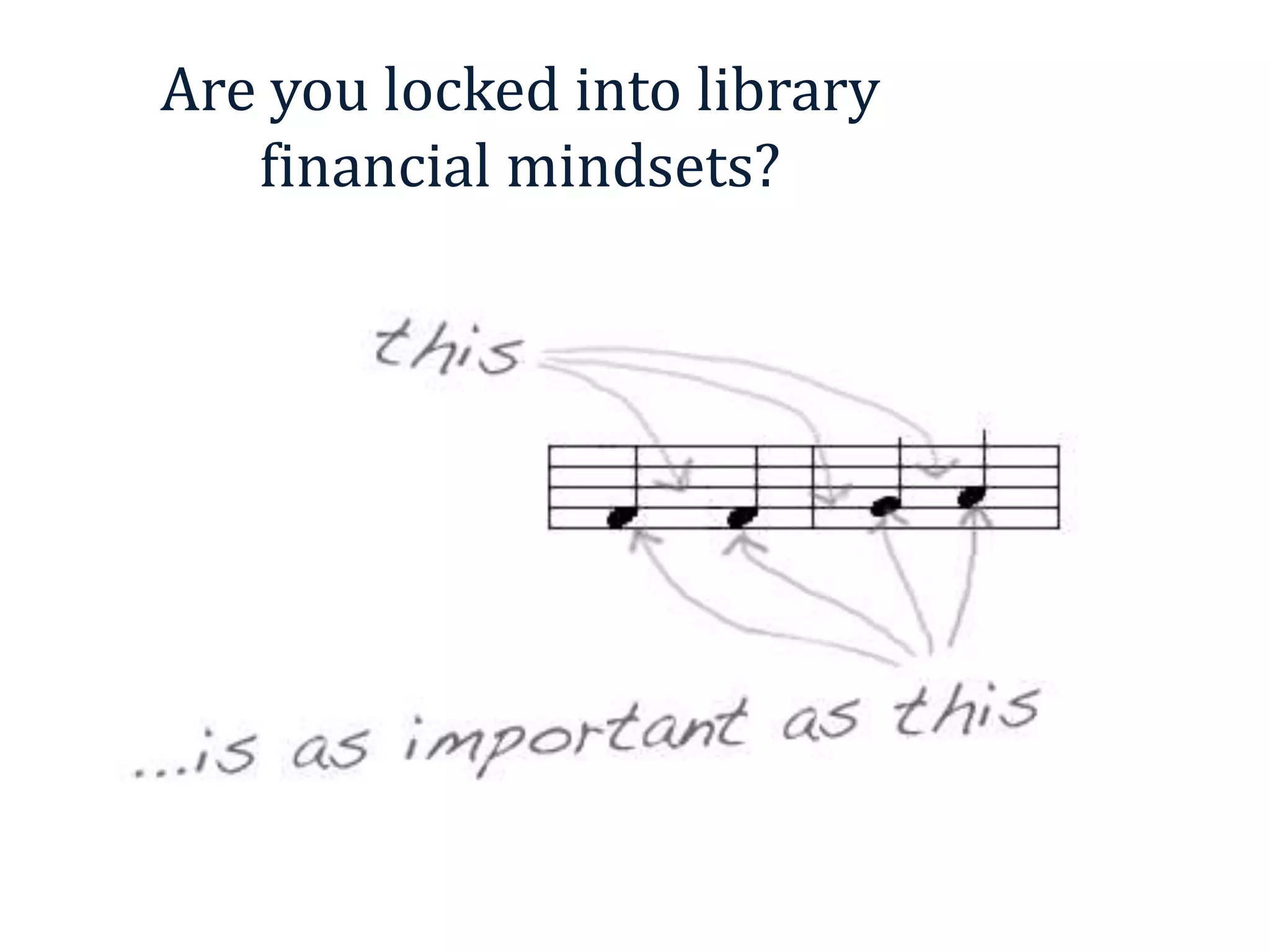
What’s the music and magic you hear?
Play? Do?
Are you locked into library
financial mindsets?
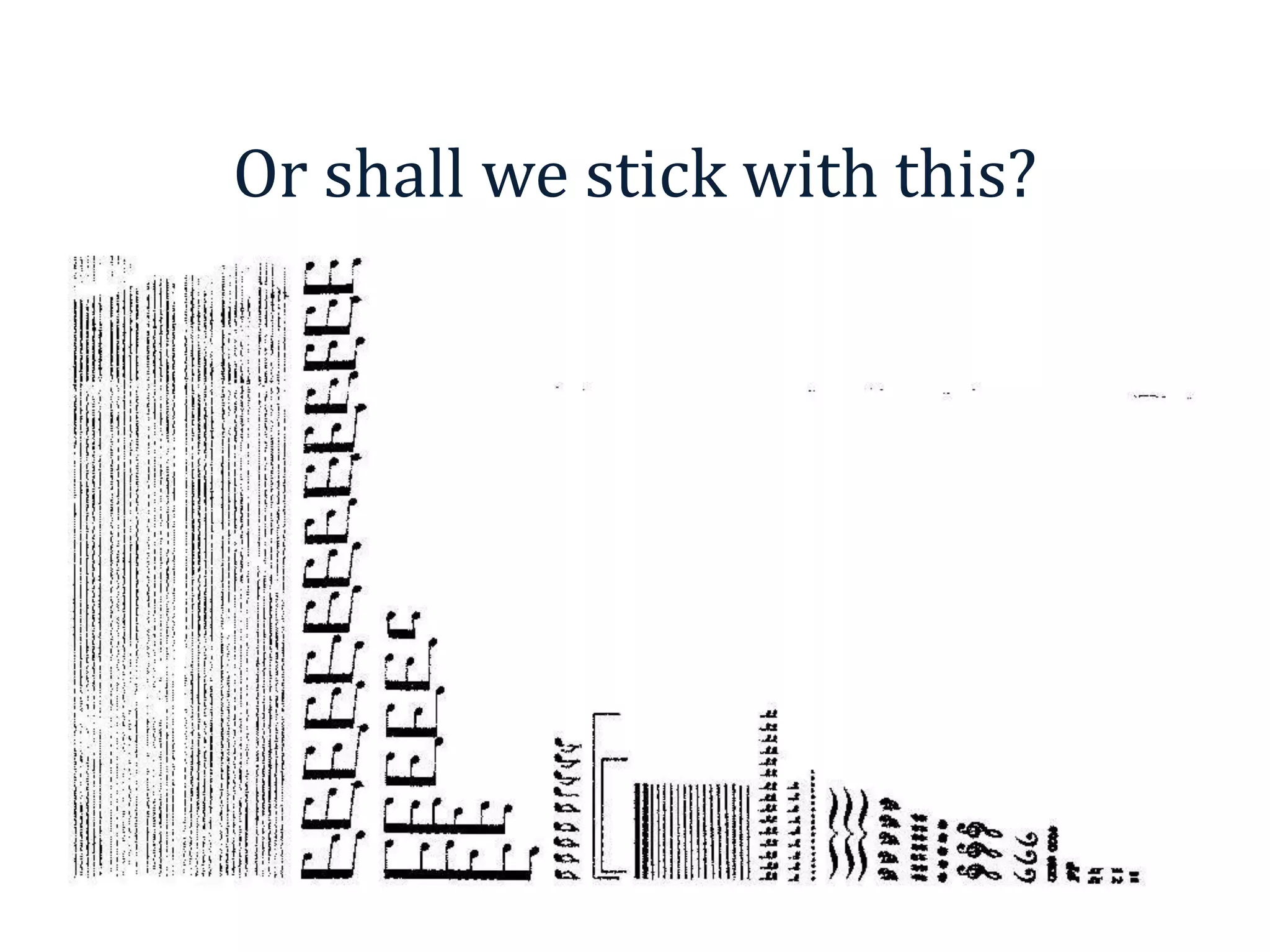
What about value and
impact?
Or shall we stick with this?
It’s the stories that happen inside
your library that matter . . . Not just
the ones you have on the shelves.
Tell those stories
Encourage the heart . . .
Better yet . . . Collect the stories in
your users’ voices
The signs . . . There’s always another view…
43
Sustaining Relevance
Being Relevant
Communicating VIP
Real relationships
Being a ‘real’ professional
Personal and Institutional Impact:
Strategies and Tactics
Let’s talk . . .
Why is the staff invisible on your virtual presence?
Are we a culture of poverty?
Do You Feel Poor?
RISK
50
Important Strategic Questions for Priority Setting
1. What are your top questions?
2. What does your community need?
3. Who are your engaged users?
4. Who isn’t using the library who should?
5. Why do we read? Why do we ask questions? What’s the
impact of learning?
6. What are the key success factors (KSF) of your library?
51
Important Strategic Issues
1. Investing for success
2. Strategic budgeting
3. Developing a culture of controlled risk
4. Learning to de-invest, sacrifice, stop, and grow.
5. “A library is a growing organism.”
52
53
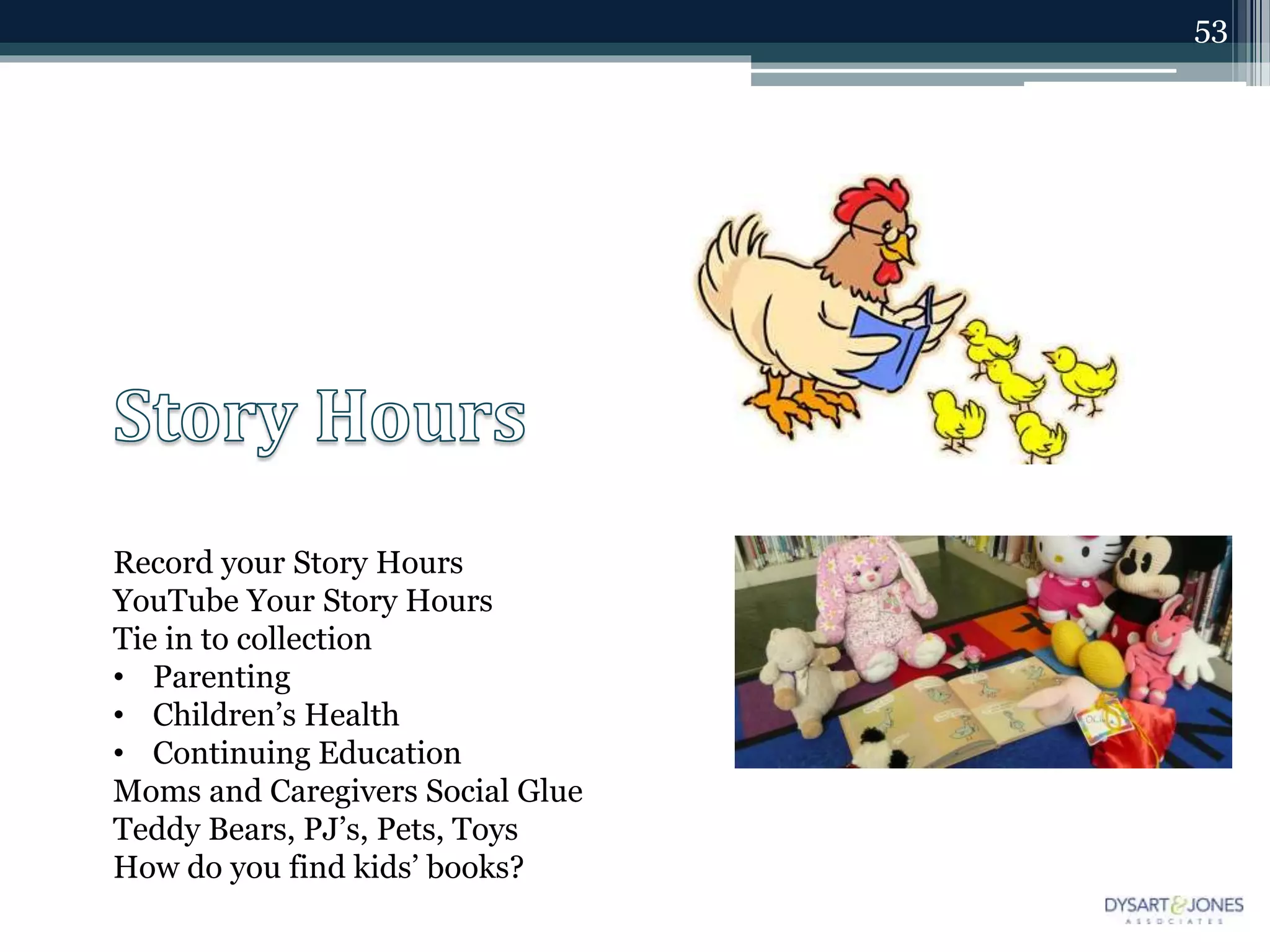
Record your Story Hours
YouTube Your Story Hours
Tie in to collection
• Parenting
• Children’s Health
• Continuing Education
Moms and Caregivers Social Glue
Teddy Bears, PJ’s, Pets, Toys
How do you find kids’ books?
54
55
56
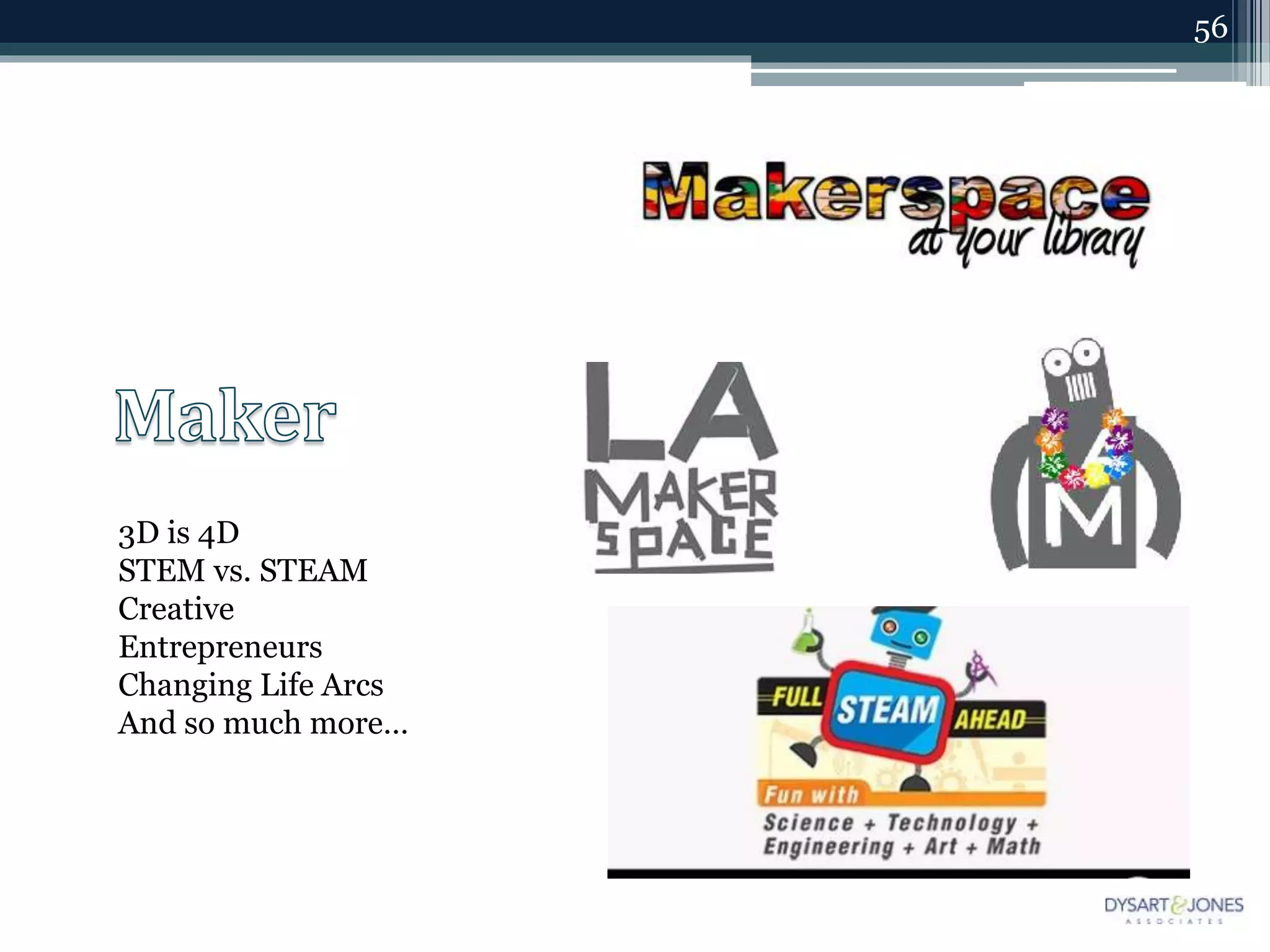
3D is 4D
STEM vs. STEAM
Creative
Entrepreneurs
Changing Life Arcs
And so much more…
57
58
Douglas County and Colorado Models
Lulu, Amazon Singles, Self-publishing
Fifty Shades of Grey
This is an economic activity
59
Hand-knitting Sweaters or an Industrial Revolution for libraries
Consider scalability and replicability
Cooperation on a massive scale
Mobility of programming
Thinking big – over 1000 attendees or 30?
Mobile Makerspaces
Mobile staff talent
60
61
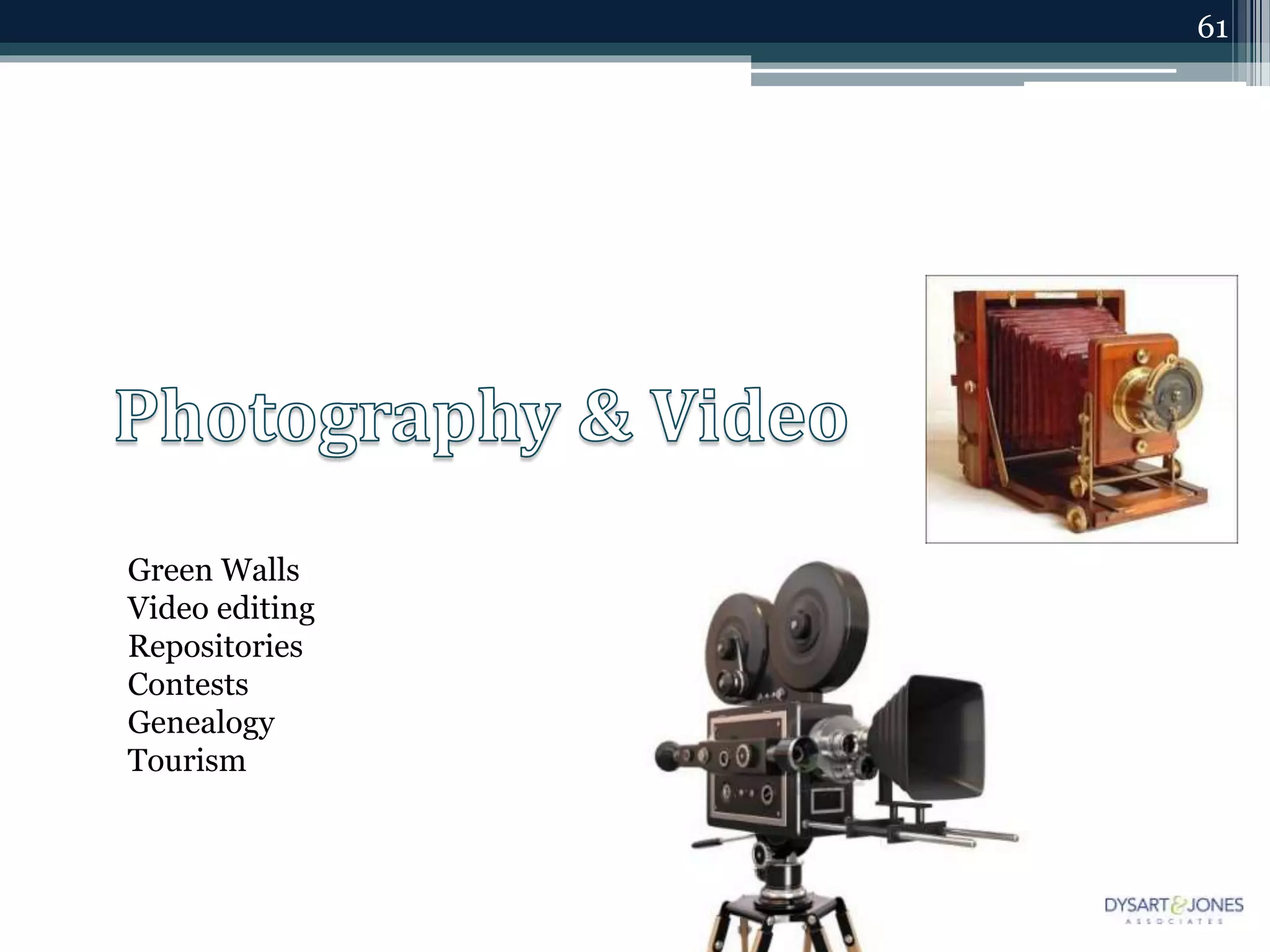
Green Walls
Video editing
Repositories
Contests
Genealogy
Tourism
62
Top Questions Pattern
Common Core Curriculum
63
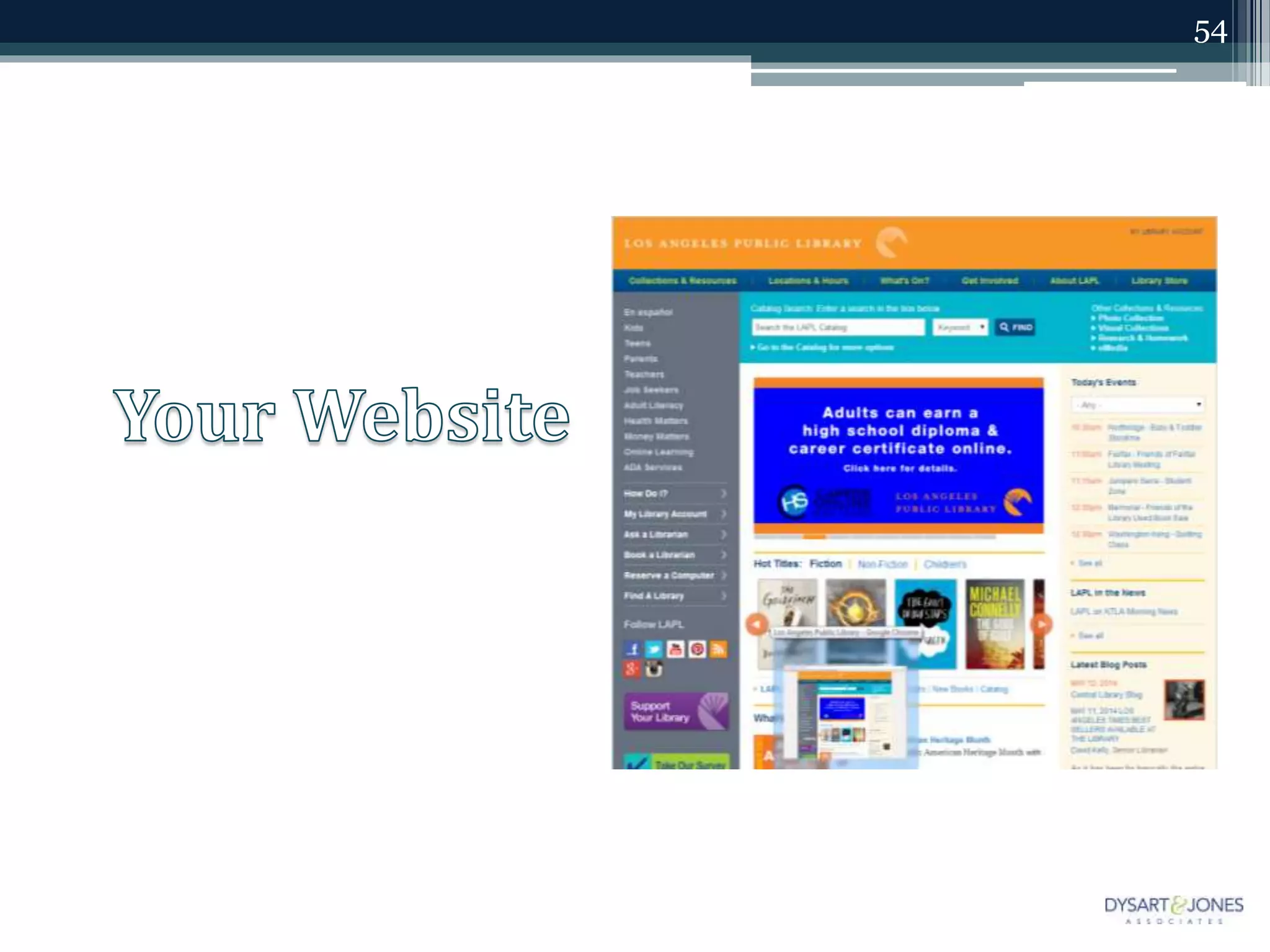
Websites and e-mail
Facebook
Pinterest
Twitter
Tumblr
Vimeo / YouTube / Vine
Instagram
Etc.
64
65
66
67
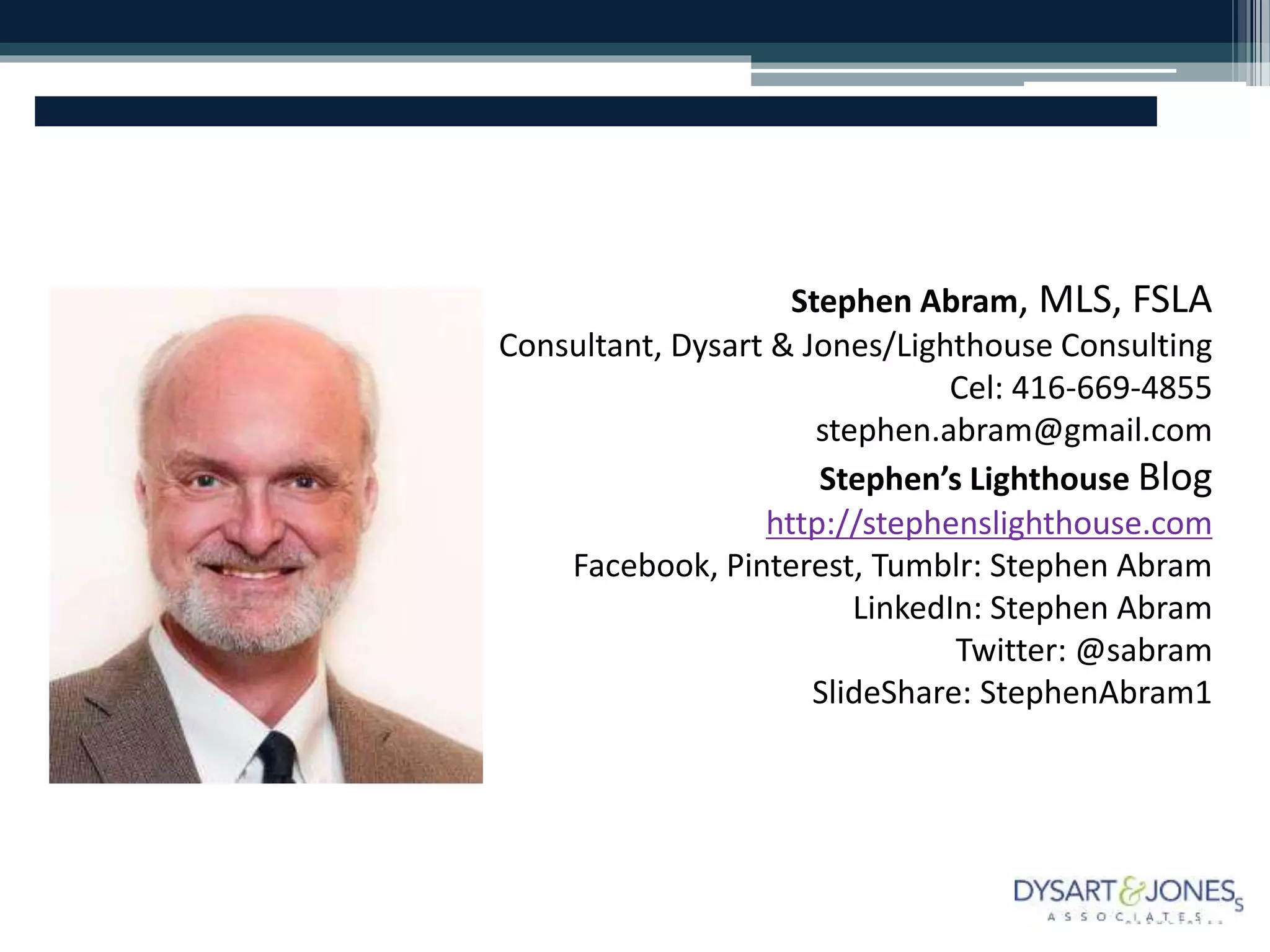
Stephen Abram, MLS, FSLA
Consultant, Dysart & Jones/Lighthouse Consulting
Cel: 416-669-4855
stephen.abram@gmail.com
Stephen’s Lighthouse Blog
http://stephenslighthouse.com
Facebook, Pinterest, Tumblr: Stephen Abram
LinkedIn: Stephen Abram
Twitter: @sabram
SlideShare: StephenAbram1

Lapl may2014

  • 1.
    EXPECT MORE: TheLibrary Story Thursday May 15, 2014 Los Angeles Public Library Stephen Abram, MLS
  • 2.
    Stop the Insanity Techis a tool Tech is an opportunity Innovation involves risk The biggest risk is not taking any. 2
  • 3.
    3 Stop Having andEngaging in BS Discussions • Libraries are more relevant than ever • We have no good reason to be on the defence • Reading is UP • E-Books aren’t replacing p-Books - the dynamic is a new hybrid marketplace • E-Books have benefits that p-Books don’t • Librarians are being hired and doing well • Change is our tradition • This new normal requires specialized professionals like us.
  • 4.
    4 Comprehensive Digital Strategies:More than just Content!
  • 5.
    Digital is morecomplicated than Print.
  • 6.
    6 Biggest Issue: GettingLost in the Reeds
  • 7.
    Understand the difference betweenSearch and Find • Roy Tennant and I have been saying for years: “Users want to find not search”. • Librarians enjoy the challenge of search and try to create mini- librarians. • Information literacy is different than contextual information fluency. •The user experience is mostly “elsewhere”. • Learning, research and decision-making processes trump search.
  • 8.
    Understand the differencebetween the roles of discovery services and native search • Search is the identification of potential objects to read or view in either a known item retrieval scenario or – more importantly – an immersion environment where choices are made. • Until recently, we handled immersion environments in the context of defined subsets of content (a single database or small group). • Discovery services are one step before search – the identification and discovery of the resources (databases) that are worth searching.
  • 9.
  • 10.
    And the AlgorithmUnderstanding Failure 10 The power of algorithm is in the target user needs, the institutional needs, and the behavioral history . . . Not the underlying content Are there any real national initiatives to understand and differentiate library end user behaviors from Google commercial constructs? (yes but …)
  • 11.
    Get the namingand labeling right • Vendors must develop unique names and brands for their services to meet positioning, marketing and sales needs to you. • There is no need for you to fall in line and pass through these names – or worse try to train end users to know hundreds of them! • Can anyone defend using these titles to be the single most important label for end users? MLA, Scopus, Compendex, ABI/Inform . . .? • Honestly! The needs of trademark law don’t match the needs of users to identify resources.
  • 12.
    Are you usingnumbers strategically? • Statistics versus measurements • Satisfaction and Impact • Visual versus data • Stories build on data springboards • Are your numbers showing customer satisfaction or just activity? • Do you trust your numbers (It’s easy to mess with an interface and increase hits or whatever statistics you’re using.) • How can the vendor help your numbers issues and insights?
  • 13.
    13 Talking Money • Price •Cost • Billing • Value • Deals • TCO • Value of Your Time • Value of Their Time
  • 14.
    Until lions learnto write their own story, the story will always be from the perspective of the hunter not the hunted.
  • 15.
    15 Library Advocacy: TheLion's Story • Are you framing your library's story well? • Are you sharing measurements about your impact, or still beating the drum of raw statistics that show funders where to cut? • Are you using great gift of social media to engage and get your message out. • Has your library's marketing and communication plan stepped up to the 21st Century? • Are we ready for advanced data mining of our websites, circulation and membership records? • Are you ready for the reach beyond outreach? • What are the skills and competencies that library teams need?
  • 16.
    First . .. Let’s stop using the word advocacy Let’s discuss influence and being influential . . .
  • 17.
    Second . .. Let’s start using verbs to describe ourselves in the context(s) of our members, audiences and communities. 17
  • 18.
  • 19.
  • 20.
  • 21.
    Third . .. Learn and use the language of benefits – not features, functions and processes.
  • 22.
    Fourth . .. Let’s build on our legacy of trust and respect and our foundation of collections and places to shine
  • 23.
  • 24.
  • 25.
  • 26.
    Fifth . .. Let’s emphasize the humans that make the magic happen . . . Library staff
  • 27.
    27 Librarian and StaffMagic Should Not be Invisible
  • 28.
  • 29.
  • 30.
  • 31.
  • 32.
  • 33.
  • 34.
    Sixth . .. Let’s focus on VALUE, IMPACT, and POSITIONING (VIP) What’s the music and magic you hear? Play? Do?
  • 35.
    Are you lockedinto library financial mindsets?
  • 36.
    What about valueand impact?
  • 37.
    Or shall westick with this?
  • 38.
    It’s the storiesthat happen inside your library that matter . . . Not just the ones you have on the shelves. Tell those stories Encourage the heart . . . Better yet . . . Collect the stories in your users’ voices
  • 43.
    The signs .. . There’s always another view… 43
  • 44.
    Sustaining Relevance Being Relevant CommunicatingVIP Real relationships Being a ‘real’ professional
  • 45.
    Personal and InstitutionalImpact: Strategies and Tactics Let’s talk . . . Why is the staff invisible on your virtual presence?
  • 46.
    Are we aculture of poverty?
  • 47.
  • 49.
  • 50.
    50 Important Strategic Questionsfor Priority Setting 1. What are your top questions? 2. What does your community need? 3. Who are your engaged users? 4. Who isn’t using the library who should? 5. Why do we read? Why do we ask questions? What’s the impact of learning? 6. What are the key success factors (KSF) of your library?
  • 51.
    51 Important Strategic Issues 1.Investing for success 2. Strategic budgeting 3. Developing a culture of controlled risk 4. Learning to de-invest, sacrifice, stop, and grow. 5. “A library is a growing organism.”
  • 52.
  • 53.
    53 Record your StoryHours YouTube Your Story Hours Tie in to collection • Parenting • Children’s Health • Continuing Education Moms and Caregivers Social Glue Teddy Bears, PJ’s, Pets, Toys How do you find kids’ books?
  • 54.
  • 55.
  • 56.
    56 3D is 4D STEMvs. STEAM Creative Entrepreneurs Changing Life Arcs And so much more…
  • 57.
  • 58.
    58 Douglas County andColorado Models Lulu, Amazon Singles, Self-publishing Fifty Shades of Grey This is an economic activity
  • 59.
    59 Hand-knitting Sweaters oran Industrial Revolution for libraries Consider scalability and replicability Cooperation on a massive scale Mobility of programming Thinking big – over 1000 attendees or 30? Mobile Makerspaces Mobile staff talent
  • 60.
  • 61.
  • 62.
  • 63.
  • 64.
  • 65.
  • 66.
  • 67.
  • 68.
    Stephen Abram, MLS,FSLA Consultant, Dysart & Jones/Lighthouse Consulting Cel: 416-669-4855 stephen.abram@gmail.com Stephen’s Lighthouse Blog http://stephenslighthouse.com Facebook, Pinterest, Tumblr: Stephen Abram LinkedIn: Stephen Abram Twitter: @sabram SlideShare: StephenAbram1