TYPES OF COMPETITION Introduction to Business 2/2009
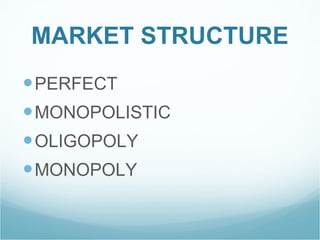
MARKET STRUCTURE PERFECT MONOPOLISTIC OLIGOPOLY MONOPOLY
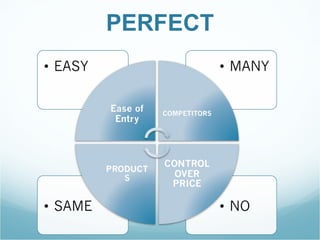
PERFECT
PERFECT
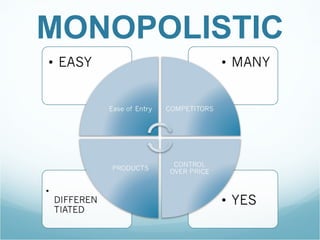
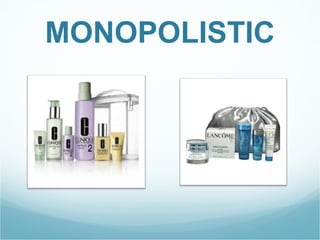
MONOPOLISTIC
MONOPOLISTIC
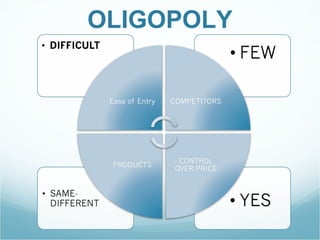
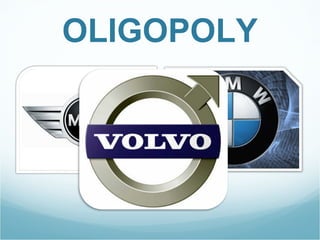
OLIGOPOLY
OLIGOPOLY
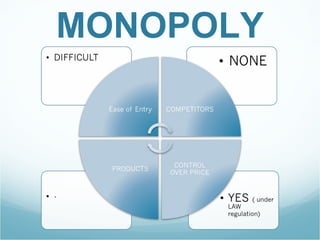
MONOPOLY
MONOPOLY A monopoly is a company that dominates and controls a specific industry.
QUESTIONS & ANSWERS  From  Wal-Mart ‘s case study
  1. What industry Wal-Mart is competing in?  GENERAL MERCHANDISE RETAILING  INDUSTRY
2. Which market structure should Wal-Mart be considered?  Monopolistic There are  a lot of retailers (competitors)  like Wal-Mart in the market. It is easy to be general merchandise retailers.  Wal-Mart can control over the price by dumping it down   while others(small retailers) cannot. The products are  differentiated  by  product testing tactics  to let the customers perceived that they are  The new, improved Great Value products  and redesigning  Great Value  packaging graphics   although it may be still similar or same. According to theory
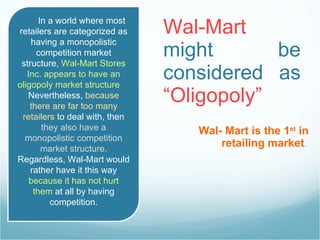
Wal-Mart  might be considered as  “Oligopoly”   Wal- Mart is the 1 st  in retailing market .  In a world where most retailers are categorized as having a monopolistic competition market structure,  Wal-Mart Stores Inc. appears to have an oligopoly market structure .  Nevertheless,  because there are far too many retailers  to deal with, then  they also have a monopolistic competition market structure.  Regardless, Wal-Mart would rather have it this way  because it has not hurt them  at all by having competition.
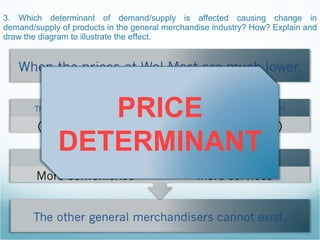
3. Which determinant of demand/supply is affected causing change in demand/supply of products in the general merchandise industry? How? Explain and draw the diagram to illustrate the effect.  PRICE DETERMINANT
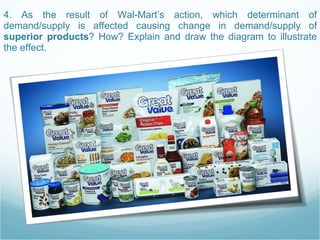
4. As the result of Wal-Mart’s action, which determinant of demand/supply is affected causing change in demand/supply of  superior products ? How? Explain and draw the diagram to illustrate the effect.
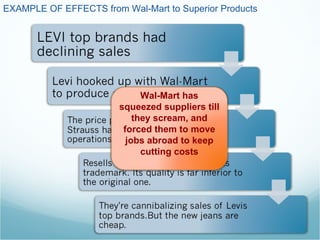
EXAMPLE OF EFFECTS from Wal-Mart to Superior Products Wal-Mart has squeezed suppliers till they scream, and forced them to move jobs abroad to keep cutting costs

Marketing Structure

  • 1.
    TYPES OF COMPETITIONIntroduction to Business 2/2009
  • 2.
    MARKET STRUCTURE PERFECTMONOPOLISTIC OLIGOPOLY MONOPOLY
  • 3.
  • 4.
  • 5.
  • 6.
  • 7.
  • 8.
  • 9.
  • 10.
    MONOPOLY A monopolyis a company that dominates and controls a specific industry.
  • 11.
    QUESTIONS & ANSWERS From Wal-Mart ‘s case study
  • 12.
      1. Whatindustry Wal-Mart is competing in? GENERAL MERCHANDISE RETAILING INDUSTRY
  • 13.
    2. Which marketstructure should Wal-Mart be considered? Monopolistic There are a lot of retailers (competitors) like Wal-Mart in the market. It is easy to be general merchandise retailers. Wal-Mart can control over the price by dumping it down while others(small retailers) cannot. The products are differentiated by product testing tactics to let the customers perceived that they are The new, improved Great Value products and redesigning Great Value packaging graphics although it may be still similar or same. According to theory
  • 14.
    Wal-Mart mightbe considered as “Oligopoly” Wal- Mart is the 1 st in retailing market . In a world where most retailers are categorized as having a monopolistic competition market structure, Wal-Mart Stores Inc. appears to have an oligopoly market structure . Nevertheless, because there are far too many retailers to deal with, then they also have a monopolistic competition market structure. Regardless, Wal-Mart would rather have it this way because it has not hurt them at all by having competition.
  • 15.
    3. Which determinantof demand/supply is affected causing change in demand/supply of products in the general merchandise industry? How? Explain and draw the diagram to illustrate the effect. PRICE DETERMINANT
  • 16.
    4. As theresult of Wal-Mart’s action, which determinant of demand/supply is affected causing change in demand/supply of superior products ? How? Explain and draw the diagram to illustrate the effect.
  • 17.
    EXAMPLE OF EFFECTSfrom Wal-Mart to Superior Products Wal-Mart has squeezed suppliers till they scream, and forced them to move jobs abroad to keep cutting costs