Profit Maximisation under Perfect Competition and Monopoly
Alternative Market Structures Classifying markets (by degree of competition) number of firms freedom of entry to industry free, restricted or blocked? nature of product homogeneous or differentiated? nature of demand curve degree of control the firm has over price
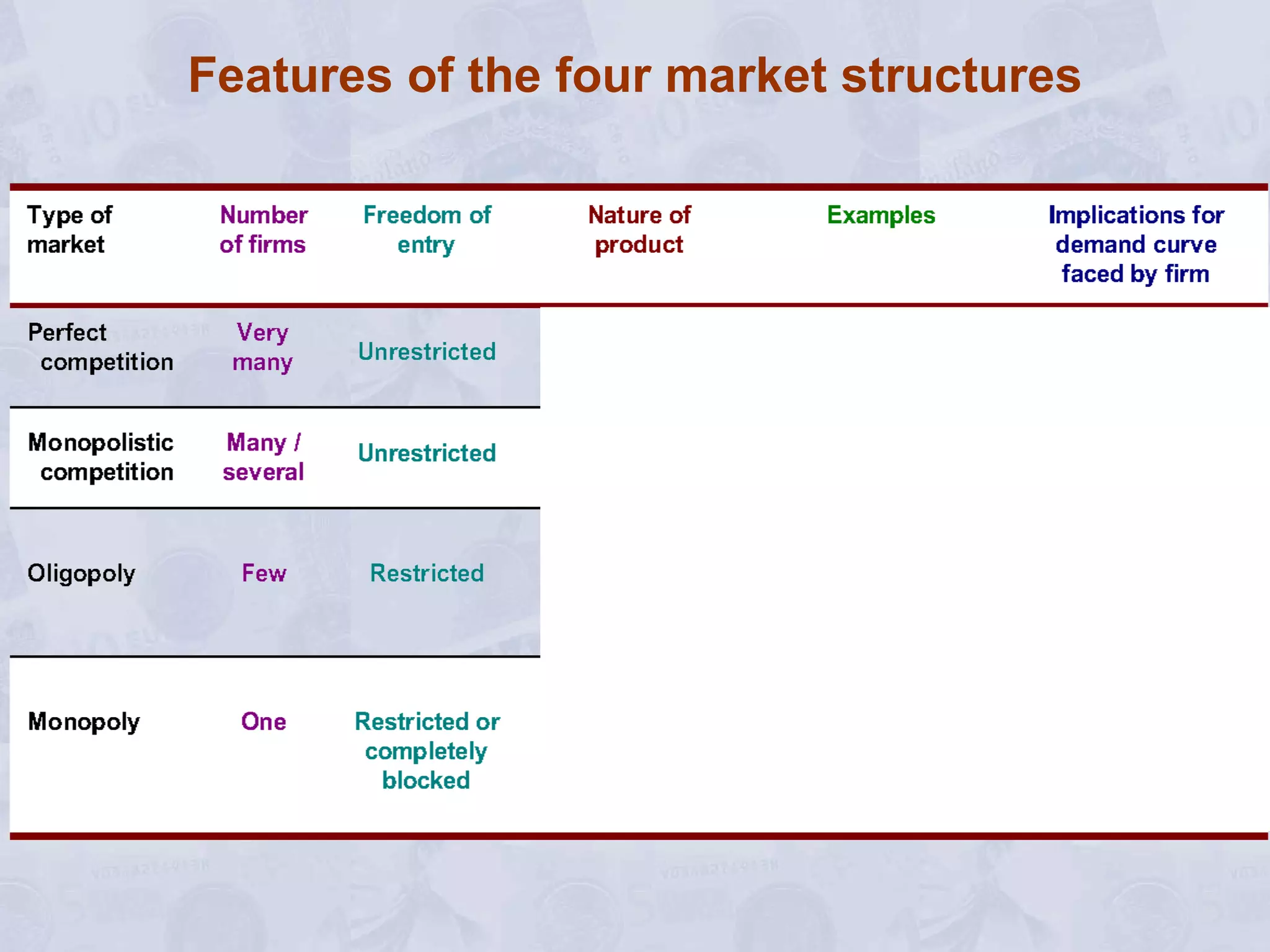
Alternative Market Structures The four market structures perfect competition monopoly monopolistic competition oligopoly
Features of the four market structures
Alternative Market Structures The four market structures perfect competition monopoly monopolistic competition oligopoly   Structure    conduct    performance
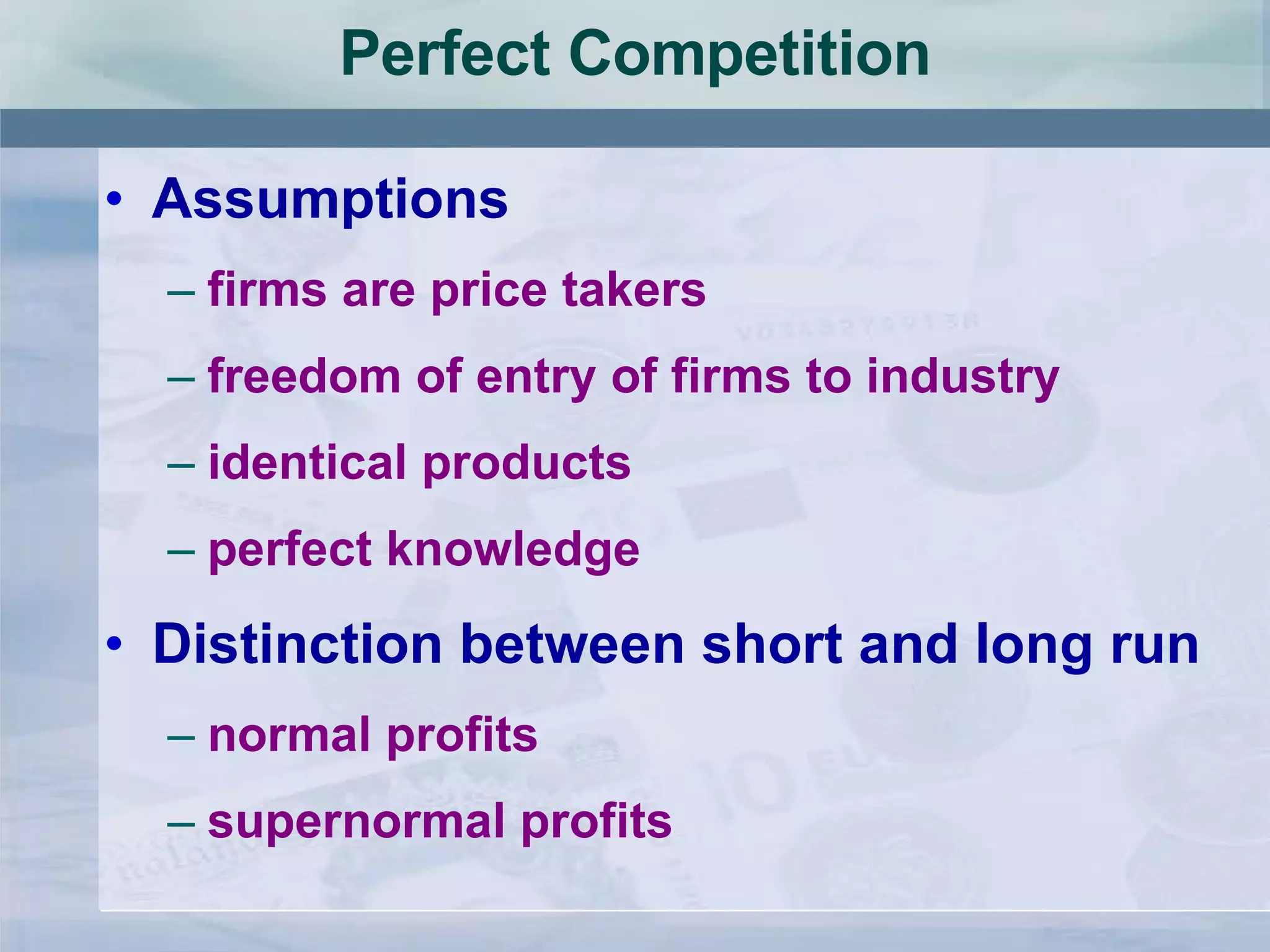
Perfect Competition Assumptions firms are price takers freedom of entry of firms to industry identical products perfect knowledge Distinction between short and long run normal profits supernormal profits
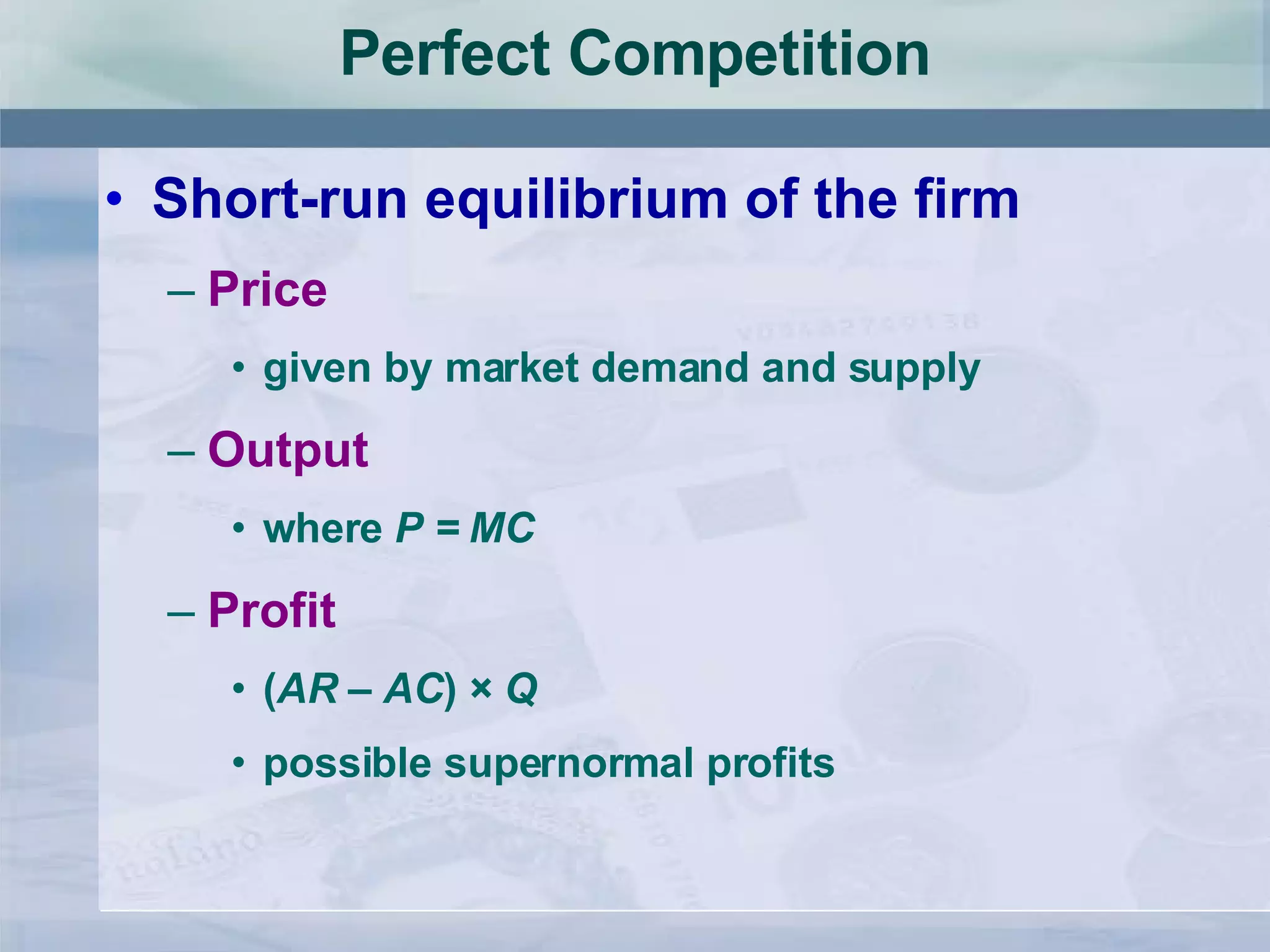
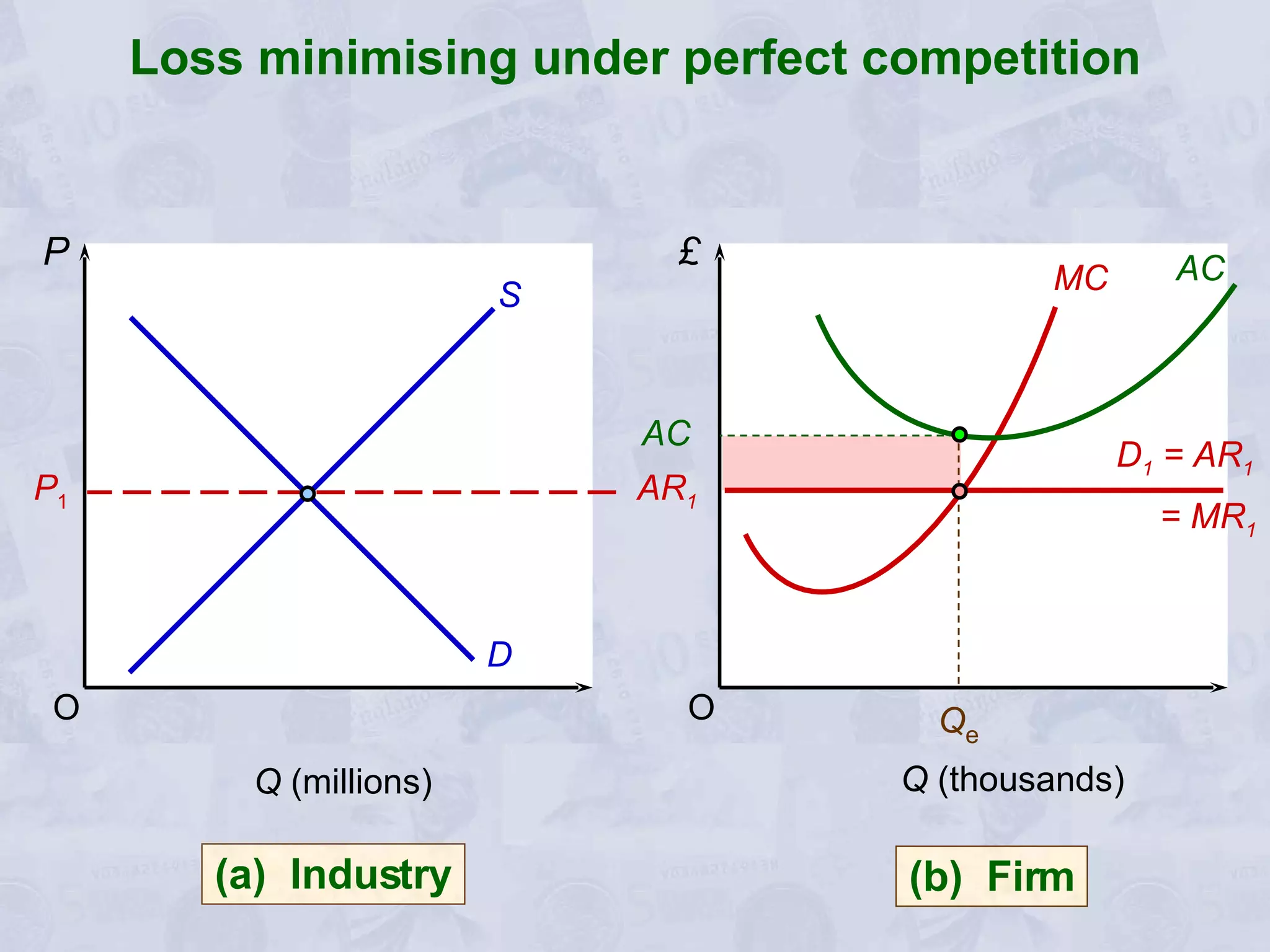
Perfect Competition Short-run equilibrium of the firm Price given by market demand and supply Output where  P = MC Profit ( AR – AC ) ×  Q possible supernormal profits
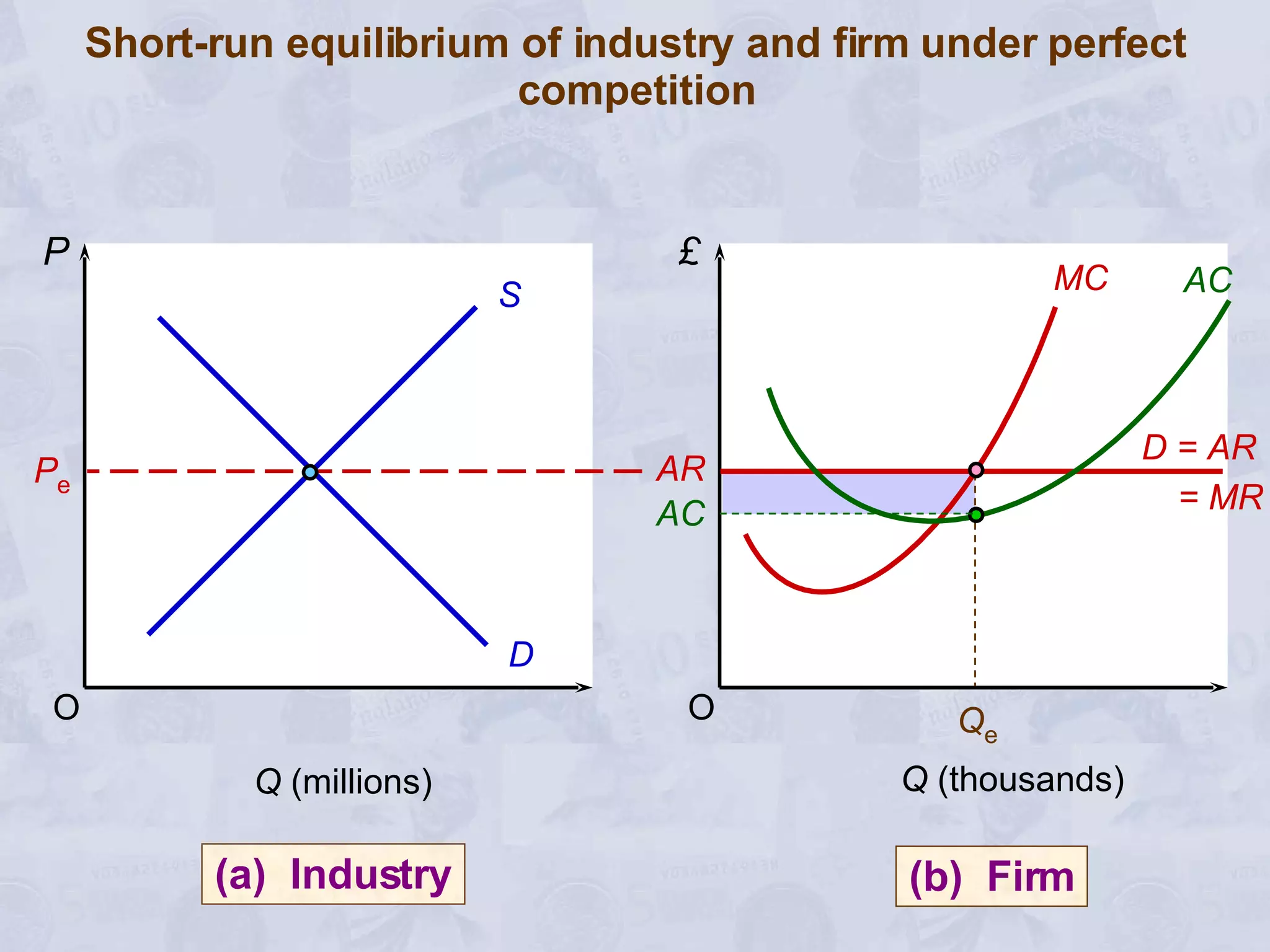
Short-run equilibrium of industry and firm under perfect competition O £ (b)  Firm Q  (thousands) O (a)  Industry P Q  (millions) Q e S D P e MC AR D = AR = MR AC AC
Loss minimising under perfect competition O O (a)  Industry P £ Q  (millions) S D (b)  Firm Q  (thousands) Q e P 1 D 1  = AR 1 = MR 1 AR 1 MC AC AC
Short-run shut-down point O O (a)  Industry P £ Q  (millions) S (b)  Firm MC AC Q  (thousands) D 2 P 2 AR 2 D 2  = AR 2 = MR 2 AVC
Perfect Competition Short-run equilibrium of the firm (cont.) short-run supply curve of firm the  MC  curve Short-run supply curve of industry sum of supply curves of firms
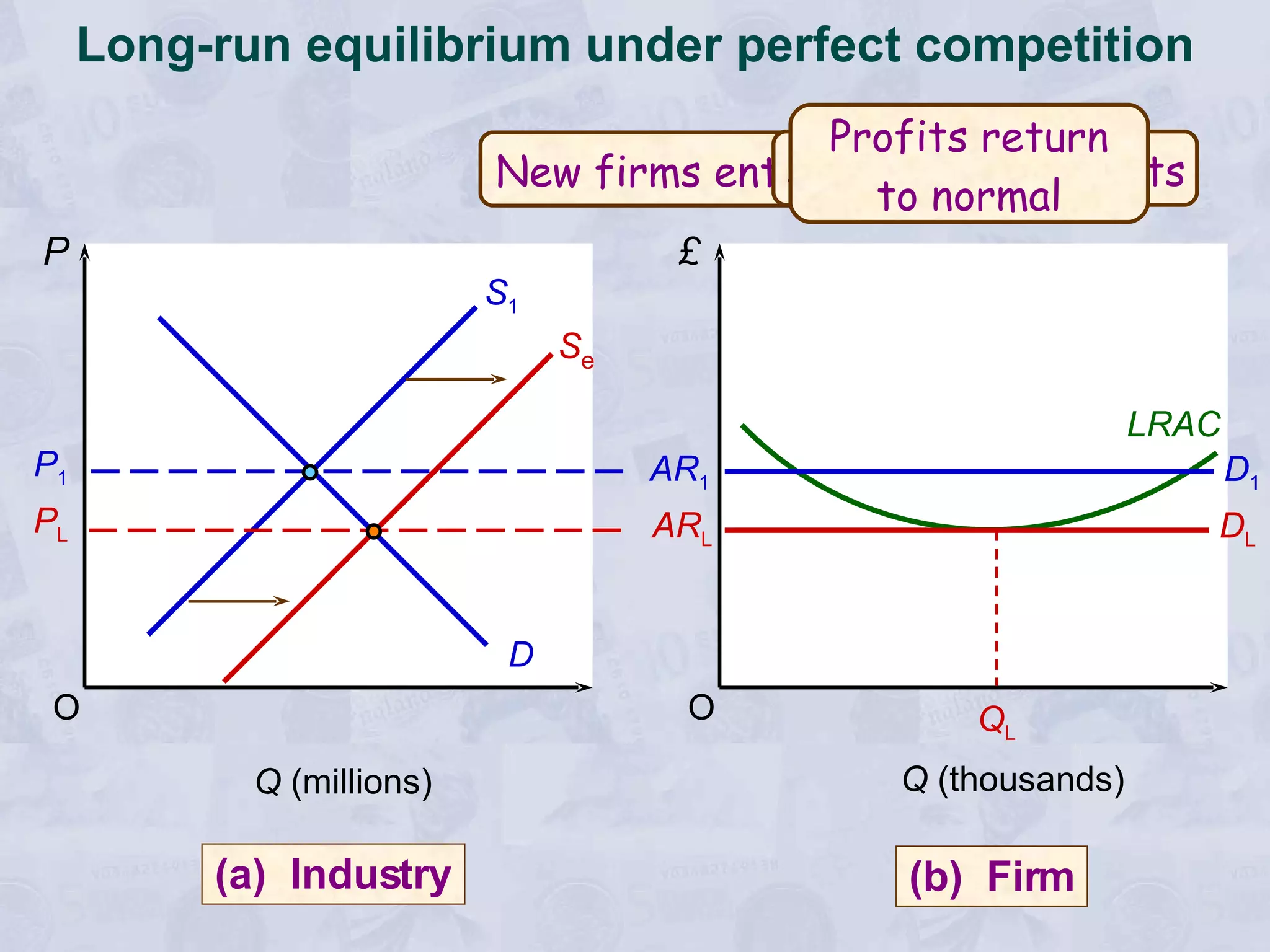
Perfect Competition The long run long-run equilibrium of the firm all supernormal profits competed away
Long-run equilibrium under perfect competition O O P £ Q  (millions) Q L Q  (thousands) New firms enter Supernormal profits Profits return to normal (a)  Industry (b)  Firm S 1 D LRAC P L P 1 S e AR 1 D 1 AR L D L
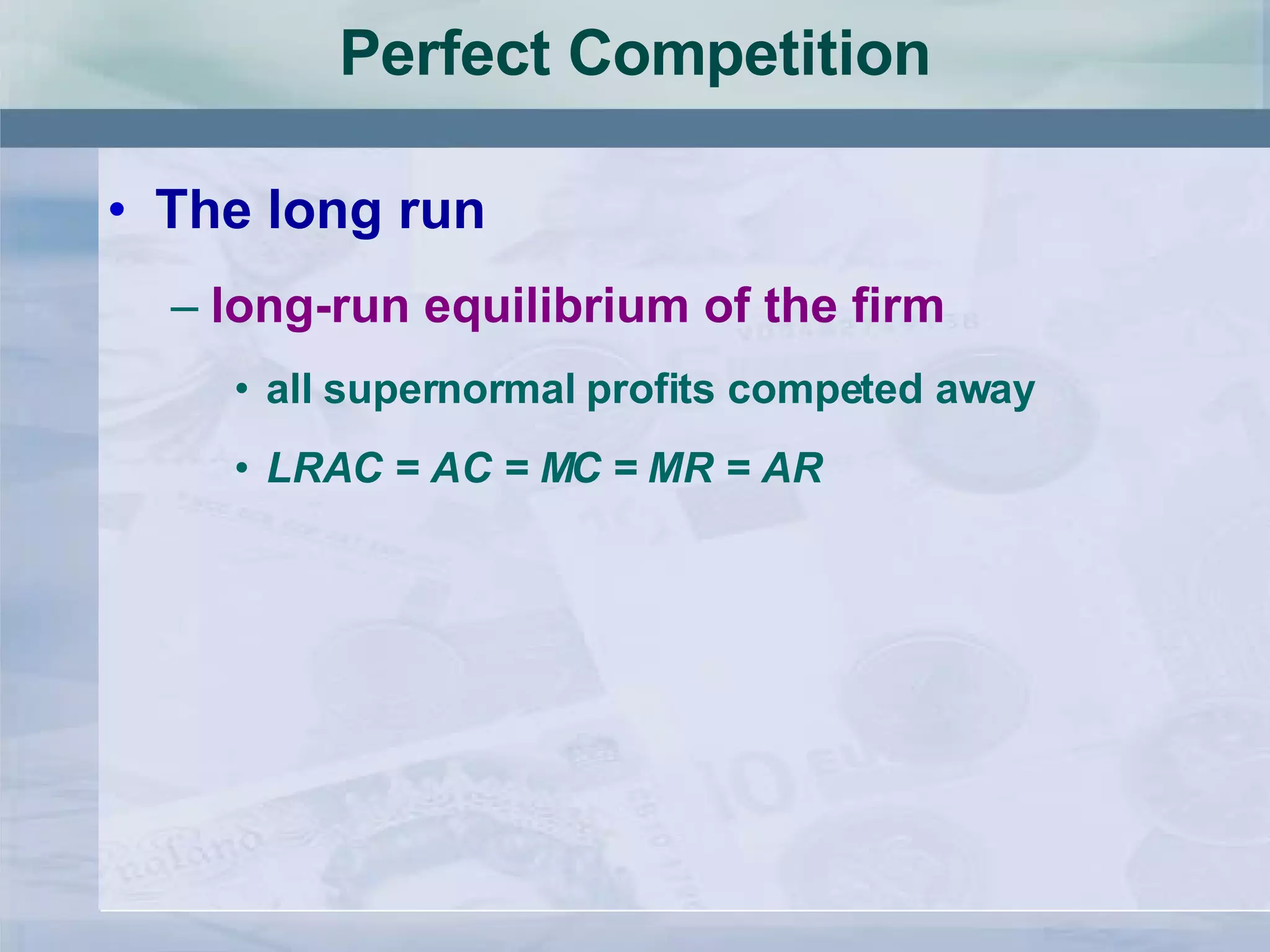
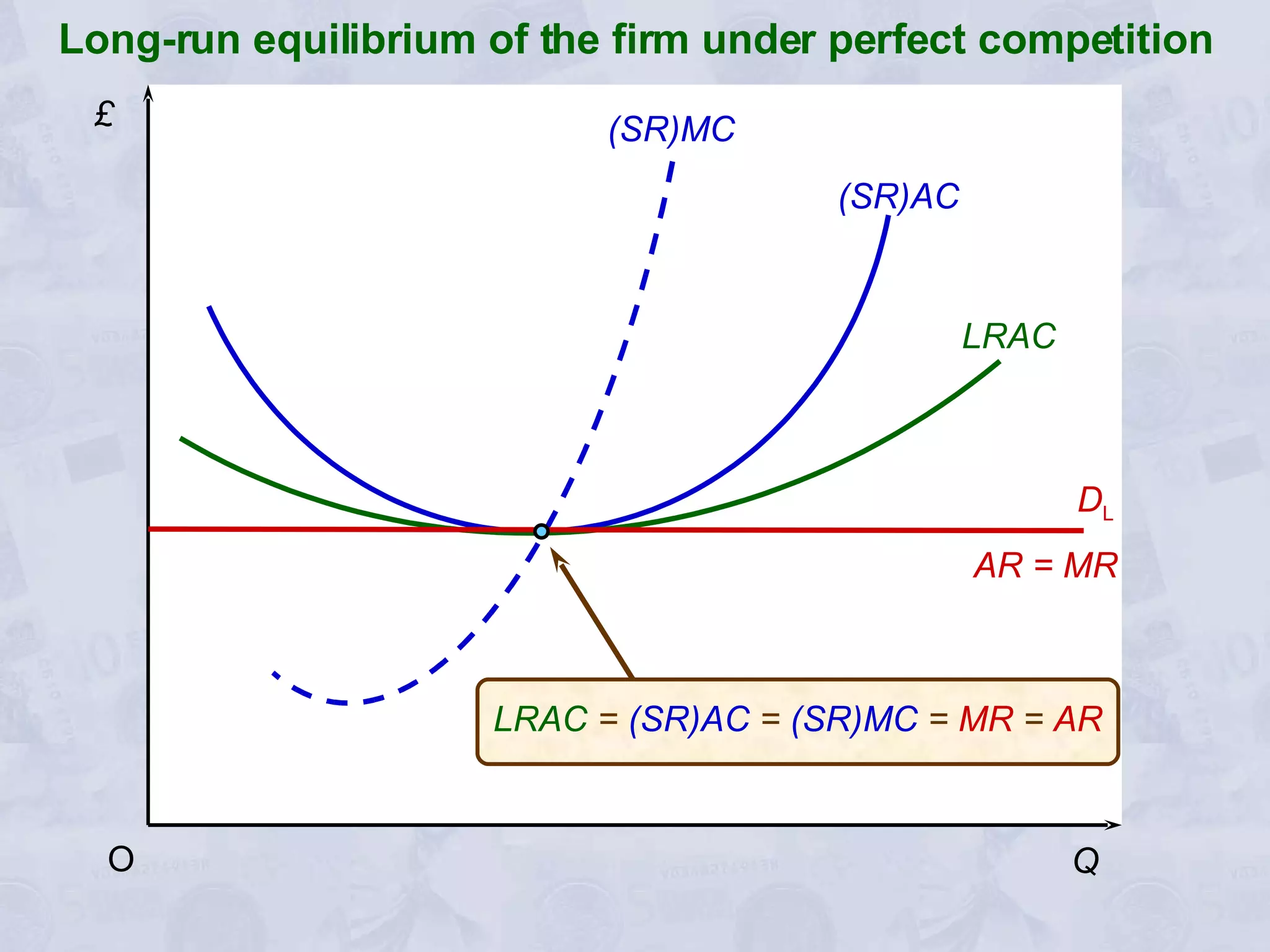
Perfect Competition The long run long-run equilibrium of the firm all supernormal profits competed away LRAC = AC = MC = MR = AR
Long-run equilibrium of the firm under perfect competition £  Q  O (SR)AC  (SR)MC  LRAC  AR = MR D L LRAC  =  (SR)AC  =  (SR)MC  =   MR   =  AR
Perfect Competition The long run long-run equilibrium of the firm all supernormal profits competed away LRAC = AC = MC = MR = AR long-run industry supply curve
Perfect Competition The long run long-run equilibrium of the firm all supernormal profits competed away LRAC = AC = MC = MR = AR long-run industry supply curve incompatibility of economies of scale with perfect competition
Perfect Competition The long run long-run equilibrium of the firm all supernormal profits competed away LRAC = AC = MC = MR = AR long-run industry supply curve incompatibility of economies of scale with perfect competition Does the firm benefit from operating under perfect competition?
Monopoly Defining monopoly importance of market power concentration ratios
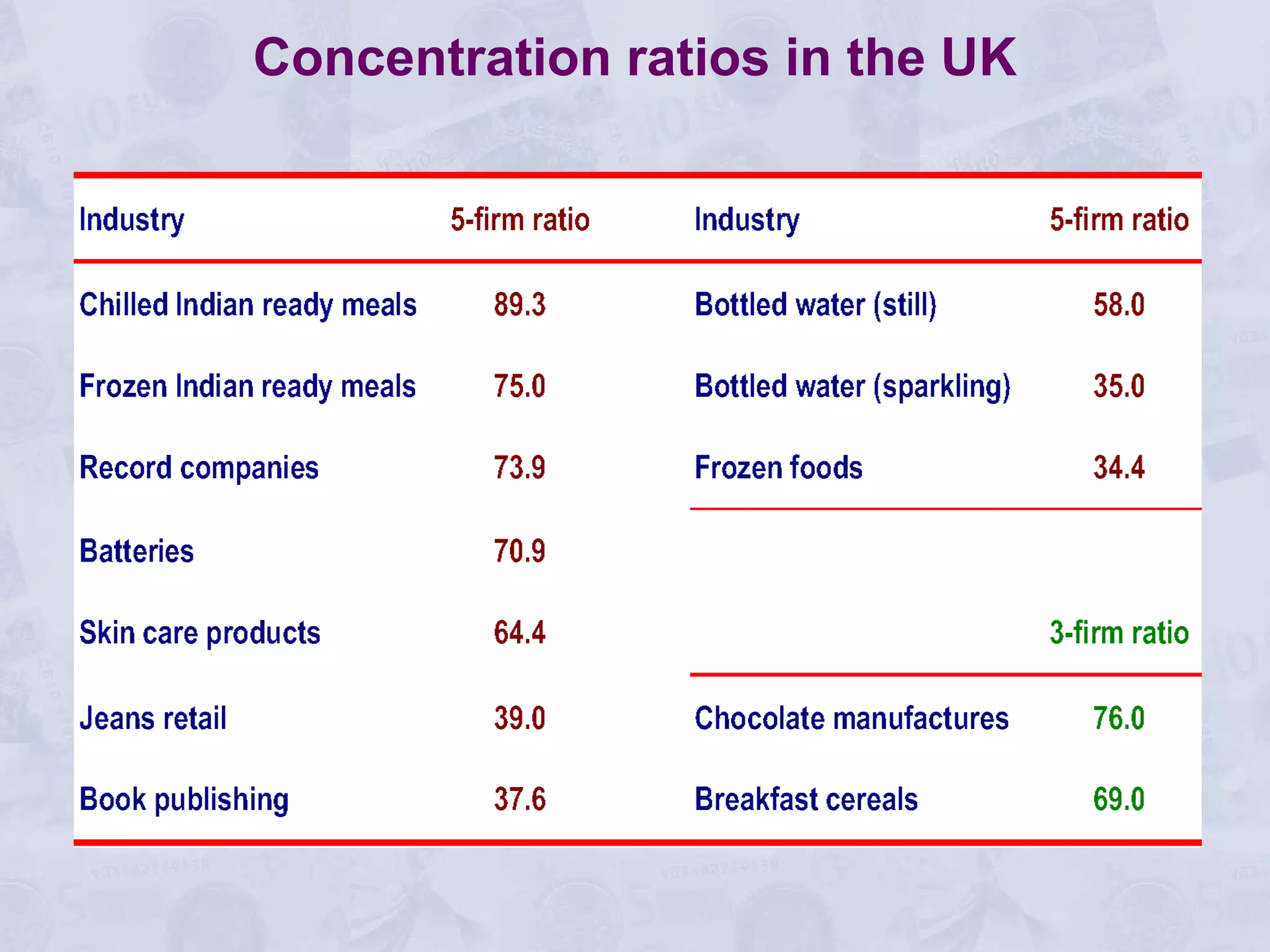
Concentration ratios in the UK
Monopoly Barriers to entry economies of scale product differentiation and brand loyalty lower costs for an established firm ownership/control of key factors or outlets legal protection mergers and takeovers aggressive tactics
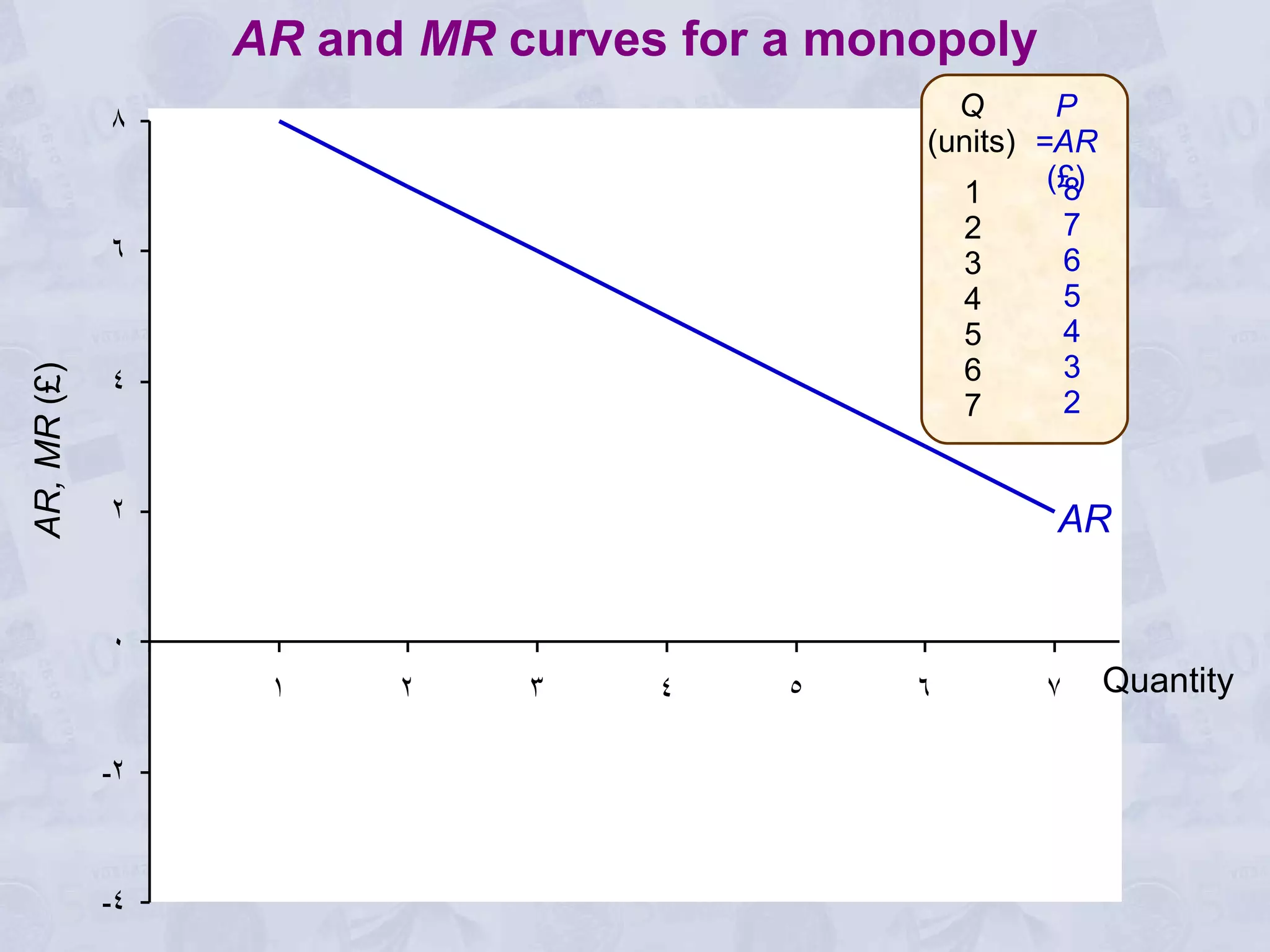
Monopoly The monopolist's demand curve downward sloping MR  below  AR
AR  and  MR  curves for a monopoly Q (units) 1 2 3 4 5 6 7 P =AR (£) 8 7 6 5 4 3 2 AR AR, MR  (£) Quantity
AR  and  MR  curves for a monopoly Q (units) 1 2 3 4 5 6 7 P =AR (£) 8 7 6 5 4 3 2 TR (£) 8 14 18 20 20 18 14 MR (£) 6 4 2 0 -2 -4 MR AR, MR  (£) Quantity AR
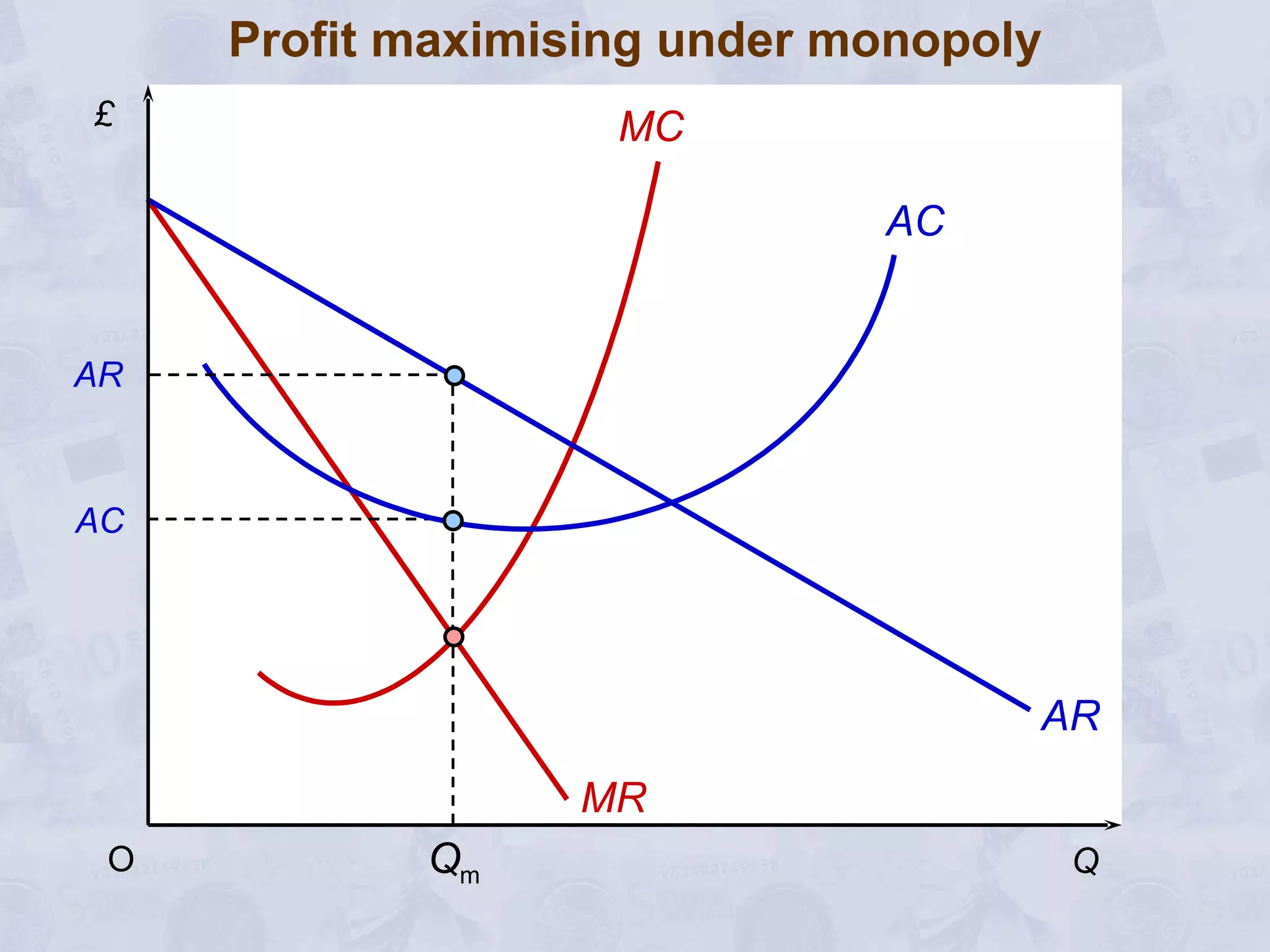
Monopoly Equilibrium price and output MC = MR
Profit maximising under monopoly £  Q  O Q m MR MC
Monopoly Equilibrium price and output MC = MR measuring level of supernormal profit
Profit maximising under monopoly £  Q  O Q m MR MC
Profit maximising under monopoly £  Q  O MC   Q m MR AC AR  AC  AR
Profit maximising under monopoly £  Q  O MC   AC Q m MR AR AR  AC  Total profit
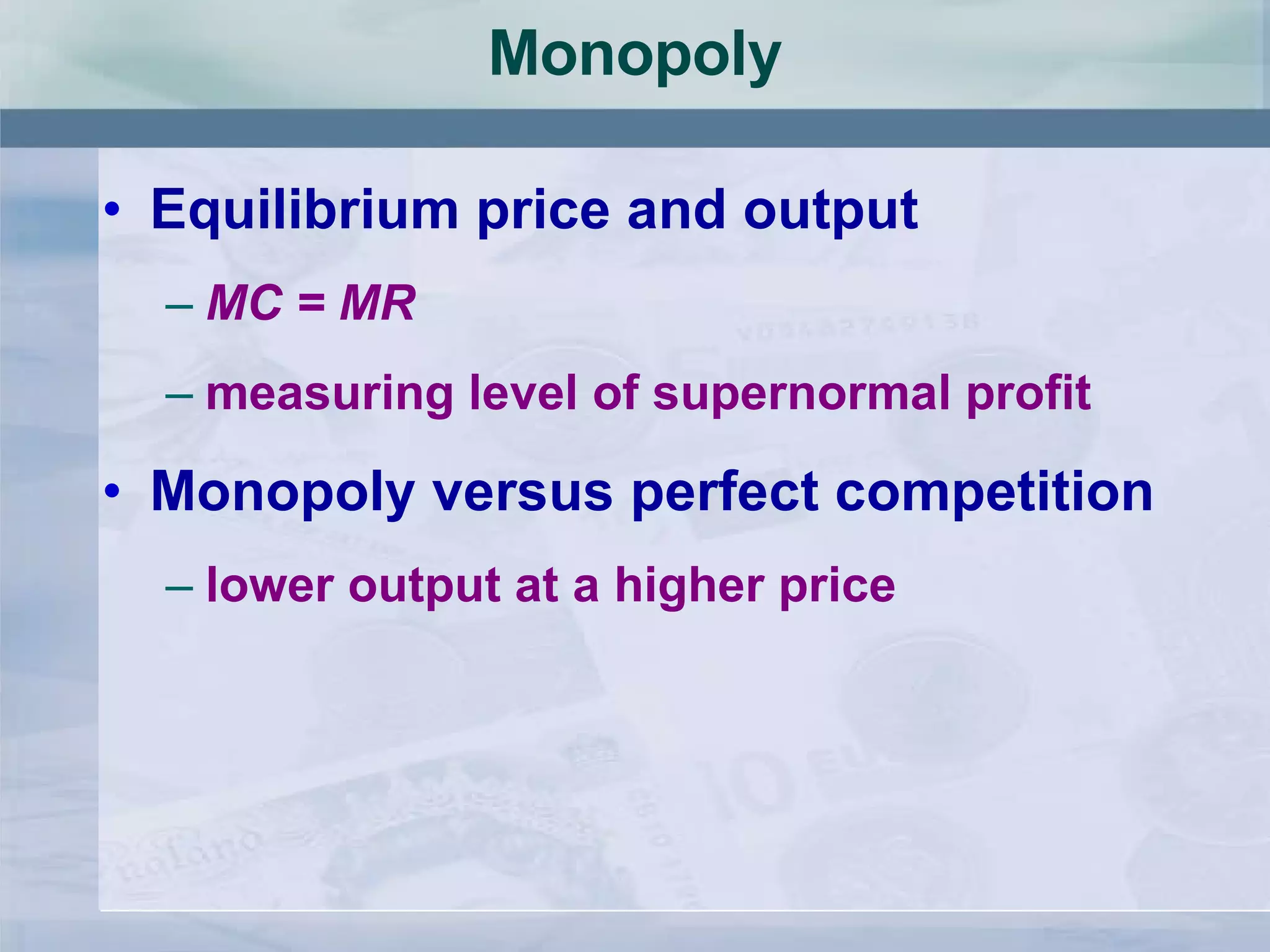
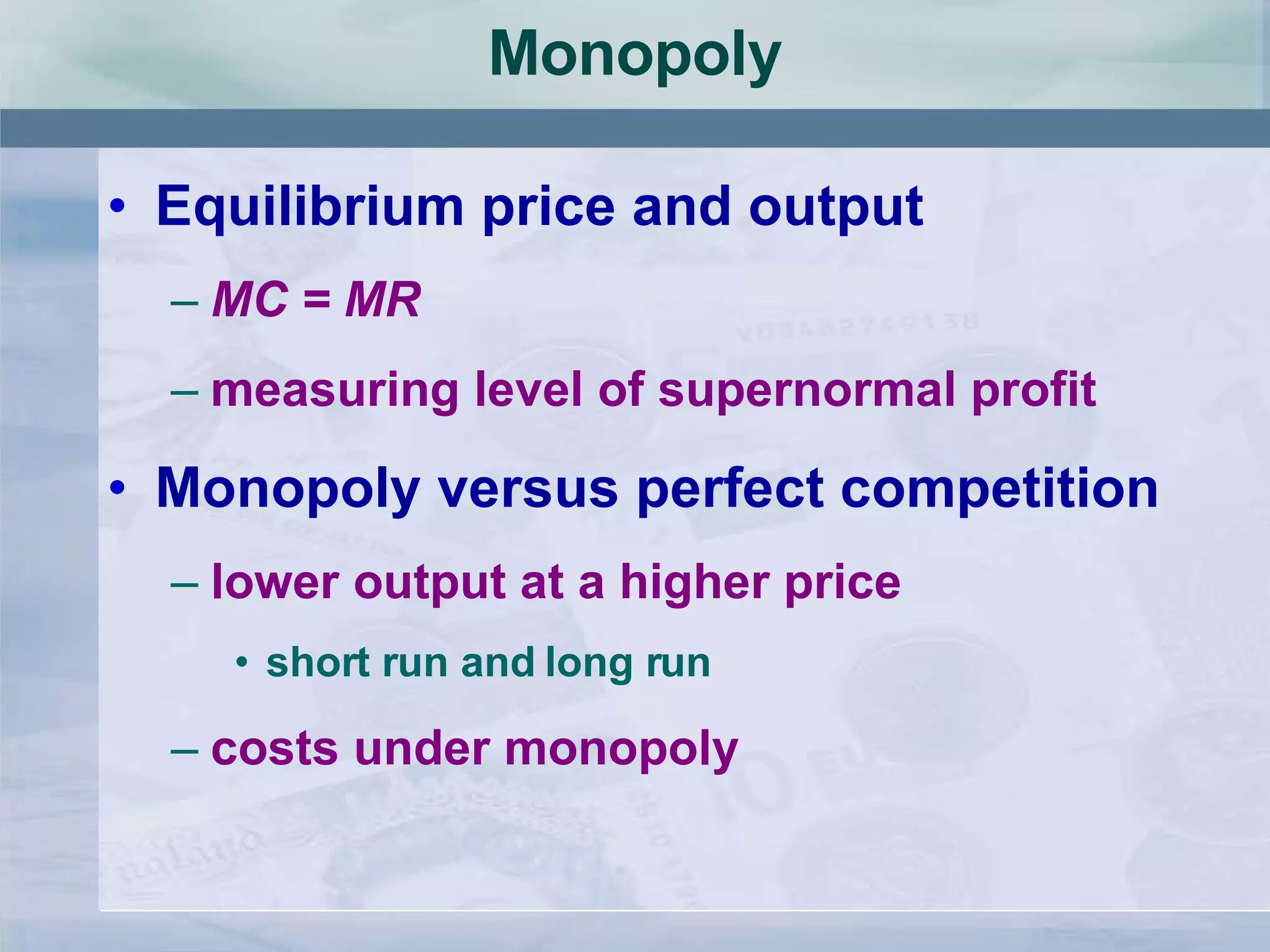
Monopoly Equilibrium price and output MC = MR measuring level of supernormal profit Monopoly versus perfect competition
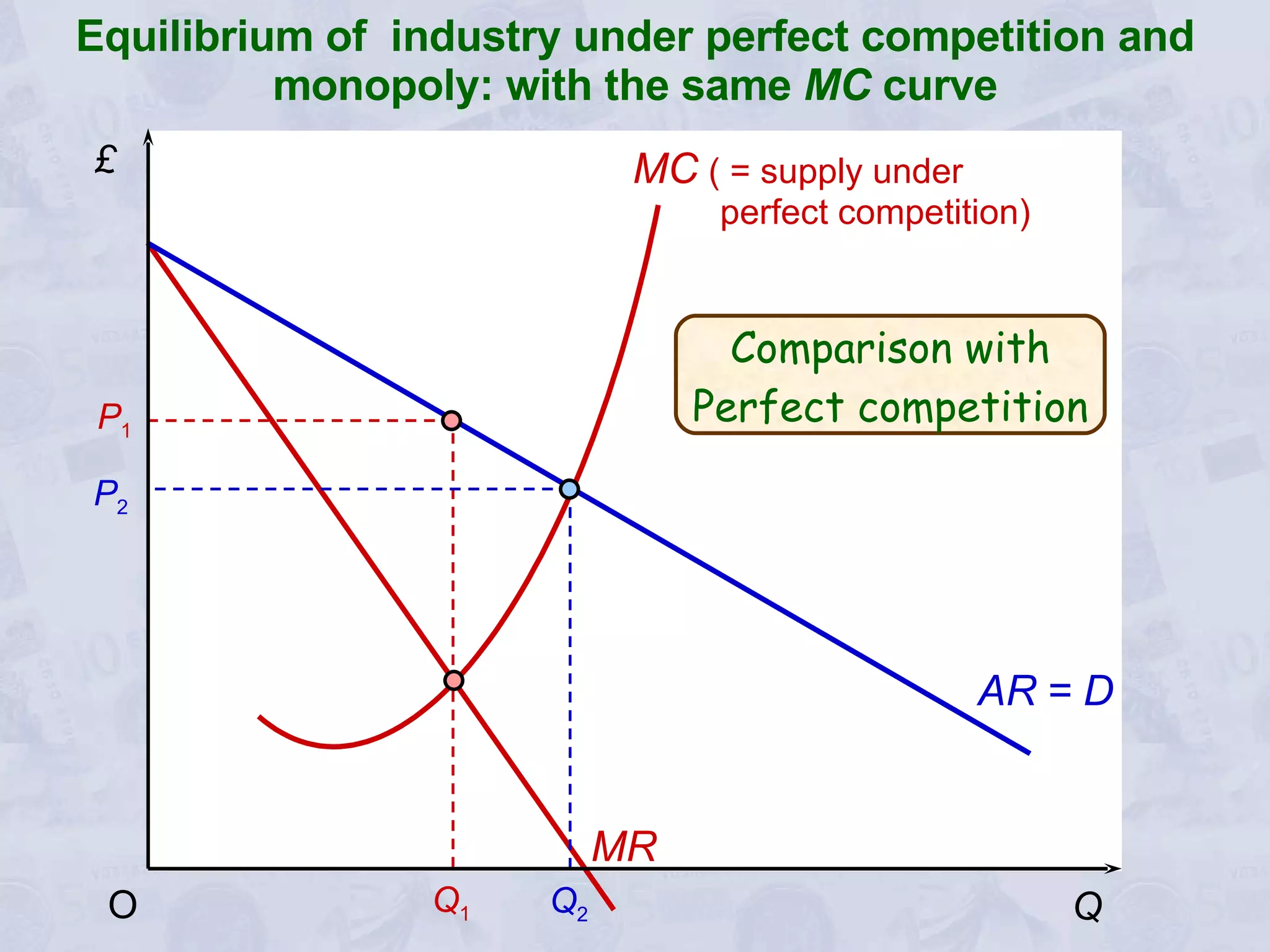
Monopoly Equilibrium price and output MC = MR measuring level of supernormal profit Monopoly versus perfect competition lower output at a higher price
Equilibrium of  industry under perfect competition and monopoly: with the same  MC  curve £  Q  O Q 1 P 1 Monopoly AR = D MC  MR
Equilibrium of  industry under perfect competition and monopoly: with the same  MC  curve £  Q  O MC  ( = supply under  perfect competition) Q 1 MR P 1 Q 2 AR = D Comparison with Perfect competition P 2
Monopoly Equilibrium price and output MC = MR measuring level of supernormal profit Monopoly versus perfect competition lower output at a higher price short run and long run
Monopoly Equilibrium price and output MC = MR measuring level of supernormal profit Monopoly versus perfect competition lower output at a higher price short run and long run costs under monopoly
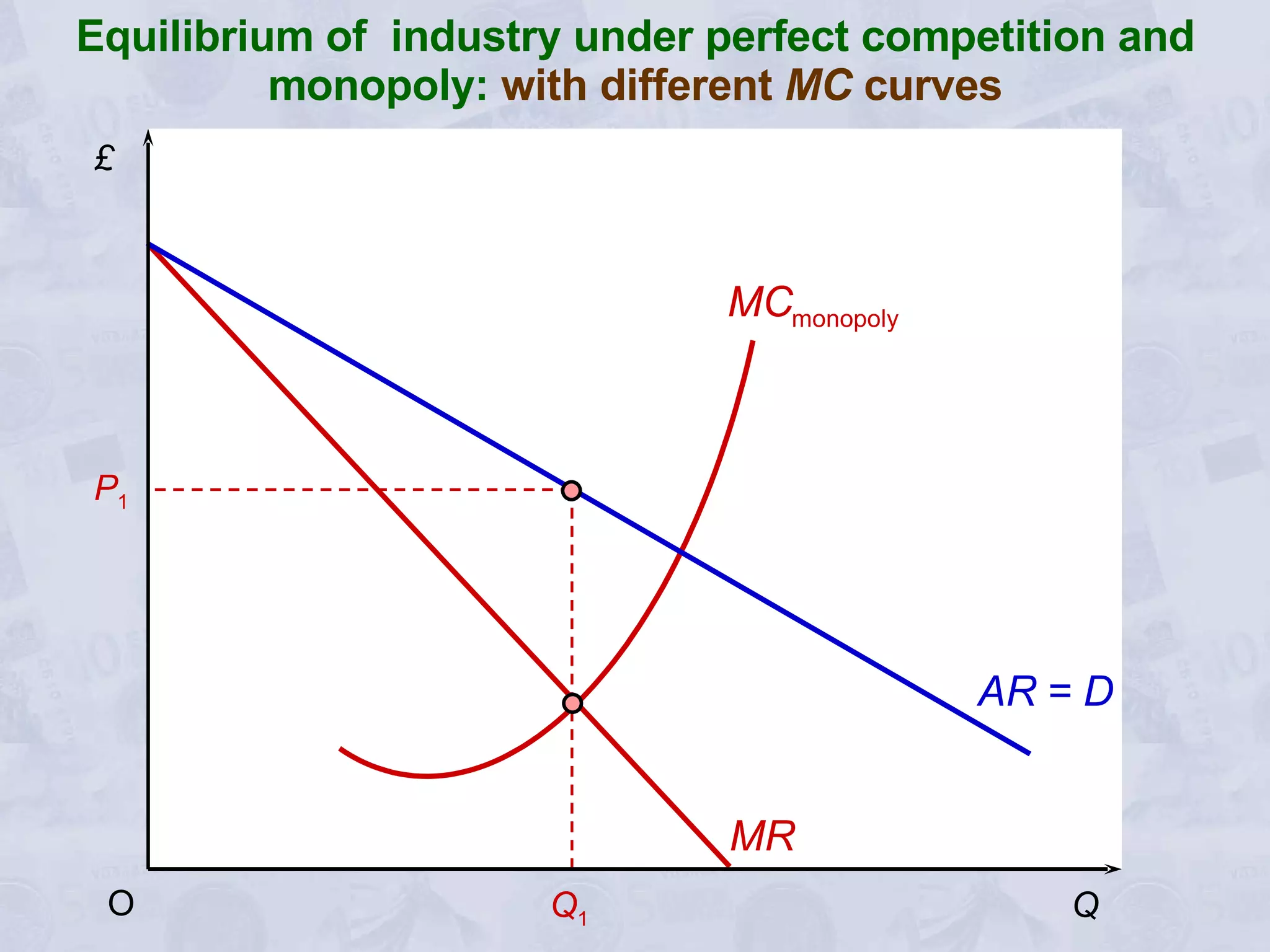
Equilibrium of  industry under perfect competition and monopoly:  with different  MC  curves £  Q  O Q 1 MR P 1 MC monopoly AR = D
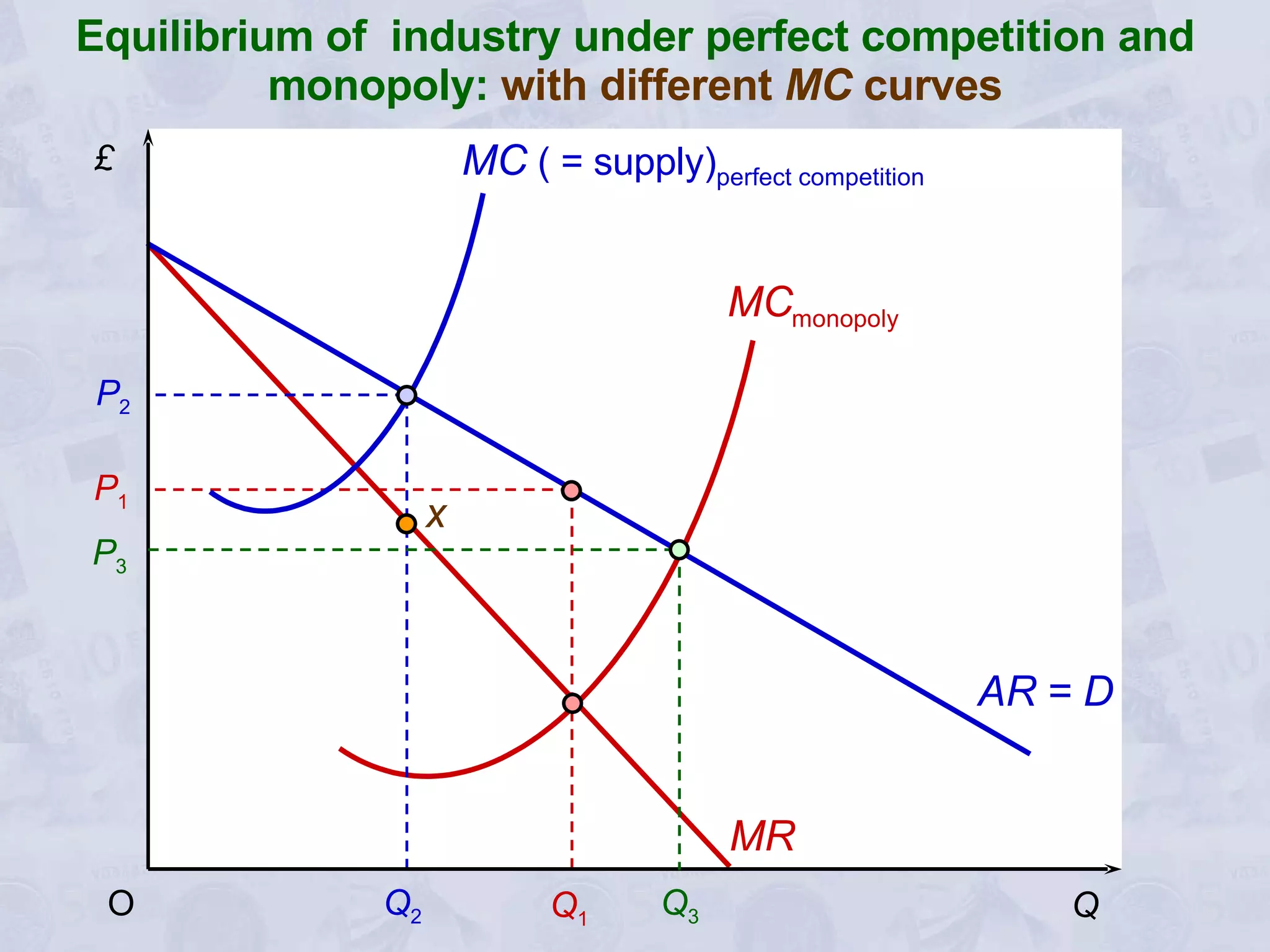
Equilibrium of  industry under perfect competition and monopoly:  with different  MC  curves £  Q  O MC  ( = supply) perfect competition Q 1 MR P 1 P 2 Q 2 MC monopoly AR = D x Q 3 P 3
Monopoly Equilibrium price and output MC = MR measuring level of supernormal profit Monopoly versus perfect competition lower output at a higher price short run and long run costs under monopoly innovation and new products
Contestable Markets Importance of potential competition low entry costs low exit costs Perfectly contestable markets Contestable markets & natural monopolies The importance of costless exit absence of sunk costs hit-and-run competition Assessment of the theory

Profitmax

  • 1.
    Profit Maximisation underPerfect Competition and Monopoly
  • 2.
    Alternative Market StructuresClassifying markets (by degree of competition) number of firms freedom of entry to industry free, restricted or blocked? nature of product homogeneous or differentiated? nature of demand curve degree of control the firm has over price
  • 3.
    Alternative Market StructuresThe four market structures perfect competition monopoly monopolistic competition oligopoly
  • 4.
    Features of thefour market structures
  • 5.
    Features of thefour market structures
  • 6.
    Features of thefour market structures
  • 7.
    Features of thefour market structures
  • 8.
    Features of thefour market structures
  • 9.
    Features of thefour market structures
  • 10.
    Alternative Market StructuresThe four market structures perfect competition monopoly monopolistic competition oligopoly Structure  conduct  performance
  • 11.
    Perfect Competition Assumptionsfirms are price takers freedom of entry of firms to industry identical products perfect knowledge Distinction between short and long run normal profits supernormal profits
  • 12.
    Perfect Competition Short-runequilibrium of the firm Price given by market demand and supply Output where P = MC Profit ( AR – AC ) × Q possible supernormal profits
  • 13.
    Short-run equilibrium ofindustry and firm under perfect competition O £ (b) Firm Q (thousands) O (a) Industry P Q (millions) Q e S D P e MC AR D = AR = MR AC AC
  • 14.
    Loss minimising underperfect competition O O (a) Industry P £ Q (millions) S D (b) Firm Q (thousands) Q e P 1 D 1 = AR 1 = MR 1 AR 1 MC AC AC
  • 15.
    Short-run shut-down pointO O (a) Industry P £ Q (millions) S (b) Firm MC AC Q (thousands) D 2 P 2 AR 2 D 2 = AR 2 = MR 2 AVC
  • 16.
    Perfect Competition Short-runequilibrium of the firm (cont.) short-run supply curve of firm the MC curve Short-run supply curve of industry sum of supply curves of firms
  • 17.
    Perfect Competition Thelong run long-run equilibrium of the firm all supernormal profits competed away
  • 18.
    Long-run equilibrium underperfect competition O O P £ Q (millions) Q L Q (thousands) New firms enter Supernormal profits Profits return to normal (a) Industry (b) Firm S 1 D LRAC P L P 1 S e AR 1 D 1 AR L D L
  • 19.
    Perfect Competition Thelong run long-run equilibrium of the firm all supernormal profits competed away LRAC = AC = MC = MR = AR
  • 20.
    Long-run equilibrium ofthe firm under perfect competition £ Q O (SR)AC (SR)MC LRAC AR = MR D L LRAC = (SR)AC = (SR)MC = MR = AR
  • 21.
    Perfect Competition Thelong run long-run equilibrium of the firm all supernormal profits competed away LRAC = AC = MC = MR = AR long-run industry supply curve
  • 22.
    Perfect Competition Thelong run long-run equilibrium of the firm all supernormal profits competed away LRAC = AC = MC = MR = AR long-run industry supply curve incompatibility of economies of scale with perfect competition
  • 23.
    Perfect Competition Thelong run long-run equilibrium of the firm all supernormal profits competed away LRAC = AC = MC = MR = AR long-run industry supply curve incompatibility of economies of scale with perfect competition Does the firm benefit from operating under perfect competition?
  • 24.
    Monopoly Defining monopolyimportance of market power concentration ratios
  • 25.
  • 26.
    Monopoly Barriers toentry economies of scale product differentiation and brand loyalty lower costs for an established firm ownership/control of key factors or outlets legal protection mergers and takeovers aggressive tactics
  • 27.
    Monopoly The monopolist'sdemand curve downward sloping MR below AR
  • 28.
    AR and MR curves for a monopoly Q (units) 1 2 3 4 5 6 7 P =AR (£) 8 7 6 5 4 3 2 AR AR, MR (£) Quantity
  • 29.
    AR and MR curves for a monopoly Q (units) 1 2 3 4 5 6 7 P =AR (£) 8 7 6 5 4 3 2 TR (£) 8 14 18 20 20 18 14 MR (£) 6 4 2 0 -2 -4 MR AR, MR (£) Quantity AR
  • 30.
    Monopoly Equilibrium priceand output MC = MR
  • 31.
    Profit maximising undermonopoly £ Q O Q m MR MC
  • 32.
    Monopoly Equilibrium priceand output MC = MR measuring level of supernormal profit
  • 33.
    Profit maximising undermonopoly £ Q O Q m MR MC
  • 34.
    Profit maximising undermonopoly £ Q O MC Q m MR AC AR AC AR
  • 35.
    Profit maximising undermonopoly £ Q O MC AC Q m MR AR AR AC Total profit
  • 36.
    Monopoly Equilibrium priceand output MC = MR measuring level of supernormal profit Monopoly versus perfect competition
  • 37.
    Monopoly Equilibrium priceand output MC = MR measuring level of supernormal profit Monopoly versus perfect competition lower output at a higher price
  • 38.
    Equilibrium of industry under perfect competition and monopoly: with the same MC curve £ Q O Q 1 P 1 Monopoly AR = D MC MR
  • 39.
    Equilibrium of industry under perfect competition and monopoly: with the same MC curve £ Q O MC ( = supply under perfect competition) Q 1 MR P 1 Q 2 AR = D Comparison with Perfect competition P 2
  • 40.
    Monopoly Equilibrium priceand output MC = MR measuring level of supernormal profit Monopoly versus perfect competition lower output at a higher price short run and long run
  • 41.
    Monopoly Equilibrium priceand output MC = MR measuring level of supernormal profit Monopoly versus perfect competition lower output at a higher price short run and long run costs under monopoly
  • 42.
    Equilibrium of industry under perfect competition and monopoly: with different MC curves £ Q O Q 1 MR P 1 MC monopoly AR = D
  • 43.
    Equilibrium of industry under perfect competition and monopoly: with different MC curves £ Q O MC ( = supply) perfect competition Q 1 MR P 1 P 2 Q 2 MC monopoly AR = D x Q 3 P 3
  • 44.
    Monopoly Equilibrium priceand output MC = MR measuring level of supernormal profit Monopoly versus perfect competition lower output at a higher price short run and long run costs under monopoly innovation and new products
  • 45.
    Contestable Markets Importanceof potential competition low entry costs low exit costs Perfectly contestable markets Contestable markets & natural monopolies The importance of costless exit absence of sunk costs hit-and-run competition Assessment of the theory