STRATEGIC MARKETING VS TACTICAL MARKETING
WHICH IS BETTER ?
INFOGRAPHICS OF STRATEGIC MARKETING
 Many people use the word strategy very
commonly, politicians talk about it,
religious leaders talk about the strategy
to outclass the communal elements in
society, Police needs to have a
strategy to curb theft, goondaism or
burglary in an area.
 In simple terms, strategy marketing is a
plan to achieve a target or a goal – it
could be achieving more sales volume in
rural areas
 it could be getting more women votes
in the Assembly election or it could be
emerging number one in cosmetics
market and so on.
INFOGRAPHICS OF TACTICAL MARKETING
 To gain women votes, politicians may distribute sarees for free in an area, to emerge the leader in
cosmetics industry, a company may spend heavily on mass media campaigns and sponsoring
beauty pageants.
 When strategy and tactics combine, the net result could be an upward shift in demand for the
product, more brand awareness, more sales volumes achieved.
 Or a company may adopt competitive pricing to stay ahead of the others in industry or to achieve
maximum sales volume.
WHO COMES FIRST?
TACTICS OR STRATEGY?
 it is strategy or the marketing plan that has to come first, followed the tactics.
However, it is not to belittle the tactics part of marketing.
 According to Jim Joseph, marketing expert and author, tactics are important in the
sense that it connects with the customers and motivates them to buy.
STRATEGY COMES FIRST
 Most countries have a Planning Commission just as in
India which identify the long term goals of developing
infrastructure, resources, housing, raising employment,
raising educational levels of poor and rural people.
 For companies, developing a marketing plan or strategy is
the first step to get noticed in the market place. Unlike
a business plan, a marketing plan is developed with the
intention of winning and retaining customers. It also spells
out the tactics and tools to achieve it
 Both strategy and tactics require a broad understanding of
the target audience, their taste and preference
and motivation to buy products apart from understanding
the status of the industry, the company’s status and that of
the competitors.
STRATEGY PLANNING
PROCESS
THE 5 PROCESS OF STRATEGY PLANNING
MARKET SHARE AND
STRENGTH OF THE COMPANY
 How much of the market share you have in the
industry and how you fare against the
competition is vital for making a marketing plan.
 A comprehensive SWOT analysis (Strength,
Weaknesses, Opportunities and Threats ) are
required to do a situation analysis.
 Market strength refers to number of your brands
in top five selling category, weakness could be a
saturated market or a lack of experienced
people in marketing and sales.
MARKET SHARE AND
STRENGTH OF THE COMPANY
Opportunities could include
changes, new markets opening up or
the disintegration of a market leader.
The product needs to be positioned
the market- entry, mid or premium. It
depends on your competition, which
all buyers are likely to buy the
and at what price.
MARKET SHARE AND
STRENGTH OF THE COMPANY
IDENTIFY THE TARGET AUDIENCE
 A marketer should be able to clearly identify the target audience for its
products and services. It should be defined in terms of demographics age,
sex, family, income, lifestyle levels among others.
 Are they conservative or traditional, do they have higher disposable incomes
and motivated to spend more? Are they business class, salaried and at
marginal income levels?
LONG TERM MARKETING GOAL SHOULD BE DEFINED
 A marketing goal can be
attain number one position
in geography or with
respect to a particular
brand or it could be to
achieve more sales. But it is
very important to specify in
quantitative terms, say 10 or
25% increase in sales.
MARKETING COMMUNICATION STRATEGY TO BE DEVELOPED
 Once the product has been developed and
target audience have been defined, the next
step is to devise marketing communication
strategies to reach the target and persuade
them to act.
 It could be through mass media
advertisements, social media
campaigns (Twitter, Facebook, Pinterest, Reddit).
 Then marcomm strategy outlines the tactics to
be undertaken to achieve the objectives and
the execution of the tactic brings the desired
impact on the product and in the market.
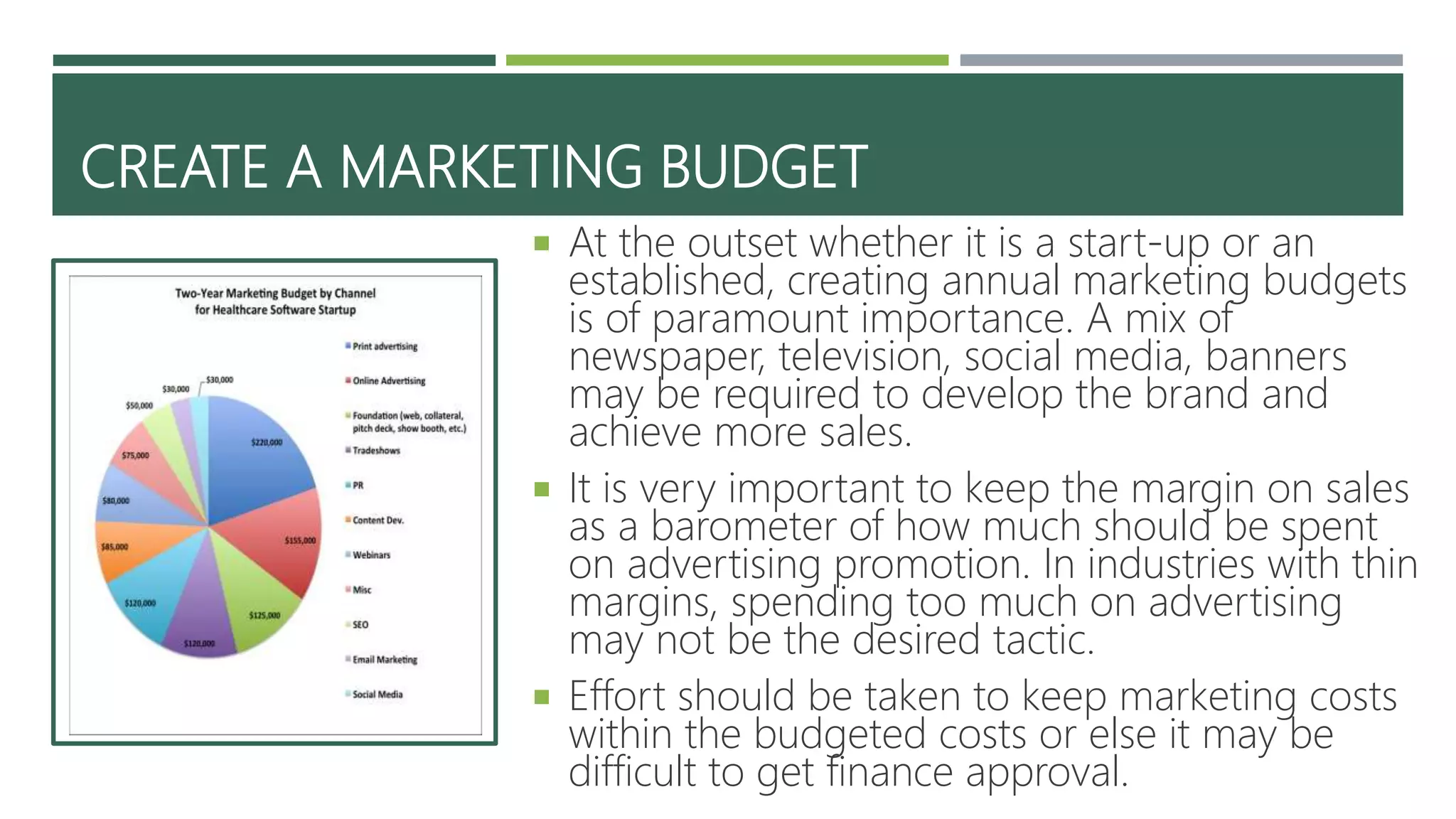
CREATE A MARKETING BUDGET
 At the outset whether it is a start-up or an
established, creating annual marketing budgets
is of paramount importance. A mix of
newspaper, television, social media, banners
may be required to develop the brand and
achieve more sales.
 It is very important to keep the margin on sales
as a barometer of how much should be spent
on advertising promotion. In industries with thin
margins, spending too much on advertising
may not be the desired tactic.
 Effort should be taken to keep marketing costs
within the budgeted costs or else it may be
difficult to get finance approval.
TACTICS-EVERYTHING REVOLVES
AROUND THE 4 P’S
IT WAS ONCE BELIEVED THAT IF YOU KNEW THE
FOUR P’S OF MARKETING YOU KNEW EVERYTHING
PRICING THE BASIC TACTIC
 Pricing is the basic tactic adopted by the
companies to attain their objectives. However, it is
also the most complex of the tactics to be pursued
by marketers.
 Too high a price could dissuade buyers away from
the product and get attracted to competitive offers
while a price that may be perceived as too low may
cause buyers to doubt its quality and value.
 Contrary to popular perception, price is not
calculated on the basis of cost plus a reasonable
profit. It is based on the brand image created in
the consumer minds and a level the market is
willing to bear.
PRICING THE BASIC TACTIC
 According to experts, pricing as a
marketing instrument is difficult to
leverage effectively as it involves
decision making horizontally and
vertically within an organization.
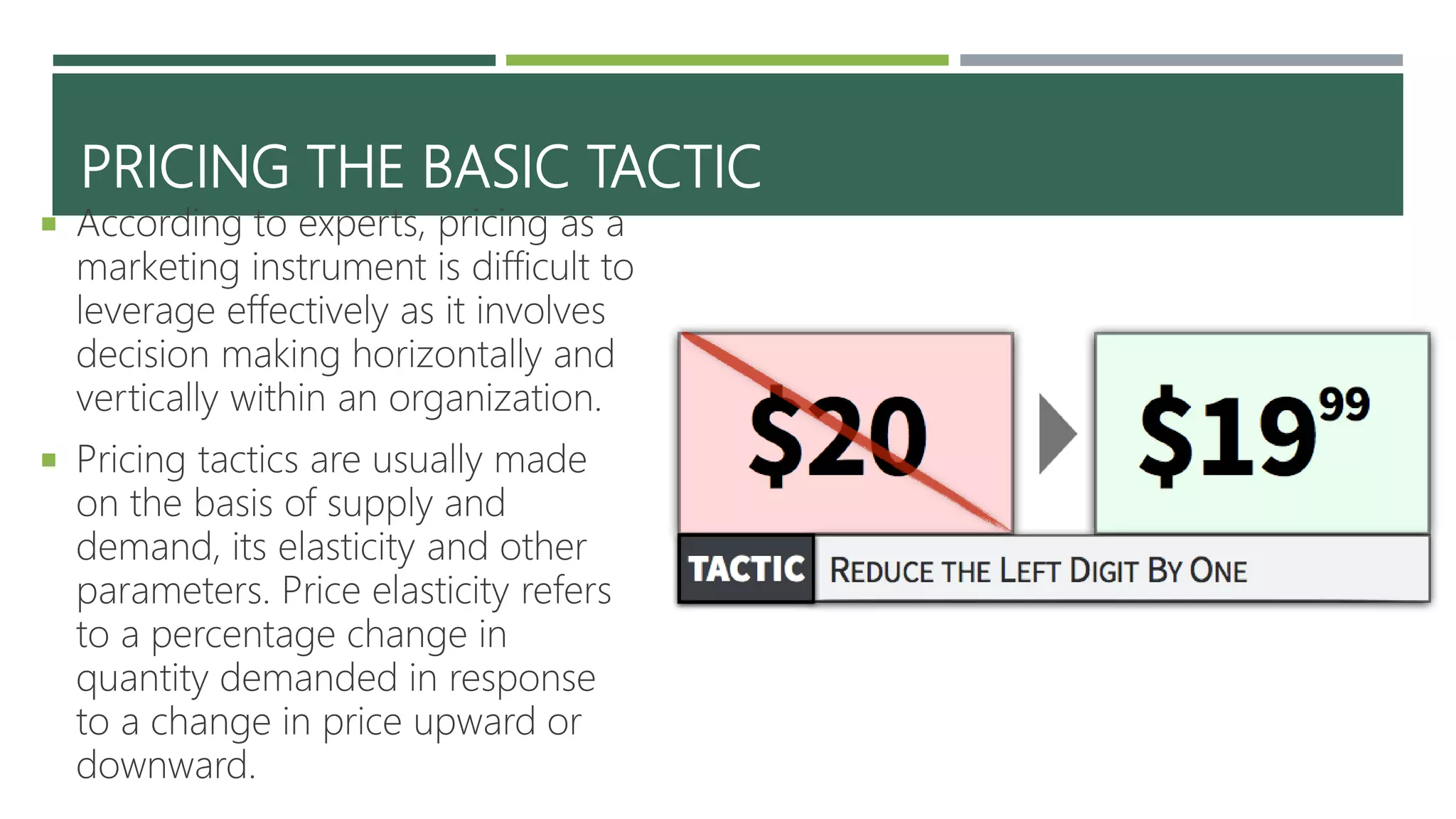
 Pricing tactics are usually made
on the basis of supply and
demand, its elasticity and other
parameters. Price elasticity refers
to a percentage change in
quantity demanded in response
to a change in price upward or
downward.
STRATEGY VS. TACTICAL PRICING MARKETING
Strategic Marketing
pricing takes into
account long-term profit
objectives of the
organization.
tactical pricing is about
achieving short term
objectives such as festival
offer, end-of-season sale
at 50% off and so on.
PRODUCT DYNAMICS
 Sometimes the product may have to be
altered or abandoned and a new
product developed in view of the
competition.
 Mosquito repellents in India were
initially smoke coils which caused
breathing problems for many people
and also littered the place with the ash.
 Thereafter, companies started to
develop liquid repellents that worked
on electric current by slowly
discharging the liquid and smell driving
away mosquitoes.
PLACE AND GEOGRAPHICAL TARGETING
 Most products are sensitive to
geographies and cultural
differences.
 What sells in the rural market may
not appeal to the urban market.
 Low priced cars may be more
suitable for emerging markets than
developed markets while places with
extreme cold, humidity and hot
conditions require different kinds of
products specifically for that region
PROMOTIONS AND THE CHANGING TECHNOLOGIES
 Marketing promotion involves
communicating the brand message to
the consumer through mass
media, email campaigns, social media,
hoardings, banners, taking part in
events, trade fairs.
 Marketing communication activities are
part of the marketing strategy to
achieve certain long term objectives of
branding, achieving more sales, more
market share, or related objectives
PROMOTIONS AND THE CHANGING TECHNOLOGIES
 The millennials were those born in the US between 1980 and 2000 have a different mindset towards
buying, spending and consumption patterns. They comprise 79 million people with a purchasing
power of $170 bn a year.
 This group are more disposed online, social media and mobile technologies. Therefore, more effort
needs to be taken to address this target group. What sets apart Millennials from boomers and Gen
Xers are they tend to share everything with friends online.
 Therefore, brands can capitalize on that behavior by giving Millennials positive customer experiences
to share a tweet about the company or let others know they have bought your product.
 According to Mikal E Belicove, GSOT- goal, strategy. Objective and tactics are the best ways to
conceptualize a marketing plan. A goal is a broad primary outcome while strategy is the plan,
objective is the measurable step and tactics are the tools and techniques used to implement
the strategy.
 Any marketing strategy will not help unless both strategic marketing and tactical marketing
are employed in combination.
 The pre-requisites for a successful campaign are knowing the status of the company vis-as-vis
competition (market share), developing marketing communication and understanding the
target audience.
 With a proper understanding of all the above factors any campaign may end up to be a
failure not able to achieve the objectives.
 Strategic marketing is vital for achieving long term goals of the company and
those only adopting tactical marketing on an ad hoc basis risk the possibility
of not able to convert potential leads.
 Disruptive technologies, recessionary market conditions, new competition
from other industry verticals and competition within the industry are all
factors that could impact the fortunes of brands and hence marketers need to
be constantly on their toes to stay ahead.
 No marketer would be wise enough to ignore the inbound marketing
strategies now in vogue thanks to rise in internet
penetration, websites, blogging and search engine optimization (SEO)
techniques.

Strategic Marketing versus Tactical Marketing

  • 1.
    STRATEGIC MARKETING VSTACTICAL MARKETING WHICH IS BETTER ?
  • 2.
    INFOGRAPHICS OF STRATEGICMARKETING  Many people use the word strategy very commonly, politicians talk about it, religious leaders talk about the strategy to outclass the communal elements in society, Police needs to have a strategy to curb theft, goondaism or burglary in an area.  In simple terms, strategy marketing is a plan to achieve a target or a goal – it could be achieving more sales volume in rural areas  it could be getting more women votes in the Assembly election or it could be emerging number one in cosmetics market and so on.
  • 3.
    INFOGRAPHICS OF TACTICALMARKETING  To gain women votes, politicians may distribute sarees for free in an area, to emerge the leader in cosmetics industry, a company may spend heavily on mass media campaigns and sponsoring beauty pageants.  When strategy and tactics combine, the net result could be an upward shift in demand for the product, more brand awareness, more sales volumes achieved.  Or a company may adopt competitive pricing to stay ahead of the others in industry or to achieve maximum sales volume.
  • 4.
    WHO COMES FIRST? TACTICSOR STRATEGY?  it is strategy or the marketing plan that has to come first, followed the tactics. However, it is not to belittle the tactics part of marketing.  According to Jim Joseph, marketing expert and author, tactics are important in the sense that it connects with the customers and motivates them to buy.
  • 5.
    STRATEGY COMES FIRST Most countries have a Planning Commission just as in India which identify the long term goals of developing infrastructure, resources, housing, raising employment, raising educational levels of poor and rural people.  For companies, developing a marketing plan or strategy is the first step to get noticed in the market place. Unlike a business plan, a marketing plan is developed with the intention of winning and retaining customers. It also spells out the tactics and tools to achieve it  Both strategy and tactics require a broad understanding of the target audience, their taste and preference and motivation to buy products apart from understanding the status of the industry, the company’s status and that of the competitors.
  • 6.
    STRATEGY PLANNING PROCESS THE 5PROCESS OF STRATEGY PLANNING
  • 7.
    MARKET SHARE AND STRENGTHOF THE COMPANY  How much of the market share you have in the industry and how you fare against the competition is vital for making a marketing plan.  A comprehensive SWOT analysis (Strength, Weaknesses, Opportunities and Threats ) are required to do a situation analysis.  Market strength refers to number of your brands in top five selling category, weakness could be a saturated market or a lack of experienced people in marketing and sales.
  • 8.
    MARKET SHARE AND STRENGTHOF THE COMPANY Opportunities could include changes, new markets opening up or the disintegration of a market leader. The product needs to be positioned the market- entry, mid or premium. It depends on your competition, which all buyers are likely to buy the and at what price.
  • 9.
  • 10.
    IDENTIFY THE TARGETAUDIENCE  A marketer should be able to clearly identify the target audience for its products and services. It should be defined in terms of demographics age, sex, family, income, lifestyle levels among others.  Are they conservative or traditional, do they have higher disposable incomes and motivated to spend more? Are they business class, salaried and at marginal income levels?
  • 11.
    LONG TERM MARKETINGGOAL SHOULD BE DEFINED  A marketing goal can be attain number one position in geography or with respect to a particular brand or it could be to achieve more sales. But it is very important to specify in quantitative terms, say 10 or 25% increase in sales.
  • 12.
    MARKETING COMMUNICATION STRATEGYTO BE DEVELOPED  Once the product has been developed and target audience have been defined, the next step is to devise marketing communication strategies to reach the target and persuade them to act.  It could be through mass media advertisements, social media campaigns (Twitter, Facebook, Pinterest, Reddit).  Then marcomm strategy outlines the tactics to be undertaken to achieve the objectives and the execution of the tactic brings the desired impact on the product and in the market.
  • 13.
    CREATE A MARKETINGBUDGET  At the outset whether it is a start-up or an established, creating annual marketing budgets is of paramount importance. A mix of newspaper, television, social media, banners may be required to develop the brand and achieve more sales.  It is very important to keep the margin on sales as a barometer of how much should be spent on advertising promotion. In industries with thin margins, spending too much on advertising may not be the desired tactic.  Effort should be taken to keep marketing costs within the budgeted costs or else it may be difficult to get finance approval.
  • 14.
    TACTICS-EVERYTHING REVOLVES AROUND THE4 P’S IT WAS ONCE BELIEVED THAT IF YOU KNEW THE FOUR P’S OF MARKETING YOU KNEW EVERYTHING
  • 15.
    PRICING THE BASICTACTIC  Pricing is the basic tactic adopted by the companies to attain their objectives. However, it is also the most complex of the tactics to be pursued by marketers.  Too high a price could dissuade buyers away from the product and get attracted to competitive offers while a price that may be perceived as too low may cause buyers to doubt its quality and value.  Contrary to popular perception, price is not calculated on the basis of cost plus a reasonable profit. It is based on the brand image created in the consumer minds and a level the market is willing to bear.
  • 16.
    PRICING THE BASICTACTIC  According to experts, pricing as a marketing instrument is difficult to leverage effectively as it involves decision making horizontally and vertically within an organization.  Pricing tactics are usually made on the basis of supply and demand, its elasticity and other parameters. Price elasticity refers to a percentage change in quantity demanded in response to a change in price upward or downward.
  • 17.
    STRATEGY VS. TACTICALPRICING MARKETING Strategic Marketing pricing takes into account long-term profit objectives of the organization. tactical pricing is about achieving short term objectives such as festival offer, end-of-season sale at 50% off and so on.
  • 18.
    PRODUCT DYNAMICS  Sometimesthe product may have to be altered or abandoned and a new product developed in view of the competition.  Mosquito repellents in India were initially smoke coils which caused breathing problems for many people and also littered the place with the ash.  Thereafter, companies started to develop liquid repellents that worked on electric current by slowly discharging the liquid and smell driving away mosquitoes.
  • 19.
    PLACE AND GEOGRAPHICALTARGETING  Most products are sensitive to geographies and cultural differences.  What sells in the rural market may not appeal to the urban market.  Low priced cars may be more suitable for emerging markets than developed markets while places with extreme cold, humidity and hot conditions require different kinds of products specifically for that region
  • 20.
    PROMOTIONS AND THECHANGING TECHNOLOGIES  Marketing promotion involves communicating the brand message to the consumer through mass media, email campaigns, social media, hoardings, banners, taking part in events, trade fairs.  Marketing communication activities are part of the marketing strategy to achieve certain long term objectives of branding, achieving more sales, more market share, or related objectives
  • 21.
    PROMOTIONS AND THECHANGING TECHNOLOGIES  The millennials were those born in the US between 1980 and 2000 have a different mindset towards buying, spending and consumption patterns. They comprise 79 million people with a purchasing power of $170 bn a year.  This group are more disposed online, social media and mobile technologies. Therefore, more effort needs to be taken to address this target group. What sets apart Millennials from boomers and Gen Xers are they tend to share everything with friends online.  Therefore, brands can capitalize on that behavior by giving Millennials positive customer experiences to share a tweet about the company or let others know they have bought your product.
  • 22.
     According toMikal E Belicove, GSOT- goal, strategy. Objective and tactics are the best ways to conceptualize a marketing plan. A goal is a broad primary outcome while strategy is the plan, objective is the measurable step and tactics are the tools and techniques used to implement the strategy.  Any marketing strategy will not help unless both strategic marketing and tactical marketing are employed in combination.  The pre-requisites for a successful campaign are knowing the status of the company vis-as-vis competition (market share), developing marketing communication and understanding the target audience.  With a proper understanding of all the above factors any campaign may end up to be a failure not able to achieve the objectives.
  • 23.
     Strategic marketingis vital for achieving long term goals of the company and those only adopting tactical marketing on an ad hoc basis risk the possibility of not able to convert potential leads.  Disruptive technologies, recessionary market conditions, new competition from other industry verticals and competition within the industry are all factors that could impact the fortunes of brands and hence marketers need to be constantly on their toes to stay ahead.  No marketer would be wise enough to ignore the inbound marketing strategies now in vogue thanks to rise in internet penetration, websites, blogging and search engine optimization (SEO) techniques.