Marketing Today
Chapter 1
Chapter Objectives
To illustrate the exciting, dynamic, and influential nature of
marketing
To define marketing and trace its evolution—with emphasis on the
marketing concept, a marketing philosophy, customer service,
and customer satisfaction and relationship marketing
To show the importance of marketing as field of study
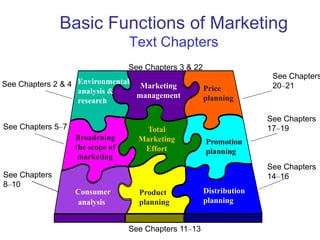
To describe the basic functions of marketing and those that perform
these functions
Marketing Definition
 Marketing is the Anticipation, Management
and Satisfaction of Demand through the
Exchange Process.
Goals:
1. Attract new customers by promising superior
value.
2. Keep and grow current customers by
delivering satisfaction.
Definition of Marketing
 Anticipation of Demand requires a firm to do
consumer research in anticipation of market’s
potential and consumers’ desires.
 Management of Demand includes:
Stimulation: motivates consumers to want
firm’s offerings
Facilitation: makes it easy to buy offerings
Regulation: involves balancing inventory to
consumer demand
Definition of Marketing
 Satisfaction of Demand involves product
availability, product performance, perceptions
of safety, and after-sale services.
 An Exchange Process includes the
agreement for payment: cash/credit/promise
to pay or support for a firm, institution, idea,
or place.
Definition of Marketing
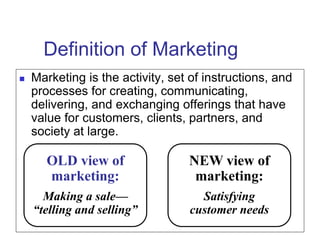
 Marketing is the activity, set of instructions, and
processes for creating, communicating,
delivering, and exchanging offerings that have
value for customers, clients, partners, and
society at large.
OLD view of
marketing:
Making a sale—
“telling and selling”
NEW view of
marketing:
Satisfying
customer needs
Ethical Exchanges
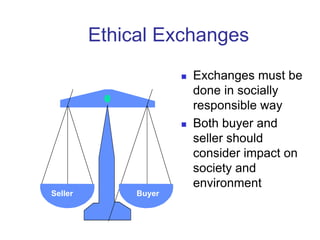
 Exchanges must be
done in socially
responsible way
 Both buyer and
seller should
consider impact on
society and
environment
Buyer
Seller
Consumer & Publics’ Demand
 Consumer Demand
refers to final and
organizational
consumers
 Publics’ Demand
refers to needs of
unions, employees,
stock holders and
general public
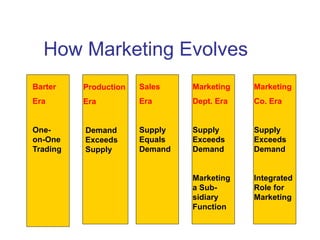
How Marketing Evolves
Barter
Era
One-
on-One
Trading
Production
Era
Demand
Exceeds
Supply
Sales
Era
Supply
Equals
Demand
Marketing
Dept. Era
Supply
Exceeds
Demand
Marketing
a Sub-
sidiary
Function
Marketing
Co. Era
Supply
Exceeds
Demand
Integrated
Role for
Marketing
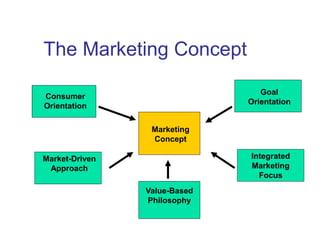
The Marketing Concept
Consumer
Orientation
Goal
Orientation
Marketing
Concept
Market-Driven
Approach
Value-Based
Philosophy
Integrated
Marketing
Focus
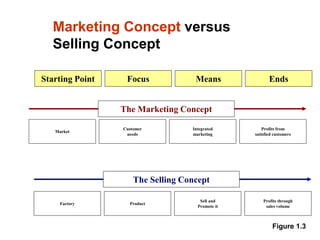
Marketing Concept versus
Selling Concept
Starting Point Focus Means Ends
Factory Product
Sell and
Promote it
Profits through
sales volume
The Selling Concept
Market
Customer
needs
Integrated
marketing
Profits from
satisfied customers
The Marketing Concept
Figure 1.3
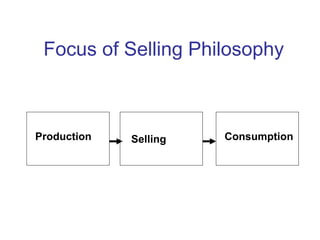
Focus of Selling Philosophy
Production Selling Consumption
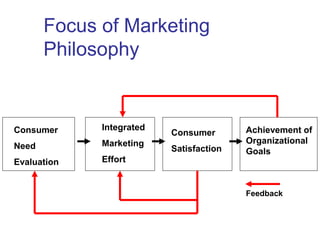
Focus of Marketing
Philosophy
Consumer
Need
Evaluation
Integrated
Marketing
Effort
Achievement of
Organizational
Goals
Consumer
Satisfaction
Feedback
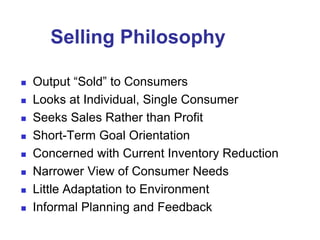
Selling Philosophy
 Output “Sold” to Consumers
 Looks at Individual, Single Consumer
 Seeks Sales Rather than Profit
 Short-Term Goal Orientation
 Concerned with Current Inventory Reduction
 Narrower View of Consumer Needs
 Little Adaptation to Environment
 Informal Planning and Feedback
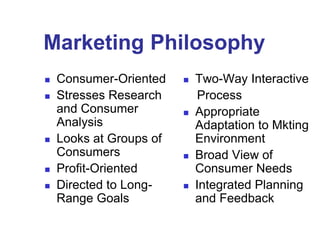
Marketing Philosophy
 Consumer-Oriented
 Stresses Research
and Consumer
Analysis
 Looks at Groups of
Consumers
 Profit-Oriented
 Directed to Long-
Range Goals
 Two-Way Interactive
Process
 Appropriate
Adaptation to Mkting
Environment
 Broad View of
Consumer Needs
 Integrated Planning
and Feedback
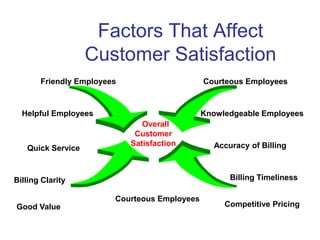
Factors That Affect
Customer Satisfaction
Overall
Customer
Satisfaction
Courteous Employees
Knowledgeable Employees
Friendly Employees
Helpful Employees
Accuracy of Billing
Quick Service
Courteous Employees
Billing Clarity Billing Timeliness
Good Value Competitive Pricing
Relationship Marketing
Through Relationship
Marketing, companies
build customer
satisfaction and
increase long-term
customer loyalty.
Customer Service
Customer Service tends to be intangible, but quite meaningful,
to many customers.
In today’s highly competitive, global marketplace, the level of
customer service a firm provides can affect its ability to attract
and retain customers more than ever before.
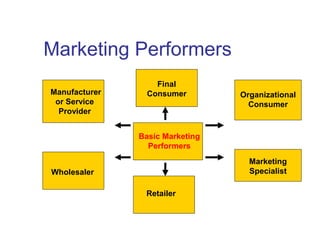
Marketing Performers
Organizational
Consumer
Marketing
Specialist
Manufacturer
or Service
Provider
Retailer
Wholesaler
Basic Marketing
Performers
Final
Consumer
Basic Functions of Marketing
Text Chapters
Environmental
analysis &
research
Total
Marketing
Effort
Marketing
management
Product
planning
Broadening
the scope of
marketing
Consumer
analysis
Promotion
planning
Distribution
planning
Price
planning
See Chapters 2 & 4
See Chapters 5–7
See Chapters
8–10
See Chapters 3 & 22
See Chapters
20–21
See Chapters
17–19
See Chapters
14–16
See Chapters 11–13
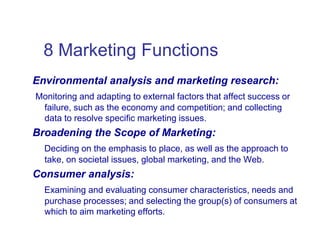
8 Marketing Functions
Environmental analysis and marketing research:
Monitoring and adapting to external factors that affect success or
failure, such as the economy and competition; and collecting
data to resolve specific marketing issues.
Broadening the Scope of Marketing:
Deciding on the emphasis to place, as well as the approach to
take, on societal issues, global marketing, and the Web.
Consumer analysis:
Examining and evaluating consumer characteristics, needs and
purchase processes; and selecting the group(s) of consumers at
which to aim marketing efforts.
8 Marketing Functions continued
Product planning (including goods, services, organizations,
people, places, ideas):
Developing and maintaining products, product assortments,
product images, brands, packaging, and optional features, and
deleting faltering products.
Distribution planning:
Forming logistical relationships with intermediaries, physical
distribution, inventory management, warehousing, transportation,
allocating goods and services, wholesaling, and retailing.
Promotion planning:
Communicating with customers, the general public, and others
through some type of advertising, public relations, personal
selling, and/or sales promotion.
8 Marketing Functions continued
Price planning:
Determining price levels and ranges, pricing techniques, terms of
purchase, price adjustments, and the use of price as an active or
passive factor.
Marketing management:
Planning, implementing, and controlling the marketing program
(strategy) and individual marketing functions; appraising the risks
and benefits in decision making; and focusing on total quality.

Chapter_01(Marketing Today).pptx

  • 1.
  • 2.
    Chapter Objectives To illustratethe exciting, dynamic, and influential nature of marketing To define marketing and trace its evolution—with emphasis on the marketing concept, a marketing philosophy, customer service, and customer satisfaction and relationship marketing To show the importance of marketing as field of study To describe the basic functions of marketing and those that perform these functions
  • 3.
    Marketing Definition  Marketingis the Anticipation, Management and Satisfaction of Demand through the Exchange Process. Goals: 1. Attract new customers by promising superior value. 2. Keep and grow current customers by delivering satisfaction.
  • 4.
    Definition of Marketing Anticipation of Demand requires a firm to do consumer research in anticipation of market’s potential and consumers’ desires.  Management of Demand includes: Stimulation: motivates consumers to want firm’s offerings Facilitation: makes it easy to buy offerings Regulation: involves balancing inventory to consumer demand
  • 5.
    Definition of Marketing Satisfaction of Demand involves product availability, product performance, perceptions of safety, and after-sale services.  An Exchange Process includes the agreement for payment: cash/credit/promise to pay or support for a firm, institution, idea, or place.
  • 6.
    Definition of Marketing Marketing is the activity, set of instructions, and processes for creating, communicating, delivering, and exchanging offerings that have value for customers, clients, partners, and society at large. OLD view of marketing: Making a sale— “telling and selling” NEW view of marketing: Satisfying customer needs
  • 7.
    Ethical Exchanges  Exchangesmust be done in socially responsible way  Both buyer and seller should consider impact on society and environment Buyer Seller
  • 8.
    Consumer & Publics’Demand  Consumer Demand refers to final and organizational consumers  Publics’ Demand refers to needs of unions, employees, stock holders and general public
  • 9.
    How Marketing Evolves Barter Era One- on-One Trading Production Era Demand Exceeds Supply Sales Era Supply Equals Demand Marketing Dept.Era Supply Exceeds Demand Marketing a Sub- sidiary Function Marketing Co. Era Supply Exceeds Demand Integrated Role for Marketing
  • 10.
  • 11.
    Marketing Concept versus SellingConcept Starting Point Focus Means Ends Factory Product Sell and Promote it Profits through sales volume The Selling Concept Market Customer needs Integrated marketing Profits from satisfied customers The Marketing Concept Figure 1.3
  • 12.
    Focus of SellingPhilosophy Production Selling Consumption
  • 13.
  • 14.
    Selling Philosophy  Output“Sold” to Consumers  Looks at Individual, Single Consumer  Seeks Sales Rather than Profit  Short-Term Goal Orientation  Concerned with Current Inventory Reduction  Narrower View of Consumer Needs  Little Adaptation to Environment  Informal Planning and Feedback
  • 15.
    Marketing Philosophy  Consumer-Oriented Stresses Research and Consumer Analysis  Looks at Groups of Consumers  Profit-Oriented  Directed to Long- Range Goals  Two-Way Interactive Process  Appropriate Adaptation to Mkting Environment  Broad View of Consumer Needs  Integrated Planning and Feedback
  • 16.
    Factors That Affect CustomerSatisfaction Overall Customer Satisfaction Courteous Employees Knowledgeable Employees Friendly Employees Helpful Employees Accuracy of Billing Quick Service Courteous Employees Billing Clarity Billing Timeliness Good Value Competitive Pricing
  • 17.
    Relationship Marketing Through Relationship Marketing,companies build customer satisfaction and increase long-term customer loyalty.
  • 18.
    Customer Service Customer Servicetends to be intangible, but quite meaningful, to many customers. In today’s highly competitive, global marketplace, the level of customer service a firm provides can affect its ability to attract and retain customers more than ever before.
  • 19.
  • 20.
    Basic Functions ofMarketing Text Chapters Environmental analysis & research Total Marketing Effort Marketing management Product planning Broadening the scope of marketing Consumer analysis Promotion planning Distribution planning Price planning See Chapters 2 & 4 See Chapters 5–7 See Chapters 8–10 See Chapters 3 & 22 See Chapters 20–21 See Chapters 17–19 See Chapters 14–16 See Chapters 11–13
  • 21.
    8 Marketing Functions Environmentalanalysis and marketing research: Monitoring and adapting to external factors that affect success or failure, such as the economy and competition; and collecting data to resolve specific marketing issues. Broadening the Scope of Marketing: Deciding on the emphasis to place, as well as the approach to take, on societal issues, global marketing, and the Web. Consumer analysis: Examining and evaluating consumer characteristics, needs and purchase processes; and selecting the group(s) of consumers at which to aim marketing efforts.
  • 22.
    8 Marketing Functionscontinued Product planning (including goods, services, organizations, people, places, ideas): Developing and maintaining products, product assortments, product images, brands, packaging, and optional features, and deleting faltering products. Distribution planning: Forming logistical relationships with intermediaries, physical distribution, inventory management, warehousing, transportation, allocating goods and services, wholesaling, and retailing. Promotion planning: Communicating with customers, the general public, and others through some type of advertising, public relations, personal selling, and/or sales promotion.
  • 23.
    8 Marketing Functionscontinued Price planning: Determining price levels and ranges, pricing techniques, terms of purchase, price adjustments, and the use of price as an active or passive factor. Marketing management: Planning, implementing, and controlling the marketing program (strategy) and individual marketing functions; appraising the risks and benefits in decision making; and focusing on total quality.