Market segmentationMarket segmentation
andand
market mappingmarket mapping
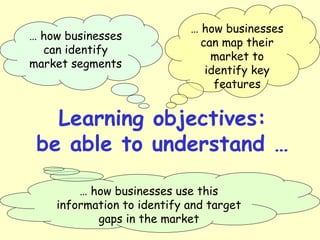
Learning objectives:
be able to understand …
… how businesses
can identify
market segments
… how businesses
can map their
market to
identify key
features
… how businesses use this
information to identify and target
gaps in the market
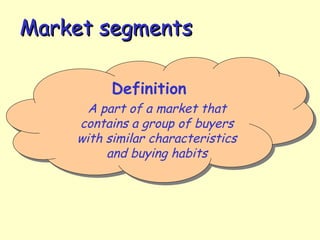
Market segmentsMarket segments
Definition
A part of a market that
contains a group of buyers
with similar characteristics
and buying habits
Definition
A part of a market that
contains a group of buyers
with similar characteristics
and buying habits
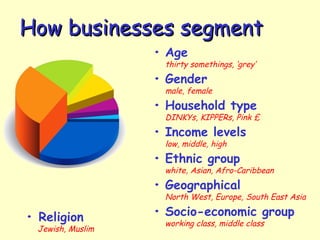
• Age
thirty somethings, ‘grey’
• Gender
male, female
• Household type
DINKYs, KIPPERs, Pink £
• Income levels
low, middle, high
• Ethnic group
white, Asian, Afro-Caribbean
• Geographical
North West, Europe, South East Asia
• Socio-economic group
working class, middle class
How businesses segmentHow businesses segment
• Religion
Jewish, Muslim
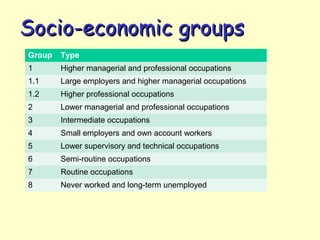
Group Type
1 Higher managerial and professional occupations
1.1 Large employers and higher managerial occupations
1.2 Higher professional occupations
2 Lower managerial and professional occupations
3 Intermediate occupations
4 Small employers and own account workers
5 Lower supervisory and technical occupations
6 Semi-routine occupations
7 Routine occupations
8 Never worked and long-term unemployed
Socio-economic groupsSocio-economic groups
Task 1: which segment?Task 1: which segment?
 In pairs, look at two adverts and decide which
market segments the company is targeting.
 Record your ideas on your worksheet
 Be ready to feedback your ideas to the rest of
the class
Task 2: homeworkTask 2: homework
 For next lesson see if you can find an advert
which is targeted at you or your family
 Stick this advert in your worksheet in the
space provided
 Write 3 sentences about why you think this
advert is targeted at you or your family
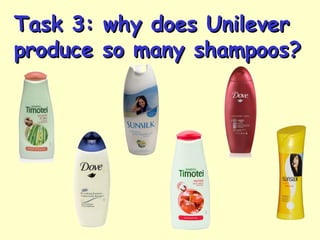
Task 3: why does UnileverTask 3: why does Unilever
produce so many shampoos?produce so many shampoos?
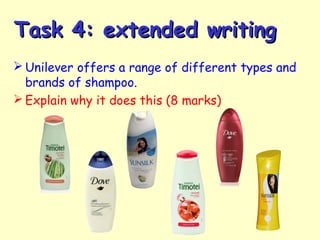
Task 4: extended writingTask 4: extended writing
 Unilever offers a range of different types and
brands of shampoo.
 Explain why it does this (8 marks)
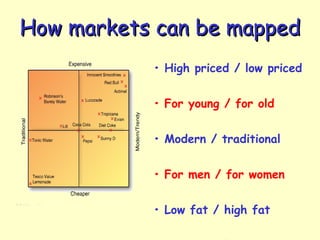
Market mappingMarket mapping
Definition
A market map is diagram that
shows the range of possible
positions for 2 features of a
product
Definition
A market map is diagram that
shows the range of possible
positions for 2 features of a
product
• High priced / low priced
• For young / for old
• Modern / traditional
• For men / for women
• Low fat / high fat
How markets can be mappedHow markets can be mapped
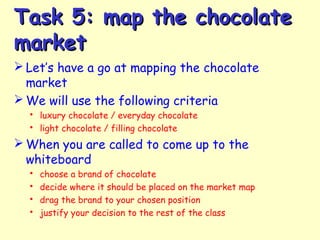
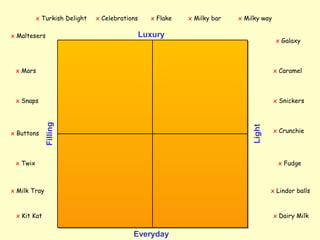
Task 5: map the chocolateTask 5: map the chocolate
marketmarket
 Let’s have a go at mapping the chocolate
market
 We will use the following criteria
 luxury chocolate / everyday chocolate
 light chocolate / filling chocolate
 When you are called to come up to the
whiteboard
 choose a brand of chocolate
 decide where it should be placed on the market map
 drag the brand to your chosen position
 justify your decision to the rest of the class
Luxury
Everyday
Light
Filling
x Twix
x Mars
x Turkish Delight
x Crunchie
x Kit Kat
x Milk Tray
x Dairy Milk
x Maltesers
x Snickers
x Caramel
x Snaps
x Celebrations
x Lindor balls
x Milky way
x Fudge
x Milky bar
x Buttons
x Galaxy
x Flake
Task 6: paired discussionTask 6: paired discussion
 Using the chocolate market map we have
created, discuss why a market map would be
useful to a business
 Record your ideas on the worksheet
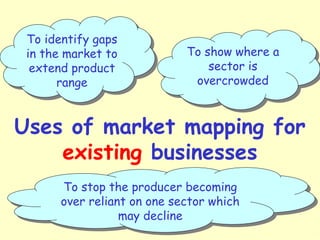
Uses of market mapping for
existing businesses
To show where a
sector is
overcrowded
To show where a
sector is
overcrowded
To identify gaps
in the market to
extend product
range
To identify gaps
in the market to
extend product
range
To stop the producer becoming
over reliant on one sector which
may decline
To stop the producer becoming
over reliant on one sector which
may decline
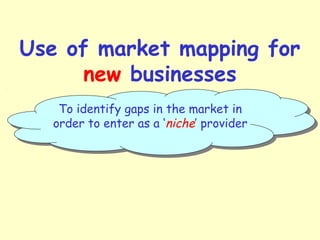
Use of market mapping for
new businesses
To identify gaps in the market in
order to enter as a ‘niche’ provider
To identify gaps in the market in
order to enter as a ‘niche’ provider
Task 7: exam practiceTask 7: exam practice
 Complete the three multiple choice questions
on the worksheet to check your
understanding of the topic we have now
completed.
 Record your mark on your worksheet.

Market mapping and segmentation dragndrop

  • 1.
  • 2.
    Learning objectives: be ableto understand … … how businesses can identify market segments … how businesses can map their market to identify key features … how businesses use this information to identify and target gaps in the market
  • 3.
    Market segmentsMarket segments Definition Apart of a market that contains a group of buyers with similar characteristics and buying habits Definition A part of a market that contains a group of buyers with similar characteristics and buying habits
  • 4.
    • Age thirty somethings,‘grey’ • Gender male, female • Household type DINKYs, KIPPERs, Pink £ • Income levels low, middle, high • Ethnic group white, Asian, Afro-Caribbean • Geographical North West, Europe, South East Asia • Socio-economic group working class, middle class How businesses segmentHow businesses segment • Religion Jewish, Muslim
  • 5.
    Group Type 1 Highermanagerial and professional occupations 1.1 Large employers and higher managerial occupations 1.2 Higher professional occupations 2 Lower managerial and professional occupations 3 Intermediate occupations 4 Small employers and own account workers 5 Lower supervisory and technical occupations 6 Semi-routine occupations 7 Routine occupations 8 Never worked and long-term unemployed Socio-economic groupsSocio-economic groups
  • 6.
    Task 1: whichsegment?Task 1: which segment?  In pairs, look at two adverts and decide which market segments the company is targeting.  Record your ideas on your worksheet  Be ready to feedback your ideas to the rest of the class
  • 7.
    Task 2: homeworkTask2: homework  For next lesson see if you can find an advert which is targeted at you or your family  Stick this advert in your worksheet in the space provided  Write 3 sentences about why you think this advert is targeted at you or your family
  • 8.
    Task 3: whydoes UnileverTask 3: why does Unilever produce so many shampoos?produce so many shampoos?
  • 9.
    Task 4: extendedwritingTask 4: extended writing  Unilever offers a range of different types and brands of shampoo.  Explain why it does this (8 marks)
  • 10.
    Market mappingMarket mapping Definition Amarket map is diagram that shows the range of possible positions for 2 features of a product Definition A market map is diagram that shows the range of possible positions for 2 features of a product
  • 11.
    • High priced/ low priced • For young / for old • Modern / traditional • For men / for women • Low fat / high fat How markets can be mappedHow markets can be mapped
  • 12.
    Task 5: mapthe chocolateTask 5: map the chocolate marketmarket  Let’s have a go at mapping the chocolate market  We will use the following criteria  luxury chocolate / everyday chocolate  light chocolate / filling chocolate  When you are called to come up to the whiteboard  choose a brand of chocolate  decide where it should be placed on the market map  drag the brand to your chosen position  justify your decision to the rest of the class
  • 13.
    Luxury Everyday Light Filling x Twix x Mars xTurkish Delight x Crunchie x Kit Kat x Milk Tray x Dairy Milk x Maltesers x Snickers x Caramel x Snaps x Celebrations x Lindor balls x Milky way x Fudge x Milky bar x Buttons x Galaxy x Flake
  • 14.
    Task 6: paireddiscussionTask 6: paired discussion  Using the chocolate market map we have created, discuss why a market map would be useful to a business  Record your ideas on the worksheet
  • 15.
    Uses of marketmapping for existing businesses To show where a sector is overcrowded To show where a sector is overcrowded To identify gaps in the market to extend product range To identify gaps in the market to extend product range To stop the producer becoming over reliant on one sector which may decline To stop the producer becoming over reliant on one sector which may decline
  • 16.
    Use of marketmapping for new businesses To identify gaps in the market in order to enter as a ‘niche’ provider To identify gaps in the market in order to enter as a ‘niche’ provider
  • 17.
    Task 7: exampracticeTask 7: exam practice  Complete the three multiple choice questions on the worksheet to check your understanding of the topic we have now completed.  Record your mark on your worksheet.

Editor's Notes

  • #6 Print this out as a hand out