 The word ‘Market’ is derived from the Latin
word
‘Marcatus’
 Meaning merchandise, wares, traffic, trade or a
place
where business is conducted.
 The common uses of market means a place where goods
are brought and sold.
 Market includes both place and region in which buyers
and sellers are in free competition with one another –
Pyle.
 ‘The term market refers not to a place, but to a
commodity or commodities and buyers and sellers who
are in direct competition with one another’ – Chapman.
 Market: Market is a place where goods and services
are exchanged. Markets consist of buyers and sellers
with facilities to communicate each other for
transactions of goods and services.
 Marketing: Marketing is the economic process by
which goods and services are exchanged between the
producers and the consumers and their value
determined in terms of money price.
 Market may mean a place, where buying and
selling take place.
 Buyers and sellers are come together for transactions.
 An organization through which exchange
of goods take place.
 The act of buying and sellingof
goods (to satisfy human wants)
 An area of operation of commercial
demand for commodities.
supply by price
 For exchange of goods and services.
 For adjustment of
demand and mechanism.
 For improvement of the quality of life of the society.
 For the introduction of new modes of life.
 For higher production.
 Markets have been classified based on
different approaches, in various ways.
 There are 10 different types of marketing systems
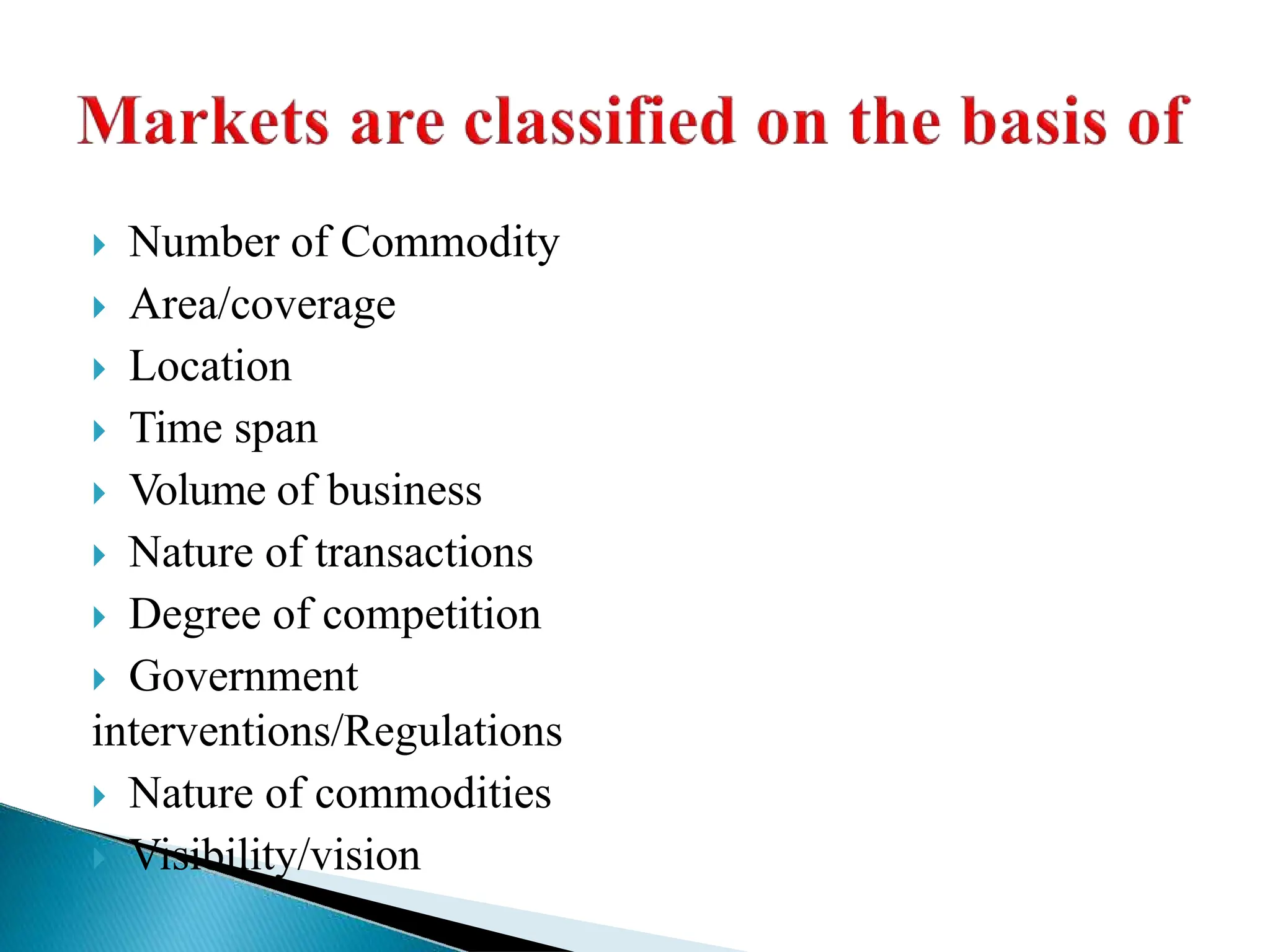
 Number of Commodity
 Area/coverage
 Location
 Time span
 Volume of business
 Nature of transactions
 Degree of competition
 Government
interventions/Regulations
 Nature of commodities
 Visibility/vision
1) General market
2) Specialized market
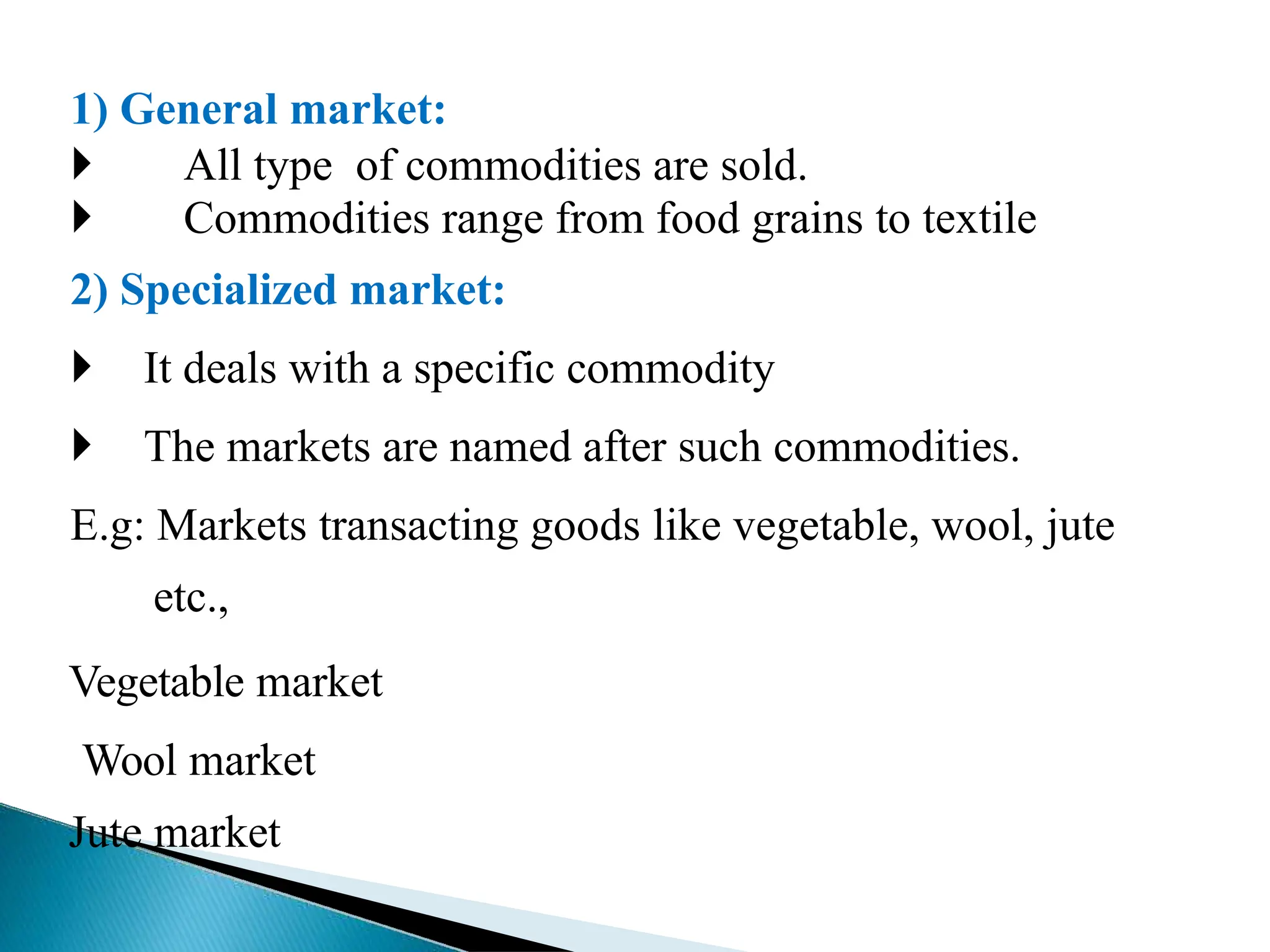
1) General market:
 All type of commodities are sold.
 Commodities range from food grains to textile
2) Specialized market:
 It deals with a specific commodity
 The markets are named after such commodities.
E.g: Markets transacting goods like vegetable, wool, jute
etc.,
Vegetable market
Wool market
Jute market
 Local market
 Regional market
 National market
 International (world) market
Local: (village/primary market)
The area covered by the market is limited to some group of
villages which are nearby or close to each other.
Perishable commodities like vegetable, fruits, fish, milk are
being transacted
E.g: Shandies and fairs
Local markets are held occasionally or on special
days Cattle market, Sheep market
Regional market:
 Area of operation of the market is
relatively larger than that of local market.
 This market covers 4-5 districts.
E.g: Food grain markets/Fruits market at state level
 These markets are regular in
conducting business transactions in notified
commodities
National market:

Area of operation of the market covers the
entire country.

The national markets are found for the
commodities which are having demand over entire
country.
E.g: Textile market
Jute market
Tea market
International market:
The commodities are sold in all the nations of
the world.
The market area of operation is extended over
the
entire globe.
The involvement of buyers and sellers beyond
the boundaries of a nation.
E.g: Cashew, Coffee, Tea, Spices,
Gold, Silver, Diamond, Machinery
1) Village market
2) Primary wholesale market
3) Secondary wholesale market
4) Terminal market
5) Seaboard market
1. Village market:
 The area of operation is confined to small village
or group of villages
 Majortransaction of goods and services
take place among the buyer and sellers of these
village
 It may be regular or occasional in nature.
2. Primary wholesale market:
 These are located in big towns or taluks or
mandal
headquarters.
 All types of agricultural commodities
from the village markets are pooled here.
3. Secondary wholesale market:
These are located in districts headquarters dealing
with major agricultural commodities like rice, pulses,
oil seeds, chillies. etc.,
 Wholesalers and village traders
are the main participants
 Bulk of the arrivals come from primary
wholesale markets or village markets
 Transaction of commodities occurs in large scale
 Commission agents, brokers, hamalies and
weighmen facilitate the process
4) Terminal market:
 Located in big cities/State capital/Seaports
 Well organized markets and controlled by the Government
to see that all modern methods of marketing operations take
place
 Processing and storage activities are predominant in these
markets
 Consumers, Wholesalers and Marketing agents are seen in
these markets with rigorous transaction activities
 These markets are generally situated in Big cities like
Bengaluru, Mumbai, Chennai and Kolkata
5) Seaboard market:
 Mainly for export and import of commodities
 Scientifically standardized and graded commodities
are transacted
 Located at Mumbai, Chennai, Kolkata,
Visakapatnam
I. Short period market
II. Long period market
III. Secular market
 Held for brief period in a day
 Supply of commodity is fixed
 Price variation is based on demand for the commodity
in a day
 Supply is zero elastic
E.g: Fish market
Vegetable market
Flower market
 Durable commodities which can be
stored for sometime are transacted in these markets
 Price for the products are governed by
supply and demand
E.g: Food grain market
Oilseeds market
 These are permanent market
 Manufactured goods and Machinery goods are transacted
in these markets
 Godown and processing facilities are highly developed
 Well organized
 Deal with Export and Import transactions
I. Wholesale Market:
II. Retail Market:
I. Wholesale Market:
When large quantities are brought and sold in the market
among the traders
Producers and Traders are seen
II. Retail Market:
Retailers sell commodities to the consumers in
very small quantities as per their requirements
Producers, Retailers and Consumers are
seen in these markets
I. Cash Market:
II. Forward Market:
I. Cash Market: (Spot market)
If there are cash transactions in buying and selling of
the goods
II. Forward Market:
These are the markets in which future sales and
purchase of commodities take place at the current
time.
This process also called as Hedging
 Perfect Competition Market
 Imperfect Competition Market
 A market is said to be perfectly competitive market
when there are many sellers (& buyers) transacting a
homogenous product.
 There are many sellers
 Homogenous products are sold
 Sellers do not have control over the price of the
commodity
 Farm commodities
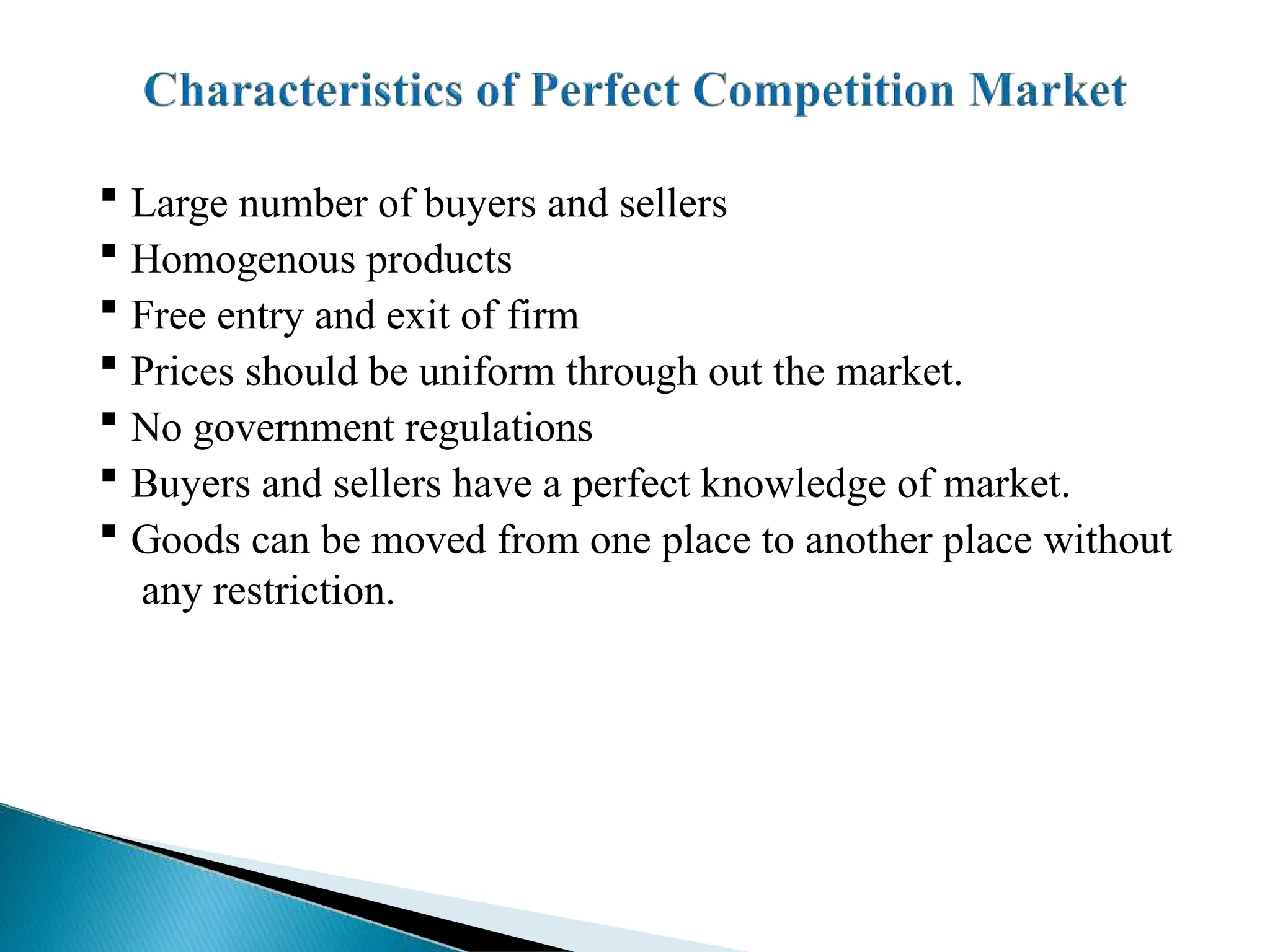
 Large number of buyers and sellers
 Homogenous products
 Free entry and exit of firm
 Prices should be uniform through out the market.
 No government regulations
 Buyers and sellers have a perfect knowledge of market.
 Goods can be moved from one place to another place without
any restriction.
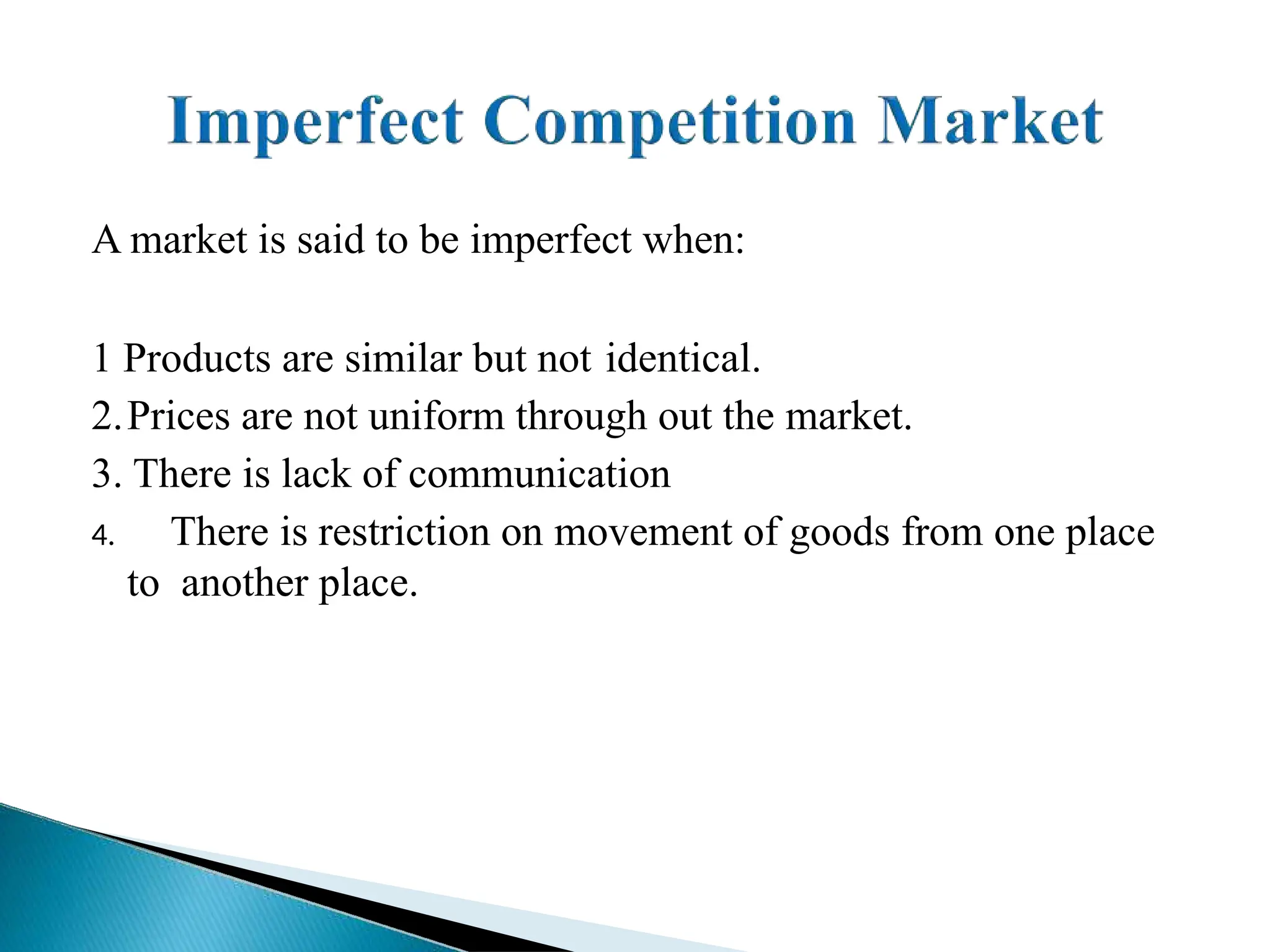
A market is said to be imperfect when:
1 Products are similar but not identical.
2.Prices are not uniform through out the market.
3. There is lack of communication
4. There is restriction on movement of goods from one place
to another place.
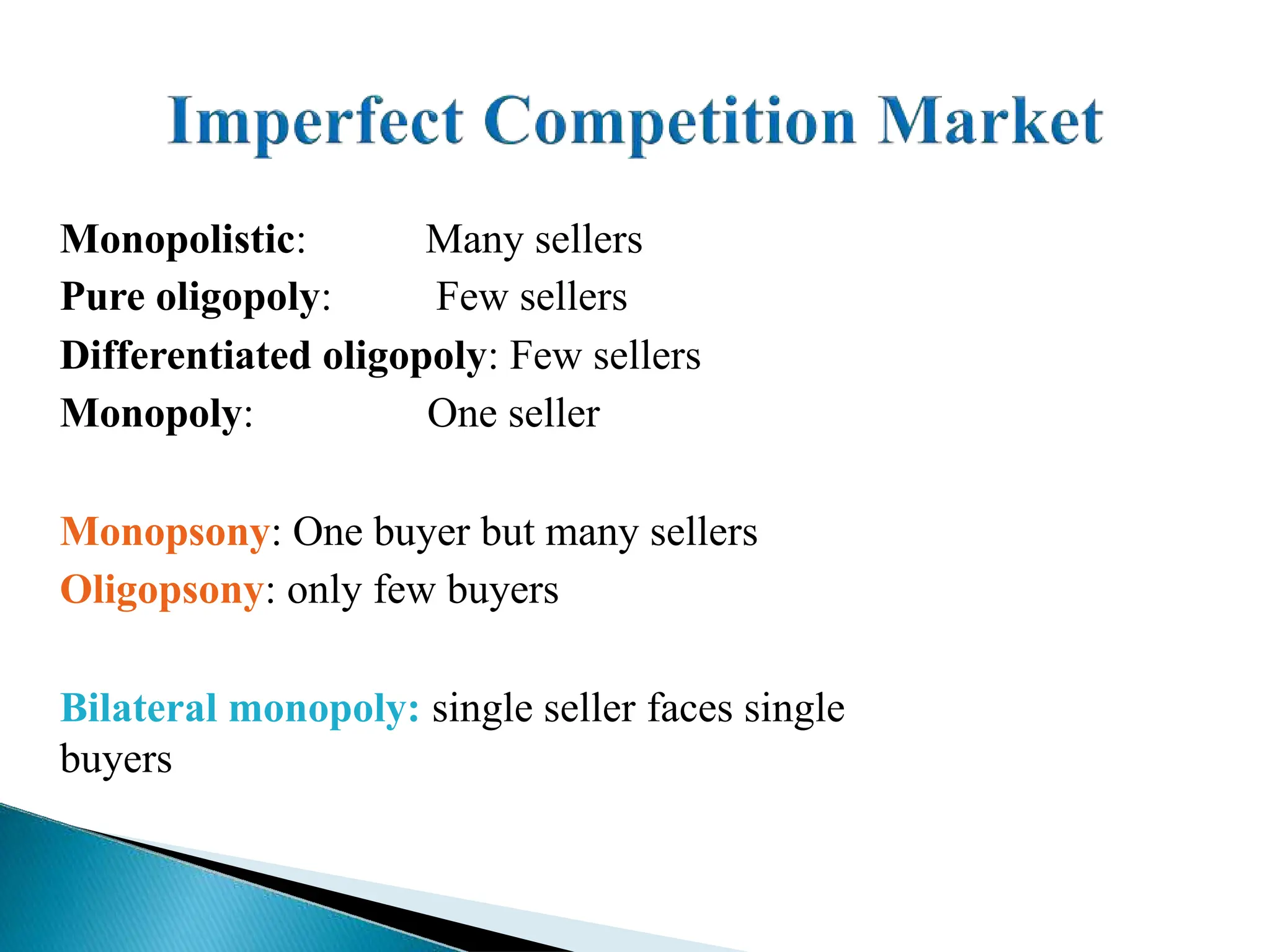
Monopolistic:
Pure oligopoly:
Many sellers
Few sellers
Differentiated oligopoly: Few sellers
Monopoly: One seller
Monopsony: One buyer but many sellers
Oligopsony: only few buyers
Bilateral monopoly: single seller faces single
buyers
I. Regulated market:
II. Unregulated market:
 The statutory market committees govern regulated
markets and the Government from time to time makes
marketing acts.
 Marketing costs, Margins and Fees are standardized.
 Price prevailing in different markets are displayed through
various mass media
 Business is conducted without any supervision
 Absence of rules and regulations
 Middleman exploit the producers and
consumers to the maximum extent.
 Producers are put to loss as middleman exploit them
in
weighment, measurement and payments etc
I. Commodity market:
 It deals with buying and selling of commodity
E.g: Cattle market, cottonmarket, silk
market, bullion market
II. Capital market:
In whichshares, securities and bonds etc
are being purchased and sold.
E.g: Share market, Money market
I. Black market
II. Open market
 In these markets, goods are not placed in shops but are
kept in the godowns.
 The goods can not be seen at the time of purchase, on
demand the goods are delivered to the buyers on cash
transaction.
 Any goods which is in short of supply and anything
which is having high effective demand will be sold in
black market.
 Wars, Droughts, Floods
 These are visiblemarkets and
transactions take place between buyers and sellers.
 Price is determined by demand and supply

Thank You

Marketing: Meaning Classification of various types

  • 2.
     The word‘Market’ is derived from the Latin word ‘Marcatus’  Meaning merchandise, wares, traffic, trade or a place where business is conducted.  The common uses of market means a place where goods are brought and sold.
  • 3.
     Market includesboth place and region in which buyers and sellers are in free competition with one another – Pyle.  ‘The term market refers not to a place, but to a commodity or commodities and buyers and sellers who are in direct competition with one another’ – Chapman.
  • 4.
     Market: Marketis a place where goods and services are exchanged. Markets consist of buyers and sellers with facilities to communicate each other for transactions of goods and services.  Marketing: Marketing is the economic process by which goods and services are exchanged between the producers and the consumers and their value determined in terms of money price.
  • 5.
     Market maymean a place, where buying and selling take place.  Buyers and sellers are come together for transactions.  An organization through which exchange of goods take place.  The act of buying and sellingof goods (to satisfy human wants)  An area of operation of commercial demand for commodities.
  • 6.
    supply by price For exchange of goods and services.  For adjustment of demand and mechanism.  For improvement of the quality of life of the society.  For the introduction of new modes of life.  For higher production.
  • 7.
     Markets havebeen classified based on different approaches, in various ways.  There are 10 different types of marketing systems
  • 8.
     Number ofCommodity  Area/coverage  Location  Time span  Volume of business  Nature of transactions  Degree of competition  Government interventions/Regulations  Nature of commodities  Visibility/vision
  • 9.
    1) General market 2)Specialized market
  • 10.
    1) General market: All type of commodities are sold.  Commodities range from food grains to textile 2) Specialized market:  It deals with a specific commodity  The markets are named after such commodities. E.g: Markets transacting goods like vegetable, wool, jute etc., Vegetable market Wool market Jute market
  • 11.
     Local market Regional market  National market  International (world) market
  • 12.
    Local: (village/primary market) Thearea covered by the market is limited to some group of villages which are nearby or close to each other. Perishable commodities like vegetable, fruits, fish, milk are being transacted E.g: Shandies and fairs Local markets are held occasionally or on special days Cattle market, Sheep market
  • 13.
    Regional market:  Areaof operation of the market is relatively larger than that of local market.  This market covers 4-5 districts. E.g: Food grain markets/Fruits market at state level  These markets are regular in conducting business transactions in notified commodities
  • 14.
    National market:  Area ofoperation of the market covers the entire country.  The national markets are found for the commodities which are having demand over entire country. E.g: Textile market Jute market Tea market
  • 15.
    International market: The commoditiesare sold in all the nations of the world. The market area of operation is extended over the entire globe. The involvement of buyers and sellers beyond the boundaries of a nation. E.g: Cashew, Coffee, Tea, Spices, Gold, Silver, Diamond, Machinery
  • 16.
    1) Village market 2)Primary wholesale market 3) Secondary wholesale market 4) Terminal market 5) Seaboard market
  • 17.
    1. Village market: The area of operation is confined to small village or group of villages  Majortransaction of goods and services take place among the buyer and sellers of these village  It may be regular or occasional in nature. 2. Primary wholesale market:  These are located in big towns or taluks or mandal headquarters.  All types of agricultural commodities from the village markets are pooled here.
  • 18.
    3. Secondary wholesalemarket: These are located in districts headquarters dealing with major agricultural commodities like rice, pulses, oil seeds, chillies. etc.,  Wholesalers and village traders are the main participants  Bulk of the arrivals come from primary wholesale markets or village markets  Transaction of commodities occurs in large scale  Commission agents, brokers, hamalies and weighmen facilitate the process
  • 19.
    4) Terminal market: Located in big cities/State capital/Seaports  Well organized markets and controlled by the Government to see that all modern methods of marketing operations take place  Processing and storage activities are predominant in these markets  Consumers, Wholesalers and Marketing agents are seen in these markets with rigorous transaction activities  These markets are generally situated in Big cities like Bengaluru, Mumbai, Chennai and Kolkata
  • 20.
    5) Seaboard market: Mainly for export and import of commodities  Scientifically standardized and graded commodities are transacted  Located at Mumbai, Chennai, Kolkata, Visakapatnam
  • 21.
    I. Short periodmarket II. Long period market III. Secular market
  • 22.
     Held forbrief period in a day  Supply of commodity is fixed  Price variation is based on demand for the commodity in a day  Supply is zero elastic E.g: Fish market Vegetable market Flower market
  • 23.
     Durable commoditieswhich can be stored for sometime are transacted in these markets  Price for the products are governed by supply and demand E.g: Food grain market Oilseeds market
  • 24.
     These arepermanent market  Manufactured goods and Machinery goods are transacted in these markets  Godown and processing facilities are highly developed  Well organized  Deal with Export and Import transactions
  • 25.
  • 26.
    I. Wholesale Market: Whenlarge quantities are brought and sold in the market among the traders Producers and Traders are seen II. Retail Market: Retailers sell commodities to the consumers in very small quantities as per their requirements Producers, Retailers and Consumers are seen in these markets
  • 27.
    I. Cash Market: II.Forward Market:
  • 28.
    I. Cash Market:(Spot market) If there are cash transactions in buying and selling of the goods II. Forward Market: These are the markets in which future sales and purchase of commodities take place at the current time. This process also called as Hedging
  • 29.
     Perfect CompetitionMarket  Imperfect Competition Market
  • 30.
     A marketis said to be perfectly competitive market when there are many sellers (& buyers) transacting a homogenous product.  There are many sellers  Homogenous products are sold  Sellers do not have control over the price of the commodity  Farm commodities
  • 31.
     Large numberof buyers and sellers  Homogenous products  Free entry and exit of firm  Prices should be uniform through out the market.  No government regulations  Buyers and sellers have a perfect knowledge of market.  Goods can be moved from one place to another place without any restriction.
  • 32.
    A market issaid to be imperfect when: 1 Products are similar but not identical. 2.Prices are not uniform through out the market. 3. There is lack of communication 4. There is restriction on movement of goods from one place to another place.
  • 33.
    Monopolistic: Pure oligopoly: Many sellers Fewsellers Differentiated oligopoly: Few sellers Monopoly: One seller Monopsony: One buyer but many sellers Oligopsony: only few buyers Bilateral monopoly: single seller faces single buyers
  • 34.
    I. Regulated market: II.Unregulated market:
  • 35.
     The statutorymarket committees govern regulated markets and the Government from time to time makes marketing acts.  Marketing costs, Margins and Fees are standardized.  Price prevailing in different markets are displayed through various mass media
  • 36.
     Business isconducted without any supervision  Absence of rules and regulations  Middleman exploit the producers and consumers to the maximum extent.  Producers are put to loss as middleman exploit them in weighment, measurement and payments etc
  • 37.
    I. Commodity market: It deals with buying and selling of commodity E.g: Cattle market, cottonmarket, silk market, bullion market II. Capital market: In whichshares, securities and bonds etc are being purchased and sold. E.g: Share market, Money market
  • 38.
  • 39.
     In thesemarkets, goods are not placed in shops but are kept in the godowns.  The goods can not be seen at the time of purchase, on demand the goods are delivered to the buyers on cash transaction.  Any goods which is in short of supply and anything which is having high effective demand will be sold in black market.  Wars, Droughts, Floods
  • 40.
     These arevisiblemarkets and transactions take place between buyers and sellers.  Price is determined by demand and supply
  • 41.