
Emerging Concepts in
Marketing
Unit 5
Presented By
M. BALASUNDARESAN
Assistant Professor,
Department of Pharmaceutics
BP803ET
Emerging Concepts in Marketing
• Marketing is an ever-evolving field, and there are
several emerging concepts that are gaining traction in
the industry.
• Here are a few examples:
1. Personalization:
• Personalization involves tailoring marketing messages
and experiences to individual consumers based on their
preferences and behavior.
• With the rise of big data and AI, companies are
increasingly able to personalize their marketing efforts
and create more meaningful connections with
customers.
2. Experiential marketing:
• Experiential marketing focuses on creating memorable
experiences for customers through immersive events or
interactions.
• This approach can help to build brand loyalty and
increase engagement, particularly among younger
consumers.
3. Influencer marketing:
• Influencer marketing involves partnering with social
media influencers to promote products or services.
• Influencer marketing has become increasingly popular
in recent years, particularly on platforms like Instagram
and YouTube.
4. Purpose-driven marketing:
• Purpose-driven marketing involves aligning a brand's
values and messaging with a larger social or
environmental cause.
• This approach can help to build brand loyalty and
attract customers who are looking to support companies
that are making a positive impact.
5. Omnichannel marketing:
• Omnichannel marketing involves providing a seamless
and consistent experience across all channels, including
social media, email, website, and brick-and-mortar
stores.
• This approach recognizes that customers often use
multiple channels to interact with a brand and seeks to
provide a cohesive experience regardless of where the
customer is engaging.
6. Voice search optimization:
• With the rise of smart speakers and voice
assistants, optimizing for voice search is
becoming increasingly important.
• This involves optimizing website content and
search engine optimization (SEO) strategies to
ensure that they are easily discoverable
through voice search.
Vertical & Horizontal Marketing
• Vertical marketing, also known as niche
marketing, involves targeting a specific industry
or market segment with a specialized product or
service.
• The idea behind vertical marketing is to focus on
a particular vertical market and offer a product or
service that meets the specific needs of that
market.
• For example, a company that specializes in
producing medical devices may focus exclusively
on marketing their products to hospitals and
healthcare providers.
• Horizontal marketing, on the other hand,
involves targeting a broad range of customers
with a single product or service.
• The goal of horizontal marketing is to appeal
to as many customers as possible, regardless of
their industry or market segment.
• For example, a company that produces a
popular soft drink may market their product to
consumers of all ages and demographics.
Rural
Marketing
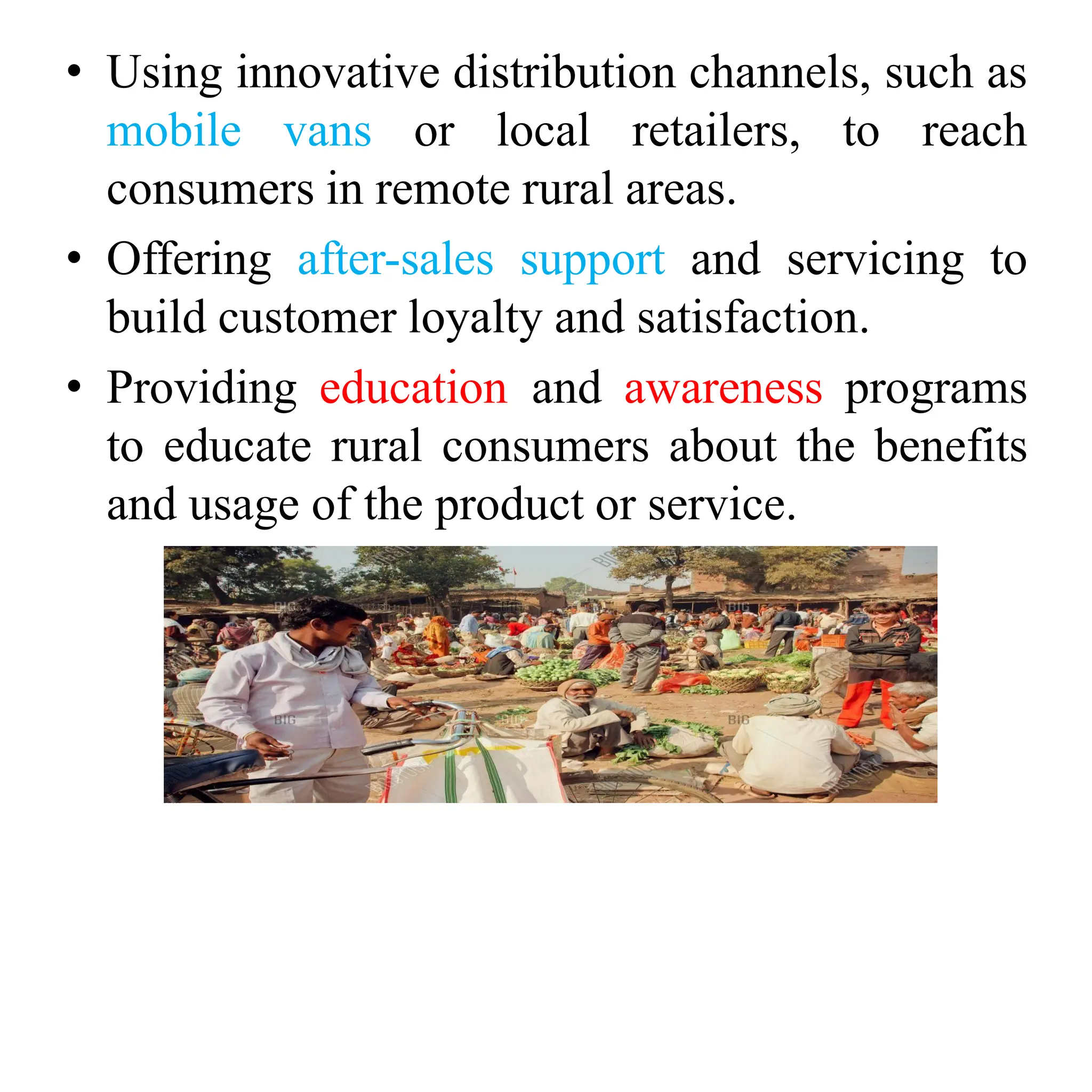
• Marketing to rural areas can be challenging
due to the unique characteristics of rural
consumers and the lack of infrastructure and
distribution channels in these areas.
• However, there are several strategies that
companies can use to effectively market their
products and services to rural consumers,
including:
• Developing products that meet the specific
needs and preferences of rural consumers, such
as low-cost and durable products that are
suitable for rural lifestyles.
• Creating marketing campaigns that resonate
with rural consumers and highlight the benefits
of the product or service.
• Partnering with local organizations and
community leaders to build trust and establish
a presence in rural areas.
• Using innovative distribution channels, such as
mobile vans or local retailers, to reach
consumers in remote rural areas.
• Offering after-sales support and servicing to
build customer loyalty and satisfaction.
• Providing education and awareness programs
to educate rural consumers about the benefits
and usage of the product or service.
Consumerism
• Consumerism refers to a social and economic
movement that advocates for the rights and
protection of consumers in the marketplace.
• It emerged in the 1960s and 1970s as a
response to the perceived exploitation of
consumers by businesses, and has since
evolved into a broader movement focused on
promoting sustainable consumption and ethical
business practices.
• There are several key aspects of consumerism,
including:
1. Consumer protection:
• Advocating for laws and regulations that
protect consumers from fraud, deception, and
other harmful practices.
2. Consumer education:
• Encouraging consumers to become more
informed and educated about their choices, and
to make purchasing decisions that align with
their values.
3. Sustainable consumption:
• Promoting the use of products and services that
are environmentally and socially sustainable, and
advocating for businesses to adopt sustainable
practices.
4. Ethical business practices:
• Advocating for businesses to adopt ethical
practices that prioritize the well-being of
consumers, employees, and other stakeholders.
5. Corporate responsibility:
• Holding businesses accountable for their actions
and encouraging them to be transparent about
their practices and policies.
Industrial
Marketing
• Industrial marketing, also known as business-
to-business (B2B) marketing, refers to the
marketing of products and services from one
business to another.
• Industrial marketing differs from consumer
marketing in that the target market is other
businesses, rather than individual consumers.
• Some key strategies used in industrial marketing
include:
1. Developing strong relationships with
customers:
• Industrial marketers often rely on long-term
relationships with their customers, as these
relationships can help to build trust and loyalty
over time.
2. Offering customized products and services:
• Industrial marketers often develop customized
products and services that are tailored to the
specific needs and preferences of their customers.
3. Providing after-sales support:
• Industrial marketers often provide extensive after-sales
support to ensure that their customers are satisfied with
their purchases and to address any concerns or issues
that may arise.
4. Building strong distribution networks:
• Industrial marketers often work closely with
distributors and other partners to ensure that their
products and services are available to customers when
and where they need them.
5. Providing technical assistance and training:
• Industrial marketers often provide technical assistance
and training to help their customers understand how to
use their products and services effectively.
Global
Marketing
• Global marketing refers to the process of
planning, producing, promoting, and
distributing products and services on a global
scale.
• It involves identifying and targeting consumers
in different countries and regions around the
world, and adapting marketing strategies and
tactics to meet the unique needs and
preferences of these consumers.
• Some key strategies used in global marketing
include:
1. Conducting market research:
marketers must conduct extensive
research to understand the unique
• Global
market
needs, preferences, and behaviors of
consumers in different countries and regions.
2. Developing a global marketing strategy:
• Global marketers must develop a comprehensive
marketing strategy that takes into account the
unique needs and preferences of consumers in
different countries and regions, as well as the
company's overall goals and objectives.
3.Adapting products and services:
• Global marketers must adapt products and
services to meet the unique needs and preferences
of consumers in different countries and regions.
• This may involve making changes to the product
itself, as well as packaging, labeling, and other
aspects of the marketing mix.
4.Adapting marketing communications:
• Global marketers must adapt their marketing
communications to the language, culture, and
regulatory environment of different countries and
regions.
• This may involve translating advertising
messages, using different media channels, and
complying with local advertising regulations.
5. Building global partnerships:
• Global marketers may build partnerships with
other companies, distributors, or other
stakeholders in different countries and regions to
help facilitate the production, promotion, and
distribution of their products and services.
View publication stats

5.1. EMERGING CONCEPTS IN MARKETING.pdf

  • 1.
    Emerging Concepts in Marketing Unit5 Presented By M. BALASUNDARESAN Assistant Professor, Department of Pharmaceutics BP803ET
  • 2.
    Emerging Concepts inMarketing • Marketing is an ever-evolving field, and there are several emerging concepts that are gaining traction in the industry. • Here are a few examples: 1. Personalization: • Personalization involves tailoring marketing messages and experiences to individual consumers based on their preferences and behavior. • With the rise of big data and AI, companies are increasingly able to personalize their marketing efforts and create more meaningful connections with customers.
  • 3.
    2. Experiential marketing: •Experiential marketing focuses on creating memorable experiences for customers through immersive events or interactions. • This approach can help to build brand loyalty and increase engagement, particularly among younger consumers. 3. Influencer marketing: • Influencer marketing involves partnering with social media influencers to promote products or services. • Influencer marketing has become increasingly popular in recent years, particularly on platforms like Instagram and YouTube.
  • 4.
    4. Purpose-driven marketing: •Purpose-driven marketing involves aligning a brand's values and messaging with a larger social or environmental cause. • This approach can help to build brand loyalty and attract customers who are looking to support companies that are making a positive impact. 5. Omnichannel marketing: • Omnichannel marketing involves providing a seamless and consistent experience across all channels, including social media, email, website, and brick-and-mortar stores. • This approach recognizes that customers often use multiple channels to interact with a brand and seeks to provide a cohesive experience regardless of where the customer is engaging.
  • 5.
    6. Voice searchoptimization: • With the rise of smart speakers and voice assistants, optimizing for voice search is becoming increasingly important. • This involves optimizing website content and search engine optimization (SEO) strategies to ensure that they are easily discoverable through voice search.
  • 6.
    Vertical & HorizontalMarketing • Vertical marketing, also known as niche marketing, involves targeting a specific industry or market segment with a specialized product or service. • The idea behind vertical marketing is to focus on a particular vertical market and offer a product or service that meets the specific needs of that market. • For example, a company that specializes in producing medical devices may focus exclusively on marketing their products to hospitals and healthcare providers.
  • 7.
    • Horizontal marketing,on the other hand, involves targeting a broad range of customers with a single product or service. • The goal of horizontal marketing is to appeal to as many customers as possible, regardless of their industry or market segment. • For example, a company that produces a popular soft drink may market their product to consumers of all ages and demographics.
  • 8.
    Rural Marketing • Marketing torural areas can be challenging due to the unique characteristics of rural consumers and the lack of infrastructure and distribution channels in these areas. • However, there are several strategies that companies can use to effectively market their products and services to rural consumers, including:
  • 9.
    • Developing productsthat meet the specific needs and preferences of rural consumers, such as low-cost and durable products that are suitable for rural lifestyles. • Creating marketing campaigns that resonate with rural consumers and highlight the benefits of the product or service. • Partnering with local organizations and community leaders to build trust and establish a presence in rural areas.
  • 10.
    • Using innovativedistribution channels, such as mobile vans or local retailers, to reach consumers in remote rural areas. • Offering after-sales support and servicing to build customer loyalty and satisfaction. • Providing education and awareness programs to educate rural consumers about the benefits and usage of the product or service.
  • 11.
    Consumerism • Consumerism refersto a social and economic movement that advocates for the rights and protection of consumers in the marketplace. • It emerged in the 1960s and 1970s as a response to the perceived exploitation of consumers by businesses, and has since evolved into a broader movement focused on promoting sustainable consumption and ethical business practices.
  • 12.
    • There areseveral key aspects of consumerism, including: 1. Consumer protection: • Advocating for laws and regulations that protect consumers from fraud, deception, and other harmful practices. 2. Consumer education: • Encouraging consumers to become more informed and educated about their choices, and to make purchasing decisions that align with their values.
  • 13.
    3. Sustainable consumption: •Promoting the use of products and services that are environmentally and socially sustainable, and advocating for businesses to adopt sustainable practices. 4. Ethical business practices: • Advocating for businesses to adopt ethical practices that prioritize the well-being of consumers, employees, and other stakeholders. 5. Corporate responsibility: • Holding businesses accountable for their actions and encouraging them to be transparent about their practices and policies.
  • 14.
    Industrial Marketing • Industrial marketing,also known as business- to-business (B2B) marketing, refers to the marketing of products and services from one business to another. • Industrial marketing differs from consumer marketing in that the target market is other businesses, rather than individual consumers.
  • 15.
    • Some keystrategies used in industrial marketing include: 1. Developing strong relationships with customers: • Industrial marketers often rely on long-term relationships with their customers, as these relationships can help to build trust and loyalty over time. 2. Offering customized products and services: • Industrial marketers often develop customized products and services that are tailored to the specific needs and preferences of their customers.
  • 16.
    3. Providing after-salessupport: • Industrial marketers often provide extensive after-sales support to ensure that their customers are satisfied with their purchases and to address any concerns or issues that may arise. 4. Building strong distribution networks: • Industrial marketers often work closely with distributors and other partners to ensure that their products and services are available to customers when and where they need them. 5. Providing technical assistance and training: • Industrial marketers often provide technical assistance and training to help their customers understand how to use their products and services effectively.
  • 17.
    Global Marketing • Global marketingrefers to the process of planning, producing, promoting, and distributing products and services on a global scale. • It involves identifying and targeting consumers in different countries and regions around the world, and adapting marketing strategies and tactics to meet the unique needs and preferences of these consumers.
  • 18.
    • Some keystrategies used in global marketing include: 1. Conducting market research: marketers must conduct extensive research to understand the unique • Global market needs, preferences, and behaviors of consumers in different countries and regions.
  • 19.
    2. Developing aglobal marketing strategy: • Global marketers must develop a comprehensive marketing strategy that takes into account the unique needs and preferences of consumers in different countries and regions, as well as the company's overall goals and objectives. 3.Adapting products and services: • Global marketers must adapt products and services to meet the unique needs and preferences of consumers in different countries and regions. • This may involve making changes to the product itself, as well as packaging, labeling, and other aspects of the marketing mix.
  • 20.
    4.Adapting marketing communications: •Global marketers must adapt their marketing communications to the language, culture, and regulatory environment of different countries and regions. • This may involve translating advertising messages, using different media channels, and complying with local advertising regulations. 5. Building global partnerships: • Global marketers may build partnerships with other companies, distributors, or other stakeholders in different countries and regions to help facilitate the production, promotion, and distribution of their products and services.
  • 21.