REVITALIZING BRANDS
REVITALIZING THE BRAND
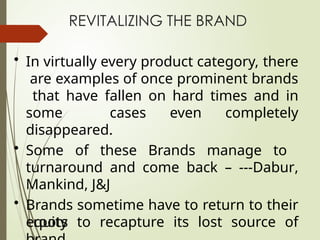
• In virtually every product category, there
are examples of once prominent brands
that have fallen on hard times and in
some cases even completely
disappeared.
• Some of these Brands manage to
turnaround and come back – ---Dabur,
Mankind, J&J
• Brands sometime have to return to their
roots to recapture its lost source of
equity
REVITALIZING THE BRAND
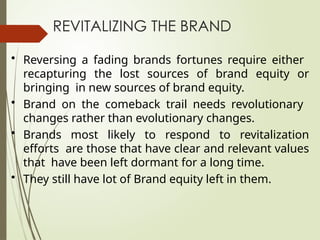
• Reversing a fading brands fortunes require either
recapturing the lost sources of brand equity or
bringing in new sources of brand equity.
• Brand on the comeback trail needs revolutionary
changes rather than evolutionary changes.
• Brands most likely to respond to revitalization
efforts are those that have clear and relevant values
that have been left dormant for a long time.
• They still have lot of Brand equity left in them.
REVITALIZING THE BRAND
• Revitalizing - deals with such brands which are old but if redirected
may
have plenty of life.
• This can be substantially less costly and risky than introducing a
new brand.
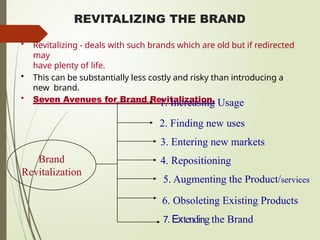
• Seven Avenues for Brand Revitalization.
Brand
Revitalization
1. Increasing Usage
2. Finding new uses
3. Entering new markets
4. Repositioning
5. Augmenting the Product/services
6. Obsoleting Existing Products
7. Extending the Brand
Increasing the Frequency of Use
• Reminder Communications
• Position for frequent / regular use
(Nicotex)
• Make the use easier (Humapen)
• Provide Incentives (frequent flier
plans)
• Address any undesirable consequences
attached with frequent use.
• Use at Different Occasions / Locations
(Sunscream and lotions)
Increasing The Quantity Used
• Insurance customer reminded to cover
more items (household).
• Positive associations with use ( Trust
more use more).
• Incentives can be used to increase
the quantity used / bought (quantity
discounts)
• Communication efforts to change
attitudes related to usage quantity.
2.Finding NewUses: Minoxidil Mintop
3.Entering New Markets
• The target market for a particular brand
may not comprise of all the market
segments.
• If firm may not have other Brands for
these target segments, then they
become potential areas for the brand
to expand.
• Johnson & Johnson baby shampoo promoted
on gentleness plank, taken to adults as a
shampoo that can be used every day.
• Texas Instruments looked for previously
neglected women‟s market
• A proposed caffeine-laden Diet Pepsi,
named Pepsi A.M represented an entry
into the breakfast market
cola that beats
coffee
– “The great-
tasting cold!”
• Small
refrigerators
• P&G‟s Ivory soap was revived by promoting it
as a pure and simple product for adults than
just babies.
• Van Heusen gained the edge over Arrow in
the US markets by targeting 50% of its ad
budget to women.
• Women buy an estimated 60% to 70% of men‟s
shirts.
• Arrow followed by retracing their strategy to
brand its shirts especially with women. (Selling
bolder colors and busier patterns at higher prices)
4.
Repositioning
• One strategic option for revitalizing a fading brand is
simply to abandon the consumer group that supported
the brand in the past to target a completely new
segment.
• Repositioning of Mankind Pharma as affordable
medicine manufacturer.
• To revive – Brylcream Gel was launched, a clear gel with
newer packaging enlisting soccer stars (now Beckham)
to endorse --- younger audience.
5.Changing Associations
• A Positioning
appropriate
as
Strategy can become
in- the target
market ages,the
association becomes less appealing as
tastes and fashions change.
• A positioning strategy can simply wear out
as the target segment becomes saturated
• New associationsand associated segments
are needed to generate growth.
NewAssociations – Add Value
by Differentiation
• Sometimes, as it matures a product becomes
a commodity and the price pressure makes
the product unprofitable.
• One approach is to attempt to reposition the
commodity.
• 1960‟s saw Frank Perdue, tired of being in the
commodity business, completely repositioned
it as a high quality branded product ----
• “It takes a tough man to make a tender
chicken”.
6.AUGMENTING THE PRODUCT
• As product categories mature
• Once strong brand associations which
differentiated your product are now matched
by most of competition.
• Customers seem more and more concerned
about price and most are not willing to pay
premium price for a brand.
• The temptation is to become resigned to a
very competitive environment.
Augmenting The Product
• Theodore Levitt: When the product is close
to becoming a commodity, consider
augmenting it by providing services or
features not expected by the customer as
they go beyond anything being offered.
• Two ways – Do something better
or do something extra / different.
• With a mature product it is more feasible
to do something extra than better.
• Improving or innovationsin packaging is
a way to provide this differentiating
extra.
• Improving package -- Nestle packaged its
chocolates in tiny tubs, so that children can use it
to make chocolate fudge or sundaes in a
microwave oven. for
children per
squeeze
• Clinic shampoo‟s special packaging
which provided the right quantity
(meant for five rinses).
• A new package can solve a customer problem. Eg:
sachets enabled packing of shampoos, tooth
paste, coconut oil to be packed for the use of
traveling lot and also for rural population.
• McKesson Inc., in drug wholesaling or Baxter
in Hospital supplies built computer based
information system for their retail /
customers
• Virtually taking over inventory management,
reorder decisions.
• McKesson could reduce its sales force
engaged in store level sales by a small force
which serviced the systems(1975)
• McKesson grew from $1 billion in 1978 to $5
billion in 10 years.
7.Customer Involvement
• Involving customer can be key to the process
of finding ways to augment the product or
service.
• Customer involvement not only helps to
identify the most appropriate areas to work
on but also makes the effort visible to the
consumer.
• The US textile firm Millikin, using Customer
Action Teams (CAT‟s), started making creative
solutions to both current customers (in better
serving them) and to new customers (in
developing them).
• A series of CA
T‟s launched every year has turned
Millikin‟s industrial towel business from a
commodity to a value added service business.
• Millikin now virtually runs the business of their
client‟s industrial laundries.
• They provide computerized ordering and logic
systems, market research assistance , leads from
trade shows, audio visual sales aids etc.
• OBSOLETING EXISTING PRODUCT WITH NEW-
GENERATION TECHNOLOGIES
• Sometimes a sleepy industry segment can be
revitalized by a product which obsoletes the
existing installed base and accelerates the
replacement cycle.
• Yamaha Disklavier, FM-radio are eg.‟s.
• Introduction of C
D‟s virtually saw a rebirth for
the audio and video entertainment industry
with the sales of audio & video systems
surging.
• Market leader who has vested interest in the
old technology, faces competitive threat and
will opt for a delay strategy.
• Gillette (1960‟s) resisted the stainless steel
technology knowing the durability of the new
material will reduce the volumes and also the
cost to change over its manufacturing.
• Small player such as Wilkinson(UK) made
permanent inroads into the market. Gillette‟s
share fell from 70% to 55% and ROI from 40%
to 30%.
ALTERNATIVES TO REVITALIZATION: END GAME
• In a declining industry there are
substantial risks in investing especially if
your brand starts to show weakness.
• At this point it may not be possible to
provide equal access to resources for all
the brands in any multi brand
organization.
• Options are:
• 1. Milking the brand
• 2. Exit the market.
ALTERNATIVES TO REVITALIZATION-END GAME
• The Milking Option
• Avoiding investment in the brand, attempting instead
to generate additional cash flow from it.
• Milking strategy will accept a decline in sales and
profits and the risk that the brand will eventually go
under.
• A variant to milking strategy is hold or maintain, where
enough investment to maintain the brand.---No
growth.
• A fast milking: sharp reductions in operating
expenses, increase in price to maximize short term
cash flow.
Situational characteristics that lead to milking
strategy rather than exit:
• 1. Industry decline rate is not exceedingly steep.
Pockets of demand exist.
• 2. Price structure will be stable allowing efficient
firms to make profits.
• 3. Brand has enough customer loyalty in certain
pockets, to generate enough sales /profits. Risk
of losing relative position due to milking is low.
• 4. Milking strategy can be successfully managed.
Difficulties in Implementing
strategy
 Customers may lose faith in the brand.
 Competitors may attack more vigorously
 Most managers will not be experience
or orientation to handle the situation.
 Tominimize such effects it is better
to keep the milking route inconspicuous.
Divestment or Liquidation
• When prospects for the brand are bad and a
milking strategy doe not seem feasible, the
final alternative – divestment or liquidation is
considered. Conditions that suggest an exit
than a milking decision are:
1. Decline rate is rapid and accelerating. (no
pockets of enduring demand).
2. Price pressures are anticipated to be
extreme. (lack of Brand loyalty, differentiation
and competitive pressures from those who
have exit barriers).
3.The brand position is weak and there are
more than one competitor who hold
dominant position.
4.Firm‟s mission has changed and the
business is becoming non related.
5.Exit barriers if any can be overcome, such
as specialized machines, long term
contracts with suppliers etc.


Brand revitalization components diss.pptx

  • 1.
  • 2.
    REVITALIZING THE BRAND •In virtually every product category, there are examples of once prominent brands that have fallen on hard times and in some cases even completely disappeared. • Some of these Brands manage to turnaround and come back – ---Dabur, Mankind, J&J • Brands sometime have to return to their roots to recapture its lost source of equity
  • 3.
    REVITALIZING THE BRAND •Reversing a fading brands fortunes require either recapturing the lost sources of brand equity or bringing in new sources of brand equity. • Brand on the comeback trail needs revolutionary changes rather than evolutionary changes. • Brands most likely to respond to revitalization efforts are those that have clear and relevant values that have been left dormant for a long time. • They still have lot of Brand equity left in them.
  • 4.
    REVITALIZING THE BRAND •Revitalizing - deals with such brands which are old but if redirected may have plenty of life. • This can be substantially less costly and risky than introducing a new brand. • Seven Avenues for Brand Revitalization. Brand Revitalization 1. Increasing Usage 2. Finding new uses 3. Entering new markets 4. Repositioning 5. Augmenting the Product/services 6. Obsoleting Existing Products 7. Extending the Brand
  • 5.
    Increasing the Frequencyof Use • Reminder Communications • Position for frequent / regular use (Nicotex) • Make the use easier (Humapen) • Provide Incentives (frequent flier plans) • Address any undesirable consequences attached with frequent use. • Use at Different Occasions / Locations (Sunscream and lotions)
  • 6.
    Increasing The QuantityUsed • Insurance customer reminded to cover more items (household). • Positive associations with use ( Trust more use more). • Incentives can be used to increase the quantity used / bought (quantity discounts) • Communication efforts to change attitudes related to usage quantity. 2.Finding NewUses: Minoxidil Mintop
  • 7.
    3.Entering New Markets •The target market for a particular brand may not comprise of all the market segments. • If firm may not have other Brands for these target segments, then they become potential areas for the brand to expand. • Johnson & Johnson baby shampoo promoted on gentleness plank, taken to adults as a shampoo that can be used every day.
  • 8.
    • Texas Instrumentslooked for previously neglected women‟s market • A proposed caffeine-laden Diet Pepsi, named Pepsi A.M represented an entry into the breakfast market cola that beats coffee – “The great- tasting cold!” • Small refrigerators
  • 9.
    • P&G‟s Ivorysoap was revived by promoting it as a pure and simple product for adults than just babies. • Van Heusen gained the edge over Arrow in the US markets by targeting 50% of its ad budget to women. • Women buy an estimated 60% to 70% of men‟s shirts. • Arrow followed by retracing their strategy to brand its shirts especially with women. (Selling bolder colors and busier patterns at higher prices)
  • 10.
    4. Repositioning • One strategicoption for revitalizing a fading brand is simply to abandon the consumer group that supported the brand in the past to target a completely new segment. • Repositioning of Mankind Pharma as affordable medicine manufacturer. • To revive – Brylcream Gel was launched, a clear gel with newer packaging enlisting soccer stars (now Beckham) to endorse --- younger audience.
  • 11.
    5.Changing Associations • APositioning appropriate as Strategy can become in- the target market ages,the association becomes less appealing as tastes and fashions change. • A positioning strategy can simply wear out as the target segment becomes saturated • New associationsand associated segments are needed to generate growth.
  • 12.
    NewAssociations – AddValue by Differentiation • Sometimes, as it matures a product becomes a commodity and the price pressure makes the product unprofitable. • One approach is to attempt to reposition the commodity. • 1960‟s saw Frank Perdue, tired of being in the commodity business, completely repositioned it as a high quality branded product ---- • “It takes a tough man to make a tender chicken”.
  • 13.
    6.AUGMENTING THE PRODUCT •As product categories mature • Once strong brand associations which differentiated your product are now matched by most of competition. • Customers seem more and more concerned about price and most are not willing to pay premium price for a brand. • The temptation is to become resigned to a very competitive environment.
  • 14.
    Augmenting The Product •Theodore Levitt: When the product is close to becoming a commodity, consider augmenting it by providing services or features not expected by the customer as they go beyond anything being offered. • Two ways – Do something better or do something extra / different. • With a mature product it is more feasible to do something extra than better. • Improving or innovationsin packaging is a way to provide this differentiating extra.
  • 15.
    • Improving package-- Nestle packaged its chocolates in tiny tubs, so that children can use it to make chocolate fudge or sundaes in a microwave oven. for children per squeeze • Clinic shampoo‟s special packaging which provided the right quantity (meant for five rinses). • A new package can solve a customer problem. Eg: sachets enabled packing of shampoos, tooth paste, coconut oil to be packed for the use of traveling lot and also for rural population.
  • 16.
    • McKesson Inc.,in drug wholesaling or Baxter in Hospital supplies built computer based information system for their retail / customers • Virtually taking over inventory management, reorder decisions. • McKesson could reduce its sales force engaged in store level sales by a small force which serviced the systems(1975) • McKesson grew from $1 billion in 1978 to $5 billion in 10 years.
  • 17.
    7.Customer Involvement • Involvingcustomer can be key to the process of finding ways to augment the product or service. • Customer involvement not only helps to identify the most appropriate areas to work on but also makes the effort visible to the consumer. • The US textile firm Millikin, using Customer Action Teams (CAT‟s), started making creative solutions to both current customers (in better serving them) and to new customers (in developing them).
  • 18.
    • A seriesof CA T‟s launched every year has turned Millikin‟s industrial towel business from a commodity to a value added service business. • Millikin now virtually runs the business of their client‟s industrial laundries. • They provide computerized ordering and logic systems, market research assistance , leads from trade shows, audio visual sales aids etc.
  • 19.
    • OBSOLETING EXISTINGPRODUCT WITH NEW- GENERATION TECHNOLOGIES • Sometimes a sleepy industry segment can be revitalized by a product which obsoletes the existing installed base and accelerates the replacement cycle. • Yamaha Disklavier, FM-radio are eg.‟s. • Introduction of C D‟s virtually saw a rebirth for the audio and video entertainment industry with the sales of audio & video systems surging.
  • 20.
    • Market leaderwho has vested interest in the old technology, faces competitive threat and will opt for a delay strategy. • Gillette (1960‟s) resisted the stainless steel technology knowing the durability of the new material will reduce the volumes and also the cost to change over its manufacturing. • Small player such as Wilkinson(UK) made permanent inroads into the market. Gillette‟s share fell from 70% to 55% and ROI from 40% to 30%.
  • 21.
    ALTERNATIVES TO REVITALIZATION:END GAME • In a declining industry there are substantial risks in investing especially if your brand starts to show weakness. • At this point it may not be possible to provide equal access to resources for all the brands in any multi brand organization. • Options are: • 1. Milking the brand • 2. Exit the market.
  • 22.
    ALTERNATIVES TO REVITALIZATION-ENDGAME • The Milking Option • Avoiding investment in the brand, attempting instead to generate additional cash flow from it. • Milking strategy will accept a decline in sales and profits and the risk that the brand will eventually go under. • A variant to milking strategy is hold or maintain, where enough investment to maintain the brand.---No growth. • A fast milking: sharp reductions in operating expenses, increase in price to maximize short term cash flow.
  • 23.
    Situational characteristics thatlead to milking strategy rather than exit: • 1. Industry decline rate is not exceedingly steep. Pockets of demand exist. • 2. Price structure will be stable allowing efficient firms to make profits. • 3. Brand has enough customer loyalty in certain pockets, to generate enough sales /profits. Risk of losing relative position due to milking is low. • 4. Milking strategy can be successfully managed.
  • 24.
    Difficulties in Implementing strategy Customers may lose faith in the brand.  Competitors may attack more vigorously  Most managers will not be experience or orientation to handle the situation.  Tominimize such effects it is better to keep the milking route inconspicuous.
  • 25.
    Divestment or Liquidation •When prospects for the brand are bad and a milking strategy doe not seem feasible, the final alternative – divestment or liquidation is considered. Conditions that suggest an exit than a milking decision are: 1. Decline rate is rapid and accelerating. (no pockets of enduring demand). 2. Price pressures are anticipated to be extreme. (lack of Brand loyalty, differentiation and competitive pressures from those who have exit barriers).
  • 26.
    3.The brand positionis weak and there are more than one competitor who hold dominant position. 4.Firm‟s mission has changed and the business is becoming non related. 5.Exit barriers if any can be overcome, such as specialized machines, long term contracts with suppliers etc.