Understanding
Segmentation, Targeting,
and Positioning in
Consumer Behavior
01
SEGMENTATION
Understanding market
segmentation
1
Defining market segmentation
Market segmentation is the process of dividing a market into distinct
groups of buyers who have different needs, characteristics, or
behaviors.
2
Benefits of market segmentation
Segmentation allows businesses to tailor their products, services, and
marketing efforts to meet the specific needs of different customer
groups, leading to increased customer satisfaction and higher sales.
3
Effective targeting through segmentation
By segmenting the market, businesses can identify and target the
most profitable customer segments, resulting in improved resource
allocation and better return on investment.
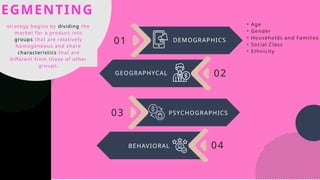
EGMENTING
DEMOGRAPHICS
01
02
PSYCHOGRAPHICS
03
04
GEOGRAPHYCAL
BEHAVIORAL
strategy begins by dividing the
market for a product into
groups that are relatively
homogeneous and share
characteristics that are
different from those of other
groups.
• Age
• Gender
• Households and Families
• Social Class
• Ethnicity
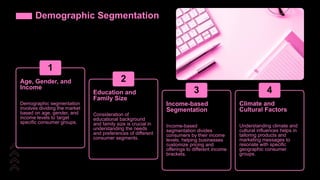
Demographic Segmentation
Age, Gender, and
Income
Demographic segmentation
involves dividing the market
based on age, gender, and
income levels to target
specific consumer groups.
1
Education and
Family Size
Consideration of
educational background
and family size is crucial in
understanding the needs
and preferences of different
consumer segments.
2
Income-based
Segmentation
Income-based
segmentation divides
consumers by their income
levels, helping businesses
customize pricing and
offerings to different income
brackets.
3
Climate and
Cultural Factors
Understanding climate and
cultural influences helps in
tailoring products and
marketing messages to
resonate with specific
geographic consumer
groups.
4
Behavioral Segmentation
Usage Rate
Segmentation
Usage rate segmentation
categorizes consumers based on
how often they use a product,
allowing businesses to tailor loyalty
programs and marketing to
different usage patterns.
Purchase occasion
Segmentation
Purchase occasion segmentation
groups consumers based on when
they make purchases, enabling
companies to create targeted
promotions for different buying
occasions.
Brand Loyalty
Segmentation
Brand loyalty segmentation
classifies consumers based on
their loyalty to specific brands,
helping businesses create
retention strategies and tailored
marketing for loyal customers.
Psychographic Segmentation
Lifestyle and Personality
Psychographic segmentation delves into
consumer lifestyles and personalities,
allowing for targeted marketing based on
interests, values, and behavior patterns.
Social Class and Values
Consideration of social class and values
aids in identifying consumer segments
with similar attitudes and beliefs,
enabling effective targeting strategies.
Attitudes and Motivations
Understanding consumer attitudes and
motivations assists in crafting marketing
messages that resonate with specific
psychographic segments.
Values-based
Values-based segmentation divides
consumers based on their deeply-held
values, helping companies create
offerings and communications that
resonate with specific value systems.
https://www.youtube.com/watch?v=F-
UO9vMS7AI
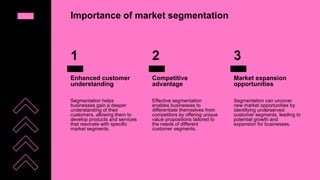
Importance of market segmentation
1
Enhanced customer
understanding
Segmentation helps
businesses gain a deeper
understanding of their
customers, allowing them to
develop products and services
that resonate with specific
market segments.
2
Competitive
advantage
Effective segmentation
enables businesses to
differentiate themselves from
competitors by offering unique
value propositions tailored to
the needs of different
customer segments.
3
Market expansion
opportunities
Segmentation can uncover
new market opportunities by
identifying underserved
customer segments, leading to
potential growth and
expansion for businesses.
02
TARGETING
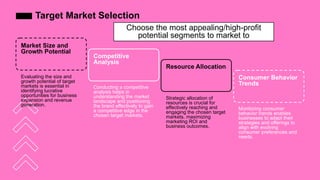
Target Market Selection
Market Size and
Growth Potential
Evaluating the size and
growth potential of target
markets is essential in
identifying lucrative
opportunities for business
expansion and revenue
generation.
Competitive
Analysis
Conducting a competitive
analysis helps in
understanding the market
landscape and positioning
the brand effectively to gain
a competitive edge in the
chosen target markets.
Resource Allocation
Strategic allocation of
resources is crucial for
effectively reaching and
engaging the chosen target
markets, maximizing
marketing ROI and
business outcomes.
Consumer Behavior
Trends
Monitoring consumer
behavior trends enables
businesses to adapt their
strategies and offerings to
align with evolving
consumer preferences and
needs.
Choose the most appealing/high-profit
potential segments to market to
03
POSITIONING
Positioning in consumer behavior
Defining positioning
Positioning refers to how a brand
or product is perceived in the
minds of consumers relative to
competing products, based on
attributes, benefits, and
associations.
Creating a unique
position
Effective positioning allows
businesses to create a unique and
compelling image for their brand or
product, influencing consumer
perceptions and purchase
decisions.
Aligning with target
segments
By aligning positioning strategies
with the needs and preferences of
specific market segments,
businesses can enhance
relevance and appeal to their
target audience.
Positioning Strategies
Unique Selling
Proposition (USP)
Developing a compelling
USP helps in differentiating
the brand and creating a
unique position in the
minds of the target market,
driving competitive
advantage.
1
Perceptual Mapping
Utilizing perceptual
mapping aids in visually
representing consumer
perceptions of competing
brands, facilitating effective
positioning strategies.
2
Brand Personality
and Image
Crafting a distinct brand
personality and image
contributes to creating a
strong and resonant
position in the minds of the
target consumers.
3
Emotional Branding
Implementing emotional
branding techniques helps
in forming deep emotional
connections with the target
market, fostering brand
loyalty and preference.
4
Benefits of effective
positioning
Targeted marketing
efforts
Clear positioning allows for
targeted marketing efforts
towards the right consumer
segments.
1
Enhanced brand
loyalty
Effective positioning fosters
brand loyalty by creating
strong emotional
connections with
consumers.
2
Increased customer
satisfaction
Well-positioned brands
meet consumer needs and
expectations, leading to
higher satisfaction.
3
Improved price
premium
Strong positioning enables
brands to command
premium prices for their
products or services.
4
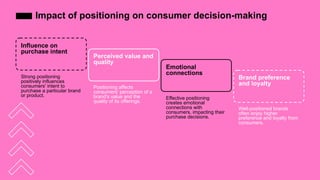
Impact of positioning on consumer decision-making
Influence on
purchase intent
Strong positioning
positively influences
consumers' intent to
purchase a particular brand
or product.
Perceived value and
quality
Positioning affects
consumers' perception of a
brand's value and the
quality of its offerings.
Emotional
connections
Effective positioning
creates emotional
connections with
consumers, impacting their
purchase decisions.
Brand preference
and loyalty
Well-positioned brands
often enjoy higher
preference and loyalty from
consumers.
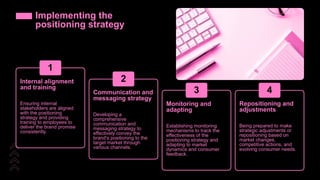
Implementing the
positioning strategy
Internal alignment
and training
Ensuring internal
stakeholders are aligned
with the positioning
strategy and providing
training to employees to
deliver the brand promise
consistently.
1
Communication and
messaging strategy
Developing a
comprehensive
communication and
messaging strategy to
effectively convey the
brand's positioning to the
target market through
various channels.
2
Monitoring and
adapting
Establishing monitoring
mechanisms to track the
effectiveness of the
positioning strategy and
adapting to market
dynamics and consumer
feedback.
3
Repositioning and
adjustments
Being prepared to make
strategic adjustments or
repositioning based on
market changes,
competitive actions, and
evolving consumer needs.
4
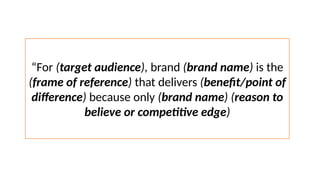
“For (target audience), brand (brand name) is the
(frame of reference) that delivers (benefit/point of
difference) because only (brand name) (reason to
believe or competitive edge)
Thank You
Meta Bara Berutu, S.E., M.M.

CB_WEEK 2 NEW mengenai segmenting, targeting, and positioning

  • 1.
  • 2.
  • 3.
    Understanding market segmentation 1 Defining marketsegmentation Market segmentation is the process of dividing a market into distinct groups of buyers who have different needs, characteristics, or behaviors. 2 Benefits of market segmentation Segmentation allows businesses to tailor their products, services, and marketing efforts to meet the specific needs of different customer groups, leading to increased customer satisfaction and higher sales. 3 Effective targeting through segmentation By segmenting the market, businesses can identify and target the most profitable customer segments, resulting in improved resource allocation and better return on investment.
  • 4.
    EGMENTING DEMOGRAPHICS 01 02 PSYCHOGRAPHICS 03 04 GEOGRAPHYCAL BEHAVIORAL strategy begins bydividing the market for a product into groups that are relatively homogeneous and share characteristics that are different from those of other groups. • Age • Gender • Households and Families • Social Class • Ethnicity
  • 5.
    Demographic Segmentation Age, Gender,and Income Demographic segmentation involves dividing the market based on age, gender, and income levels to target specific consumer groups. 1 Education and Family Size Consideration of educational background and family size is crucial in understanding the needs and preferences of different consumer segments. 2 Income-based Segmentation Income-based segmentation divides consumers by their income levels, helping businesses customize pricing and offerings to different income brackets. 3 Climate and Cultural Factors Understanding climate and cultural influences helps in tailoring products and marketing messages to resonate with specific geographic consumer groups. 4
  • 6.
    Behavioral Segmentation Usage Rate Segmentation Usagerate segmentation categorizes consumers based on how often they use a product, allowing businesses to tailor loyalty programs and marketing to different usage patterns. Purchase occasion Segmentation Purchase occasion segmentation groups consumers based on when they make purchases, enabling companies to create targeted promotions for different buying occasions. Brand Loyalty Segmentation Brand loyalty segmentation classifies consumers based on their loyalty to specific brands, helping businesses create retention strategies and tailored marketing for loyal customers.
  • 7.
    Psychographic Segmentation Lifestyle andPersonality Psychographic segmentation delves into consumer lifestyles and personalities, allowing for targeted marketing based on interests, values, and behavior patterns. Social Class and Values Consideration of social class and values aids in identifying consumer segments with similar attitudes and beliefs, enabling effective targeting strategies. Attitudes and Motivations Understanding consumer attitudes and motivations assists in crafting marketing messages that resonate with specific psychographic segments. Values-based Values-based segmentation divides consumers based on their deeply-held values, helping companies create offerings and communications that resonate with specific value systems.
  • 8.
  • 9.
    Importance of marketsegmentation 1 Enhanced customer understanding Segmentation helps businesses gain a deeper understanding of their customers, allowing them to develop products and services that resonate with specific market segments. 2 Competitive advantage Effective segmentation enables businesses to differentiate themselves from competitors by offering unique value propositions tailored to the needs of different customer segments. 3 Market expansion opportunities Segmentation can uncover new market opportunities by identifying underserved customer segments, leading to potential growth and expansion for businesses.
  • 10.
  • 11.
    Target Market Selection MarketSize and Growth Potential Evaluating the size and growth potential of target markets is essential in identifying lucrative opportunities for business expansion and revenue generation. Competitive Analysis Conducting a competitive analysis helps in understanding the market landscape and positioning the brand effectively to gain a competitive edge in the chosen target markets. Resource Allocation Strategic allocation of resources is crucial for effectively reaching and engaging the chosen target markets, maximizing marketing ROI and business outcomes. Consumer Behavior Trends Monitoring consumer behavior trends enables businesses to adapt their strategies and offerings to align with evolving consumer preferences and needs. Choose the most appealing/high-profit potential segments to market to
  • 12.
  • 13.
    Positioning in consumerbehavior Defining positioning Positioning refers to how a brand or product is perceived in the minds of consumers relative to competing products, based on attributes, benefits, and associations. Creating a unique position Effective positioning allows businesses to create a unique and compelling image for their brand or product, influencing consumer perceptions and purchase decisions. Aligning with target segments By aligning positioning strategies with the needs and preferences of specific market segments, businesses can enhance relevance and appeal to their target audience.
  • 14.
    Positioning Strategies Unique Selling Proposition(USP) Developing a compelling USP helps in differentiating the brand and creating a unique position in the minds of the target market, driving competitive advantage. 1 Perceptual Mapping Utilizing perceptual mapping aids in visually representing consumer perceptions of competing brands, facilitating effective positioning strategies. 2 Brand Personality and Image Crafting a distinct brand personality and image contributes to creating a strong and resonant position in the minds of the target consumers. 3 Emotional Branding Implementing emotional branding techniques helps in forming deep emotional connections with the target market, fostering brand loyalty and preference. 4
  • 15.
    Benefits of effective positioning Targetedmarketing efforts Clear positioning allows for targeted marketing efforts towards the right consumer segments. 1 Enhanced brand loyalty Effective positioning fosters brand loyalty by creating strong emotional connections with consumers. 2 Increased customer satisfaction Well-positioned brands meet consumer needs and expectations, leading to higher satisfaction. 3 Improved price premium Strong positioning enables brands to command premium prices for their products or services. 4
  • 16.
    Impact of positioningon consumer decision-making Influence on purchase intent Strong positioning positively influences consumers' intent to purchase a particular brand or product. Perceived value and quality Positioning affects consumers' perception of a brand's value and the quality of its offerings. Emotional connections Effective positioning creates emotional connections with consumers, impacting their purchase decisions. Brand preference and loyalty Well-positioned brands often enjoy higher preference and loyalty from consumers.
  • 17.
    Implementing the positioning strategy Internalalignment and training Ensuring internal stakeholders are aligned with the positioning strategy and providing training to employees to deliver the brand promise consistently. 1 Communication and messaging strategy Developing a comprehensive communication and messaging strategy to effectively convey the brand's positioning to the target market through various channels. 2 Monitoring and adapting Establishing monitoring mechanisms to track the effectiveness of the positioning strategy and adapting to market dynamics and consumer feedback. 3 Repositioning and adjustments Being prepared to make strategic adjustments or repositioning based on market changes, competitive actions, and evolving consumer needs. 4
  • 18.
    “For (target audience),brand (brand name) is the (frame of reference) that delivers (benefit/point of difference) because only (brand name) (reason to believe or competitive edge)
  • 19.
    Thank You Meta BaraBerutu, S.E., M.M.