Webinar: Sochi Games Wrap-Up 
March 20, 2014
Introduction 
• John Tkaczewski, President and Co-Founder 
• Chris Bailey, CEO and Co-Founder 
• Check out our blog: http://www.filecatalyst.com/blog 
| © Copyright 2 FileCatalyst, 2013
Overview 
• Accelerated File Transfer Introduction 
• Challenges of Live Sports Production 
• Accelerated File Transfer as a Solution for live sports 
production 
• Demo 
| © Copyright 3 FileCatalyst, 2013
What is File Transfer Acceleration? 
• File transfer acceleration technology allows large files, or “big data” 
to be sent quickly over large geographical distances without being 
impeded by network impairments such as latency and packet loss 
• This is accomplished by transferring files using the UDP protocol 
instead of the TCP protocol, the protocol used for FTP 
• The main difference between UDP and TCP is that UDP wastes no 
time communicating about the receipt of a block of data so 
that regardless of network latency, data transmission remains 
constant, thus overcoming the peak and valley effect that occurs 
with TCP based protocols on links with high latency 
• Reliability and congestion control is added to UDP at the application 
layer thus it doesn’t sacrifice its other desirable properties 
| © Copyright 4 FileCatalyst, 2013
Growth of “at home” concept 
• Explosion of equipment required to be shipped to a live venue 
• Centralized production team (like OBS) does much of the camera 
and event production work 
• Our planet is very well connected; you can provision a fast network 
connection to almost any venue around the world, this link can 
then be used to transfer video and all other data really fast back to 
the studio at home. 
• Having file based video available to you in a central studio in real 
time will help you to minimize the amount of gear required at a 
venue. 
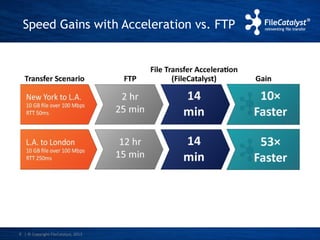
• The only hiccup is that even the fastest connections cannot reach 
full line speed with traditional file transfers using HTTP or FTP. 
| © Copyright 5 FileCatalyst, 2013
Speed Gains with Acceleration vs. FTP 
| © Copyright 6 FileCatalyst, 2013
Challenges of Live Sports Production 
• Video files tend to be very large in size, up to 100 GB for a full 
resolution video file making file transfers lengthy 
• Geographical distances when editing from remote locations further 
slow file transfers 
• Non-standard MXF (Material Exchange Format) files are extremely 
difficult and unreliable to transfer using traditional file transfer 
methods 
• Large sporting events often require multiple files to be transferred 
simultaneously from multiple camera feeds or events 
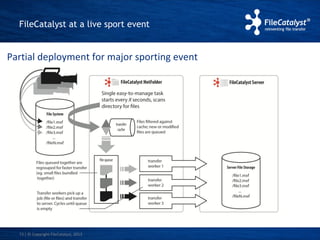
• Transferring dynamic file sets (transferring video files as they are 
still being recorded) – growth files 
| © Copyright 7 FileCatalyst, 2013
Challenges of Live Sports Production 
• MXF is a “container” that supports many formats, MXF files can 
grow in many different ways: 
– Growing in the tail – new content is appended to the tail of the file 
– Growing within – the initial size of the file is set in the beginning and the file is 
then “filled” (like a water pitcher) 
– Essence is written and only headers change – in this condition the content of 
the file does not change but only the headers are updated. This occur every 
time the file grows a little (as essence is added) or it could simply happen at 
the very end as the file is finalized. 
• During a file transfer a software solution has to be able to handle all 
those use cases 
| © Copyright 8 FileCatalyst, 2013
Accelerated File Transfer Software as a Solution 
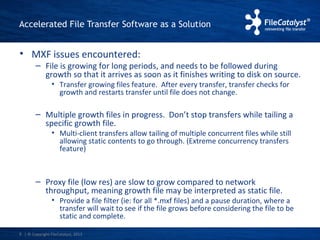
• MXF issues encountered: 
– File is growing for long periods, and needs to be followed during 
growth so that it arrives as soon as it finishes writing to disk on source. 
• Transfer growing files feature. After every transfer, transfer checks for 
growth and restarts transfer until file does not change. 
– Multiple growth files in progress. Don’t stop transfers while tailing a 
specific growth file. 
• Multi-client transfers allow tailing of multiple concurrent files while still 
allowing static contents to go through. (Extreme concurrency transfers 
feature) 
– Proxy file (low res) are slow to grow compared to network 
throughput, meaning growth file may be interpreted as static file. 
• Provide a file filter (ie: for all *.mxf files) and a pause duration, where a 
transfer will wait to see if the file grows before considering the file to be 
static and complete. 
| © Copyright 9 FileCatalyst, 2013
Accelerated File Transfer Software as a Solution 
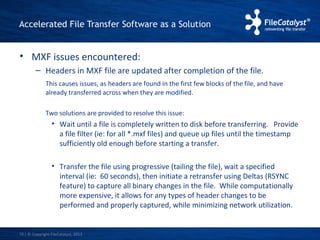
• MXF issues encountered: 
– Headers in MXF file are updated after completion of the file. 
This causes issues, as headers are found in the first few blocks of the file, and have 
already transferred across when they are modified. 
Two solutions are provided to resolve this issue: 
• Wait until a file is completely written to disk before transferring. Provide 
a file filter (ie: for all *.mxf files) and queue up files until the timestamp 
sufficiently old enough before starting a transfer. 
• Transfer the file using progressive (tailing the file), wait a specified 
interval (ie: 60 seconds), then initiate a retransfer using Deltas (RSYNC 
feature) to capture all binary changes in the file. While computationally 
more expensive, it allows for any types of header changes to be 
performed and properly captured, while minimizing network utilization. 
| © Copyright 10 FileCatalyst, 2013
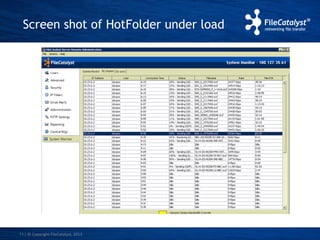
Screen shot of HotFolder under load 
| © Copyright 11 FileCatalyst, 2013
Accelerated File Transfer Software as a Solution 
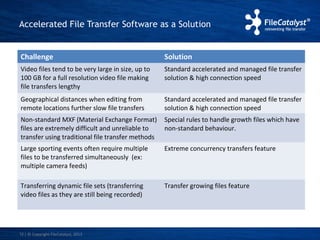
Challenge Solution 
Video files tend to be very large in size, up to 
100 GB for a full resolution video file making 
file transfers lengthy 
| © Copyright 12 FileCatalyst, 2013 
Standard accelerated and managed file transfer 
solution & high connection speed 
Geographical distances when editing from 
remote locations further slow file transfers 
Standard accelerated and managed file transfer 
solution & high connection speed 
Non-standard MXF (Material Exchange Format) 
files are extremely difficult and unreliable to 
transfer using traditional file transfer methods 
Special rules to handle growth files which have 
non-standard behaviour. 
Large sporting events often require multiple 
files to be transferred simultaneously (ex: 
multiple camera feeds) 
Extreme concurrency transfers feature 
Transferring dynamic file sets (transferring 
video files as they are still being recorded) 
Transfer growing files feature
FileCatalyst at a live sport event 
Partial deployment for major sporting event 
| © Copyright 13 FileCatalyst, 2013
Demo
About FileCatalyst 
FileCatalyst technology is developed by Unlimi-Tech Software Inc., a world 
leader in file transfer solutions. Founded in 2000, the company has more 
than 1000 clients with a user base of over 1 million. FileCatalyst provides 
software-based solutions designed to accelerate and optimize file transfers 
across global networks. Being immune to packet loss and latency, FileCatalyst 
can send files much faster than methods such as FTP, HTTP or CIFS, while 
adding security and reliability. 
To learn more visit www.filecatalyst.com 
| © Copyright 15 FileCatalyst, 2013
Upcoming Events 
- JB&A Conference, Las Vegas, Nevada (April 5-6) at MGM Grand 
- NAB Show, Las Vegas, Nevada (April 6-10) 
– Don’t miss our NAB session “Accelerating Olympic Winter Games Footage from Sochi, 
Russia to Stamford, CT”. 
– Date: Tuesday, January 21 Time: 11 am EST 
- IBC 2014, RAI, Amsterdam (September 12-16) 
And of course don’t forget our monthly webinars... 
| © Copyright 16 FileCatalyst, 2013
Thank you! 
Questions?

Sochi games wrap-up

  • 1.
    Webinar: Sochi GamesWrap-Up March 20, 2014
  • 2.
    Introduction • JohnTkaczewski, President and Co-Founder • Chris Bailey, CEO and Co-Founder • Check out our blog: http://www.filecatalyst.com/blog | © Copyright 2 FileCatalyst, 2013
  • 3.
    Overview • AcceleratedFile Transfer Introduction • Challenges of Live Sports Production • Accelerated File Transfer as a Solution for live sports production • Demo | © Copyright 3 FileCatalyst, 2013
  • 4.
    What is FileTransfer Acceleration? • File transfer acceleration technology allows large files, or “big data” to be sent quickly over large geographical distances without being impeded by network impairments such as latency and packet loss • This is accomplished by transferring files using the UDP protocol instead of the TCP protocol, the protocol used for FTP • The main difference between UDP and TCP is that UDP wastes no time communicating about the receipt of a block of data so that regardless of network latency, data transmission remains constant, thus overcoming the peak and valley effect that occurs with TCP based protocols on links with high latency • Reliability and congestion control is added to UDP at the application layer thus it doesn’t sacrifice its other desirable properties | © Copyright 4 FileCatalyst, 2013
  • 5.
    Growth of “athome” concept • Explosion of equipment required to be shipped to a live venue • Centralized production team (like OBS) does much of the camera and event production work • Our planet is very well connected; you can provision a fast network connection to almost any venue around the world, this link can then be used to transfer video and all other data really fast back to the studio at home. • Having file based video available to you in a central studio in real time will help you to minimize the amount of gear required at a venue. • The only hiccup is that even the fastest connections cannot reach full line speed with traditional file transfers using HTTP or FTP. | © Copyright 5 FileCatalyst, 2013
  • 6.
    Speed Gains withAcceleration vs. FTP | © Copyright 6 FileCatalyst, 2013
  • 7.
    Challenges of LiveSports Production • Video files tend to be very large in size, up to 100 GB for a full resolution video file making file transfers lengthy • Geographical distances when editing from remote locations further slow file transfers • Non-standard MXF (Material Exchange Format) files are extremely difficult and unreliable to transfer using traditional file transfer methods • Large sporting events often require multiple files to be transferred simultaneously from multiple camera feeds or events • Transferring dynamic file sets (transferring video files as they are still being recorded) – growth files | © Copyright 7 FileCatalyst, 2013
  • 8.
    Challenges of LiveSports Production • MXF is a “container” that supports many formats, MXF files can grow in many different ways: – Growing in the tail – new content is appended to the tail of the file – Growing within – the initial size of the file is set in the beginning and the file is then “filled” (like a water pitcher) – Essence is written and only headers change – in this condition the content of the file does not change but only the headers are updated. This occur every time the file grows a little (as essence is added) or it could simply happen at the very end as the file is finalized. • During a file transfer a software solution has to be able to handle all those use cases | © Copyright 8 FileCatalyst, 2013
  • 9.
    Accelerated File TransferSoftware as a Solution • MXF issues encountered: – File is growing for long periods, and needs to be followed during growth so that it arrives as soon as it finishes writing to disk on source. • Transfer growing files feature. After every transfer, transfer checks for growth and restarts transfer until file does not change. – Multiple growth files in progress. Don’t stop transfers while tailing a specific growth file. • Multi-client transfers allow tailing of multiple concurrent files while still allowing static contents to go through. (Extreme concurrency transfers feature) – Proxy file (low res) are slow to grow compared to network throughput, meaning growth file may be interpreted as static file. • Provide a file filter (ie: for all *.mxf files) and a pause duration, where a transfer will wait to see if the file grows before considering the file to be static and complete. | © Copyright 9 FileCatalyst, 2013
  • 10.
    Accelerated File TransferSoftware as a Solution • MXF issues encountered: – Headers in MXF file are updated after completion of the file. This causes issues, as headers are found in the first few blocks of the file, and have already transferred across when they are modified. Two solutions are provided to resolve this issue: • Wait until a file is completely written to disk before transferring. Provide a file filter (ie: for all *.mxf files) and queue up files until the timestamp sufficiently old enough before starting a transfer. • Transfer the file using progressive (tailing the file), wait a specified interval (ie: 60 seconds), then initiate a retransfer using Deltas (RSYNC feature) to capture all binary changes in the file. While computationally more expensive, it allows for any types of header changes to be performed and properly captured, while minimizing network utilization. | © Copyright 10 FileCatalyst, 2013
  • 11.
    Screen shot ofHotFolder under load | © Copyright 11 FileCatalyst, 2013
  • 12.
    Accelerated File TransferSoftware as a Solution Challenge Solution Video files tend to be very large in size, up to 100 GB for a full resolution video file making file transfers lengthy | © Copyright 12 FileCatalyst, 2013 Standard accelerated and managed file transfer solution & high connection speed Geographical distances when editing from remote locations further slow file transfers Standard accelerated and managed file transfer solution & high connection speed Non-standard MXF (Material Exchange Format) files are extremely difficult and unreliable to transfer using traditional file transfer methods Special rules to handle growth files which have non-standard behaviour. Large sporting events often require multiple files to be transferred simultaneously (ex: multiple camera feeds) Extreme concurrency transfers feature Transferring dynamic file sets (transferring video files as they are still being recorded) Transfer growing files feature
  • 13.
    FileCatalyst at alive sport event Partial deployment for major sporting event | © Copyright 13 FileCatalyst, 2013
  • 14.
  • 15.
    About FileCatalyst FileCatalysttechnology is developed by Unlimi-Tech Software Inc., a world leader in file transfer solutions. Founded in 2000, the company has more than 1000 clients with a user base of over 1 million. FileCatalyst provides software-based solutions designed to accelerate and optimize file transfers across global networks. Being immune to packet loss and latency, FileCatalyst can send files much faster than methods such as FTP, HTTP or CIFS, while adding security and reliability. To learn more visit www.filecatalyst.com | © Copyright 15 FileCatalyst, 2013
  • 16.
    Upcoming Events -JB&A Conference, Las Vegas, Nevada (April 5-6) at MGM Grand - NAB Show, Las Vegas, Nevada (April 6-10) – Don’t miss our NAB session “Accelerating Olympic Winter Games Footage from Sochi, Russia to Stamford, CT”. – Date: Tuesday, January 21 Time: 11 am EST - IBC 2014, RAI, Amsterdam (September 12-16) And of course don’t forget our monthly webinars... | © Copyright 16 FileCatalyst, 2013
  • 17.

Editor's Notes

  • #8 Producing a live sporting event is, at the best of times, a challenging proposition for broadcasters.  With multiple cameras producing massive high resolution video files, moving the video files for in-studio editing can be a daunting task.  Even with a high bandwidth link and an accelerated and managed file transfer solution in place, there are sometimes other distinct obstacles which must be addressed.  In addition, in today’s digital age it is expected that content (i.e. highlights, mash-ups) will be made available in near real time via all mediums including live broadcast, the web, and mobile devices.  
  • #9 Producing a live sporting event is, at the best of times, a challenging proposition for broadcasters.  With multiple cameras producing massive high resolution video files, moving the video files for in-studio editing can be a daunting task.  Even with a high bandwidth link and an accelerated and managed file transfer solution in place, there are sometimes other distinct obstacles which must be addressed.  In addition, in today’s digital age it is expected that content (i.e. highlights, mash-ups) will be made available in near real time via all mediums including live broadcast, the web, and mobile devices.