1© Cloudera, Inc. All rights reserved.
Simplifying Analytic Workloads via Complex Schemas
Marcel Kornacker
Data Modeling for Data Science
2© Cloudera, Inc. All rights reserved.
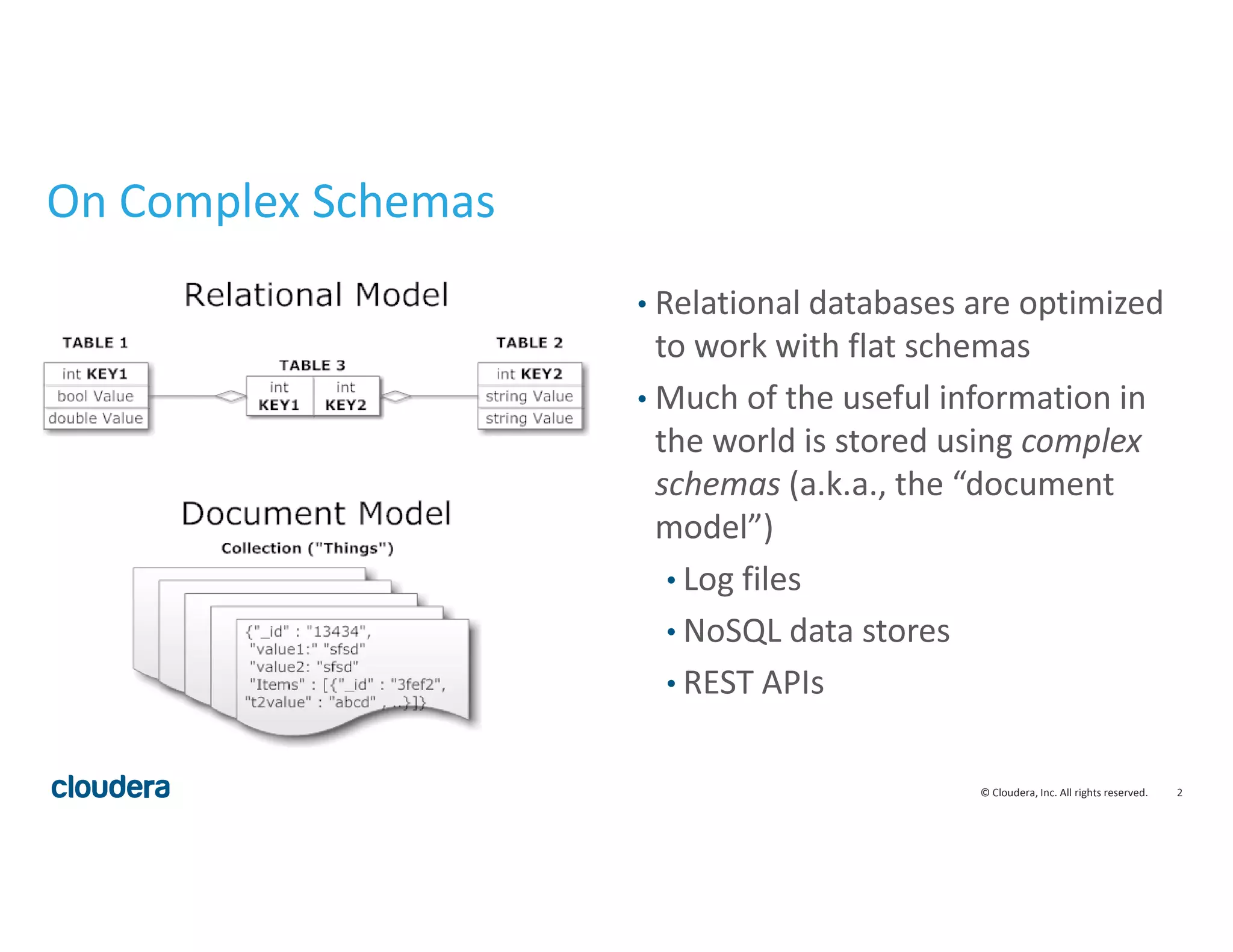
• Relational databases are optimized
to work with flat schemas
• Much of the useful information in
the world is stored using complex
schemas (a.k.a., the “document
model”)
• Log files
• NoSQL data stores
• REST APIs
On Complex Schemas
3© Cloudera, Inc. All rights reserved.
Handling Complex Schemas in SQL
4© Cloudera, Inc. All rights reserved.
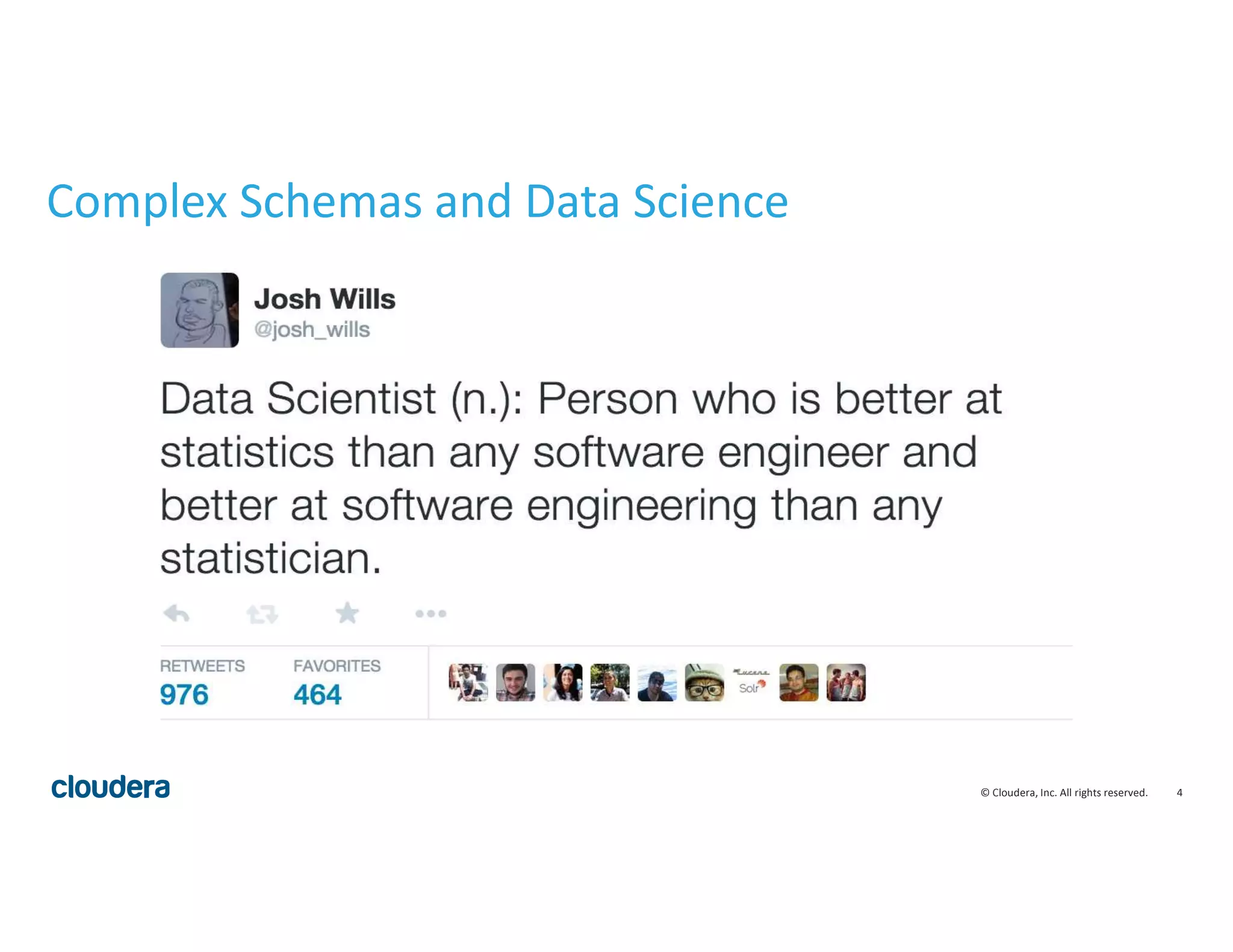
Complex Schemas and Data Science
5© Cloudera, Inc. All rights reserved.
Think Like A Data Scientist
6© Cloudera, Inc. All rights reserved.
Building Data Science Teams: A Moneyball Approach
7© Cloudera, Inc. All rights reserved.
Leveraging The Power of SQL Engines…
8© Cloudera, Inc. All rights reserved.
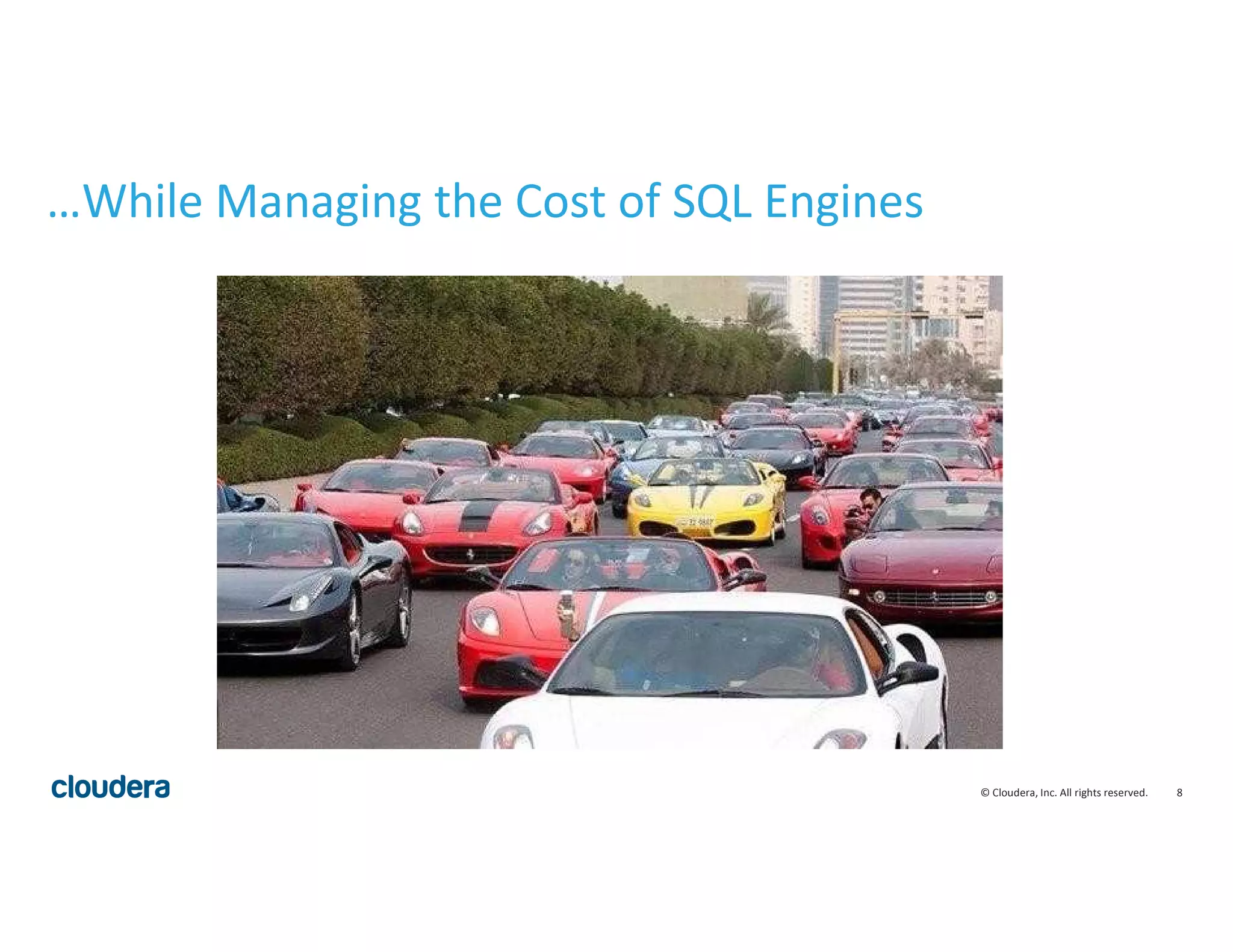
…While Managing the Cost of SQL Engines
9© Cloudera, Inc. All rights reserved.
Intentional Complex Schemas
10© Cloudera, Inc. All rights reserved.
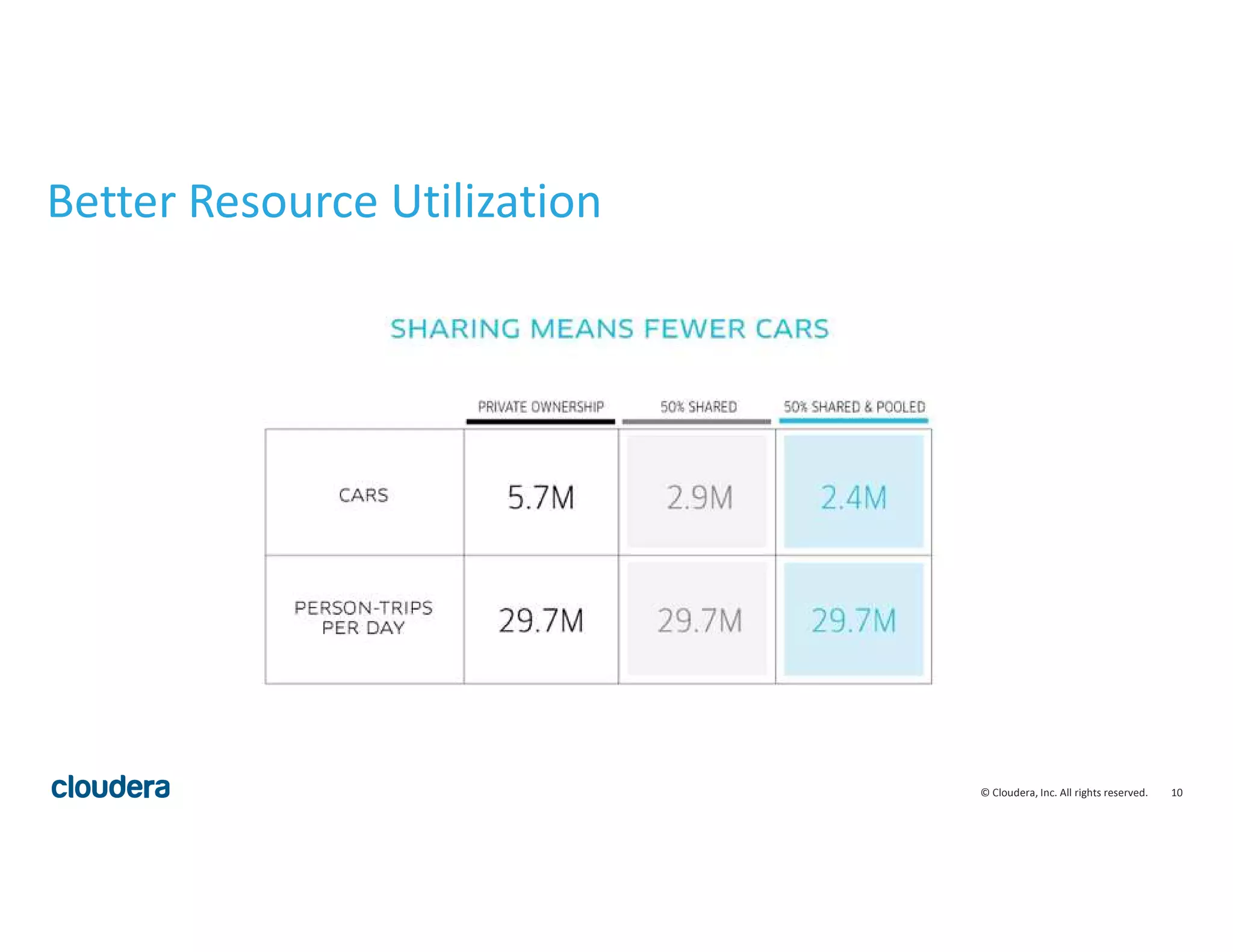
Better Resource Utilization
11© Cloudera, Inc. All rights reserved.
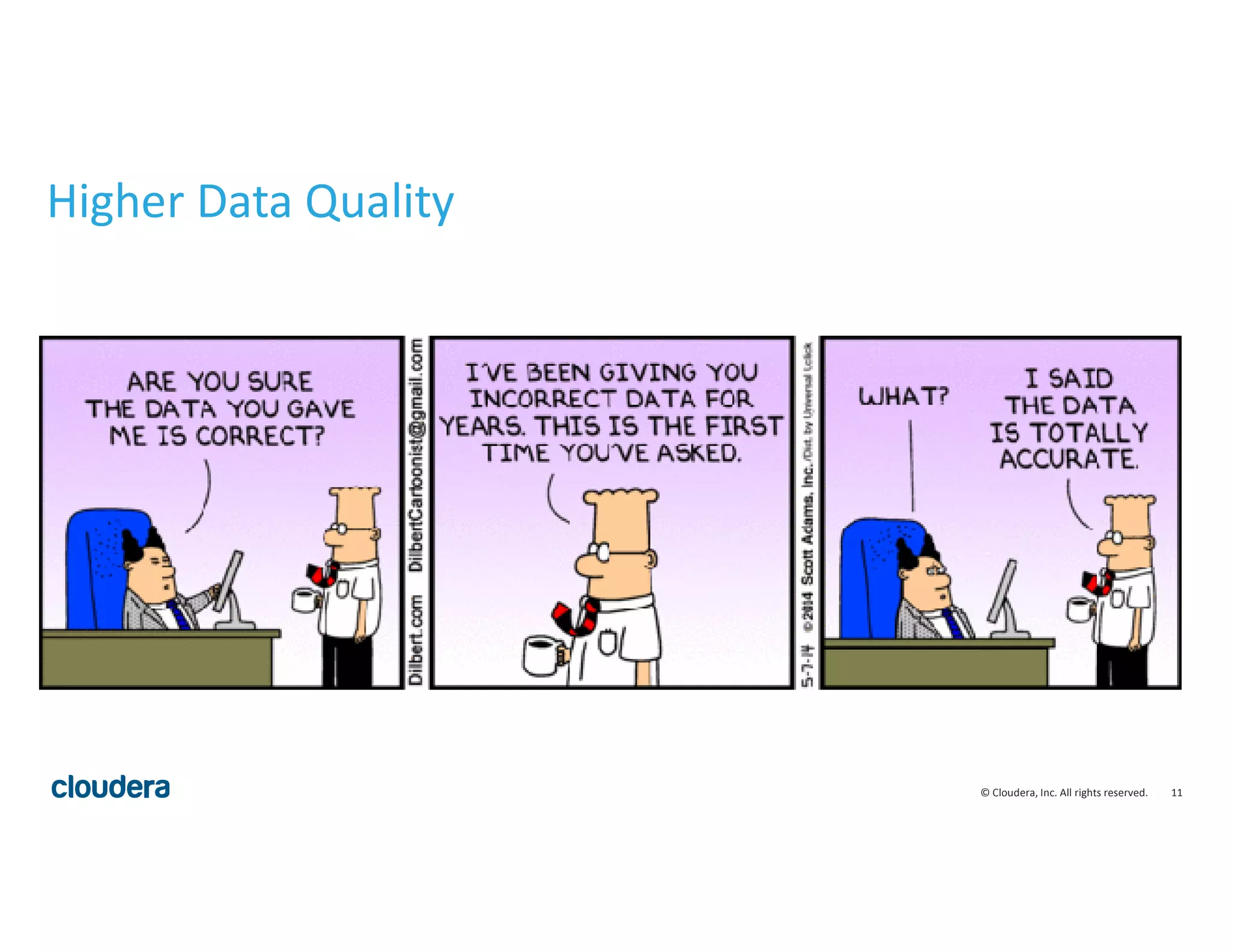
Higher Data Quality
12© Cloudera, Inc. All rights reserved.
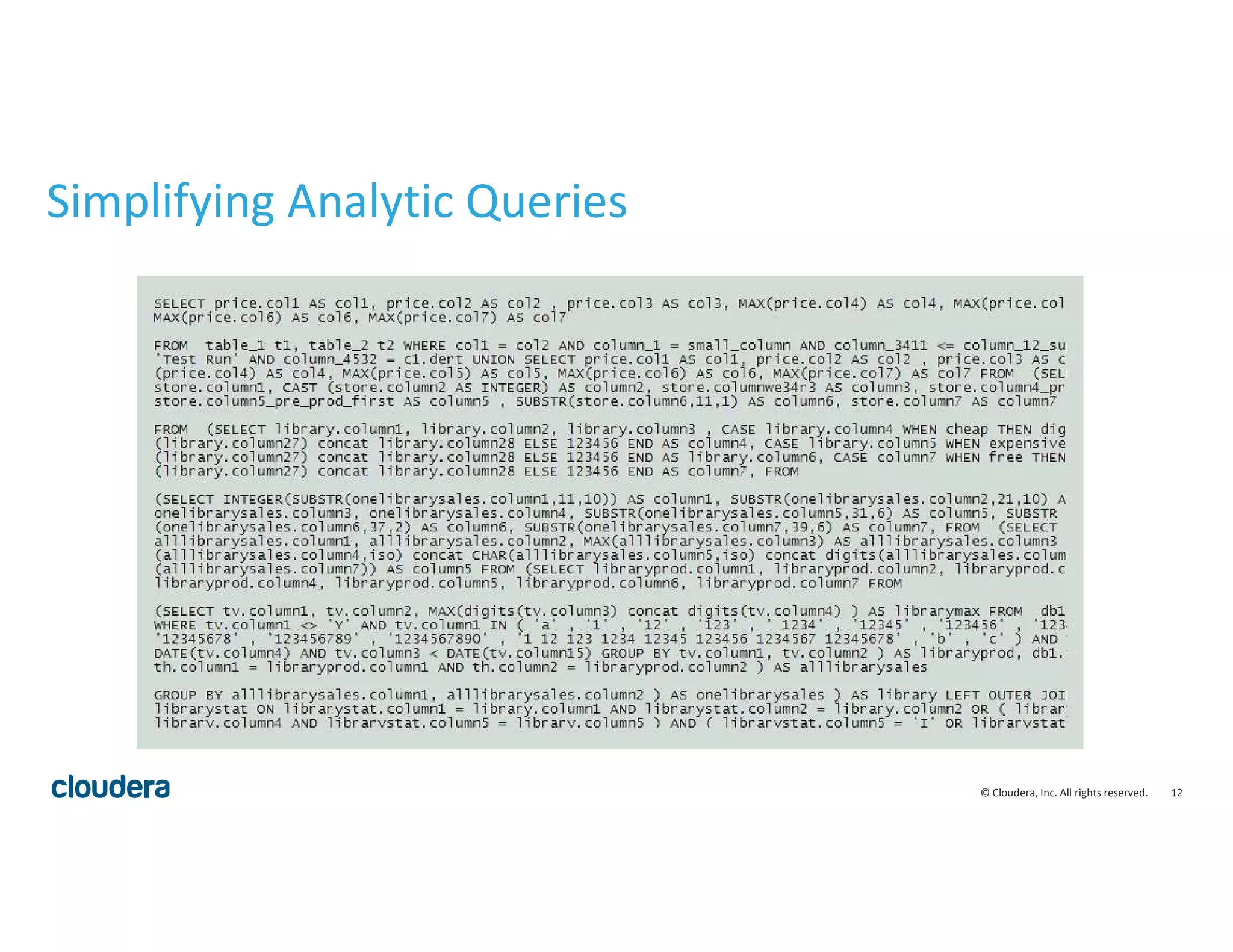
Simplifying Analytic Queries
13© Cloudera, Inc. All rights reserved.
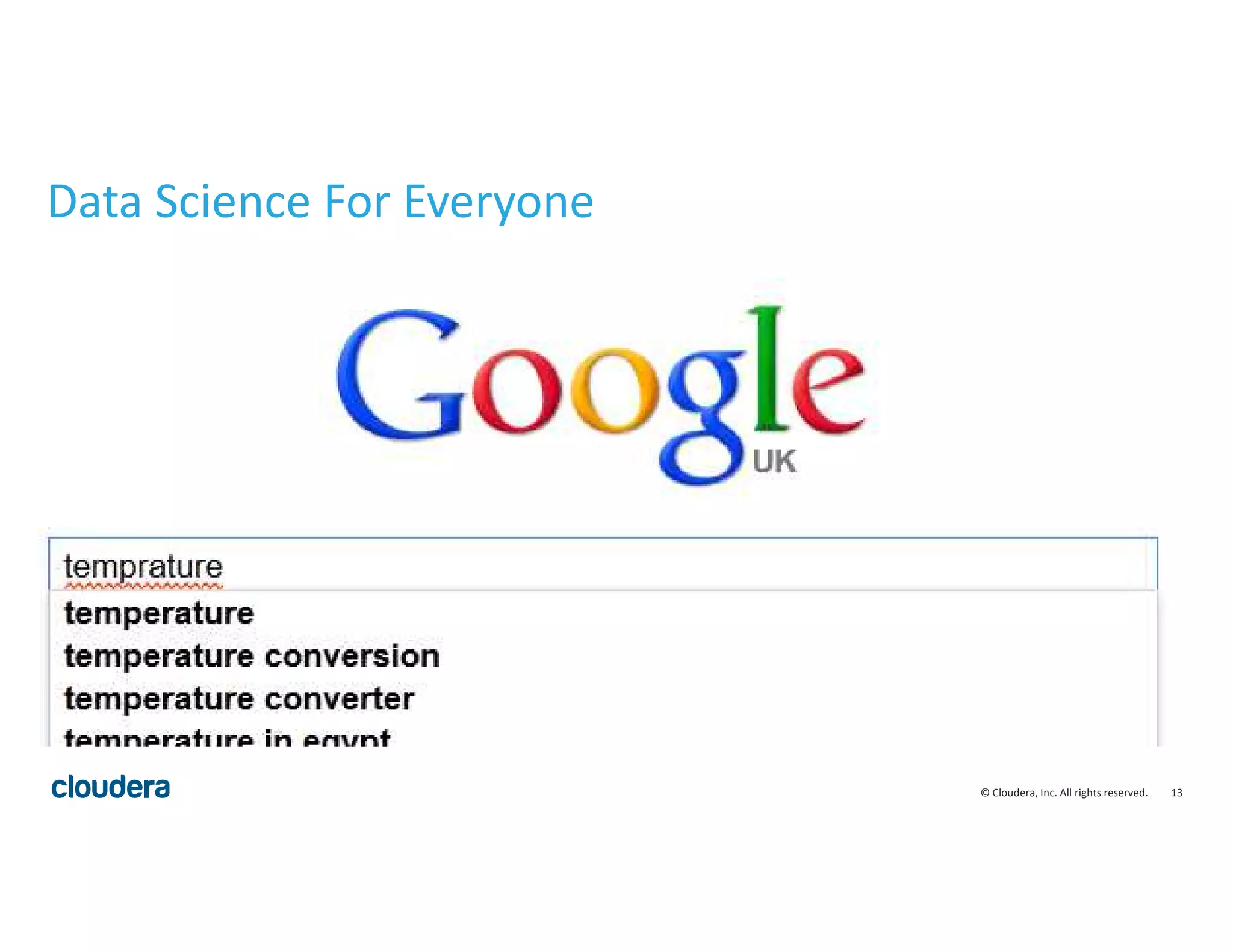
Data Science For Everyone
14© Cloudera, Inc. All rights reserved.
Nested Types in Impala
Support for Nested Data Types: STRUCT, MAP, ARRAY
Natural Extensions to SQL
Full Expressiveness of SQL with Nested Types
15© Cloudera, Inc. All rights reserved.
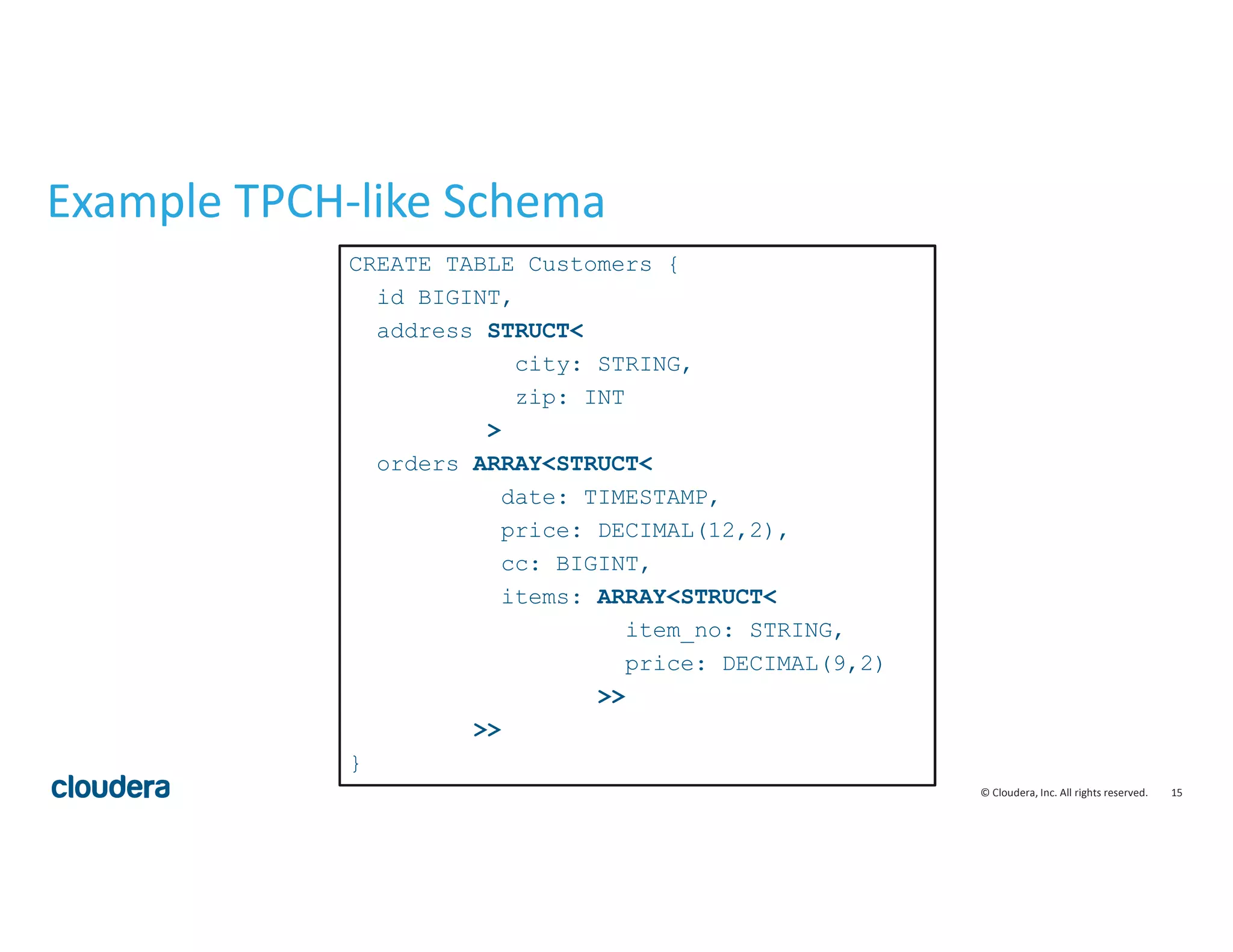
Example TPCH-like Schema
CREATE TABLE Customers {
id BIGINT,
address STRUCT<
city: STRING,
zip: INT
>
orders ARRAY<STRUCT<
date: TIMESTAMP,
price: DECIMAL(12,2),
cc: BIGINT,
items: ARRAY<STRUCT<
item_no: STRING,
price: DECIMAL(9,2)
>>
>>
}
16© Cloudera, Inc. All rights reserved.
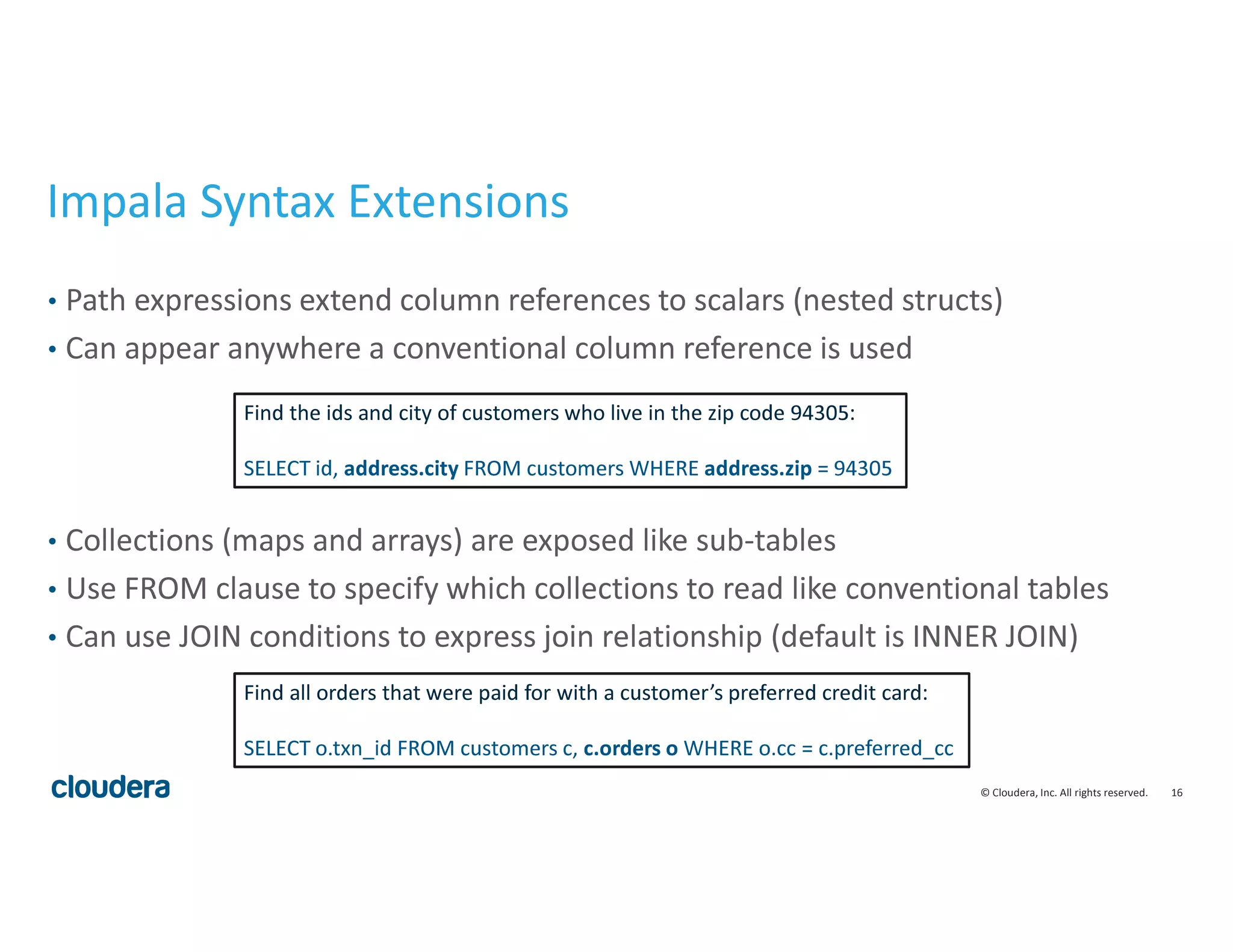
Impala Syntax Extensions
• Path expressions extend column references to scalars (nested structs)
• Can appear anywhere a conventional column reference is used
• Collections (maps and arrays) are exposed like sub-tables
• Use FROM clause to specify which collections to read like conventional tables
• Can use JOIN conditions to express join relationship (default is INNER JOIN)
Find the ids and city of customers who live in the zip code 94305:
SELECT id, address.city FROM customers WHERE address.zip = 94305
Find all orders that were paid for with a customer’s preferred credit card:
SELECT o.txn_id FROM customers c, c.orders o WHERE o.cc = c.preferred_cc
17© Cloudera, Inc. All rights reserved.
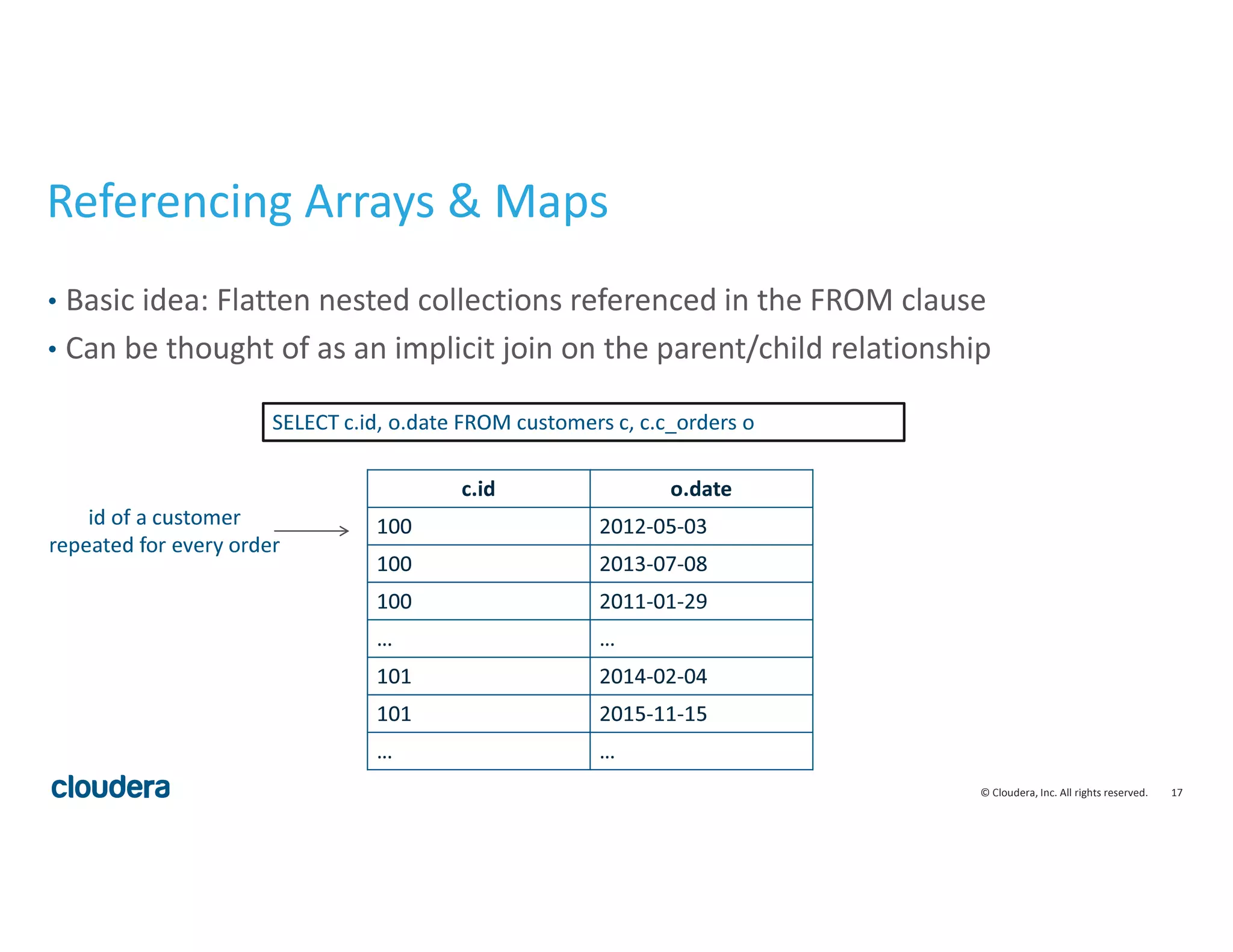
Referencing Arrays & Maps
• Basic idea: Flatten nested collections referenced in the FROM clause
• Can be thought of as an implicit join on the parent/child relationship
SELECT c.id, o.date FROM customers c, c.c_orders o
c.id o.date
100 2012-05-03
100 2013-07-08
100 2011-01-29
… …
101 2014-02-04
101 2015-11-15
… …
id of a customer
repeated for every order
18© Cloudera, Inc. All rights reserved.
Referencing Arrays & Maps
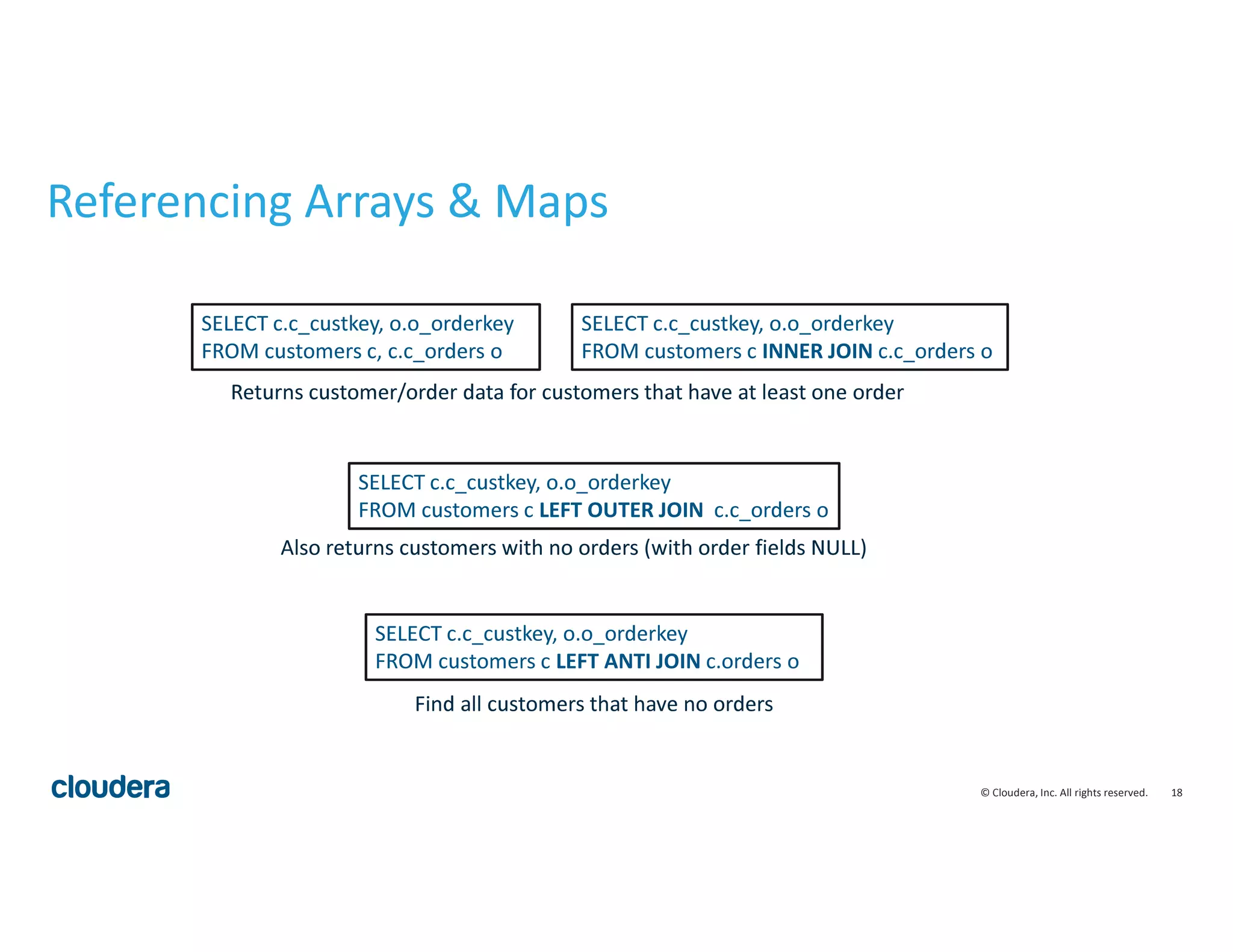
SELECT c.c_custkey, o.o_orderkey
FROM customers c, c.c_orders o
Returns customer/order data for customers that have at least one order
SELECT c.c_custkey, o.o_orderkey
FROM customers c LEFT OUTER JOIN c.c_orders o
Also returns customers with no orders (with order fields NULL)
SELECT c.c_custkey, o.o_orderkey
FROM customers c LEFT ANTI JOIN c.orders o
Find all customers that have no orders
SELECT c.c_custkey, o.o_orderkey
FROM customers c INNER JOIN c.c_orders o
19© Cloudera, Inc. All rights reserved.
Motivation for Advanced Querying Capabilities
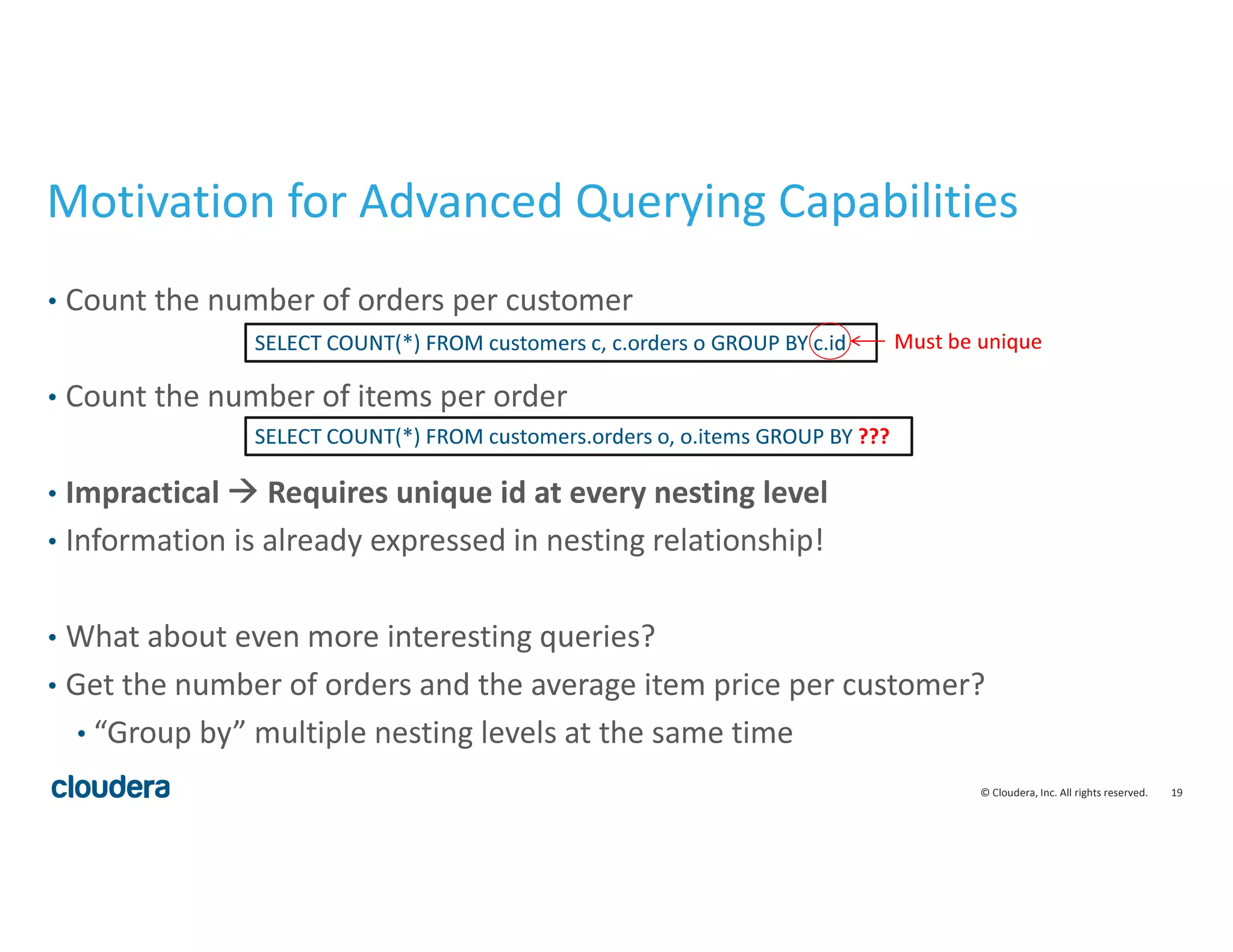
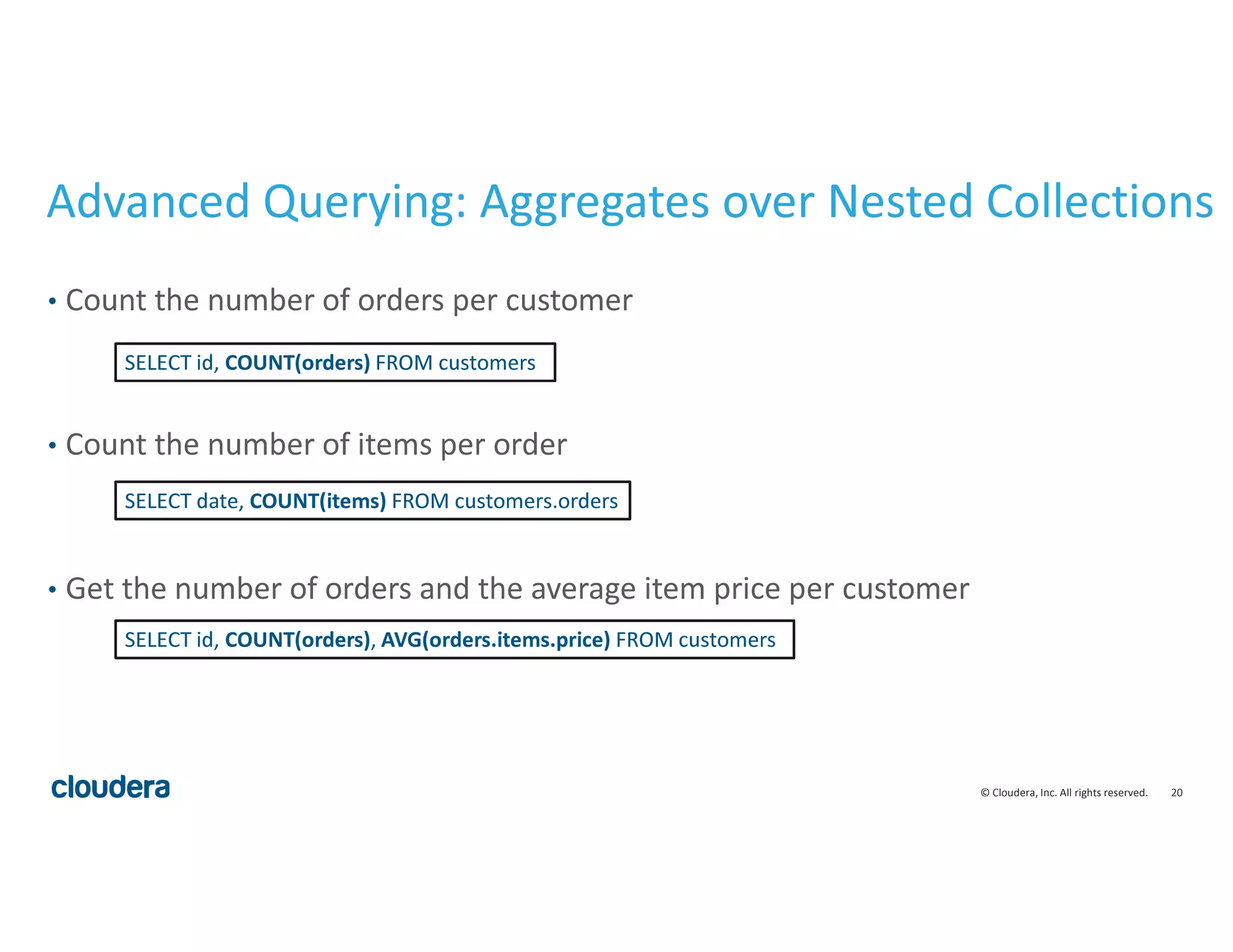
• Count the number of orders per customer
• Count the number of items per order
• Impractical Requires unique id at every nesting level
• Information is already expressed in nesting relationship!
• What about even more interesting queries?
• Get the number of orders and the average item price per customer?
• “Group by” multiple nesting levels at the same time
SELECT COUNT(*) FROM customers c, c.orders o GROUP BY c.id
SELECT COUNT(*) FROM customers.orders o, o.items GROUP BY ???
Must be unique
20© Cloudera, Inc. All rights reserved.
Advanced Querying: Aggregates over Nested Collections
• Count the number of orders per customer
• Count the number of items per order
• Get the number of orders and the average item price per customer
SELECT id, COUNT(orders) FROM customers
SELECT date, COUNT(items) FROM customers.orders
SELECT id, COUNT(orders), AVG(orders.items.price) FROM customers
21© Cloudera, Inc. All rights reserved.
Advanced Querying: Relative Table References
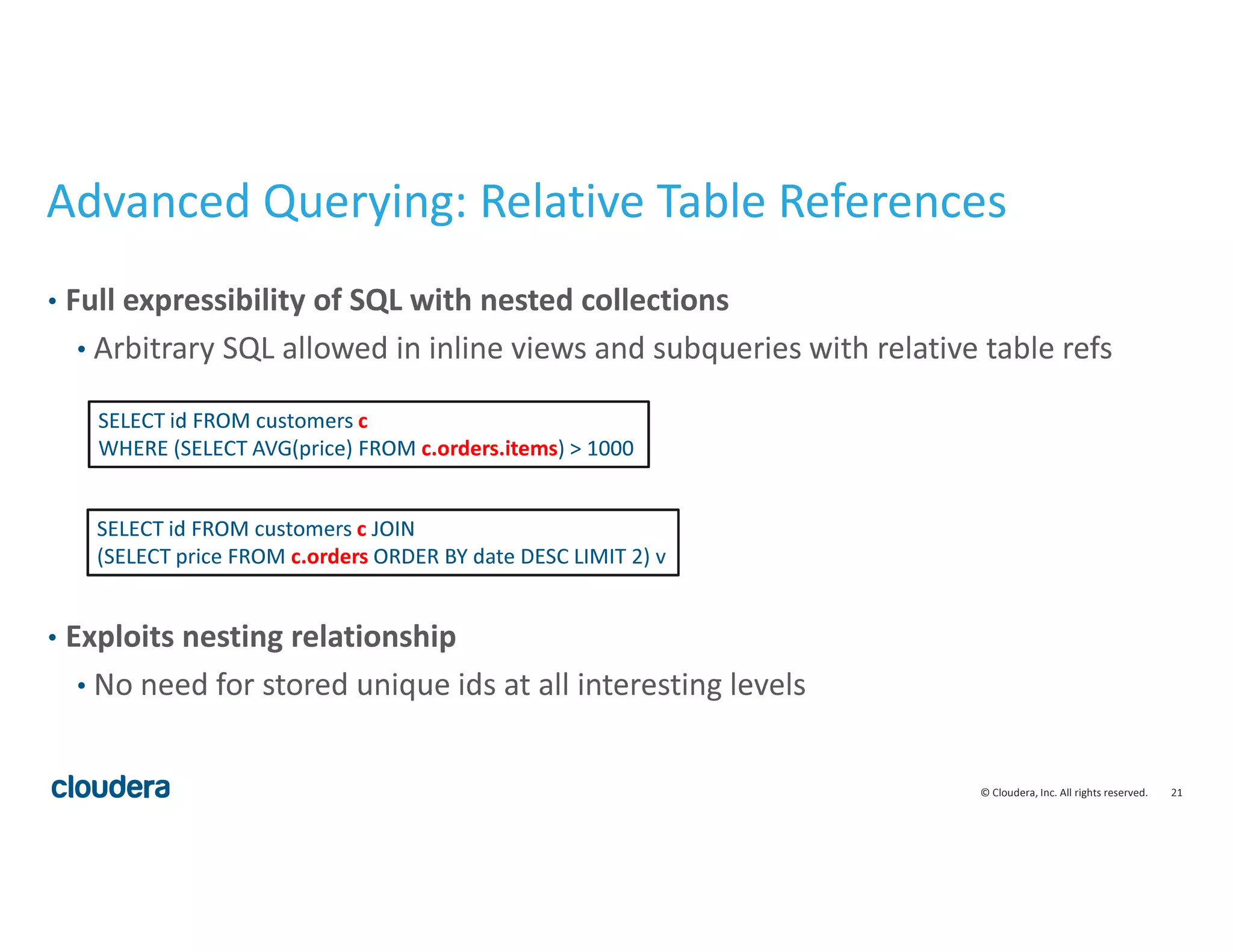
• Full expressibility of SQL with nested collections
• Arbitrary SQL allowed in inline views and subqueries with relative table refs
• Exploits nesting relationship
• No need for stored unique ids at all interesting levels
SELECT id FROM customers c
WHERE (SELECT AVG(price) FROM c.orders.items) > 1000
SELECT id FROM customers c JOIN
(SELECT price FROM c.orders ORDER BY date DESC LIMIT 2) v
22© Cloudera, Inc. All rights reserved.
Impala Nested Types in Action
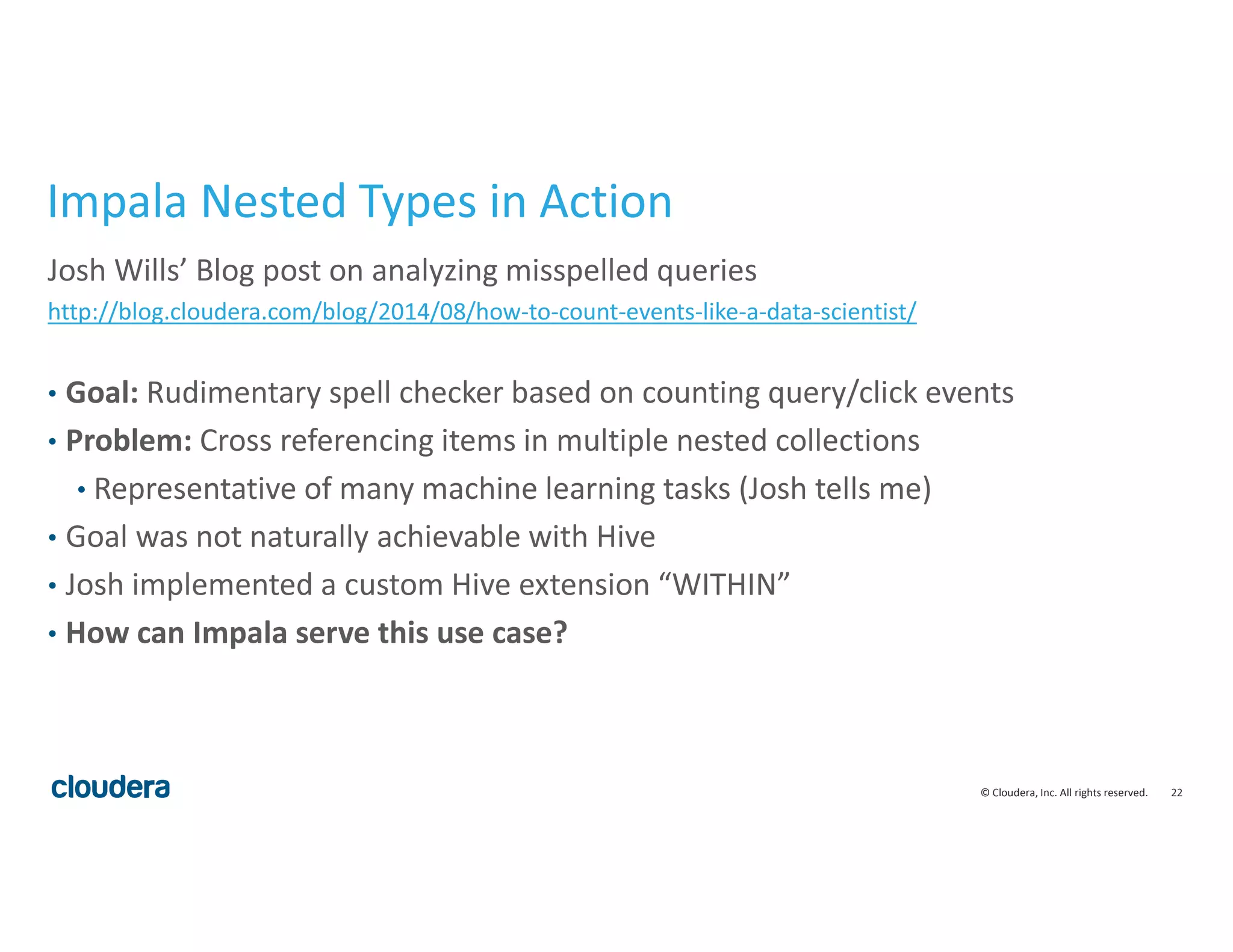
Josh Wills’ Blog post on analyzing misspelled queries
http://blog.cloudera.com/blog/2014/08/how-to-count-events-like-a-data-scientist/
• Goal: Rudimentary spell checker based on counting query/click events
• Problem: Cross referencing items in multiple nested collections
• Representative of many machine learning tasks (Josh tells me)
• Goal was not naturally achievable with Hive
• Josh implemented a custom Hive extension “WITHIN”
• How can Impala serve this use case?
23© Cloudera, Inc. All rights reserved.
Impala Nested Types in Action
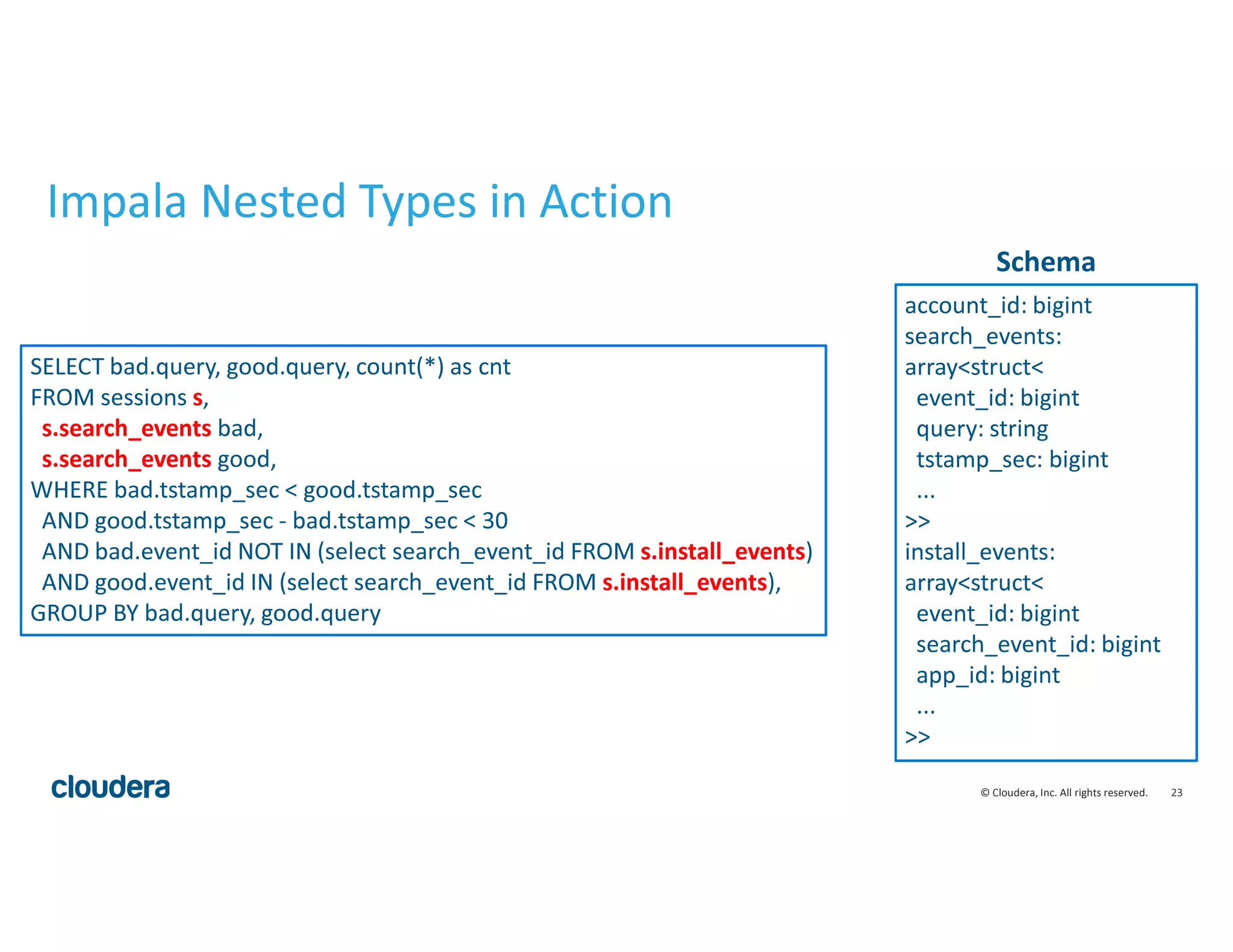
account_id: bigint
search_events:
array<struct<
event_id: bigint
query: string
tstamp_sec: bigint
...
>>
install_events:
array<struct<
event_id: bigint
search_event_id: bigint
app_id: bigint
...
>>
SELECT bad.query, good.query, count(*) as cnt
FROM sessions s,
s.search_events bad,
s.search_events good,
WHERE bad.tstamp_sec < good.tstamp_sec
AND good.tstamp_sec - bad.tstamp_sec < 30
AND bad.event_id NOT IN (select search_event_id FROM s.install_events)
AND good.event_id IN (select search_event_id FROM s.install_events),
GROUP BY bad.query, good.query
Schema
24© Cloudera, Inc. All rights reserved.
Design Considerations for Complex Schemas
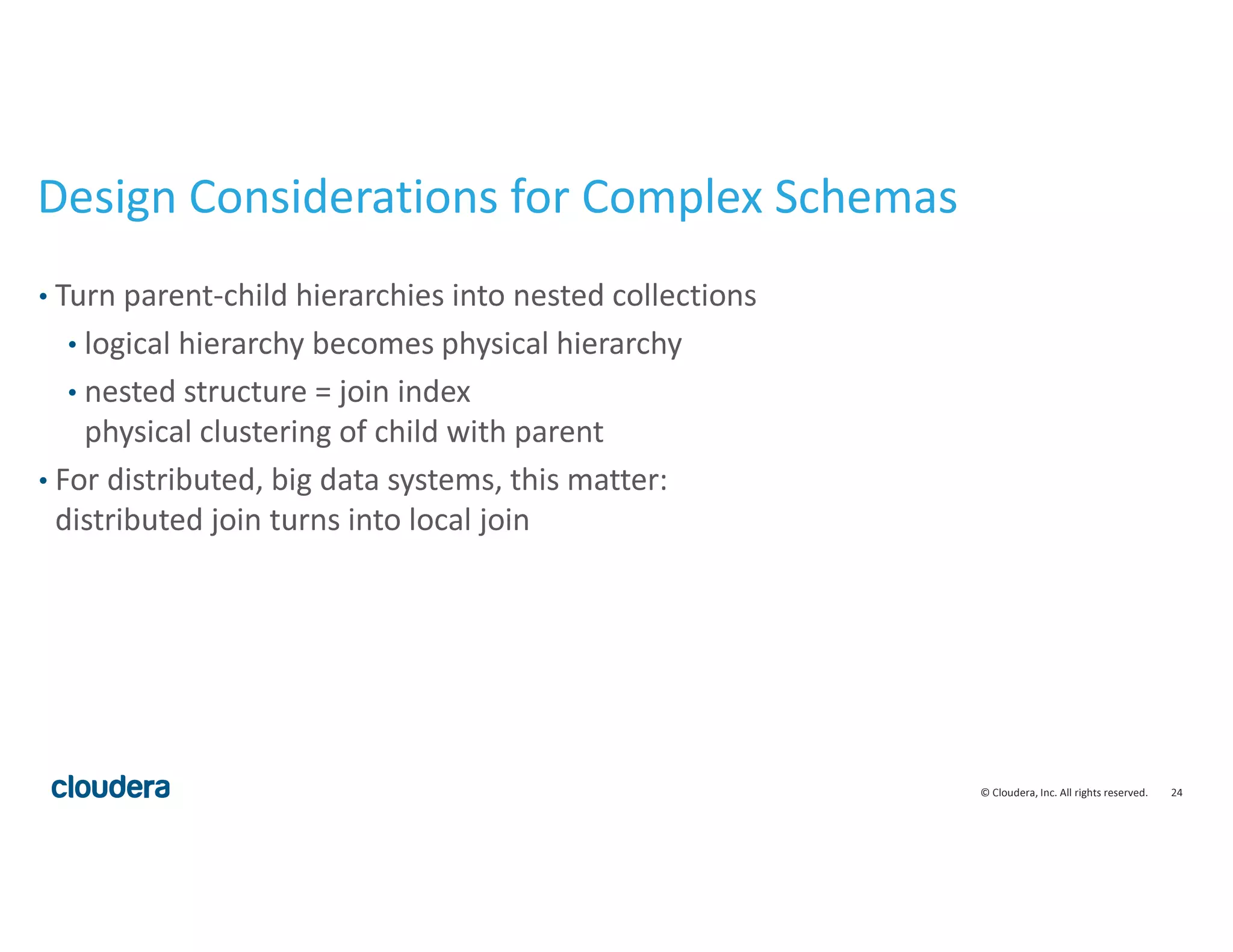
• Turn parent-child hierarchies into nested collections
• logical hierarchy becomes physical hierarchy
• nested structure = join index
physical clustering of child with parent
• For distributed, big data systems, this matter:
distributed join turns into local join
25© Cloudera, Inc. All rights reserved.
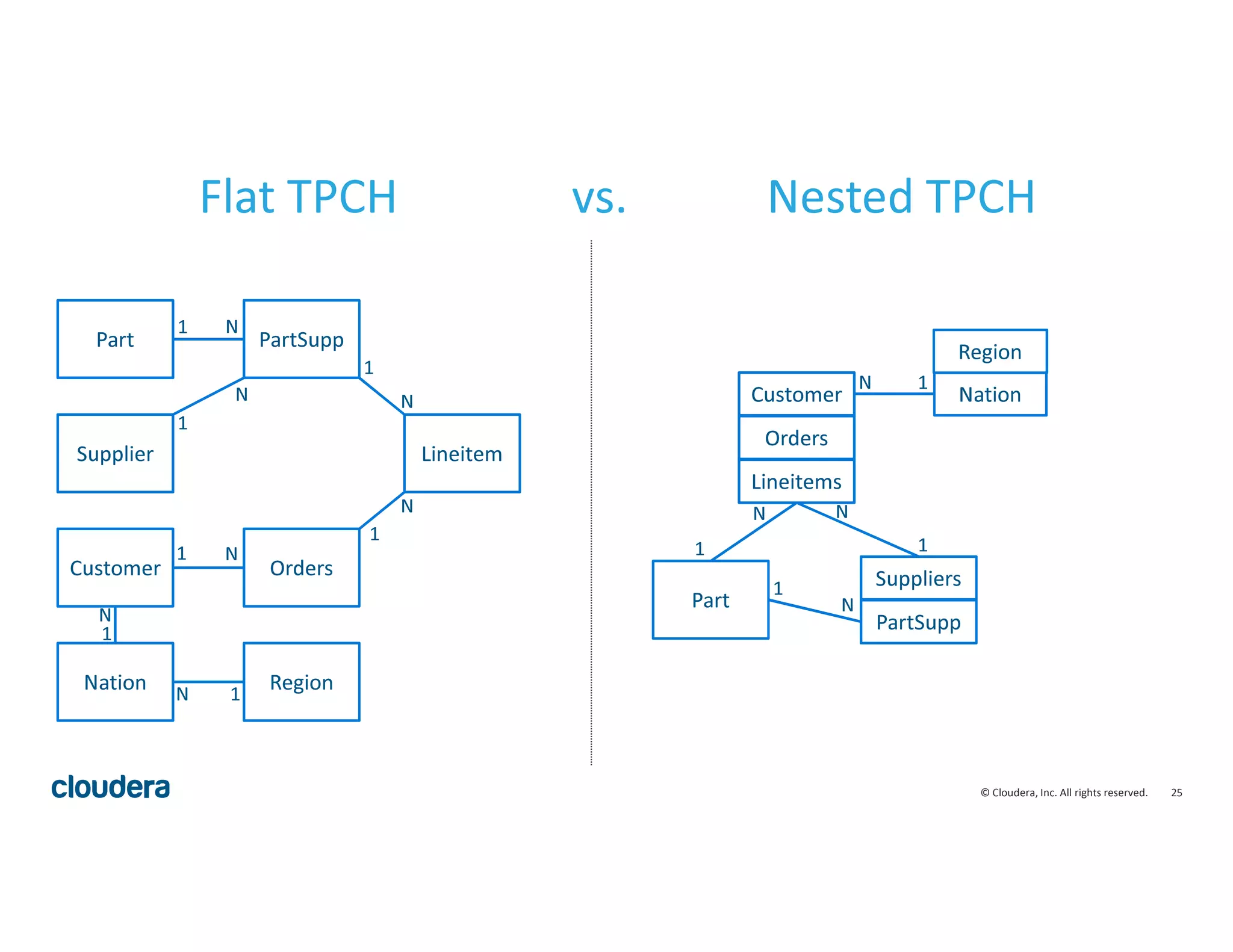
Flat TPCH vs. Nested TPCH
Part PartSupp
Supplier Lineitem
Customer Orders
Nation Region
Part
PartSupp
Suppliers
Lineitems
Customer
Orders
Nation
Region
1 N
1
N
1
N
1
N
N
1 N
1
N
1
N 1
N
1
1
N
N
1
26© Cloudera, Inc. All rights reserved.
Columnar Storage for Complex Schemas
• Columnar storage: a necessity for processing nested data at speed
• complex schemas = really wide tables
• row-wise storage: read lots of data you don’t care about
• Columnar formats effectively store a join index
{id: 17
orders: [{date: 2014-01-29, price: 10.2}, {date: ….} …]
}
{id: 18
orders: [{date: 2015-04-10, price: 2000.0}, {date: ….} …]
}
17
18
10.2
22.1
100
200
id orders.price
…
…
…
27© Cloudera, Inc. All rights reserved.
Columnar Storage for Complex Schemas
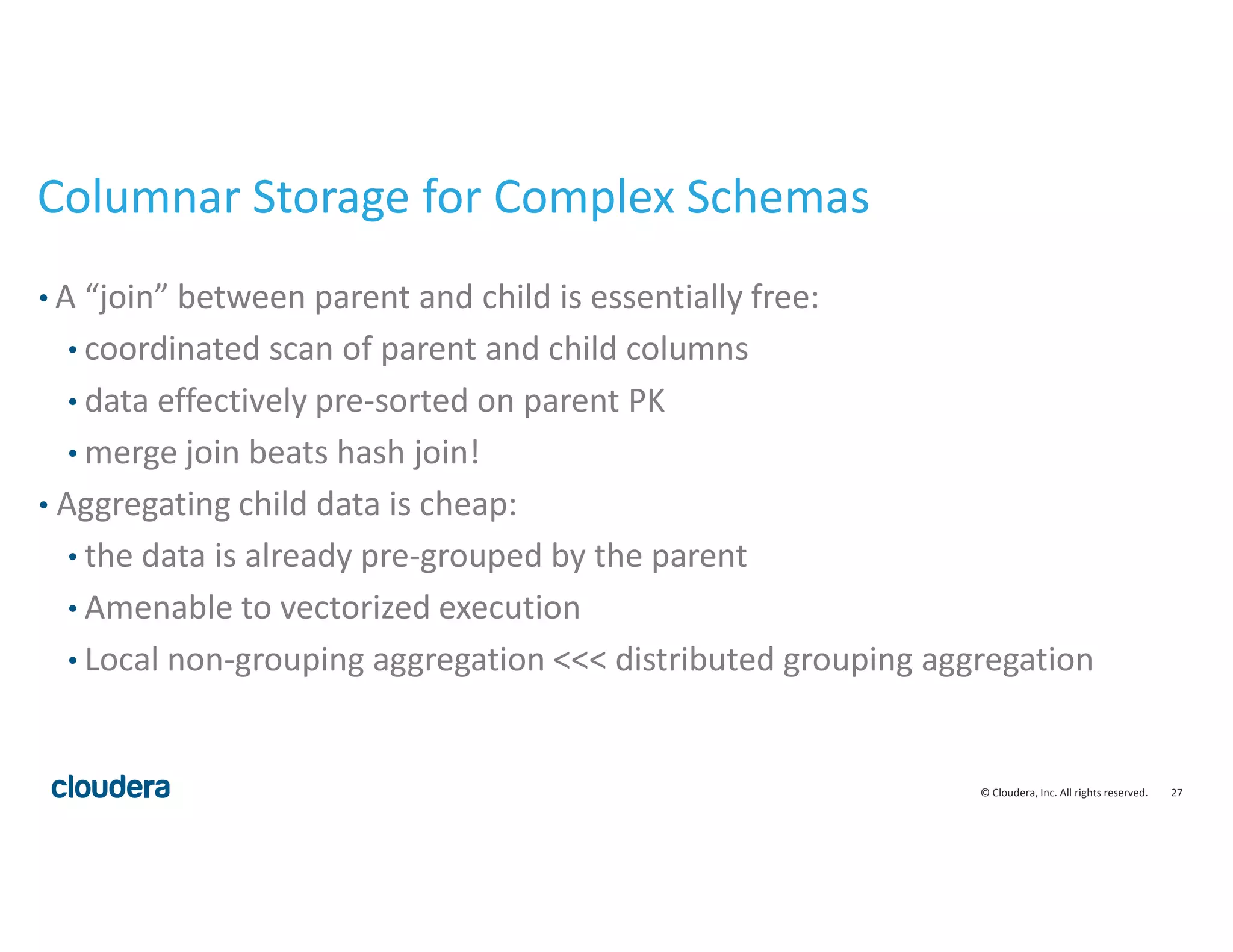
• A “join” between parent and child is essentially free:
• coordinated scan of parent and child columns
• data effectively pre-sorted on parent PK
• merge join beats hash join!
• Aggregating child data is cheap:
• the data is already pre-grouped by the parent
• Amenable to vectorized execution
• Local non-grouping aggregation <<< distributed grouping aggregation
28© Cloudera, Inc. All rights reserved.
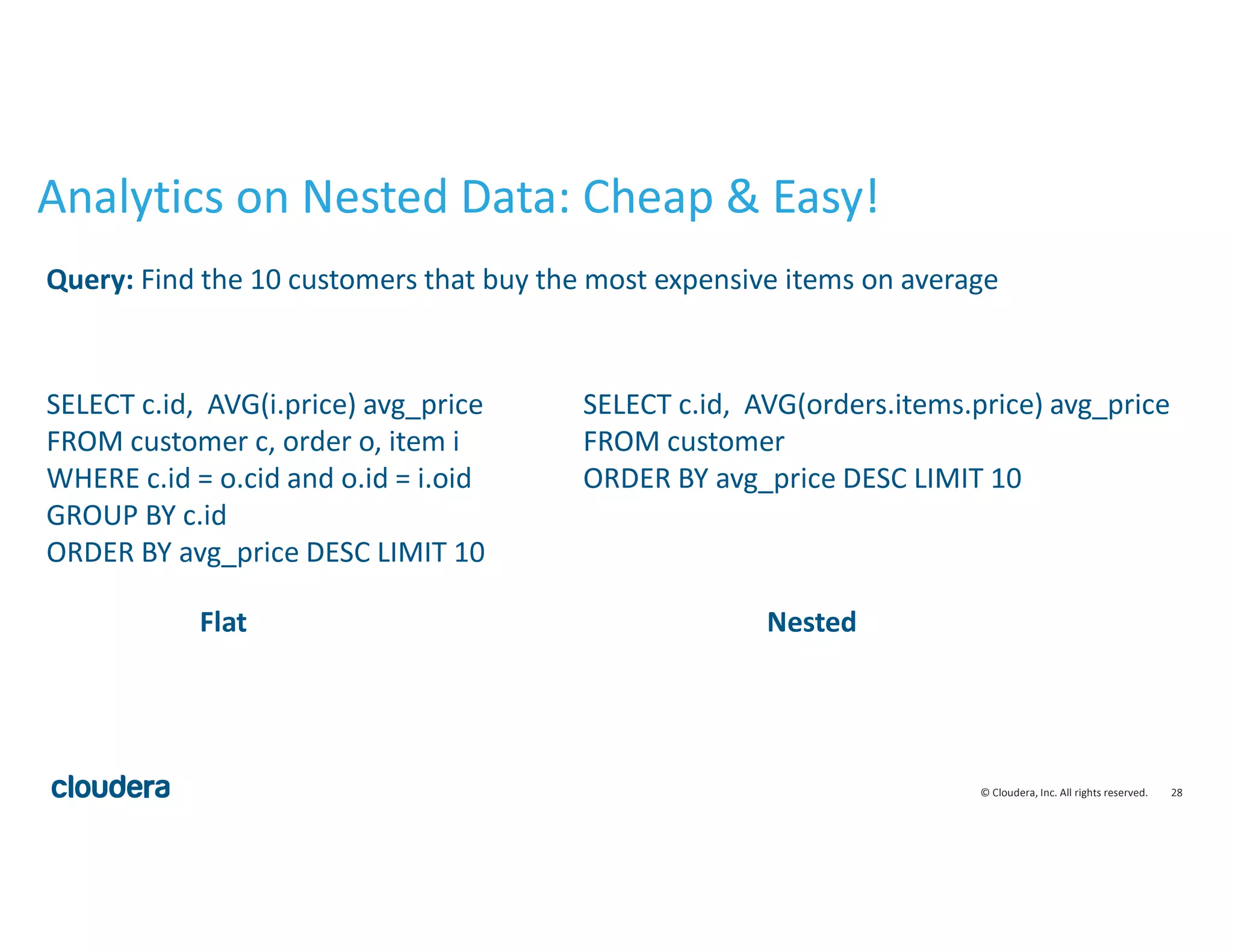
Analytics on Nested Data: Cheap & Easy!
SELECT c.id, AVG(orders.items.price) avg_price
FROM customer
ORDER BY avg_price DESC LIMIT 10
Query: Find the 10 customers that buy the most expensive items on average
SELECT c.id, AVG(i.price) avg_price
FROM customer c, order o, item i
WHERE c.id = o.cid and o.id = i.oid
GROUP BY c.id
ORDER BY avg_price DESC LIMIT 10
Flat Nested
29© Cloudera, Inc. All rights reserved.
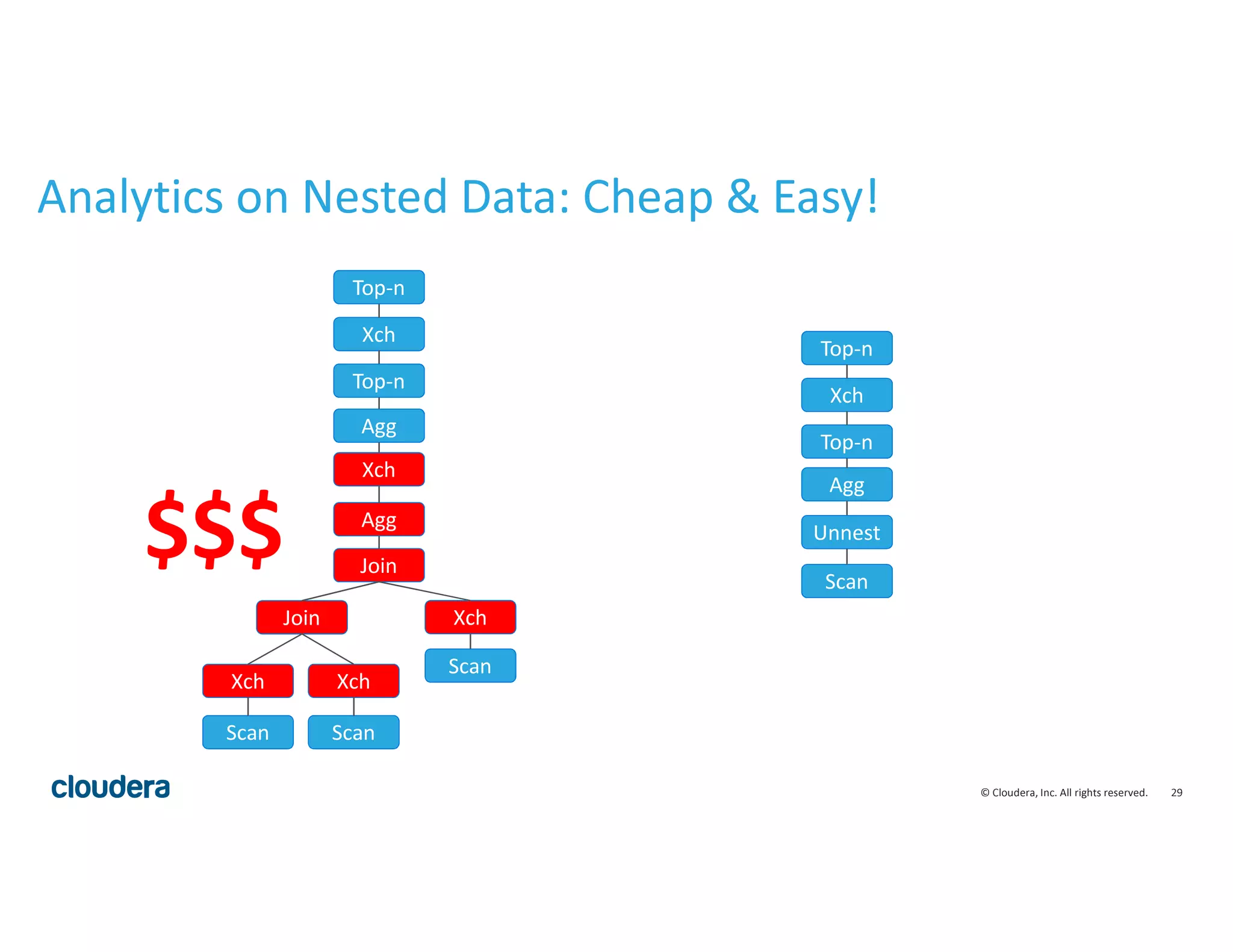
Scan Scan
Xch Xch
Join
Scan
Xch
Join
Agg
Xch
Agg
Scan
Unnest
Agg
Top-n
Xch
Top-n
Top-n
Xch
Top-n
Analytics on Nested Data: Cheap & Easy!
$$$
30© Cloudera, Inc. All rights reserved.
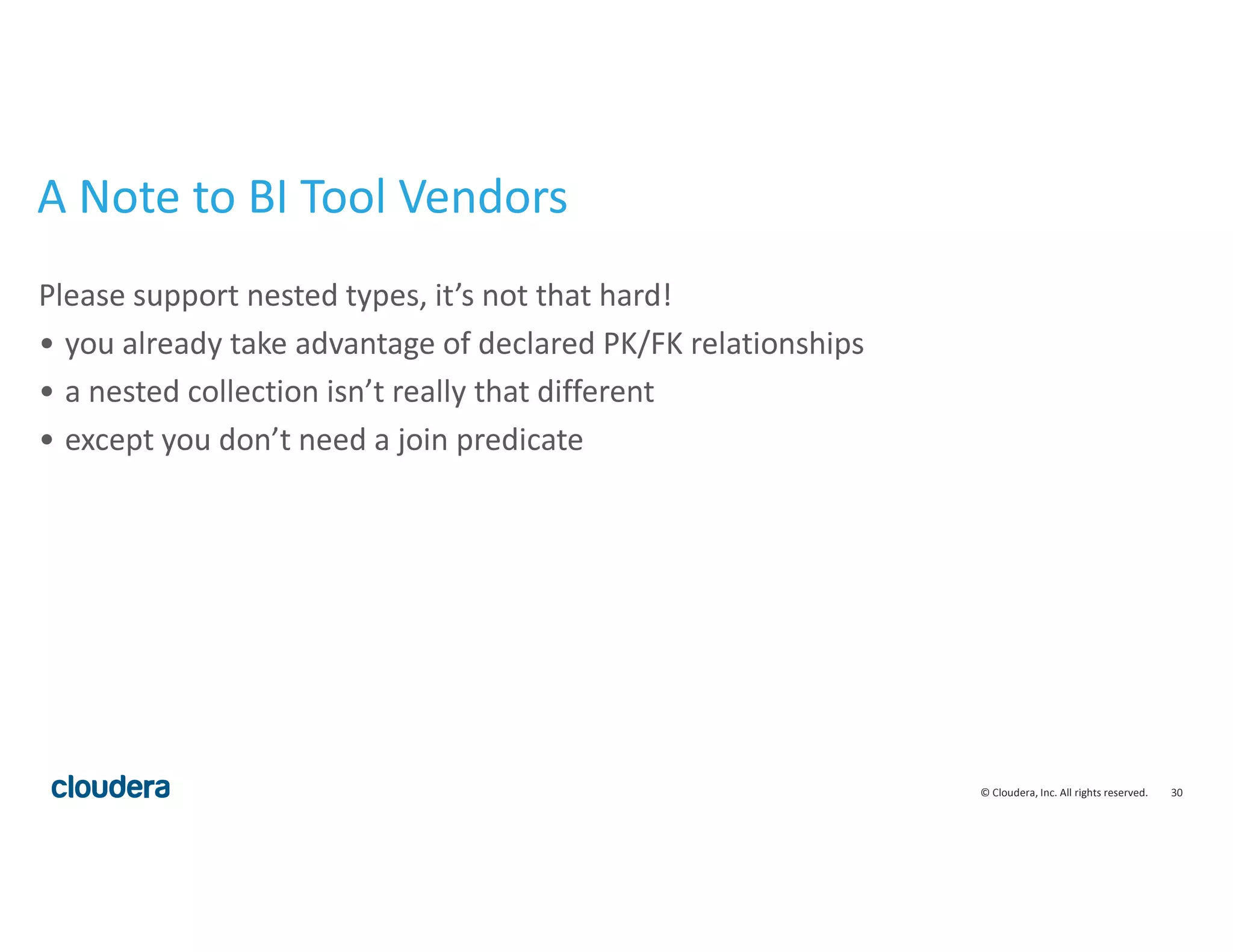
A Note to BI Tool Vendors
Please support nested types, it’s not that hard!
• you already take advantage of declared PK/FK relationships
• a nested collection isn’t really that different
• except you don’t need a join predicate
31© Cloudera, Inc. All rights reserved.
Thank you

Marcel Kornacker, Software Enginner at Cloudera - "Data modeling for data science: Simplify your workload with complex types"

  • 1.
    1© Cloudera, Inc.All rights reserved. Simplifying Analytic Workloads via Complex Schemas Marcel Kornacker Data Modeling for Data Science
  • 2.
    2© Cloudera, Inc.All rights reserved. • Relational databases are optimized to work with flat schemas • Much of the useful information in the world is stored using complex schemas (a.k.a., the “document model”) • Log files • NoSQL data stores • REST APIs On Complex Schemas
  • 3.
    3© Cloudera, Inc.All rights reserved. Handling Complex Schemas in SQL
  • 4.
    4© Cloudera, Inc.All rights reserved. Complex Schemas and Data Science
  • 5.
    5© Cloudera, Inc.All rights reserved. Think Like A Data Scientist
  • 6.
    6© Cloudera, Inc.All rights reserved. Building Data Science Teams: A Moneyball Approach
  • 7.
    7© Cloudera, Inc.All rights reserved. Leveraging The Power of SQL Engines…
  • 8.
    8© Cloudera, Inc.All rights reserved. …While Managing the Cost of SQL Engines
  • 9.
    9© Cloudera, Inc.All rights reserved. Intentional Complex Schemas
  • 10.
    10© Cloudera, Inc.All rights reserved. Better Resource Utilization
  • 11.
    11© Cloudera, Inc.All rights reserved. Higher Data Quality
  • 12.
    12© Cloudera, Inc.All rights reserved. Simplifying Analytic Queries
  • 13.
    13© Cloudera, Inc.All rights reserved. Data Science For Everyone
  • 14.
    14© Cloudera, Inc.All rights reserved. Nested Types in Impala Support for Nested Data Types: STRUCT, MAP, ARRAY Natural Extensions to SQL Full Expressiveness of SQL with Nested Types
  • 15.
    15© Cloudera, Inc.All rights reserved. Example TPCH-like Schema CREATE TABLE Customers { id BIGINT, address STRUCT< city: STRING, zip: INT > orders ARRAY<STRUCT< date: TIMESTAMP, price: DECIMAL(12,2), cc: BIGINT, items: ARRAY<STRUCT< item_no: STRING, price: DECIMAL(9,2) >> >> }
  • 16.
    16© Cloudera, Inc.All rights reserved. Impala Syntax Extensions • Path expressions extend column references to scalars (nested structs) • Can appear anywhere a conventional column reference is used • Collections (maps and arrays) are exposed like sub-tables • Use FROM clause to specify which collections to read like conventional tables • Can use JOIN conditions to express join relationship (default is INNER JOIN) Find the ids and city of customers who live in the zip code 94305: SELECT id, address.city FROM customers WHERE address.zip = 94305 Find all orders that were paid for with a customer’s preferred credit card: SELECT o.txn_id FROM customers c, c.orders o WHERE o.cc = c.preferred_cc
  • 17.
    17© Cloudera, Inc.All rights reserved. Referencing Arrays & Maps • Basic idea: Flatten nested collections referenced in the FROM clause • Can be thought of as an implicit join on the parent/child relationship SELECT c.id, o.date FROM customers c, c.c_orders o c.id o.date 100 2012-05-03 100 2013-07-08 100 2011-01-29 … … 101 2014-02-04 101 2015-11-15 … … id of a customer repeated for every order
  • 18.
    18© Cloudera, Inc.All rights reserved. Referencing Arrays & Maps SELECT c.c_custkey, o.o_orderkey FROM customers c, c.c_orders o Returns customer/order data for customers that have at least one order SELECT c.c_custkey, o.o_orderkey FROM customers c LEFT OUTER JOIN c.c_orders o Also returns customers with no orders (with order fields NULL) SELECT c.c_custkey, o.o_orderkey FROM customers c LEFT ANTI JOIN c.orders o Find all customers that have no orders SELECT c.c_custkey, o.o_orderkey FROM customers c INNER JOIN c.c_orders o
  • 19.
    19© Cloudera, Inc.All rights reserved. Motivation for Advanced Querying Capabilities • Count the number of orders per customer • Count the number of items per order • Impractical Requires unique id at every nesting level • Information is already expressed in nesting relationship! • What about even more interesting queries? • Get the number of orders and the average item price per customer? • “Group by” multiple nesting levels at the same time SELECT COUNT(*) FROM customers c, c.orders o GROUP BY c.id SELECT COUNT(*) FROM customers.orders o, o.items GROUP BY ??? Must be unique
  • 20.
    20© Cloudera, Inc.All rights reserved. Advanced Querying: Aggregates over Nested Collections • Count the number of orders per customer • Count the number of items per order • Get the number of orders and the average item price per customer SELECT id, COUNT(orders) FROM customers SELECT date, COUNT(items) FROM customers.orders SELECT id, COUNT(orders), AVG(orders.items.price) FROM customers
  • 21.
    21© Cloudera, Inc.All rights reserved. Advanced Querying: Relative Table References • Full expressibility of SQL with nested collections • Arbitrary SQL allowed in inline views and subqueries with relative table refs • Exploits nesting relationship • No need for stored unique ids at all interesting levels SELECT id FROM customers c WHERE (SELECT AVG(price) FROM c.orders.items) > 1000 SELECT id FROM customers c JOIN (SELECT price FROM c.orders ORDER BY date DESC LIMIT 2) v
  • 22.
    22© Cloudera, Inc.All rights reserved. Impala Nested Types in Action Josh Wills’ Blog post on analyzing misspelled queries http://blog.cloudera.com/blog/2014/08/how-to-count-events-like-a-data-scientist/ • Goal: Rudimentary spell checker based on counting query/click events • Problem: Cross referencing items in multiple nested collections • Representative of many machine learning tasks (Josh tells me) • Goal was not naturally achievable with Hive • Josh implemented a custom Hive extension “WITHIN” • How can Impala serve this use case?
  • 23.
    23© Cloudera, Inc.All rights reserved. Impala Nested Types in Action account_id: bigint search_events: array<struct< event_id: bigint query: string tstamp_sec: bigint ... >> install_events: array<struct< event_id: bigint search_event_id: bigint app_id: bigint ... >> SELECT bad.query, good.query, count(*) as cnt FROM sessions s, s.search_events bad, s.search_events good, WHERE bad.tstamp_sec < good.tstamp_sec AND good.tstamp_sec - bad.tstamp_sec < 30 AND bad.event_id NOT IN (select search_event_id FROM s.install_events) AND good.event_id IN (select search_event_id FROM s.install_events), GROUP BY bad.query, good.query Schema
  • 24.
    24© Cloudera, Inc.All rights reserved. Design Considerations for Complex Schemas • Turn parent-child hierarchies into nested collections • logical hierarchy becomes physical hierarchy • nested structure = join index physical clustering of child with parent • For distributed, big data systems, this matter: distributed join turns into local join
  • 25.
    25© Cloudera, Inc.All rights reserved. Flat TPCH vs. Nested TPCH Part PartSupp Supplier Lineitem Customer Orders Nation Region Part PartSupp Suppliers Lineitems Customer Orders Nation Region 1 N 1 N 1 N 1 N N 1 N 1 N 1 N 1 N 1 1 N N 1
  • 26.
    26© Cloudera, Inc.All rights reserved. Columnar Storage for Complex Schemas • Columnar storage: a necessity for processing nested data at speed • complex schemas = really wide tables • row-wise storage: read lots of data you don’t care about • Columnar formats effectively store a join index {id: 17 orders: [{date: 2014-01-29, price: 10.2}, {date: ….} …] } {id: 18 orders: [{date: 2015-04-10, price: 2000.0}, {date: ….} …] } 17 18 10.2 22.1 100 200 id orders.price … … …
  • 27.
    27© Cloudera, Inc.All rights reserved. Columnar Storage for Complex Schemas • A “join” between parent and child is essentially free: • coordinated scan of parent and child columns • data effectively pre-sorted on parent PK • merge join beats hash join! • Aggregating child data is cheap: • the data is already pre-grouped by the parent • Amenable to vectorized execution • Local non-grouping aggregation <<< distributed grouping aggregation
  • 28.
    28© Cloudera, Inc.All rights reserved. Analytics on Nested Data: Cheap & Easy! SELECT c.id, AVG(orders.items.price) avg_price FROM customer ORDER BY avg_price DESC LIMIT 10 Query: Find the 10 customers that buy the most expensive items on average SELECT c.id, AVG(i.price) avg_price FROM customer c, order o, item i WHERE c.id = o.cid and o.id = i.oid GROUP BY c.id ORDER BY avg_price DESC LIMIT 10 Flat Nested
  • 29.
    29© Cloudera, Inc.All rights reserved. Scan Scan Xch Xch Join Scan Xch Join Agg Xch Agg Scan Unnest Agg Top-n Xch Top-n Top-n Xch Top-n Analytics on Nested Data: Cheap & Easy! $$$
  • 30.
    30© Cloudera, Inc.All rights reserved. A Note to BI Tool Vendors Please support nested types, it’s not that hard! • you already take advantage of declared PK/FK relationships • a nested collection isn’t really that different • except you don’t need a join predicate
  • 31.
    31© Cloudera, Inc.All rights reserved. Thank you