MEXICAN GRAY WOLF
Jesus R.
Science Report
Mr. Castrellón
May 2014
Introduction
The presentation will be on the Mexican
Gray Wolf. Its scientific name is Canis Lupus.
You are going to learn about their diet, family
life, interesting facts, habitat and range. They
are related to the jackals, domestic dogs, and
foxes.
jackal
Interesting Facts
It could live up to 15 years in captivity.
When wolves show they want to play with
humans they bend down low, they put their
front legs flat on ground, and they wag their
tails. Wolves have the strength , energy, and
hunting skills to track prey over long distances
.
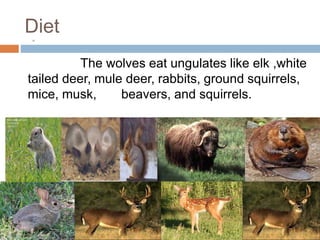
Diet
The wolves eat ungulates like elk ,white
tailed deer, mule deer, rabbits, ground squirrels,
mice, musk, beavers, and squirrels.
Habitat And range
They live in the forests and grasslands of
North America and Central Mexico.
Map Of Range
Family Life
When the pups are born, they are blind
and defenseless. At 10 months the young
wolves can join the pack. Once they are grown
they no longer need help from parents. Also
the leaders are the alpha male or alpha female
in wolf packs there is only 7 to 20 members in
a pack. Some packs carry up to 8 members.
Some wolves travel until they find a mate. And
when a pup is 6 months old they are able to
hunt.
Life Cycle
Anatomy
Range
Their range extended from Central Mexico
and into Southwestern U.S. deserts.
Average body size and weight
They weight up to 60 to 80 lbs, no more
than 100 pounds.
Evolution
The Mexican Gray Wolf is related to the
Gray Wolf, Timber Wolf, and the Arctic Wolf,
as well as, wild dogs, jackals, and domestic
dogs.

Jesus 2014

  • 1.
    MEXICAN GRAY WOLF JesusR. Science Report Mr. Castrellón May 2014
  • 2.
    Introduction The presentation willbe on the Mexican Gray Wolf. Its scientific name is Canis Lupus. You are going to learn about their diet, family life, interesting facts, habitat and range. They are related to the jackals, domestic dogs, and foxes. jackal
  • 3.
    Interesting Facts It couldlive up to 15 years in captivity. When wolves show they want to play with humans they bend down low, they put their front legs flat on ground, and they wag their tails. Wolves have the strength , energy, and hunting skills to track prey over long distances .
  • 4.
    Diet The wolves eatungulates like elk ,white tailed deer, mule deer, rabbits, ground squirrels, mice, musk, beavers, and squirrels.
  • 5.
    Habitat And range Theylive in the forests and grasslands of North America and Central Mexico.
  • 6.
  • 7.
    Family Life When thepups are born, they are blind and defenseless. At 10 months the young wolves can join the pack. Once they are grown they no longer need help from parents. Also the leaders are the alpha male or alpha female in wolf packs there is only 7 to 20 members in a pack. Some packs carry up to 8 members. Some wolves travel until they find a mate. And when a pup is 6 months old they are able to hunt.
  • 8.
  • 9.
  • 10.
    Range Their range extendedfrom Central Mexico and into Southwestern U.S. deserts.
  • 11.
    Average body sizeand weight They weight up to 60 to 80 lbs, no more than 100 pounds.
  • 12.
    Evolution The Mexican GrayWolf is related to the Gray Wolf, Timber Wolf, and the Arctic Wolf, as well as, wild dogs, jackals, and domestic dogs.