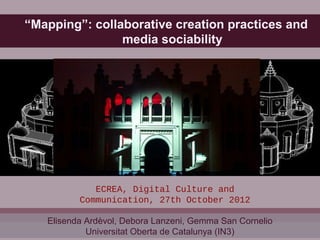
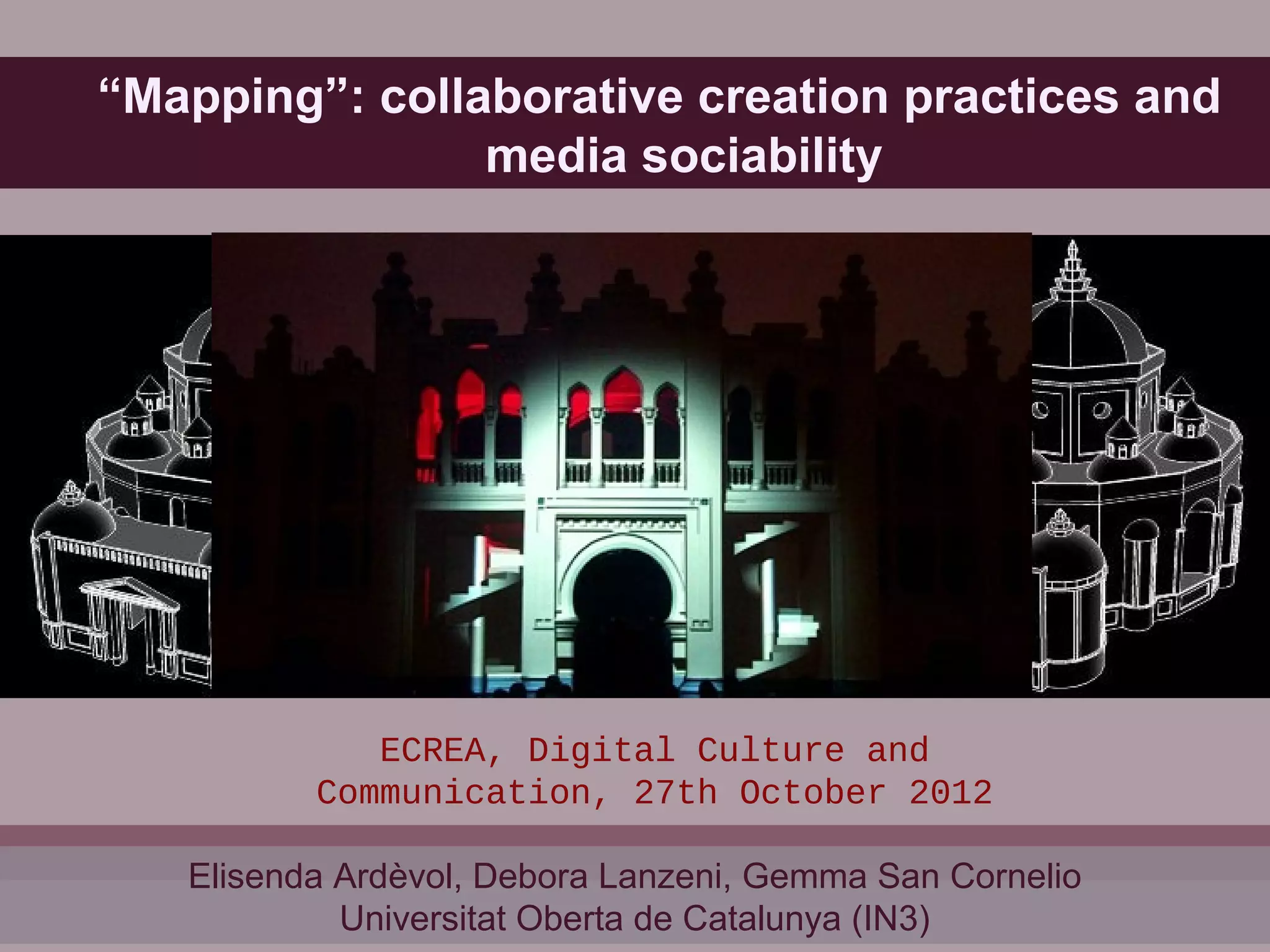
“Mapping”: collaborative creation practices and
                media sociability


             ECREA, Digital Culture and
          Communication, 27th October 2012

   Elisenda Ardèvol, Debora Lanzeni, Gemma San Cornelio
            Universitat Oberta de Catalunya (IN3)
Introduction

    •   “Digital culture and cultural production” -- MEDIACCIONS
        research group-
    •   “Creative practices and participation in new media”
        --CREATIVE research project, funded by MICINN
        (HAR2010-18982)
    •   Research project on free culture movement
Methodological approach

• Theories of practices. Theodor Schatzki (2001). Avoiding the
  "mediacentrics" approaches (media influence), "textcentrics"
  (based on the interpretation of texts or representations) or
  "technocentrics" (technological determinism).

• Case studies. The production of empirical data is based on case
  studies; using techniques of netsurfing, participant observation
  and interviews, and their interpretation and analysis, taking into
  account the perspective of actors and their material practices... to
  attend to "people's doings and sayings"...
Mapping and free software culture

The work we present today is
based on an ethnographic
fieldwork among free culture
activist and technology makers    •How mapping is characterized as a
mainly set in Barcelona.              collaborative creative practice?

People who support the              •How the process of creation and
movement through create,               the mapping performance are
circulate and connect knowledge          shaped by the free-software
and information and people who                              culture?
make things such software,
images, hardware, art, etc.         •How mapping is related to social
                                                        innovation?
Theoretical background
 Participation in digital culture

 • Hybrid identities and products: 'prosumer' (consumer + producer); 'proam'
 (amateur + professional); 'viewsers' (viewers + users); 'produser', user-
 generated content, long tail.

 • Liberating discourses vs free labour discourses. The uncertainty around
 the restatement of creative work and professional roles: fusion of leisure and
 work through play. Free labor (Lazzaratto) The institutionalization of the
 bohemia (Neff, 2005)

 • Co-creation. The phenomenon of consumers that are increasingly
 participative in the process of making and circulating media content and
 experiences (Banks & Deuze, 2009). Relating (implicitly or explicitly) industries
 with external agents that include audiences, fans, amateurs, or independent
 artists.
Theoretical background

Creative industries and new media

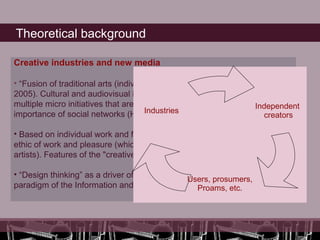
• “Fusion of traditional arts (individual) with cultural industries”. (Hartley,
2005). Cultural and audiovisual industry currently is no such But are
multiple micro initiatives that are created for a specific purpose. Independent
                                       Industries
importance of social networks (Hartley, 2005)                             creators

• Based on individual work and free-lance, logic-based project, the hacker
ethic of work and pleasure (which has always been a feature of the
artists). Features of the "creative class" (Richard Florida, 2002).

• “Design thinking” as a driver of innovation instead of the cultural
                                                 Users, prosumers,
paradigm of the Information and Knowledge Society (Catells, 2002).
                                                    Proams, etc.
Theoretical background
Social innovation

• Immaterial labor (Corsani, Negri, Lazzarato, 1996) Innovation is beyond the
control of corporations (Corsani, 2004:91). To produce this transformation is
necessary to forget the segmentation: labor / leisure, production / creativity,
duty…

• Mass creativity. (Leadbeater 2006:4-9). Innovation is not just a mass-
produced thing but also produced by the masses. Wikipedia, or free software
are a new paradigm in such modes of production. In this context ProAms
(Professional Amateur), are the main drivers of innovation on the Internet,
through spaces as Youtube, MySpace, etc.

• Hidden innovation. (NESTA, 2007:17). There is innovation that is not
controlled by scientific indicators located only in scientific and industrial centers.
Create new indicators to account for all the invisible creativity. The concept of
"open innovation" in which companies must learn to use ideas from external
sources rather than trying always invent for themselves.
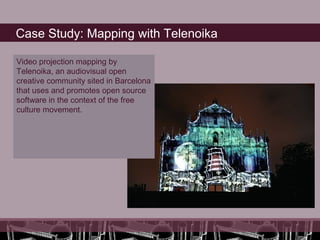
Case Study: Mapping with Telenoika

Video projection mapping by
Telenoika, an audiovisual open
creative community sited in Barcelona
that uses and promotes open source
software in the context of the free
culture movement.
Theories of space

• Augmented Space (Manovich, 2006) new aesthetic paradigm of the space
experience” “is the physical space overlaid with dynamically changing information”
(Manovich, 2006, p. 220)

• Informational territories (Lemos, 2010, p. 405), “the digital layer is in relationship
with other layers like laws, regulations and subjectivities constituting then a “new
sense” of the space. The intersection of the digital media with other uses and
social conceptions of space is explored by artists and activists as a way of re-
appropriation and creation of new meanings of a place.

• “the technologically mediated world does not stand apart from the physical world
within which it is embedded; rather, it provides a new set of ways for that physical
world to be understood and appropriated” (Brewer and Dourish, 2008, p. 969).
MediaSpace
     MediaSpace (Couldry, 2004) is a multidimensional approach to the
      relations established between media and place.

     “the artefactual existence of media forms within social space, the
        links that media objects forge between spaces, and the (no less
        real) cultural visions of a physical space transcended by
        technology and emergent virtual pathways of communication. It is
        also expanding too. We can no longer ignore what Thrift and French
        (2002) call the 'automatic production of space' through
        software, a condition of spatialized governance in which media and
        space quite literally merge in architectural infrastructure”. (Thrift and
        French 2002:314, 317).

     “ the politics of media images and economies are not separate
        from the politics of space”.
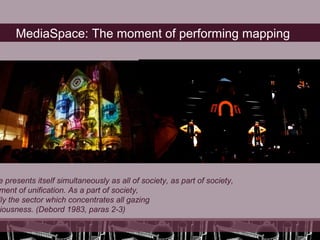
MediaSpace: The moment of performing mapping


e presents itself simultaneously as all of society, as part of society,
ment of unification. As a part of society,
lly the sector which concentrates all gazing
 iousness. (Debord 1983, paras 2-3)
MediaSpace: The moment of performing mapping

  • Space ecology is not only present during the event or mapping
  display, but also in every step of the practice, from the very
  creation of it.

  •This technique, especially when done by open code, implies a
  sophisticated coordination of software and hardware in real time.

  • Open software vs private software. The risk of projection.

  •The ideological position of sharing.

  •The necessity of collaborating
SharingSpace: The moment of creating mapping
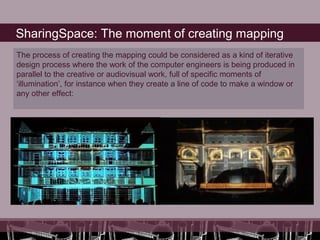
The process of creating the mapping could be considered as a kind of iterative
design process where the work of the computer engineers is being produced in
parallel to the creative or audiovisual work, full of specific moments of
‘illumination’, for instance when they create a line of code to make a window or
any other effect:
SharingSpace: The moment of creating mapping
We hear waves of uplifting and happy if!, Ohhh!, Well,
Molt Be!, Que bonic! in unison, coming from the row in front of computers of
those who were playing with software doing mapping. Enric, who was with the
projector comes running "what happened, what happened?”

"Oh, you missed it, you had to be to see it!" Oliver replied sarcastically. What
had happened is that, in real time, they had managed to open a "window" that
worked with pyton from blender and wormap, but what everyone saw it was a
red shadow crept symmetrically from the outside right towards the western side
of the same building-image taken from the film Metropolis and projected on the
wall on which was mapping. The same effect for about 30 minutes.

Here, several parallel activities began while Carles, hastily opened the wormap
and began writing new lines of code that would be able to share to the Blender
community. Not 10 minutes had passed when they got the first comment.
WorkSpace: Labour aspects and organization
• The members of the collective are working professionally for other companies
or individually as free-lancers. So the teams of work are variable in scale and
components.

•They organize themselves in relation to the projects and their own availability.

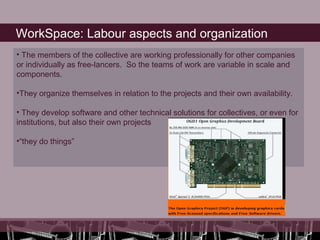
• They develop software and other technical solutions for collectives, or even for
institutions, but also their own projects

•“they do things”
WorkSpace: Labour aspects and organization

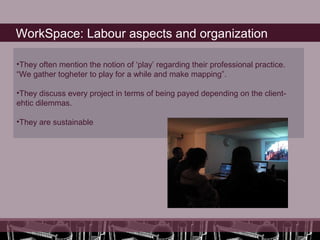
•They often mention the notion of ‘play’ regarding their professional practice.
“We gather togheter to play for a while and make mapping”.

•They discuss every project in terms of being payed depending on the client-
ehtic dilemmas.

•They are sustainable
Conclusions
Mapping is the result and the intersection between creative practices and
mediated sociability that take place in a thickish digital environment or media
ecology (Horst, 2008).

For Telenoika members Creative practices and digital media are both
constitutive to “mapping” as a collaborative practice.

They need to collaborate in order to keep running the creative process. Since
they are using open software, many hands, minds and creativity is needed in
order to produce their works. Collaboration is not only a choice, is a necessity.

Sharing is a constitutive element of the creative practice, influencing the
creative process and also the results. By this process of sharing they do not
only create a cultural product or an artistic performance, but a certain moral
order (that they need to continue creating). They know that the only way of
creating and developing new products freely is by sharing.
Conclusions
Again, it is a necessity, since they know that if they don’t share, they will depend
on the private programmes which are inaccessible for young creative artists and
engineers. So the gate of innovation will be closed. They must be social
innovators if they want to continue developing their technical expertise and
artistic expressions.

By doing so, they believe that they move from improvisation to innovation. That
is, they are social innovators.

Their innovations are intrinsic to the practice of hardware design and mapping.

They want to influence the market.

But they also want to change the world.
Thank You!!

“Mapping”: collaborative creation practices and media sociability

  • 1.
    “Mapping”: collaborative creationpractices and media sociability ECREA, Digital Culture and Communication, 27th October 2012 Elisenda Ardèvol, Debora Lanzeni, Gemma San Cornelio Universitat Oberta de Catalunya (IN3)
  • 2.
    Introduction • “Digital culture and cultural production” -- MEDIACCIONS research group- • “Creative practices and participation in new media” --CREATIVE research project, funded by MICINN (HAR2010-18982) • Research project on free culture movement
  • 3.
    Methodological approach • Theoriesof practices. Theodor Schatzki (2001). Avoiding the "mediacentrics" approaches (media influence), "textcentrics" (based on the interpretation of texts or representations) or "technocentrics" (technological determinism). • Case studies. The production of empirical data is based on case studies; using techniques of netsurfing, participant observation and interviews, and their interpretation and analysis, taking into account the perspective of actors and their material practices... to attend to "people's doings and sayings"...
  • 4.
    Mapping and freesoftware culture The work we present today is based on an ethnographic fieldwork among free culture activist and technology makers •How mapping is characterized as a mainly set in Barcelona. collaborative creative practice? People who support the •How the process of creation and movement through create, the mapping performance are circulate and connect knowledge shaped by the free-software and information and people who culture? make things such software, images, hardware, art, etc. •How mapping is related to social innovation?
  • 5.
    Theoretical background Participationin digital culture • Hybrid identities and products: 'prosumer' (consumer + producer); 'proam' (amateur + professional); 'viewsers' (viewers + users); 'produser', user- generated content, long tail. • Liberating discourses vs free labour discourses. The uncertainty around the restatement of creative work and professional roles: fusion of leisure and work through play. Free labor (Lazzaratto) The institutionalization of the bohemia (Neff, 2005) • Co-creation. The phenomenon of consumers that are increasingly participative in the process of making and circulating media content and experiences (Banks & Deuze, 2009). Relating (implicitly or explicitly) industries with external agents that include audiences, fans, amateurs, or independent artists.
  • 6.
    Theoretical background Creative industriesand new media • “Fusion of traditional arts (individual) with cultural industries”. (Hartley, 2005). Cultural and audiovisual industry currently is no such But are multiple micro initiatives that are created for a specific purpose. Independent Industries importance of social networks (Hartley, 2005) creators • Based on individual work and free-lance, logic-based project, the hacker ethic of work and pleasure (which has always been a feature of the artists). Features of the "creative class" (Richard Florida, 2002). • “Design thinking” as a driver of innovation instead of the cultural Users, prosumers, paradigm of the Information and Knowledge Society (Catells, 2002). Proams, etc.
  • 7.
    Theoretical background Social innovation •Immaterial labor (Corsani, Negri, Lazzarato, 1996) Innovation is beyond the control of corporations (Corsani, 2004:91). To produce this transformation is necessary to forget the segmentation: labor / leisure, production / creativity, duty… • Mass creativity. (Leadbeater 2006:4-9). Innovation is not just a mass- produced thing but also produced by the masses. Wikipedia, or free software are a new paradigm in such modes of production. In this context ProAms (Professional Amateur), are the main drivers of innovation on the Internet, through spaces as Youtube, MySpace, etc. • Hidden innovation. (NESTA, 2007:17). There is innovation that is not controlled by scientific indicators located only in scientific and industrial centers. Create new indicators to account for all the invisible creativity. The concept of "open innovation" in which companies must learn to use ideas from external sources rather than trying always invent for themselves.
  • 8.
    Case Study: Mappingwith Telenoika Video projection mapping by Telenoika, an audiovisual open creative community sited in Barcelona that uses and promotes open source software in the context of the free culture movement.
  • 9.
    Theories of space •Augmented Space (Manovich, 2006) new aesthetic paradigm of the space experience” “is the physical space overlaid with dynamically changing information” (Manovich, 2006, p. 220) • Informational territories (Lemos, 2010, p. 405), “the digital layer is in relationship with other layers like laws, regulations and subjectivities constituting then a “new sense” of the space. The intersection of the digital media with other uses and social conceptions of space is explored by artists and activists as a way of re- appropriation and creation of new meanings of a place. • “the technologically mediated world does not stand apart from the physical world within which it is embedded; rather, it provides a new set of ways for that physical world to be understood and appropriated” (Brewer and Dourish, 2008, p. 969).
  • 10.
    MediaSpace MediaSpace (Couldry, 2004) is a multidimensional approach to the relations established between media and place. “the artefactual existence of media forms within social space, the links that media objects forge between spaces, and the (no less real) cultural visions of a physical space transcended by technology and emergent virtual pathways of communication. It is also expanding too. We can no longer ignore what Thrift and French (2002) call the 'automatic production of space' through software, a condition of spatialized governance in which media and space quite literally merge in architectural infrastructure”. (Thrift and French 2002:314, 317). “ the politics of media images and economies are not separate from the politics of space”.
  • 11.
    MediaSpace: The momentof performing mapping e presents itself simultaneously as all of society, as part of society, ment of unification. As a part of society, lly the sector which concentrates all gazing iousness. (Debord 1983, paras 2-3)
  • 12.
    MediaSpace: The momentof performing mapping • Space ecology is not only present during the event or mapping display, but also in every step of the practice, from the very creation of it. •This technique, especially when done by open code, implies a sophisticated coordination of software and hardware in real time. • Open software vs private software. The risk of projection. •The ideological position of sharing. •The necessity of collaborating
  • 13.
    SharingSpace: The momentof creating mapping The process of creating the mapping could be considered as a kind of iterative design process where the work of the computer engineers is being produced in parallel to the creative or audiovisual work, full of specific moments of ‘illumination’, for instance when they create a line of code to make a window or any other effect:
  • 14.
    SharingSpace: The momentof creating mapping We hear waves of uplifting and happy if!, Ohhh!, Well, Molt Be!, Que bonic! in unison, coming from the row in front of computers of those who were playing with software doing mapping. Enric, who was with the projector comes running "what happened, what happened?” "Oh, you missed it, you had to be to see it!" Oliver replied sarcastically. What had happened is that, in real time, they had managed to open a "window" that worked with pyton from blender and wormap, but what everyone saw it was a red shadow crept symmetrically from the outside right towards the western side of the same building-image taken from the film Metropolis and projected on the wall on which was mapping. The same effect for about 30 minutes. Here, several parallel activities began while Carles, hastily opened the wormap and began writing new lines of code that would be able to share to the Blender community. Not 10 minutes had passed when they got the first comment.
  • 15.
    WorkSpace: Labour aspectsand organization • The members of the collective are working professionally for other companies or individually as free-lancers. So the teams of work are variable in scale and components. •They organize themselves in relation to the projects and their own availability. • They develop software and other technical solutions for collectives, or even for institutions, but also their own projects •“they do things”
  • 16.
    WorkSpace: Labour aspectsand organization •They often mention the notion of ‘play’ regarding their professional practice. “We gather togheter to play for a while and make mapping”. •They discuss every project in terms of being payed depending on the client- ehtic dilemmas. •They are sustainable
  • 17.
    Conclusions Mapping is theresult and the intersection between creative practices and mediated sociability that take place in a thickish digital environment or media ecology (Horst, 2008). For Telenoika members Creative practices and digital media are both constitutive to “mapping” as a collaborative practice. They need to collaborate in order to keep running the creative process. Since they are using open software, many hands, minds and creativity is needed in order to produce their works. Collaboration is not only a choice, is a necessity. Sharing is a constitutive element of the creative practice, influencing the creative process and also the results. By this process of sharing they do not only create a cultural product or an artistic performance, but a certain moral order (that they need to continue creating). They know that the only way of creating and developing new products freely is by sharing.
  • 18.
    Conclusions Again, it isa necessity, since they know that if they don’t share, they will depend on the private programmes which are inaccessible for young creative artists and engineers. So the gate of innovation will be closed. They must be social innovators if they want to continue developing their technical expertise and artistic expressions. By doing so, they believe that they move from improvisation to innovation. That is, they are social innovators. Their innovations are intrinsic to the practice of hardware design and mapping. They want to influence the market. But they also want to change the world.
  • 19.