









About design
(and disruptive technologies)
              Teemu Leinonen
  Media Lab Helsinki, Department of Media
   School of Arts, Design and Architecture
               Aalto University
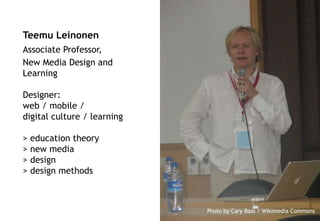
Teemu Leinonen
Associate Professor,
New Media Design and
Learning

Designer:
web / mobile /
digital culture / learning

> education theory
> new media
> design
> design methods


                             Photo by Cary Bass / Wikimedia Commons
About design
(and disruptive technologies)
              Teemu Leinonen
  Media Lab Helsinki, Department of Media
   School of Arts, Design and Architecture
               Aalto University
About design
(and disruptive technologies)
designer (in art and design trad.)
   . . . focuses on experiences,
   . . . the future experiences,
        . . . to design them.
design researcher / student:
          . . . do stuff,
    . . . be experimental,
     . . . be avant-garde.
Two things

     1. About technology (and media)

     2. About design (as research)
Two things

     1. About technology (and media)

     2. About design (as research)
What are disruptive
      technologies

         Examples

 You and disruptive
      technologies
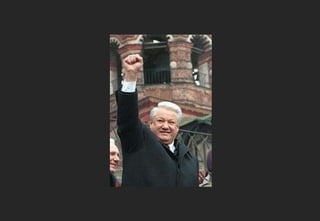
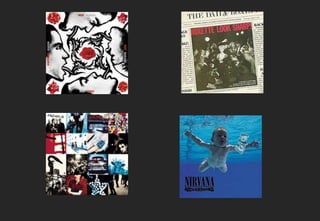
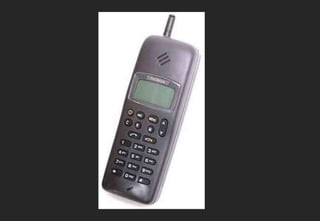
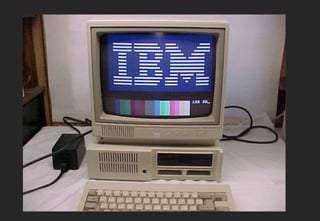
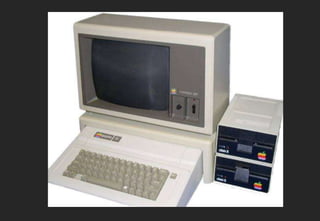
Me and New Media
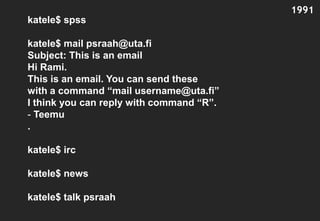
1991
1991
1991
katele$ spss

katele$ mail psraah@uta.fi
Subject: This is an email
Hi Rami.
This is an email. You can send these
with a command “mail username@uta.fi”
I think you can reply with command “R”.
- Teemu
.

katele$ irc

katele$ news

katele$ talk psraah
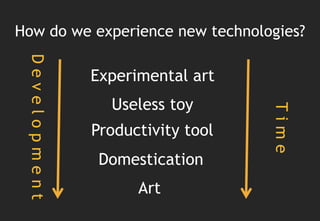
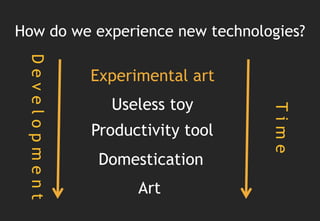
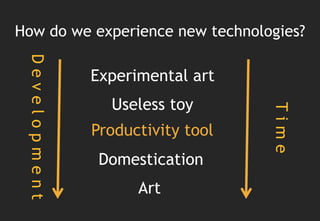
How do we experience new technologies?
 Development


               Experimental art
                 Useless toy


                                   Time
               Productivity tool
                Domestication
                     Art
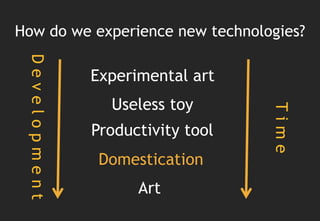
How do we experience new technologies?
 Development


               Experimental art
                 Useless toy


                                   Time
               Productivity tool
                Domestication
                     Art
Examples of . . .


 Domestication
Facebook
What after Facebook?
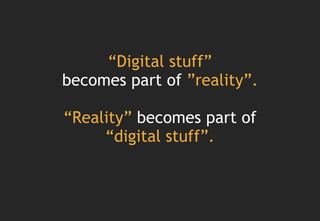
“Digital stuff”
becomes part of ”reality”.

“Reality” becomes part of
     “digital stuff”.
How do we experience new technologies?
 Development


               Experimental art
                 Useless toy


                                   Time
               Productivity tool
                Domestication
                     Art
Example of . . .
Experimental art
http://mlab.taik.fi/~kkallio/mr-pong/mr-pong-360.mov
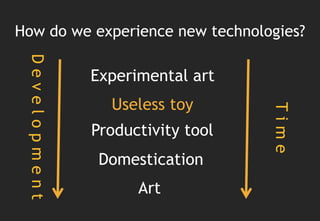
How do we experience new technologies?
 Development


               Experimental art
                 Useless toy


                                   Time
               Productivity tool
                Domestication
                     Art
Example of . . .


  Useless toy
http://youtu.be/MzDBOQD-woc
How do we experience new technologies?
 Development


               Experimental art
                 Useless toy


                                   Time
               Productivity tool
                Domestication
                     Art
Example of . . .


Productivity tool
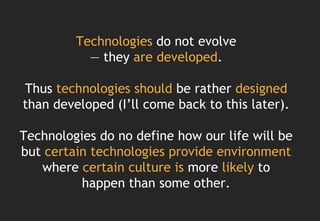
Technologies do not evolve
           — they are developed.

Thus technologies should be rather designed
than developed (I’ll come back to this later).

Technologies do no define how our life will be
but certain technologies provide environment
   where certain culture is more likely to
          happen than some other.
Two things

     1. About technology (and media)

     2. About design (as research)
Two things

     1. About technology (and media)

     2. About design (as research)
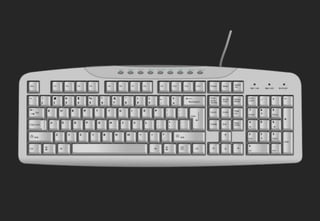
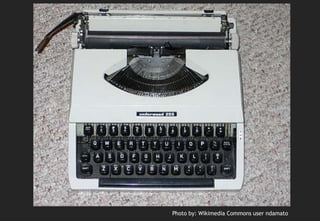
Why are the keys on a
computer keyboard in the
       order they are in

           Why QWERTY
Photo by: Wikimedia Commons user ndamato
Design
                 is
              activity
      in the crossing point of
science, art, technology and craft
   in a socio-cultural historical
              context.
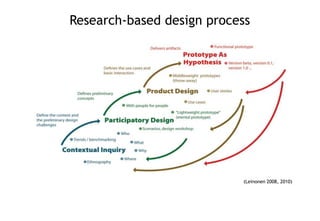
Research-based design process

Käyttäjä-, asiakas ja ihmislähtöiset
              menetelmät.

 . . . pyrkimys luoda tuotteita tai
palveluita jotka vastaavat ihmisten
        todellisiin tarpeisiin.
                                 (Leinonen 2008, 2010)
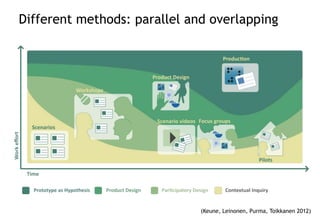
Different methods: parallel and overlapping


                              (Keune, Leinonen, Purma, Toikkanen 2012)
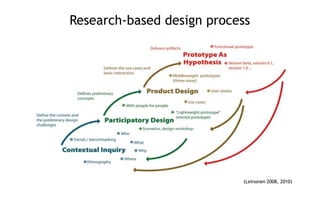
Research-based design process

Käyttäjä-, asiakas ja ihmislähtöiset
              menetelmät.

 . . . pyrkimys luoda tuotteita tai
palveluita jotka vastaavat ihmisten
        todellisiin tarpeisiin.
                                 (Leinonen 2008, 2010)
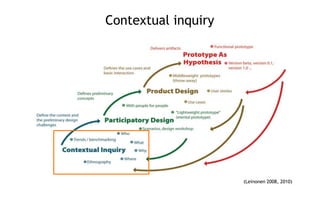
Contextual inquiry


                     (Leinonen 2008, 2010)
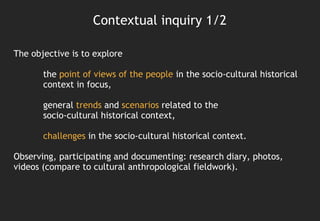
Contextual inquiry 1/2

The objective is to explore

       the point of views of the people in the socio-cultural historical
       context in focus,

       general trends and scenarios related to the
       socio-cultural historical context,

       challenges in the socio-cultural historical context.

Observing, participating and documenting: research diary, photos,
videos (compare to cultural anthropological fieldwork).
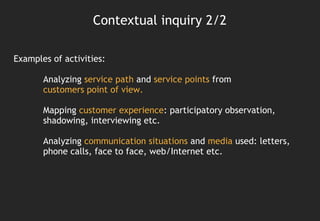
Contextual inquiry 2/2

Examples of activities:

       Analyzing service path and service points from
       customers point of view.

       Mapping customer experience: participatory observation,
       shadowing, interviewing etc.

       Analyzing communication situations and media used: letters,
       phone calls, face to face, web/Internet etc.
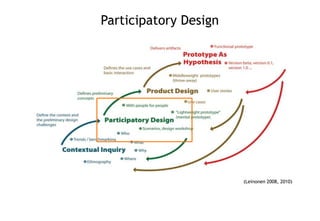
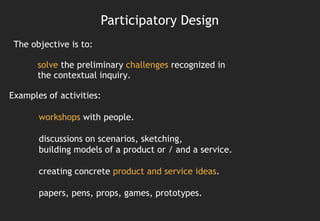
Participatory Design


                       (Leinonen 2008, 2010)
Participatory Design
 The objective is to:

       solve the preliminary challenges recognized in
       the contextual inquiry.

Examples of activities:

       workshops with people.

       discussions on scenarios, sketching,
       building models of a product or / and a service.

       creating concrete product and service ideas.

       papers, pens, props, games, prototypes.
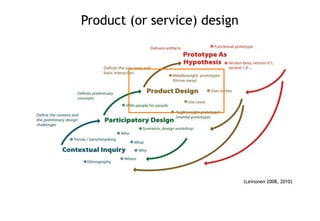
Product (or service) design


                              (Leinonen 2008, 2010)
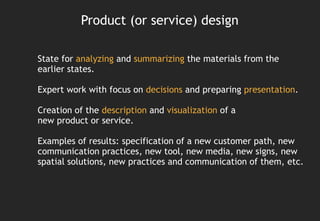
Product (or service) design

State for analyzing and summarizing the materials from the
earlier states.

Expert work with focus on decisions and preparing presentation.

Creation of the description and visualization of a
new product or service.

Examples of results: specification of a new customer path, new
communication practices, new tool, new media, new signs, new
spatial solutions, new practices and communication of them, etc.
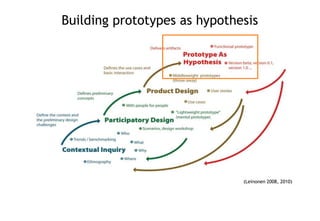
Building prototypes as hypothesis


                              (Leinonen 2008, 2010)
http://vimeo.com/46812964
Kiitos

About design (and disruptive technologies)

  • 1.
    About design (and disruptivetechnologies) Teemu Leinonen Media Lab Helsinki, Department of Media School of Arts, Design and Architecture Aalto University
  • 2.
    Teemu Leinonen Associate Professor, NewMedia Design and Learning Designer: web / mobile / digital culture / learning > education theory > new media > design > design methods Photo by Cary Bass / Wikimedia Commons
  • 3.
    About design (and disruptivetechnologies) Teemu Leinonen Media Lab Helsinki, Department of Media School of Arts, Design and Architecture Aalto University
  • 4.
  • 5.
    designer (in artand design trad.) . . . focuses on experiences, . . . the future experiences, . . . to design them.
  • 6.
    design researcher /student: . . . do stuff, . . . be experimental, . . . be avant-garde.
  • 7.
    Two things 1. About technology (and media) 2. About design (as research)
  • 8.
    Two things 1. About technology (and media) 2. About design (as research)
  • 9.
    What are disruptive technologies Examples You and disruptive technologies
  • 10.
  • 11.
  • 19.
  • 20.
    1991 katele$ spss katele$ mailpsraah@uta.fi Subject: This is an email Hi Rami. This is an email. You can send these with a command “mail username@uta.fi” I think you can reply with command “R”. - Teemu . katele$ irc katele$ news katele$ talk psraah
  • 21.
    How do weexperience new technologies? Development Experimental art Useless toy Time Productivity tool Domestication Art
  • 22.
    How do weexperience new technologies? Development Experimental art Useless toy Time Productivity tool Domestication Art
  • 23.
    Examples of .. . Domestication
  • 24.
  • 25.
  • 26.
    “Digital stuff” becomes partof ”reality”. “Reality” becomes part of “digital stuff”.
  • 27.
    How do weexperience new technologies? Development Experimental art Useless toy Time Productivity tool Domestication Art
  • 28.
    Example of .. . Experimental art
  • 29.
  • 30.
    How do weexperience new technologies? Development Experimental art Useless toy Time Productivity tool Domestication Art
  • 31.
    Example of .. . Useless toy
  • 32.
  • 33.
    How do weexperience new technologies? Development Experimental art Useless toy Time Productivity tool Domestication Art
  • 34.
    Example of .. . Productivity tool
  • 35.
    Technologies do notevolve — they are developed. Thus technologies should be rather designed than developed (I’ll come back to this later). Technologies do no define how our life will be but certain technologies provide environment where certain culture is more likely to happen than some other.
  • 36.
    Two things 1. About technology (and media) 2. About design (as research)
  • 37.
    Two things 1. About technology (and media) 2. About design (as research)
  • 38.
    Why are thekeys on a computer keyboard in the order they are in Why QWERTY
  • 40.
    Photo by: WikimediaCommons user ndamato
  • 41.
    Design is activity in the crossing point of science, art, technology and craft in a socio-cultural historical context.
  • 42.
    Research-based design process Käyttäjä-,asiakas ja ihmislähtöiset menetelmät. . . . pyrkimys luoda tuotteita tai palveluita jotka vastaavat ihmisten todellisiin tarpeisiin. (Leinonen 2008, 2010)
  • 43.
    Different methods: paralleland overlapping (Keune, Leinonen, Purma, Toikkanen 2012)
  • 44.
    Research-based design process Käyttäjä-,asiakas ja ihmislähtöiset menetelmät. . . . pyrkimys luoda tuotteita tai palveluita jotka vastaavat ihmisten todellisiin tarpeisiin. (Leinonen 2008, 2010)
  • 45.
    Contextual inquiry (Leinonen 2008, 2010)
  • 46.
    Contextual inquiry 1/2 Theobjective is to explore the point of views of the people in the socio-cultural historical context in focus, general trends and scenarios related to the socio-cultural historical context, challenges in the socio-cultural historical context. Observing, participating and documenting: research diary, photos, videos (compare to cultural anthropological fieldwork).
  • 47.
    Contextual inquiry 2/2 Examplesof activities: Analyzing service path and service points from customers point of view. Mapping customer experience: participatory observation, shadowing, interviewing etc. Analyzing communication situations and media used: letters, phone calls, face to face, web/Internet etc.
  • 48.
    Participatory Design (Leinonen 2008, 2010)
  • 49.
    Participatory Design Theobjective is to: solve the preliminary challenges recognized in the contextual inquiry. Examples of activities: workshops with people. discussions on scenarios, sketching, building models of a product or / and a service. creating concrete product and service ideas. papers, pens, props, games, prototypes.
  • 50.
    Product (or service)design (Leinonen 2008, 2010)
  • 51.
    Product (or service)design State for analyzing and summarizing the materials from the earlier states. Expert work with focus on decisions and preparing presentation. Creation of the description and visualization of a new product or service. Examples of results: specification of a new customer path, new communication practices, new tool, new media, new signs, new spatial solutions, new practices and communication of them, etc.
  • 52.
    Building prototypes ashypothesis (Leinonen 2008, 2010)
  • 53.
  • 54.

Editor's Notes

  • #10 Tolstoy has proposed that: “The vocation of every man and woman is to serve other people ”.  In this presentation today I am aiming to demonstrate how I have tried to do it. How I have tried to serve other people.  My study is about design. According to Nelson and Stolterman design is not about self-expression. Design is not about self-service. Design isother-service. Design is always an attempt to serve other people.