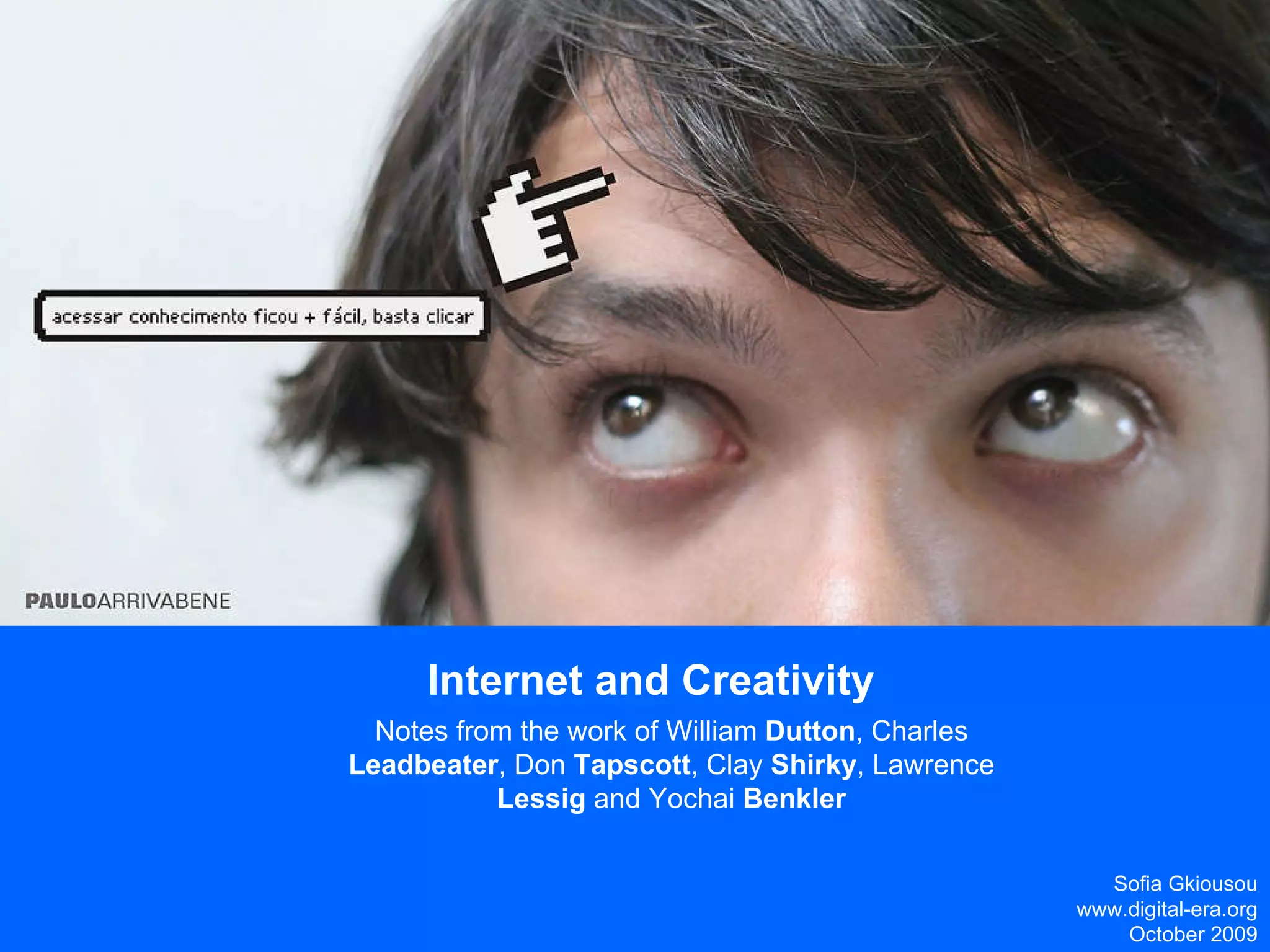
Internet and Creativity Notes from the work of William  Dutton , Charles  Leadbeater , Don  Tapscott , Clay  Shirky , Lawrence  Lessig  and Yochai  Benkler Sofia Gkiousou www.digital-era.org October 2009
Setting the scene Cyberspace.  A consensual hallucination William Gibson - Neuromancer www.digital-era.org October 2009
Defining the internet The machine (as a network of hardware & software) The place (as a disconnected collective of ) The third place (Oldenberg’s ‘anchor’ of community life and creative interaction) The medium (is it the message – content vs. form in McLuhan) The metamedium (a medium for the invention of media AND their capture) The cultural domain (as a collection of cultures and subcultures)  etc.  www.digital-era.org October 2009
Defining creativity The new idea The artistic idea The product  Creativity is  not  innovation.  www.digital-era.org October 2009
Web 2.0  The economic model for what is called 'Web 2.0' is based on promoting the desire to  share  and  exchange  things, an attempt to  make profits from the voluntary collaboration  of its users and its potential for compiling data and making them available to the public. The new companies operating on the Internet base their role on promoting  cooperative communities  and managing access to the data and files contributed. This business model increasingly tends  not to sell any product at all  to the consumer, but rather sells the consumer to the product, integrating the user and the files he or she contributes into the actual service being offered. 'Web 2.0' as a new context for artistic practices Juan Martin Prada, University of Cádiz, Spain www.digital-era.org October 2009
The ‘new’ creativity Users as sharers/ lurkers  Users as creators The cult of the amateur? (Andrew Keen) …  many hopes have always been focused on the conversion of consumers into producers of means. For  Guy Debord , to cite one example, there was no possibility of freedom in the use of time unless one possessed modern instruments for constructing everyday life. Only through their use, he said, could one progress 'from a utopian revolutionary art to an experiential revolutionary art' as quoted in  'Web 2.0' as a new context for artistic practices Juan Martin Prada, University of Cádiz, Spain www.digital-era.org October 2009
William H. Dutton: Tele-access The design and use of ICTs and tele-access 5 major sets of factors that shape this Economic Resources and Constraints 2)  ICT Paradigms and Practices  3)  Conceptions and responses of users 4)  Geography of space and place 5)  Institutional arrangements and public policy  Could this be changing form AND content? www.digital-era.org October 2009
Charles Leadbeater: We think More people than ever can participate in culture, contributing their ideas, views, information. The web allows them not just to publish but to share and connect, to collaborate and when the conditions are right, to create, together, at scale. Issues of Abuse and invasions of privacy  Cacophony  Self- organisation is paramount.  Are  you more in control of your life or less? www.digital-era.org October 2009
Don Tapscott: Wikinomics Wikinomics :  Openness Peering Sharing Acting Globally Mass collaboration as outsourcing (crowdsourcing)  New models of mass collaboration Prosumers : Where consumers are also the producers e.g. Second Life  New Alexandrians : Sharing knowledge  www.digital-era.org October 2009
Clay Shirky: Crowdsourcing The Internet runs on love Cognitive surplus:  time freed from passive activities as productive Groups are entities in their own right . (concerns about trust and reputation)  www.digital-era.org October 2009
Lawrence Lessig: CC & Remix Creative Commons Licenses that allow creators to communicate which rights they reserve, and which rights they waive for the benefit of recipients or other creators. Read/Write culture vs. Read/Only culture Remixing as a new way to create which also inspires the original artist BUT Those who would contribute happily to non-profit Wikipedia do not contribute so happily if the fruits of their efforts are being pocketed by others. What then? www.digital-era.org October 2009
Yochai Benkler: Collaboration Commons-based peer production Collaborative efforts (e.g. Wikipedia) Networked information economy  "system of production, distribution, and consumption of information  goods characterized by decentralized individual action carried out  through widely distributed, nonmarket means that do not depend on  market strategies.”  www.digital-era.org October 2009
Some food for thought How do you navigate the cacophony?  How do you monetize production? How do you incentivise participation?  The commodity of your attention span (Advertising trading on people’s  attention e.g. Facebook) www.digital-era.org October 2009

Internet And Creativity

  • 1.
    Internet and CreativityNotes from the work of William Dutton , Charles Leadbeater , Don Tapscott , Clay Shirky , Lawrence Lessig and Yochai Benkler Sofia Gkiousou www.digital-era.org October 2009
  • 2.
    Setting the sceneCyberspace. A consensual hallucination William Gibson - Neuromancer www.digital-era.org October 2009
  • 3.
    Defining the internetThe machine (as a network of hardware & software) The place (as a disconnected collective of ) The third place (Oldenberg’s ‘anchor’ of community life and creative interaction) The medium (is it the message – content vs. form in McLuhan) The metamedium (a medium for the invention of media AND their capture) The cultural domain (as a collection of cultures and subcultures) etc. www.digital-era.org October 2009
  • 4.
    Defining creativity Thenew idea The artistic idea The product Creativity is not innovation. www.digital-era.org October 2009
  • 5.
    Web 2.0 The economic model for what is called 'Web 2.0' is based on promoting the desire to share and exchange things, an attempt to make profits from the voluntary collaboration of its users and its potential for compiling data and making them available to the public. The new companies operating on the Internet base their role on promoting cooperative communities and managing access to the data and files contributed. This business model increasingly tends not to sell any product at all to the consumer, but rather sells the consumer to the product, integrating the user and the files he or she contributes into the actual service being offered. 'Web 2.0' as a new context for artistic practices Juan Martin Prada, University of Cádiz, Spain www.digital-era.org October 2009
  • 6.
    The ‘new’ creativityUsers as sharers/ lurkers Users as creators The cult of the amateur? (Andrew Keen) … many hopes have always been focused on the conversion of consumers into producers of means. For Guy Debord , to cite one example, there was no possibility of freedom in the use of time unless one possessed modern instruments for constructing everyday life. Only through their use, he said, could one progress 'from a utopian revolutionary art to an experiential revolutionary art' as quoted in 'Web 2.0' as a new context for artistic practices Juan Martin Prada, University of Cádiz, Spain www.digital-era.org October 2009
  • 7.
    William H. Dutton:Tele-access The design and use of ICTs and tele-access 5 major sets of factors that shape this Economic Resources and Constraints 2) ICT Paradigms and Practices 3) Conceptions and responses of users 4) Geography of space and place 5) Institutional arrangements and public policy Could this be changing form AND content? www.digital-era.org October 2009
  • 8.
    Charles Leadbeater: Wethink More people than ever can participate in culture, contributing their ideas, views, information. The web allows them not just to publish but to share and connect, to collaborate and when the conditions are right, to create, together, at scale. Issues of Abuse and invasions of privacy Cacophony Self- organisation is paramount. Are you more in control of your life or less? www.digital-era.org October 2009
  • 9.
    Don Tapscott: WikinomicsWikinomics : Openness Peering Sharing Acting Globally Mass collaboration as outsourcing (crowdsourcing) New models of mass collaboration Prosumers : Where consumers are also the producers e.g. Second Life New Alexandrians : Sharing knowledge www.digital-era.org October 2009
  • 10.
    Clay Shirky: CrowdsourcingThe Internet runs on love Cognitive surplus: time freed from passive activities as productive Groups are entities in their own right . (concerns about trust and reputation) www.digital-era.org October 2009
  • 11.
    Lawrence Lessig: CC& Remix Creative Commons Licenses that allow creators to communicate which rights they reserve, and which rights they waive for the benefit of recipients or other creators. Read/Write culture vs. Read/Only culture Remixing as a new way to create which also inspires the original artist BUT Those who would contribute happily to non-profit Wikipedia do not contribute so happily if the fruits of their efforts are being pocketed by others. What then? www.digital-era.org October 2009
  • 12.
    Yochai Benkler: CollaborationCommons-based peer production Collaborative efforts (e.g. Wikipedia) Networked information economy "system of production, distribution, and consumption of information goods characterized by decentralized individual action carried out through widely distributed, nonmarket means that do not depend on market strategies.” www.digital-era.org October 2009
  • 13.
    Some food forthought How do you navigate the cacophony? How do you monetize production? How do you incentivise participation? The commodity of your attention span (Advertising trading on people’s attention e.g. Facebook) www.digital-era.org October 2009