1
4
TIME MANAGEMENT
Everyone has the same amount of
time
60 minutes per hour
1,440 minutes per day
525,600 minutes per year
Time Management
Solutions to excessive stress
usually boil down to eating right,
exercise,getting enough sleep,
and managing your time
effectively. Organization is time
management, and time
management is one part of
stress management.”
Pareto’s Principle (80/20 Rule)
 80% of Work gives 20% Results & 20% of
Work gives 80% Results
 One Rs.500/- v/s Hundred Rs.5/-
 Effective v/s Efficient
 Smart work v/s Hard work
Myths about Time
1. Myth: The longer or harder you work the
more you accomplish.
2. Myth: If you want something done right, do
it yourself.
3. Myth: We should take pride in working
hard.
How We Waste Time
 Lack of discipline
 Indecisiveness
 Personal
Disorganization
 Procrastination
 Inability to say “NO”
 Poor Delegation
Skills
 Day Dreaming
 Worry
Time Waste - Caused by Others
 Telephone
Interruptions
 Drop-In Visitors
 Unscheduled
Meetings
 Poor
Communications
 Confused chain of
Authority
YOUR TIME WASTERS
 E-Mail
 Meetings
 Phone calls / Cell calls
 Co-workers
 Stress
 Family issues
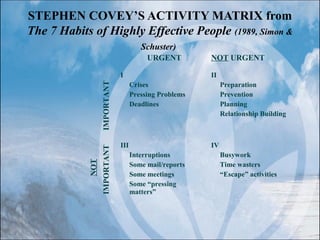
STEPHEN COVEY’S ACTIVITY MATRIX from
The 7 Habits of Highly Effective People (1989, Simon &
Schuster)
I
Crises
Pressing Problems
Deadlines
II
Preparation
Prevention
Planning
Relationship Building
III
Interruptions
Some mail/reports
Some meetings
Some “pressing
matters”
IV
Busywork
Time wasters
“Escape” activities
URGENT NOT URGENT
NOT
IMPORTANTIMPORTANT
Type 1: Aspiring to mediocrity…
Important
Not
Important
Urgent
Quadrant I
Quadrant IVQuadrant III
Quadrant II
Not Urgent
Type 2: Busy going nowhere…
Important
Not
Important
Urgent
Quadrant I
Quadrant IVQuadrant III
Quadrant II
Not Urgent
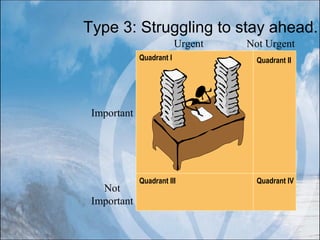
Type 3: Struggling to stay ahead…
Important
Not
Important
Urgent
Quadrant I
Quadrant IVQuadrant III
Quadrant II
Not Urgent
Type 4: Calm and in control…
Important
Not
Important
Urgent
Quadrant I
Quadrant IVQuadrant III
Quadrant II
Not Urgent
Time Log
Write down everything you do
for a period of time
Learn how you really spend
your time
Identify areas where you can
improve your use of time
Why do we procrastinate?
Don’t know where to start.
To avoid an unpleasant task.
We’re afraid to fail.
Waiting for more information.
You may think if you put it off
someone else will do it.
You’re over-committed.
PLANNING and GOAL SETTING
 Specific
 Measurable
 Achievable
 Realistic
 Timed
PLAN DE ACCION
 Step 1 – Define your Role
 Step 2 – Set your Monthly Goal
 Step 3 – Schedule your Weekly Time
 Step 4 – Adopt it Daily - 80/20
 Step 5 – Act on it, Now!
 Step 1 –
Define your Role
 Step 2 –
Set your Monthly Goal
How much $$ do you need to
make to meet your
obligations
 Step 2 –
Set your Monthly Goal
How many Clients do I need
generate that income
 Step 2 –
Set your Monthly Goal
How many people do you
need to talk to everyday to
find those clients?
 Step 3 – Plan Weakly
• DMO
• Gauges
• Accountability
An example maybe:
Personal Time: 6:00am to 8:00am
Personal Development maybe 30 Minutes.
Exercise maybe 30 Minutes
Regular Job: Monday – Friday 8:00am to 5:00pm
Family Time: - 5:00pm to 7:00pm
Herbalife Time: - Monday – Thursday 7:00pm to 10:00pm
7:00pm – 10:00pm
7:00pm to 8:00pm leads calls
8:00pm to 9:00pm customer calls
9:00pm to 10:00pm misc. calls
Friday night maybe family night.
Saturday 9:00am to Noon
Family Time: - Sunday
29 THANK YOU

Time management herbalife

  • 1.
  • 4.
  • 5.
  • 6.
    Everyone has thesame amount of time 60 minutes per hour 1,440 minutes per day 525,600 minutes per year
  • 7.
    Time Management Solutions toexcessive stress usually boil down to eating right, exercise,getting enough sleep, and managing your time effectively. Organization is time management, and time management is one part of stress management.”
  • 8.
    Pareto’s Principle (80/20Rule)  80% of Work gives 20% Results & 20% of Work gives 80% Results  One Rs.500/- v/s Hundred Rs.5/-  Effective v/s Efficient  Smart work v/s Hard work
  • 9.
    Myths about Time 1.Myth: The longer or harder you work the more you accomplish. 2. Myth: If you want something done right, do it yourself. 3. Myth: We should take pride in working hard.
  • 10.
    How We WasteTime  Lack of discipline  Indecisiveness  Personal Disorganization  Procrastination  Inability to say “NO”  Poor Delegation Skills  Day Dreaming  Worry
  • 11.
    Time Waste -Caused by Others  Telephone Interruptions  Drop-In Visitors  Unscheduled Meetings  Poor Communications  Confused chain of Authority
  • 12.
    YOUR TIME WASTERS E-Mail  Meetings  Phone calls / Cell calls  Co-workers  Stress  Family issues
  • 13.
    STEPHEN COVEY’S ACTIVITYMATRIX from The 7 Habits of Highly Effective People (1989, Simon & Schuster) I Crises Pressing Problems Deadlines II Preparation Prevention Planning Relationship Building III Interruptions Some mail/reports Some meetings Some “pressing matters” IV Busywork Time wasters “Escape” activities URGENT NOT URGENT NOT IMPORTANTIMPORTANT
  • 14.
    Type 1: Aspiringto mediocrity… Important Not Important Urgent Quadrant I Quadrant IVQuadrant III Quadrant II Not Urgent
  • 15.
    Type 2: Busygoing nowhere… Important Not Important Urgent Quadrant I Quadrant IVQuadrant III Quadrant II Not Urgent
  • 16.
    Type 3: Strugglingto stay ahead… Important Not Important Urgent Quadrant I Quadrant IVQuadrant III Quadrant II Not Urgent
  • 17.
    Type 4: Calmand in control… Important Not Important Urgent Quadrant I Quadrant IVQuadrant III Quadrant II Not Urgent
  • 18.
    Time Log Write downeverything you do for a period of time Learn how you really spend your time Identify areas where you can improve your use of time
  • 19.
    Why do weprocrastinate? Don’t know where to start. To avoid an unpleasant task. We’re afraid to fail. Waiting for more information. You may think if you put it off someone else will do it. You’re over-committed.
  • 20.
    PLANNING and GOALSETTING  Specific  Measurable  Achievable  Realistic  Timed
  • 21.
    PLAN DE ACCION Step 1 – Define your Role  Step 2 – Set your Monthly Goal  Step 3 – Schedule your Weekly Time  Step 4 – Adopt it Daily - 80/20  Step 5 – Act on it, Now!
  • 22.
     Step 1– Define your Role
  • 24.
     Step 2– Set your Monthly Goal How much $$ do you need to make to meet your obligations
  • 25.
     Step 2– Set your Monthly Goal How many Clients do I need generate that income
  • 26.
     Step 2– Set your Monthly Goal How many people do you need to talk to everyday to find those clients?
  • 27.
     Step 3– Plan Weakly • DMO • Gauges • Accountability
  • 28.
    An example maybe: PersonalTime: 6:00am to 8:00am Personal Development maybe 30 Minutes. Exercise maybe 30 Minutes Regular Job: Monday – Friday 8:00am to 5:00pm Family Time: - 5:00pm to 7:00pm Herbalife Time: - Monday – Thursday 7:00pm to 10:00pm 7:00pm – 10:00pm 7:00pm to 8:00pm leads calls 8:00pm to 9:00pm customer calls 9:00pm to 10:00pm misc. calls Friday night maybe family night. Saturday 9:00am to Noon Family Time: - Sunday
  • 29.

Editor's Notes

  • #2 Herbalife’s International Business Opportunity is based around these fantastic products which have brought amazing results to millions. •Build up a profitable business both locally and internationally. •Low start-up costs and virtually no risks. •Work from your home or office. •Work at your own pace, part-timeor full-time. •Receive the training and support you need to reach your goals.
  • #5 Herbalife’s International Business Opportunity is based around these fantastic products which have brought amazing results to millions. •Build up a profitable business both locally and internationally. •Low start-up costs and virtually no risks. •Work from your home or office. •Work at your own pace, part-timeor full-time. •Receive the training and support you need to reach your goals.
  • #30 Herbalife’s International Business Opportunity is based around these fantastic products which have brought amazing results to millions. •Build up a profitable business both locally and internationally. •Low start-up costs and virtually no risks. •Work from your home or office. •Work at your own pace, part-timeor full-time. •Receive the training and support you need to reach your goals.