!1
Mark Suster
Managing Partner,
Upfront Ventures
Managing Your
Startup Board
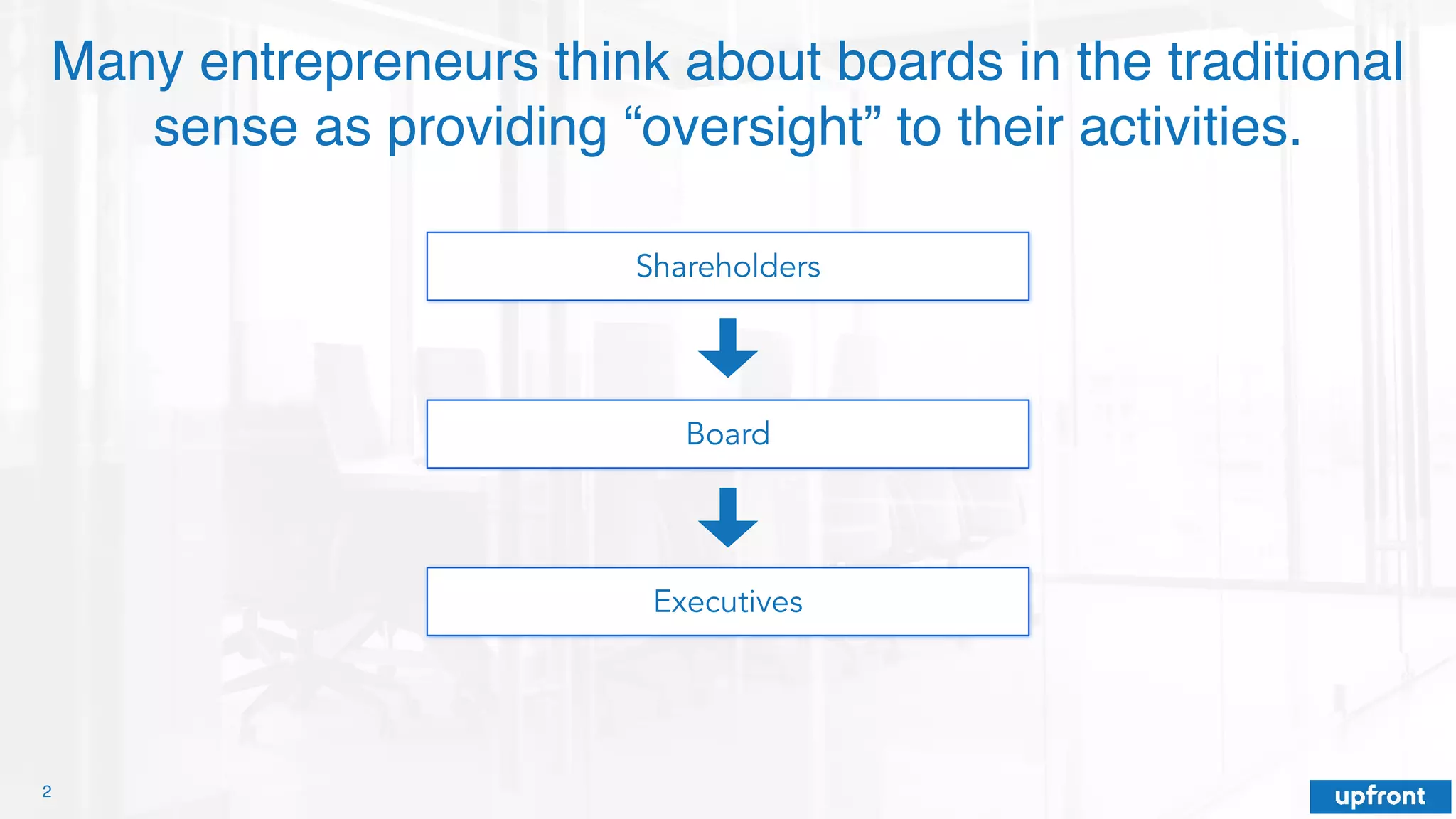
Many entrepreneurs think about boards in the traditional
sense as providing “oversight” to their activities.
Shareholders
Board
Executives
2
3
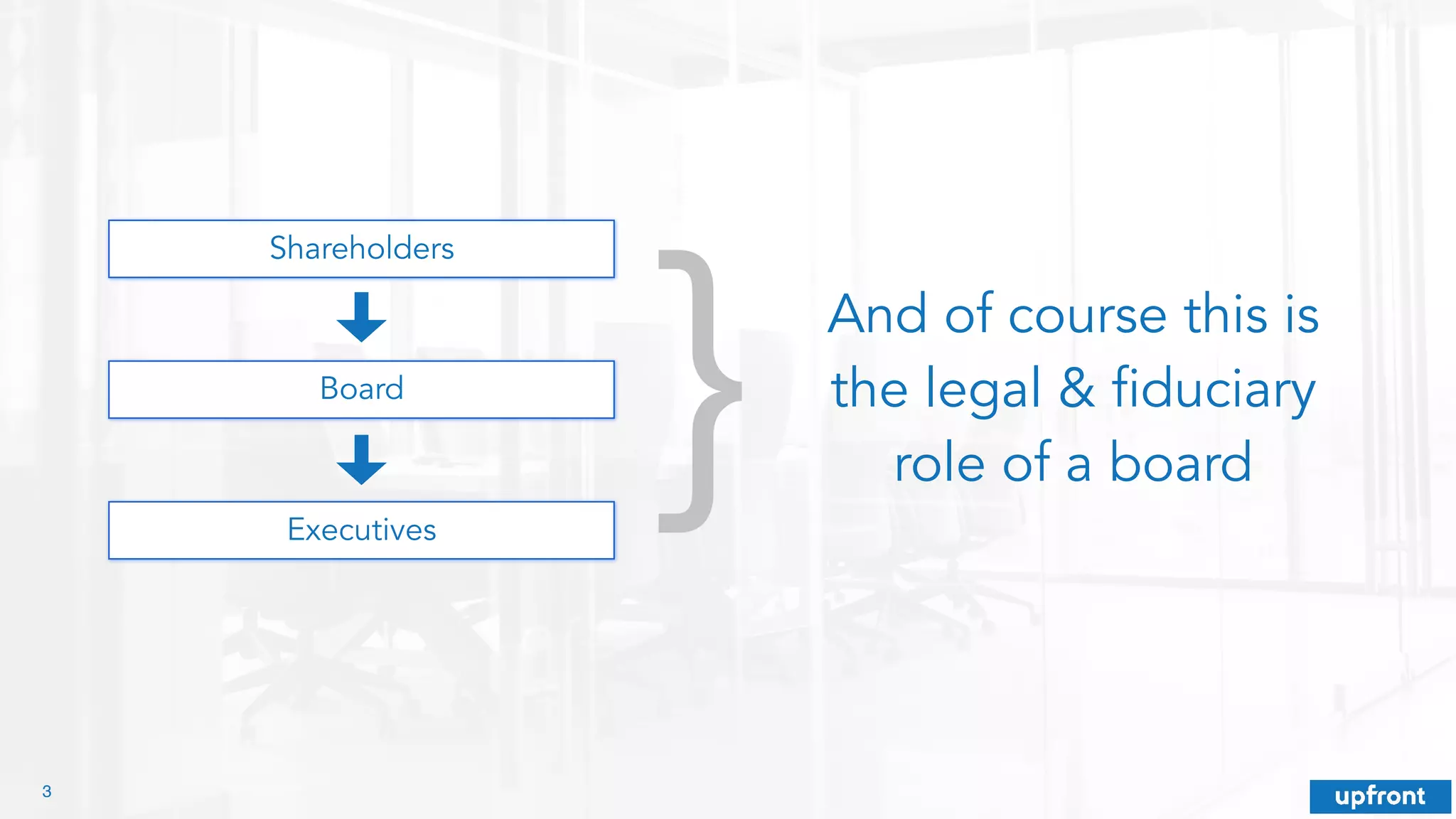
And of course this is
the legal & fiduciary
role of a board
Shareholders
Board
Executives
}
4
But if you want to be truly effective as a founder you
should think more about how YOU manage the BOARD.
Board
Executives
Make your board an
extended part of your
executive team:
super-connected,
free interns.
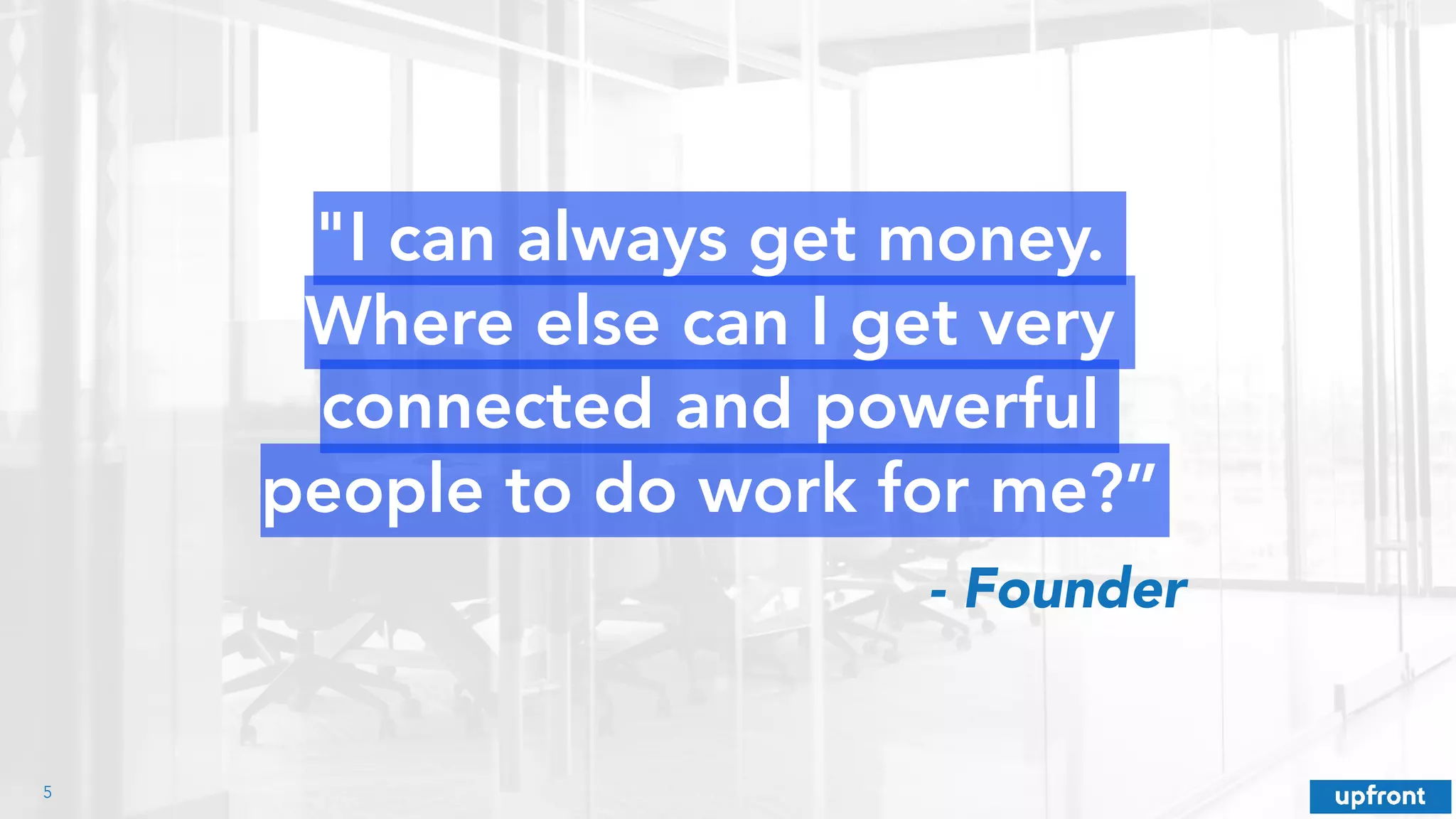
"I can always get money.
Where else can I get very
connected and powerful
people to do work for me?”
!5
- Founder
Photo by Brittany Simuangco on Unsplash6
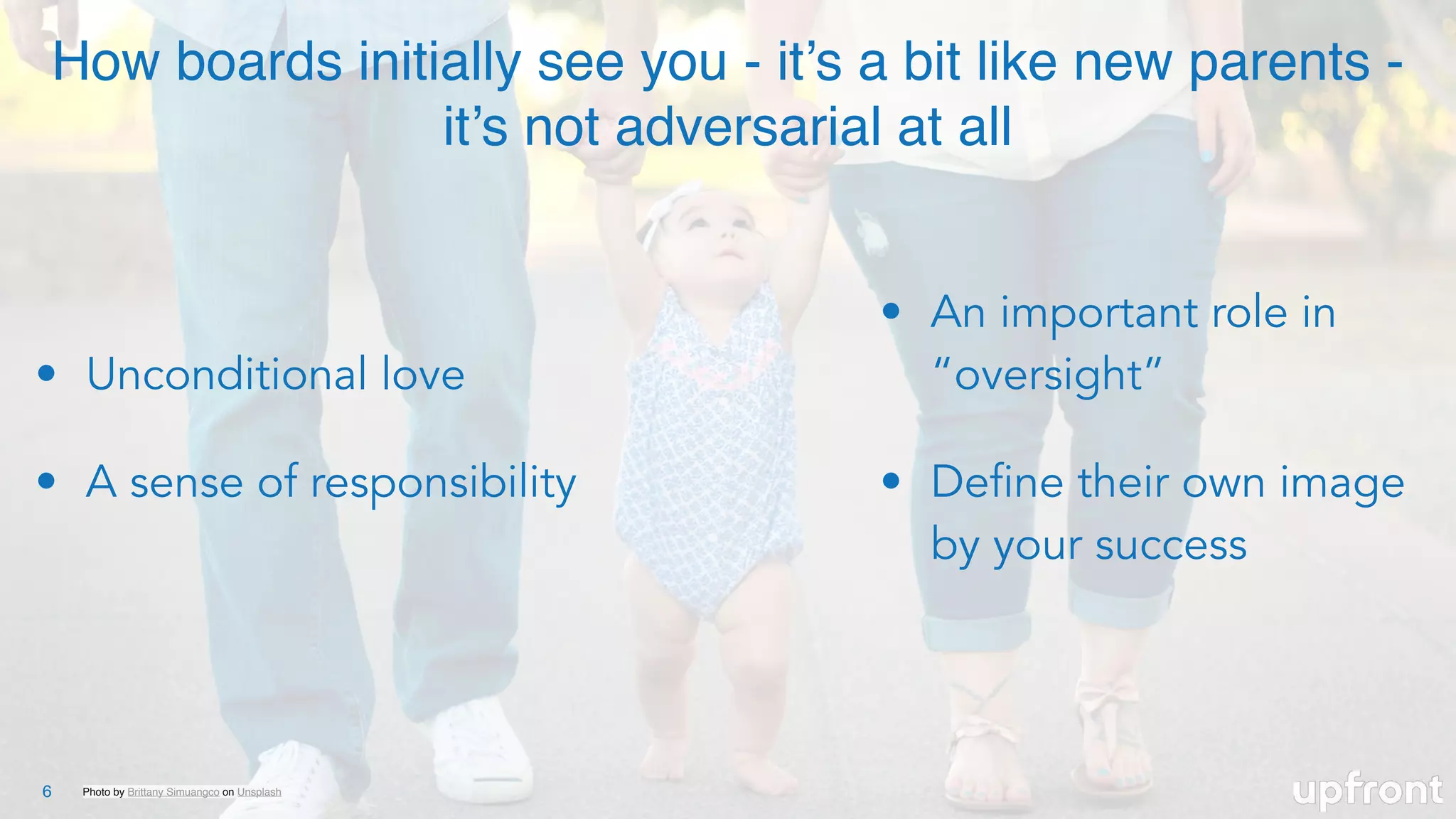
How boards initially see you - it’s a bit like new parents -
it’s not adversarial at all
• Unconditional love
• A sense of responsibility
• An important role in
“oversight”
• Define their own image
by your success
7
As you grow what you think
you should do & what the
board thinks can diverge
8
Ultimately it’s up to you to take
appropriate risks - but you
must then manage the board
The Continuous Board
A different way to think about
managing your board
!9 Photo by Sasha • Stories on Unsplash
Board meetings are how most founders
think about board interactions
but they're actually the least valuable
part of your board relationship
A great board is a
highly-engaged group
who knows your
business intimately
If you build trust they’re
the only people you can
share most sensitive
decisions with
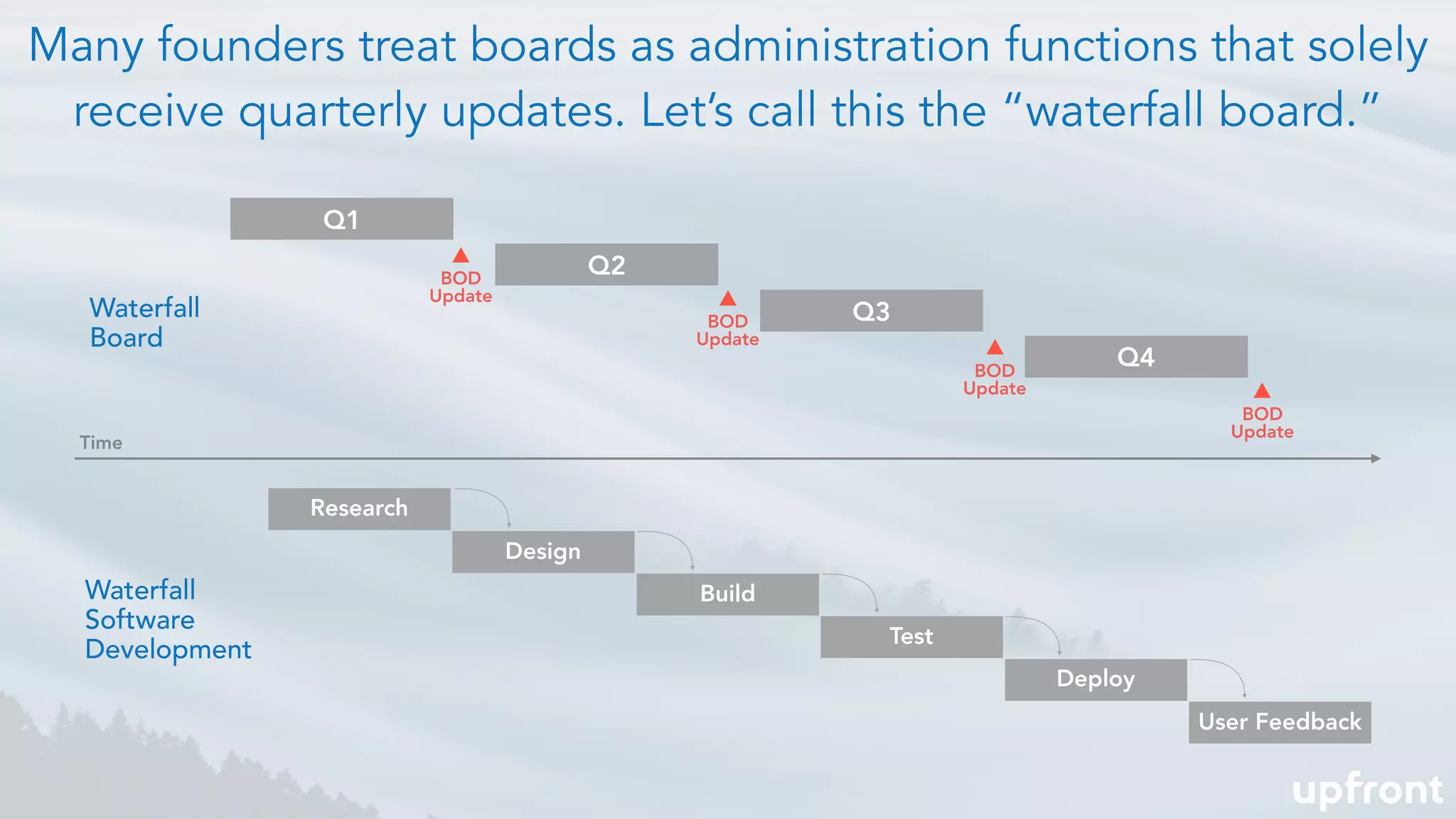
Many founders treat boards as administration functions that solely
receive quarterly updates. Let’s call this the “waterfall board.”
Time
Research
Design
Build
Test
Deploy
Waterfall
Software
Development
User Feedback
Waterfall
Board
Q2
Q3
Q4
Q1
BOD
Update
BOD
Update
BOD
Update
BOD
Update
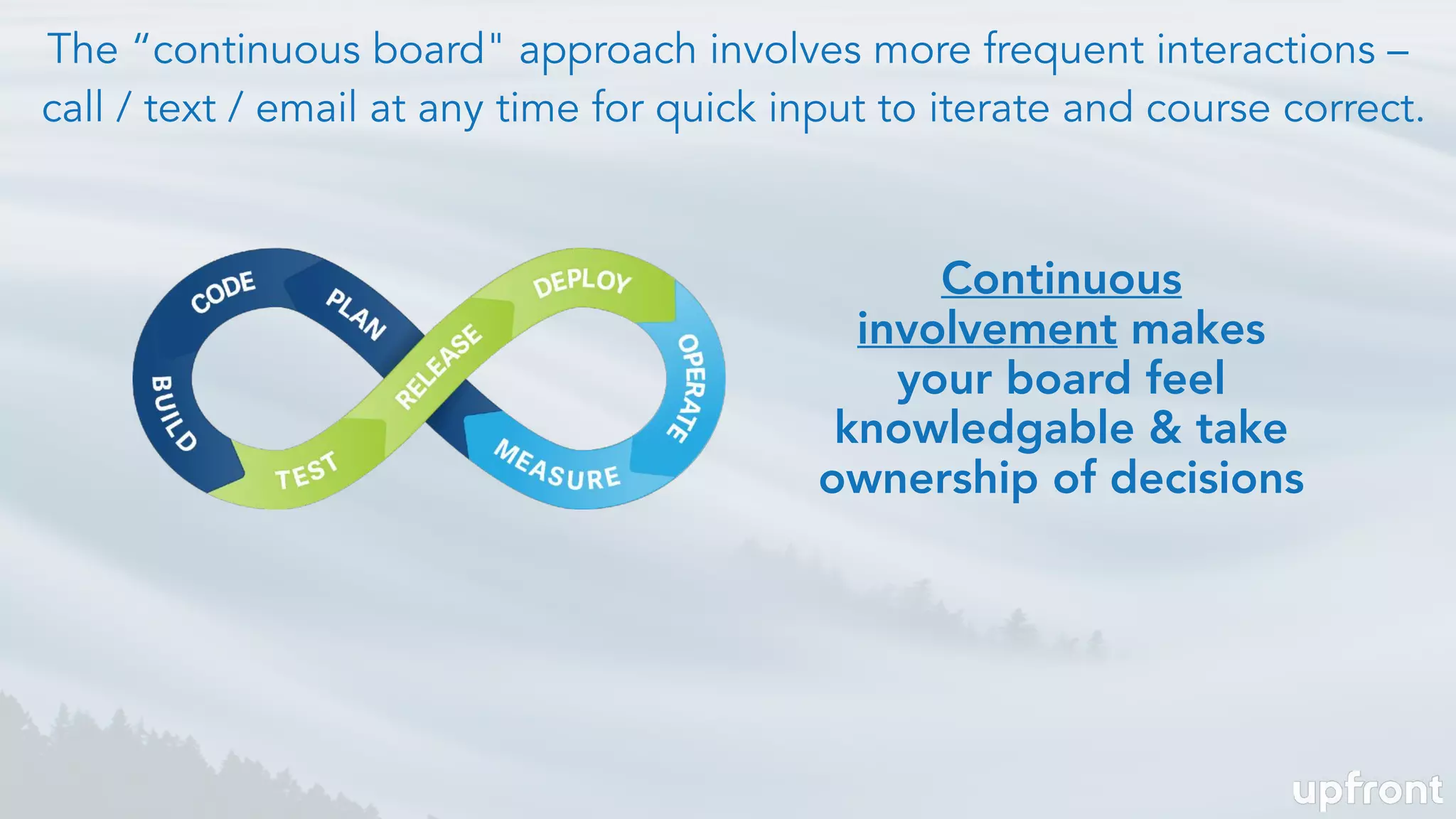
The “continuous board" approach involves more frequent interactions –
 call / text / email at any time for quick input to iterate and course correct.
Continuous
involvement makes
your board feel
knowledgable & take
ownership of decisions
Building a High-Functioning
Board
!15
Each member of a high functioning board…
- Knows each other personally. Has a working relationship
where they can resolve differences of opinions
- Truly understands the underlying businesses. Knows strategy,
execution & financial metrics
Each member of a high functioning board…
- Knows each other personally. Has a working relationship where they can
resolve differences of opinions
- Finds this board assignment important relative to their other
time commitments
Each member of a high functioning board…
- Knows each other personally. Has a working relationship where they can
resolve differences of opinions
- Truly understands the underlying businesses. Knows strategy, execution
& financial metrics
- Doesn’t have incentives that are misaligned with the
company, its shareholders or other board members
Each member of a high functioning board…
- Knows each other personally. Has a working relationship where they can
resolve differences of opinions
- Truly understands the underlying businesses. Knows strategy, execution
& financial metrics
- Finds this board assignment important relative to their other time
commitments
- Knows it’s his or her fiduciary obligation to serve interests of
the company first & foremost
Each member of a high functioning board…
- Knows each other personally. Has a working relationship where they can
resolve differences of opinions
- Truly understands the underlying businesses. Knows strategy, execution
& financial metrics
- Finds this board assignment important relative to their other time
commitments
- Doesn’t have incentives that are misaligned with the company, its
shareholders or other board members
Ultimately it’s in your interest to
invest in creating these working
relationships - not just with you but
amongst non-exec board members.
A board that knows and likes each
other is more likely to resolve hard
conflicts.
• Schedule board meals / social time
• Encourage non-exec board sessions
• Help plan non-exec board calls
Building relationships takes effort
Board Members
Source: Mark Suster, Both Sides of the Table
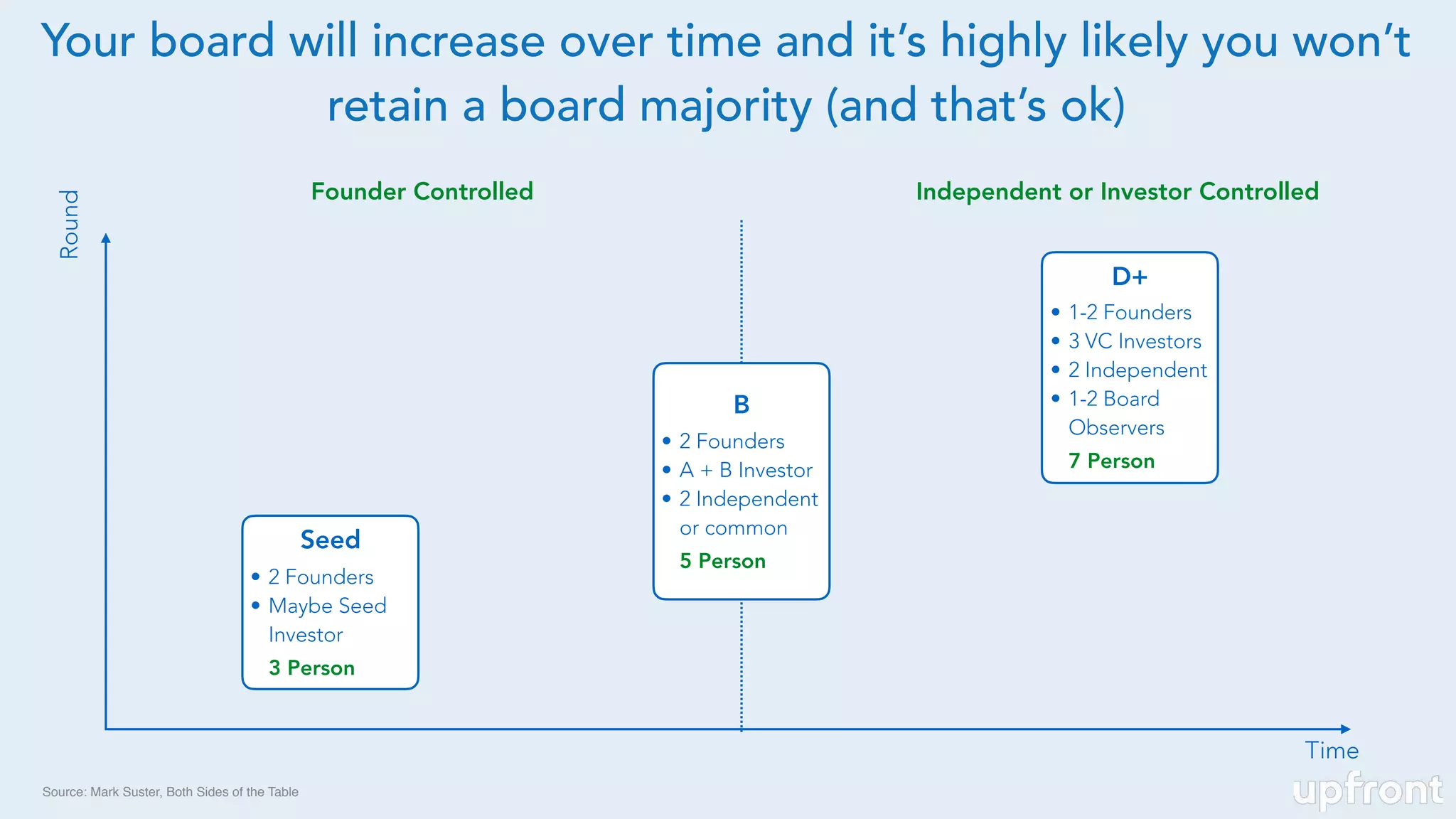
Your board will increase over time and it’s highly likely you won’t
retain a board majority (and that’s ok)
Time
Round
Seed
• 2 Founders
• Maybe Seed
Investor
3 Person
D+
• 1-2 Founders
• 3 VC Investors
• 2 Independent
• 1-2 Board
Observers
7 Person
B
• 2 Founders
• A + B Investor
• 2 Independent
or common
5 Person
Founder Controlled Independent or Investor Controlled
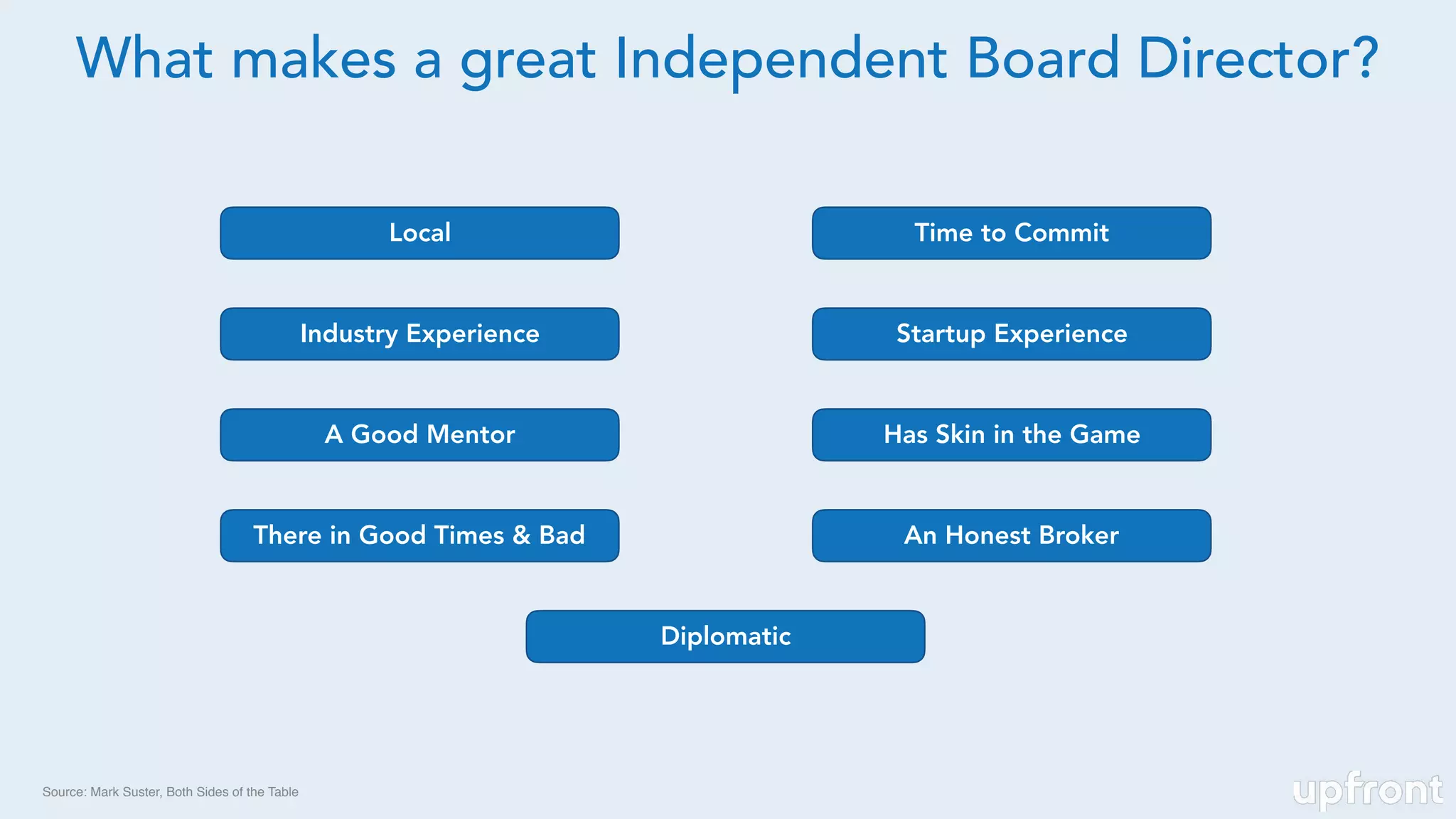
What makes a great Independent Board Director?
A Good Mentor
Industry Experience
Local
Has Skin in the Game
Time to Commit
Startup Experience
An Honest BrokerThere in Good Times & Bad
Diplomatic
Source: Mark Suster, Both Sides of the Table
Board Meetings
!27
Photo by Pineapple Supply Co. on Unsplash
If you ask your board about your logo or brand colors,
they will debate it for 30 minutes
…if you do this, that’s on you
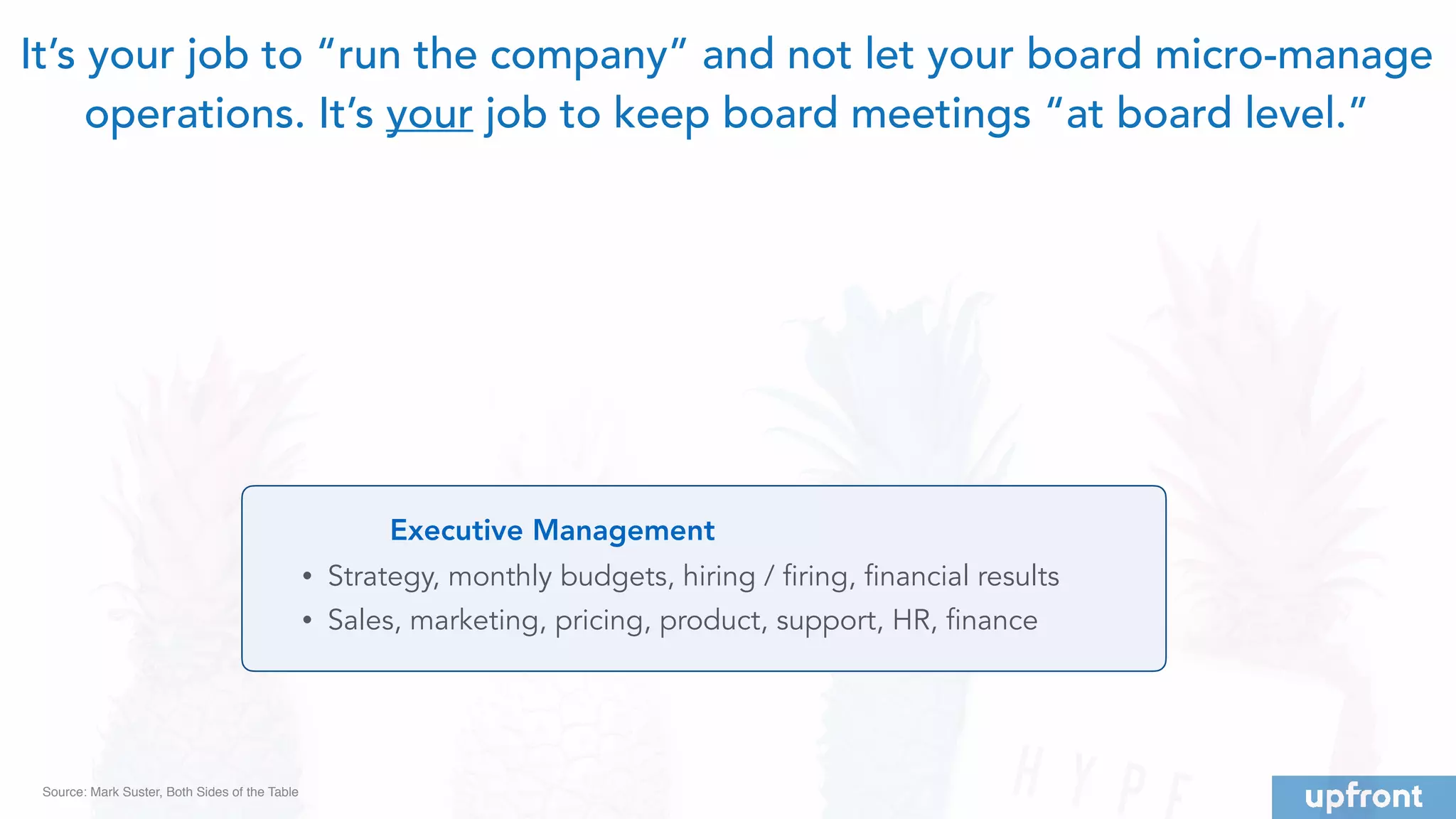
Executive Management
• Strategy, monthly budgets, hiring / firing, financial results
• Sales, marketing, pricing, product, support, HR, finance
It’s your job to “run the company” and not let your board micro-manage
operations. It’s your job to keep board meetings “at board level.”
Source: Mark Suster, Both Sides of the Table
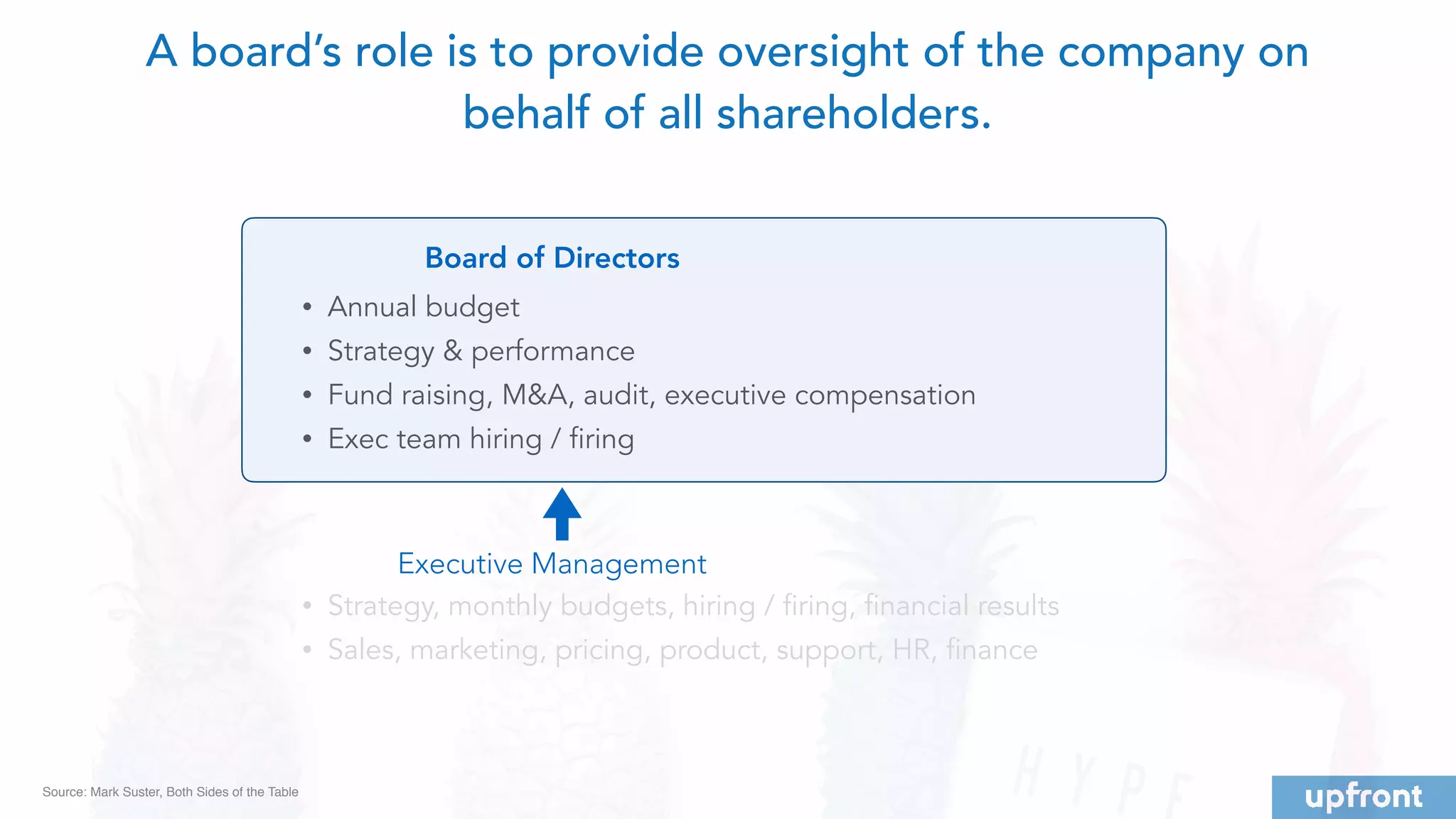
Executive Management
Board of Directors
• Strategy, monthly budgets, hiring / firing, financial results
• Sales, marketing, pricing, product, support, HR, finance
• Annual budget
• Strategy & performance
• Fund raising, M&A, audit, executive compensation
• Exec team hiring / firing
A board’s role is to provide oversight of the company on
behalf of all shareholders.
Source: Mark Suster, Both Sides of the Table
Executive Management
Board of Directors
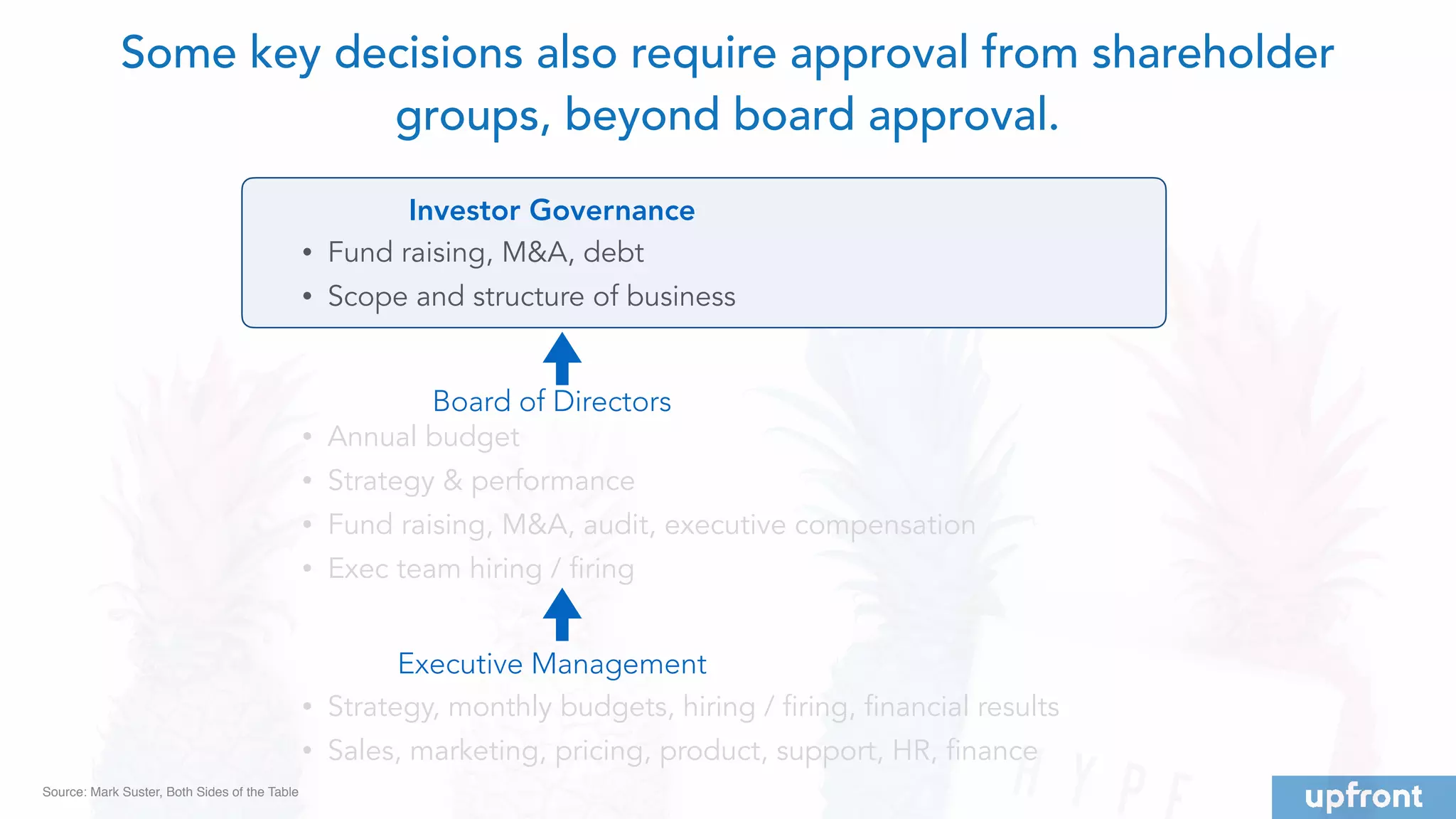
Investor Governance
• Strategy, monthly budgets, hiring / firing, financial results
• Sales, marketing, pricing, product, support, HR, finance
• Annual budget
• Strategy & performance
• Fund raising, M&A, audit, executive compensation
• Exec team hiring / firing
• Fund raising, M&A, debt
• Scope and structure of business
Some key decisions also require approval from shareholder
groups, beyond board approval.
Source: Mark Suster, Both Sides of the Table
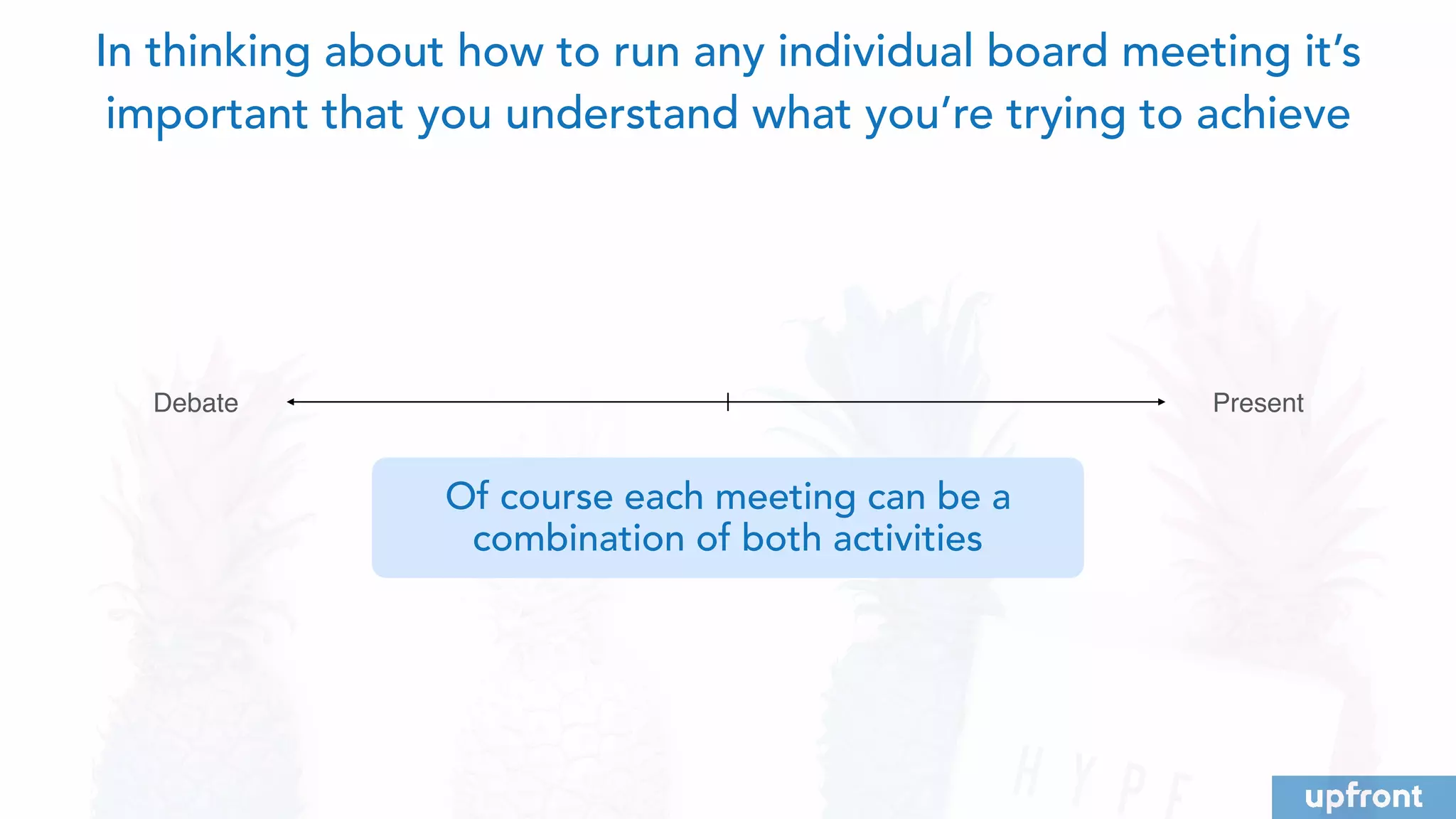
PresentDebate
In thinking about how to run any individual board meeting it’s
important that you understand what you’re trying to achieve
Of course each meeting can be a
combination of both activities
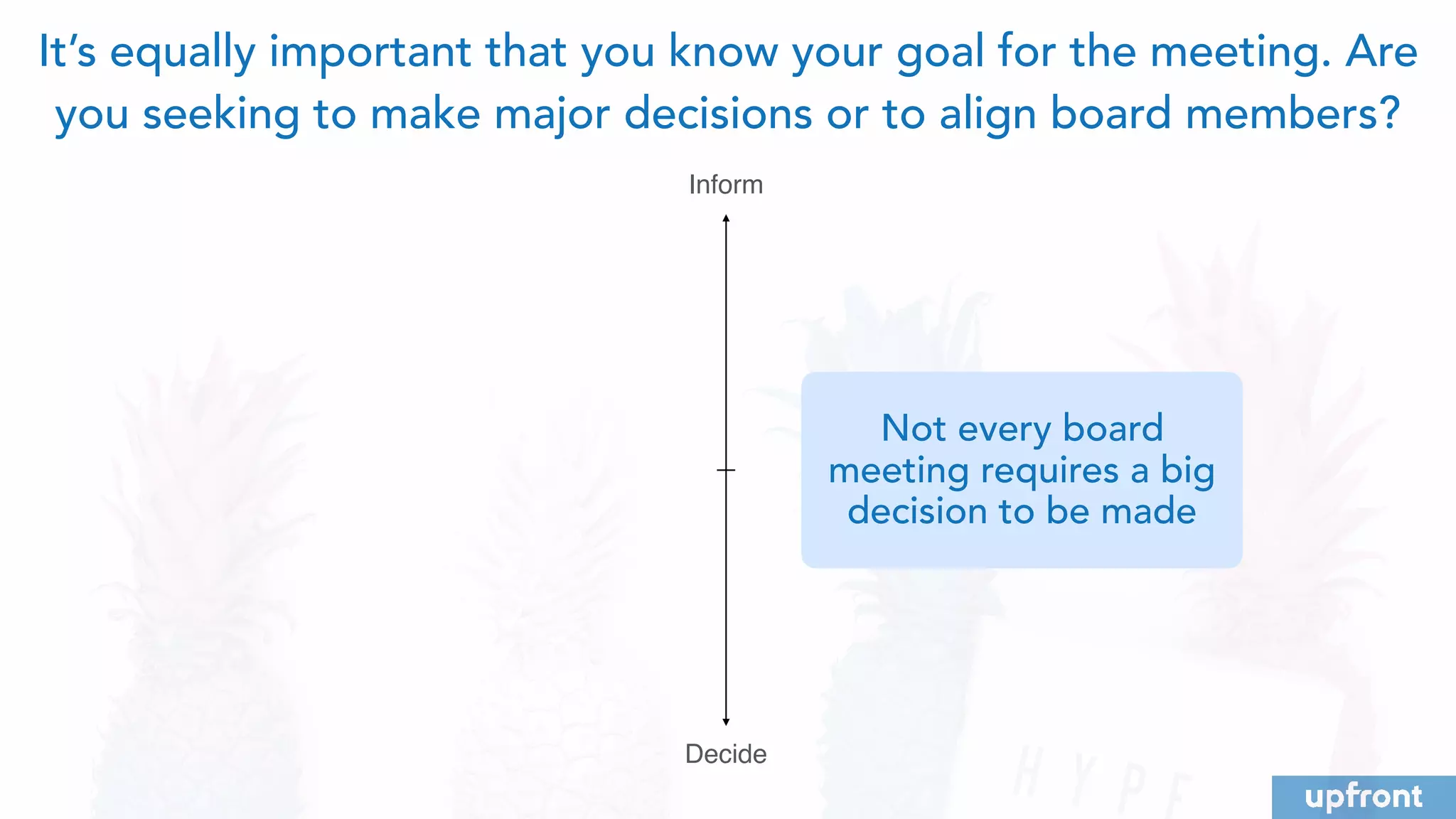
Inform
Decide
It’s equally important that you know your goal for the meeting. Are
you seeking to make major decisions or to align board members?
Not every board
meeting requires a big
decision to be made
PresentDebate
Inform
Decide
Filibuster
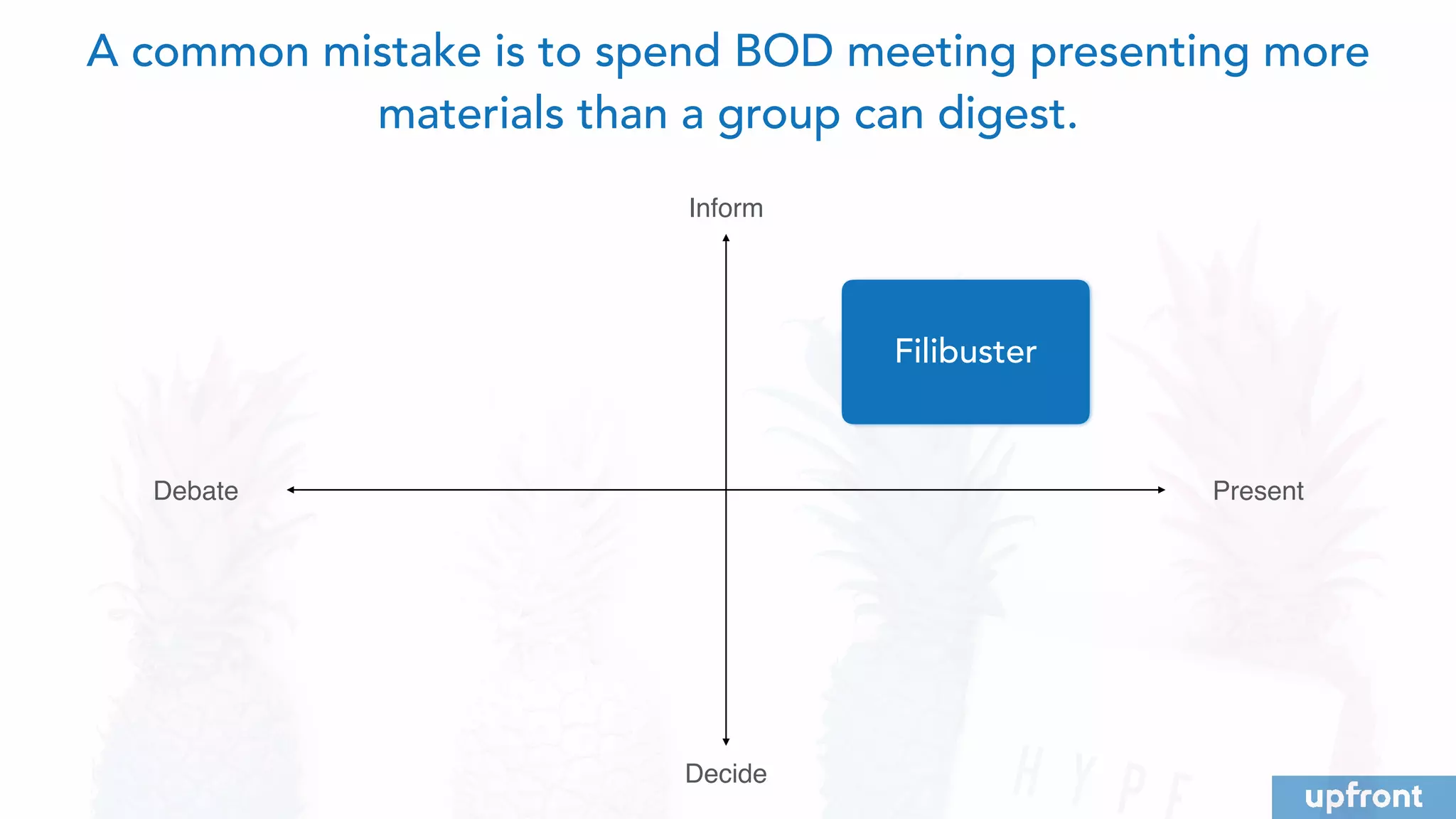
A common mistake is to spend BOD meeting presenting more
materials than a group can digest.
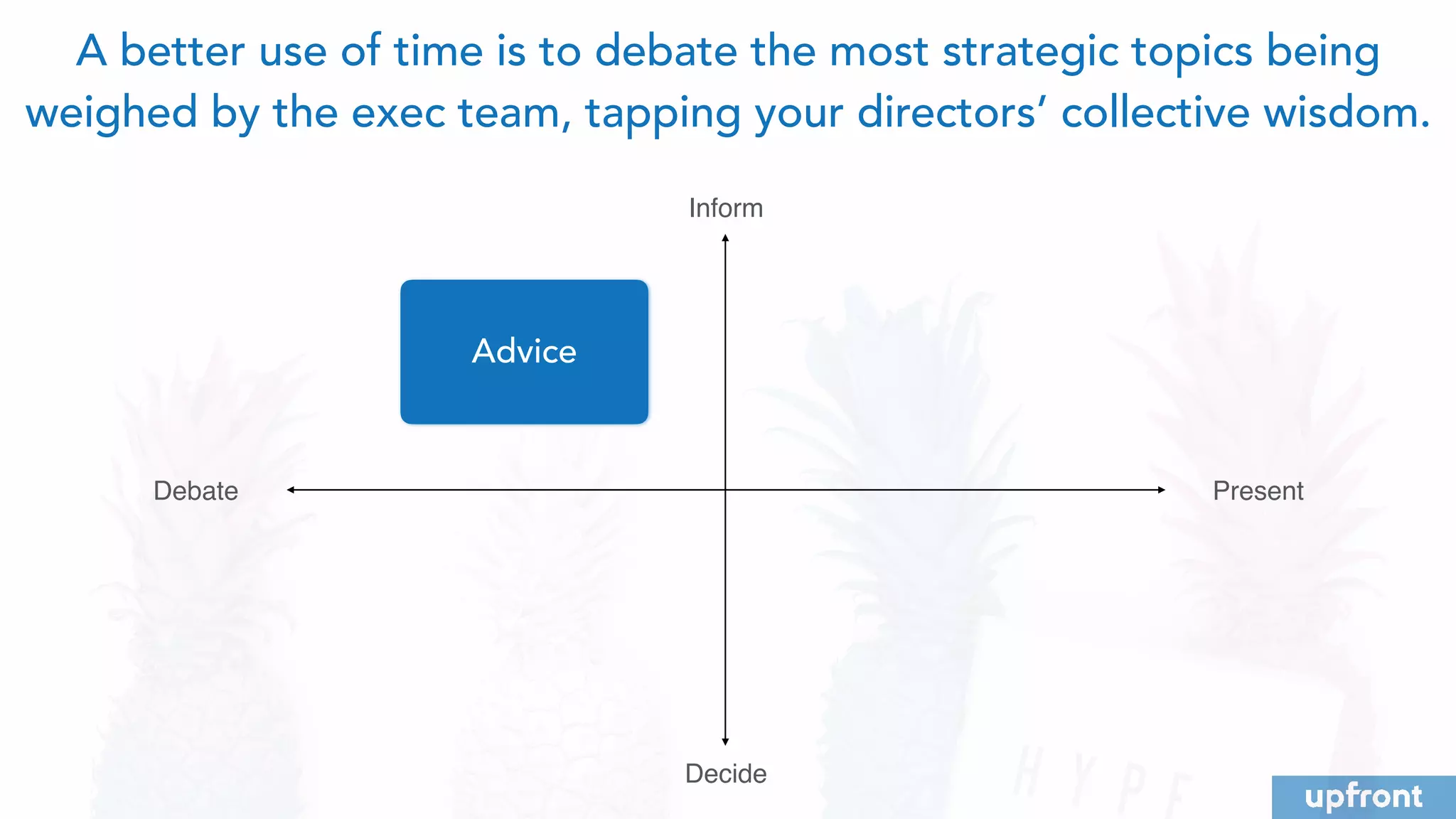
A better use of time is to debate the most strategic topics being
weighed by the exec team, tapping your directors’ collective wisdom.
PresentDebate
Inform
Decide
Advice
PresentDebate
Inform
Decide
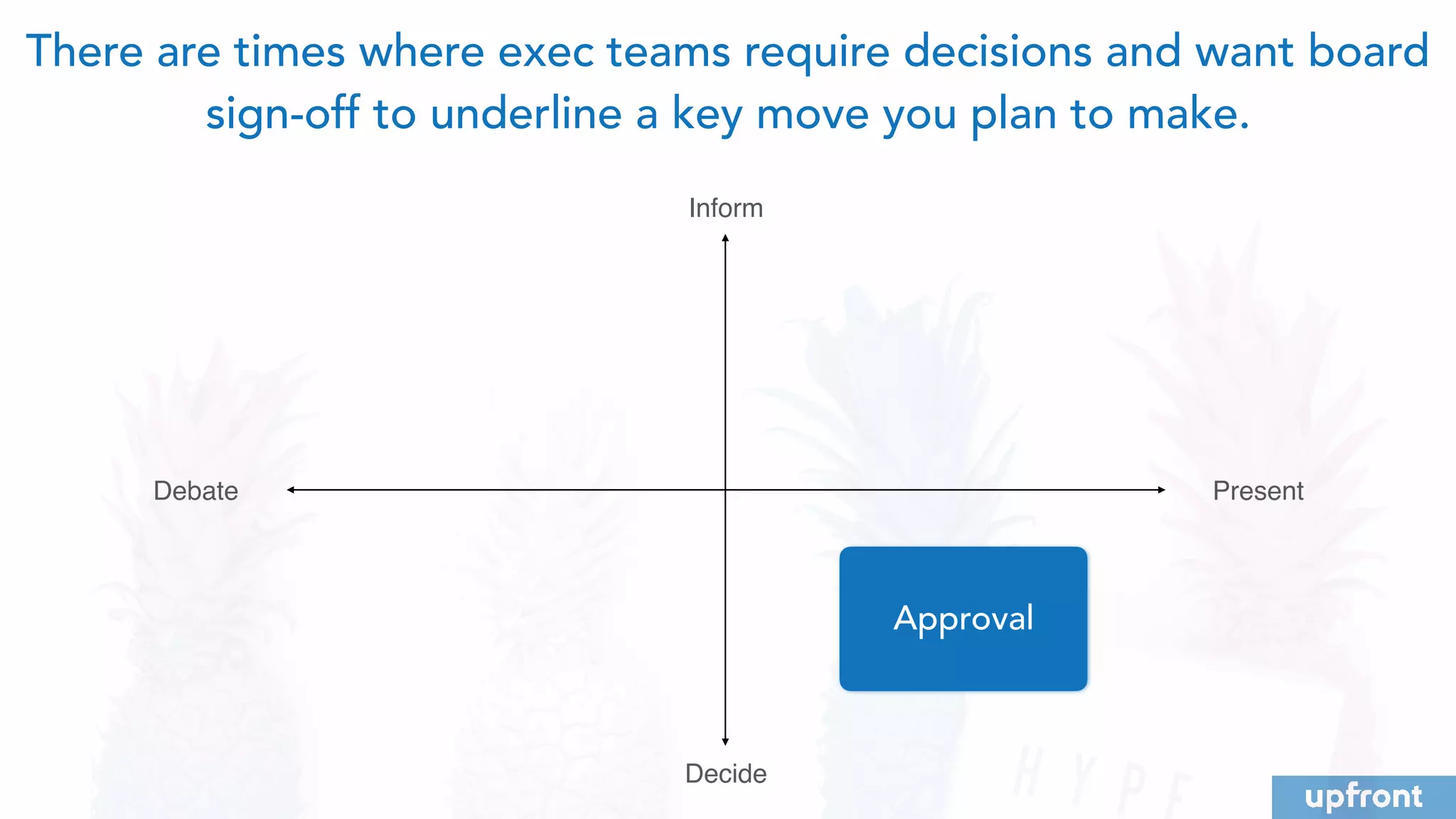
There are times where exec teams require decisions and want board
sign-off to underline a key move you plan to make.
Approval
• M&A
• Capital Raise
• Annual Budget
• Hire / Fire Critical Executives
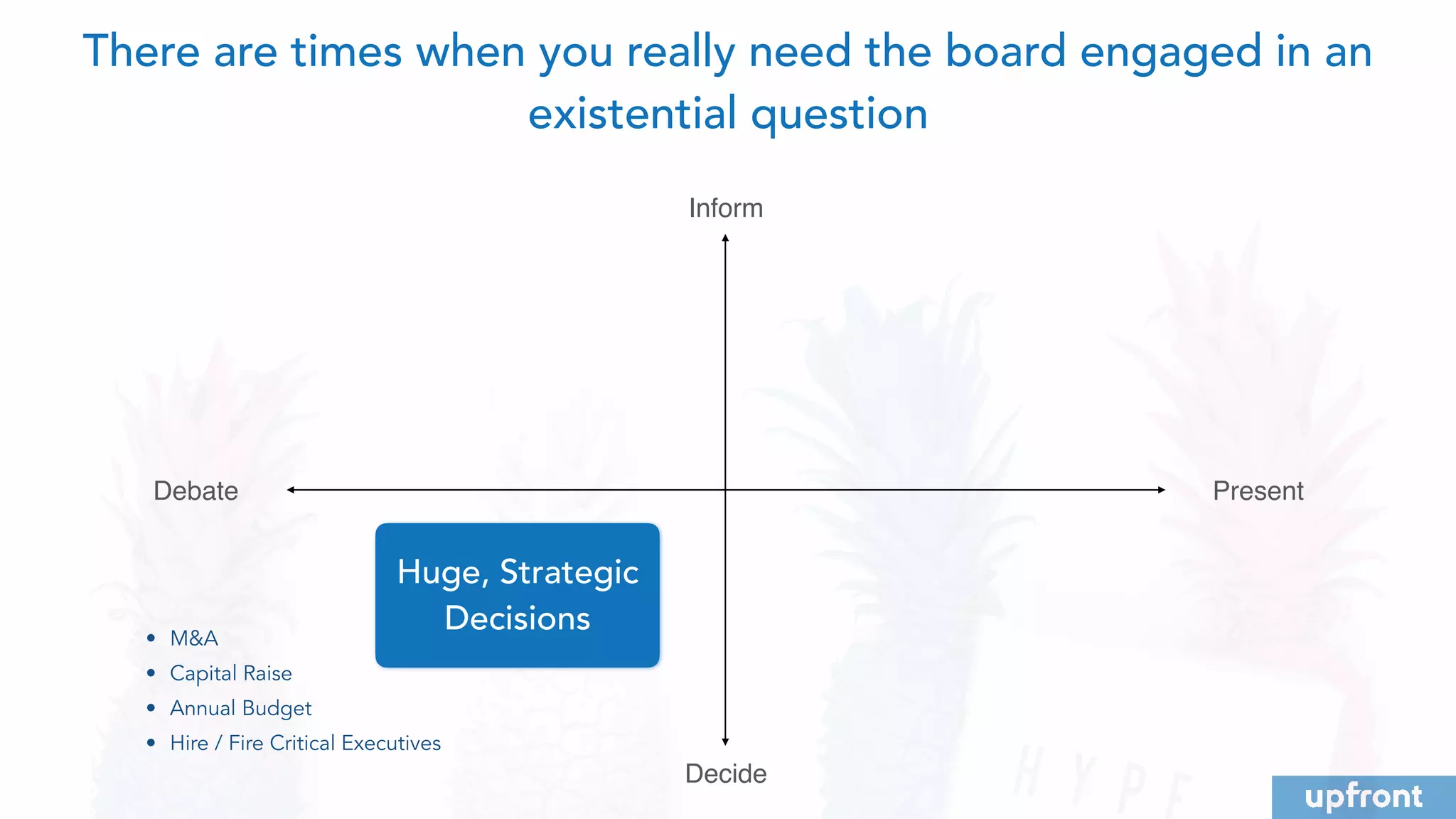
There are times when you really need the board engaged in an
existential question
PresentDebate
Inform
Decide
Huge, Strategic
Decisions
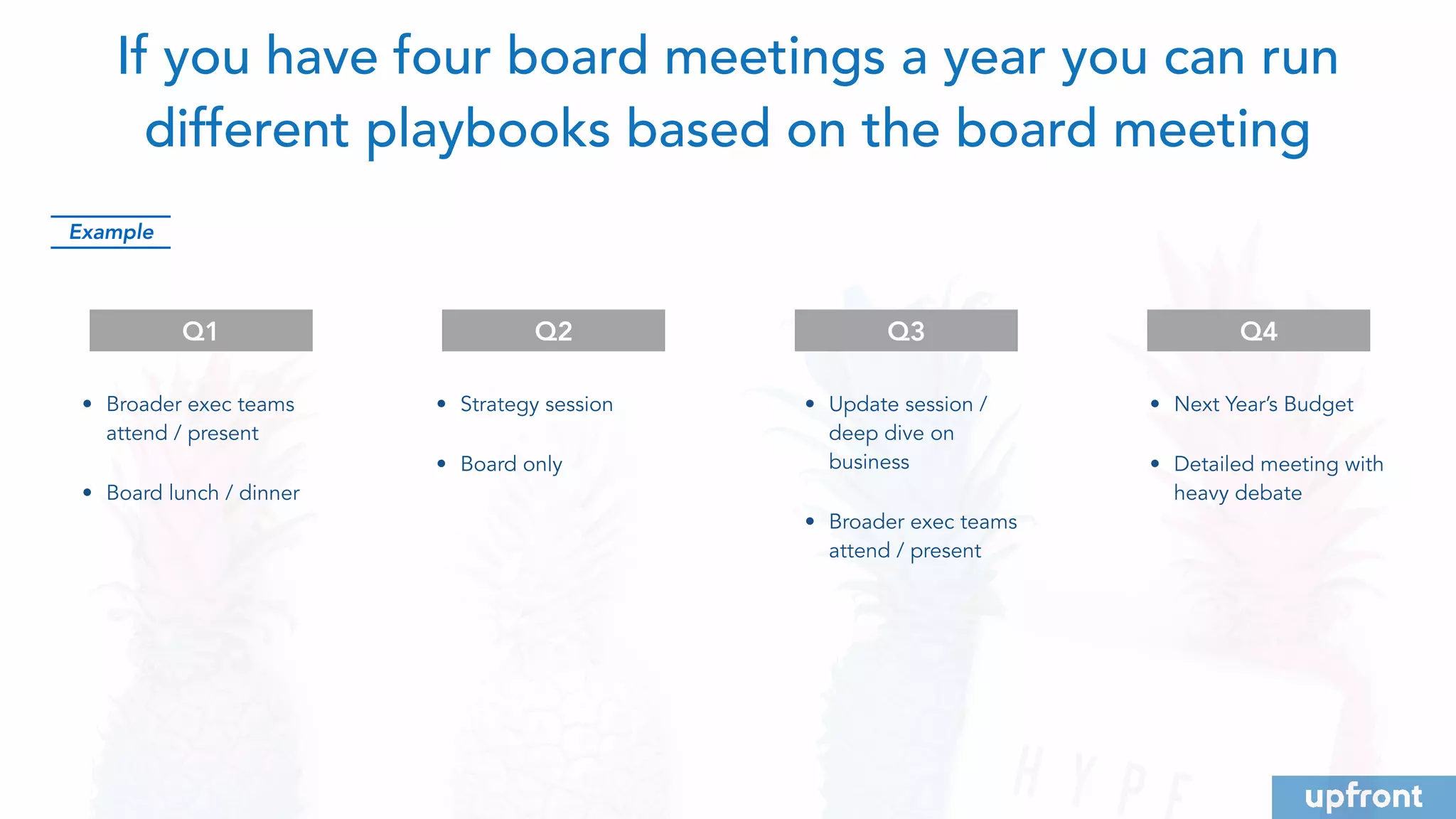
If you have four board meetings a year you can run
different playbooks based on the board meeting
Q2 Q3 Q4Q1
• Next Year’s Budget
• Detailed meeting with
heavy debate
• Broader exec teams
attend / present
• Board lunch / dinner
• Strategy session
• Board only
• Update session /
deep dive on
business
• Broader exec teams
attend / present
Example
Boards. At times your best
cheerleaders, coaches, mentors and
disappointed mom & dad.
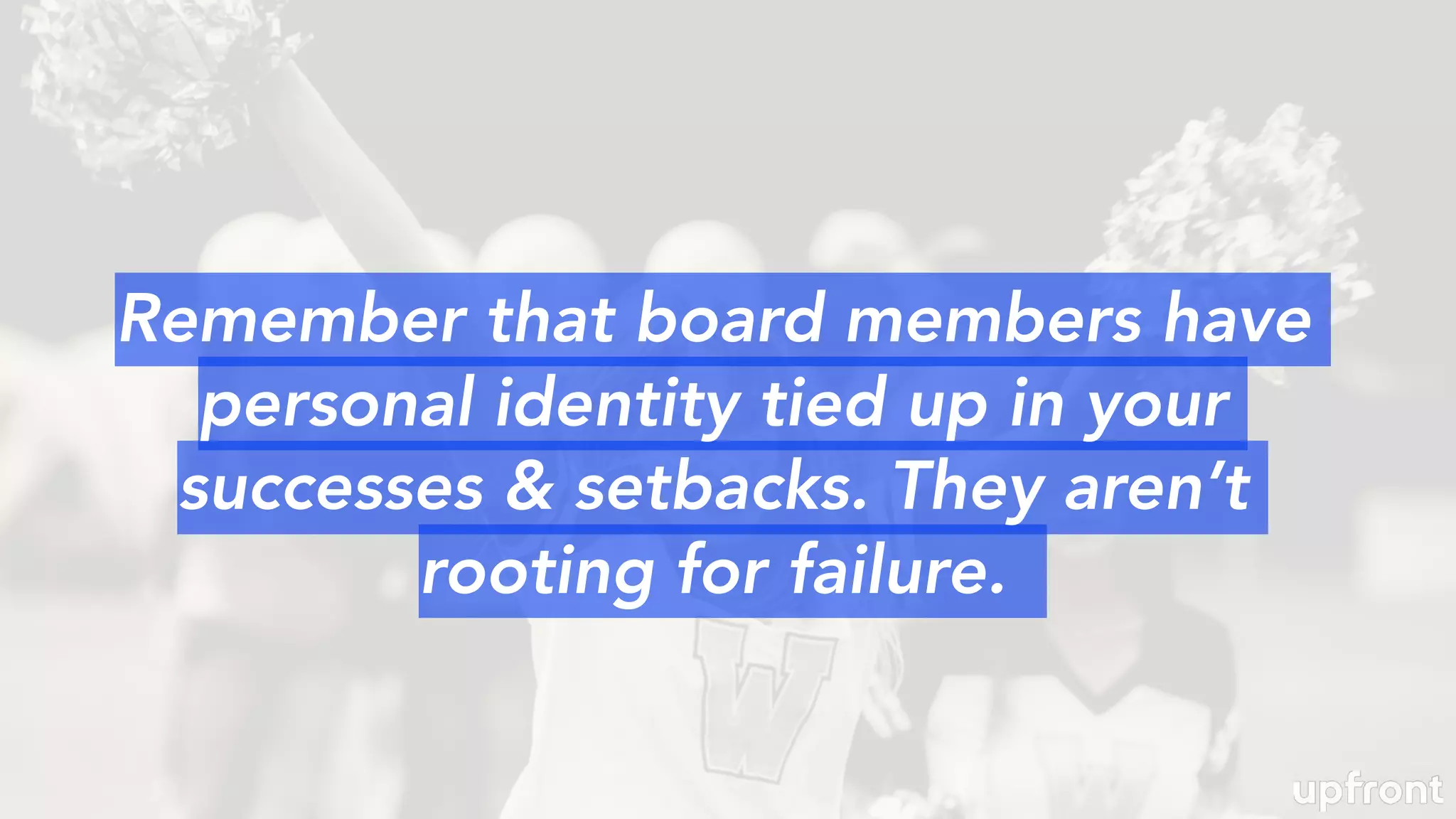
Remember that board members have
personal identity tied up in your
successes & setbacks. They aren’t
rooting for failure.
Photo by Brittany Simuangco on Unsplash41
But even your biggest
champions have oversight
responsibilities to encourage
what they ultimately believe
is right, which isn’t always
what you want to do.
If you proactively communicate
with and manage your board
you’re much more likely to
stay in sync.
!43
Mark Suster
Managing Partner,
Upfront Ventures
Managing Your
Startup Board
Thank You

Managing Your Startup Board

  • 1.
    !1 Mark Suster Managing Partner, UpfrontVentures Managing Your Startup Board
  • 2.
    Many entrepreneurs thinkabout boards in the traditional sense as providing “oversight” to their activities. Shareholders Board Executives 2
  • 3.
    3 And of coursethis is the legal & fiduciary role of a board Shareholders Board Executives }
  • 4.
    4 But if youwant to be truly effective as a founder you should think more about how YOU manage the BOARD. Board Executives Make your board an extended part of your executive team: super-connected, free interns.
  • 5.
    "I can alwaysget money. Where else can I get very connected and powerful people to do work for me?” !5 - Founder
  • 6.
    Photo by Brittany Simuangco on Unsplash6 Howboards initially see you - it’s a bit like new parents - it’s not adversarial at all • Unconditional love • A sense of responsibility • An important role in “oversight” • Define their own image by your success
  • 7.
    7 As you growwhat you think you should do & what the board thinks can diverge
  • 8.
    8 Ultimately it’s upto you to take appropriate risks - but you must then manage the board
  • 9.
    The Continuous Board Adifferent way to think about managing your board !9 Photo by Sasha • Stories on Unsplash
  • 10.
    Board meetings arehow most founders think about board interactions but they're actually the least valuable part of your board relationship
  • 11.
    A great boardis a highly-engaged group who knows your business intimately
  • 12.
    If you buildtrust they’re the only people you can share most sensitive decisions with
  • 13.
    Many founders treatboards as administration functions that solely receive quarterly updates. Let’s call this the “waterfall board.” Time Research Design Build Test Deploy Waterfall Software Development User Feedback Waterfall Board Q2 Q3 Q4 Q1 BOD Update BOD Update BOD Update BOD Update
  • 14.
    The “continuous board"approach involves more frequent interactions –  call / text / email at any time for quick input to iterate and course correct. Continuous involvement makes your board feel knowledgable & take ownership of decisions
  • 15.
  • 16.
    Each member ofa high functioning board… - Knows each other personally. Has a working relationship where they can resolve differences of opinions
  • 17.
    - Truly understandsthe underlying businesses. Knows strategy, execution & financial metrics Each member of a high functioning board… - Knows each other personally. Has a working relationship where they can resolve differences of opinions
  • 18.
    - Finds thisboard assignment important relative to their other time commitments Each member of a high functioning board… - Knows each other personally. Has a working relationship where they can resolve differences of opinions - Truly understands the underlying businesses. Knows strategy, execution & financial metrics
  • 19.
    - Doesn’t haveincentives that are misaligned with the company, its shareholders or other board members Each member of a high functioning board… - Knows each other personally. Has a working relationship where they can resolve differences of opinions - Truly understands the underlying businesses. Knows strategy, execution & financial metrics - Finds this board assignment important relative to their other time commitments
  • 20.
    - Knows it’shis or her fiduciary obligation to serve interests of the company first & foremost Each member of a high functioning board… - Knows each other personally. Has a working relationship where they can resolve differences of opinions - Truly understands the underlying businesses. Knows strategy, execution & financial metrics - Finds this board assignment important relative to their other time commitments - Doesn’t have incentives that are misaligned with the company, its shareholders or other board members
  • 21.
    Ultimately it’s inyour interest to invest in creating these working relationships - not just with you but amongst non-exec board members.
  • 22.
    A board thatknows and likes each other is more likely to resolve hard conflicts.
  • 23.
    • Schedule boardmeals / social time • Encourage non-exec board sessions • Help plan non-exec board calls Building relationships takes effort
  • 24.
  • 25.
    Source: Mark Suster,Both Sides of the Table Your board will increase over time and it’s highly likely you won’t retain a board majority (and that’s ok) Time Round Seed • 2 Founders • Maybe Seed Investor 3 Person D+ • 1-2 Founders • 3 VC Investors • 2 Independent • 1-2 Board Observers 7 Person B • 2 Founders • A + B Investor • 2 Independent or common 5 Person Founder Controlled Independent or Investor Controlled
  • 26.
    What makes agreat Independent Board Director? A Good Mentor Industry Experience Local Has Skin in the Game Time to Commit Startup Experience An Honest BrokerThere in Good Times & Bad Diplomatic Source: Mark Suster, Both Sides of the Table
  • 27.
  • 28.
    Photo by Pineapple SupplyCo. on Unsplash If you ask your board about your logo or brand colors, they will debate it for 30 minutes …if you do this, that’s on you

  • 29.
    Executive Management • Strategy,monthly budgets, hiring / firing, financial results • Sales, marketing, pricing, product, support, HR, finance It’s your job to “run the company” and not let your board micro-manage operations. It’s your job to keep board meetings “at board level.” Source: Mark Suster, Both Sides of the Table
  • 30.
    Executive Management Board ofDirectors • Strategy, monthly budgets, hiring / firing, financial results • Sales, marketing, pricing, product, support, HR, finance • Annual budget • Strategy & performance • Fund raising, M&A, audit, executive compensation • Exec team hiring / firing A board’s role is to provide oversight of the company on behalf of all shareholders. Source: Mark Suster, Both Sides of the Table
  • 31.
    Executive Management Board ofDirectors Investor Governance • Strategy, monthly budgets, hiring / firing, financial results • Sales, marketing, pricing, product, support, HR, finance • Annual budget • Strategy & performance • Fund raising, M&A, audit, executive compensation • Exec team hiring / firing • Fund raising, M&A, debt • Scope and structure of business Some key decisions also require approval from shareholder groups, beyond board approval. Source: Mark Suster, Both Sides of the Table
  • 32.
    PresentDebate In thinking abouthow to run any individual board meeting it’s important that you understand what you’re trying to achieve Of course each meeting can be a combination of both activities
  • 33.
    Inform Decide It’s equally importantthat you know your goal for the meeting. Are you seeking to make major decisions or to align board members? Not every board meeting requires a big decision to be made
  • 34.
    PresentDebate Inform Decide Filibuster A common mistakeis to spend BOD meeting presenting more materials than a group can digest.
  • 35.
    A better useof time is to debate the most strategic topics being weighed by the exec team, tapping your directors’ collective wisdom. PresentDebate Inform Decide Advice
  • 36.
    PresentDebate Inform Decide There are timeswhere exec teams require decisions and want board sign-off to underline a key move you plan to make. Approval
  • 37.
    • M&A • CapitalRaise • Annual Budget • Hire / Fire Critical Executives There are times when you really need the board engaged in an existential question PresentDebate Inform Decide Huge, Strategic Decisions
  • 38.
    If you havefour board meetings a year you can run different playbooks based on the board meeting Q2 Q3 Q4Q1 • Next Year’s Budget • Detailed meeting with heavy debate • Broader exec teams attend / present • Board lunch / dinner • Strategy session • Board only • Update session / deep dive on business • Broader exec teams attend / present Example
  • 39.
    Boards. At timesyour best cheerleaders, coaches, mentors and disappointed mom & dad.
  • 40.
    Remember that boardmembers have personal identity tied up in your successes & setbacks. They aren’t rooting for failure.
  • 41.
    Photo by Brittany Simuangco on Unsplash41 Buteven your biggest champions have oversight responsibilities to encourage what they ultimately believe is right, which isn’t always what you want to do.
  • 42.
    If you proactivelycommunicate with and manage your board you’re much more likely to stay in sync.
  • 43.
    !43 Mark Suster Managing Partner, UpfrontVentures Managing Your Startup Board Thank You