Presentation to ACS
2014 Technology and IT Conference
Sydney International Airport
24th March 2014
Working with your outsourcer –
What are the roles and responsibilities of
the various parties
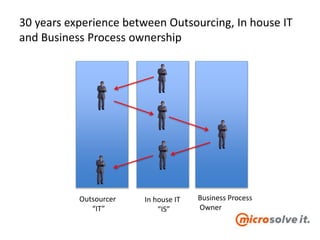
30 years experience between Outsourcing, In house IT
and Business Process ownership
Outsourcer
“IT”
In house IT
“IS”
Business Process
Owner
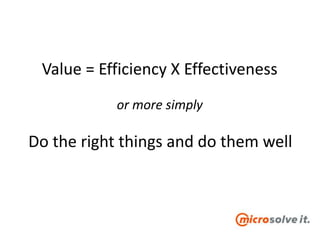
Value = Efficiency X Effectiveness
or more simply
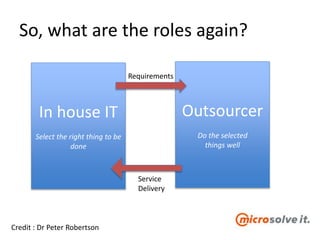
Do the right things and do them well
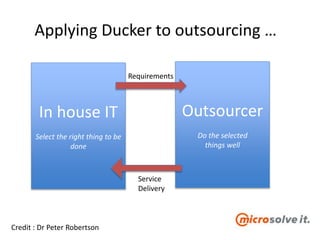
Applying Ducker to outsourcing …
Credit : Dr Peter Robertson
Outsourcer
Do the selected
things well
In house IT
Select the right thing to be
done
Requirements
Service
Delivery
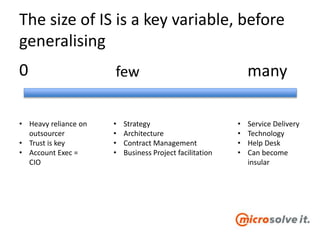
The size of IS is a key variable, before
generalising
0 many
• Heavy reliance on
outsourcer
• Trust is key
• Account Exec =
CIO
• Service Delivery
• Technology
• Help Desk
• Can become
insular
• Strategy
• Architecture
• Contract Management
• Business Project facilitation
few
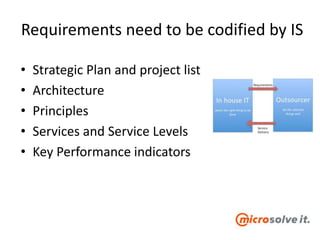
Requirements need to be codified by IS
• Strategic Plan and project list
• Architecture
• Principles
• Services and Service Levels
• Key Performance indicators
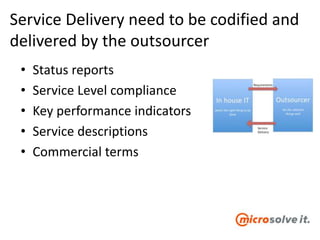
Service Delivery need to be codified and
delivered by the outsourcer
• Status reports
• Service Level compliance
• Key performance indicators
• Service descriptions
• Commercial terms
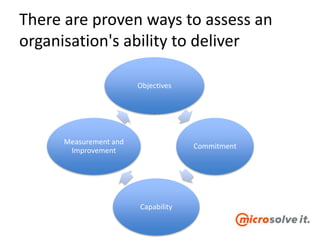
There are proven ways to assess an
organisation's ability to deliver
Objectives
Commitment
Capability
Measurement and
Improvement
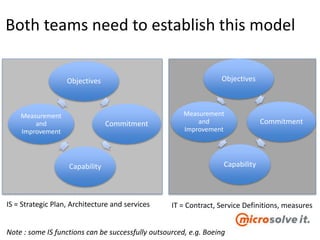
Both teams need to establish this model
Objectives
Commitment
Capability
Measurement
and
Improvement
Objectives
Commitment
Capability
Measurement
and
Improvement
IS = Strategic Plan, Architecture and services IT = Contract, Service Definitions, measures
Note : some IS functions can be successfully outsourced, e.g. Boeing
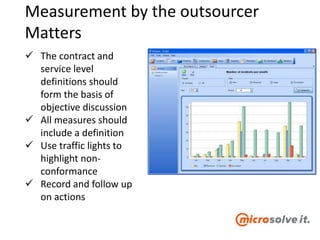
Measurement by the outsourcer
Matters
 The contract and
service level
definitions should
form the basis of
objective discussion
 All measures should
include a definition
 Use traffic lights to
highlight non-
conformance
 Record and follow up
on actions
Service Level Compliance on it’s own
can let you down
Outsourcer :
“100% SLA compliance this month for the 5th month in a
row, we should celebrate”
Customer :
“we hate you, you are not innovative, you do not
support Windows8 on my phone and our applications
are rubbish”
What is in the contract, what are the real objectives?
Use Customer Satisfaction Surveys,
driven by IS carefully
• Ask the end customer are they happy with their
computing ( the sum total of IS and IT )
• Ask why or why not
• Process the answers thoroughly
– “my computing experience is poor as I am not allowed
to have dual monitors”
– “my terminal freezes regularly” ( yet uptime is high )
– The application crashes if I enter >100 characters ( the
outsourcer may have no control over the app )
Service Improvement Plans – a joint
responsibility
• A Service Improvement Plan can be called for by any
party
• Improvement areas are agreed
• “Completion criteria” are agreed
• Funding is agreed
• Work is thoroughly governed
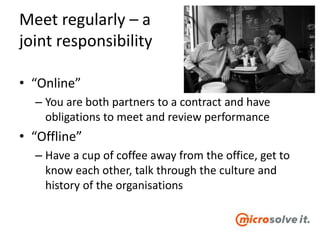
Meet regularly – a
joint responsibility
• “Online”
– You are both partners to a contract and have
obligations to meet and review performance
• “Offline”
– Have a cup of coffee away from the office, get to
know each other, talk through the culture and
history of the organisations
Other Useful tools
• RACI – Responsible, Accountable, Contributor,
Information
• Swim lanes
• Service Charter
• Service Definitions
• Team building
• Cross pollination
So, what are the roles again?
Credit : Dr Peter Robertson
Outsourcer
Do the selected
things well
In house IT
Select the right thing to be
done
Requirements
Service
Delivery
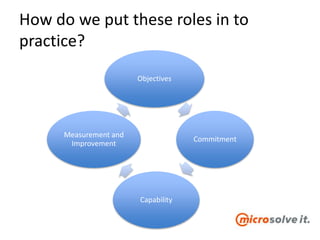
How do we put these roles in to
practice?
Objectives
Commitment
Capability
Measurement and
Improvement
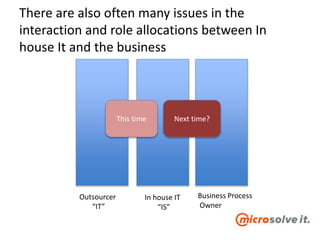
There are also often many issues in the
interaction and role allocations between In
house It and the business
Outsourcer
“IT”
In house IT
“IS”
Business Process
Owner
This time Next time?
thanks ...

Managing Your Outsourcer

  • 1.
    Presentation to ACS 2014Technology and IT Conference Sydney International Airport 24th March 2014 Working with your outsourcer – What are the roles and responsibilities of the various parties
  • 2.
    30 years experiencebetween Outsourcing, In house IT and Business Process ownership Outsourcer “IT” In house IT “IS” Business Process Owner
  • 4.
    Value = EfficiencyX Effectiveness or more simply Do the right things and do them well
  • 5.
    Applying Ducker tooutsourcing … Credit : Dr Peter Robertson Outsourcer Do the selected things well In house IT Select the right thing to be done Requirements Service Delivery
  • 6.
    The size ofIS is a key variable, before generalising 0 many • Heavy reliance on outsourcer • Trust is key • Account Exec = CIO • Service Delivery • Technology • Help Desk • Can become insular • Strategy • Architecture • Contract Management • Business Project facilitation few
  • 7.
    Requirements need tobe codified by IS • Strategic Plan and project list • Architecture • Principles • Services and Service Levels • Key Performance indicators
  • 8.
    Service Delivery needto be codified and delivered by the outsourcer • Status reports • Service Level compliance • Key performance indicators • Service descriptions • Commercial terms
  • 9.
    There are provenways to assess an organisation's ability to deliver Objectives Commitment Capability Measurement and Improvement
  • 10.
    Both teams needto establish this model Objectives Commitment Capability Measurement and Improvement Objectives Commitment Capability Measurement and Improvement IS = Strategic Plan, Architecture and services IT = Contract, Service Definitions, measures Note : some IS functions can be successfully outsourced, e.g. Boeing
  • 11.
    Measurement by theoutsourcer Matters  The contract and service level definitions should form the basis of objective discussion  All measures should include a definition  Use traffic lights to highlight non- conformance  Record and follow up on actions
  • 12.
    Service Level Complianceon it’s own can let you down Outsourcer : “100% SLA compliance this month for the 5th month in a row, we should celebrate” Customer : “we hate you, you are not innovative, you do not support Windows8 on my phone and our applications are rubbish” What is in the contract, what are the real objectives?
  • 13.
    Use Customer SatisfactionSurveys, driven by IS carefully • Ask the end customer are they happy with their computing ( the sum total of IS and IT ) • Ask why or why not • Process the answers thoroughly – “my computing experience is poor as I am not allowed to have dual monitors” – “my terminal freezes regularly” ( yet uptime is high ) – The application crashes if I enter >100 characters ( the outsourcer may have no control over the app )
  • 14.
    Service Improvement Plans– a joint responsibility • A Service Improvement Plan can be called for by any party • Improvement areas are agreed • “Completion criteria” are agreed • Funding is agreed • Work is thoroughly governed
  • 15.
    Meet regularly –a joint responsibility • “Online” – You are both partners to a contract and have obligations to meet and review performance • “Offline” – Have a cup of coffee away from the office, get to know each other, talk through the culture and history of the organisations
  • 16.
    Other Useful tools •RACI – Responsible, Accountable, Contributor, Information • Swim lanes • Service Charter • Service Definitions • Team building • Cross pollination
  • 17.
    So, what arethe roles again? Credit : Dr Peter Robertson Outsourcer Do the selected things well In house IT Select the right thing to be done Requirements Service Delivery
  • 18.
    How do weput these roles in to practice? Objectives Commitment Capability Measurement and Improvement
  • 19.
    There are alsooften many issues in the interaction and role allocations between In house It and the business Outsourcer “IT” In house IT “IS” Business Process Owner This time Next time?
  • 20.