Best Practices and Key Considerations in Auditing “
IT Suppliers”

Shankar Subramaniyan
ISACA Greater Houston Chapter
August 15,2013
Agenda
• Provide an overview on the “Suppliers”” environment
• ISACA Guideline for Auditing Outsourced Environment
• Discuss Key considerations/best practices
Dependency on IT SUPPLIERS
21st Century is ushering in a new kind of company…

The complex product markets of the 21st Century will demand the ability to quickly and
globally deliver a high variety of customized products. The products will be differentiated
not only by form and function but also by the services provided with the product including
the ability of the customer to be involved in the design of the product…A company will not
be an isolated facility of production, but rather a node in a complex network of suppliers,
customers, engineering and other service functions.
-William Davidow & Michael Malone
The Virtual Corporation

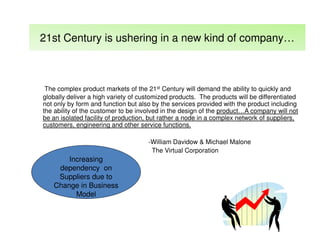
Increasing
dependency on
Suppliers due to
Change in Business
Model
Technology Changes

•
•
•

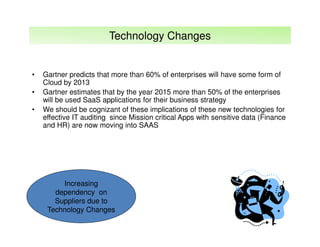
Gartner predicts that more than 60% of enterprises will have some form of
Cloud by 2013
Gartner estimates that by the year 2015 more than 50% of the enterprises
will be used SaaS applications for their business strategy
We should be cognizant of these implications of these new technologies for
effective IT auditing since Mission critical Apps with sensitive data (Finance
and HR) are now moving into SAAS

Increasing
dependency on
Suppliers due to
Technology Changes
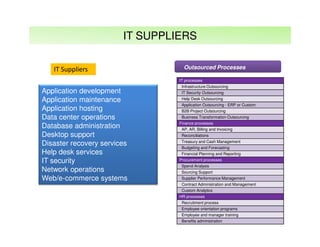
IT SUPPLIERS
IT Suppliers

Outsourced Processes
IT processes

Application development
Application maintenance
Application hosting
Data center operations
Database administration
Desktop support
Disaster recovery services
Help desk services
IT security
Network operations
Web/e-commerce systems

Infrastructure Outsourcing
IT Security Outsourcing
Help Desk Outsourcing
Application Outsourcing - ERP or Custom
B2B Project Outsourcing
Business Transformation Outsourcing
Finance processes
AP, AR, Billing and Invoicing
Reconciliations
Treasury and Cash Management
Budgeting and Forecasting
Financial Planning and Reporting
Procurement processes
Spend Analysis
Sourcing Support
Supplier Performance Management
Contract Administration and Management
Custom Analytics
HR processes
Recruitment process
Employee orientation programs
Employee and manager training
Benefits administration
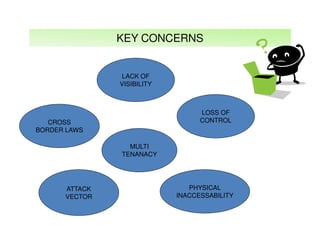
KEY CONCERNS

LACK OF
VISIBILITY

LOSS OF
CONTROL

CROSS
BORDER LAWS
MULTI
TENANACY

ATTACK
VECTOR

PHYSICAL
INACCESSABILITY
ISACA Outsourcing Audit Guideline

www.isaca.org/Outsourced-IT-AP
Scope
•
•
•
•
•
•

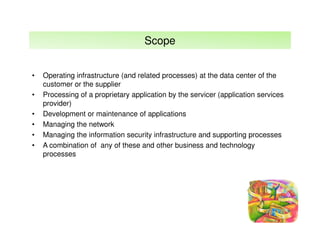
Operating infrastructure (and related processes) at the data center of the
customer or the supplier
Processing of a proprietary application by the servicer (application services
provider)
Development or maintenance of applications
Managing the network
Managing the information security infrastructure and supporting processes
A combination of any of these and other business and technology
processes
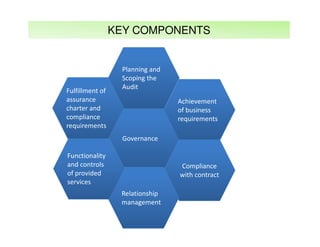
KEY COMPONENTS

Fulfillment of
assurance
charter and
compliance
requirements

Planning and
Scoping the
Audit
Achievement
of business
requirements
Governance

Functionality
and controls
of provided
services

Compliance
with contract
Relationship
management
Planning and Scoping the Audit
Audit Planning

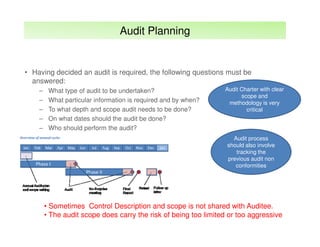
• Having decided an audit is required, the following questions must be
answered:
–
–
–
–
–

What type of audit to be undertaken?
What particular information is required and by when?
To what depth and scope audit needs to be done?
On what dates should the audit be done?
Who should perform the audit?

Audit Charter with clear
scope and
methodology is very
critical

Audit process
should also involve
tracking the
previous audit non
conformities

• Sometimes Control Description and scope is not shared with Auditee.
• The audit scope does carry the risk of being too limited or too aggressive
Key Considerations in Audit Planning
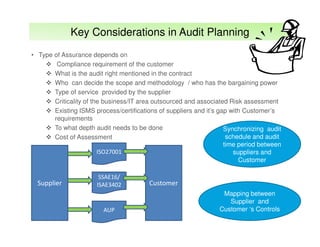
• Type of Assurance depends on
Compliance requirement of the customer
What is the audit right mentioned in the contract
Who can decide the scope and methodology / who has the bargaining power
Type of service provided by the supplier
Criticality of the business/IT area outsourced and associated Risk assessment
Existing ISMS process/certifications of suppliers and it’s gap with Customer’s
requirements
To what depth audit needs to be done
Synchronizing audit
schedule and audit
Cost of Assessment
time period between
ISO27001
suppliers and
Customer

Supplier

SSAE16/
ISAE3402

AUP

Customer
Mapping between
Supplier and
Customer ‘s Controls
Overcoming Resistance to Audit

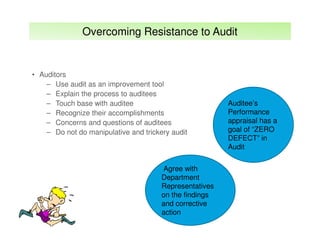
• Auditors
– Use audit as an improvement tool
– Explain the process to auditees
– Touch base with auditee
– Recognize their accomplishments
– Concerns and questions of auditees
– Do not do manipulative and trickery audit

Agree with
Department
Representatives
on the findings
and corrective
action

Auditee’s
Performance
appraisal has a
goal of “ZERO
DEFECT” in
Audit
Achievement of business requirements
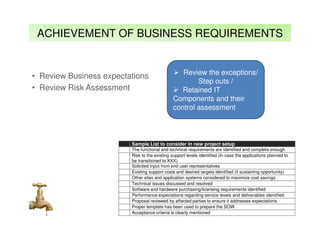
ACHIEVEMENT OF BUSINESS REQUIREMENTS

• Review Business expectations
• Review Risk Assessment

Review the exceptions/
Step outs /
Retained IT
Components and their
control assessment

Sample List to consider in new project setup
The functional and technical requirements are identified and complete enough
Risk to the existing support levels identified (In case the applications planned to
be transitioned to XXX)
Solicited input from end user representatives
Existing support costs and desired targets identified (if sustaining opportunity)
Other sites and application systems considered to maximize cost savings
Technical issues discussed and resolved
Software and hardware purchasing/licensing requirements identified
Performance expectations regarding service levels and deliverables identified
Proposal reviewed by affected parties to ensure it addresses expectations
Proper template has been used to prepare the SOW
Acceptance criteria is clearly mentioned
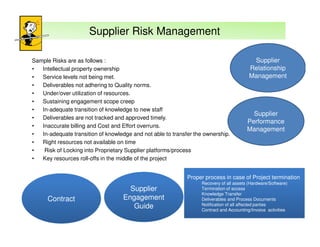
Supplier Risk Management
Sample Risks are as follows :
•
Intellectual property ownership
•
Service levels not being met.
•
Deliverables not adhering to Quality norms.
•
Under/over utilization of resources.
•
Sustaining engagement scope creep
•
In-adequate transition of knowledge to new staff
•
Deliverables are not tracked and approved timely.
•
Inaccurate billing and Cost and Effort overruns.
•
In-adequate transition of knowledge and not able to transfer the ownership.
•
Right resources not available on time
•
Risk of Locking into Proprietary Supplier platforms/process
•
Key resources roll-offs in the middle of the project

Supplier
Relationship
Management

Supplier
Performance
Management

Proper process in case of Project termination

Contract

Supplier
Engagement
Guide

Recovery of all assets (Hardware/Software)
Termination of access
Knowledge Transfer
Deliverables and Process Documents
Notification of all affected parties
Contract and Accounting/Invoice activities
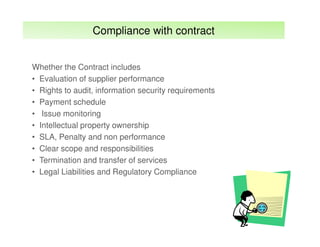
Compliance with contract
Whether the Contract includes
• Evaluation of supplier performance
• Rights to audit, information security requirements
• Payment schedule
• Issue monitoring
• Intellectual property ownership
• SLA, Penalty and non performance
• Clear scope and responsibilities
• Termination and transfer of services
• Legal Liabilities and Regulatory Compliance
Relationship management
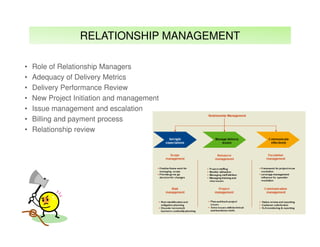
RELATIONSHIP MANAGEMENT
•
•
•
•
•
•
•

Role of Relationship Managers
Adequacy of Delivery Metrics
Delivery Performance Review
New Project Initiation and management
Issue management and escalation
Billing and payment process
Relationship review
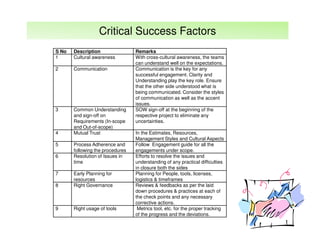
Critical Success Factors
S No
1

Description
Cultural awareness

2

Communication

3

Common Understanding
and sign-off on
Requirements (In-scope
and Out-of-scope)
Mutual Trust

4
5
6

7

Process Adherence and
following the procedures
Resolution of Issues in
time

8

Early Planning for
resources
Right Governance

9

Right usage of tools

Remarks
With cross-cultural awareness, the teams
can understand well on the expectations.
Communication is the key for any
successful engagement. Clarity and
Understanding play the key role. Ensure
that the other side understood what is
being communicated. Consider the styles
of communication as well as the accent
issues.
SOW sign-off at the beginning of the
respective project to eliminate any
uncertainties.
In the Estimates, Resources,
Management Styles and Cultural Aspects
Follow Engagement guide for all the
engagements under scope.
Efforts to resolve the issues and
understanding of any practical difficulties
in closure both the sides
Planning for People, tools, licenses,
logistics & timeframes
Reviews & feedbacks as per the laid
down procedures & practices at each of
the check points and any necessary
corrective actions.
Metrics tool, etc. for the proper tracking
of the progress and the deviations.
Functionality and controls of provided
services
Functionality and controls of provided services

•
•
•
•

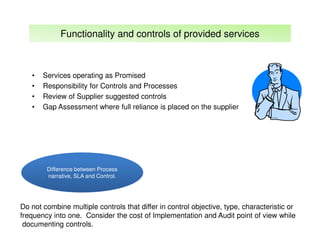
Services operating as Promised
Responsibility for Controls and Processes
Review of Supplier suggested controls
Gap Assessment where full reliance is placed on the supplier

Difference between Process
narrative, SLA and Control.

Do not combine multiple controls that differ in control objective, type, characteristic or
frequency into one. Consider the cost of Implementation and Audit point of view while
documenting controls.
Fulfillment of assurance charter and
compliance requirements

Operational responsibility might
have got transferred to Supplier,
but legal and regulatory
responsibility will still be with
Customer
Fulfillment of assurance charter and compliance requirements

•
•
•

•
•

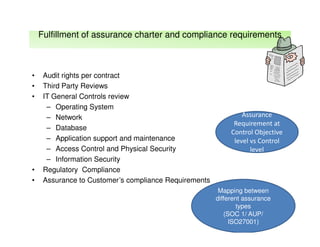
Audit rights per contract
Third Party Reviews
IT General Controls review
– Operating System
– Network
– Database
– Application support and maintenance
– Access Control and Physical Security
– Information Security
Regulatory Compliance
Assurance to Customer’s compliance Requirements

Assurance
Requirement at
Control Objective
level vs Control
level

Mapping between
different assurance
types
(SOC 1/ AUP/
ISO27001)
Audit points in Third Party reviews

•

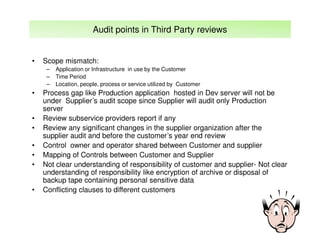
Scope mismatch:
–
–
–

•

•
•
•
•
•

•

Application or Infrastructure in use by the Customer
Time Period
Location, people, process or service utilized by Customer

Process gap like Production application hosted in Dev server will not be
under Supplier’s audit scope since Supplier will audit only Production
server
Review subservice providers report if any
Review any significant changes in the supplier organization after the
supplier audit and before the customer’s year end review
Control owner and operator shared between Customer and supplier
Mapping of Controls between Customer and Supplier
Not clear understanding of responsibility of customer and supplier- Not clear
understanding of responsibility like encryption of archive or disposal of
backup tape containing personal sensitive data
Conflicting clauses to different customers
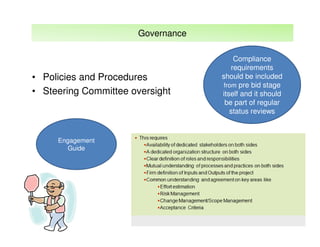
Governance
Governance

• Policies and Procedures
• Steering Committee oversight

Engagement
Guide

Compliance
requirements
should be included
from pre bid stage
itself and it should
be part of regular
status reviews
SUMMARY

•
•
•
•

Supplier Risk Management
Contract Management
Supplier Performance monitoring
Relationship Management
What is the Role of IT Auditor ?

Thank You

Best Practices & Considerations in “IT Suppliers Audit”

  • 1.
    Best Practices andKey Considerations in Auditing “ IT Suppliers” Shankar Subramaniyan ISACA Greater Houston Chapter August 15,2013
  • 2.
    Agenda • Provide anoverview on the “Suppliers”” environment • ISACA Guideline for Auditing Outsourced Environment • Discuss Key considerations/best practices
  • 3.
  • 4.
    21st Century isushering in a new kind of company… The complex product markets of the 21st Century will demand the ability to quickly and globally deliver a high variety of customized products. The products will be differentiated not only by form and function but also by the services provided with the product including the ability of the customer to be involved in the design of the product…A company will not be an isolated facility of production, but rather a node in a complex network of suppliers, customers, engineering and other service functions. -William Davidow & Michael Malone The Virtual Corporation Increasing dependency on Suppliers due to Change in Business Model
  • 5.
    Technology Changes • • • Gartner predictsthat more than 60% of enterprises will have some form of Cloud by 2013 Gartner estimates that by the year 2015 more than 50% of the enterprises will be used SaaS applications for their business strategy We should be cognizant of these implications of these new technologies for effective IT auditing since Mission critical Apps with sensitive data (Finance and HR) are now moving into SAAS Increasing dependency on Suppliers due to Technology Changes
  • 6.
    IT SUPPLIERS IT Suppliers OutsourcedProcesses IT processes Application development Application maintenance Application hosting Data center operations Database administration Desktop support Disaster recovery services Help desk services IT security Network operations Web/e-commerce systems Infrastructure Outsourcing IT Security Outsourcing Help Desk Outsourcing Application Outsourcing - ERP or Custom B2B Project Outsourcing Business Transformation Outsourcing Finance processes AP, AR, Billing and Invoicing Reconciliations Treasury and Cash Management Budgeting and Forecasting Financial Planning and Reporting Procurement processes Spend Analysis Sourcing Support Supplier Performance Management Contract Administration and Management Custom Analytics HR processes Recruitment process Employee orientation programs Employee and manager training Benefits administration
  • 7.
    KEY CONCERNS LACK OF VISIBILITY LOSSOF CONTROL CROSS BORDER LAWS MULTI TENANACY ATTACK VECTOR PHYSICAL INACCESSABILITY
  • 8.
    ISACA Outsourcing AuditGuideline www.isaca.org/Outsourced-IT-AP
  • 10.
    Scope • • • • • • Operating infrastructure (andrelated processes) at the data center of the customer or the supplier Processing of a proprietary application by the servicer (application services provider) Development or maintenance of applications Managing the network Managing the information security infrastructure and supporting processes A combination of any of these and other business and technology processes
  • 11.
    KEY COMPONENTS Fulfillment of assurance charterand compliance requirements Planning and Scoping the Audit Achievement of business requirements Governance Functionality and controls of provided services Compliance with contract Relationship management
  • 12.
  • 13.
    Audit Planning • Havingdecided an audit is required, the following questions must be answered: – – – – – What type of audit to be undertaken? What particular information is required and by when? To what depth and scope audit needs to be done? On what dates should the audit be done? Who should perform the audit? Audit Charter with clear scope and methodology is very critical Audit process should also involve tracking the previous audit non conformities • Sometimes Control Description and scope is not shared with Auditee. • The audit scope does carry the risk of being too limited or too aggressive
  • 14.
    Key Considerations inAudit Planning • Type of Assurance depends on Compliance requirement of the customer What is the audit right mentioned in the contract Who can decide the scope and methodology / who has the bargaining power Type of service provided by the supplier Criticality of the business/IT area outsourced and associated Risk assessment Existing ISMS process/certifications of suppliers and it’s gap with Customer’s requirements To what depth audit needs to be done Synchronizing audit schedule and audit Cost of Assessment time period between ISO27001 suppliers and Customer Supplier SSAE16/ ISAE3402 AUP Customer Mapping between Supplier and Customer ‘s Controls
  • 15.
    Overcoming Resistance toAudit • Auditors – Use audit as an improvement tool – Explain the process to auditees – Touch base with auditee – Recognize their accomplishments – Concerns and questions of auditees – Do not do manipulative and trickery audit Agree with Department Representatives on the findings and corrective action Auditee’s Performance appraisal has a goal of “ZERO DEFECT” in Audit
  • 16.
  • 17.
    ACHIEVEMENT OF BUSINESSREQUIREMENTS • Review Business expectations • Review Risk Assessment Review the exceptions/ Step outs / Retained IT Components and their control assessment Sample List to consider in new project setup The functional and technical requirements are identified and complete enough Risk to the existing support levels identified (In case the applications planned to be transitioned to XXX) Solicited input from end user representatives Existing support costs and desired targets identified (if sustaining opportunity) Other sites and application systems considered to maximize cost savings Technical issues discussed and resolved Software and hardware purchasing/licensing requirements identified Performance expectations regarding service levels and deliverables identified Proposal reviewed by affected parties to ensure it addresses expectations Proper template has been used to prepare the SOW Acceptance criteria is clearly mentioned
  • 18.
    Supplier Risk Management SampleRisks are as follows : • Intellectual property ownership • Service levels not being met. • Deliverables not adhering to Quality norms. • Under/over utilization of resources. • Sustaining engagement scope creep • In-adequate transition of knowledge to new staff • Deliverables are not tracked and approved timely. • Inaccurate billing and Cost and Effort overruns. • In-adequate transition of knowledge and not able to transfer the ownership. • Right resources not available on time • Risk of Locking into Proprietary Supplier platforms/process • Key resources roll-offs in the middle of the project Supplier Relationship Management Supplier Performance Management Proper process in case of Project termination Contract Supplier Engagement Guide Recovery of all assets (Hardware/Software) Termination of access Knowledge Transfer Deliverables and Process Documents Notification of all affected parties Contract and Accounting/Invoice activities
  • 19.
  • 20.
    Compliance with contract Whetherthe Contract includes • Evaluation of supplier performance • Rights to audit, information security requirements • Payment schedule • Issue monitoring • Intellectual property ownership • SLA, Penalty and non performance • Clear scope and responsibilities • Termination and transfer of services • Legal Liabilities and Regulatory Compliance
  • 21.
  • 22.
    RELATIONSHIP MANAGEMENT • • • • • • • Role ofRelationship Managers Adequacy of Delivery Metrics Delivery Performance Review New Project Initiation and management Issue management and escalation Billing and payment process Relationship review
  • 23.
    Critical Success Factors SNo 1 Description Cultural awareness 2 Communication 3 Common Understanding and sign-off on Requirements (In-scope and Out-of-scope) Mutual Trust 4 5 6 7 Process Adherence and following the procedures Resolution of Issues in time 8 Early Planning for resources Right Governance 9 Right usage of tools Remarks With cross-cultural awareness, the teams can understand well on the expectations. Communication is the key for any successful engagement. Clarity and Understanding play the key role. Ensure that the other side understood what is being communicated. Consider the styles of communication as well as the accent issues. SOW sign-off at the beginning of the respective project to eliminate any uncertainties. In the Estimates, Resources, Management Styles and Cultural Aspects Follow Engagement guide for all the engagements under scope. Efforts to resolve the issues and understanding of any practical difficulties in closure both the sides Planning for People, tools, licenses, logistics & timeframes Reviews & feedbacks as per the laid down procedures & practices at each of the check points and any necessary corrective actions. Metrics tool, etc. for the proper tracking of the progress and the deviations.
  • 24.
    Functionality and controlsof provided services
  • 25.
    Functionality and controlsof provided services • • • • Services operating as Promised Responsibility for Controls and Processes Review of Supplier suggested controls Gap Assessment where full reliance is placed on the supplier Difference between Process narrative, SLA and Control. Do not combine multiple controls that differ in control objective, type, characteristic or frequency into one. Consider the cost of Implementation and Audit point of view while documenting controls.
  • 26.
    Fulfillment of assurancecharter and compliance requirements Operational responsibility might have got transferred to Supplier, but legal and regulatory responsibility will still be with Customer
  • 27.
    Fulfillment of assurancecharter and compliance requirements • • • • • Audit rights per contract Third Party Reviews IT General Controls review – Operating System – Network – Database – Application support and maintenance – Access Control and Physical Security – Information Security Regulatory Compliance Assurance to Customer’s compliance Requirements Assurance Requirement at Control Objective level vs Control level Mapping between different assurance types (SOC 1/ AUP/ ISO27001)
  • 28.
    Audit points inThird Party reviews • Scope mismatch: – – – • • • • • • • Application or Infrastructure in use by the Customer Time Period Location, people, process or service utilized by Customer Process gap like Production application hosted in Dev server will not be under Supplier’s audit scope since Supplier will audit only Production server Review subservice providers report if any Review any significant changes in the supplier organization after the supplier audit and before the customer’s year end review Control owner and operator shared between Customer and supplier Mapping of Controls between Customer and Supplier Not clear understanding of responsibility of customer and supplier- Not clear understanding of responsibility like encryption of archive or disposal of backup tape containing personal sensitive data Conflicting clauses to different customers
  • 29.
  • 30.
    Governance • Policies andProcedures • Steering Committee oversight Engagement Guide Compliance requirements should be included from pre bid stage itself and it should be part of regular status reviews
  • 31.
    SUMMARY • • • • Supplier Risk Management ContractManagement Supplier Performance monitoring Relationship Management
  • 33.
    What is theRole of IT Auditor ? Thank You