 R&D
 Marketing
 Finance
 Production
 HR
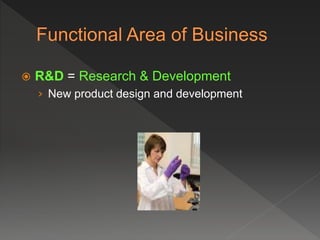
 R&D = Research & Development
› New product design and development
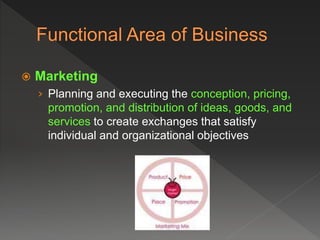
 Marketing
› Planning and executing the conception, pricing,
promotion, and distribution of ideas, goods, and
services to create exchanges that satisfy
individual and organizational objectives
 Finance
› Revenue, expenses, budget, financial records
and financial statements
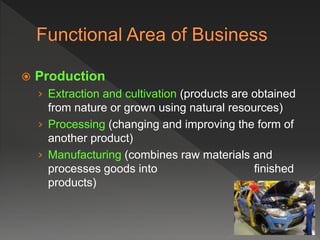
 Production
› Extraction and cultivation (products are obtained
from nature or grown using natural resources)
› Processing (changing and improving the form of
another product)
› Manufacturing (combines raw materials and
processes goods into finished
products)
 HR = Human Resources
› People who work for a business/organization
› Involves in planning & staffing, performance
management, compensation & benefits, and
employee relations
 Someone who coordinates and oversees the
work of other people in order to accomplish
organizational goals.
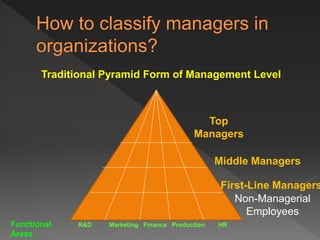
Traditional Pyramid Form of Management Level
Top
Managers
Middle Managers
First-Line Managers
Non-Managerial
Employees
Functional
Areas
R&D Marketing Finance Production HR
 First-line managers: manage the work of
nonmanagerial employees who typically are
involve with producing the organization’s
products or servicing the organization’s
customer
 They are often called: supervisor, shift
manager, district manager, department
manager, office manager
 Middle managers: manage work of first-line
managers
 They are often called: regional manager,
project leader, store manager, division
manager
 Top managers: are responsible for making
organizationwide decisions and establishing
the plans and goals that affect the entire
organization.
 They are often called: executive vice
president, president, managing director, chief
operating officer, chief executive officer
 Management involves coordinating and
overseeing the work activities of others so
that their activities are completed efficiently
and effectively.
 Or Management is the art of getting work
done through others
Efficiency
Effectiveness
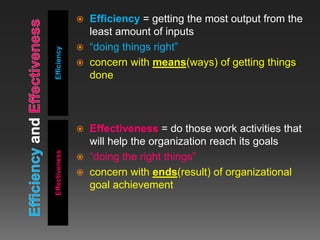
 Efficiency = getting the most output from the
least amount of inputs
 “doing things right”
 concern with means(ways) of getting things
done
 Effectiveness = do those work activities that
will help the organization reach its goals
 “doing the right things”
 concern with ends(result) of organizational
goal achievement
Efficiency
Effectiveness
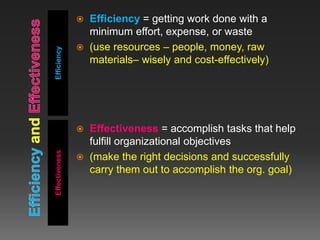
 Efficiency = getting work done with a
minimum effort, expense, or waste
 (use resources – people, money, raw
materials– wisely and cost-effectively)
 Effectiveness = accomplish tasks that help
fulfill organizational objectives
 (make the right decisions and successfully
carry them out to accomplish the org. goal)
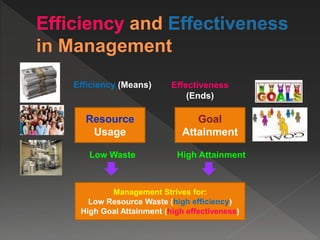
Resource
Usage
Goal
Attainment
Management Strives for:
Low Resource Waste (high efficiency)
High Goal Attainment (high effectiveness)
Low Waste High Attainment
Efficiency (Means) Effectiveness
(Ends)
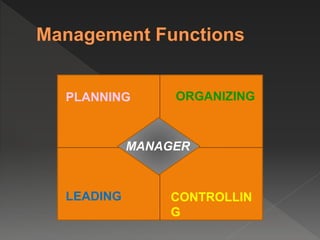
PLANNING ORGANIZING
LEADING CONTROLLIN
G
MANAGER
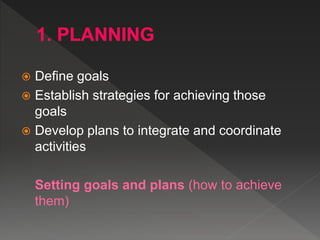
 Define goals
 Establish strategies for achieving those
goals
 Develop plans to integrate and coordinate
activities
Setting goals and plans (how to achieve
them)
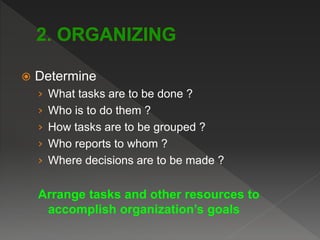
 Determine
› What tasks are to be done ?
› Who is to do them ?
› How tasks are to be grouped ?
› Who reports to whom ?
› Where decisions are to be made ?
Arrange tasks and other resources to
accomplish organization’s goals
 Motivate subordinates(lower positions)
 Help resolve group conflicts
 Influence individuals or teams as they work
 Select the most effective communication
channel
 Deal with employee behavior issues
Hire, train, motivate(lead) people
 Monitor activities’ performance
 Compare actual performance with the set goals
 Evaluate activities’ performance whether things
are going as planed
 Correct any disturbance to get work back on
track and achieve the set goals
Ensure all activities are accomplished as
planned
 Using current business periodicals (Wall Street
Journal, Financial Times, Fortune, The
Economist, Forbes, etc.), find 1 example of
manager you would describe as master
managers.
 Write a paper describing the individual as
manager and why you feel he/she deserve this
title.
 Due: next class
 Functional Managers V.S. General
Managers
 Functional Manager is responsible
for just 1 organizational activity
 General Manager is responsible for
several organizational activities
1. For-Profit Organizations: For making money,
or profits, by offering products or services
2. Nonprofit Organizations: For offering
services in either public sector or private sector
such as hospitals, colleges, social-welfare
agencies
3. Mutual-Benefit Organizations: For aiding
members such as farm cooperatives, labor
unions, trade associations, and clubs
SAME
 4 management
functions—planning,
organizing, leading,
and controlling– are
needed for all types
DIFFERENCE
 Measurement of
success
 For-profit: how much
profit (or loss) it
generate
 Nonprofit & Mutual-
benefit: effectiveness
of services delivered
 Specific actions or behaviors expected of
a manager
 3 types of managerial roles:
› Interpersonal
› Informational
› decisional
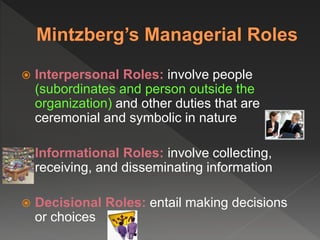
 Interpersonal Roles: involve people
(subordinates and person outside the
organization) and other duties that are
ceremonial and symbolic in nature
 Informational Roles: involve collecting,
receiving, and disseminating information
 Decisional Roles: entail making decisions
or choices
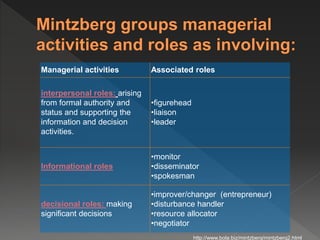
Managerial activities Associated roles
interpersonal roles: arising
from formal authority and
status and supporting the
information and decision
activities.
•figurehead
•liaison
•leader
Informational roles
•monitor
•disseminator
•spokesman
decisional roles: making
significant decisions
•improver/changer (entrepreneur)
•disturbance handler
•resource allocator
•negotiator
http://www.bola.biz/mintzberg/mintzberg2.html
 Figurehead: perform ceremonial duties like
greeting company visitors, speaking at the
opening of a new facility, or representing the
company at a community luncheon to
support local charities
 Leader: motivate and encourage workers to
accomplish organizational objectives
 Liaison: deal with people outside their units
to develop alliances that will help in org. goal
achievement
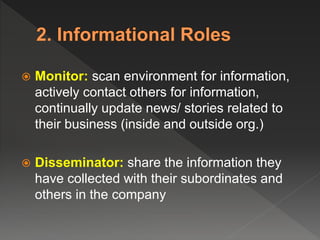
 Monitor: scan environment for information,
actively contact others for information,
continually update news/ stories related to
their business (inside and outside org.)
 Disseminator: share the information they
have collected with their subordinates and
others in the company
 Spokeperson: share information with
people outside their departments and
companies
 Entrepreneur: adapt themselves, their
subordinates, and their units to change/
innovation
 Disturbance Handler: respond to pressures
and problems demand immediate attention
and action
 Resource Allocator: set priorities and
decide about use of resources
 Negotiator: continual negotiate schedules,
projects, goals, outcomes, resources, and
employee raises in order to accomplish the
goals
 Technical Skills: job-specific knowledge and
techniques needed to proficiently perform work
tasks
 Human Skills: ability to work well with other people
both individually and in group
 Conceptual Skills: ability to see the organization
as a whole, understand the relationships among
various subunits, visualize how the organization fits
into its external environment
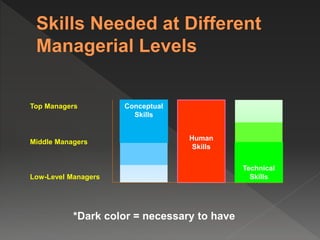
Human
Skills
Conceptual
Skills
Technical
Skills
Top Managers
Middle Managers
Low-Level Managers
*Dark color = necessary to have
 The universality of management
The reality that management is needed in all
types, sizes, level, areas of organizations.
 The reality of work
You will either manage or be managed in your
future career
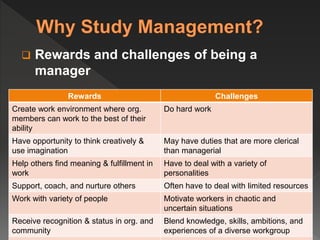
 Rewards and challenges of being a
manager
Rewards Challenges
Create work environment where org.
members can work to the best of their
ability
Do hard work
Have opportunity to think creatively &
use imagination
May have duties that are more clerical
than managerial
Help others find meaning & fulfillment in
work
Have to deal with a variety of
personalities
Support, coach, and nurture others Often have to deal with limited resources
Work with variety of people Motivate workers in chaotic and
uncertain situations
Receive recognition & status in org. and
community
Blend knowledge, skills, ambitions, and
experiences of a diverse workgroup

Introductiontomanagement.pptx

  • 2.
     R&D  Marketing Finance  Production  HR
  • 3.
     R&D =Research & Development › New product design and development
  • 4.
     Marketing › Planningand executing the conception, pricing, promotion, and distribution of ideas, goods, and services to create exchanges that satisfy individual and organizational objectives
  • 5.
     Finance › Revenue,expenses, budget, financial records and financial statements
  • 6.
     Production › Extractionand cultivation (products are obtained from nature or grown using natural resources) › Processing (changing and improving the form of another product) › Manufacturing (combines raw materials and processes goods into finished products)
  • 7.
     HR =Human Resources › People who work for a business/organization › Involves in planning & staffing, performance management, compensation & benefits, and employee relations
  • 9.
     Someone whocoordinates and oversees the work of other people in order to accomplish organizational goals.
  • 11.
    Traditional Pyramid Formof Management Level Top Managers Middle Managers First-Line Managers Non-Managerial Employees Functional Areas R&D Marketing Finance Production HR
  • 12.
     First-line managers:manage the work of nonmanagerial employees who typically are involve with producing the organization’s products or servicing the organization’s customer  They are often called: supervisor, shift manager, district manager, department manager, office manager
  • 13.
     Middle managers:manage work of first-line managers  They are often called: regional manager, project leader, store manager, division manager
  • 14.
     Top managers:are responsible for making organizationwide decisions and establishing the plans and goals that affect the entire organization.  They are often called: executive vice president, president, managing director, chief operating officer, chief executive officer
  • 15.
     Management involvescoordinating and overseeing the work activities of others so that their activities are completed efficiently and effectively.  Or Management is the art of getting work done through others
  • 17.
    Efficiency Effectiveness  Efficiency =getting the most output from the least amount of inputs  “doing things right”  concern with means(ways) of getting things done  Effectiveness = do those work activities that will help the organization reach its goals  “doing the right things”  concern with ends(result) of organizational goal achievement
  • 19.
    Efficiency Effectiveness  Efficiency =getting work done with a minimum effort, expense, or waste  (use resources – people, money, raw materials– wisely and cost-effectively)  Effectiveness = accomplish tasks that help fulfill organizational objectives  (make the right decisions and successfully carry them out to accomplish the org. goal)
  • 20.
    Resource Usage Goal Attainment Management Strives for: LowResource Waste (high efficiency) High Goal Attainment (high effectiveness) Low Waste High Attainment Efficiency (Means) Effectiveness (Ends)
  • 21.
  • 22.
     Define goals Establish strategies for achieving those goals  Develop plans to integrate and coordinate activities Setting goals and plans (how to achieve them)
  • 23.
     Determine › Whattasks are to be done ? › Who is to do them ? › How tasks are to be grouped ? › Who reports to whom ? › Where decisions are to be made ? Arrange tasks and other resources to accomplish organization’s goals
  • 24.
     Motivate subordinates(lowerpositions)  Help resolve group conflicts  Influence individuals or teams as they work  Select the most effective communication channel  Deal with employee behavior issues Hire, train, motivate(lead) people
  • 25.
     Monitor activities’performance  Compare actual performance with the set goals  Evaluate activities’ performance whether things are going as planed  Correct any disturbance to get work back on track and achieve the set goals Ensure all activities are accomplished as planned
  • 26.
     Using currentbusiness periodicals (Wall Street Journal, Financial Times, Fortune, The Economist, Forbes, etc.), find 1 example of manager you would describe as master managers.  Write a paper describing the individual as manager and why you feel he/she deserve this title.  Due: next class
  • 27.
     Functional ManagersV.S. General Managers
  • 28.
     Functional Manageris responsible for just 1 organizational activity  General Manager is responsible for several organizational activities
  • 29.
    1. For-Profit Organizations:For making money, or profits, by offering products or services 2. Nonprofit Organizations: For offering services in either public sector or private sector such as hospitals, colleges, social-welfare agencies 3. Mutual-Benefit Organizations: For aiding members such as farm cooperatives, labor unions, trade associations, and clubs
  • 31.
    SAME  4 management functions—planning, organizing,leading, and controlling– are needed for all types DIFFERENCE  Measurement of success  For-profit: how much profit (or loss) it generate  Nonprofit & Mutual- benefit: effectiveness of services delivered
  • 33.
     Specific actionsor behaviors expected of a manager  3 types of managerial roles: › Interpersonal › Informational › decisional
  • 34.
     Interpersonal Roles:involve people (subordinates and person outside the organization) and other duties that are ceremonial and symbolic in nature  Informational Roles: involve collecting, receiving, and disseminating information  Decisional Roles: entail making decisions or choices
  • 35.
    Managerial activities Associatedroles interpersonal roles: arising from formal authority and status and supporting the information and decision activities. •figurehead •liaison •leader Informational roles •monitor •disseminator •spokesman decisional roles: making significant decisions •improver/changer (entrepreneur) •disturbance handler •resource allocator •negotiator http://www.bola.biz/mintzberg/mintzberg2.html
  • 36.
     Figurehead: performceremonial duties like greeting company visitors, speaking at the opening of a new facility, or representing the company at a community luncheon to support local charities
  • 37.
     Leader: motivateand encourage workers to accomplish organizational objectives  Liaison: deal with people outside their units to develop alliances that will help in org. goal achievement
  • 38.
     Monitor: scanenvironment for information, actively contact others for information, continually update news/ stories related to their business (inside and outside org.)  Disseminator: share the information they have collected with their subordinates and others in the company
  • 39.
     Spokeperson: shareinformation with people outside their departments and companies
  • 40.
     Entrepreneur: adaptthemselves, their subordinates, and their units to change/ innovation  Disturbance Handler: respond to pressures and problems demand immediate attention and action
  • 41.
     Resource Allocator:set priorities and decide about use of resources  Negotiator: continual negotiate schedules, projects, goals, outcomes, resources, and employee raises in order to accomplish the goals
  • 43.
     Technical Skills:job-specific knowledge and techniques needed to proficiently perform work tasks  Human Skills: ability to work well with other people both individually and in group  Conceptual Skills: ability to see the organization as a whole, understand the relationships among various subunits, visualize how the organization fits into its external environment
  • 44.
  • 46.
     The universalityof management The reality that management is needed in all types, sizes, level, areas of organizations.  The reality of work You will either manage or be managed in your future career
  • 47.
     Rewards andchallenges of being a manager Rewards Challenges Create work environment where org. members can work to the best of their ability Do hard work Have opportunity to think creatively & use imagination May have duties that are more clerical than managerial Help others find meaning & fulfillment in work Have to deal with a variety of personalities Support, coach, and nurture others Often have to deal with limited resources Work with variety of people Motivate workers in chaotic and uncertain situations Receive recognition & status in org. and community Blend knowledge, skills, ambitions, and experiences of a diverse workgroup