Managers and Managing
McGraw-Hill/Irwin
Contemporary Management, 5/e
Copyright © 2008 The McGraw-Hill Companies, Inc. All rights reserved.
chapter one
1-3
Learning Objectives
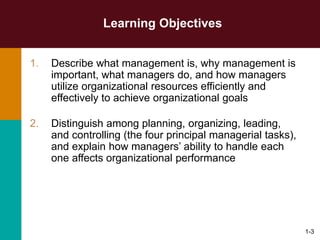
1. Describe what management is, why management is
important, what managers do, and how managers
utilize organizational resources efficiently and
effectively to achieve organizational goals
2. Distinguish among planning, organizing, leading,
and controlling (the four principal managerial tasks),
and explain how managers’ ability to handle each
one affects organizational performance
1-4
Learning Objectives
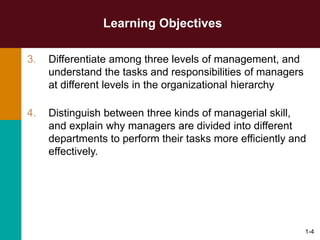
3. Differentiate among three levels of management, and
understand the tasks and responsibilities of managers
at different levels in the organizational hierarchy
4. Distinguish between three kinds of managerial skill,
and explain why managers are divided into different
departments to perform their tasks more efficiently and
effectively.
1-5
Learning Objectives
5. Discuss some major changes in management
practices today that have occurred as a result of
globalization and the use of advanced information
technology (IT).
6. Discuss the principal challenges managers face in
today’s increasingly competitive global environment
1-6
What is Management?
• All managers work in organizations
• Organizations – collections of people
who work together and coordinate their
actions to achieve a wide variety of goals
1-7
Question?
What is a person responsible for
supervising the use of an organization’s
resources to meet its goals?
A. Team leader
B. Manager
C. President
D. Resource allocator
1-8
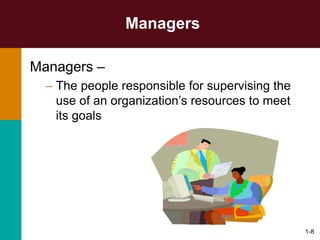
Managers
Managers –
– The people responsible for supervising the
use of an organization’s resources to meet
its goals
1-9
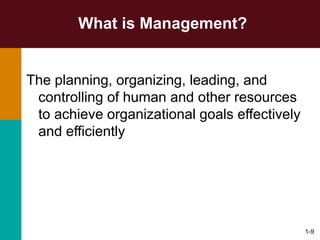
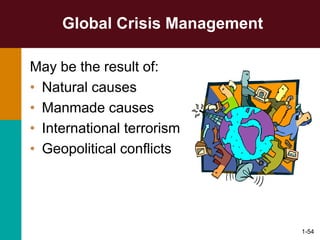
What is Management?
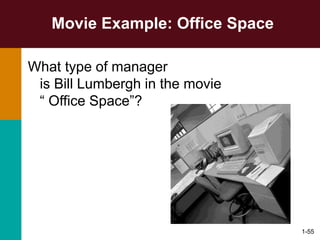
The planning, organizing, leading, and
controlling of human and other resources
to achieve organizational goals effectively
and efficiently
1-10
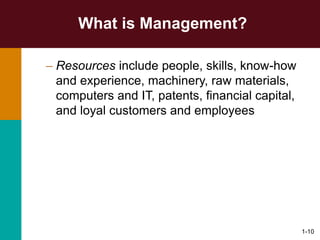
What is Management?
– Resources include people, skills, know-how
and experience, machinery, raw materials,
computers and IT, patents, financial capital,
and loyal customers and employees
1-11
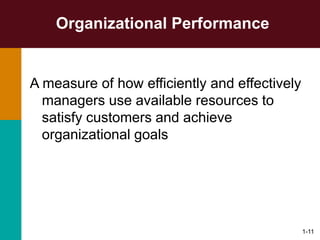
Organizational Performance
A measure of how efficiently and effectively
managers use available resources to
satisfy customers and achieve
organizational goals
1-12
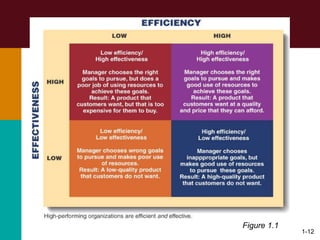
Figure 1.1
1-13
Organizational Performance
Efficiency
– A measure of how well or how productively
resources are used to achieve a goal
Effectiveness
– A measure of the appropriateness of the
goals an organization is pursuing and the
degree to which they are achieved.
1-14
Why study management?
1. The more efficient and effective use of
scarce resources that organizations
make of those resources, the greater
the relative well-being and prosperity of
people in that society
1-15
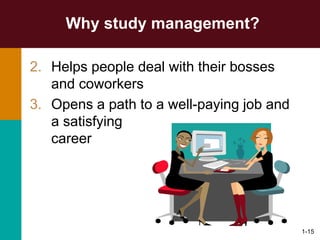
Why study management?
2. Helps people deal with their bosses
and coworkers
3. Opens a path to a well-paying job and
a satisfying
career
1-16
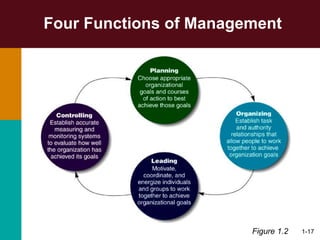
Managerial Tasks
• Managers at all levels in all organizations
perform each of the four essential
managerial tasks of planning, organizing,
leading, and controlling
1-17
Four Functions of Management
Figure 1.2
1-18
Planning
Process of identifying and selecting
appropriate organizational goals and
courses of action
1-19
Steps in the Planning Process
• Deciding which goals the organization
will pursue
• Deciding what courses of action to
adopt to attain those goals
• Deciding how to allocate organizational
resources
1-20
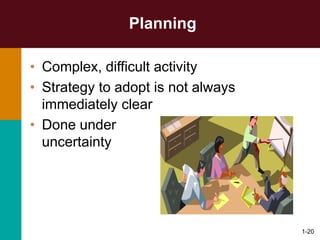
Planning
• Complex, difficult activity
• Strategy to adopt is not always
immediately clear
• Done under
uncertainty
1-21
Organizing
Task managers perform to create a
structure of working relationships that
allow organizational members to interact
and cooperate to achieve organizational
goals
1-22
Organizing
• Involves grouping people into
departments according to the kinds of
job-specific tasks they perform
• Managers lay out lines of authority and
responsibility
• Decide how to coordinate organizational
resources
1-23
Organizational Structure
A formal system of task and reporting
relationships that coordinates and
motivates members so that they work
together to achieve organizational goals
1-24
Leading
Articulating a clear organizational vision for
its members to accomplish, and energize
and enable employees so that everyone
understands the part they play in
achieving organizational goals
1-25
Leading
• Leadership involves using power,
personality, and influence, persuasion,
and communication skills
• Outcome of leadership is highly
motivated and committed workforce
1-26
Controlling
• Task of managers is to evaluate how well
an organization has achieved its goals
and to take any corrective actions
needed to maintain or improve
performance
– The outcome of the control process is the ability to
measure performance accurately and regulate
organizational efficiency and effectiveness
1-27
Decisional Roles
Roles associated with methods managers use in planning
strategy and utilizing resources.
– Entrepreneur—deciding which new projects or programs to
initiate and to invest resources in.
– Disturbance handler—managing an unexpected event or
crisis.
– Resource allocator—assigning resources between
functions and divisions, setting the budgets of lower
managers.
– Negotiator—reaching agreements between other
managers, unions, customers, or shareholders.
1-28
Interpersonal Roles
Roles that managers assume to provide direction and
supervision to both employees and the organization as
a whole.
– Figurehead—symbolizing the organization’s mission
and what it is seeking to achieve.
– Leader—training, counseling, and mentoring high
employee performance.
– Liaison—linking and coordinating the activities of
people and groups both inside and outside the
organization.
1-29
Informational Roles
Roles associated with the tasks needed to obtain and
transmit information in the process of managing the
organization.
– Monitor—analyzing information from both the internal
and external environment.
– Disseminator—transmitting information to influence the
attitudes and behavior of employees.
– Spokesperson—using information to positively
influence the way people in and out of the organization
respond to it.
1-30
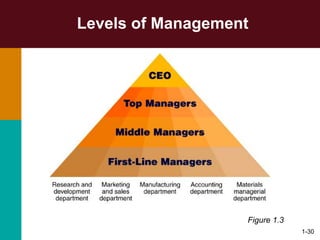
Levels of Management
Figure 1.3
1-31
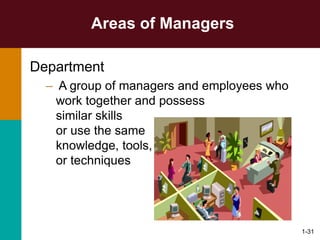
Areas of Managers
Department
– A group of managers and employees who
work together and possess
similar skills
or use the same
knowledge, tools,
or techniques
1-32
Levels of Management
• First line managers - Responsible for daily
supervision of the non-managerial employees who
perform many of the specific activities necessary to
produce goods and services
• Middle managers - Supervise first-line
managers. Responsible for finding the best way to
organize human and other resources to achieve
organizational goals
1-33
Levels of Management
• Top managers –
• Responsible for the performance of all departments
and have cross-departmental responsibility.
• Establish organizational goals and monitor middle
managers
• Decide how different departments should interact
• Ultimately responsible for the success or failure of
an organization
1-34
Levels of Management
• Chief executive officer (CEO) is
company’s most senior and important
manager
• Central concern is creation of a smoothly
functioning top-management team
– CEO, COO, Department heads
1-35
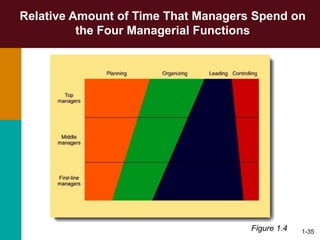
Relative Amount of Time That Managers Spend on
the Four Managerial Functions
Figure 1.4
1-36
Question?
What skill is the ability to understand, alter,
lead, and control the behavior of other
individuals and groups?
A. Conceptual
B. Human
C. Technical
D. Managerial
1-37
Managerial Skills
• Conceptual skills
– The ability to analyze and diagnose a situation and
distinguish between cause and effect.
• Human skills
– The ability to understand, alter, lead, and control
the behavior of other individuals and groups.
• Technical skills
– Job-specific skills required to perform a particular
type of work or occupation at a high level.
1-38
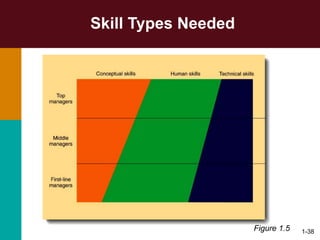
Skill Types Needed
Figure 1.5
1-39
Core Competency
Specific set of departmental skills, abilities,
knowledge and experience that allows
one organization to outperform its
competitors
1-40
Restructuring
• Involves simplifying, shrinking, or
downsizing an organization’s operations
to lower operating costs
– Can reduce the morale of remaining
employees
1-41
Outsourcing
• Contracting with another company, usually in
a low cost country abroad, to perform a work
activity the company previously performed
itself
• Increases efficiency by lowering operating
costs, freeing up money and resources that
can now be used in more effective ways
1-42
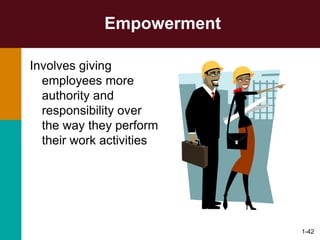
Empowerment
Involves giving
employees more
authority and
responsibility over
the way they perform
their work activities
1-43
Self-managed teams
Groups of employees who assume
collective responsibility for organizing,
controlling, and supervising their own
work activities
1-44
Discussion Question
What is the biggest challenge for
management in a Global Environment?
A. Building a Competitive Advantage
B. Maintaining Ethical Standards
C. Managing a Diverse Workforce
D. Global Crisis Management
1-45
Challenges for Management in
a Global Environment
• Rise of Global Organizations.
• Building a Competitive Advantage
• Maintaining Ethical Standards
• Managing a Diverse Workforce
• Utilizing Information Technology and
Technologies
• Global Crisis Management
1-46
Building Competitive Advantage
• Competitive Advantage – ability of one
organization to outperform other
organizations because it produces
desired goods or services more
efficiently and effectively than its
competitors
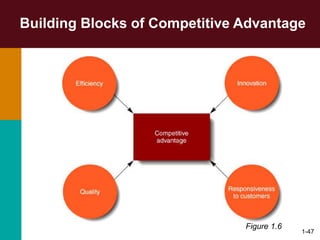
1-47
Building Blocks of Competitive Advantage
Figure 1.6
1-48
Building Competitive Advantage
• Increasing efficiency
– Reduce the quantity of resources used to
produce goods or services
• Increasing Quality
– Improve the skills and abilities of the
workforce
– Introduce total quality management
1-49
Building Competitive Advantage
• Increasing speed, flexibility, and
innovation
– How fast a firm can bring new products to
market
– How easily a firm can change or alter the
way they perform their activities
1-50
Building Competitive Advantage
• Innovation
– Process of creating new or improved goods
and services that customers want
– Developing better ways to produce or
provide goods and services
1-51
Turnaround Management
• Difficult and complex management task
• Done under conditions of great
uncertainty
• Risk of failure is greater for a troubled
company
• More radical restructuring necessary
1-52
Maintaining Ethical and Socially
Responsible Standards
• Managers are under considerable
pressure to make the best use of
resources
• Too much pressure may induce
managers to behave unethically, and
even illegally
1-53
Managing a Diverse Workforce
• To create a highly trained and motivated
workforce managers must establish
HRM procedures that are legal, fair and
do not discriminate against
organizational members
1-54
Global Crisis Management
May be the result of:
• Natural causes
• Manmade causes
• International terrorism
• Geopolitical conflicts
1-55
Movie Example: Office Space
What type of manager
is Bill Lumbergh in the movie
“ Office Space”?

Management

  • 2.
    Managers and Managing McGraw-Hill/Irwin ContemporaryManagement, 5/e Copyright © 2008 The McGraw-Hill Companies, Inc. All rights reserved. chapter one
  • 3.
    1-3 Learning Objectives 1. Describewhat management is, why management is important, what managers do, and how managers utilize organizational resources efficiently and effectively to achieve organizational goals 2. Distinguish among planning, organizing, leading, and controlling (the four principal managerial tasks), and explain how managers’ ability to handle each one affects organizational performance
  • 4.
    1-4 Learning Objectives 3. Differentiateamong three levels of management, and understand the tasks and responsibilities of managers at different levels in the organizational hierarchy 4. Distinguish between three kinds of managerial skill, and explain why managers are divided into different departments to perform their tasks more efficiently and effectively.
  • 5.
    1-5 Learning Objectives 5. Discusssome major changes in management practices today that have occurred as a result of globalization and the use of advanced information technology (IT). 6. Discuss the principal challenges managers face in today’s increasingly competitive global environment
  • 6.
    1-6 What is Management? •All managers work in organizations • Organizations – collections of people who work together and coordinate their actions to achieve a wide variety of goals
  • 7.
    1-7 Question? What is aperson responsible for supervising the use of an organization’s resources to meet its goals? A. Team leader B. Manager C. President D. Resource allocator
  • 8.
    1-8 Managers Managers – – Thepeople responsible for supervising the use of an organization’s resources to meet its goals
  • 9.
    1-9 What is Management? Theplanning, organizing, leading, and controlling of human and other resources to achieve organizational goals effectively and efficiently
  • 10.
    1-10 What is Management? –Resources include people, skills, know-how and experience, machinery, raw materials, computers and IT, patents, financial capital, and loyal customers and employees
  • 11.
    1-11 Organizational Performance A measureof how efficiently and effectively managers use available resources to satisfy customers and achieve organizational goals
  • 12.
  • 13.
    1-13 Organizational Performance Efficiency – Ameasure of how well or how productively resources are used to achieve a goal Effectiveness – A measure of the appropriateness of the goals an organization is pursuing and the degree to which they are achieved.
  • 14.
    1-14 Why study management? 1.The more efficient and effective use of scarce resources that organizations make of those resources, the greater the relative well-being and prosperity of people in that society
  • 15.
    1-15 Why study management? 2.Helps people deal with their bosses and coworkers 3. Opens a path to a well-paying job and a satisfying career
  • 16.
    1-16 Managerial Tasks • Managersat all levels in all organizations perform each of the four essential managerial tasks of planning, organizing, leading, and controlling
  • 17.
    1-17 Four Functions ofManagement Figure 1.2
  • 18.
    1-18 Planning Process of identifyingand selecting appropriate organizational goals and courses of action
  • 19.
    1-19 Steps in thePlanning Process • Deciding which goals the organization will pursue • Deciding what courses of action to adopt to attain those goals • Deciding how to allocate organizational resources
  • 20.
    1-20 Planning • Complex, difficultactivity • Strategy to adopt is not always immediately clear • Done under uncertainty
  • 21.
    1-21 Organizing Task managers performto create a structure of working relationships that allow organizational members to interact and cooperate to achieve organizational goals
  • 22.
    1-22 Organizing • Involves groupingpeople into departments according to the kinds of job-specific tasks they perform • Managers lay out lines of authority and responsibility • Decide how to coordinate organizational resources
  • 23.
    1-23 Organizational Structure A formalsystem of task and reporting relationships that coordinates and motivates members so that they work together to achieve organizational goals
  • 24.
    1-24 Leading Articulating a clearorganizational vision for its members to accomplish, and energize and enable employees so that everyone understands the part they play in achieving organizational goals
  • 25.
    1-25 Leading • Leadership involvesusing power, personality, and influence, persuasion, and communication skills • Outcome of leadership is highly motivated and committed workforce
  • 26.
    1-26 Controlling • Task ofmanagers is to evaluate how well an organization has achieved its goals and to take any corrective actions needed to maintain or improve performance – The outcome of the control process is the ability to measure performance accurately and regulate organizational efficiency and effectiveness
  • 27.
    1-27 Decisional Roles Roles associatedwith methods managers use in planning strategy and utilizing resources. – Entrepreneur—deciding which new projects or programs to initiate and to invest resources in. – Disturbance handler—managing an unexpected event or crisis. – Resource allocator—assigning resources between functions and divisions, setting the budgets of lower managers. – Negotiator—reaching agreements between other managers, unions, customers, or shareholders.
  • 28.
    1-28 Interpersonal Roles Roles thatmanagers assume to provide direction and supervision to both employees and the organization as a whole. – Figurehead—symbolizing the organization’s mission and what it is seeking to achieve. – Leader—training, counseling, and mentoring high employee performance. – Liaison—linking and coordinating the activities of people and groups both inside and outside the organization.
  • 29.
    1-29 Informational Roles Roles associatedwith the tasks needed to obtain and transmit information in the process of managing the organization. – Monitor—analyzing information from both the internal and external environment. – Disseminator—transmitting information to influence the attitudes and behavior of employees. – Spokesperson—using information to positively influence the way people in and out of the organization respond to it.
  • 30.
  • 31.
    1-31 Areas of Managers Department –A group of managers and employees who work together and possess similar skills or use the same knowledge, tools, or techniques
  • 32.
    1-32 Levels of Management •First line managers - Responsible for daily supervision of the non-managerial employees who perform many of the specific activities necessary to produce goods and services • Middle managers - Supervise first-line managers. Responsible for finding the best way to organize human and other resources to achieve organizational goals
  • 33.
    1-33 Levels of Management •Top managers – • Responsible for the performance of all departments and have cross-departmental responsibility. • Establish organizational goals and monitor middle managers • Decide how different departments should interact • Ultimately responsible for the success or failure of an organization
  • 34.
    1-34 Levels of Management •Chief executive officer (CEO) is company’s most senior and important manager • Central concern is creation of a smoothly functioning top-management team – CEO, COO, Department heads
  • 35.
    1-35 Relative Amount ofTime That Managers Spend on the Four Managerial Functions Figure 1.4
  • 36.
    1-36 Question? What skill isthe ability to understand, alter, lead, and control the behavior of other individuals and groups? A. Conceptual B. Human C. Technical D. Managerial
  • 37.
    1-37 Managerial Skills • Conceptualskills – The ability to analyze and diagnose a situation and distinguish between cause and effect. • Human skills – The ability to understand, alter, lead, and control the behavior of other individuals and groups. • Technical skills – Job-specific skills required to perform a particular type of work or occupation at a high level.
  • 38.
  • 39.
    1-39 Core Competency Specific setof departmental skills, abilities, knowledge and experience that allows one organization to outperform its competitors
  • 40.
    1-40 Restructuring • Involves simplifying,shrinking, or downsizing an organization’s operations to lower operating costs – Can reduce the morale of remaining employees
  • 41.
    1-41 Outsourcing • Contracting withanother company, usually in a low cost country abroad, to perform a work activity the company previously performed itself • Increases efficiency by lowering operating costs, freeing up money and resources that can now be used in more effective ways
  • 42.
    1-42 Empowerment Involves giving employees more authorityand responsibility over the way they perform their work activities
  • 43.
    1-43 Self-managed teams Groups ofemployees who assume collective responsibility for organizing, controlling, and supervising their own work activities
  • 44.
    1-44 Discussion Question What isthe biggest challenge for management in a Global Environment? A. Building a Competitive Advantage B. Maintaining Ethical Standards C. Managing a Diverse Workforce D. Global Crisis Management
  • 45.
    1-45 Challenges for Managementin a Global Environment • Rise of Global Organizations. • Building a Competitive Advantage • Maintaining Ethical Standards • Managing a Diverse Workforce • Utilizing Information Technology and Technologies • Global Crisis Management
  • 46.
    1-46 Building Competitive Advantage •Competitive Advantage – ability of one organization to outperform other organizations because it produces desired goods or services more efficiently and effectively than its competitors
  • 47.
    1-47 Building Blocks ofCompetitive Advantage Figure 1.6
  • 48.
    1-48 Building Competitive Advantage •Increasing efficiency – Reduce the quantity of resources used to produce goods or services • Increasing Quality – Improve the skills and abilities of the workforce – Introduce total quality management
  • 49.
    1-49 Building Competitive Advantage •Increasing speed, flexibility, and innovation – How fast a firm can bring new products to market – How easily a firm can change or alter the way they perform their activities
  • 50.
    1-50 Building Competitive Advantage •Innovation – Process of creating new or improved goods and services that customers want – Developing better ways to produce or provide goods and services
  • 51.
    1-51 Turnaround Management • Difficultand complex management task • Done under conditions of great uncertainty • Risk of failure is greater for a troubled company • More radical restructuring necessary
  • 52.
    1-52 Maintaining Ethical andSocially Responsible Standards • Managers are under considerable pressure to make the best use of resources • Too much pressure may induce managers to behave unethically, and even illegally
  • 53.
    1-53 Managing a DiverseWorkforce • To create a highly trained and motivated workforce managers must establish HRM procedures that are legal, fair and do not discriminate against organizational members
  • 54.
    1-54 Global Crisis Management Maybe the result of: • Natural causes • Manmade causes • International terrorism • Geopolitical conflicts
  • 55.
    1-55 Movie Example: OfficeSpace What type of manager is Bill Lumbergh in the movie “ Office Space”?