

















Jayadeva de SilvaJayadeva de Silva
Human Resource
Human ResourceManagement
Management
Jayadeva de Silva
Jayadeva de Silva
M.Sc,MBIM,FIPM,FITD
M.Sc,MBIM,FIPM,FITD
Managing People at Work
About meAbout me
PagePage 44
Jayadeva de Silva
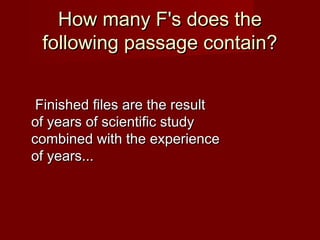
How many F's does theHow many F's does the
following passage contain?following passage contain?
  Finished files are the resultFinished files are the result
of years of scientific studyof years of scientific study
combined with the experiencecombined with the experience
of years...of years...
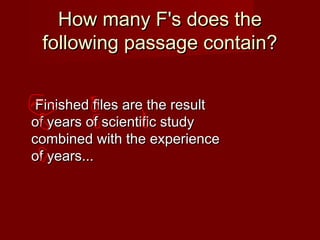
How many F's does theHow many F's does the
following passage contain?following passage contain?
  Finished files are the resultFinished files are the result
of years of scientific studyof years of scientific study
combined with the experiencecombined with the experience
of years...of years...
Course Code & TitleCourse Code & Title PGDBMPGDBM
1206 Managing People1206 Managing People
HoursHours 45 hours45 hours
Number of CreditsNumber of Credits 33
 The aim of this module is to examine aThe aim of this module is to examine a
number of topics in the field of humannumber of topics in the field of human
resource management from the point ofresource management from the point of
view of both theory and practice.view of both theory and practice.
 By making extensive use of researchBy making extensive use of research
evidence, the module aims to highlight toevidence, the module aims to highlight to
managers the problems and dilemmas thatmanagers the problems and dilemmas that
can frequently emerge in thecan frequently emerge in the
implementation of human resourceimplementation of human resource
practices and how to resolve those practicalpractices and how to resolve those practical
issues.issues.
At the completion of this module, studentsAt the completion of this module, students
should be able to;should be able to;
 gain an understanding of key terms,gain an understanding of key terms,
theories/concepts and practices within thetheories/concepts and practices within the
field of human resource management.field of human resource management.
 identify and analyze problems in the fieldidentify and analyze problems in the field
of HRM and be able to provide innovativeof HRM and be able to provide innovative
solutions.solutions.
 be able to identify and appreciate thebe able to identify and appreciate the
significance of ethical issues in HRsignificance of ethical issues in HR
practices and the management of people inpractices and the management of people in
the workplace.the workplace.
 obtain the practical skills required byobtain the practical skills required by
managers actively engaged in themanagers actively engaged in the
strategic management of people withinstrategic management of people within
organizations.organizations.
 demonstrate competence in skills relateddemonstrate competence in skills related
to managing peopleto managing people
 No of HoursNo of Hours TopicTopic DiscussionDiscussion
AreasAreas
 6hrs6hrs IntroductionIntroduction
  Definition of Human ResourceDefinition of Human Resource
 ManagementManagement
  Evolution of HRMEvolution of HRM
  Functions of HRMFunctions of HRM
  Business Strategy and HRMBusiness Strategy and HRM
  Human Resource DepartmentHuman Resource Department
 6hrs6hrs Employment PlanningEmployment Planning
  Job designJob design
  Job AnalysisJob Analysis
  Human Resource PlanningHuman Resource Planning
 6hrs6hrs Employee StaffingEmployee Staffing
  RecruitmentRecruitment
  SelectionSelection
  HiringHiring
  Employee InductionEmployee Induction
 9hrs9hrs Human ResourceHuman Resource
DevelopmentDevelopment
  Employee Performance EvaluationEmployee Performance Evaluation
  Training and DevelopmentTraining and Development
  Career ManagementCareer Management
 6hrs6hrs Reward ManagementReward Management
  Pay ManagementPay Management
  Employee Welfare ManagementEmployee Welfare Management
 9hrs9hrs Employee and LabourEmployee and Labour
relationsrelations
  Health and Safety ManagementHealth and Safety Management
  Employee discipline managementEmployee discipline management
  Labour Management RelationsLabour Management Relations
  Grievance HandlingGrievance Handling
 3hrs3hrs Group/IndividualGroup/Individual
PresentationsPresentations
PagePage 1818
. Course Text. Course Text
Opatha, H.H.D.N.P. (2012) HumanOpatha, H.H.D.N.P. (2012) Human
Resource Management 3rd EditionResource Management 3rd Edition
Author PublicationAuthor Publication
Supplementary ReadingsSupplementary Readings
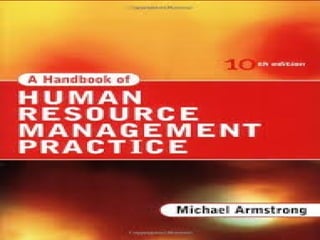
Amstrong M. (2012) Hand Book OnAmstrong M. (2012) Hand Book On
Human Resource MangementHuman Resource Mangement
Practices, 12th Edition Kogan Page,Practices, 12th Edition Kogan Page,
London & PhiladelphiaLondon & Philadelphia
 Dessler G. (2012) Human ResourceDessler G. (2012) Human Resource
Managemnt 13th Edition, Prentice –HallManagemnt 13th Edition, Prentice –Hall
India Ltd, New DelhiIndia Ltd, New Delhi
CD ?CD ?
 Michael ArmstrongMichael Armstrong
Handbook on HUMAN RESOURCEHandbook on HUMAN RESOURCE
MANAGEMENT PRACTICEMANAGEMENT PRACTICE
 Jayadeva de Silva- HumantalentsJayadeva de Silva- Humantalents
ManagementManagement
 http://www.slideshare.net/Jayadeva/humahttp://www.slideshare.net/Jayadeva/huma
ntalents-management-byjayadeva-de-silvantalents-management-byjayadeva-de-silva
Evaluation Strategy:Evaluation Strategy:
Students will be evaluated on the basis of aStudents will be evaluated on the basis of a
group assignment, classroomgroup assignment, classroom
assessments, and end-term exam. Theassessments, and end-term exam. The
weightage given to each of these units isweightage given to each of these units is
listed below:listed below:
  Assessments 50%Assessments 50%
  End Term Exam 50%End Term Exam 50%
Instructions to StudentsInstructions to Students
Listen to the Lecture
Inputs
PPT is used as a Visual
Aid only
Take your own notes
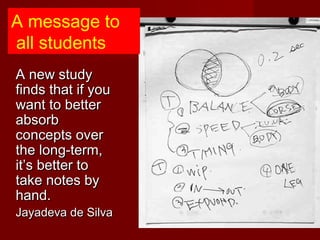
A new studyA new study
finds that if youfinds that if you
want to betterwant to better
absorbabsorb
concepts overconcepts over
the long-term,the long-term,
it’s better toit’s better to
take notes bytake notes by
hand.hand.
Jayadeva de SilvaJayadeva de Silva
A message to
all students
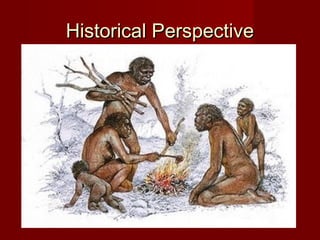
Historical PerspectiveHistorical Perspective
And after that
 Let us recap what we reviewed so farLet us recap what we reviewed so far
HISTORICAL PERSPECTIVEHISTORICAL PERSPECTIVE
 Principles of scientific managementPrinciples of scientific management
 (F.W. Taylor)(F.W. Taylor)
 Emergence of Human Relations SchoolEmergence of Human Relations School
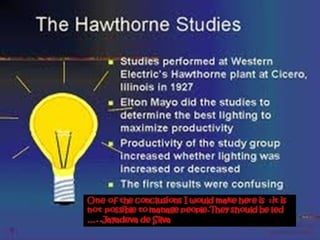
 George Elton Mayo & "Hawthorne experiments".George Elton Mayo & "Hawthorne experiments".
This effort comprised of 04 experiments whichThis effort comprised of 04 experiments which
indicated that the human factor has an effect onindicated that the human factor has an effect on
work, Social needs at work are as important aswork, Social needs at work are as important as
work are as important as economic & physicalwork are as important as economic & physical
needs.needs.
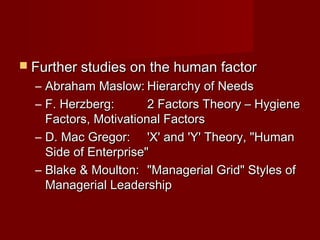
 Further studies on the human factorFurther studies on the human factor
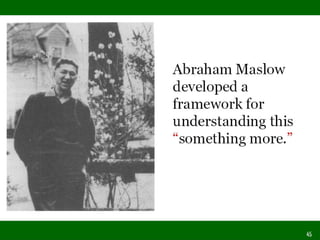
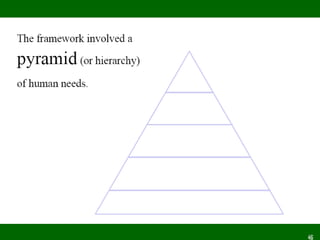
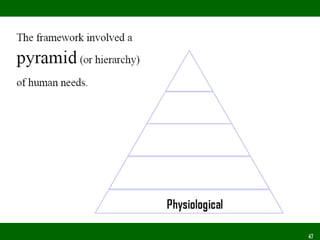
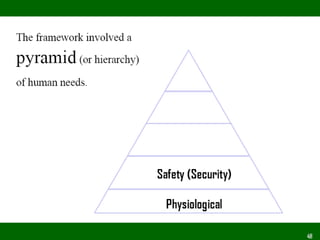
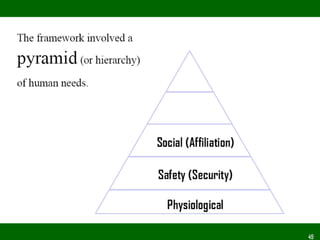
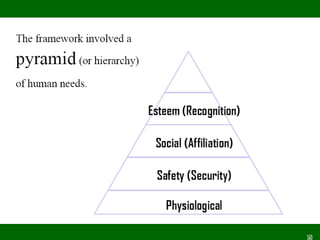
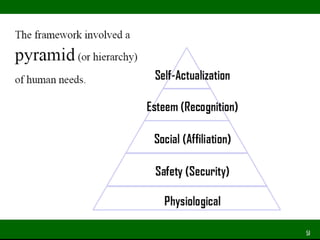
– Abraham Maslow:Abraham Maslow: Hierarchy of NeedsHierarchy of Needs
– F. Herzberg:F. Herzberg: 2 Factors Theory – Hygiene2 Factors Theory – Hygiene
Factors, Motivational FactorsFactors, Motivational Factors
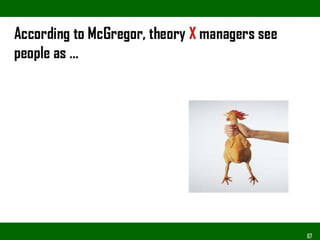
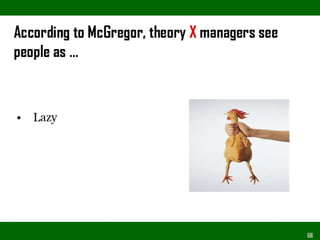
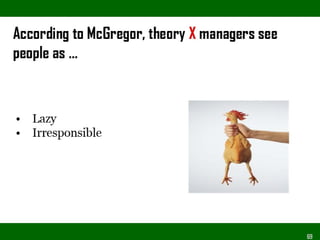
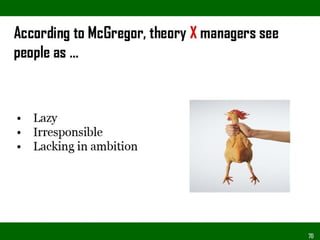
– D. Mac Gregor:D. Mac Gregor: 'X' and 'Y' Theory, "Human'X' and 'Y' Theory, "Human
Side of Enterprise"Side of Enterprise"
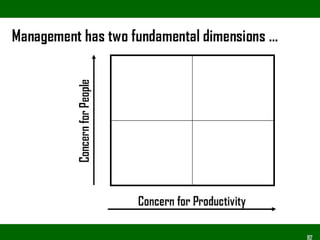
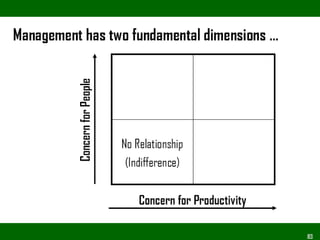
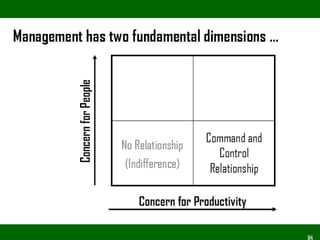
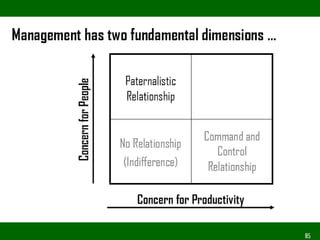
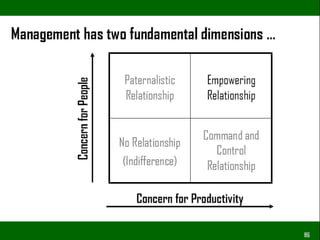
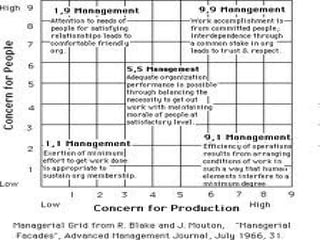
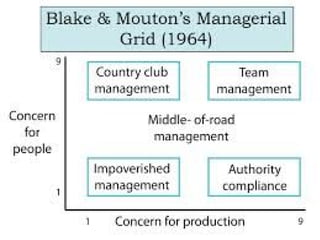
– Blake & Moulton:Blake & Moulton: "Managerial Grid" Styles of"Managerial Grid" Styles of
Managerial LeadershipManagerial Leadership
HUMAN RESOURCEHUMAN RESOURCE
MANAGEMENT - CONCEPTMANAGEMENT - CONCEPT
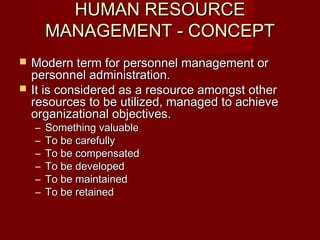
 Modern term for personnel management orModern term for personnel management or
personnel administration.personnel administration.
 It is considered as a resource amongst otherIt is considered as a resource amongst other
resources to be utilized, managed to achieveresources to be utilized, managed to achieve
organizational objectives.organizational objectives.
– Something valuableSomething valuable
– To be carefullyTo be carefully
– To be compensatedTo be compensated
– To be developedTo be developed
– To be maintainedTo be maintained
– To be retainedTo be retained
HUMAN RESOURCE IN THEHUMAN RESOURCE IN THE
TOTAL MANAGEMENT PROCESSTOTAL MANAGEMENT PROCESS
 The significance/ importance of the humanThe significance/ importance of the human
resource.resource.
 Organization's policy towards managing theOrganization's policy towards managing the
Human ResourceHuman Resource
– Acceptance by the management that people are anAcceptance by the management that people are an
important resourceimportant resource
– It is a part of the corporate philosophyIt is a part of the corporate philosophy
– However most important is the faithful adherence toHowever most important is the faithful adherence to
the principle: This should be manifested in thethe principle: This should be manifested in the
behaviour of managers (Leaders)behaviour of managers (Leaders)
 Manager's responsibility in achieving resultsManager's responsibility in achieving results
through people.through people.
CORPORATE POLICY ONCORPORATE POLICY ON
HUMAN RESOURCESHUMAN RESOURCES
 "Our company considers its employees,"Our company considers its employees,
as it's most valuable asset. Theiras it's most valuable asset. Their
development, progress, welfare,development, progress, welfare,
contentment will receive due priority andcontentment will receive due priority and
will be carried out continuously. While thewill be carried out continuously. While the
primary objective of the company isprimary objective of the company is
achieving steady growth in profitability andachieving steady growth in profitability and
asset. It will always be mindful of the needasset. It will always be mindful of the need
to maintain, develop and look after itsto maintain, develop and look after its
most valuable asset; it's employees."most valuable asset; it's employees."
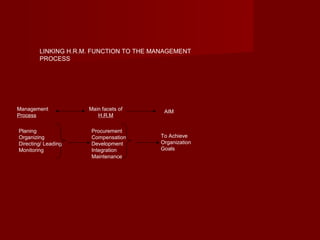
AIMManagement
Process
Main facets of
H.R.M
Planing
Organizing
Directing/ Leading
Monitoring
Procurement
Compensation
Development
Integration
Maintenance
To Achieve
Organization
Goals
LINKING H.R.M. FUNCTION TO THE MANAGEMENT
PROCESS
Management ProcessManagement Process
 Planning: The determination of H.R. systems inPlanning: The determination of H.R. systems in
advance after careful analysis.advance after careful analysis.
 Organizing: Establishment of an organizationOrganizing: Establishment of an organization
necessary to carry out a pre-determinated plannecessary to carry out a pre-determinated plan
(Structures – Systems – Relationship)(Structures – Systems – Relationship)
 Directing: The task of translating a plan intoDirecting: The task of translating a plan into
action.action.
 Monitoring: To ensure that activities are takingMonitoring: To ensure that activities are taking
place according to the plan & take correctiveplace according to the plan & take corrective
measures where necessarymeasures where necessary
Main Facets of HRMMain Facets of HRM
 Procurement: To obtain suitable personnelProcurement: To obtain suitable personnel
 Compensate: To reward for theirCompensate: To reward for their
contributioncontribution
 Development: To train & develop them asDevelopment: To train & develop them as
whole personswhole persons
 Integrate: Harmonize individual'sIntegrate: Harmonize individual's
objectives with organization's object.objectives with organization's object.
 Maintain: To retain them as contendedMaintain: To retain them as contended
employeesemployees
HUMAN RESOURCEHUMAN RESOURCE
MANAGEMENT: DEFINITIONSMANAGEMENT: DEFINITIONS
 "Personnel management is the part of"Personnel management is the part of
management concerned with the peoplemanagement concerned with the people
at work & their relations within theat work & their relations within the
enterprise. It applies not only to industryenterprise. It applies not only to industry
commerce but to all fields of employment"commerce but to all fields of employment"
 I.P.M. (U.K)I.P.M. (U.K)
 "Personnel Management is that function of"Personnel Management is that function of
an enterprise which provides for effectivean enterprise which provides for effective
utilization of Human Resource to achieveutilization of Human Resource to achieve
both objectives of enterprise, satisfaction,both objectives of enterprise, satisfaction,
development of the employee"development of the employee"
– GlueckGlueck
 "Human Resources Management"Human Resources Management
encompasses those objectives designedencompasses those objectives designed
to provide for & Co-ordinate the Humanto provide for & Co-ordinate the Human
Resources of an organization"Resources of an organization"
– Byers & RueByers & Rue
 "Personnel Management is a series of"Personnel Management is a series of
activities which trust enable workingactivities which trust enable working
people and the business which use newpeople and the business which use new
skills to agree about the objectives andskills to agree about the objectives and
nature of their working relationships andnature of their working relationships and
secondly ensures the agreement is fulfilledsecondly ensures the agreement is fulfilled
 Torrinton & HallTorrinton & Hall
Personnel Management Vs.Personnel Management Vs.
HRMHRM
– Difference is really matter of opinionDifference is really matter of opinion
– Similarities greater than differencesSimilarities greater than differences
– In correct to say Old/ Modern or Right/ WrongIn correct to say Old/ Modern or Right/ Wrong
– Human Resource Management is only the re-Human Resource Management is only the re-
positioning of the Personnel Function to meetpositioning of the Personnel Function to meet
emerging demandsemerging demands
– It provides the focusIt provides the focus
 HumanHuman assetasset ManagementManagement
 HumanHuman CapitalCapital ManagementManagement
 HumanHuman TalentTalent ManagementManagement
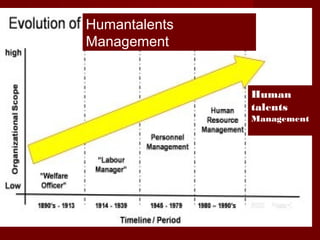
Human
talents
Management
Humantalents
Management
Human Talent ManagementHuman Talent Management
KEY RESULT AREAS OF HRKEY RESULT AREAS OF HR
FUNCTIONFUNCTION
 Human Resource planningHuman Resource planning
– Assessment of present & future requirementsAssessment of present & future requirements
– Recruitment on a planned basisRecruitment on a planned basis
– Continuous control & monitoringContinuous control & monitoring
– Job Analysis, Job Design, Job DescriptionJob Analysis, Job Design, Job Description
and Persons specificationand Persons specification
 Management of compensation systemsManagement of compensation systems
– The determination Salary and wage levelsThe determination Salary and wage levels
– Incentive schemesIncentive schemes
– Fringe benefitsFringe benefits
– Maintenance of competitive terms.Maintenance of competitive terms.
– Employee Cost, ProductivityEmployee Cost, Productivity
 Performance managementPerformance management
– Performance review systemsPerformance review systems
– Progression schemesProgression schemes
– Career planningCareer planning
– Succession planningSuccession planning
 Human resource developmentHuman resource development
– Training & development to meetTraining & development to meet
organizational & individual needs.organizational & individual needs.
– Role of Training & DevelopmentRole of Training & Development
 T & D need analysisT & D need analysis
 Resourcing of TrainingResourcing of Training
 Evaluation of TrainingEvaluation of Training
 Developing and Managing Human TalentDeveloping and Managing Human Talent
 Employee relationsEmployee relations
– Maintenance of disciplineMaintenance of discipline
– Leave & absenteeismLeave & absenteeism
– Employee Communication/ RelationshipsEmployee Communication/ Relationships
– Employee counselling/ GuidanceEmployee counselling/ Guidance
– Industrial safety & HealthIndustrial safety & Health
– Building Employee CommitmentBuilding Employee Commitment
 Employee servicesEmployee services
– Policy on employee welfarePolicy on employee welfare
– Managing Welfare Services (Medical, Loan,Managing Welfare Services (Medical, Loan,
Canteen, Uniform etc.)Canteen, Uniform etc.)
– Work environmentWork environment
– Quality of Work LifeQuality of Work Life
 Industrial RelationsIndustrial Relations
– Union- Management relationsUnion- Management relations
– Collective bargaining/ agreementsCollective bargaining/ agreements
– Grievance settlement procedureGrievance settlement procedure
– Conflict resolutionConflict resolution
 HR Systems procedures & practicesHR Systems procedures & practices
 Maintenance and reviewMaintenance and review
 Changes/ Improvements and formulationChanges/ Improvements and formulation
ROLE OF H.R.M. DIVISIONROLE OF H.R.M. DIVISION
 To formulate implement & monitor H.R. systems inTo formulate implement & monitor H.R. systems in
regard to the management of employees effectively inregard to the management of employees effectively in
order to achieve corporate objectives as well as meetingorder to achieve corporate objectives as well as meeting
the needs and aspirations of employees.the needs and aspirations of employees.
 Assist the line management and collaborate with them inAssist the line management and collaborate with them in
the management of their employees effectively through athe management of their employees effectively through a
process of providing effective H.R.M. services.process of providing effective H.R.M. services.
 Constantly review current H.R.M. systems & change/Constantly review current H.R.M. systems & change/
improve same in order to meet emerging demands of aimprove same in order to meet emerging demands of a
dynamic business environment.dynamic business environment.
ROLE OF HUMAN RESOURCEROLE OF HUMAN RESOURCE
MANAGERMANAGER
 A member of the corporate (top) management teamA member of the corporate (top) management team
 Mission:Mission:
 To plan, organize, execute & monitor all aspects ofTo plan, organize, execute & monitor all aspects of
managing the human resource function and therebymanaging the human resource function and thereby
ensure the optimisation of the human resource in orderensure the optimisation of the human resource in order
to achieve organizational objective, whilst satisfying theto achieve organizational objective, whilst satisfying the
needs & aspirations of employees.needs & aspirations of employees.
 An effective leader/ managerAn effective leader/ manager
 An administratorAn administrator
 A strategistA strategist
 A psychologistA psychologist
 A counsellorA counsellor
 A prophetA prophet
STRATEGIC HUMANSTRATEGIC HUMAN
RESOURCES MANAGEMENTRESOURCES MANAGEMENT
 Employees are central to achieving competitiveEmployees are central to achieving competitive
advantageadvantage
– Core CompetenciesCore Competencies
– Employee CommitmentEmployee Commitment
 Strategic HRM defined asStrategic HRM defined as
 "The linking of HRM with Strategic Goals and"The linking of HRM with Strategic Goals and
Objectives in order to improve BusinessObjectives in order to improve Business
Performance and Develop OrganisationalPerformance and Develop Organisational
Cultures that foster Innovation and Flexibility"Cultures that foster Innovation and Flexibility"
 In other words -In other words -
 The pattern of planned Human ResourceThe pattern of planned Human Resource
Deployment Activities is geared to achieveDeployment Activities is geared to achieve
Organisational GoalsOrganisational Goals
 It is more than providing advice/ consulting or toIt is more than providing advice/ consulting or to
adapt individual HR practices to fit specificadapt individual HR practices to fit specific
corporate and competitive strategies.corporate and competitive strategies.
 HRM should be an equal partner in the StrategicHRM should be an equal partner in the Strategic
Planning Process. In both formulation andPlanning Process. In both formulation and
implementation of the company's organisation-implementation of the company's organisation-
wide and competitive strategies.wide and competitive strategies.
A NEW MANDATE FOR HR –A NEW MANDATE FOR HR –
Dave UlichDave Ulich
 HR has beleaguered reputation. It is saidHR has beleaguered reputation. It is said
that HR is often Ineffective, Incompetentthat HR is often Ineffective, Incompetent
and Costly. It is value sappingand Costly. It is value sapping
 But the truth is HR has never been moreBut the truth is HR has never been more
necessary.necessary.
– Should we do away with HR?Should we do away with HR?
– What should we do with HR?What should we do with HR?
Answer !Answer !
 The answer: Create an entirely new roleThe answer: Create an entirely new role
and agenda for HRand agenda for HR
 Not on traditional activities such asNot on traditional activities such as
Staffing, Compensation but on outcomesStaffing, Compensation but on outcomes
 HR should be defined byHR should be defined by
 Not by what it doesNot by what it does
 But by what it delivers Results that enrichBut by what it delivers Results that enrich
Organisation's value to Customers,Organisation's value to Customers,
Investors and Employees.Investors and Employees.
HR CAN HELP DELIVERHR CAN HELP DELIVER
ORGANISATIONAL EXCELLENCEORGANISATIONAL EXCELLENCE
IN FOUR WAYSIN FOUR WAYS AA partner with senior and line managers in strategypartner with senior and line managers in strategy
execution move planning from conference room toexecution move planning from conference room to
market place.market place.
 To become an exert in the way work is organised andTo become an exert in the way work is organised and
executed provide administrative efficiency reduce cost;executed provide administrative efficiency reduce cost;
enhance qualityenhance quality
 A champion for employees vigorously representing theirA champion for employees vigorously representing their
concerns to senior management at the same timeconcerns to senior management at the same time
working to increase their contribution commitment andworking to increase their contribution commitment and
ability to deliver resultsability to deliver results
 To become an agent of continuous transformation,To become an agent of continuous transformation,
shaping processes a culture that together improve anshaping processes a culture that together improve an
organisation's capacity for change.organisation's capacity for change.
HUMAN RESOURCEHUMAN RESOURCE
MANAGEMENT - FUTUREMANAGEMENT - FUTURE
 Increasingly becoming important & criticalIncreasingly becoming important & critical
for organizational success.for organizational success.
 A distinct discipline; A specialist role.A distinct discipline; A specialist role.
 Role acceptance by top managementRole acceptance by top management
 Role played by the line managementRole played by the line management
 Educated & intelligent workforce, but theEducated & intelligent workforce, but the
education not fitting to organizationaleducation not fitting to organizational
requirements.requirements.
 Volatile workforce with high aspirations.Volatile workforce with high aspirations.
 Industrial relations: Aggressive tradeIndustrial relations: Aggressive trade
unionsunions
 External interferenceExternal interference
 Implications of new technologyImplications of new technology
 People productivityPeople productivity
 Skills in managing people.Skills in managing people.
 Need to add value to HR functionNeed to add value to HR function
 These challenges could be met byThese challenges could be met by
 Positive Attitude/ approach by topPositive Attitude/ approach by top
management.management.
 Involvement of the workforceInvolvement of the workforce
 High degree of professionalism by theHigh degree of professionalism by the
H.R. SpecialistH.R. Specialist
 "The greatest challenge in the business"The greatest challenge in the business
operation in the 21st century will beoperation in the 21st century will be
managing people and not the implicationmanaging people and not the implication
of new technology"of new technology"
J
Jayadeva de Silva
(Humantalents Group)
djayadeva@gmail.com
94 77 272295
For moreFor more
 Obtain free membership todayObtain free membership today
 Send a blank e mail toSend a blank e mail to
 humantalents-subscribe@yahoogroups.comhumantalents-subscribe@yahoogroups.com
QuestionsQuestions
Answer this questionAnswer this question
Should organization view human resourcesShould organization view human resources
from an investment perspective?from an investment perspective?
Discuss the factors that determine theDiscuss the factors that determine the
extent to which an organization isextent to which an organization is
investment oriented in its management ofinvestment oriented in its management of
human resources.human resources.

Managing People at work

  • 2.
    Jayadeva de SilvaJayadevade Silva Human Resource Human ResourceManagement Management Jayadeva de Silva Jayadeva de Silva M.Sc,MBIM,FIPM,FITD M.Sc,MBIM,FIPM,FITD Managing People at Work
  • 3.
  • 4.
  • 5.
    How many F'sdoes theHow many F's does the following passage contain?following passage contain?   Finished files are the resultFinished files are the result of years of scientific studyof years of scientific study combined with the experiencecombined with the experience of years...of years...
  • 6.
    How many F'sdoes theHow many F's does the following passage contain?following passage contain?   Finished files are the resultFinished files are the result of years of scientific studyof years of scientific study combined with the experiencecombined with the experience of years...of years...
  • 7.
    Course Code &TitleCourse Code & Title PGDBMPGDBM 1206 Managing People1206 Managing People HoursHours 45 hours45 hours Number of CreditsNumber of Credits 33
  • 8.
     The aimof this module is to examine aThe aim of this module is to examine a number of topics in the field of humannumber of topics in the field of human resource management from the point ofresource management from the point of view of both theory and practice.view of both theory and practice.  By making extensive use of researchBy making extensive use of research evidence, the module aims to highlight toevidence, the module aims to highlight to managers the problems and dilemmas thatmanagers the problems and dilemmas that can frequently emerge in thecan frequently emerge in the implementation of human resourceimplementation of human resource practices and how to resolve those practicalpractices and how to resolve those practical issues.issues.
  • 9.
    At the completionof this module, studentsAt the completion of this module, students should be able to;should be able to;  gain an understanding of key terms,gain an understanding of key terms, theories/concepts and practices within thetheories/concepts and practices within the field of human resource management.field of human resource management.  identify and analyze problems in the fieldidentify and analyze problems in the field of HRM and be able to provide innovativeof HRM and be able to provide innovative solutions.solutions.  be able to identify and appreciate thebe able to identify and appreciate the significance of ethical issues in HRsignificance of ethical issues in HR practices and the management of people inpractices and the management of people in the workplace.the workplace.
  • 10.
     obtain thepractical skills required byobtain the practical skills required by managers actively engaged in themanagers actively engaged in the strategic management of people withinstrategic management of people within organizations.organizations.  demonstrate competence in skills relateddemonstrate competence in skills related to managing peopleto managing people
  • 11.
     No ofHoursNo of Hours TopicTopic DiscussionDiscussion AreasAreas  6hrs6hrs IntroductionIntroduction   Definition of Human ResourceDefinition of Human Resource  ManagementManagement   Evolution of HRMEvolution of HRM   Functions of HRMFunctions of HRM   Business Strategy and HRMBusiness Strategy and HRM   Human Resource DepartmentHuman Resource Department
  • 12.
     6hrs6hrs EmploymentPlanningEmployment Planning   Job designJob design   Job AnalysisJob Analysis   Human Resource PlanningHuman Resource Planning
  • 13.
     6hrs6hrs EmployeeStaffingEmployee Staffing   RecruitmentRecruitment   SelectionSelection   HiringHiring   Employee InductionEmployee Induction
  • 14.
     9hrs9hrs HumanResourceHuman Resource DevelopmentDevelopment   Employee Performance EvaluationEmployee Performance Evaluation   Training and DevelopmentTraining and Development   Career ManagementCareer Management
  • 15.
     6hrs6hrs RewardManagementReward Management   Pay ManagementPay Management   Employee Welfare ManagementEmployee Welfare Management
  • 16.
     9hrs9hrs Employeeand LabourEmployee and Labour relationsrelations   Health and Safety ManagementHealth and Safety Management   Employee discipline managementEmployee discipline management   Labour Management RelationsLabour Management Relations   Grievance HandlingGrievance Handling
  • 17.
  • 18.
  • 19.
    . Course Text.Course Text Opatha, H.H.D.N.P. (2012) HumanOpatha, H.H.D.N.P. (2012) Human Resource Management 3rd EditionResource Management 3rd Edition Author PublicationAuthor Publication
  • 20.
    Supplementary ReadingsSupplementary Readings AmstrongM. (2012) Hand Book OnAmstrong M. (2012) Hand Book On Human Resource MangementHuman Resource Mangement Practices, 12th Edition Kogan Page,Practices, 12th Edition Kogan Page, London & PhiladelphiaLondon & Philadelphia  Dessler G. (2012) Human ResourceDessler G. (2012) Human Resource Managemnt 13th Edition, Prentice –HallManagemnt 13th Edition, Prentice –Hall India Ltd, New DelhiIndia Ltd, New Delhi
  • 21.
    CD ?CD ? Michael ArmstrongMichael Armstrong Handbook on HUMAN RESOURCEHandbook on HUMAN RESOURCE MANAGEMENT PRACTICEMANAGEMENT PRACTICE
  • 24.
     Jayadeva deSilva- HumantalentsJayadeva de Silva- Humantalents ManagementManagement  http://www.slideshare.net/Jayadeva/humahttp://www.slideshare.net/Jayadeva/huma ntalents-management-byjayadeva-de-silvantalents-management-byjayadeva-de-silva
  • 25.
    Evaluation Strategy:Evaluation Strategy: Studentswill be evaluated on the basis of aStudents will be evaluated on the basis of a group assignment, classroomgroup assignment, classroom assessments, and end-term exam. Theassessments, and end-term exam. The weightage given to each of these units isweightage given to each of these units is listed below:listed below:   Assessments 50%Assessments 50%   End Term Exam 50%End Term Exam 50%
  • 26.
    Instructions to StudentsInstructionsto Students Listen to the Lecture Inputs PPT is used as a Visual Aid only Take your own notes
  • 27.
    A new studyAnew study finds that if youfinds that if you want to betterwant to better absorbabsorb concepts overconcepts over the long-term,the long-term, it’s better toit’s better to take notes bytake notes by hand.hand. Jayadeva de SilvaJayadeva de Silva A message to all students
  • 32.
  • 41.
  • 115.
     Let usrecap what we reviewed so farLet us recap what we reviewed so far
  • 116.
    HISTORICAL PERSPECTIVEHISTORICAL PERSPECTIVE Principles of scientific managementPrinciples of scientific management  (F.W. Taylor)(F.W. Taylor)  Emergence of Human Relations SchoolEmergence of Human Relations School  George Elton Mayo & "Hawthorne experiments".George Elton Mayo & "Hawthorne experiments". This effort comprised of 04 experiments whichThis effort comprised of 04 experiments which indicated that the human factor has an effect onindicated that the human factor has an effect on work, Social needs at work are as important aswork, Social needs at work are as important as work are as important as economic & physicalwork are as important as economic & physical needs.needs.
  • 119.
     Further studieson the human factorFurther studies on the human factor – Abraham Maslow:Abraham Maslow: Hierarchy of NeedsHierarchy of Needs – F. Herzberg:F. Herzberg: 2 Factors Theory – Hygiene2 Factors Theory – Hygiene Factors, Motivational FactorsFactors, Motivational Factors – D. Mac Gregor:D. Mac Gregor: 'X' and 'Y' Theory, "Human'X' and 'Y' Theory, "Human Side of Enterprise"Side of Enterprise" – Blake & Moulton:Blake & Moulton: "Managerial Grid" Styles of"Managerial Grid" Styles of Managerial LeadershipManagerial Leadership
  • 122.
    HUMAN RESOURCEHUMAN RESOURCE MANAGEMENT- CONCEPTMANAGEMENT - CONCEPT  Modern term for personnel management orModern term for personnel management or personnel administration.personnel administration.  It is considered as a resource amongst otherIt is considered as a resource amongst other resources to be utilized, managed to achieveresources to be utilized, managed to achieve organizational objectives.organizational objectives. – Something valuableSomething valuable – To be carefullyTo be carefully – To be compensatedTo be compensated – To be developedTo be developed – To be maintainedTo be maintained – To be retainedTo be retained
  • 123.
    HUMAN RESOURCE INTHEHUMAN RESOURCE IN THE TOTAL MANAGEMENT PROCESSTOTAL MANAGEMENT PROCESS  The significance/ importance of the humanThe significance/ importance of the human resource.resource.  Organization's policy towards managing theOrganization's policy towards managing the Human ResourceHuman Resource – Acceptance by the management that people are anAcceptance by the management that people are an important resourceimportant resource – It is a part of the corporate philosophyIt is a part of the corporate philosophy – However most important is the faithful adherence toHowever most important is the faithful adherence to the principle: This should be manifested in thethe principle: This should be manifested in the behaviour of managers (Leaders)behaviour of managers (Leaders)  Manager's responsibility in achieving resultsManager's responsibility in achieving results through people.through people.
  • 124.
    CORPORATE POLICY ONCORPORATEPOLICY ON HUMAN RESOURCESHUMAN RESOURCES  "Our company considers its employees,"Our company considers its employees, as it's most valuable asset. Theiras it's most valuable asset. Their development, progress, welfare,development, progress, welfare, contentment will receive due priority andcontentment will receive due priority and will be carried out continuously. While thewill be carried out continuously. While the primary objective of the company isprimary objective of the company is achieving steady growth in profitability andachieving steady growth in profitability and asset. It will always be mindful of the needasset. It will always be mindful of the need to maintain, develop and look after itsto maintain, develop and look after its most valuable asset; it's employees."most valuable asset; it's employees."
  • 125.
    AIMManagement Process Main facets of H.R.M Planing Organizing Directing/Leading Monitoring Procurement Compensation Development Integration Maintenance To Achieve Organization Goals LINKING H.R.M. FUNCTION TO THE MANAGEMENT PROCESS
  • 126.
    Management ProcessManagement Process Planning: The determination of H.R. systems inPlanning: The determination of H.R. systems in advance after careful analysis.advance after careful analysis.  Organizing: Establishment of an organizationOrganizing: Establishment of an organization necessary to carry out a pre-determinated plannecessary to carry out a pre-determinated plan (Structures – Systems – Relationship)(Structures – Systems – Relationship)  Directing: The task of translating a plan intoDirecting: The task of translating a plan into action.action.  Monitoring: To ensure that activities are takingMonitoring: To ensure that activities are taking place according to the plan & take correctiveplace according to the plan & take corrective measures where necessarymeasures where necessary
  • 127.
    Main Facets ofHRMMain Facets of HRM  Procurement: To obtain suitable personnelProcurement: To obtain suitable personnel  Compensate: To reward for theirCompensate: To reward for their contributioncontribution  Development: To train & develop them asDevelopment: To train & develop them as whole personswhole persons  Integrate: Harmonize individual'sIntegrate: Harmonize individual's objectives with organization's object.objectives with organization's object.  Maintain: To retain them as contendedMaintain: To retain them as contended employeesemployees
  • 128.
    HUMAN RESOURCEHUMAN RESOURCE MANAGEMENT:DEFINITIONSMANAGEMENT: DEFINITIONS  "Personnel management is the part of"Personnel management is the part of management concerned with the peoplemanagement concerned with the people at work & their relations within theat work & their relations within the enterprise. It applies not only to industryenterprise. It applies not only to industry commerce but to all fields of employment"commerce but to all fields of employment"  I.P.M. (U.K)I.P.M. (U.K)
  • 129.
     "Personnel Managementis that function of"Personnel Management is that function of an enterprise which provides for effectivean enterprise which provides for effective utilization of Human Resource to achieveutilization of Human Resource to achieve both objectives of enterprise, satisfaction,both objectives of enterprise, satisfaction, development of the employee"development of the employee" – GlueckGlueck
  • 130.
     "Human ResourcesManagement"Human Resources Management encompasses those objectives designedencompasses those objectives designed to provide for & Co-ordinate the Humanto provide for & Co-ordinate the Human Resources of an organization"Resources of an organization" – Byers & RueByers & Rue
  • 131.
     "Personnel Managementis a series of"Personnel Management is a series of activities which trust enable workingactivities which trust enable working people and the business which use newpeople and the business which use new skills to agree about the objectives andskills to agree about the objectives and nature of their working relationships andnature of their working relationships and secondly ensures the agreement is fulfilledsecondly ensures the agreement is fulfilled  Torrinton & HallTorrinton & Hall
  • 132.
    Personnel Management Vs.PersonnelManagement Vs. HRMHRM – Difference is really matter of opinionDifference is really matter of opinion – Similarities greater than differencesSimilarities greater than differences – In correct to say Old/ Modern or Right/ WrongIn correct to say Old/ Modern or Right/ Wrong – Human Resource Management is only the re-Human Resource Management is only the re- positioning of the Personnel Function to meetpositioning of the Personnel Function to meet emerging demandsemerging demands – It provides the focusIt provides the focus  HumanHuman assetasset ManagementManagement  HumanHuman CapitalCapital ManagementManagement  HumanHuman TalentTalent ManagementManagement
  • 133.
  • 134.
  • 135.
    KEY RESULT AREASOF HRKEY RESULT AREAS OF HR FUNCTIONFUNCTION  Human Resource planningHuman Resource planning – Assessment of present & future requirementsAssessment of present & future requirements – Recruitment on a planned basisRecruitment on a planned basis – Continuous control & monitoringContinuous control & monitoring – Job Analysis, Job Design, Job DescriptionJob Analysis, Job Design, Job Description and Persons specificationand Persons specification
  • 136.
     Management ofcompensation systemsManagement of compensation systems – The determination Salary and wage levelsThe determination Salary and wage levels – Incentive schemesIncentive schemes – Fringe benefitsFringe benefits – Maintenance of competitive terms.Maintenance of competitive terms. – Employee Cost, ProductivityEmployee Cost, Productivity  Performance managementPerformance management – Performance review systemsPerformance review systems – Progression schemesProgression schemes – Career planningCareer planning – Succession planningSuccession planning
  • 137.
     Human resourcedevelopmentHuman resource development – Training & development to meetTraining & development to meet organizational & individual needs.organizational & individual needs. – Role of Training & DevelopmentRole of Training & Development  T & D need analysisT & D need analysis  Resourcing of TrainingResourcing of Training  Evaluation of TrainingEvaluation of Training  Developing and Managing Human TalentDeveloping and Managing Human Talent
  • 138.
     Employee relationsEmployeerelations – Maintenance of disciplineMaintenance of discipline – Leave & absenteeismLeave & absenteeism – Employee Communication/ RelationshipsEmployee Communication/ Relationships – Employee counselling/ GuidanceEmployee counselling/ Guidance – Industrial safety & HealthIndustrial safety & Health – Building Employee CommitmentBuilding Employee Commitment
  • 139.
     Employee servicesEmployeeservices – Policy on employee welfarePolicy on employee welfare – Managing Welfare Services (Medical, Loan,Managing Welfare Services (Medical, Loan, Canteen, Uniform etc.)Canteen, Uniform etc.) – Work environmentWork environment – Quality of Work LifeQuality of Work Life
  • 140.
     Industrial RelationsIndustrialRelations – Union- Management relationsUnion- Management relations – Collective bargaining/ agreementsCollective bargaining/ agreements – Grievance settlement procedureGrievance settlement procedure – Conflict resolutionConflict resolution
  • 141.
     HR Systemsprocedures & practicesHR Systems procedures & practices  Maintenance and reviewMaintenance and review  Changes/ Improvements and formulationChanges/ Improvements and formulation
  • 142.
    ROLE OF H.R.M.DIVISIONROLE OF H.R.M. DIVISION  To formulate implement & monitor H.R. systems inTo formulate implement & monitor H.R. systems in regard to the management of employees effectively inregard to the management of employees effectively in order to achieve corporate objectives as well as meetingorder to achieve corporate objectives as well as meeting the needs and aspirations of employees.the needs and aspirations of employees.  Assist the line management and collaborate with them inAssist the line management and collaborate with them in the management of their employees effectively through athe management of their employees effectively through a process of providing effective H.R.M. services.process of providing effective H.R.M. services.  Constantly review current H.R.M. systems & change/Constantly review current H.R.M. systems & change/ improve same in order to meet emerging demands of aimprove same in order to meet emerging demands of a dynamic business environment.dynamic business environment.
  • 143.
    ROLE OF HUMANRESOURCEROLE OF HUMAN RESOURCE MANAGERMANAGER  A member of the corporate (top) management teamA member of the corporate (top) management team  Mission:Mission:  To plan, organize, execute & monitor all aspects ofTo plan, organize, execute & monitor all aspects of managing the human resource function and therebymanaging the human resource function and thereby ensure the optimisation of the human resource in orderensure the optimisation of the human resource in order to achieve organizational objective, whilst satisfying theto achieve organizational objective, whilst satisfying the needs & aspirations of employees.needs & aspirations of employees.  An effective leader/ managerAn effective leader/ manager  An administratorAn administrator  A strategistA strategist  A psychologistA psychologist  A counsellorA counsellor  A prophetA prophet
  • 144.
    STRATEGIC HUMANSTRATEGIC HUMAN RESOURCESMANAGEMENTRESOURCES MANAGEMENT  Employees are central to achieving competitiveEmployees are central to achieving competitive advantageadvantage – Core CompetenciesCore Competencies – Employee CommitmentEmployee Commitment  Strategic HRM defined asStrategic HRM defined as  "The linking of HRM with Strategic Goals and"The linking of HRM with Strategic Goals and Objectives in order to improve BusinessObjectives in order to improve Business Performance and Develop OrganisationalPerformance and Develop Organisational Cultures that foster Innovation and Flexibility"Cultures that foster Innovation and Flexibility"
  • 145.
     In otherwords -In other words -  The pattern of planned Human ResourceThe pattern of planned Human Resource Deployment Activities is geared to achieveDeployment Activities is geared to achieve Organisational GoalsOrganisational Goals  It is more than providing advice/ consulting or toIt is more than providing advice/ consulting or to adapt individual HR practices to fit specificadapt individual HR practices to fit specific corporate and competitive strategies.corporate and competitive strategies.  HRM should be an equal partner in the StrategicHRM should be an equal partner in the Strategic Planning Process. In both formulation andPlanning Process. In both formulation and implementation of the company's organisation-implementation of the company's organisation- wide and competitive strategies.wide and competitive strategies.
  • 146.
    A NEW MANDATEFOR HR –A NEW MANDATE FOR HR – Dave UlichDave Ulich  HR has beleaguered reputation. It is saidHR has beleaguered reputation. It is said that HR is often Ineffective, Incompetentthat HR is often Ineffective, Incompetent and Costly. It is value sappingand Costly. It is value sapping  But the truth is HR has never been moreBut the truth is HR has never been more necessary.necessary. – Should we do away with HR?Should we do away with HR? – What should we do with HR?What should we do with HR?
  • 147.
    Answer !Answer ! The answer: Create an entirely new roleThe answer: Create an entirely new role and agenda for HRand agenda for HR  Not on traditional activities such asNot on traditional activities such as Staffing, Compensation but on outcomesStaffing, Compensation but on outcomes  HR should be defined byHR should be defined by  Not by what it doesNot by what it does  But by what it delivers Results that enrichBut by what it delivers Results that enrich Organisation's value to Customers,Organisation's value to Customers, Investors and Employees.Investors and Employees.
  • 148.
    HR CAN HELPDELIVERHR CAN HELP DELIVER ORGANISATIONAL EXCELLENCEORGANISATIONAL EXCELLENCE IN FOUR WAYSIN FOUR WAYS AA partner with senior and line managers in strategypartner with senior and line managers in strategy execution move planning from conference room toexecution move planning from conference room to market place.market place.  To become an exert in the way work is organised andTo become an exert in the way work is organised and executed provide administrative efficiency reduce cost;executed provide administrative efficiency reduce cost; enhance qualityenhance quality  A champion for employees vigorously representing theirA champion for employees vigorously representing their concerns to senior management at the same timeconcerns to senior management at the same time working to increase their contribution commitment andworking to increase their contribution commitment and ability to deliver resultsability to deliver results  To become an agent of continuous transformation,To become an agent of continuous transformation, shaping processes a culture that together improve anshaping processes a culture that together improve an organisation's capacity for change.organisation's capacity for change.
  • 149.
    HUMAN RESOURCEHUMAN RESOURCE MANAGEMENT- FUTUREMANAGEMENT - FUTURE  Increasingly becoming important & criticalIncreasingly becoming important & critical for organizational success.for organizational success.  A distinct discipline; A specialist role.A distinct discipline; A specialist role.  Role acceptance by top managementRole acceptance by top management  Role played by the line managementRole played by the line management
  • 150.
     Educated &intelligent workforce, but theEducated & intelligent workforce, but the education not fitting to organizationaleducation not fitting to organizational requirements.requirements.  Volatile workforce with high aspirations.Volatile workforce with high aspirations.  Industrial relations: Aggressive tradeIndustrial relations: Aggressive trade unionsunions  External interferenceExternal interference
  • 151.
     Implications ofnew technologyImplications of new technology  People productivityPeople productivity  Skills in managing people.Skills in managing people.  Need to add value to HR functionNeed to add value to HR function  These challenges could be met byThese challenges could be met by
  • 152.
     Positive Attitude/approach by topPositive Attitude/ approach by top management.management.  Involvement of the workforceInvolvement of the workforce  High degree of professionalism by theHigh degree of professionalism by the H.R. SpecialistH.R. Specialist  "The greatest challenge in the business"The greatest challenge in the business operation in the 21st century will beoperation in the 21st century will be managing people and not the implicationmanaging people and not the implication of new technology"of new technology"
  • 153.
    J Jayadeva de Silva (HumantalentsGroup) djayadeva@gmail.com 94 77 272295
  • 155.
    For moreFor more Obtain free membership todayObtain free membership today  Send a blank e mail toSend a blank e mail to  humantalents-subscribe@yahoogroups.comhumantalents-subscribe@yahoogroups.com
  • 156.
  • 157.
    Answer this questionAnswerthis question Should organization view human resourcesShould organization view human resources from an investment perspective?from an investment perspective? Discuss the factors that determine theDiscuss the factors that determine the extent to which an organization isextent to which an organization is investment oriented in its management ofinvestment oriented in its management of human resources.human resources.