Chapter 8 Managing Human Resources Leonardo Matarrese @MyPlick
The Foundations of Human Resource Management (HRM) Human Resource Management (HRM)    Set of organizational activities directed at attracting, developing, and maintaining an effective workforce Leonardo Matarrese @MyPlick
The Strategic Importance of HRM HRM’s importance has grown dramatically in the last two decades. This new importance stems from:  Increased legal complexities The recognition that human resources are a valuable means for improving productivity The awareness today of the costs associated with poor human resource management Leonardo Matarrese @MyPlick
Human Resource Planning  HR planning involves  job analysis  and  forecasting   the demand for and supply of labor. Job Analysis  Systematic analysis of jobs in an organization Job Description  Systematic evaluation of the duties, working conditions, tools, materials, and equipment related to the performance of a job Job Specification   Description of the skills, abilities, and other credentials required by a job Leonardo Matarrese @MyPlick
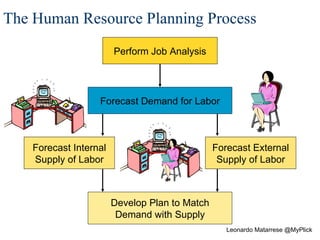
The Human Resource Planning Process  Perform Job Analysis Forecast Demand for Labor Forecast Internal Supply of Labor Develop Plan to Match Demand with Supply Forecast External Supply of Labor Leonardo Matarrese @MyPlick
Forecasting HR Demand & Supply Forecasting the supply of labor is really two tasks:  Forecasting Internal Supply The number and type of employees who will be in the firm at some future date Forecasting External Supply The number and type of  people who will be available for hiring from the labor market at large Leonardo Matarrese @MyPlick
Forecasting HR Demand & Supply Replacement Charts Listing of each managerial position, who occupies it, how long that person will likely stay in the job, and who is qualified as a replacement Employee Information System (or Skills Inventory) Computerized system containing information on each employee’s education, skills, work experiences, and career aspirations Leonardo Matarrese @MyPlick
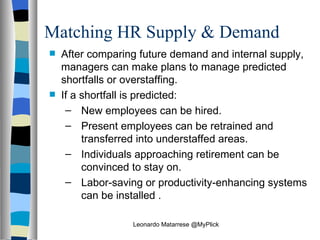
Matching HR Supply & Demand After comparing future demand and internal supply, managers can make plans to manage predicted shortfalls or overstaffing.  If a shortfall is predicted: New employees can be hired. Present employees can be retrained and transferred into understaffed areas. Individuals approaching retirement can be convinced to stay on. Labor-saving or productivity-enhancing systems can be installed . Leonardo Matarrese @MyPlick
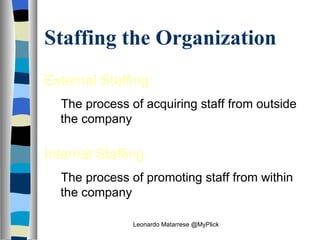
Staffing the Organization External Staffing The process of acquiring staff from outside the company Internal Staffing The process of promoting staff from within the company Leonardo Matarrese @MyPlick
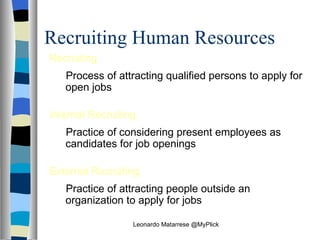
Recruiting Human Resources Recruiting Process of attracting qualified persons to apply for open jobs Internal Recruiting Practice of considering present employees as candidates for job openings External Recruiting Practice of attracting people outside an organization to apply for jobs Leonardo Matarrese @MyPlick
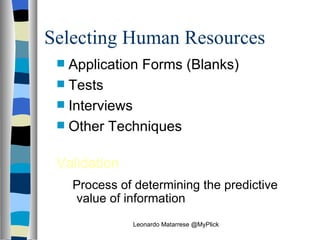
Selecting Human Resources Application Forms (Blanks) Tests Interviews Other Techniques Validation   Process of determining the predictive value of information Leonardo Matarrese @MyPlick
Developing Human Resources Orientation   Process of introducing new employees to the organization so that they can become effective contributors more quickly. Leonardo Matarrese @MyPlick
Assessing Training & Development Needs Needs Analysis Determines the organization’s true needs and the training programs necessary to meet them What knowledge, skills, and abilities does the organization need to compete?  What skills must its workforce possess in order to perform the organization’s work effectively? Leonardo Matarrese @MyPlick
Training & Development Techniques & Methods Work-Based Program    Training technique that ties training and development activities directly to task performance On-the-Job Training:   Work‑based training, sometimes informal, conducted while an employee is in actual work situation Vestibule Training:   Worked‑based training conducted in a simulated environment away from the work site Systematic Job Rotation & Transfer:   Work‑based training in which employees are systematically moved from one job to another so that they can learn a wider array of tasks and skills Leonardo Matarrese @MyPlick
Training & Development Techniques & Methods Instructional-Based Program   Training designed to impart new knowledge and information Lecture or Discussion Approach:  Instructional‑based training in which knowledge and information are descriptively presented Computer-Assisted Training:  Instruction‑based training in which is knowledge and information are presented via computer  Leonardo Matarrese @MyPlick
Training & Development Techniques & Methods Training Technology Video Teleconferencing Trainers in centralized locations deliver material live by satellite hookup to remote sites  Interactive Video Material is presented via video technology on a monitor from a central serving mechanism, a video disk, CD-ROM, or web site   Leonardo Matarrese @MyPlick
Training & Development Techniques & Methods Team Building & Group‑Based Training More and more organizations are using teams as a basis for doing their jobs. Many of the same companies are developing training programs specifically designed to facilitate intragroup cooperation among members of teams.  Leonardo Matarrese @MyPlick
Evaluating Employee Performance Performance Appraisal Formal evaluation of an employee’s job performance in order to determine the degree to which the employee is performing effectively Leonardo Matarrese @MyPlick
The Performance Appraisal Process Conducting the Performance Appraisal Who should conduct the performance appraisal? What sources of information should be used? Providing Feedback 360° Feedback:  Performance appraisal system in which information is provided from all sources—supervisors, employees, peers, and so forth  Leonardo Matarrese @MyPlick
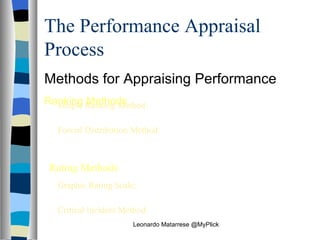
The Performance Appraisal Process Methods for Appraising Performance Ranking Methods Simple Ranking Method:  Performance appraisal method that ranks employees from best to worst Forced Distribution Method:  Performance appraisal method that classifies employees into different performance categories based on a predetermined distribution Rating Methods Graphic Rating Scale:  Performance rating method using a numerical scale to rate performance along a set of dimensions Critical Incident Method:  Performance rating method based on stated examples that reflect especially good or poor performance   Leonardo Matarrese @MyPlick
Providing Compensation & Benefits  Compensation   Set of rewards that organizations provide to individuals in return for their willingness to perform various jobs and tasks   Leonardo Matarrese @MyPlick
Determining Basic Compensation Basic Compensation The base level of wages or salary paid to an employee Wages:  Compensation in the form of money paid for time worked Salary:  Compensation in the form of money paid for discharging the responsibilities of a job Leonardo Matarrese @MyPlick
Determining Basic Compensation Pay Surveys in Compensation Method used to obtain information about compensation paid to employees by other employers  Job Evaluation Methods for determining the relative worth of jobs in order to set compensation levels Establishing a Pay Structure Compensation for different jobs is based on the organization’s assessment of the relative value to the organization of each job class. Leonardo Matarrese @MyPlick
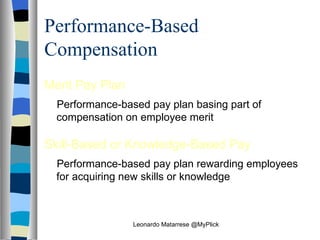
Performance-Based Compensation Merit Pay Plan   Performance‑based pay plan basing part of compensation on employee merit Skill-Based or Knowledge-Based Pay   Performance‑based pay plan rewarding employees for acquiring new skills or knowledge Leonardo Matarrese @MyPlick
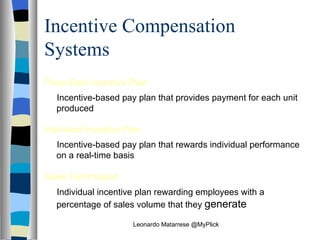
Incentive Compensation Systems   Piece-Rate Incentive Plan   Incentive‑based pay plan that provides payment for each unit produced Individual Incentive Plan   Incentive‑based pay plan that rewards individual performance on a real-time basis Sales Commission   Individual incentive plan rewarding employees with a percentage of sales volume that they  generate Leonardo Matarrese @MyPlick
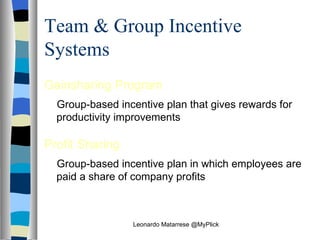
Team & Group Incentive Systems Gainsharing Program   Group‑based incentive plan that gives rewards for productivity improvements Profit Sharing   Group‑based incentive plan in which employees are paid a share of company profits Leonardo Matarrese @MyPlick
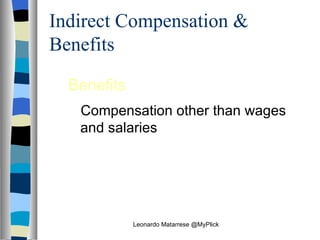
Indirect Compensation & Benefits Benefits Compensation other than wages and salaries Leonardo Matarrese @MyPlick
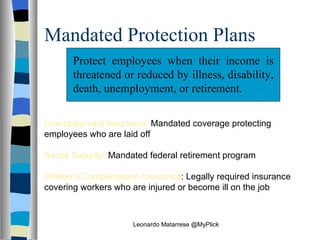
Mandated Protection Plans Unemployment Insurance:  Mandated coverage protecting employees who are laid off Social Security:  Mandated federal retirement program Worker’s Compensation Insurance : Legally required insurance covering workers who are injured or become ill on the job Protect employees when their income is threatened or reduced by illness, disability, death, unemployment, or retirement. Leonardo Matarrese @MyPlick
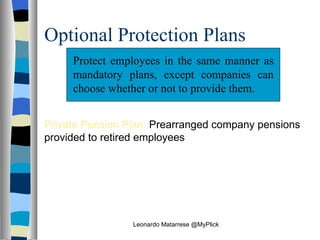
Optional Protection Plans Private Pension Plan:  Prearranged company pensions provided to retired employees Protect employees in the same manner as mandatory plans, except companies can choose whether or not to provide them. Leonardo Matarrese @MyPlick
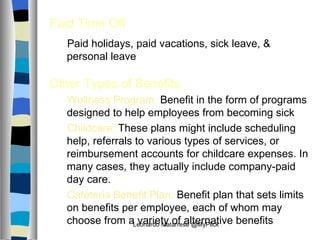
Paid Time Off Paid holidays, paid vacations, sick leave, & personal leave Other Types of Benefits Wellness Program:  Benefit in the form of programs designed to help employees from becoming sick Childcare:   These plans might include scheduling help, referrals to various types of services, or reimbursement accounts for childcare expenses. In many cases, they actually include company‑paid day care.  Cafeteria Benefit Plan:  Benefit plan that sets limits on benefits per employee, each of whom may choose from a variety of alternative benefits  Leonardo Matarrese @MyPlick
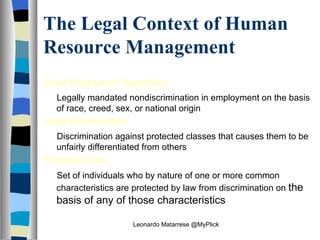
The Legal Context of Human Resource Management Equal Employment Opportunity Legally mandated nondiscrimination in employment on the basis of race, creed, sex, or national origin Illegal Discrimination Discrimination against protected classes that causes them to be unfairly differentiated from others Protected Class Set of individuals who by nature of one or more common characteristics are protected by law from discrimination on  the basis of any of those characteristics Leonardo Matarrese @MyPlick
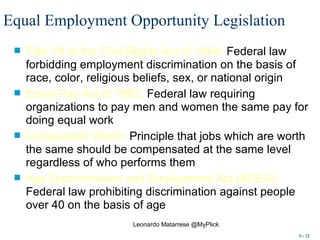
Equal Employment Opportunity Legislation   Title VII of the Civil Rights Act of 1964:  Federal law forbidding employment discrimination on the basis of race, color, religious beliefs, sex, or national origin Equal Pay Act of 1963:  Federal law requiring organizations to pay men and women the same pay for doing equal work Comparable Worth:  Principle that jobs which are worth the same should be compensated at the same level regardless of who performs them Age Discrimination and Employment Act (ADEA):  Federal law prohibiting discrimination against people over 40 on the basis of age 8 -  Leonardo Matarrese @MyPlick
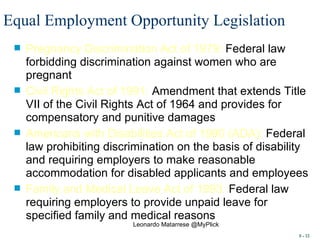
Equal Employment Opportunity Legislation   Pregnancy Discrimination Act of 1979:  Federal law forbidding discrimination against women who are pregnant  Civil Rights Act of 1991:  Amendment that extends Title VII of the Civil Rights Act of 1964 and provides for compensatory and punitive damages Americans with Disabilities Act of 1990 (ADA):  Federal law prohibiting discrimination on the basis of disability and requiring employers to make reasonable accommodation for disabled applicants and employees Family and Medical Leave Act of 1993:  Federal law requiring employers to provide unpaid leave for specified family and medical reasons 8 -  Leonardo Matarrese @MyPlick
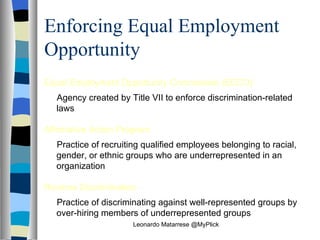
Enforcing Equal Employment Opportunity Equal Employment Opportunity Commission (EECO)  Agency created by Title VII to enforce discrimination-related laws Affirmative Action Program   Practice of recruiting qualified employees belonging to racial, gender, or ethnic groups who are underrepresented in an organization Reverse Discrimination   Practice of discriminating against well-represented groups by over-hiring members of underrepresented groups Leonardo Matarrese @MyPlick
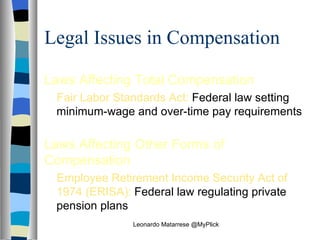
Legal Issues in Compensation Laws Affecting Total Compensation Fair Labor Standards Act:  Federal law setting minimum‑wage and over‑time pay requirements Laws Affecting Other Forms of Compensation Employee Retirement Income Security Act of 1974 (ERISA):  Federal law regulating private pension plans Leonardo Matarrese @MyPlick
Contemporary Legal Issues in HR Management Occupational Safety and Health Act of 1970 (OSHA) Federal law setting and enforcing guidelines for protecting workers from unsafe conditions and potential health hazards in the workplace Emerging Areas of Discrimination Law AIDS in the Workplace Sexual Harassment Quid Pro Quo Harassment Hostile Work Environment Employment-at-Will Leonardo Matarrese @MyPlick
New Challenges in the Changing Workplace Managing Workforce Diversity  Range of workers’ attitudes, values, and behaviors that differ by gender, race, and ethnicity  Leonardo Matarrese @MyPlick
New Challenges in the Changing Workplace Managing Knowledge Workers Employee who is of value because of the knowledge that he or she possesses Leonardo Matarrese @MyPlick
New Challenges in the Changing Workplace Contingent Worker   Employee hired on something other than a full-time basis to supplement an organization’s permanent work force Leonardo Matarrese @MyPlick

Managing HR - Leonardo Matarrese

  • 1.
    Chapter 8 ManagingHuman Resources Leonardo Matarrese @MyPlick
  • 2.
    The Foundations ofHuman Resource Management (HRM) Human Resource Management (HRM)    Set of organizational activities directed at attracting, developing, and maintaining an effective workforce Leonardo Matarrese @MyPlick
  • 3.
    The Strategic Importanceof HRM HRM’s importance has grown dramatically in the last two decades. This new importance stems from: Increased legal complexities The recognition that human resources are a valuable means for improving productivity The awareness today of the costs associated with poor human resource management Leonardo Matarrese @MyPlick
  • 4.
    Human Resource Planning HR planning involves job analysis and forecasting the demand for and supply of labor. Job Analysis Systematic analysis of jobs in an organization Job Description  Systematic evaluation of the duties, working conditions, tools, materials, and equipment related to the performance of a job Job Specification   Description of the skills, abilities, and other credentials required by a job Leonardo Matarrese @MyPlick
  • 5.
    The Human ResourcePlanning Process Perform Job Analysis Forecast Demand for Labor Forecast Internal Supply of Labor Develop Plan to Match Demand with Supply Forecast External Supply of Labor Leonardo Matarrese @MyPlick
  • 6.
    Forecasting HR Demand& Supply Forecasting the supply of labor is really two tasks: Forecasting Internal Supply The number and type of employees who will be in the firm at some future date Forecasting External Supply The number and type of people who will be available for hiring from the labor market at large Leonardo Matarrese @MyPlick
  • 7.
    Forecasting HR Demand& Supply Replacement Charts Listing of each managerial position, who occupies it, how long that person will likely stay in the job, and who is qualified as a replacement Employee Information System (or Skills Inventory) Computerized system containing information on each employee’s education, skills, work experiences, and career aspirations Leonardo Matarrese @MyPlick
  • 8.
    Matching HR Supply& Demand After comparing future demand and internal supply, managers can make plans to manage predicted shortfalls or overstaffing. If a shortfall is predicted: New employees can be hired. Present employees can be retrained and transferred into understaffed areas. Individuals approaching retirement can be convinced to stay on. Labor-saving or productivity-enhancing systems can be installed . Leonardo Matarrese @MyPlick
  • 9.
    Staffing the OrganizationExternal Staffing The process of acquiring staff from outside the company Internal Staffing The process of promoting staff from within the company Leonardo Matarrese @MyPlick
  • 10.
    Recruiting Human ResourcesRecruiting Process of attracting qualified persons to apply for open jobs Internal Recruiting Practice of considering present employees as candidates for job openings External Recruiting Practice of attracting people outside an organization to apply for jobs Leonardo Matarrese @MyPlick
  • 11.
    Selecting Human ResourcesApplication Forms (Blanks) Tests Interviews Other Techniques Validation   Process of determining the predictive value of information Leonardo Matarrese @MyPlick
  • 12.
    Developing Human ResourcesOrientation   Process of introducing new employees to the organization so that they can become effective contributors more quickly. Leonardo Matarrese @MyPlick
  • 13.
    Assessing Training &Development Needs Needs Analysis Determines the organization’s true needs and the training programs necessary to meet them What knowledge, skills, and abilities does the organization need to compete? What skills must its workforce possess in order to perform the organization’s work effectively? Leonardo Matarrese @MyPlick
  • 14.
    Training & DevelopmentTechniques & Methods Work-Based Program    Training technique that ties training and development activities directly to task performance On-the-Job Training: Work‑based training, sometimes informal, conducted while an employee is in actual work situation Vestibule Training: Worked‑based training conducted in a simulated environment away from the work site Systematic Job Rotation & Transfer: Work‑based training in which employees are systematically moved from one job to another so that they can learn a wider array of tasks and skills Leonardo Matarrese @MyPlick
  • 15.
    Training & DevelopmentTechniques & Methods Instructional-Based Program   Training designed to impart new knowledge and information Lecture or Discussion Approach: Instructional‑based training in which knowledge and information are descriptively presented Computer-Assisted Training: Instruction‑based training in which is knowledge and information are presented via computer Leonardo Matarrese @MyPlick
  • 16.
    Training & DevelopmentTechniques & Methods Training Technology Video Teleconferencing Trainers in centralized locations deliver material live by satellite hookup to remote sites Interactive Video Material is presented via video technology on a monitor from a central serving mechanism, a video disk, CD-ROM, or web site Leonardo Matarrese @MyPlick
  • 17.
    Training & DevelopmentTechniques & Methods Team Building & Group‑Based Training More and more organizations are using teams as a basis for doing their jobs. Many of the same companies are developing training programs specifically designed to facilitate intragroup cooperation among members of teams. Leonardo Matarrese @MyPlick
  • 18.
    Evaluating Employee PerformancePerformance Appraisal Formal evaluation of an employee’s job performance in order to determine the degree to which the employee is performing effectively Leonardo Matarrese @MyPlick
  • 19.
    The Performance AppraisalProcess Conducting the Performance Appraisal Who should conduct the performance appraisal? What sources of information should be used? Providing Feedback 360° Feedback: Performance appraisal system in which information is provided from all sources—supervisors, employees, peers, and so forth Leonardo Matarrese @MyPlick
  • 20.
    The Performance AppraisalProcess Methods for Appraising Performance Ranking Methods Simple Ranking Method: Performance appraisal method that ranks employees from best to worst Forced Distribution Method: Performance appraisal method that classifies employees into different performance categories based on a predetermined distribution Rating Methods Graphic Rating Scale: Performance rating method using a numerical scale to rate performance along a set of dimensions Critical Incident Method: Performance rating method based on stated examples that reflect especially good or poor performance Leonardo Matarrese @MyPlick
  • 21.
    Providing Compensation &Benefits Compensation   Set of rewards that organizations provide to individuals in return for their willingness to perform various jobs and tasks Leonardo Matarrese @MyPlick
  • 22.
    Determining Basic CompensationBasic Compensation The base level of wages or salary paid to an employee Wages: Compensation in the form of money paid for time worked Salary: Compensation in the form of money paid for discharging the responsibilities of a job Leonardo Matarrese @MyPlick
  • 23.
    Determining Basic CompensationPay Surveys in Compensation Method used to obtain information about compensation paid to employees by other employers Job Evaluation Methods for determining the relative worth of jobs in order to set compensation levels Establishing a Pay Structure Compensation for different jobs is based on the organization’s assessment of the relative value to the organization of each job class. Leonardo Matarrese @MyPlick
  • 24.
    Performance-Based Compensation MeritPay Plan   Performance‑based pay plan basing part of compensation on employee merit Skill-Based or Knowledge-Based Pay   Performance‑based pay plan rewarding employees for acquiring new skills or knowledge Leonardo Matarrese @MyPlick
  • 25.
    Incentive Compensation Systems  Piece-Rate Incentive Plan   Incentive‑based pay plan that provides payment for each unit produced Individual Incentive Plan   Incentive‑based pay plan that rewards individual performance on a real-time basis Sales Commission   Individual incentive plan rewarding employees with a percentage of sales volume that they generate Leonardo Matarrese @MyPlick
  • 26.
    Team & GroupIncentive Systems Gainsharing Program   Group‑based incentive plan that gives rewards for productivity improvements Profit Sharing   Group‑based incentive plan in which employees are paid a share of company profits Leonardo Matarrese @MyPlick
  • 27.
    Indirect Compensation &Benefits Benefits Compensation other than wages and salaries Leonardo Matarrese @MyPlick
  • 28.
    Mandated Protection PlansUnemployment Insurance: Mandated coverage protecting employees who are laid off Social Security: Mandated federal retirement program Worker’s Compensation Insurance : Legally required insurance covering workers who are injured or become ill on the job Protect employees when their income is threatened or reduced by illness, disability, death, unemployment, or retirement. Leonardo Matarrese @MyPlick
  • 29.
    Optional Protection PlansPrivate Pension Plan:  Prearranged company pensions provided to retired employees Protect employees in the same manner as mandatory plans, except companies can choose whether or not to provide them. Leonardo Matarrese @MyPlick
  • 30.
    Paid Time OffPaid holidays, paid vacations, sick leave, & personal leave Other Types of Benefits Wellness Program:  Benefit in the form of programs designed to help employees from becoming sick Childcare: These plans might include scheduling help, referrals to various types of services, or reimbursement accounts for childcare expenses. In many cases, they actually include company‑paid day care. Cafeteria Benefit Plan:  Benefit plan that sets limits on benefits per employee, each of whom may choose from a variety of alternative benefits Leonardo Matarrese @MyPlick
  • 31.
    The Legal Contextof Human Resource Management Equal Employment Opportunity Legally mandated nondiscrimination in employment on the basis of race, creed, sex, or national origin Illegal Discrimination Discrimination against protected classes that causes them to be unfairly differentiated from others Protected Class Set of individuals who by nature of one or more common characteristics are protected by law from discrimination on the basis of any of those characteristics Leonardo Matarrese @MyPlick
  • 32.
    Equal Employment OpportunityLegislation   Title VII of the Civil Rights Act of 1964: Federal law forbidding employment discrimination on the basis of race, color, religious beliefs, sex, or national origin Equal Pay Act of 1963: Federal law requiring organizations to pay men and women the same pay for doing equal work Comparable Worth:  Principle that jobs which are worth the same should be compensated at the same level regardless of who performs them Age Discrimination and Employment Act (ADEA): Federal law prohibiting discrimination against people over 40 on the basis of age 8 - Leonardo Matarrese @MyPlick
  • 33.
    Equal Employment OpportunityLegislation   Pregnancy Discrimination Act of 1979: Federal law forbidding discrimination against women who are pregnant Civil Rights Act of 1991: Amendment that extends Title VII of the Civil Rights Act of 1964 and provides for compensatory and punitive damages Americans with Disabilities Act of 1990 (ADA): Federal law prohibiting discrimination on the basis of disability and requiring employers to make reasonable accommodation for disabled applicants and employees Family and Medical Leave Act of 1993: Federal law requiring employers to provide unpaid leave for specified family and medical reasons 8 - Leonardo Matarrese @MyPlick
  • 34.
    Enforcing Equal EmploymentOpportunity Equal Employment Opportunity Commission (EECO)  Agency created by Title VII to enforce discrimination-related laws Affirmative Action Program   Practice of recruiting qualified employees belonging to racial, gender, or ethnic groups who are underrepresented in an organization Reverse Discrimination   Practice of discriminating against well-represented groups by over-hiring members of underrepresented groups Leonardo Matarrese @MyPlick
  • 35.
    Legal Issues inCompensation Laws Affecting Total Compensation Fair Labor Standards Act: Federal law setting minimum‑wage and over‑time pay requirements Laws Affecting Other Forms of Compensation Employee Retirement Income Security Act of 1974 (ERISA): Federal law regulating private pension plans Leonardo Matarrese @MyPlick
  • 36.
    Contemporary Legal Issuesin HR Management Occupational Safety and Health Act of 1970 (OSHA) Federal law setting and enforcing guidelines for protecting workers from unsafe conditions and potential health hazards in the workplace Emerging Areas of Discrimination Law AIDS in the Workplace Sexual Harassment Quid Pro Quo Harassment Hostile Work Environment Employment-at-Will Leonardo Matarrese @MyPlick
  • 37.
    New Challenges inthe Changing Workplace Managing Workforce Diversity Range of workers’ attitudes, values, and behaviors that differ by gender, race, and ethnicity Leonardo Matarrese @MyPlick
  • 38.
    New Challenges inthe Changing Workplace Managing Knowledge Workers Employee who is of value because of the knowledge that he or she possesses Leonardo Matarrese @MyPlick
  • 39.
    New Challenges inthe Changing Workplace Contingent Worker   Employee hired on something other than a full-time basis to supplement an organization’s permanent work force Leonardo Matarrese @MyPlick