Managing HR Issues Relating to
Reforms
Dr. Elijah Ezendu
FIMC, FCCM, FIIAN, FBDI, FAAFM, FSSM, MIMIS, MIAP, MITD, ACIArb, ACIPM,
PhD, DocM, MBA, CWM, CBDA, CMA, MPM, PME, CSOL, CCIP, CMC, CMgr
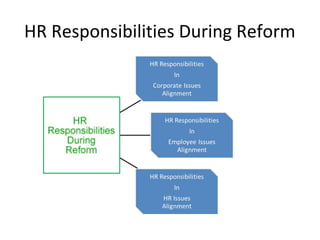
HR Responsibilities During Reform
A survey of some organisations prove that
during reform HR departments focus the utmost
attention on employee issues, and as a result fail
to align corporate issues besides paying little or
no attention to HR issues.
The primary course of action in managing HR
issues relating to reform focus on identification
and delineation of established objectives
earmarked for that reform.
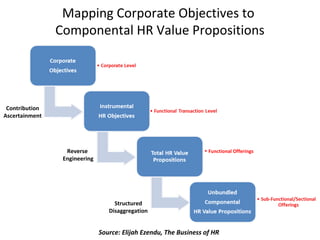
Mapping Corporate Objectives to
Componental HR Value Propositions
Contribution
Ascertainment
Structured
Disaggregation
• Functional OfferingsReverse
Engineering
Source: Elijah Ezendu, The Business of HR
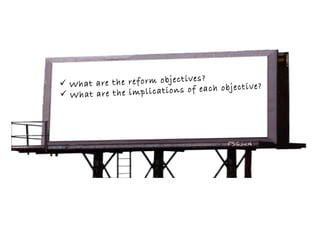
 What are the reform objectives?
 What are the implications of each objective?
HR Contribution Ascertainment
HR contribution ascertainment involves multi-
layered review of specified corporate objectives
for purpose of identifying the most fitting set of
human resources objectives that their
accomplishment would provide the required
level of HR business values for achieving those
corporate objectives.
Success of Reform Versus
Contributable HR Business Values
The success of a corporate reform programme
depends on the level of contributable HR
Business Values.
If Contributable HR Business Values < Requirement, the
corporate reform = failure.
If Contributable HR Business Values ≥ Requirement,
then the corporate reform would proceed successfully
on condition that additional requirement such as
finance had been fulfilled.
Value Chain
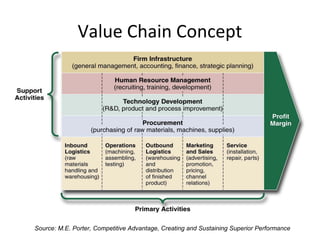
The value chain concept was developed by Prof.
Michael Porter for describing activities that
occur within and around an organisation and
relating them to its competitive strength.
• It differentiates primary activities from non-
core that are regarded as support activities.
• It provides for identification of key activities in
every functional silo as part of the value chain
of an organisation.
Value Chain Concept
Source: M.E. Porter, Competitive Advantage, Creating and Sustaining Superior Performance
Value Chain Snapshot
In a scenario where the value chain snapshot of
an organisation highlights some key activities in
HR function as part of the value chain, whereas
they are non-value adding activities; they would
crystallize as invalid links in the value chain, and
indicate quandary, dissonance, nonconforming
focus, miscarriage of resources, in addition to
systemic blunder.
Where Business Value Shows Up
Fortunately, there are only five places in a business where we can see
the value of our work. These are the same for any type of
organization, whether it’s a commercial enterprise, a government
entity, or a non-profit group (similar to how accounting practices are
essentially the same across each type).
We can identify business value by asking the following questions about
the end results of our project:
•Will it increase revenue?
•Will it decrease expenses?
•Will it bring in new customers?
•Will it bring in more money from existing customers?
•Will it increase shareholder/taxpayer value?
Depending on the nature of our business, a given project could affect
any of these value areas. It could increase revenues or decrease
expenses. In fact, sometimes a project could affect two or three
simultaneously, such as increase revenues, bring in more new
customers, and increase revenue from existing customers.
Source: Jared Spool, Identifying Business Value of What We Do
Business Alignment
Business Alignment is occasioned by placement
of key activities with content and direction that
are geared for achievement of organisational
goals.
Effective Business Alignment of HR Function
shall occur when every activity output from
each section of HR contributes fittingly to
organisational pool of output earmarked for
generating product or service.
HR Value vs. Business Goal
Contemporary HR Value had been self-centred
and somewhat disconnected from business goal
orientated perspective. That’s why such output
is not identified as ‘value adding result’ in
corporate strategic outlay.
HR Thrust
Effective Business Alignment of HR Function
implies every component of HR system,
structure, policy, procedures, initiatives,
objectives and strategy must be focused on
provisioning of excellent enablement for
achievement of organisational goals. This should
be the HR Thrust.
Best Practices – How to Bridge the Business Divide
•Evaluate current opportunity with the business
# Bringing insight to investment decisions
# Building future value through today’s forums
# Bridging the people visibility gap
# Removing barriers and optimize performance
•Develop platforms for strategic conversation
•Transform HR Business Partners into strategic advisors
•Report Links
Source: Amy Wilson, Wilson Insight
The Top 10 Best Practices of
High Impact HR Organisations
1. Structured governance and business case development
2. Developing advanced workforce planning capabilities
3. Implementing the “right” HR philosophies
4. Reducing administrative work for HR Business Partners
5. Implementing flexible HR organisation design
6. Improving employee-facing HR systems
7. Measuring both HR operational and business metrics
8. Developing internal HR skills
9. Improving line manager capabilities
10. Outsourcing HR services strategically
Source: John Hollon, TLNT- The Business of HR
Current Changes in Nature of Work
• Content
• Structure
• Process
• System
• Flow Dynamics
• Applicable Technology
Major Drivers for Changing Nature of Work
• Customer Values
• Competition
• Transitory Technology
• Organizational Agility
• Innovation
• Expansive Career Thrust
• Financial Leverage
• Operational Mobility
• Global Labour Convergence
• Advancement in Capacity Management
• Advancement in Lean Enterprise
• Advancement in Process Based Management
Impact of Changing Nature of Work on Organisation
• Flatter Structures
• Increase in Project Groups
• More Emphasis on Cross-Functional Teams
• Rise of Kaizen Philosophy that Quickens Reform
• More Complex Reporting Relationships
• Increase in Interactive Bonds Between Top and
Bottom thereby boosting holistic performance
initiative
• Indistinct Boundaries
The corporate reform implementation will not
meet a static work environment but a fleeting
pattern in the nature of work. All the dynamic
components of work must be aligned for optimal
achievement of stated reform objectives.
Competency Framework can be applied in
ensuring that every position in the organisation
shall be effectively manned by a worker who
possesses the fitting competence, thus
guaranteeing required performance.
Implications:
•Up-skilling
•Right-sourcing
What is Competency?
“Observable performance dimensions, including
individual knowledge, skills, attitudes, and
behaviours, as well as collective team, process,
and organizational capabilities, that are linked
to high performance, and provide the
organization with sustainable competitive
advantage”
(Arvy & Orth).
Competence vs. Competency
In the past, HR professionals have tended to draw a clear
distinction between 'competences' and 'competencies'. The
term ‘competence’ (competences) was used to describe what
people need to do to perform a job and was concerned with
effect and output rather than effort and input. ‘Competency’
(competencies) described the behaviour that lies behind
competent performance, such as critical thinking or analytical
skills, and described what people bring to the job. However, in
recent years, there has been growing awareness that job
performance requires a mix of behaviour, attitude and action
and hence the two terms are now more often used
interchangeably.
Source: CIPD
Competency Framework
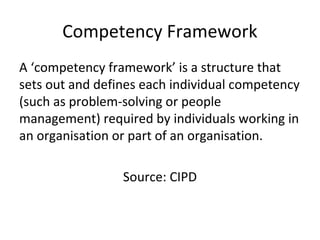
A ‘competency framework’ is a structure that
sets out and defines each individual competency
(such as problem-solving or people
management) required by individuals working in
an organisation or part of an organisation.
Source: CIPD
Components of a Competency Framework
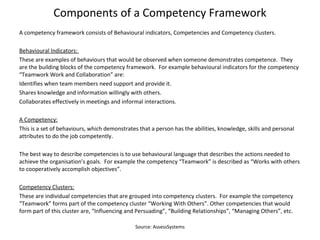
A competency framework consists of Behavioural indicators, Competencies and Competency clusters.
Behavioural Indicators:
These are examples of behaviours that would be observed when someone demonstrates competence. They
are the building blocks of the competency framework. For example behavioural indicators for the competency
“Teamwork Work and Collaboration” are:
Identifies when team members need support and provide it.
Shares knowledge and information willingly with others.
Collaborates effectively in meetings and informal interactions.
A Competency:
This is a set of behaviours, which demonstrates that a person has the abilities, knowledge, skills and personal
attributes to do the job competently.
The best way to describe competencies is to use behavioural language that describes the actions needed to
achieve the organisation’s goals. For example the competency “Teamwork” is described as “Works with others
to cooperatively accomplish objectives”.
Competency Clusters:
These are individual competencies that are grouped into competency clusters. For example the competency
“Teamwork” forms part of the competency cluster “Working With Others”. Other competencies that would
form part of this cluster are, “Influencing and Persuading”, “Building Relationships”, “Managing Others”, etc.
Source: AssessSystems
Progression in Competency
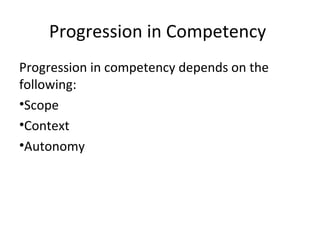
Progression in competency depends on the
following:
•Scope
•Context
•Autonomy
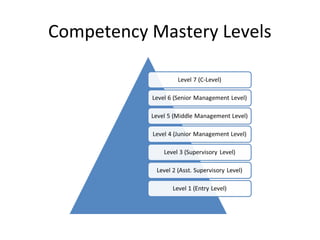
Competency Mastery Levels
Configuration of Mastery Levels
Size of Mastery Levels depends on the following:
•Organisational Structure
•Hierarchical Layer Variance
•Organisational Dynamics Philosophy
Progress from one Mastery Level to another is
characterised by calibrated increase in
proficiency which synchronises with
performance requirement at that level for
effective contribution to business goals.
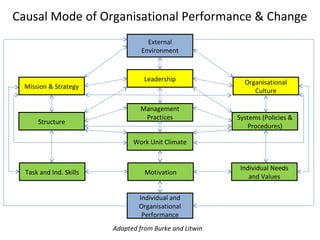
Causal Mode of Organisational Performance & Change
External
Environment
Individual and
Organisational
Performance
Mission & Strategy
Motivation
Work Unit Climate
Management
Practices
Organisational
Culture
Leadership
Task and Ind. Skills
Structure
Individual Needs
and Values
Systems (Policies &
Procedures)
Adapted from Burke and Litwin
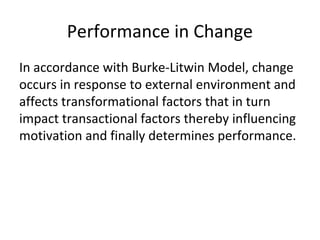
Performance in Change
In accordance with Burke-Litwin Model, change
occurs in response to external environment and
affects transformational factors that in turn
impact transactional factors thereby influencing
motivation and finally determines performance.
Dr Elijah Ezendu is Award-Winning Business Expert & Certified Management Consultant with expertise
in Interim Management, Strategy, Competitive Intelligence, Transformation, Restructuring, Turnaround
Management, Business Development, Marketing, Project & Cost Management, Leadership, HR, CSR, e-
Business & Software Architecture. He had functioned as Founder, Initiative for Sustainable Business
Equity; Chairman of Board, Charisma Broadcast Film Academy; Group Chief Operating Officer, Idova
Group; CEO, Rubiini (UAE); Special Advisor, RTEAN; Director, MMNA Investments; Chair, Int’l Board of
GCC Business Council (UAE); Senior Partner, Shevach Consulting; Chairman (Certification & Training),
Coordinator (Board of Fellows), Lead Assessor & Governing Council Member, Institute of Management
Consultants, Nigeria; Lead Resource, Centre for Competitive Intelligence Development; Lead
Consultant/ Partner, JK Michaels; Turnaround Project Director, Consolidated Business Holdings Limited;
Technical Director, Gestalt; Chief Operating Officer, Rohan Group; Executive Director (Various Roles),
Fortuna, Gambia & Malta; Chief Advisor/ Partner, D & E; Vice Chairman of Board, Refined Shipping;
Director of Programmes & Governing Council Member, Institute of Business Development, Nigeria;
Member of TDD Committee, International Association of Software Architects, USA; Member of Strategic
Planning and Implementation Committee, Chartered Institute of Personnel Management of Nigeria;
Country Manager (Nigeria) & Adjunct Faculty (MBA Programme), Regent Business School, South Africa;
Adjunct Faculty (MBA Programme), Ladoke Akintola University of Technology; Editor-in-Chief, Cost
Management Journal; Council Member, Institute of Internal Auditors of Nigeria; Member, Board of
Directors (Several Organizations). He holds Doctoral Degree in Management, Master of Business
Administration and Fellow of Professional Institutes in North America, UK & Nigeria. He is Innovator of
Corporate Investment Structure Based on Financials and Intangibles, for valuation highlighting
intangible contributions of host communities and ecological environment: A model celebrated globally
as remedy for unmitigated depreciation of ecological capital and developmental deprivation of host
communities. He had served as Examiner to Professional Institutes and Universities. He had been a
member of Guild of Soundtrack Producers of Nigeria. He's an author and extensively featured speaker.
Thank You

Managing HR Issues Relating to Reforms

  • 1.
    Managing HR IssuesRelating to Reforms Dr. Elijah Ezendu FIMC, FCCM, FIIAN, FBDI, FAAFM, FSSM, MIMIS, MIAP, MITD, ACIArb, ACIPM, PhD, DocM, MBA, CWM, CBDA, CMA, MPM, PME, CSOL, CCIP, CMC, CMgr
  • 2.
  • 3.
    A survey ofsome organisations prove that during reform HR departments focus the utmost attention on employee issues, and as a result fail to align corporate issues besides paying little or no attention to HR issues.
  • 4.
    The primary courseof action in managing HR issues relating to reform focus on identification and delineation of established objectives earmarked for that reform.
  • 5.
    Mapping Corporate Objectivesto Componental HR Value Propositions Contribution Ascertainment Structured Disaggregation • Functional OfferingsReverse Engineering Source: Elijah Ezendu, The Business of HR
  • 6.
     What arethe reform objectives?  What are the implications of each objective?
  • 7.
    HR Contribution Ascertainment HRcontribution ascertainment involves multi- layered review of specified corporate objectives for purpose of identifying the most fitting set of human resources objectives that their accomplishment would provide the required level of HR business values for achieving those corporate objectives.
  • 8.
    Success of ReformVersus Contributable HR Business Values The success of a corporate reform programme depends on the level of contributable HR Business Values. If Contributable HR Business Values < Requirement, the corporate reform = failure. If Contributable HR Business Values ≥ Requirement, then the corporate reform would proceed successfully on condition that additional requirement such as finance had been fulfilled.
  • 9.
    Value Chain The valuechain concept was developed by Prof. Michael Porter for describing activities that occur within and around an organisation and relating them to its competitive strength. • It differentiates primary activities from non- core that are regarded as support activities. • It provides for identification of key activities in every functional silo as part of the value chain of an organisation.
  • 10.
    Value Chain Concept Source:M.E. Porter, Competitive Advantage, Creating and Sustaining Superior Performance
  • 11.
    Value Chain Snapshot Ina scenario where the value chain snapshot of an organisation highlights some key activities in HR function as part of the value chain, whereas they are non-value adding activities; they would crystallize as invalid links in the value chain, and indicate quandary, dissonance, nonconforming focus, miscarriage of resources, in addition to systemic blunder.
  • 12.
    Where Business ValueShows Up Fortunately, there are only five places in a business where we can see the value of our work. These are the same for any type of organization, whether it’s a commercial enterprise, a government entity, or a non-profit group (similar to how accounting practices are essentially the same across each type). We can identify business value by asking the following questions about the end results of our project: •Will it increase revenue? •Will it decrease expenses? •Will it bring in new customers? •Will it bring in more money from existing customers? •Will it increase shareholder/taxpayer value? Depending on the nature of our business, a given project could affect any of these value areas. It could increase revenues or decrease expenses. In fact, sometimes a project could affect two or three simultaneously, such as increase revenues, bring in more new customers, and increase revenue from existing customers. Source: Jared Spool, Identifying Business Value of What We Do
  • 13.
    Business Alignment Business Alignmentis occasioned by placement of key activities with content and direction that are geared for achievement of organisational goals. Effective Business Alignment of HR Function shall occur when every activity output from each section of HR contributes fittingly to organisational pool of output earmarked for generating product or service.
  • 14.
    HR Value vs.Business Goal Contemporary HR Value had been self-centred and somewhat disconnected from business goal orientated perspective. That’s why such output is not identified as ‘value adding result’ in corporate strategic outlay.
  • 15.
    HR Thrust Effective BusinessAlignment of HR Function implies every component of HR system, structure, policy, procedures, initiatives, objectives and strategy must be focused on provisioning of excellent enablement for achievement of organisational goals. This should be the HR Thrust.
  • 16.
    Best Practices –How to Bridge the Business Divide •Evaluate current opportunity with the business # Bringing insight to investment decisions # Building future value through today’s forums # Bridging the people visibility gap # Removing barriers and optimize performance •Develop platforms for strategic conversation •Transform HR Business Partners into strategic advisors •Report Links Source: Amy Wilson, Wilson Insight
  • 17.
    The Top 10Best Practices of High Impact HR Organisations 1. Structured governance and business case development 2. Developing advanced workforce planning capabilities 3. Implementing the “right” HR philosophies 4. Reducing administrative work for HR Business Partners 5. Implementing flexible HR organisation design 6. Improving employee-facing HR systems 7. Measuring both HR operational and business metrics 8. Developing internal HR skills 9. Improving line manager capabilities 10. Outsourcing HR services strategically Source: John Hollon, TLNT- The Business of HR
  • 18.
    Current Changes inNature of Work • Content • Structure • Process • System • Flow Dynamics • Applicable Technology
  • 19.
    Major Drivers forChanging Nature of Work • Customer Values • Competition • Transitory Technology • Organizational Agility • Innovation • Expansive Career Thrust • Financial Leverage • Operational Mobility • Global Labour Convergence • Advancement in Capacity Management • Advancement in Lean Enterprise • Advancement in Process Based Management
  • 20.
    Impact of ChangingNature of Work on Organisation • Flatter Structures • Increase in Project Groups • More Emphasis on Cross-Functional Teams • Rise of Kaizen Philosophy that Quickens Reform • More Complex Reporting Relationships • Increase in Interactive Bonds Between Top and Bottom thereby boosting holistic performance initiative • Indistinct Boundaries
  • 21.
    The corporate reformimplementation will not meet a static work environment but a fleeting pattern in the nature of work. All the dynamic components of work must be aligned for optimal achievement of stated reform objectives.
  • 22.
    Competency Framework canbe applied in ensuring that every position in the organisation shall be effectively manned by a worker who possesses the fitting competence, thus guaranteeing required performance. Implications: •Up-skilling •Right-sourcing
  • 23.
    What is Competency? “Observableperformance dimensions, including individual knowledge, skills, attitudes, and behaviours, as well as collective team, process, and organizational capabilities, that are linked to high performance, and provide the organization with sustainable competitive advantage” (Arvy & Orth).
  • 24.
    Competence vs. Competency Inthe past, HR professionals have tended to draw a clear distinction between 'competences' and 'competencies'. The term ‘competence’ (competences) was used to describe what people need to do to perform a job and was concerned with effect and output rather than effort and input. ‘Competency’ (competencies) described the behaviour that lies behind competent performance, such as critical thinking or analytical skills, and described what people bring to the job. However, in recent years, there has been growing awareness that job performance requires a mix of behaviour, attitude and action and hence the two terms are now more often used interchangeably. Source: CIPD
  • 25.
    Competency Framework A ‘competencyframework’ is a structure that sets out and defines each individual competency (such as problem-solving or people management) required by individuals working in an organisation or part of an organisation. Source: CIPD
  • 26.
    Components of aCompetency Framework A competency framework consists of Behavioural indicators, Competencies and Competency clusters. Behavioural Indicators: These are examples of behaviours that would be observed when someone demonstrates competence. They are the building blocks of the competency framework. For example behavioural indicators for the competency “Teamwork Work and Collaboration” are: Identifies when team members need support and provide it. Shares knowledge and information willingly with others. Collaborates effectively in meetings and informal interactions. A Competency: This is a set of behaviours, which demonstrates that a person has the abilities, knowledge, skills and personal attributes to do the job competently. The best way to describe competencies is to use behavioural language that describes the actions needed to achieve the organisation’s goals. For example the competency “Teamwork” is described as “Works with others to cooperatively accomplish objectives”. Competency Clusters: These are individual competencies that are grouped into competency clusters. For example the competency “Teamwork” forms part of the competency cluster “Working With Others”. Other competencies that would form part of this cluster are, “Influencing and Persuading”, “Building Relationships”, “Managing Others”, etc. Source: AssessSystems
  • 27.
    Progression in Competency Progressionin competency depends on the following: •Scope •Context •Autonomy
  • 28.
  • 29.
    Configuration of MasteryLevels Size of Mastery Levels depends on the following: •Organisational Structure •Hierarchical Layer Variance •Organisational Dynamics Philosophy Progress from one Mastery Level to another is characterised by calibrated increase in proficiency which synchronises with performance requirement at that level for effective contribution to business goals.
  • 30.
    Causal Mode ofOrganisational Performance & Change External Environment Individual and Organisational Performance Mission & Strategy Motivation Work Unit Climate Management Practices Organisational Culture Leadership Task and Ind. Skills Structure Individual Needs and Values Systems (Policies & Procedures) Adapted from Burke and Litwin
  • 31.
    Performance in Change Inaccordance with Burke-Litwin Model, change occurs in response to external environment and affects transformational factors that in turn impact transactional factors thereby influencing motivation and finally determines performance.
  • 32.
    Dr Elijah Ezenduis Award-Winning Business Expert & Certified Management Consultant with expertise in Interim Management, Strategy, Competitive Intelligence, Transformation, Restructuring, Turnaround Management, Business Development, Marketing, Project & Cost Management, Leadership, HR, CSR, e- Business & Software Architecture. He had functioned as Founder, Initiative for Sustainable Business Equity; Chairman of Board, Charisma Broadcast Film Academy; Group Chief Operating Officer, Idova Group; CEO, Rubiini (UAE); Special Advisor, RTEAN; Director, MMNA Investments; Chair, Int’l Board of GCC Business Council (UAE); Senior Partner, Shevach Consulting; Chairman (Certification & Training), Coordinator (Board of Fellows), Lead Assessor & Governing Council Member, Institute of Management Consultants, Nigeria; Lead Resource, Centre for Competitive Intelligence Development; Lead Consultant/ Partner, JK Michaels; Turnaround Project Director, Consolidated Business Holdings Limited; Technical Director, Gestalt; Chief Operating Officer, Rohan Group; Executive Director (Various Roles), Fortuna, Gambia & Malta; Chief Advisor/ Partner, D & E; Vice Chairman of Board, Refined Shipping; Director of Programmes & Governing Council Member, Institute of Business Development, Nigeria; Member of TDD Committee, International Association of Software Architects, USA; Member of Strategic Planning and Implementation Committee, Chartered Institute of Personnel Management of Nigeria; Country Manager (Nigeria) & Adjunct Faculty (MBA Programme), Regent Business School, South Africa; Adjunct Faculty (MBA Programme), Ladoke Akintola University of Technology; Editor-in-Chief, Cost Management Journal; Council Member, Institute of Internal Auditors of Nigeria; Member, Board of Directors (Several Organizations). He holds Doctoral Degree in Management, Master of Business Administration and Fellow of Professional Institutes in North America, UK & Nigeria. He is Innovator of Corporate Investment Structure Based on Financials and Intangibles, for valuation highlighting intangible contributions of host communities and ecological environment: A model celebrated globally as remedy for unmitigated depreciation of ecological capital and developmental deprivation of host communities. He had served as Examiner to Professional Institutes and Universities. He had been a member of Guild of Soundtrack Producers of Nigeria. He's an author and extensively featured speaker.
  • 33.