





Welcome to the HR Orientation Sessions
HR Department-ABM
Agile Business Modules
Date:2016-04-19
Provided by:
ABM
Core Competences
Session Outlines
By the end of this session you will be aware of the following:
1. Competencies definition
2. Linking Competences to ABM Values
3. Competences Framework
4. Measuring Competences
5. Using Core Competence Framework
6. ABM Core Competences
Hello!
I am Mahmoud Sayed
I am HR Generalist here and I
am here because I love to give
presentations :)
1.
What are
Competences?
“A competence represents the set of skills & behaviors
needed to perform work activities competently.”
Behaviors are the manifestation of an organization
culture, no matter how clearly the organization’s
values are stated, it is the way that people act that
defines the culture.
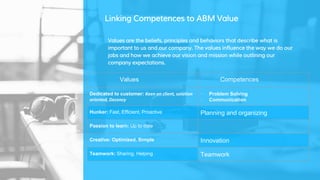
Linking Competences to ABM Value
Values are the beliefs, principles and behaviors that describe what is
important to us and our company. The values influence the way we do our
jobs and how we achieve our vision and mission while outlining our
company expectations.
Values Competences
Dedicated to customer: Keen on client, solution
oriented, Decency
· Problem Solving
· Communication
Hunker: Fast, Efficient, Proactive Planning and organizing
Passion to learn: Up to date
Creative: Optimized, Simple Innovation
Teamwork: Sharing, Helping Teamwork
Competence
s
Framework
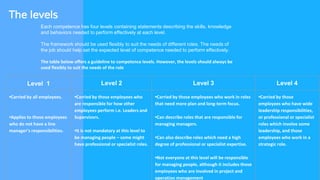
The levels
Each competence has four levels containing statements describing the skills, knowledge
and behaviors needed to perform effectively at each level.
The framework should be used flexibly to suit the needs of different roles. The needs of
the job should help set the expected level of competence needed to perform effectively.
The table below offers a guideline to competence levels. However, the levels should always be
used flexibly to suit the needs of the role
Level 1 Level 2 Level 3 Level 4
•Carried by all employees.
•Applies to those employees
who do not have a line
manager’s responsibilities.
•Carried by those employees who
are responsible for how other
employees perform i.e. Leaders and
Supervisors.
•It is not mandatory at this level to
be managing people – some might
have professional or specialist roles.
•Carried by those employees who work in roles
that need more plan and long-term focus.
•Can describe roles that are responsible for
managing managers.
•Can also describe roles which need a high
degree of professional or specialist expertise.
•Not everyone at this level will be responsible
for managing people, although it includes those
employees who are involved in project and
operation management
•Carried by those
employees who have wide
leadership responsibilities,
or professional or specialist
roles which involve some
leadership, and those
employees who work in a
strategic role.
Measuring Competences
First Step
The line manager review
job description and defines
the needs of the role.
Second Step
The manager then
identifies the competence
level that most accurately
reflects the needs of the
role for each competence.
(Remember, the level may
vary between
competences.)
Third Step
They then review the
statements within the
level and choose the
statements that are
relevant to the role.
(Remember, some of
the statements within
each level may not
apply to every role.)
Fourth Step
The manager discusses
and agrees with the
member of staff which of
the statements need to
be specifically shown.
These are recorded as
objectives throughout the
performance
management process.
Fifth Step
The member of staff collects and provides
evidence to show their ability against their
competence-based objectives.
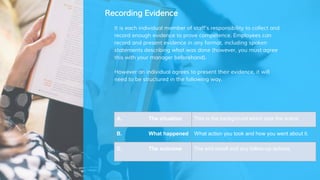
Recording Evidence
It is each individual member of staff’s responsibility to collect and
record enough evidence to prove competence. Employees can
record and present evidence in any format, including spoken
statements describing what was done (however, you must agree
this with your manager beforehand).
However an individual agrees to present their evidence, it will
need to be structured in the following way.
A. The situation This is the background which sets the scene
B. What happened What action you took and how you went about it.
C. The outcome The end result and any follow-up actions.
What is the Usage of
The Core Competences
Framework?
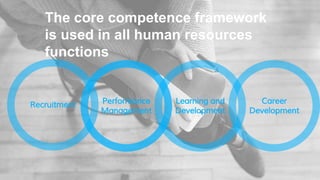
The core competence framework
is used in all human resources
functions
Performance
Management
Learning and
Development
Recruitment Career
Development
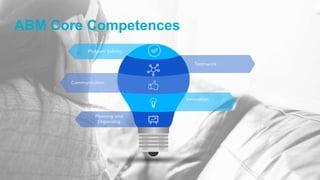
Problem Solving
ABM Core Competences
Teamwork
Innovation
Planning and
Organizing
Communication
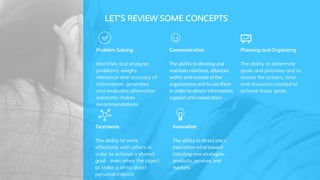
LET’S REVIEW SOME CONCEPTS
Problem Solving
Identifies and analyzes
problems; weighs
relevance and accuracy of
information; generates
and evaluates alternative
solutions; makes
recommendations
Communication
The ability to develop and
maintain relations, alliances
within and outside of the
organization and to use them
in order to obtain information,
support and cooperation
Planning and Organizing
The ability to determine
goals and priorities and to
assess the actions, time
and resources needed to
achieve those goals
Teamwork
The ability to work
effectively with others in
order to achieve a shared
goal - even when the object
at stake is of no direct
personal interest
Innovation
The ability to direct one’s
inquisitive mind toward
initiating new strategies,
products, services, and
markets
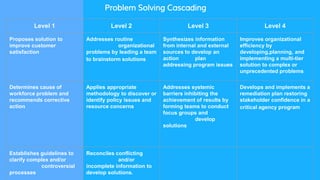
Problem Solving Cascading
Level 1 Level 2 Level 3 Level 4
Proposes solution to
improve customer
satisfaction
Addresses routine
organizational
problems by leading a team
to brainstorm solutions
Synthesizes information
from internal and external
sources to develop an
action plan
addressing program issues
Improves organizational
efficiency by
developing,planning, and
implementing a multi-tier
solution to complex or
unprecedented problems
Determines cause of
workforce problem and
recommends corrective
action
Applies appropriate
methodology to discover or
identify policy issues and
resource concerns
Addresses systemic
barriers inhibiting the
achievement of results by
forming teams to conduct
focus groups and
develop
solutions
Develops and implements a
remediation plan restoring
stakeholder confidence in a
critical agency program
Establishes guidelines to
clarify complex and/or
controversial
processes
Reconciles conflicting
and/or
incomplete information to
develop solutions.
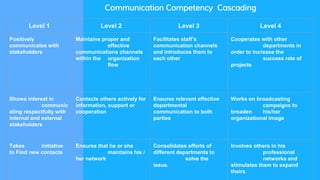
Communication Competency Cascading
Level 1 Level 2 Level 3 Level 4
Positively
communicates with
stakeholders
Maintains proper and
effective
communications channels
within the organization
flow
Facilitates staff’s
communication channels
and introduces them to
each other
Cooperates with other
departments in
order to increase the
success rate of
projects
Shows interest in
communic
ating respectfully with
internal and external
stakeholders
Contacts others actively for
information, support or
cooperation
Ensures relevant effective
departmental
communication to both
parties
Works on broadcasting
campaigns to
broaden his/her
organizational image
Takes initiative
to Find new contacts
Ensures that he or she
maintains his /
her network
Consolidates efforts of
different departments to
solve the
issue.
Involves others in his
professional
networks and
stimulates them to expand
theirs
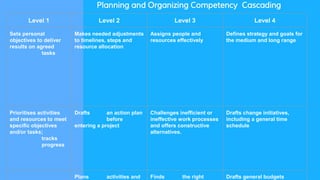
Planning and Organizing Competency Cascading
Level 1 Level 2 Level 3 Level 4
Sets personal
objectives to deliver
results on agreed
tasks
Makes needed adjustments
to timelines, steps and
resource allocation
Assigns people and
resources effectively
Defines strategy and goals for
the medium and long range
Prioritises activities
and resources to meet
specific objectives
and/or tasks;
tracks
progress
Drafts an action plan
before
entering a project
Challenges inefficient or
ineffective work processes
and offers constructive
alternatives.
Drafts change initiatives,
including a general time
schedule
Plans activities and Finds the right Drafts general budgets
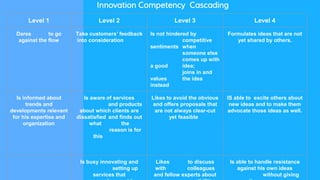
Innovation Competency Cascading
Level 1 Level 2 Level 3 Level 4
Dares to go
against the flow
Take customers’ feedback
into consideration
Is not hindered by
competitive
sentiments when
someone else
comes up with
a good idea;
joins in and
values the idea
instead
Formulates ideas that are not
yet shared by others.
Is informed about
trends and
developments relevant
for his expertise and
organization
Is aware of services
and products
about which clients are
dissatisfied and finds out
what the
reason is for
this
Likes to avoid the obvious
and offers proposals that
are not always clear-cut
yet feasible
IS able to excite others about
new ideas and to make them
advocate those ideas as well.
Is busy innovating and
setting up
services that
Likes to discuss
with colleagues
and fellow experts about
Is able to handle resistance
against his own ideas
without giving
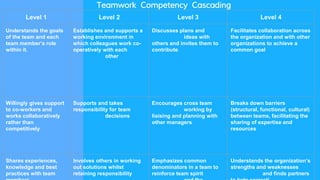
Teamwork Competency Cascading
Level 1 Level 2 Level 3 Level 4
Understands the goals
of the team and each
team member’s role
within it.
Establishes and supports a
working environment in
which colleagues work co-
operatively with each
other
Discusses plans and
ideas with
others and invites them to
contribute
Facilitates collaboration across
the organization and with other
organizations to achieve a
common goal
Willingly gives support
to co-workers and
works collaboratively
rather than
competitively
Supports and takes
responsibility for team
decisions
Encourages cross team
working by
liaising and planning with
other managers
Breaks down barriers
(structural, functional, cultural)
between teams, facilitating the
sharing of expertise and
resources
Shares experiences,
knowledge and best
practices with team
Involves others in working
out solutions whilst
retaining responsibility
Emphasizes common
denominators in a team to
reinforce team spirit
Understands the organization’s
strengths and weaknesses
and finds partners
Thanks!
Any questions?
You can find me at:
mdishnawy@agilebm.com

Abm competences

  • 1.
    Welcome to theHR Orientation Sessions HR Department-ABM Agile Business Modules Date:2016-04-19 Provided by:
  • 2.
  • 3.
    Session Outlines By theend of this session you will be aware of the following: 1. Competencies definition 2. Linking Competences to ABM Values 3. Competences Framework 4. Measuring Competences 5. Using Core Competence Framework 6. ABM Core Competences
  • 4.
    Hello! I am MahmoudSayed I am HR Generalist here and I am here because I love to give presentations :)
  • 5.
  • 6.
    “A competence representsthe set of skills & behaviors needed to perform work activities competently.” Behaviors are the manifestation of an organization culture, no matter how clearly the organization’s values are stated, it is the way that people act that defines the culture.
  • 7.
    Linking Competences toABM Value Values are the beliefs, principles and behaviors that describe what is important to us and our company. The values influence the way we do our jobs and how we achieve our vision and mission while outlining our company expectations. Values Competences Dedicated to customer: Keen on client, solution oriented, Decency · Problem Solving · Communication Hunker: Fast, Efficient, Proactive Planning and organizing Passion to learn: Up to date Creative: Optimized, Simple Innovation Teamwork: Sharing, Helping Teamwork
  • 8.
  • 9.
    The levels Each competencehas four levels containing statements describing the skills, knowledge and behaviors needed to perform effectively at each level. The framework should be used flexibly to suit the needs of different roles. The needs of the job should help set the expected level of competence needed to perform effectively. The table below offers a guideline to competence levels. However, the levels should always be used flexibly to suit the needs of the role Level 1 Level 2 Level 3 Level 4 •Carried by all employees. •Applies to those employees who do not have a line manager’s responsibilities. •Carried by those employees who are responsible for how other employees perform i.e. Leaders and Supervisors. •It is not mandatory at this level to be managing people – some might have professional or specialist roles. •Carried by those employees who work in roles that need more plan and long-term focus. •Can describe roles that are responsible for managing managers. •Can also describe roles which need a high degree of professional or specialist expertise. •Not everyone at this level will be responsible for managing people, although it includes those employees who are involved in project and operation management •Carried by those employees who have wide leadership responsibilities, or professional or specialist roles which involve some leadership, and those employees who work in a strategic role.
  • 10.
    Measuring Competences First Step Theline manager review job description and defines the needs of the role. Second Step The manager then identifies the competence level that most accurately reflects the needs of the role for each competence. (Remember, the level may vary between competences.) Third Step They then review the statements within the level and choose the statements that are relevant to the role. (Remember, some of the statements within each level may not apply to every role.) Fourth Step The manager discusses and agrees with the member of staff which of the statements need to be specifically shown. These are recorded as objectives throughout the performance management process. Fifth Step The member of staff collects and provides evidence to show their ability against their competence-based objectives.
  • 11.
    Recording Evidence It iseach individual member of staff’s responsibility to collect and record enough evidence to prove competence. Employees can record and present evidence in any format, including spoken statements describing what was done (however, you must agree this with your manager beforehand). However an individual agrees to present their evidence, it will need to be structured in the following way. A. The situation This is the background which sets the scene B. What happened What action you took and how you went about it. C. The outcome The end result and any follow-up actions.
  • 12.
    What is theUsage of The Core Competences Framework?
  • 13.
    The core competenceframework is used in all human resources functions Performance Management Learning and Development Recruitment Career Development
  • 14.
    Problem Solving ABM CoreCompetences Teamwork Innovation Planning and Organizing Communication
  • 15.
    LET’S REVIEW SOMECONCEPTS Problem Solving Identifies and analyzes problems; weighs relevance and accuracy of information; generates and evaluates alternative solutions; makes recommendations Communication The ability to develop and maintain relations, alliances within and outside of the organization and to use them in order to obtain information, support and cooperation Planning and Organizing The ability to determine goals and priorities and to assess the actions, time and resources needed to achieve those goals Teamwork The ability to work effectively with others in order to achieve a shared goal - even when the object at stake is of no direct personal interest Innovation The ability to direct one’s inquisitive mind toward initiating new strategies, products, services, and markets
  • 16.
    Problem Solving Cascading Level1 Level 2 Level 3 Level 4 Proposes solution to improve customer satisfaction Addresses routine organizational problems by leading a team to brainstorm solutions Synthesizes information from internal and external sources to develop an action plan addressing program issues Improves organizational efficiency by developing,planning, and implementing a multi-tier solution to complex or unprecedented problems Determines cause of workforce problem and recommends corrective action Applies appropriate methodology to discover or identify policy issues and resource concerns Addresses systemic barriers inhibiting the achievement of results by forming teams to conduct focus groups and develop solutions Develops and implements a remediation plan restoring stakeholder confidence in a critical agency program Establishes guidelines to clarify complex and/or controversial processes Reconciles conflicting and/or incomplete information to develop solutions.
  • 17.
    Communication Competency Cascading Level1 Level 2 Level 3 Level 4 Positively communicates with stakeholders Maintains proper and effective communications channels within the organization flow Facilitates staff’s communication channels and introduces them to each other Cooperates with other departments in order to increase the success rate of projects Shows interest in communic ating respectfully with internal and external stakeholders Contacts others actively for information, support or cooperation Ensures relevant effective departmental communication to both parties Works on broadcasting campaigns to broaden his/her organizational image Takes initiative to Find new contacts Ensures that he or she maintains his / her network Consolidates efforts of different departments to solve the issue. Involves others in his professional networks and stimulates them to expand theirs
  • 18.
    Planning and OrganizingCompetency Cascading Level 1 Level 2 Level 3 Level 4 Sets personal objectives to deliver results on agreed tasks Makes needed adjustments to timelines, steps and resource allocation Assigns people and resources effectively Defines strategy and goals for the medium and long range Prioritises activities and resources to meet specific objectives and/or tasks; tracks progress Drafts an action plan before entering a project Challenges inefficient or ineffective work processes and offers constructive alternatives. Drafts change initiatives, including a general time schedule Plans activities and Finds the right Drafts general budgets
  • 19.
    Innovation Competency Cascading Level1 Level 2 Level 3 Level 4 Dares to go against the flow Take customers’ feedback into consideration Is not hindered by competitive sentiments when someone else comes up with a good idea; joins in and values the idea instead Formulates ideas that are not yet shared by others. Is informed about trends and developments relevant for his expertise and organization Is aware of services and products about which clients are dissatisfied and finds out what the reason is for this Likes to avoid the obvious and offers proposals that are not always clear-cut yet feasible IS able to excite others about new ideas and to make them advocate those ideas as well. Is busy innovating and setting up services that Likes to discuss with colleagues and fellow experts about Is able to handle resistance against his own ideas without giving
  • 20.
    Teamwork Competency Cascading Level1 Level 2 Level 3 Level 4 Understands the goals of the team and each team member’s role within it. Establishes and supports a working environment in which colleagues work co- operatively with each other Discusses plans and ideas with others and invites them to contribute Facilitates collaboration across the organization and with other organizations to achieve a common goal Willingly gives support to co-workers and works collaboratively rather than competitively Supports and takes responsibility for team decisions Encourages cross team working by liaising and planning with other managers Breaks down barriers (structural, functional, cultural) between teams, facilitating the sharing of expertise and resources Shares experiences, knowledge and best practices with team Involves others in working out solutions whilst retaining responsibility Emphasizes common denominators in a team to reinforce team spirit Understands the organization’s strengths and weaknesses and finds partners
  • 22.
    Thanks! Any questions? You canfind me at: mdishnawy@agilebm.com