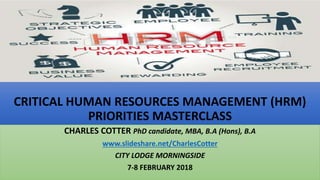
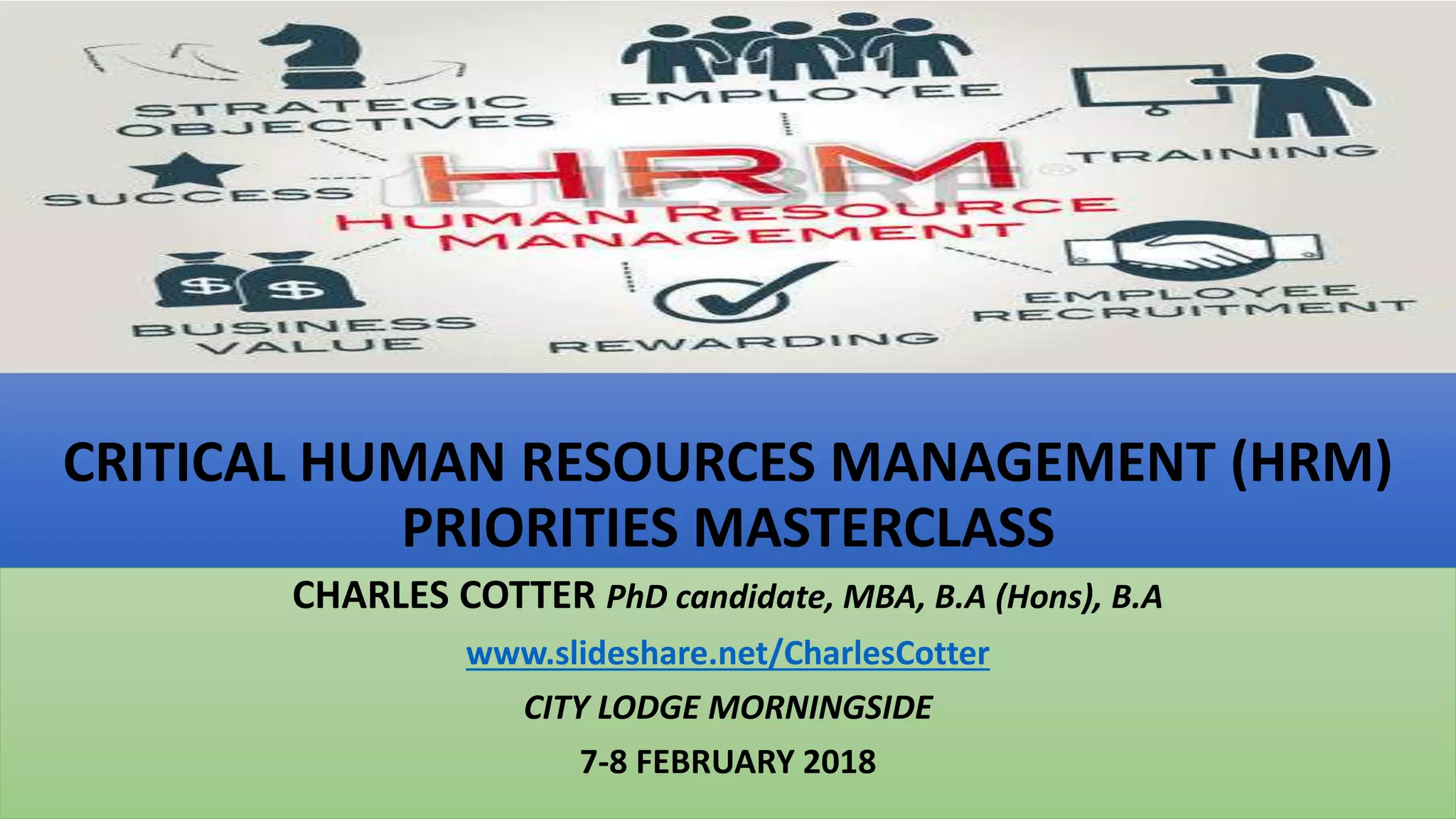
CRITICAL HUMAN RESOURCES MANAGEMENT (HRM)
PRIORITIES MASTERCLASS
CHARLES COTTER PhD candidate, MBA, B.A (Hons), B.A
www.slideshare.net/CharlesCotter
CITY LODGE MORNINGSIDE
7-8 FEBRUARY 2018
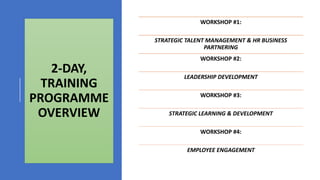
2-DAY,
TRAINING
PROGRAMME
OVERVIEW
WORKSHOP #1:
STRATEGIC TALENT MANAGEMENT & HR BUSINESS
PARTNERING
WORKSHOP #2:
LEADERSHIP DEVELOPMENT
WORKSHOP #3:
STRATEGIC LEARNING & DEVELOPMENT
WORKSHOP #4:
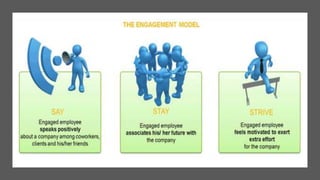
EMPLOYEE ENGAGEMENT
WORKSHOP #1:
Strategic Talent Management & HR Business Partnering
AGREE OR DISAGREE?
WHY?
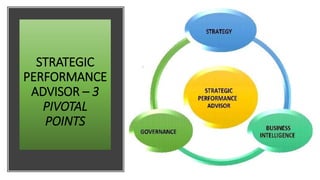
STRATEGIC
PERFORMANCE
ADVISOR – 3
PIVOTAL
POINTS
INTRODUCTORY ACTIVITY
• Individual activity:
• Complete the following statement by inserting one word only. As a HR Manager,
in order to be regarded as a strategic performance advisor, I need to/to
be………………………………………………
• Jot this word down and find other learners who have written down the same
word. Write this word down on the flip-chart.
• Each learner will have the opportunity to explain their choice of word.
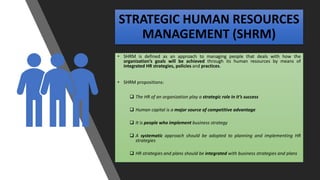
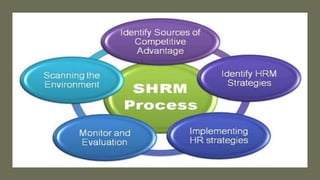
STRATEGIC HUMAN RESOURCES
MANAGEMENT (SHRM)
• SHRM is defined as an approach to managing people that deals with how the
organization’s goals will be achieved through its human resources by means of
integrated HR strategies, policies and practices.
• SHRM propositions:
 The HR of an organization play a strategic role in it’s success
 Human capital is a major source of competitive advantage
 It is people who implement business strategy
 A systematic approach should be adopted to planning and implementing HR
strategies
 HR strategies and plans should be integrated with business strategies and plans
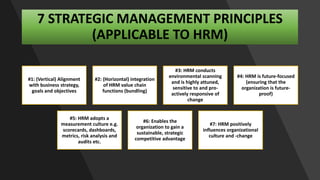
7 STRATEGIC MANAGEMENT PRINCIPLES
(APPLICABLE TO HRM)
#1: (Vertical) Alignment
with business strategy,
goals and objectives
#2: (Horizontal) integration
of HRM value chain
functions (bundling)
#3: HRM conducts
environmental scanning
and is highly attuned,
sensitive to and pro-
actively responsive of
change
#4: HRM is future-focused
(ensuring that the
organization is future-
proof)
#5: HRM adopts a
measurement culture e.g.
scorecards, dashboards,
metrics, risk analysis and
audits etc.
#6: Enables the
organization to gain a
sustainable, strategic
competitive advantage
#7: HRM positively
influences organizational
culture and -change
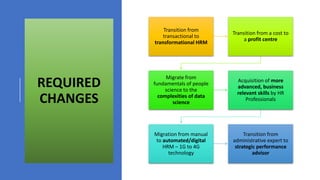
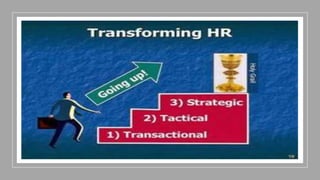
Transition from
transactional to
transformational HRM
Transition from a cost to
a profit centre
Migrate from
fundamentals of people
science to the
complexities of data
science
Acquisition of more
advanced, business
relevant skills by HR
Professionals
Migration from manual
to automated/digital
HRM – 1G to 4G
technology
Transition from
administrative expert to
strategic performance
advisor
REQUIRED
CHANGES
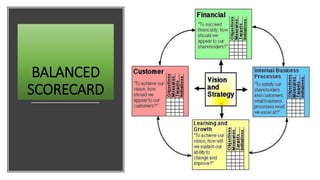
BALANCED
SCORECARD
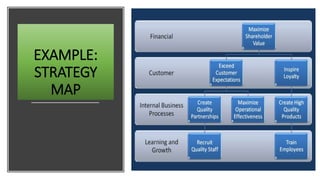
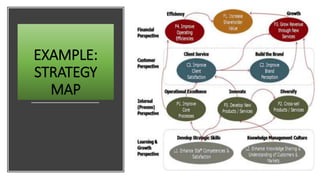
EXAMPLE:
STRATEGY
MAP
EXAMPLE:
STRATEGY
MAP
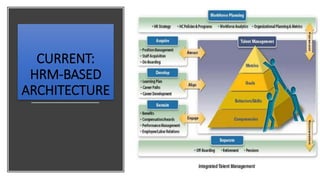
CURRENT:
HRM-BASED
ARCHITECTURE
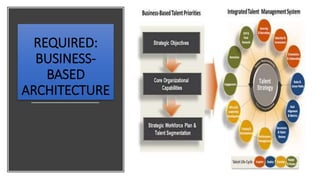
REQUIRED:
BUSINESS-
BASED
ARCHITECTURE
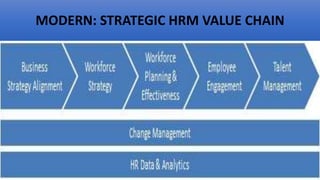
MODERN: STRATEGIC HRM VALUE CHAIN
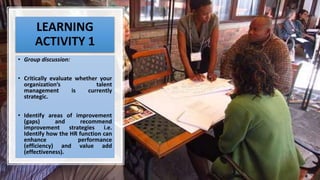
LEARNING
ACTIVITY 1
• Group discussion:
• Critically evaluate whether your
organization’s talent
management is currently
strategic.
• Identify areas of improvement
(gaps) and recommend
improvement strategies i.e.
Identify how the HR function can
enhance performance
(efficiency) and value add
(effectiveness).
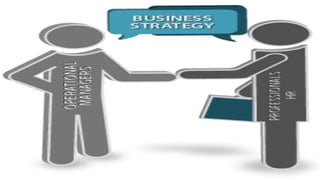
DEFINING HR BUSINESS PARTNERING
• Partnership: A relationship between individuals or groups characterized by mutual co-
operation and responsibility, for the achievement of a specified shared goal.
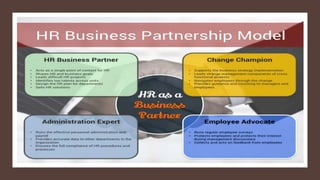
• HR business partners are HR professionals who work closely with an organization’s
senior leaders in order to develop an HR agenda that closely supports the overall aims
of the organization. The process of alignment is known as HR business partnering.
• Strategic business partners: A long-term relationship (alliance) to achieve defined
objectives common to all partners.
• In the context of strategic human resource management, the HR function and activities
are intended to ensure the organization's financial success and prosperity (business
continuity).
DIAGNOSIS: 10 BEST PRACTICE GUIDELINES FOR
HRBP
• https://www.surveymonkey.com/r/5X9BTT9
• #1 Embedding HRM strategy in business strategy and able to translate that strategy into deliverable
actions
• #2 Well-defined, implemented and reported HRM performance and ROI metrics (creating credibility
and accountability)
• #3 Generating business intelligence e.g. predictive and strategic analytics (that shapes, informs, guides
and ultimately, influences strategic business decisions)
• #4 Offering a professional, value-adding business proposition sensitive to and supportive of business
needs, interests and strategic priorities
• #5 Ongoing line management consultation, engagement, coaching and building trusting, collegial and
mutually beneficial business relationships
DIAGNOSIS: 10 BEST PRACTICE GUIDELINES FOR
HRBP
• https://www.surveymonkey.com/r/5X9BTT9
• #6 HR Management and practitioners possess business and industry knowledge, acumen and
insight
• #7 HRM collaborates with line management to broker meaningful and impactful business
solutions
• #8 HRM processes, systems and practices are horizontally integrated (bundled), agile,
responsive and stream-lined (that enhance productivity and efficiency)
• #9 HRM is a transformational initiator, driver and implementer of business change
• #10 HRM is technology-savvy innovator, enabling and leveraging best practices (e.g. CoE;
Shared Services and e-HRM)
LEARNING
ACTIVITY 2
• https://www.surveymonkey.com/r/5
X9BTT9
• Individual Diagnostic Activity:
 Critically review and evaluate
your current HR processes and
function against the ten (10)
best practice criteria.
• Group Discussion:
 Identify gaps. Recommend
improvement strategies.
HRBP CRITICAL SUCCESS FACTORS
• Strategic focus and thrust (on issues that contribute to business growth and
competitiveness)
• Adopting a “big picture” perspective (regarding the organization’s priorities and goals)
• Having personal impact and credibility (to influence key decision-makers)
• Adopting an Key Account Management, (internal) client-centric approach
• Possessing a set of value-adding skills and knowledge (customers and business)
• Being a diplomat and negotiator (in harmonizing the HRM agenda with business needs)
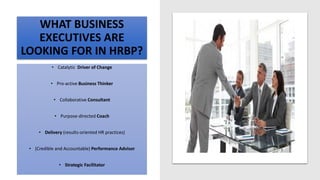
WHAT BUSINESS
EXECUTIVES ARE
LOOKING FOR IN HRBP?
• Catalytic Driver of Change
• Pro-active Business Thinker
• Collaborative Consultant
• Purpose-directed Coach
• Delivery (results-oriented HR practices)
• (Credible and Accountable) Performance Advisor
• Strategic Facilitator
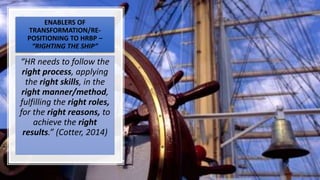
ENABLERS OF
TRANSFORMATION/RE-
POSITIONING TO HRBP –
“RIGHTING THE SHIP”
“HR needs to follow the
right process, applying
the right skills, in the
right manner/method,
fulfilling the right roles,
for the right reasons, to
achieve the right
results.” (Cotter, 2014)
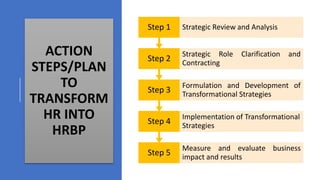
ACTION
STEPS/PLAN
TO
TRANSFORM
HR INTO
HRBP
Step 5
Measure and evaluate business
impact and results
Step 4
Implementation of Transformational
Strategies
Step 3
Formulation and Development of
Transformational Strategies
Step 2
Strategic Role Clarification and
Contracting
Step 1 Strategic Review and Analysis
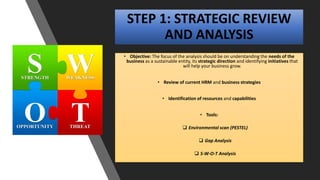
STEP 1: STRATEGIC REVIEW
AND ANALYSIS
• Objective: The focus of the analysis should be on understanding the needs of the
business as a sustainable entity, its strategic direction and identifying initiatives that
will help your business grow.
• Review of current HRM and business strategies
• Identification of resources and capabilities
• Tools:
 Environmental scan (PESTEL)
 Gap Analysis
 S-W-O-T Analysis
STEP 2: STRATEGIC ROLE CLARIFICATION AND CONTRACTING
• Objective: The concluding of Service Delivery Agreements with
line/operational and senior/executive management
• Consultation, engagement and communication with operational
management
• Clarification of expectations, needs and value-adding roles of HRBP
• Contracting agreements
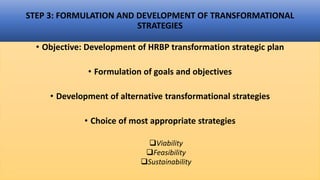
STEP 3: FORMULATION AND DEVELOPMENT OF TRANSFORMATIONAL
STRATEGIES
• Objective: Development of HRBP transformation strategic plan
• Formulation of goals and objectives
• Development of alternative transformational strategies
• Choice of most appropriate strategies
Viability
Feasibility
Sustainability
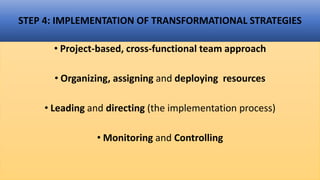
STEP 4: IMPLEMENTATION OF TRANSFORMATIONAL STRATEGIES
• Project-based, cross-functional team approach
• Organizing, assigning and deploying resources
• Leading and directing (the implementation process)
• Monitoring and Controlling
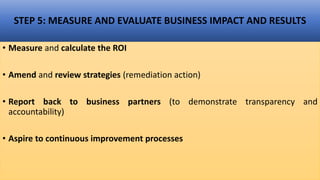
STEP 5: MEASURE AND EVALUATE BUSINESS IMPACT AND RESULTS
• Measure and calculate the ROI
• Amend and review strategies (remediation action)
• Report back to business partners (to demonstrate transparency and
accountability)
• Aspire to continuous improvement processes
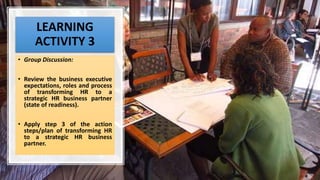
LEARNING
ACTIVITY 3
• Group Discussion:
• Review the business executive
expectations, roles and process
of transforming HR to a
strategic HR business partner
(state of readiness).
• Apply step 3 of the action
steps/plan of transforming HR
to a strategic HR business
partner.
WORKSHOP #2:
Leadership Development
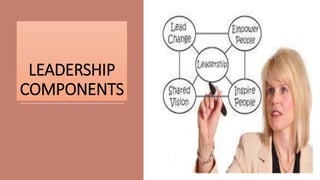
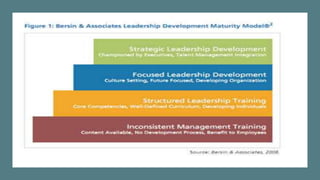
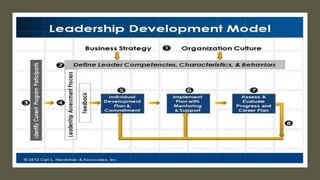
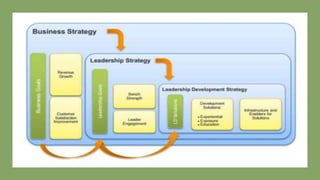
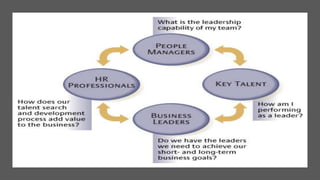
LEADERSHIP
COMPONENTS
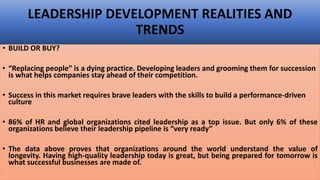
• BUILD OR BUY?
• “Replacing people” is a dying practice. Developing leaders and grooming them for succession
is what helps companies stay ahead of their competition.
• Success in this market requires brave leaders with the skills to build a performance-driven
culture
• 86% of HR and global organizations cited leadership as a top issue. But only 6% of these
organizations believe their leadership pipeline is “very ready”
• The data above proves that organizations around the world understand the value of
longevity. Having high-quality leadership today is great, but being prepared for tomorrow is
what successful businesses are made of.
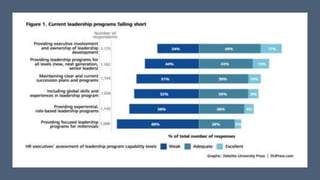
LEADERSHIP DEVELOPMENT REALITIES AND
TRENDS
• The bottom line: Identify potential leaders and actively develop their skills
• For today’s digital leaders, the most difficult question to answer is how to successfully identify and
develop high-potential employees – the future leaders who are able to thrive in more demanding
roles. Companies that successfully unlock this potential in its leaders gain a competitive edge that
very few have.
• Leadership and its most effective characteristics are changing. Today’s millennials place less value on
visible (19%), well-networked (17%) and technically skilled (17%) leaders. Instead, they define true
leaders as: strategic thinkers (39%), inspirational (37%), personable (34%) and visionary (31%).
(Source: Deloitte, Millennial Survey)
• To successfully lead in the new world of work, the Deloitte 2015 Global Human Capital Trends Report
explains that “organisations must understand that leadership development is not a short-term
problem and begin investing in programmes that not only provide online and classroom learning

opportunities, but also build a leadership culture that inspires employees to become active
contributors to the overall success of a company.”
LEADERSHIP DEVELOPMENT REALITIES AND
TRENDS
Leadership Development goes far beyond
management training.
Modern Leadership Development is very highly
blended
Modern Leadership Development includes coaches,
assessments, and a wide range of mentoring
strategies.
Modern Leadership Development represents an
investment in the company's legacy.
Modern Leadership Development must be
globalized, and focus on collaboration and team
leadership.
CHANGES IN
LEADERSHIP
DEVELOPMENT
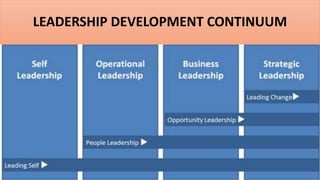
LEADERSHIP DEVELOPMENT CONTINUUM
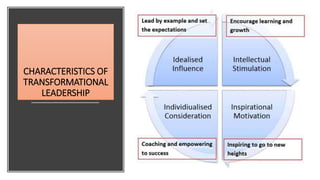
CHARACTERISTICS OF
TRANSFORMATIONAL
LEADERSHIP
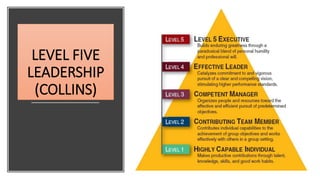
LEVEL FIVE
LEADERSHIP
(COLLINS)
LEARNING ACTIVITY 4
• Group discussion:
• Identify the most critical leadership skills in
your organization, to cope with the disruption
of the digital age.
• Evaluate the current degree of leadership
development maturity in your organization.
• Identify viable strategies to enhance the
leadership development model in your
organization.
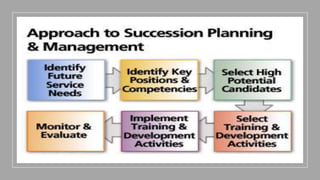
Succession planning is the identification and
development of potential successors for key
positions in an organization, through a systematic
evaluation process and possible training or
mentoring.
Succession planning and management involves an
integrated, systematic approach to identify,
develop and retain talent for key positions and
areas in line with current and projected business
objectives.
Succession Planning is "a means of identifying
critical management positions, starting at the
levels of project manager and supervisor and
extending up to the highest position in the
organization.”
DEFINING
SUCCESSION
PLANNING
Succession planning is about filling the
organization's talent pipeline and building
internal bench strength.
It is about leveraging the talent that the
organization already possesses by developing
it to full potential.
The focus is on developing employees so that
the organization has a pool of qualified
candidates who are ready to compete for key
positions and areas when they become vacant.
OBJECTIVES
OF
SUCCESSION
PLANNING
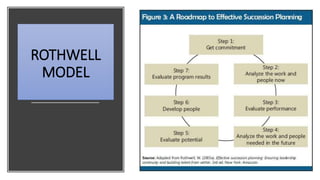
ROTHWELL
MODEL
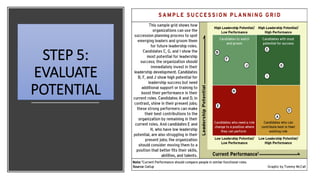
STEP 5:
EVALUATE
POTENTIAL
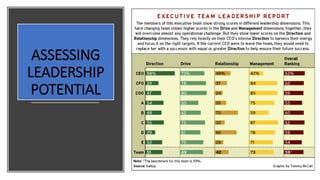
ASSESSING
LEADERSHIP
POTENTIAL
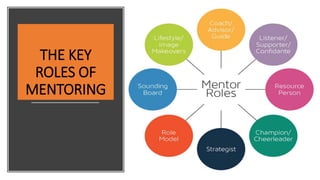
THE KEY
ROLES OF
MENTORING
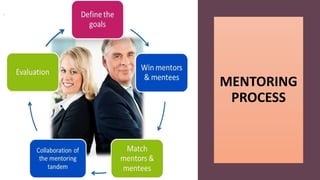
MENTORING
PROCESS
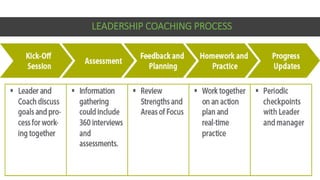
LEADERSHIP COACHING PROCESS
LEARNING ACTIVITY 5
• Group Discussion:
• Evaluate the merits of the following
leadership development strategies:
Succession Planning
Mentoring
Leadership coaching
WORKSHOP #3:
Strategic Learning and Development
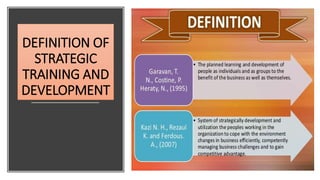
DEFINITION OF
STRATEGIC
TRAINING AND
DEVELOPMENT
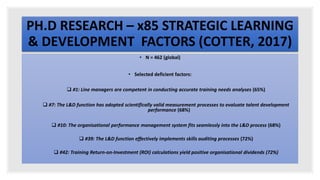
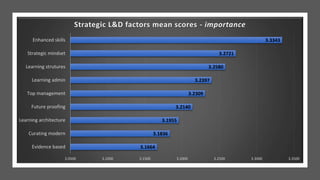
PH.D RESEARCH – x85 STRATEGIC LEARNING
& DEVELOPMENT FACTORS (COTTER, 2017)
• N = 462 (global)
• Selected deficient factors:
 #1: Line managers are competent in conducting accurate training needs analyses (65%)
 #7: The L&D function has adopted scientifically valid measurement processes to evaluate talent development
performance (68%)
 #10: The organisational performance management system fits seamlessly into the L&D process (68%)
 #39: The L&D function effectively implements skills auditing processes (72%)
 #42: Training Return-on-Investment (ROI) calculations yield positive organisational dividends (72%)
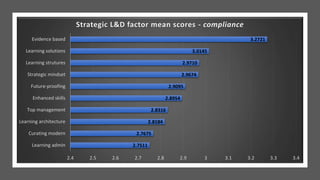
2.7511
2.7675
2.8184
2.8316
2.8954
2.9095
2.9674
2.9710
3.0145
3.2721
2.4 2.5 2.6 2.7 2.8 2.9 3 3.1 3.2 3.3 3.4
Learning admin
Curating modern
Learning architecture
Top management
Enhanced skills
Future-proofing
Strategic mindset
Learning strutures
Learning solutions
Evidence based
Strategic L&D factor mean scores - compliance
3.1664
3.1836
3.1955
3.2140
3.2309
3.2397
3.2580
3.2721
3.3343
3.0500 3.1000 3.1500 3.2000 3.2500 3.3000 3.3500
Evidence based
Curating modern
Learning architecture
Future proofing
Top management
Learning admin
Learning strutures
Strategic mindset
Enhanced skills
Strategic L&D factors mean scores - importance
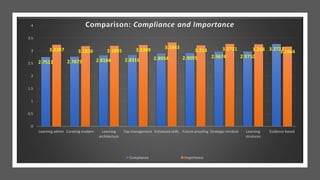
2.7511 2.7675 2.8184 2.8316 2.8954 2.9095 2.9674 2.9710
3.27213.2397 3.1836 3.1955 3.2309 3.3343
3.214 3.2721 3.258 3.1664
0
0.5
1
1.5
2
2.5
3
3.5
4
Learning admin Curating modern Learning
architecture
Top management Enhanced skills Future-proofing Strategic mindset Learning
strutures
Evidence based
Comparison: Compliance and Importance
Compliance Importance
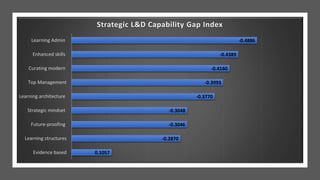
0.1057
-0.2870
-0.3046
-0.3048
-0.3770
-0.3993
-0.4160
-0.4389
-0.4886
Evidence based
Learning structures
Future-proofing
Strategic mindset
Learning architecture
Top Management
Curating modern
Enhanced skills
Learning Admin
Strategic L&D Capability Gap Index
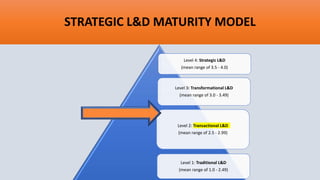
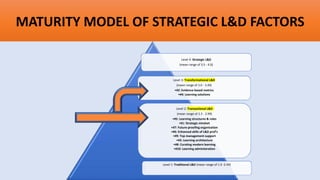
STRATEGIC L&D MATURITY MODEL
Level 4: Strategic L&D
(mean range of 3.5 - 4.0)
Level 3: Transformational L&D
(mean range of 3.0 - 3.49)
Level 2: Transactional L&D
(mean range of 2.5 - 2.99)
Level 1: Traditional L&D
(mean range of 1.0 - 2.49)
MATURITY MODEL OF STRATEGIC L&D FACTORS
Level 4: Strategic L&D
(mean range of 3.5 - 4.0)
Level 3: Transformational L&D
(mean range of 3.0 - 3.49)
•#2: Evidence based metrics
•#4: Learning solutions
Level 2: Transactional L&D
(mean range of 2.5 - 2.99)
•#5: Learning structures & roles
•#1: Strategic mindset
•#7: Future-proofing organization
•#6: Enhanced skills of L&D prof’s
•#9: Top management support
•#3: Learning architecture
•#8: Curating modern learning
•#10: Learning administration
Level 1: Traditional L&D (mean range of 1.0 -2.49)
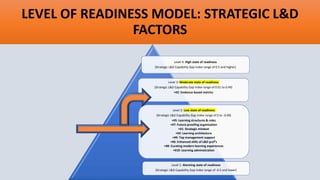
LEVEL OF READINESS MODEL: STRATEGIC L&D
FACTORS
Level 4: High state of readiness
(Strategic L&D Capability Gap Index range of 0.5 and higher)
Level 3: Moderate state of readiness
(Strategic L&D Capability Gap Index range of 0.01 to 0.49)
•#2: Evidence-based metrics
Level 2: Low state of readiness
(Strategic L&D Capability Gap Index range of 0 to -0.49)
•#5: Learning structures & roles
•#7: Future-proofing organization
•#1: Strategic mindset
•#3: Learning architecture
•#9: Top management support
•#6: Enhanced skills of L&D prof’s
•#8: Curating modern learning experiences
•#10: Learning administration
Level 1: Alarming state of readiness
(Strategic L&D Capability Gap Index range of -0.5 and lower)
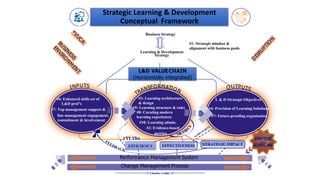
Strategic Learning & Development
Conceptual Framework
Business Strategy
#1: Strategic mindset &
alignment with business goals
Learning & Development
Strategy
L&D VALUECHAIN
(Horizontally integrated)
#6: Enhanced skills set of
… L&D prof’s
#7: Top management support &
line management engagement,
commitment & involvement
L & D Strategic Objectives
#4: Provision of Learning Solutions
#7: Future-proofing organisation
EFFICIENCY EFFECTIVENESS STRATEGIC IMPACT
STRATEGIC
L&D
SCORECARD
Performance Management System
Change Management Process
}
#3: Learning architecture
& design
#5: Learning structure & roles
#8: Curating modern
learning experiences
#10: Learning admin.
#2: Evidence-based
metrics
3 YEARS
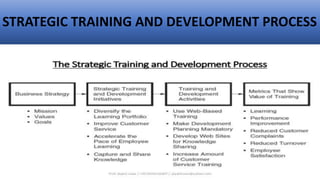
STRATEGIC TRAINING AND DEVELOPMENT PROCESS
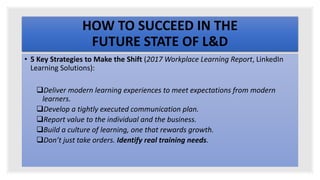
HOW TO SUCCEED IN THE
FUTURE STATE OF L&D
• 5 Key Strategies to Make the Shift (2017 Workplace Learning Report, LinkedIn
Learning Solutions):
Deliver modern learning experiences to meet expectations from modern
learners.
Develop a tightly executed communication plan.
Report value to the individual and the business.
Build a culture of learning, one that rewards growth.
Don’t just take orders. Identify real training needs.
STEP 1:
ANALYSIS
• Required Thinking – Laboratory Scientist
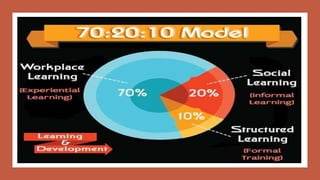
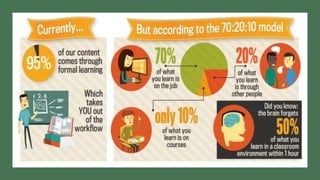
• Applying the 70-20-10% TNA sourcing principle :
 Accurate sourcing of performance gaps by means of a vibrant
performance management system/process (70%)
 Accurate sourcing of training needs by means of properly performed
and scientifically reliable and valid skills audits (20%)
 Sourcing of training needs through business changes, job changes,
market shifts and ad-hoc requests (10%)
• (Vertical) Alignment with Strategic Business Plan and Strategic Workforce
Plan and horizontal integration (bundling) with other key HRM
functions/processes
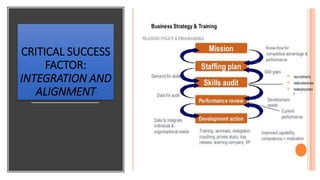
CRITICAL SUCCESS
FACTOR:
INTEGRATION AND
ALIGNMENT
10 CRITICAL
SUCCESS FACTORS
FOR THE
TRANSFORMATION
OF TRAINING TO A
STRATEGIC
LEARNING
SOLUTION
• #1: Top management support and ownership
• #2: Vibrant and effective Performance Management
System (PMS)
• #3: Direct and active engagement, consultation and
participation of line management in all learning
processes
• #4: Training Managers need to adopt and apply a
strategic mind-set (conceptual thinking)
• #5: Establishment of a learning organizational culture
10 CRITICAL
SUCCESS FACTORS
FOR THE
TRANSFORMATION
OF TRAINING TO A
STRATEGIC
LEARNING
SOLUTION
• #6: Holding individuals accountable for application of
learning by means of e.g. learner contracts/agreements
• #7: When utilizing outsourced training providers ensure
performance-directed, Service Level Agreements are in
place
• #8: Learning and Development must be embedded in the
business strategy
• #9: Learning strategy must precede structure
• #10: Commitment to training as an investment and not cost
item
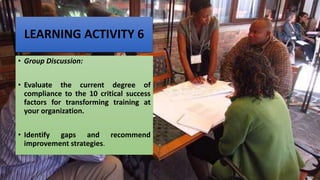
LEARNING ACTIVITY 6
• Group Discussion:
• Evaluate the current degree of
compliance to the 10 critical success
factors for transforming training at
your organization.
• Identify gaps and recommend
improvement strategies.
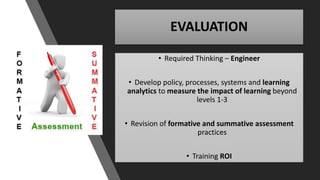
EVALUATION
• Required Thinking – Engineer
• Develop policy, processes, systems and learning
analytics to measure the impact of learning beyond
levels 1-3
• Revision of formative and summative assessment
practices
• Training ROI
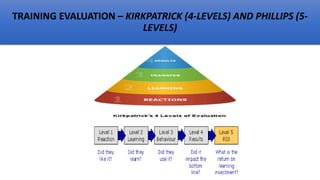
TRAINING EVALUATION – KIRKPATRICK (4-LEVELS) AND PHILLIPS (5-
LEVELS)
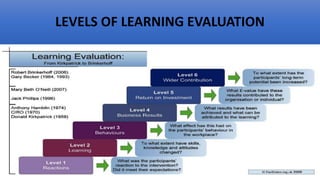
LEVELS OF LEARNING EVALUATION
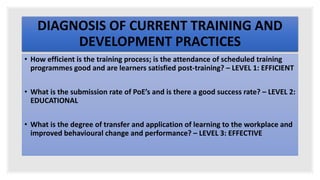
DIAGNOSIS OF CURRENT TRAINING AND
DEVELOPMENT PRACTICES
• How efficient is the training process; is the attendance of scheduled training
programmes good and are learners satisfied post-training? – LEVEL 1: EFFICIENT
• What is the submission rate of PoE’s and is there a good success rate? – LEVEL 2:
EDUCATIONAL
• What is the degree of transfer and application of learning to the workplace and
improved behavioural change and performance? – LEVEL 3: EFFECTIVE
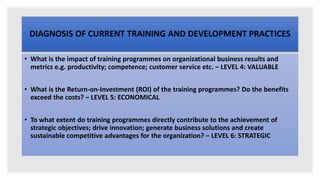
DIAGNOSIS OF CURRENT TRAINING AND DEVELOPMENT PRACTICES
• What is the impact of training programmes on organizational business results and
metrics e.g. productivity; competence; customer service etc. – LEVEL 4: VALUABLE
• What is the Return-on-Investment (ROI) of the training programmes? Do the benefits
exceed the costs? – LEVEL 5: ECONOMICAL
• To what extent do training programmes directly contribute to the achievement of
strategic objectives; drive innovation; generate business solutions and create
sustainable competitive advantages for the organization? – LEVEL 6: STRATEGIC
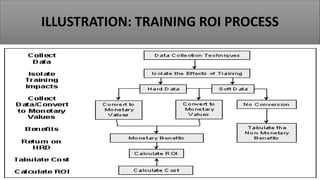
DEFINING TRAINING ROI FORMULA
ROI is a key financial metric of the value of training investments and costs. It is a ratio of net benefits to costs,
expressed as a percentage.
The formula can be expressed as:
[(monetary benefits – cost of the training) / cost of the training] x 100
ILLUSTRATION: TRAINING ROI PROCESS
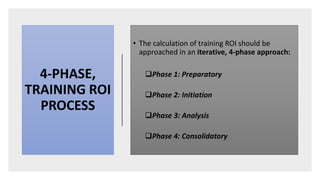
4-PHASE,
TRAINING ROI
PROCESS
• The calculation of training ROI should be
approached in an iterative, 4-phase approach:
Phase 1: Preparatory
Phase 2: Initiation
Phase 3: Analysis
Phase 4: Consolidatory
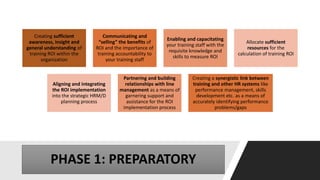
PHASE 1: PREPARATORY
Creating sufficient
awareness, insight and
general understanding of
training ROI within the
organization
Communicating and
“selling” the benefits of
ROI and the importance of
training accountability to
your training staff
Enabling and capacitating
your training staff with the
requisite knowledge and
skills to measure ROI
Allocate sufficient
resources for the
calculation of training ROI
Aligning and integrating
the ROI implementation
into the strategic HRM/D
planning process
Partnering and building
relationships with line
management as a means of
garnering support and
assistance for the ROI
implementation process
Creating a synergistic link between
training and other HR systems like
performance management, skills
development etc. as a means of
accurately identifying performance
problems/gaps
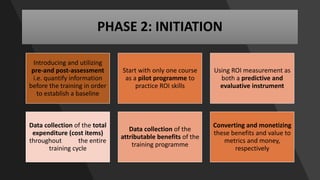
PHASE 2: INITIATION
Introducing and utilizing
pre-and post-assessment
i.e. quantify information
before the training in order
to establish a baseline
Start with only one course
as a pilot programme to
practice ROI skills
Using ROI measurement as
both a predictive and
evaluative instrument
Data collection of the total
expenditure (cost items)

throughout the entire
training cycle
Data collection of the
attributable benefits of the
training programme
Converting and monetizing
these benefits and value to
metrics and money,
respectively
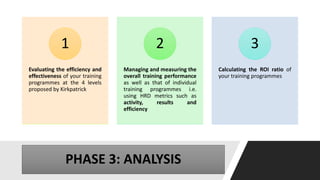
PHASE 3: ANALYSIS
Evaluating the efficiency and
effectiveness of your training
programmes at the 4 levels
proposed by Kirkpatrick
1
Managing and measuring the
overall training performance
as well as that of individual
training programmes i.e.
using HRD metrics such as
activity, results and
efficiency
2
Calculating the ROI ratio of
your training programmes
3
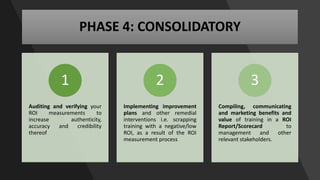
PHASE 4: CONSOLIDATORY
Auditing and verifying your
ROI measurements to
increase authenticity,
accuracy and credibility
thereof
1
Implementing improvement
plans and other remedial
interventions i.e. scrapping
training with a negative/low
ROI, as a result of the ROI
measurement process
2
Compiling, communicating
and marketing benefits and
value of training in a ROI
Report/Scorecard to
management and other
relevant stakeholders.
3
L&D METRICS
Measures of training activity (concerning how
much training and development occurred with
the focus on formalised, structured learning)
Measures of training results (concerning how
well training and development achieved its
goals)
Measures of training efficiency (concerning
the extent to which training and development
maximises resources in pursuit of its mission)
Refer to the specific L&D metrics
TRAINING ROI
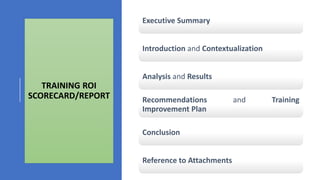
SCORECARD/REPORT
Executive Summary
Introduction and Contextualization
Analysis and Results
Recommendations and Training
Improvement Plan
Conclusion
Reference to Attachments
LEARNING ACTIVITY 7
• Group Discussion:
• Indicate what L&D metrics are currently
utilized at your organization. Describe
the credibility and the effectiveness of
these metrics to accurately measure the
impact and value of training and
development.
• By referring to the 4-step ROI process,
describe how the measurement of the
impact of training can be measured at
your organization.
WORKSHOP #4:
Employee Engagement
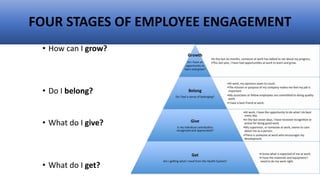
FOUR STAGES OF EMPLOYEE ENGAGEMENT
• How can I grow?
• Do I belong?
• What do I give?
• What do I get?
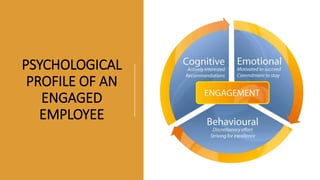
PSYCHOLOGICAL
PROFILE OF AN
ENGAGED
EMPLOYEE
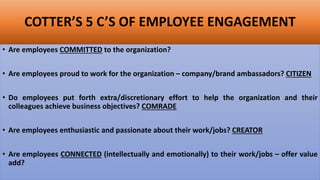
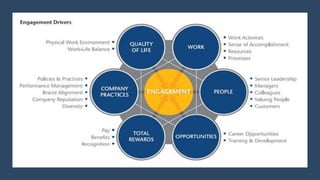
COTTER’S 5 C’S OF EMPLOYEE ENGAGEMENT
• Are employees COMMITTED to the organization?
• Are employees proud to work for the organization – company/brand ambassadors? CITIZEN
• Do employees put forth extra/discretionary effort to help the organization and their
colleagues achieve business objectives? COMRADE
• Are employees enthusiastic and passionate about their work/jobs? CREATOR
• Are employees CONNECTED (intellectually and emotionally) to their work/jobs – offer value
add?
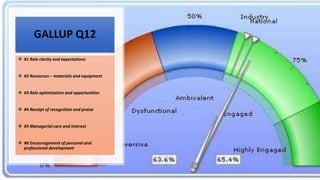
 #1 Role clarity and expectations
 #2 Resources – materials and equipment
 #3 Role optimization and opportunities
 #4 Receipt of recognition and praise
 #5 Managerial care and interest
 #6 Encouragement of personal and
professional development
GALLUP Q12
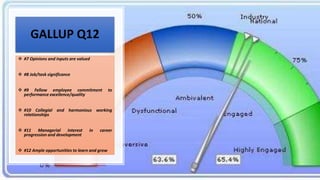
 #7 Opinions and inputs are valued
 #8 Job/task significance
 #9 Fellow employee commitment to
performance excellence/quality
 #10 Collegial and harmonious working
relationships
 #11 Managerial interest in career
progression and development
 #12 Ample opportunities to learn and grow
GALLUP Q12
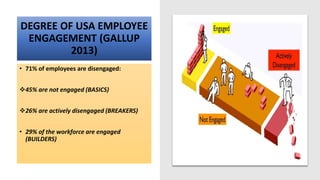
DEGREE OF USA EMPLOYEE
ENGAGEMENT (GALLUP
2013)
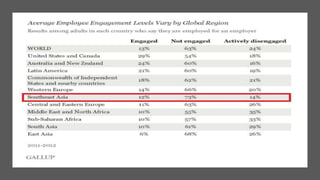
• 71% of employees are disengaged:
45% are not engaged (BASICS)
26% are actively disengaged (BREAKERS)
• 29% of the workforce are engaged
(BUILDERS)
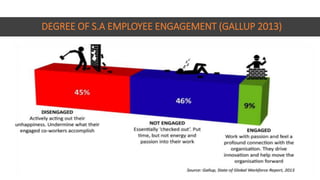
DEGREE OF S.A EMPLOYEE ENGAGEMENT (GALLUP 2013)
LEARNING
ACTIVITY 8
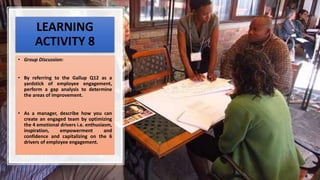
• Group Discussion:
• By referring to the Gallup Q12 as a
yardstick of employee engagement,
perform a gap analysis to determine
the areas of improvement.
• As a manager, describe how you can
create an engaged team by optimizing
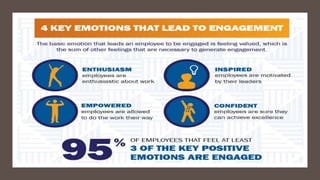
the 4 emotional drivers i.e. enthusiasm,
inspiration, empowerment and
confidence and capitalizing on the 6
drivers of employee engagement.
AGREE OR DISAGREE?
WHY?
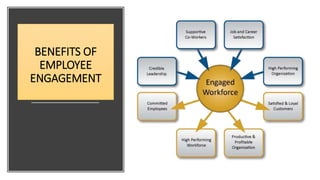
BENEFITS OF
EMPLOYEE
ENGAGEMENT
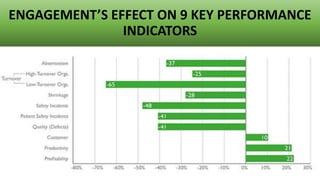
ENGAGEMENT’S EFFECT ON 9 KEY PERFORMANCE
INDICATORS
STRATEGIES
AGREE OR DISAGREE?
WHY?
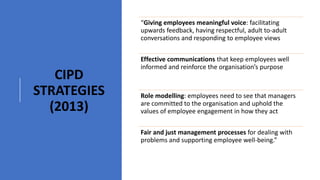
CIPD
STRATEGIES
(2013)
“Giving employees meaningful voice: facilitating
upwards feedback, having respectful, adult to-adult
conversations and responding to employee views
Effective communications that keep employees well
informed and reinforce the organisation’s purpose
Role modelling: employees need to see that managers
are committed to the organisation and uphold the
values of employee engagement in how they act
Fair and just management processes for dealing with
problems and supporting employee well-being.”
STRATEGIES TO ACCELERATE
EMPLOYEE ENGAGEMENT
• According to Gallup (2013),
three (3) strategies to accelerate
employee engagement are:
Select the Right People and
Managers
Develop employees’
strengths
Enhance employees’ well-
being
BEST PRACTICE
EMPLOYEE
ENGAGEMENT
• According to Gallup (2013) research, the best
organizations deeply integrate employee
engagement into the following four (4) areas:
Strategy and Leadership Philosophy
Accountability and Performance
Communication and Knowledge
Management
Development and on-going Learning
Opportunities
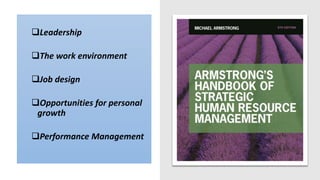
ARMSTRONG’S EMPLOYEE
ENGAGEMENT STRATEGIES
Leadership
The work environment
Job design
Opportunities for personal
growth
Performance Management
TINYpulse (2014)
STRATEGIES
• Showing employee appreciation and recognition
• Fostering a positive work culture
• Mapping professional growth plans
• Recruiting collegial, hard-working colleagues
• Hiring managers that are truly leaders
• Empowering employees with tools to succeed
• Enabling peer recognition
LEARNING
ACTIVITY 9
• Group Discussion:
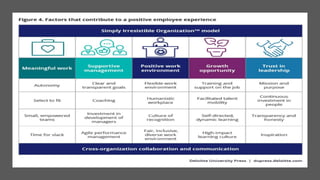
• Critically evaluate your organization
against the 5 factors of the Deloitte
Irresistible Organization model.
Identify gaps and recommend
improvements strategies.
• Critically review the various expert
employee engagement strategies and
extract those that you believe are
most relevant to your organization.
CONCLUSION
• Key points
• Summary
• Questions
CONTACT DETAILS
• Charles Cotter
• (+27) 84 562 9446
• charlescot@polka.co.za
• LinkedIn
• Twitter: @Charles_Cotter
• https://www.facebook.com/CharlesACotter/
• http://www.slideshare.net/CharlesCotter

Critical Human Resources Management and Learning & Development Priorities

  • 1.
    CRITICAL HUMAN RESOURCESMANAGEMENT (HRM) PRIORITIES MASTERCLASS CHARLES COTTER PhD candidate, MBA, B.A (Hons), B.A www.slideshare.net/CharlesCotter CITY LODGE MORNINGSIDE 7-8 FEBRUARY 2018
  • 2.
    2-DAY, TRAINING PROGRAMME OVERVIEW WORKSHOP #1: STRATEGIC TALENTMANAGEMENT & HR BUSINESS PARTNERING WORKSHOP #2: LEADERSHIP DEVELOPMENT WORKSHOP #3: STRATEGIC LEARNING & DEVELOPMENT WORKSHOP #4: EMPLOYEE ENGAGEMENT
  • 3.
    WORKSHOP #1: Strategic TalentManagement & HR Business Partnering
  • 4.
  • 8.
  • 9.
    INTRODUCTORY ACTIVITY • Individualactivity: • Complete the following statement by inserting one word only. As a HR Manager, in order to be regarded as a strategic performance advisor, I need to/to be……………………………………………… • Jot this word down and find other learners who have written down the same word. Write this word down on the flip-chart. • Each learner will have the opportunity to explain their choice of word.
  • 10.
    STRATEGIC HUMAN RESOURCES MANAGEMENT(SHRM) • SHRM is defined as an approach to managing people that deals with how the organization’s goals will be achieved through its human resources by means of integrated HR strategies, policies and practices. • SHRM propositions:  The HR of an organization play a strategic role in it’s success  Human capital is a major source of competitive advantage  It is people who implement business strategy  A systematic approach should be adopted to planning and implementing HR strategies  HR strategies and plans should be integrated with business strategies and plans
  • 12.
    7 STRATEGIC MANAGEMENTPRINCIPLES (APPLICABLE TO HRM) #1: (Vertical) Alignment with business strategy, goals and objectives #2: (Horizontal) integration of HRM value chain functions (bundling) #3: HRM conducts environmental scanning and is highly attuned, sensitive to and pro- actively responsive of change #4: HRM is future-focused (ensuring that the organization is future- proof) #5: HRM adopts a measurement culture e.g. scorecards, dashboards, metrics, risk analysis and audits etc. #6: Enables the organization to gain a sustainable, strategic competitive advantage #7: HRM positively influences organizational culture and -change
  • 13.
    Transition from transactional to transformationalHRM Transition from a cost to a profit centre Migrate from fundamentals of people science to the complexities of data science Acquisition of more advanced, business relevant skills by HR Professionals Migration from manual to automated/digital HRM – 1G to 4G technology Transition from administrative expert to strategic performance advisor REQUIRED CHANGES
  • 14.
  • 16.
  • 17.
  • 18.
  • 19.
  • 21.
  • 22.
    LEARNING ACTIVITY 1 • Groupdiscussion: • Critically evaluate whether your organization’s talent management is currently strategic. • Identify areas of improvement (gaps) and recommend improvement strategies i.e. Identify how the HR function can enhance performance (efficiency) and value add (effectiveness).
  • 25.
    DEFINING HR BUSINESSPARTNERING • Partnership: A relationship between individuals or groups characterized by mutual co- operation and responsibility, for the achievement of a specified shared goal. • HR business partners are HR professionals who work closely with an organization’s senior leaders in order to develop an HR agenda that closely supports the overall aims of the organization. The process of alignment is known as HR business partnering. • Strategic business partners: A long-term relationship (alliance) to achieve defined objectives common to all partners. • In the context of strategic human resource management, the HR function and activities are intended to ensure the organization's financial success and prosperity (business continuity).
  • 27.
    DIAGNOSIS: 10 BESTPRACTICE GUIDELINES FOR HRBP • https://www.surveymonkey.com/r/5X9BTT9 • #1 Embedding HRM strategy in business strategy and able to translate that strategy into deliverable actions • #2 Well-defined, implemented and reported HRM performance and ROI metrics (creating credibility and accountability) • #3 Generating business intelligence e.g. predictive and strategic analytics (that shapes, informs, guides and ultimately, influences strategic business decisions) • #4 Offering a professional, value-adding business proposition sensitive to and supportive of business needs, interests and strategic priorities • #5 Ongoing line management consultation, engagement, coaching and building trusting, collegial and mutually beneficial business relationships
  • 28.
    DIAGNOSIS: 10 BESTPRACTICE GUIDELINES FOR HRBP • https://www.surveymonkey.com/r/5X9BTT9 • #6 HR Management and practitioners possess business and industry knowledge, acumen and insight • #7 HRM collaborates with line management to broker meaningful and impactful business solutions • #8 HRM processes, systems and practices are horizontally integrated (bundled), agile, responsive and stream-lined (that enhance productivity and efficiency) • #9 HRM is a transformational initiator, driver and implementer of business change • #10 HRM is technology-savvy innovator, enabling and leveraging best practices (e.g. CoE; Shared Services and e-HRM)
  • 29.
    LEARNING ACTIVITY 2 • https://www.surveymonkey.com/r/5 X9BTT9 •Individual Diagnostic Activity:  Critically review and evaluate your current HR processes and function against the ten (10) best practice criteria. • Group Discussion:  Identify gaps. Recommend improvement strategies.
  • 31.
    HRBP CRITICAL SUCCESSFACTORS • Strategic focus and thrust (on issues that contribute to business growth and competitiveness) • Adopting a “big picture” perspective (regarding the organization’s priorities and goals) • Having personal impact and credibility (to influence key decision-makers) • Adopting an Key Account Management, (internal) client-centric approach • Possessing a set of value-adding skills and knowledge (customers and business) • Being a diplomat and negotiator (in harmonizing the HRM agenda with business needs)
  • 32.
    WHAT BUSINESS EXECUTIVES ARE LOOKINGFOR IN HRBP? • Catalytic Driver of Change • Pro-active Business Thinker • Collaborative Consultant • Purpose-directed Coach • Delivery (results-oriented HR practices) • (Credible and Accountable) Performance Advisor • Strategic Facilitator
  • 34.
    ENABLERS OF TRANSFORMATION/RE- POSITIONING TOHRBP – “RIGHTING THE SHIP” “HR needs to follow the right process, applying the right skills, in the right manner/method, fulfilling the right roles, for the right reasons, to achieve the right results.” (Cotter, 2014)
  • 37.
    ACTION STEPS/PLAN TO TRANSFORM HR INTO HRBP Step 5 Measureand evaluate business impact and results Step 4 Implementation of Transformational Strategies Step 3 Formulation and Development of Transformational Strategies Step 2 Strategic Role Clarification and Contracting Step 1 Strategic Review and Analysis
  • 38.
    STEP 1: STRATEGICREVIEW AND ANALYSIS • Objective: The focus of the analysis should be on understanding the needs of the business as a sustainable entity, its strategic direction and identifying initiatives that will help your business grow. • Review of current HRM and business strategies • Identification of resources and capabilities • Tools:  Environmental scan (PESTEL)  Gap Analysis  S-W-O-T Analysis
  • 39.
    STEP 2: STRATEGICROLE CLARIFICATION AND CONTRACTING • Objective: The concluding of Service Delivery Agreements with line/operational and senior/executive management • Consultation, engagement and communication with operational management • Clarification of expectations, needs and value-adding roles of HRBP • Contracting agreements
  • 40.
    STEP 3: FORMULATIONAND DEVELOPMENT OF TRANSFORMATIONAL STRATEGIES • Objective: Development of HRBP transformation strategic plan • Formulation of goals and objectives • Development of alternative transformational strategies • Choice of most appropriate strategies Viability Feasibility Sustainability
  • 41.
    STEP 4: IMPLEMENTATIONOF TRANSFORMATIONAL STRATEGIES • Project-based, cross-functional team approach • Organizing, assigning and deploying resources • Leading and directing (the implementation process) • Monitoring and Controlling
  • 42.
    STEP 5: MEASUREAND EVALUATE BUSINESS IMPACT AND RESULTS • Measure and calculate the ROI • Amend and review strategies (remediation action) • Report back to business partners (to demonstrate transparency and accountability) • Aspire to continuous improvement processes
  • 43.
    LEARNING ACTIVITY 3 • GroupDiscussion: • Review the business executive expectations, roles and process of transforming HR to a strategic HR business partner (state of readiness). • Apply step 3 of the action steps/plan of transforming HR to a strategic HR business partner.
  • 44.
  • 46.
  • 47.
    • BUILD ORBUY? • “Replacing people” is a dying practice. Developing leaders and grooming them for succession is what helps companies stay ahead of their competition. • Success in this market requires brave leaders with the skills to build a performance-driven culture • 86% of HR and global organizations cited leadership as a top issue. But only 6% of these organizations believe their leadership pipeline is “very ready” • The data above proves that organizations around the world understand the value of longevity. Having high-quality leadership today is great, but being prepared for tomorrow is what successful businesses are made of. LEADERSHIP DEVELOPMENT REALITIES AND TRENDS
  • 48.
    • The bottomline: Identify potential leaders and actively develop their skills • For today’s digital leaders, the most difficult question to answer is how to successfully identify and develop high-potential employees – the future leaders who are able to thrive in more demanding roles. Companies that successfully unlock this potential in its leaders gain a competitive edge that very few have. • Leadership and its most effective characteristics are changing. Today’s millennials place less value on visible (19%), well-networked (17%) and technically skilled (17%) leaders. Instead, they define true leaders as: strategic thinkers (39%), inspirational (37%), personable (34%) and visionary (31%). (Source: Deloitte, Millennial Survey) • To successfully lead in the new world of work, the Deloitte 2015 Global Human Capital Trends Report explains that “organisations must understand that leadership development is not a short-term problem and begin investing in programmes that not only provide online and classroom learning opportunities, but also build a leadership culture that inspires employees to become active contributors to the overall success of a company.” LEADERSHIP DEVELOPMENT REALITIES AND TRENDS
  • 50.
    Leadership Development goesfar beyond management training. Modern Leadership Development is very highly blended Modern Leadership Development includes coaches, assessments, and a wide range of mentoring strategies. Modern Leadership Development represents an investment in the company's legacy. Modern Leadership Development must be globalized, and focus on collaboration and team leadership. CHANGES IN LEADERSHIP DEVELOPMENT
  • 51.
  • 55.
  • 56.
  • 61.
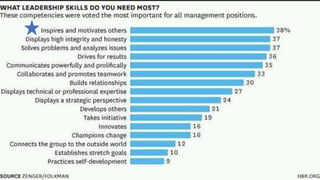
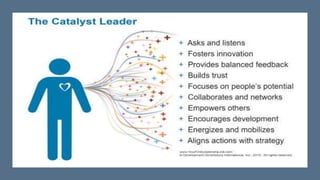
    LEARNING ACTIVITY 4 •Group discussion: • Identify the most critical leadership skills in your organization, to cope with the disruption of the digital age. • Evaluate the current degree of leadership development maturity in your organization. • Identify viable strategies to enhance the leadership development model in your organization.
  • 63.
    Succession planning isthe identification and development of potential successors for key positions in an organization, through a systematic evaluation process and possible training or mentoring. Succession planning and management involves an integrated, systematic approach to identify, develop and retain talent for key positions and areas in line with current and projected business objectives. Succession Planning is "a means of identifying critical management positions, starting at the levels of project manager and supervisor and extending up to the highest position in the organization.” DEFINING SUCCESSION PLANNING
  • 64.
    Succession planning isabout filling the organization's talent pipeline and building internal bench strength. It is about leveraging the talent that the organization already possesses by developing it to full potential. The focus is on developing employees so that the organization has a pool of qualified candidates who are ready to compete for key positions and areas when they become vacant. OBJECTIVES OF SUCCESSION PLANNING
  • 66.
  • 67.
  • 68.
  • 69.
  • 70.
  • 72.
  • 73.
    LEARNING ACTIVITY 5 •Group Discussion: • Evaluate the merits of the following leadership development strategies: Succession Planning Mentoring Leadership coaching
  • 74.
  • 76.
  • 77.
    PH.D RESEARCH –x85 STRATEGIC LEARNING & DEVELOPMENT FACTORS (COTTER, 2017) • N = 462 (global) • Selected deficient factors:  #1: Line managers are competent in conducting accurate training needs analyses (65%)  #7: The L&D function has adopted scientifically valid measurement processes to evaluate talent development performance (68%)  #10: The organisational performance management system fits seamlessly into the L&D process (68%)  #39: The L&D function effectively implements skills auditing processes (72%)  #42: Training Return-on-Investment (ROI) calculations yield positive organisational dividends (72%)
  • 78.
    2.7511 2.7675 2.8184 2.8316 2.8954 2.9095 2.9674 2.9710 3.0145 3.2721 2.4 2.5 2.62.7 2.8 2.9 3 3.1 3.2 3.3 3.4 Learning admin Curating modern Learning architecture Top management Enhanced skills Future-proofing Strategic mindset Learning strutures Learning solutions Evidence based Strategic L&D factor mean scores - compliance
  • 79.
    3.1664 3.1836 3.1955 3.2140 3.2309 3.2397 3.2580 3.2721 3.3343 3.0500 3.1000 3.15003.2000 3.2500 3.3000 3.3500 Evidence based Curating modern Learning architecture Future proofing Top management Learning admin Learning strutures Strategic mindset Enhanced skills Strategic L&D factors mean scores - importance
  • 80.
    2.7511 2.7675 2.81842.8316 2.8954 2.9095 2.9674 2.9710 3.27213.2397 3.1836 3.1955 3.2309 3.3343 3.214 3.2721 3.258 3.1664 0 0.5 1 1.5 2 2.5 3 3.5 4 Learning admin Curating modern Learning architecture Top management Enhanced skills Future-proofing Strategic mindset Learning strutures Evidence based Comparison: Compliance and Importance Compliance Importance
  • 81.
    0.1057 -0.2870 -0.3046 -0.3048 -0.3770 -0.3993 -0.4160 -0.4389 -0.4886 Evidence based Learning structures Future-proofing Strategicmindset Learning architecture Top Management Curating modern Enhanced skills Learning Admin Strategic L&D Capability Gap Index
  • 82.
    STRATEGIC L&D MATURITYMODEL Level 4: Strategic L&D (mean range of 3.5 - 4.0) Level 3: Transformational L&D (mean range of 3.0 - 3.49) Level 2: Transactional L&D (mean range of 2.5 - 2.99) Level 1: Traditional L&D (mean range of 1.0 - 2.49)
  • 83.
    MATURITY MODEL OFSTRATEGIC L&D FACTORS Level 4: Strategic L&D (mean range of 3.5 - 4.0) Level 3: Transformational L&D (mean range of 3.0 - 3.49) •#2: Evidence based metrics •#4: Learning solutions Level 2: Transactional L&D (mean range of 2.5 - 2.99) •#5: Learning structures & roles •#1: Strategic mindset •#7: Future-proofing organization •#6: Enhanced skills of L&D prof’s •#9: Top management support •#3: Learning architecture •#8: Curating modern learning •#10: Learning administration Level 1: Traditional L&D (mean range of 1.0 -2.49)
  • 84.
    LEVEL OF READINESSMODEL: STRATEGIC L&D FACTORS Level 4: High state of readiness (Strategic L&D Capability Gap Index range of 0.5 and higher) Level 3: Moderate state of readiness (Strategic L&D Capability Gap Index range of 0.01 to 0.49) •#2: Evidence-based metrics Level 2: Low state of readiness (Strategic L&D Capability Gap Index range of 0 to -0.49) •#5: Learning structures & roles •#7: Future-proofing organization •#1: Strategic mindset •#3: Learning architecture •#9: Top management support •#6: Enhanced skills of L&D prof’s •#8: Curating modern learning experiences •#10: Learning administration Level 1: Alarming state of readiness (Strategic L&D Capability Gap Index range of -0.5 and lower)
  • 85.
    Strategic Learning &Development Conceptual Framework Business Strategy #1: Strategic mindset & alignment with business goals Learning & Development Strategy L&D VALUECHAIN (Horizontally integrated) #6: Enhanced skills set of … L&D prof’s #7: Top management support & line management engagement, commitment & involvement L & D Strategic Objectives #4: Provision of Learning Solutions #7: Future-proofing organisation EFFICIENCY EFFECTIVENESS STRATEGIC IMPACT STRATEGIC L&D SCORECARD Performance Management System Change Management Process } #3: Learning architecture & design #5: Learning structure & roles #8: Curating modern learning experiences #10: Learning admin. #2: Evidence-based metrics 3 YEARS
  • 87.
    STRATEGIC TRAINING ANDDEVELOPMENT PROCESS
  • 88.
    HOW TO SUCCEEDIN THE FUTURE STATE OF L&D • 5 Key Strategies to Make the Shift (2017 Workplace Learning Report, LinkedIn Learning Solutions): Deliver modern learning experiences to meet expectations from modern learners. Develop a tightly executed communication plan. Report value to the individual and the business. Build a culture of learning, one that rewards growth. Don’t just take orders. Identify real training needs.
  • 89.
    STEP 1: ANALYSIS • RequiredThinking – Laboratory Scientist • Applying the 70-20-10% TNA sourcing principle :  Accurate sourcing of performance gaps by means of a vibrant performance management system/process (70%)  Accurate sourcing of training needs by means of properly performed and scientifically reliable and valid skills audits (20%)  Sourcing of training needs through business changes, job changes, market shifts and ad-hoc requests (10%) • (Vertical) Alignment with Strategic Business Plan and Strategic Workforce Plan and horizontal integration (bundling) with other key HRM functions/processes
  • 90.
  • 93.
    10 CRITICAL SUCCESS FACTORS FORTHE TRANSFORMATION OF TRAINING TO A STRATEGIC LEARNING SOLUTION • #1: Top management support and ownership • #2: Vibrant and effective Performance Management System (PMS) • #3: Direct and active engagement, consultation and participation of line management in all learning processes • #4: Training Managers need to adopt and apply a strategic mind-set (conceptual thinking) • #5: Establishment of a learning organizational culture
  • 96.
    10 CRITICAL SUCCESS FACTORS FORTHE TRANSFORMATION OF TRAINING TO A STRATEGIC LEARNING SOLUTION • #6: Holding individuals accountable for application of learning by means of e.g. learner contracts/agreements • #7: When utilizing outsourced training providers ensure performance-directed, Service Level Agreements are in place • #8: Learning and Development must be embedded in the business strategy • #9: Learning strategy must precede structure • #10: Commitment to training as an investment and not cost item
  • 98.
    LEARNING ACTIVITY 6 •Group Discussion: • Evaluate the current degree of compliance to the 10 critical success factors for transforming training at your organization. • Identify gaps and recommend improvement strategies.
  • 100.
    EVALUATION • Required Thinking– Engineer • Develop policy, processes, systems and learning analytics to measure the impact of learning beyond levels 1-3 • Revision of formative and summative assessment practices • Training ROI
  • 102.
    TRAINING EVALUATION –KIRKPATRICK (4-LEVELS) AND PHILLIPS (5- LEVELS)
  • 103.
  • 104.
    DIAGNOSIS OF CURRENTTRAINING AND DEVELOPMENT PRACTICES • How efficient is the training process; is the attendance of scheduled training programmes good and are learners satisfied post-training? – LEVEL 1: EFFICIENT • What is the submission rate of PoE’s and is there a good success rate? – LEVEL 2: EDUCATIONAL • What is the degree of transfer and application of learning to the workplace and improved behavioural change and performance? – LEVEL 3: EFFECTIVE
  • 105.
    DIAGNOSIS OF CURRENTTRAINING AND DEVELOPMENT PRACTICES • What is the impact of training programmes on organizational business results and metrics e.g. productivity; competence; customer service etc. – LEVEL 4: VALUABLE • What is the Return-on-Investment (ROI) of the training programmes? Do the benefits exceed the costs? – LEVEL 5: ECONOMICAL • To what extent do training programmes directly contribute to the achievement of strategic objectives; drive innovation; generate business solutions and create sustainable competitive advantages for the organization? – LEVEL 6: STRATEGIC
  • 106.
    DEFINING TRAINING ROIFORMULA ROI is a key financial metric of the value of training investments and costs. It is a ratio of net benefits to costs, expressed as a percentage. The formula can be expressed as: [(monetary benefits – cost of the training) / cost of the training] x 100
  • 107.
  • 108.
    4-PHASE, TRAINING ROI PROCESS • Thecalculation of training ROI should be approached in an iterative, 4-phase approach: Phase 1: Preparatory Phase 2: Initiation Phase 3: Analysis Phase 4: Consolidatory
  • 109.
    PHASE 1: PREPARATORY Creatingsufficient awareness, insight and general understanding of training ROI within the organization Communicating and “selling” the benefits of ROI and the importance of training accountability to your training staff Enabling and capacitating your training staff with the requisite knowledge and skills to measure ROI Allocate sufficient resources for the calculation of training ROI Aligning and integrating the ROI implementation into the strategic HRM/D planning process Partnering and building relationships with line management as a means of garnering support and assistance for the ROI implementation process Creating a synergistic link between training and other HR systems like performance management, skills development etc. as a means of accurately identifying performance problems/gaps
  • 110.
    PHASE 2: INITIATION Introducingand utilizing pre-and post-assessment i.e. quantify information before the training in order to establish a baseline Start with only one course as a pilot programme to practice ROI skills Using ROI measurement as both a predictive and evaluative instrument Data collection of the total expenditure (cost items) throughout the entire training cycle Data collection of the attributable benefits of the training programme Converting and monetizing these benefits and value to metrics and money, respectively
  • 111.
    PHASE 3: ANALYSIS Evaluatingthe efficiency and effectiveness of your training programmes at the 4 levels proposed by Kirkpatrick 1 Managing and measuring the overall training performance as well as that of individual training programmes i.e. using HRD metrics such as activity, results and efficiency 2 Calculating the ROI ratio of your training programmes 3
  • 112.
    PHASE 4: CONSOLIDATORY Auditingand verifying your ROI measurements to increase authenticity, accuracy and credibility thereof 1 Implementing improvement plans and other remedial interventions i.e. scrapping training with a negative/low ROI, as a result of the ROI measurement process 2 Compiling, communicating and marketing benefits and value of training in a ROI Report/Scorecard to management and other relevant stakeholders. 3
  • 114.
    L&D METRICS Measures oftraining activity (concerning how much training and development occurred with the focus on formalised, structured learning) Measures of training results (concerning how well training and development achieved its goals) Measures of training efficiency (concerning the extent to which training and development maximises resources in pursuit of its mission) Refer to the specific L&D metrics
  • 115.
    TRAINING ROI SCORECARD/REPORT Executive Summary Introductionand Contextualization Analysis and Results Recommendations and Training Improvement Plan Conclusion Reference to Attachments
  • 116.
    LEARNING ACTIVITY 7 •Group Discussion: • Indicate what L&D metrics are currently utilized at your organization. Describe the credibility and the effectiveness of these metrics to accurately measure the impact and value of training and development. • By referring to the 4-step ROI process, describe how the measurement of the impact of training can be measured at your organization.
  • 117.
  • 119.
    FOUR STAGES OFEMPLOYEE ENGAGEMENT • How can I grow? • Do I belong? • What do I give? • What do I get?
  • 121.
  • 123.
    COTTER’S 5 C’SOF EMPLOYEE ENGAGEMENT • Are employees COMMITTED to the organization? • Are employees proud to work for the organization – company/brand ambassadors? CITIZEN • Do employees put forth extra/discretionary effort to help the organization and their colleagues achieve business objectives? COMRADE • Are employees enthusiastic and passionate about their work/jobs? CREATOR • Are employees CONNECTED (intellectually and emotionally) to their work/jobs – offer value add?
  • 124.
     #1 Roleclarity and expectations  #2 Resources – materials and equipment  #3 Role optimization and opportunities  #4 Receipt of recognition and praise  #5 Managerial care and interest  #6 Encouragement of personal and professional development GALLUP Q12
  • 125.
     #7 Opinionsand inputs are valued  #8 Job/task significance  #9 Fellow employee commitment to performance excellence/quality  #10 Collegial and harmonious working relationships  #11 Managerial interest in career progression and development  #12 Ample opportunities to learn and grow GALLUP Q12
  • 127.
    DEGREE OF USAEMPLOYEE ENGAGEMENT (GALLUP 2013) • 71% of employees are disengaged: 45% are not engaged (BASICS) 26% are actively disengaged (BREAKERS) • 29% of the workforce are engaged (BUILDERS)
  • 129.
    DEGREE OF S.AEMPLOYEE ENGAGEMENT (GALLUP 2013)
  • 130.
    LEARNING ACTIVITY 8 • GroupDiscussion: • By referring to the Gallup Q12 as a yardstick of employee engagement, perform a gap analysis to determine the areas of improvement. • As a manager, describe how you can create an engaged team by optimizing the 4 emotional drivers i.e. enthusiasm, inspiration, empowerment and confidence and capitalizing on the 6 drivers of employee engagement.
  • 131.
  • 132.
  • 134.
    ENGAGEMENT’S EFFECT ON9 KEY PERFORMANCE INDICATORS
  • 135.
  • 136.
  • 138.
    CIPD STRATEGIES (2013) “Giving employees meaningfulvoice: facilitating upwards feedback, having respectful, adult to-adult conversations and responding to employee views Effective communications that keep employees well informed and reinforce the organisation’s purpose Role modelling: employees need to see that managers are committed to the organisation and uphold the values of employee engagement in how they act Fair and just management processes for dealing with problems and supporting employee well-being.”
  • 139.
    STRATEGIES TO ACCELERATE EMPLOYEEENGAGEMENT • According to Gallup (2013), three (3) strategies to accelerate employee engagement are: Select the Right People and Managers Develop employees’ strengths Enhance employees’ well- being
  • 140.
    BEST PRACTICE EMPLOYEE ENGAGEMENT • Accordingto Gallup (2013) research, the best organizations deeply integrate employee engagement into the following four (4) areas: Strategy and Leadership Philosophy Accountability and Performance Communication and Knowledge Management Development and on-going Learning Opportunities
  • 141.
    ARMSTRONG’S EMPLOYEE ENGAGEMENT STRATEGIES Leadership Thework environment Job design Opportunities for personal growth Performance Management
  • 142.
    TINYpulse (2014) STRATEGIES • Showingemployee appreciation and recognition • Fostering a positive work culture • Mapping professional growth plans • Recruiting collegial, hard-working colleagues • Hiring managers that are truly leaders • Empowering employees with tools to succeed • Enabling peer recognition
  • 143.
    LEARNING ACTIVITY 9 • GroupDiscussion: • Critically evaluate your organization against the 5 factors of the Deloitte Irresistible Organization model. Identify gaps and recommend improvements strategies. • Critically review the various expert employee engagement strategies and extract those that you believe are most relevant to your organization.
  • 144.
    CONCLUSION • Key points •Summary • Questions
  • 145.
    CONTACT DETAILS • CharlesCotter • (+27) 84 562 9446 • charlescot@polka.co.za • LinkedIn • Twitter: @Charles_Cotter • https://www.facebook.com/CharlesACotter/ • http://www.slideshare.net/CharlesCotter