

By Anushka Kapoor
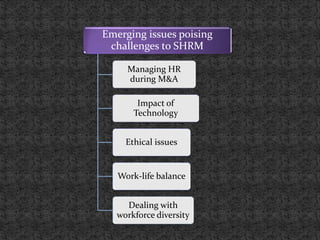
Emerging issues poising
challenges to SHRM
Managing HR
during M&A
Impact of
Technology
Ethical issues
Work-life balance
Dealing with
workforce diversity
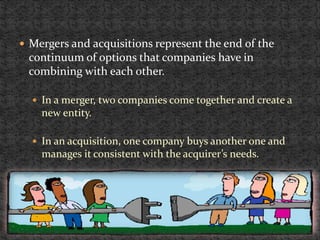
 Mergers and acquisitions represent the end of the
continuum of options that companies have in
combining with each other.
 In a merger, two companies come together and create a
new entity.
 In an acquisition, one company buys another one and
manages it consistent with the acquirer’s needs.
 Mergers for market dominance; economies of scale.
 Mergers for risk spreading, cost cutting
 Growth for world class leadership and global reach.
 Survival; sales maximization.
 Bigger asset base to leverage borrowing.
 Financial gain and personal power.
 Gaining a core competence to do more combinations.
 Acquiring talent, knowledge, and technology
According to studies
“One of the major reasons M & A fail is improper
handling of HR issues”
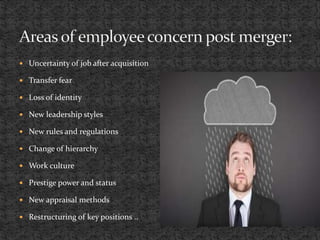
 Uncertainty of job after acquisition
 Transfer fear
 Loss of identity
 New leadership styles
 New rules and regulations
 Change of hierarchy
 Work culture
 Prestige power and status
 New appraisal methods
 Restructuring of key positions ..
 New board composition
 Human resource audit
 Effective communication
 Retention strategy
 Integration of HR
functions
 Cultural integrations
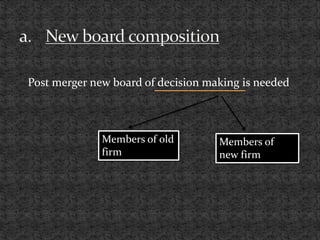
Post merger new board of decision making is needed
Members of old
firm
Members of
new firm
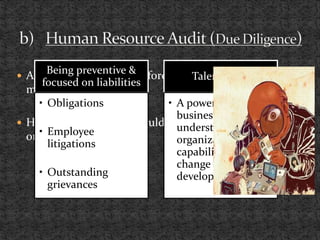
 Audit should be done before starting
merger process
 Human capital audit should be focused
on 2 dimensions
Being preventive &
focused on liabilities
• Obligations
• Employee
litigations
• Outstanding
grievances
Talent audit
• A powerful tool for
business leaders to
understand an
organization's
capability to
change and
develop.
 Should be carried in such a way to avoid confusion &
mixed messages
 Management should clearly communicate to employees
 Roles of employees
 Future Goals
 Inform Overall process of M & A
 Job description
1. Helps to alleviate tension among employees
2. Communication feeds the top management
about the integration that should take place
between partners
3. Encourages widespread acceptance of the
merger process
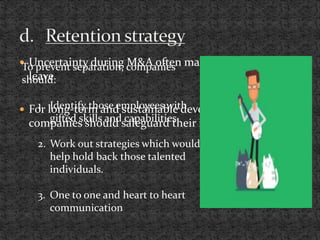
 Uncertainty during M&A often makes talented lot to
leave
 For long-term and sustainable development
companies should safeguard their intellectual assets
To prevent separation, companies
should:
1. Identify those employees with
gifted skills and capabilities
2. Work out strategies which would
help hold back those talented
individuals.
3. One to one and heart to heart
communication
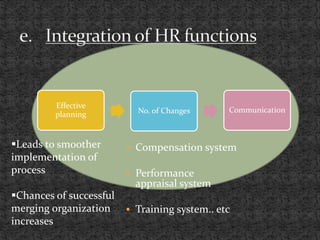
 Compensation system
 Performance
appraisal system
 Training system.. etc
Effective
planning No. of Changes Communication
Leads to smoother
implementation of
process
Chances of successful
merging organization
increases
Cultural differences
 How organization define/measure success
 Benefits employees enjoys
 Personal time
 Insurance
 How problems are handled within the organizations
 Overall attitude of employees
 Language barriers
Cultural audit is thus
conducted.
•It raise awareness of
potential difficulties and
issues in merging
•Helps in minimizing
cultural clashes by building
an effective communication
system
1. Not being involved early enough
2. Not understanding employees’ need and concerns
3. Not involving and empowering the incoming
leadership team
4. Not working with the receiving business unit
5. Underestimating the time, work that acquisitions &
integration require
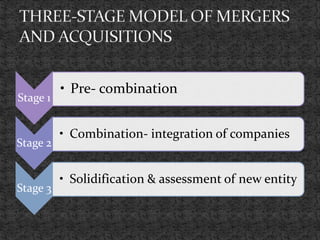
Stage 1
• Pre- combination
Stage 2
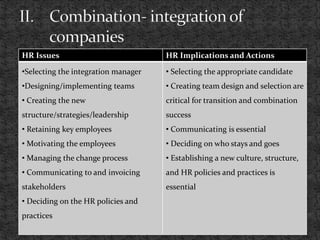
• Combination- integration of companies
Stage 3
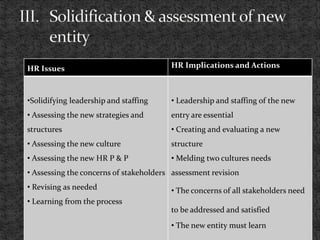
• Solidification & assessment of new entity
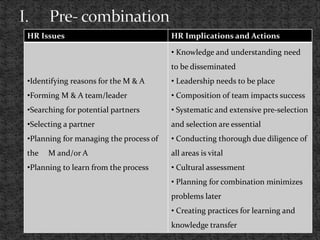
HR Issues HR Implications and Actions
•Identifying reasons for the M & A
•Forming M & A team/leader
•Searching for potential partners
•Selecting a partner
•Planning for managing the process of
the M and/or A
•Planning to learn from the process
• Knowledge and understanding need
to be disseminated
• Leadership needs to be place
• Composition of team impacts success
• Systematic and extensive pre-selection
and selection are essential
• Conducting thorough due diligence of
all areas is vital
• Cultural assessment
• Planning for combination minimizes
problems later
• Creating practices for learning and
knowledge transfer
HR Issues HR Implications and Actions
•Selecting the integration manager
•Designing/implementing teams
• Creating the new
structure/strategies/leadership
• Retaining key employees
• Motivating the employees
• Managing the change process
• Communicating to and invoicing
stakeholders
• Deciding on the HR policies and
practices
• Selecting the appropriate candidate
• Creating team design and selection are
critical for transition and combination
success
• Communicating is essential
• Deciding on who stays and goes
• Establishing a new culture, structure,
and HR policies and practices is
essential
HR Issues HR Implications and Actions
•Solidifying leadership and staffing
• Assessing the new strategies and
structures
• Assessing the new culture
• Assessing the new HR P & P
• Assessing the concerns of stakeholders
• Revising as needed
• Learning from the process
• Leadership and staffing of the new
entry are essential
• Creating and evaluating a new
structure
• Melding two cultures needs
assessment revision
• The concerns of all stakeholders need
to be addressed and satisfied
• The new entity must learn
TechMahindra-
Satyam
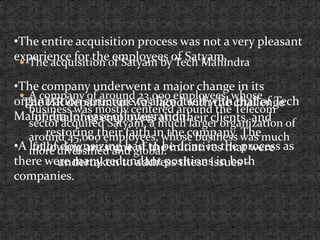
 The acquisition of Satyam by Tech Mahindra
 A company of around 23,000 employees, whose
business was mostly centered around the Telecom
sector acquired Satyam, a much larger organization of
around 45,000 employees, whose business was much
more diversified and global.
•The entire acquisition process was not a very pleasant
experience for the employees of Satyam.
•The company underwent a major change in its
organization structure to align itself with that of Tech
Mahindra for ease of integration.
•A lot of downsizing had to be done in the process as
there were many redundant positions in both
companies.
The HR department was faced with the challenge
of retaining employees and their clients, and
restoring their faith in the company. The
following are some of the initiatives that were
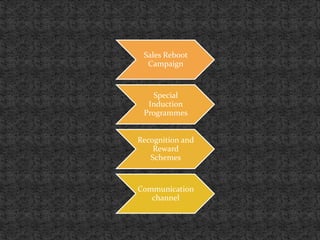
undertaken to address these issues -
Sales Reboot
Campaign
Special
Induction
Programmes
Recognition and
Reward
Schemes
Communication
channel
 The senior
management
conducted a 3 day
program for its sales
force and gave them
some much needed
motivation to pursue
new clients.
Sales
Reboot
Campaign
 The Satyam scandal tarnished the image of
the company.
 Employees quit the company in large
numbers, and it was almost impossible to
recruit new employees for the vacant
positions.
 So Satyam advertised for these vacant
positions within the organization.
 The members who were willing to join were
given an intensive 2-week induction
program in Sales and other functions so that
they could be quickly be made productive
and posted in regions abroad
Special
Induction
Programmes
 As the company initiated a
variable pay cut for all
employees,
 The senior management had to
devise new strategies to
motivate and retain their
employees.
 They decided to identify Star
Performers and 'Excel-lerators'
within each division and give
them special recognition for
their efforts.
Recognition
and Reward
Schemes
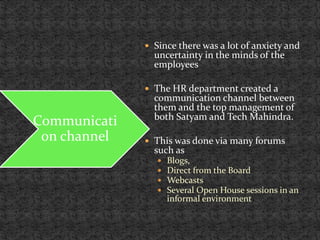
 Since there was a lot of anxiety and
uncertainty in the minds of the
employees
 The HR department created a
communication channel between
them and the top management of
both Satyam and Tech Mahindra.
 This was done via many forums
such as
 Blogs,
 Direct from the Board
 Webcasts
 Several Open House sessions in an
informal environment
Communicati
on channel
 HR facilitated the movement of Satyam employees into
TechM offices by organizing get-togethers and other events
to promote bonding between employees of TechM and
Satyam.
 They organized cultural and sports activities such as
singing competitions, cricket tournaments, etc. to promote
bonding between the two sets of employees.
 On the anniversary of the acquisition, the HR team
distributed fliers and stickers to all employees advertising
the successful integration of the two companies.
Managing hr during mergers &; acquisitions

Managing hr during mergers &; acquisitions

  • 1.
  • 2.
    Emerging issues poising challengesto SHRM Managing HR during M&A Impact of Technology Ethical issues Work-life balance Dealing with workforce diversity
  • 4.
     Mergers andacquisitions represent the end of the continuum of options that companies have in combining with each other.  In a merger, two companies come together and create a new entity.  In an acquisition, one company buys another one and manages it consistent with the acquirer’s needs.
  • 5.
     Mergers formarket dominance; economies of scale.  Mergers for risk spreading, cost cutting  Growth for world class leadership and global reach.  Survival; sales maximization.  Bigger asset base to leverage borrowing.  Financial gain and personal power.  Gaining a core competence to do more combinations.  Acquiring talent, knowledge, and technology
  • 6.
    According to studies “Oneof the major reasons M & A fail is improper handling of HR issues”
  • 7.
     Uncertainty ofjob after acquisition  Transfer fear  Loss of identity  New leadership styles  New rules and regulations  Change of hierarchy  Work culture  Prestige power and status  New appraisal methods  Restructuring of key positions ..
  • 8.
     New boardcomposition  Human resource audit  Effective communication  Retention strategy  Integration of HR functions  Cultural integrations
  • 9.
    Post merger newboard of decision making is needed Members of old firm Members of new firm
  • 10.
     Audit shouldbe done before starting merger process  Human capital audit should be focused on 2 dimensions Being preventive & focused on liabilities • Obligations • Employee litigations • Outstanding grievances Talent audit • A powerful tool for business leaders to understand an organization's capability to change and develop.
  • 11.
     Should becarried in such a way to avoid confusion & mixed messages  Management should clearly communicate to employees  Roles of employees  Future Goals  Inform Overall process of M & A  Job description 1. Helps to alleviate tension among employees 2. Communication feeds the top management about the integration that should take place between partners 3. Encourages widespread acceptance of the merger process
  • 12.
     Uncertainty duringM&A often makes talented lot to leave  For long-term and sustainable development companies should safeguard their intellectual assets To prevent separation, companies should: 1. Identify those employees with gifted skills and capabilities 2. Work out strategies which would help hold back those talented individuals. 3. One to one and heart to heart communication
  • 13.
     Compensation system Performance appraisal system  Training system.. etc Effective planning No. of Changes Communication Leads to smoother implementation of process Chances of successful merging organization increases
  • 14.
    Cultural differences  Howorganization define/measure success  Benefits employees enjoys  Personal time  Insurance  How problems are handled within the organizations  Overall attitude of employees  Language barriers Cultural audit is thus conducted. •It raise awareness of potential difficulties and issues in merging •Helps in minimizing cultural clashes by building an effective communication system
  • 15.
    1. Not beinginvolved early enough 2. Not understanding employees’ need and concerns 3. Not involving and empowering the incoming leadership team 4. Not working with the receiving business unit 5. Underestimating the time, work that acquisitions & integration require
  • 16.
    Stage 1 • Pre-combination Stage 2 • Combination- integration of companies Stage 3 • Solidification & assessment of new entity
  • 17.
    HR Issues HRImplications and Actions •Identifying reasons for the M & A •Forming M & A team/leader •Searching for potential partners •Selecting a partner •Planning for managing the process of the M and/or A •Planning to learn from the process • Knowledge and understanding need to be disseminated • Leadership needs to be place • Composition of team impacts success • Systematic and extensive pre-selection and selection are essential • Conducting thorough due diligence of all areas is vital • Cultural assessment • Planning for combination minimizes problems later • Creating practices for learning and knowledge transfer
  • 18.
    HR Issues HRImplications and Actions •Selecting the integration manager •Designing/implementing teams • Creating the new structure/strategies/leadership • Retaining key employees • Motivating the employees • Managing the change process • Communicating to and invoicing stakeholders • Deciding on the HR policies and practices • Selecting the appropriate candidate • Creating team design and selection are critical for transition and combination success • Communicating is essential • Deciding on who stays and goes • Establishing a new culture, structure, and HR policies and practices is essential
  • 19.
    HR Issues HRImplications and Actions •Solidifying leadership and staffing • Assessing the new strategies and structures • Assessing the new culture • Assessing the new HR P & P • Assessing the concerns of stakeholders • Revising as needed • Learning from the process • Leadership and staffing of the new entry are essential • Creating and evaluating a new structure • Melding two cultures needs assessment revision • The concerns of all stakeholders need to be addressed and satisfied • The new entity must learn
  • 20.
  • 21.
     The acquisitionof Satyam by Tech Mahindra  A company of around 23,000 employees, whose business was mostly centered around the Telecom sector acquired Satyam, a much larger organization of around 45,000 employees, whose business was much more diversified and global. •The entire acquisition process was not a very pleasant experience for the employees of Satyam. •The company underwent a major change in its organization structure to align itself with that of Tech Mahindra for ease of integration. •A lot of downsizing had to be done in the process as there were many redundant positions in both companies. The HR department was faced with the challenge of retaining employees and their clients, and restoring their faith in the company. The following are some of the initiatives that were undertaken to address these issues -
  • 22.
  • 23.
     The senior management conducteda 3 day program for its sales force and gave them some much needed motivation to pursue new clients. Sales Reboot Campaign
  • 24.
     The Satyamscandal tarnished the image of the company.  Employees quit the company in large numbers, and it was almost impossible to recruit new employees for the vacant positions.  So Satyam advertised for these vacant positions within the organization.  The members who were willing to join were given an intensive 2-week induction program in Sales and other functions so that they could be quickly be made productive and posted in regions abroad Special Induction Programmes
  • 25.
     As thecompany initiated a variable pay cut for all employees,  The senior management had to devise new strategies to motivate and retain their employees.  They decided to identify Star Performers and 'Excel-lerators' within each division and give them special recognition for their efforts. Recognition and Reward Schemes
  • 26.
     Since therewas a lot of anxiety and uncertainty in the minds of the employees  The HR department created a communication channel between them and the top management of both Satyam and Tech Mahindra.  This was done via many forums such as  Blogs,  Direct from the Board  Webcasts  Several Open House sessions in an informal environment Communicati on channel
  • 27.
     HR facilitatedthe movement of Satyam employees into TechM offices by organizing get-togethers and other events to promote bonding between employees of TechM and Satyam.  They organized cultural and sports activities such as singing competitions, cricket tournaments, etc. to promote bonding between the two sets of employees.  On the anniversary of the acquisition, the HR team distributed fliers and stickers to all employees advertising the successful integration of the two companies.

Editor's Notes

  • #5 The least intense and complex form of combination is licensing. Next come alliances and partnerships, and then joint ventures.
  • #6 There are numerous reasons for companies to merge or acquire. Some of the most frequent include
  • #7 So it is necessary to handle employees properly with care
  • #12 It is essential for smooth treansition