The Hindu Business Line : To make success of M&As — Focus on `people and culture' f...   Page 1 of 4


Business Daily from THE HINDU group of publications
Wednesday, Jan 31, 2007
ePaper


Opinion - Mergers & Acquisitions
Corporate - Insight
To make success of M&As — Focus on `people
and culture' factor
ACHAL RAGHAVAN

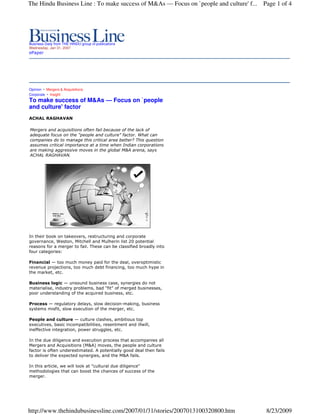
Mergers and acquisitions often fail because of the lack of
adequate focus on the "people and culture" factor. What can
companies do to manage this critical area better? This question
assumes critical importance at a time when Indian corporations
are making aggressive moves in the global M&A arena, says
ACHAL RAGHAVAN.


In their book on takeovers, restructuring and corporate
governance, Weston, Mitchell and Mulherin list 20 potential
reasons for a merger to fail. These can be classified broadly into
four categories:

Financial — too much money paid for the deal, overoptimistic
revenue projections, too much debt financing, too much hype in
the market, etc.

Business logic — unsound business case, synergies do not
materialise, industry problems, bad "fit" of merged businesses,
poor understanding of the acquired business, etc.

Process — regulatory delays, slow decision-making, business
systems misfit, slow execution of the merger, etc.

People and culture — culture clashes, ambitious top
executives, basic incompatibilities, resentment and illwill,
ineffective integration, power struggles, etc.

In the due diligence and execution process that accompanies all
Mergers and Acquisitions (M&A) moves, the people and culture
factor is often underestimated. A potentially good deal then fails
to deliver the expected synergies, and the M&A fails.

In this article, we will look at "cultural due diligence"
methodologies that can boost the chances of success of the
merger.


http://www.thehindubusinessline.com/2007/01/31/stories/2007013100320800.htm               8/23/2009
The Hindu Business Line : To make success of M&As — Focus on `people and culture' f...   Page 2 of 4


Human, cultural aspects

`Corporate culture' is essentially the manner in which a
company goes about getting its business done. It is made up of
operating traditions, belief systems, rules, norms, behaviours
and values.

When employees conform to the culture, they are rewarded;
non-conformance typically leads to punishment, friction or exit.

Many organisations create and publish formal statements of
values and codes of conduct, to align the people and help
newcomers.

In M&As, two organisations are brought together for the express
purpose of achieving synergies. In other words, their combined
output needs to be greater than the sum of their individual
outputs.

While products, processes, customers and financials will play
their own roles in achieving this synergy, human and cultural
factors remain the most complex.

This is because cultural aspects of an organisation mostly lie
under the surface, rather like the major mass of an iceberg that
remains submerged. Though mostly invisible, these factors are
very significant in terms of sheer influence they exert. Hence,
any M&A evaluation and implementation process must give due
weightage to this area from the beginning.

Cultural differences

No two organisations are likely to be exactly alike in their
culture. Based on the company's origin, leadership and past
history, each organisation develops its own cultural `DNA',
which is unique. Differences in culture between two
organisations may manifest themselves in many ways. Here are
some examples:

High degree of comfort with aggressive growth — as compared
to a more measured style which seeks moderate, consistent
growth.

Risk taking capabilities and tolerance for mistakes, versus a
"play safe" culture.

Leadership style — a top-down, "do it my way" culture, as
against a consensus-oriented, team approach.

Playing for the long term, versus " got to make the numbers
this month."

High regard for ethics and responsible corporate behaviour, as
compared to "only results matter."

High level of customer orientation, versus "we know what's
good for the customer."

Progress by merit and performance, versus seniority or
personal equations.

Encouragement for cross-functional involvement and learning,
as compared to sticking to departmental "silos." The
combination of all such traits and values can be termed the
"cultural configuration" of an organisation.

Given the increasingly global nature of M&A deals, the sheer
differences in nationalities and cultural traits themselves cause


http://www.thehindubusinessline.com/2007/01/31/stories/2007013100320800.htm               8/23/2009
The Hindu Business Line : To make success of M&As — Focus on `people and culture' f...   Page 3 of 4


formidable obstacles to smooth integration and value addition.
Ignoring these "soft" issues greatly increases the risk of failure
of the M&A project.

Cultural due diligence

Walker, Walker and Schmitz, in their book on doing business
internationally, define "cultural due diligence" as the ability to
assess and plan adequately for the possible effects of culture in
interactions. The exact methodology to be followed will have to
be customised in each case, depending upon the nature of the
organisations involved. Human resource professionals will have
to be an integral part of this activity from the very beginning,
teamed with senior management from other functions.

In general, the process of understanding the human/cultural
aspects of the merger, and drawing up an integration strategy,
consists of the following steps:

Information gathering: In this phase, the objective is to
gather as much information as possible about the values, belief
systems, norms, organisational behaviour and "cultural DNA" of
the company to be acquired or merged with. Possible sources for
such information are the media, individuals who have had
exposure to the organisation's inner workings, information on
how prior exercises of similar nature were handled, focus groups
of senior executives, surveys of employees, and so on. Since the
entire exercise is highly subjective, data gathering from multiple
sources is a must.

Cultural assessment: The next step is to formulate
hypotheses about the human and cultural configuration of the
two organisations, based on the information gathered. These
hypotheses will have to be validated through iterative
observations of the cultures in action.

Identification of potential cultural gaps: Differences in the
cultural configuration are listed and evaluated for potential
action. A decision has to be made at this stage whether some of
the cultural differences need to be deliberately left as they are —
if that would add to the synergy and value from the acquisition.
For example, autonomous and fast decision-making styles might
be a highly desirable trait in organisations that are engaged in
markets where technology changes are rapid and continuous.
Modifying such traits to a more conservative style would clearly
be detrimental.

Integration strategies: Proactive strategies and action plans
are then drawn up for maximising synergy in the integration
phase, and getting the joint entity off to a quick start. Involving
key managers from both entities at this stage makes the
strategies more robust.

Integration process

In a basic way, the entire merger (or acquisition) exercise
involves the transition of human resource from one scenario
(which is familiar and comforting) to another (which is alien and
uncertain). This transition is a process, and not an event.

The "integration team" (typically a combination of HR and line
managers) should develop a clear and common understanding of
the overall logic and features of the entire M&A deal, before
getting into the implementation. And right through the process,
clear communications hold the key to success.

Human and cultural aspects of M&As require the committed
attention of senior business leaders, and not just HR
professionals. This is a critical part of the whole M&A exercise.


http://www.thehindubusinessline.com/2007/01/31/stories/2007013100320800.htm               8/23/2009
The Hindu Business Line : To make success of M&As — Focus on `people and culture' f...                                                             Page 4 of 4


Navigated well, it significantly improves the chances of realising
the expected value from the deal. When ignored, or dealt with
superficially, the results could be the opposite.

(The author is a Bangalore-based consultant in strategy and
business excellence. He can be contacted at
achalraghavan@yahoo.co.in.)

More Stories on : Mergers & Acquisitions | Insight

Article E-Mail :: Comment :: Syndication :: Printer Friendly Page


The Hindu Group: Home | About Us | Copyright | Archives | Contacts | Subscription
Group Sites: The Hindu | The Hindu ePaper | Business Line | Business Line ePaper | Sportstar | Frontline | The Hindu eBooks | The Hindu Images | Home |

Copyright © 2007, The Hindu Business Line. Republication or redissemination of the contents of this screen are expressly prohibited without the written consent of
The Hindu Business Line


http://www.thehindubusinessline.com/2007/01/31/stories/2007013100320800.htm                                                                          8/23/2009

M&As People And Culture Factor

  • 1.
    The Hindu BusinessLine : To make success of M&As — Focus on `people and culture' f... Page 1 of 4 Business Daily from THE HINDU group of publications Wednesday, Jan 31, 2007 ePaper Opinion - Mergers & Acquisitions Corporate - Insight To make success of M&As — Focus on `people and culture' factor ACHAL RAGHAVAN Mergers and acquisitions often fail because of the lack of adequate focus on the "people and culture" factor. What can companies do to manage this critical area better? This question assumes critical importance at a time when Indian corporations are making aggressive moves in the global M&A arena, says ACHAL RAGHAVAN. In their book on takeovers, restructuring and corporate governance, Weston, Mitchell and Mulherin list 20 potential reasons for a merger to fail. These can be classified broadly into four categories: Financial — too much money paid for the deal, overoptimistic revenue projections, too much debt financing, too much hype in the market, etc. Business logic — unsound business case, synergies do not materialise, industry problems, bad "fit" of merged businesses, poor understanding of the acquired business, etc. Process — regulatory delays, slow decision-making, business systems misfit, slow execution of the merger, etc. People and culture — culture clashes, ambitious top executives, basic incompatibilities, resentment and illwill, ineffective integration, power struggles, etc. In the due diligence and execution process that accompanies all Mergers and Acquisitions (M&A) moves, the people and culture factor is often underestimated. A potentially good deal then fails to deliver the expected synergies, and the M&A fails. In this article, we will look at "cultural due diligence" methodologies that can boost the chances of success of the merger. http://www.thehindubusinessline.com/2007/01/31/stories/2007013100320800.htm 8/23/2009
  • 2.
    The Hindu BusinessLine : To make success of M&As — Focus on `people and culture' f... Page 2 of 4 Human, cultural aspects `Corporate culture' is essentially the manner in which a company goes about getting its business done. It is made up of operating traditions, belief systems, rules, norms, behaviours and values. When employees conform to the culture, they are rewarded; non-conformance typically leads to punishment, friction or exit. Many organisations create and publish formal statements of values and codes of conduct, to align the people and help newcomers. In M&As, two organisations are brought together for the express purpose of achieving synergies. In other words, their combined output needs to be greater than the sum of their individual outputs. While products, processes, customers and financials will play their own roles in achieving this synergy, human and cultural factors remain the most complex. This is because cultural aspects of an organisation mostly lie under the surface, rather like the major mass of an iceberg that remains submerged. Though mostly invisible, these factors are very significant in terms of sheer influence they exert. Hence, any M&A evaluation and implementation process must give due weightage to this area from the beginning. Cultural differences No two organisations are likely to be exactly alike in their culture. Based on the company's origin, leadership and past history, each organisation develops its own cultural `DNA', which is unique. Differences in culture between two organisations may manifest themselves in many ways. Here are some examples: High degree of comfort with aggressive growth — as compared to a more measured style which seeks moderate, consistent growth. Risk taking capabilities and tolerance for mistakes, versus a "play safe" culture. Leadership style — a top-down, "do it my way" culture, as against a consensus-oriented, team approach. Playing for the long term, versus " got to make the numbers this month." High regard for ethics and responsible corporate behaviour, as compared to "only results matter." High level of customer orientation, versus "we know what's good for the customer." Progress by merit and performance, versus seniority or personal equations. Encouragement for cross-functional involvement and learning, as compared to sticking to departmental "silos." The combination of all such traits and values can be termed the "cultural configuration" of an organisation. Given the increasingly global nature of M&A deals, the sheer differences in nationalities and cultural traits themselves cause http://www.thehindubusinessline.com/2007/01/31/stories/2007013100320800.htm 8/23/2009
  • 3.
    The Hindu BusinessLine : To make success of M&As — Focus on `people and culture' f... Page 3 of 4 formidable obstacles to smooth integration and value addition. Ignoring these "soft" issues greatly increases the risk of failure of the M&A project. Cultural due diligence Walker, Walker and Schmitz, in their book on doing business internationally, define "cultural due diligence" as the ability to assess and plan adequately for the possible effects of culture in interactions. The exact methodology to be followed will have to be customised in each case, depending upon the nature of the organisations involved. Human resource professionals will have to be an integral part of this activity from the very beginning, teamed with senior management from other functions. In general, the process of understanding the human/cultural aspects of the merger, and drawing up an integration strategy, consists of the following steps: Information gathering: In this phase, the objective is to gather as much information as possible about the values, belief systems, norms, organisational behaviour and "cultural DNA" of the company to be acquired or merged with. Possible sources for such information are the media, individuals who have had exposure to the organisation's inner workings, information on how prior exercises of similar nature were handled, focus groups of senior executives, surveys of employees, and so on. Since the entire exercise is highly subjective, data gathering from multiple sources is a must. Cultural assessment: The next step is to formulate hypotheses about the human and cultural configuration of the two organisations, based on the information gathered. These hypotheses will have to be validated through iterative observations of the cultures in action. Identification of potential cultural gaps: Differences in the cultural configuration are listed and evaluated for potential action. A decision has to be made at this stage whether some of the cultural differences need to be deliberately left as they are — if that would add to the synergy and value from the acquisition. For example, autonomous and fast decision-making styles might be a highly desirable trait in organisations that are engaged in markets where technology changes are rapid and continuous. Modifying such traits to a more conservative style would clearly be detrimental. Integration strategies: Proactive strategies and action plans are then drawn up for maximising synergy in the integration phase, and getting the joint entity off to a quick start. Involving key managers from both entities at this stage makes the strategies more robust. Integration process In a basic way, the entire merger (or acquisition) exercise involves the transition of human resource from one scenario (which is familiar and comforting) to another (which is alien and uncertain). This transition is a process, and not an event. The "integration team" (typically a combination of HR and line managers) should develop a clear and common understanding of the overall logic and features of the entire M&A deal, before getting into the implementation. And right through the process, clear communications hold the key to success. Human and cultural aspects of M&As require the committed attention of senior business leaders, and not just HR professionals. This is a critical part of the whole M&A exercise. http://www.thehindubusinessline.com/2007/01/31/stories/2007013100320800.htm 8/23/2009
  • 4.
    The Hindu BusinessLine : To make success of M&As — Focus on `people and culture' f... Page 4 of 4 Navigated well, it significantly improves the chances of realising the expected value from the deal. When ignored, or dealt with superficially, the results could be the opposite. (The author is a Bangalore-based consultant in strategy and business excellence. He can be contacted at achalraghavan@yahoo.co.in.) More Stories on : Mergers & Acquisitions | Insight Article E-Mail :: Comment :: Syndication :: Printer Friendly Page The Hindu Group: Home | About Us | Copyright | Archives | Contacts | Subscription Group Sites: The Hindu | The Hindu ePaper | Business Line | Business Line ePaper | Sportstar | Frontline | The Hindu eBooks | The Hindu Images | Home | Copyright © 2007, The Hindu Business Line. Republication or redissemination of the contents of this screen are expressly prohibited without the written consent of The Hindu Business Line http://www.thehindubusinessline.com/2007/01/31/stories/2007013100320800.htm 8/23/2009