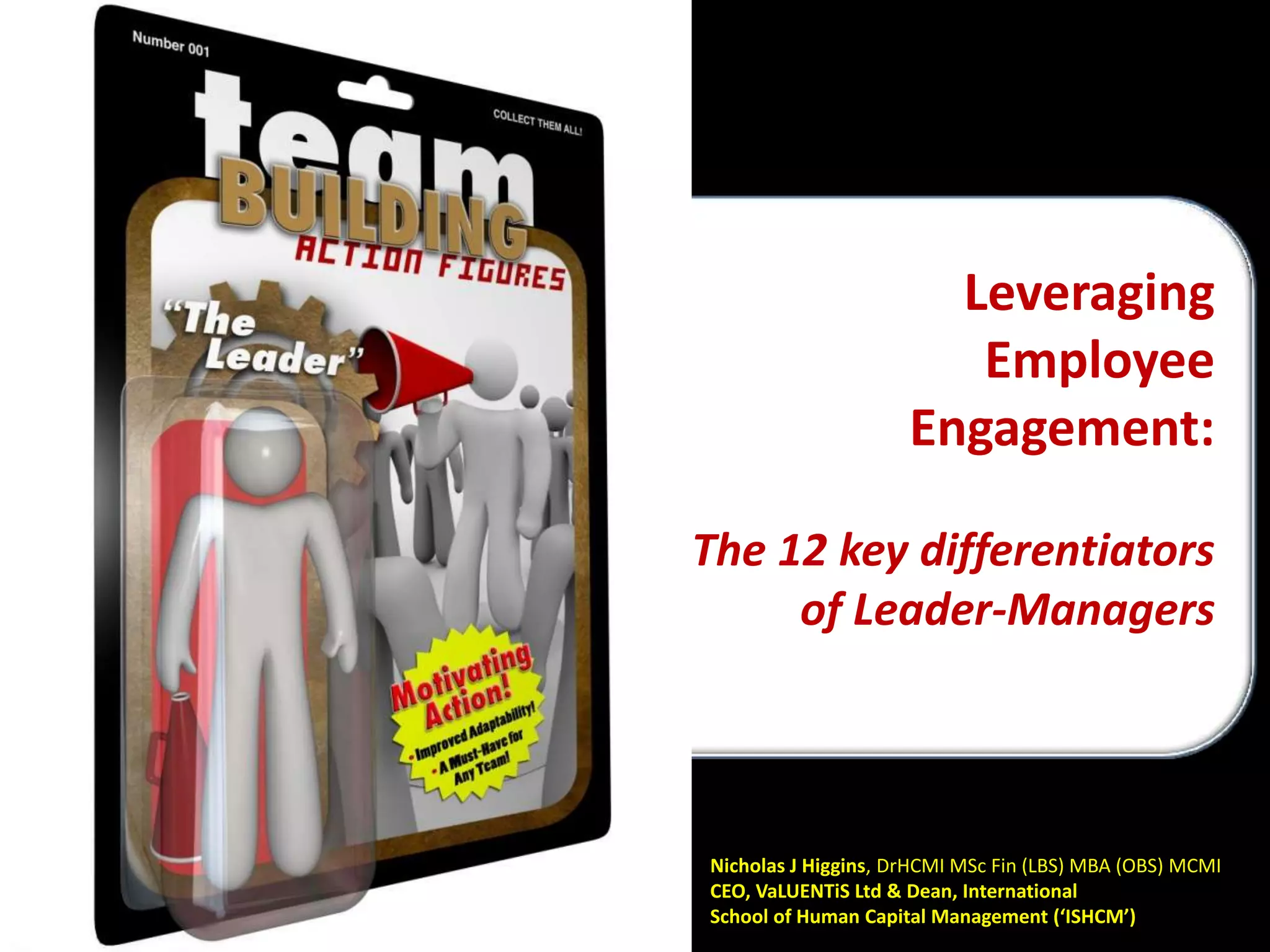


Leveraging
Employee
Engagement:
The 12 key differentiators
of Leader-Managers

Nicholas J Higgins, DrHCMI MSc Fin (LBS) MBA (OBS) MCMI
CEO, VaLUENTiS Ltd & Dean, International
School of Human Capital Management (‘ISHCM’)
 As organisations continue to grapple with the means to
optimise employee engagement on a daily basis – one of their
biggest assets (or liabilities) is the ‘Leader-Manager’.

 To shortcut the leadership/management debate I use Drucker’s
dictum:

“Management is doing things right;
leadership is doing the right things.”
 Thus my interpretation here is that Leadership and
management are two sides of the same ‘Leader-Manager’ coin.
 Any individual who finds himself/herself ‘in charge’ of people
and wants to be successful, needs to be good at both. Period.
2
 Having spent the last thirty years successfully managing
teams, being part of teams and latterly consulting on
successful team/organisation performance projects with regard
to employee engagement and talent management, I’ve
shortlisted a number of defining ‘traits’ that differentiate good
‘Leader-Managers’ from the rest.
 If organisations are to demand, and get, the best from
employees in their organisation on a daily basis – then
ensuring that their cadre of Leader-Managers are ‘highperforming’ in engaging their staff is paramount.
 This of course extends to ensuring that these LeaderManagers, themselves, are highly engaged. And we’re not just
talking about frontline Leader-Managers here – they are at all
levels starting with the CEO, continuing ‘downwards’. So what
are these ‘differentiators’ with regard to employee
engagement?
3
1

Good Leader-Managers have good
self-awareness and score well on
any emotionally intelligent test.
This basic requirement feeds into
a number of the differentiators.
Many may observe that this is
common sense – but how many
current Leader-Managers pass this
basic requirement?

4
2

Good Leader-Managers treat those
in their charge as organisation
assets and not their ‘own’.
That is – decisions made about
individuals are done from an
organisational perspective not the
individual manager’s perspective
(in terms of benefit).
It is important to recognise that
highly politicised environments
quite often work against this
‘good’ trait.
5
3

Good Leader-Managers are more
pro-active (as opposed to good
‘fire-fighters’), forward-looking
and confident in dealing with dayto-day staff/operational matters.
However, many organisations
mistakenly associate good ‘firefighters’ as good ‘LeaderManagers’.
Having good ‘firefighters’ doesn’t
necessarily equate to high
employee engagement.
6
4

Good Leader-Managers have a
good working understanding of
managing people and how to
optimise employee engagement getting the best out of people with
regard to performance.
This comes with both access to
requisite knowledge through
learning and gaining the right
experience.
Note, experience alone is not
enough.
7
5

Good Leader-Managers understand
the importance of clear and
consistent one-to-one and one-tomany communication, particularly
around performance and decisions.
They also understand the good
and bad impact of the various
aspects of social media when it
comes to productivity.

8
6

Good Leader-Managers get results
but not at the expense of overrelying on their best performers,
nor generating higher than needed
attrition whether it is absenteeism
or turnover.
Understanding the related positive
and negative aspects of employee
engagement in relation to
attaining targets, measures,
objectives and values is crucial.

9
7

Good Leader-Managers always
make the tough calls for the
benefit of the team.
The collective employee
engagement will always be higher.
This is in marked contrast to
Leader-Managers who defer
decisions, using cover excuses or
who make politically expedient
decisions.

10
8

Good Leader-Managers don’t
procrastinate or postpone issues
important to an individual team
member.

Cancelled appraisals are an
obvious and common example as
are delays in granting holiday
times and so on.
The Good Leader-Manager always
asks: Would I be happy being on
the receiving end? (And even if
they are from their own boss it is
no excuse to repeat the practice.)
11
9

Good Leader-Managers understand
that making and explaining
decisions are all about team
equity.

It is one of the most underrecognised elements in employee
engagement.
Perceived fairness is paramount.
This is way beyond just ‘equality’
or ‘diversity’ issues.

12
10

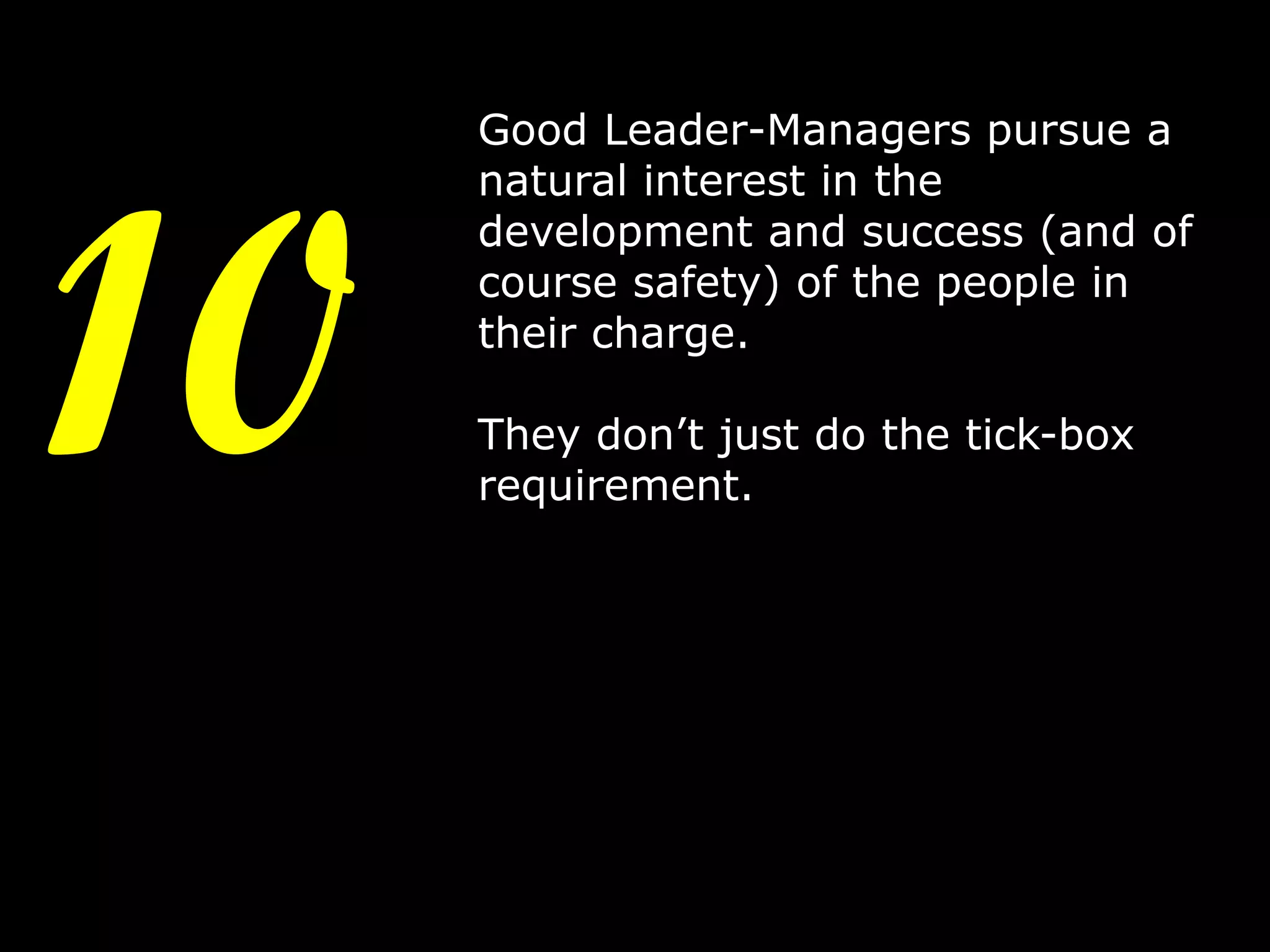
Good Leader-Managers pursue a
natural interest in the
development and success (and of
course safety) of the people in
their charge.
They don’t just do the tick-box
requirement.

13
11

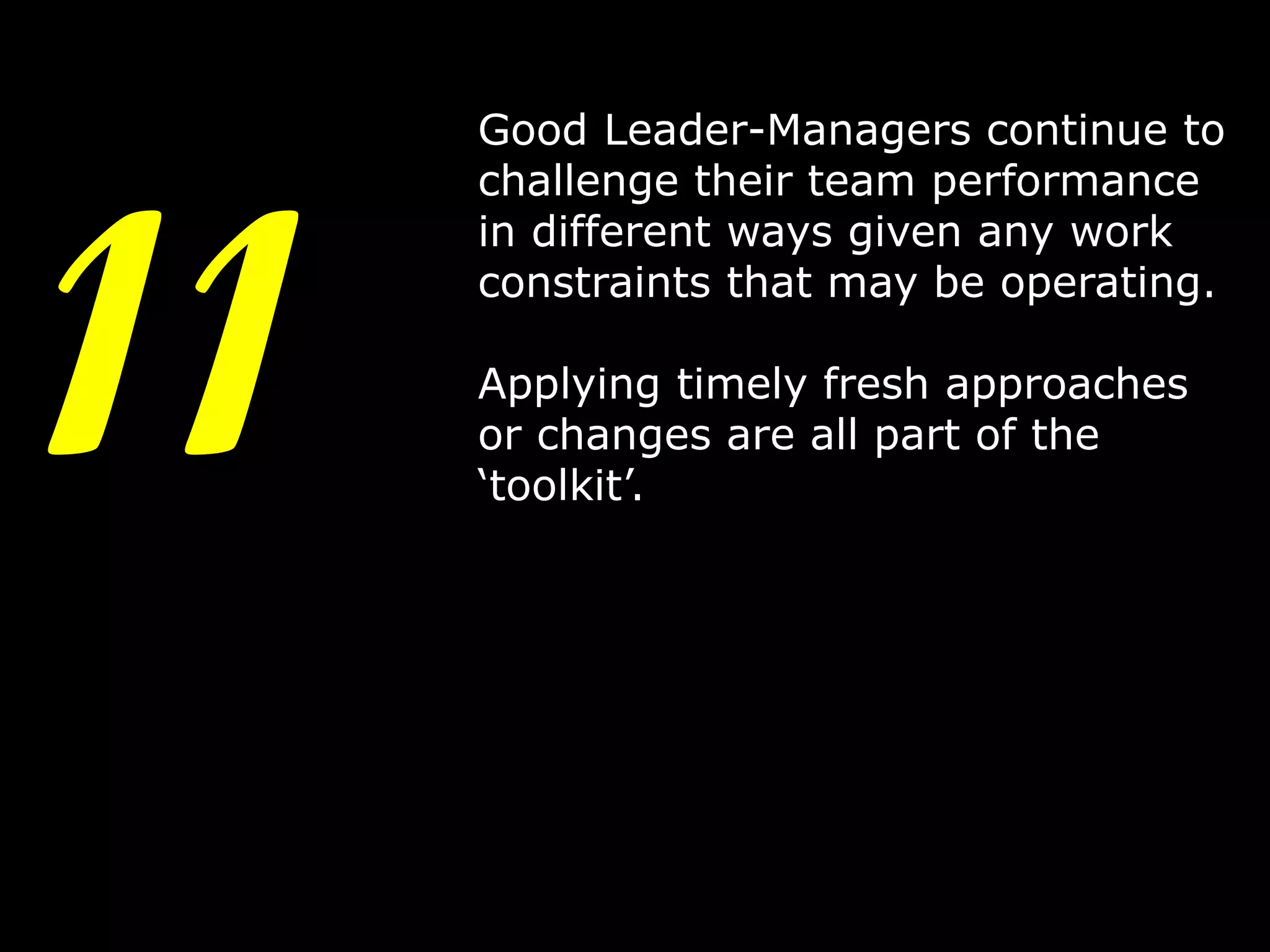
Good Leader-Managers continue to
challenge their team performance
in different ways given any work
constraints that may be operating.

Applying timely fresh approaches
or changes are all part of the
‘toolkit’.

14
12

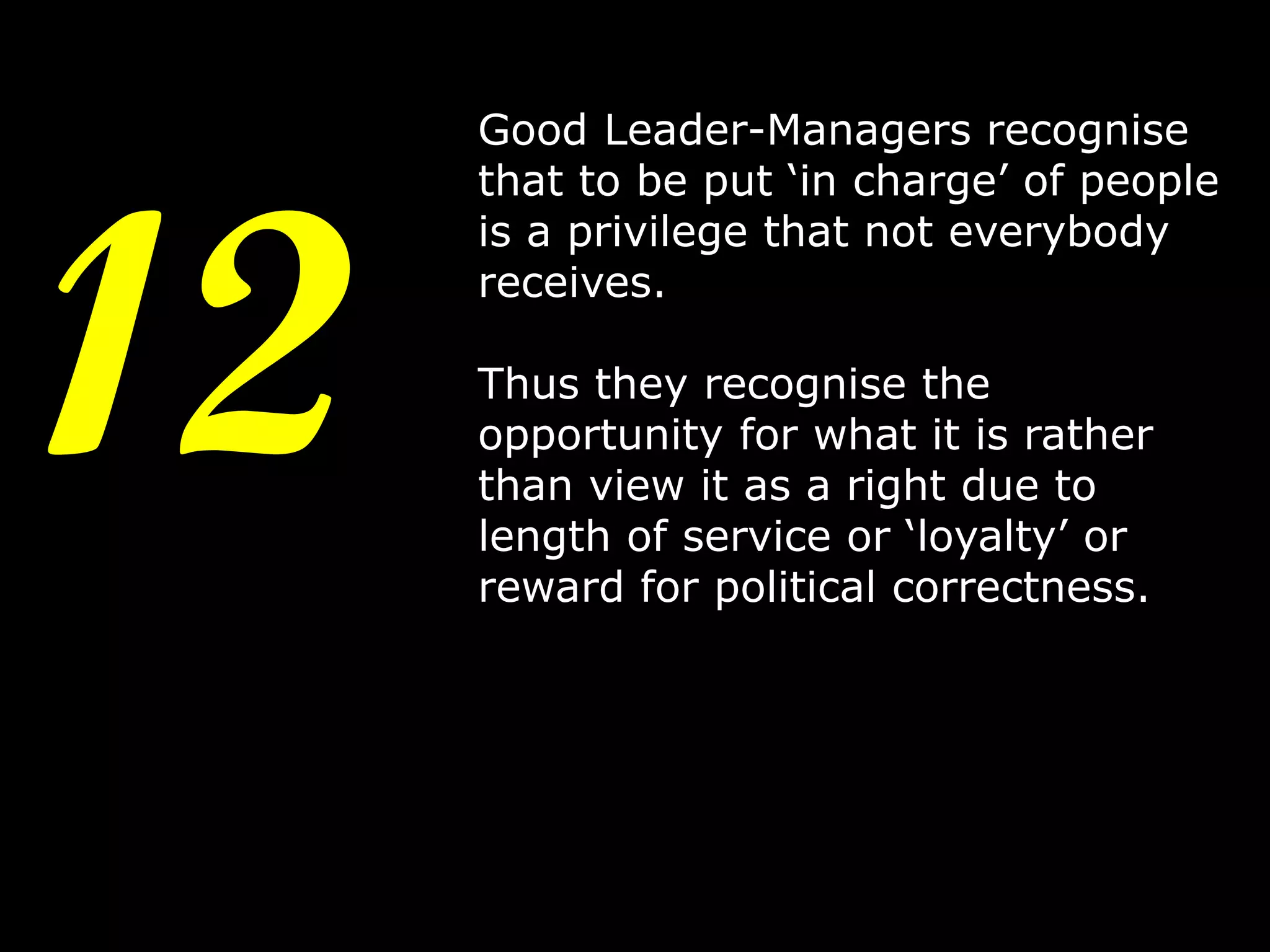
Good Leader-Managers recognise
that to be put ‘in charge’ of people
is a privilege that not everybody
receives.

Thus they recognise the
opportunity for what it is rather
than view it as a right due to
length of service or ‘loyalty’ or
reward for political correctness.

15
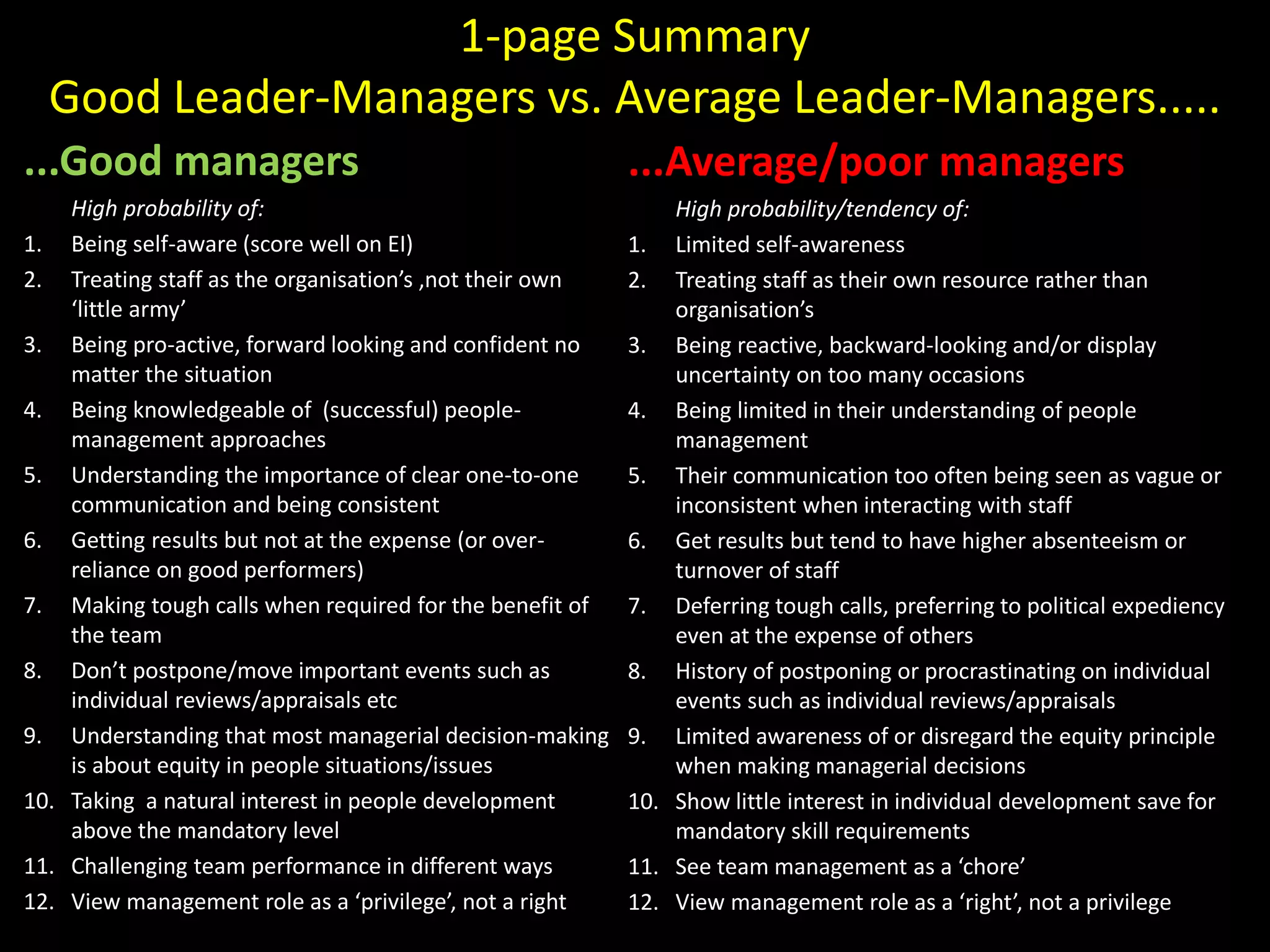
1-page Summary
Good Leader-Managers vs. Average Leader-Managers.....
...Good managers

...Average/poor managers

High probability of:
1. Being self-aware (score well on EI)
2. Treating staff as the organisation’s ,not their own
‘little army’
3. Being pro-active, forward looking and confident no
matter the situation
4. Being knowledgeable of (successful) peoplemanagement approaches
5. Understanding the importance of clear one-to-one
communication and being consistent
6. Getting results but not at the expense (or overreliance on good performers)
7. Making tough calls when required for the benefit of
the team
8. Don’t postpone/move important events such as
individual reviews/appraisals etc
9. Understanding that most managerial decision-making
is about equity in people situations/issues
10. Taking a natural interest in people development
above the mandatory level
11. Challenging team performance in different ways
12. View management role as a ‘privilege’, not a right

High probability/tendency of:
1. Limited self-awareness
2. Treating staff as their own resource rather than
organisation’s
3. Being reactive, backward-looking and/or display
uncertainty on too many occasions
4. Being limited in their understanding of people
management
5. Their communication too often being seen as vague or
inconsistent when interacting with staff
6. Get results but tend to have higher absenteeism or
turnover of staff
7. Deferring tough calls, preferring to political expediency
even at the expense of others
8. History of postponing or procrastinating on individual
events such as individual reviews/appraisals
9. Limited awareness of or disregard the equity principle
when making managerial decisions
10. Show little interest in individual development save for
mandatory skill requirements
11. See team management as a ‘chore’
12. View management role as a ‘right’, not a privilege
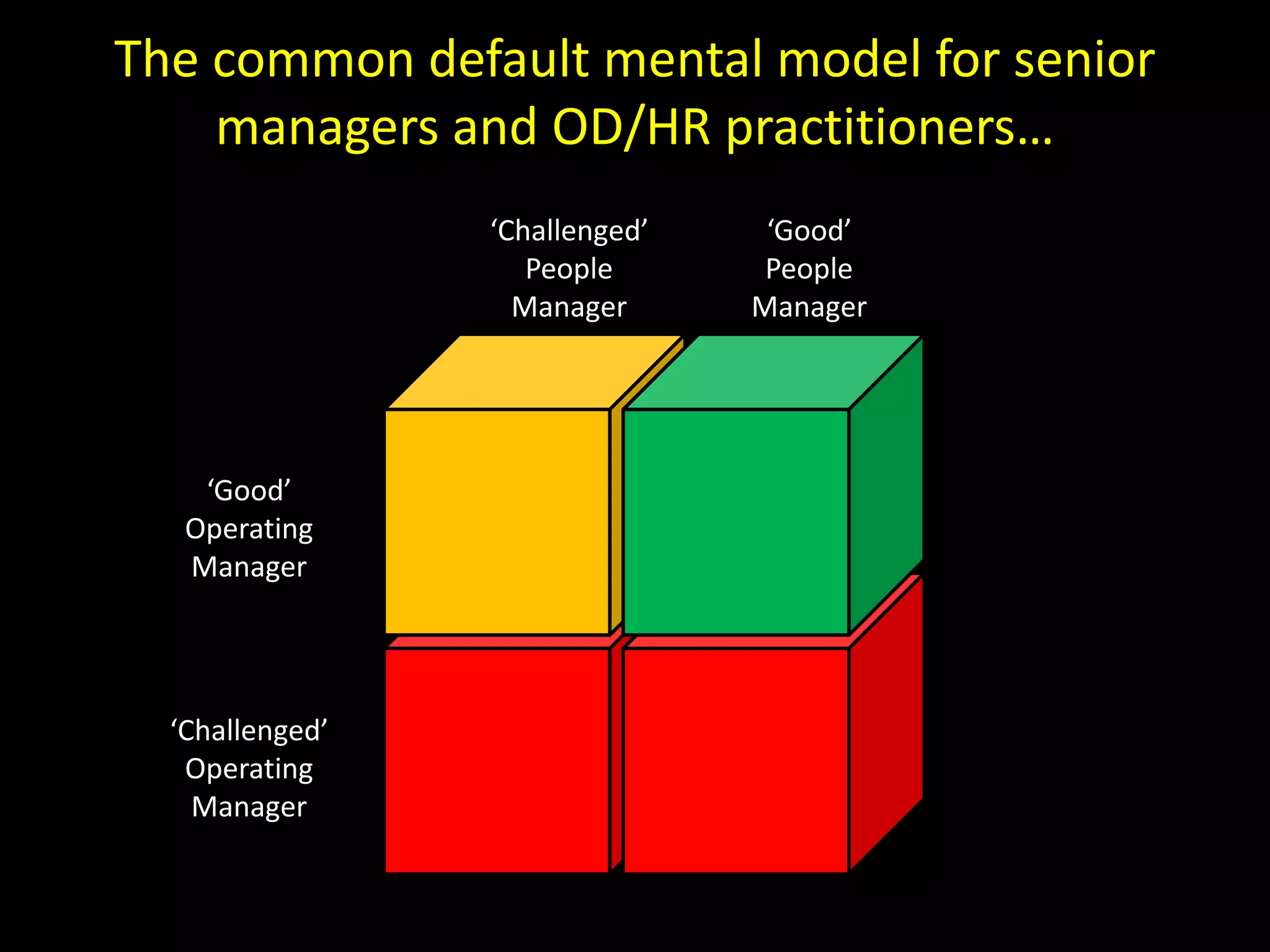
The common default mental model for senior
managers and OD/HR practitioners…
‘Challenged’
People
Manager

‘Good’
Operating
Manager

‘Challenged’
Operating
Manager

‘Good’
People
Manager
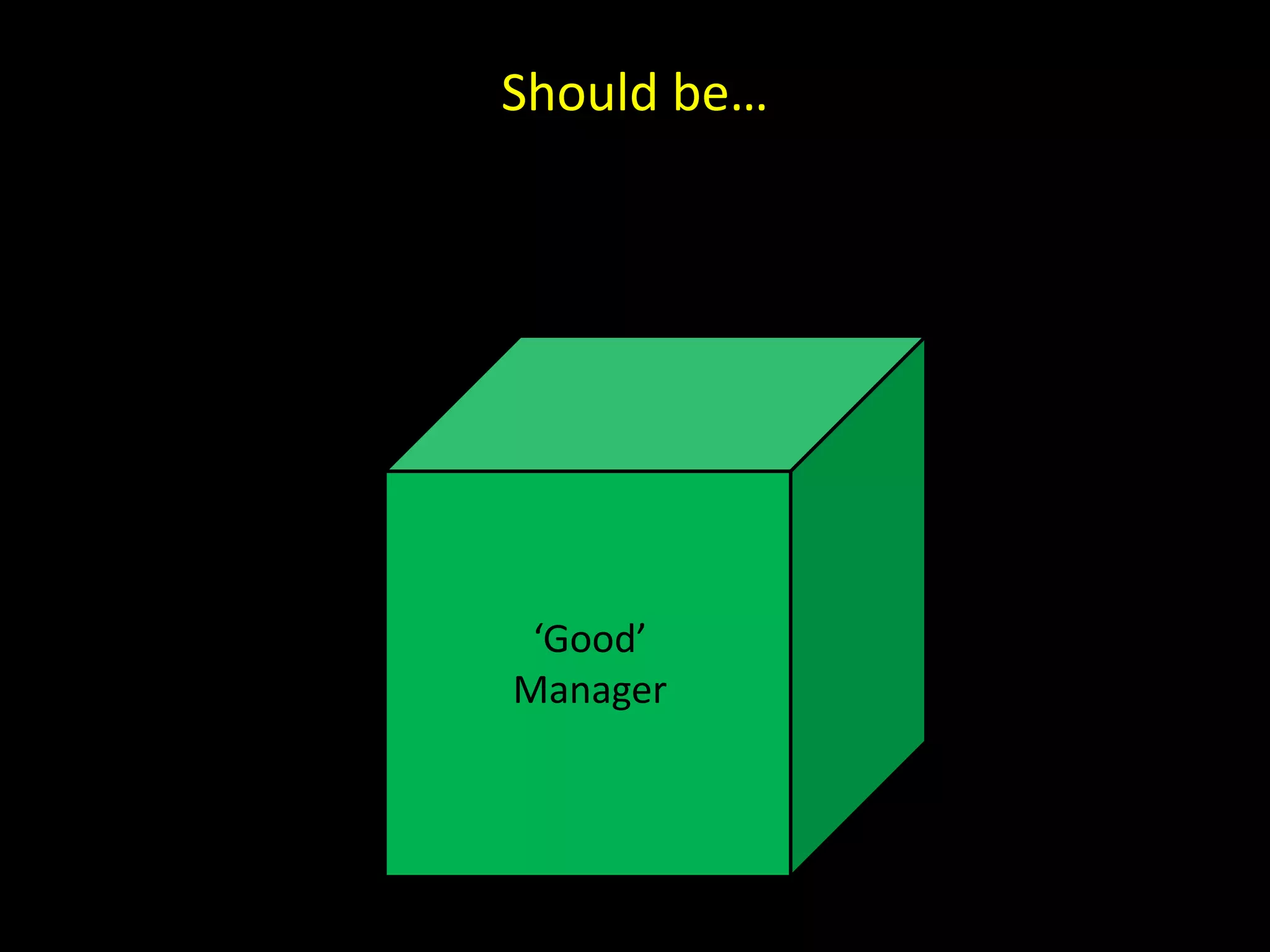
Should be…

‘Good’
Manager
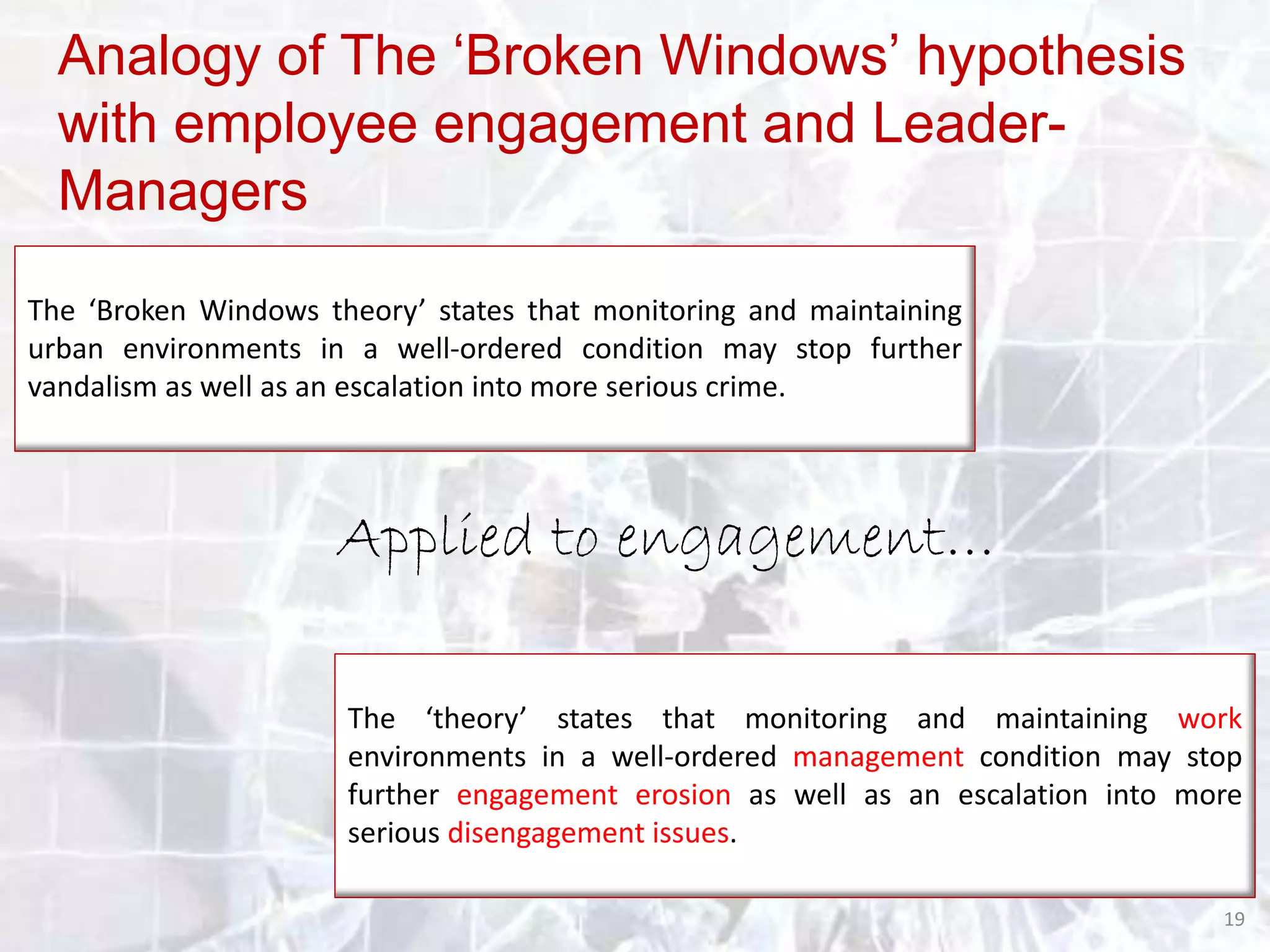
Analogy of The ‘Broken Windows’ hypothesis
with employee engagement and LeaderManagers
The ‘Broken Windows theory’ states that monitoring and maintaining
urban environments in a well-ordered condition may stop further
vandalism as well as an escalation into more serious crime.

Applied to engagement…
The ‘theory’ states that monitoring and maintaining work
environments in a well-ordered management condition may stop
further engagement erosion as well as an escalation into more
serious disengagement issues.
19
A reminder that not all Leader-Managers are
highly engaged themselves. This is often
overlooked in organisations.
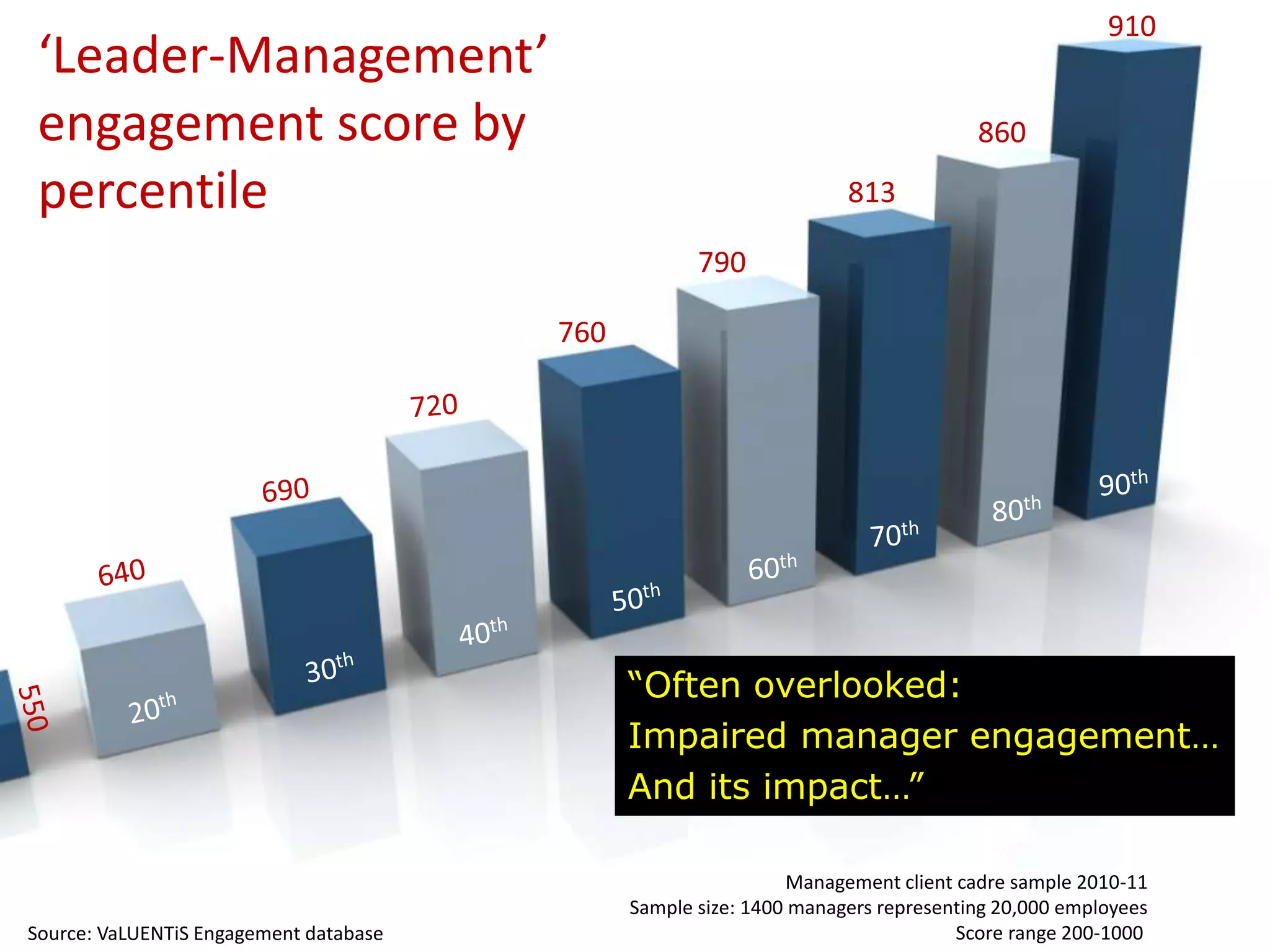
The impact of this should be obvious. Our
research showed the distribution of differing
scores across a random sample of LeaderManagers from our database (overleaf):

20
910

‘Leader-Management’
engagement score by
percentile

860
813
790

760

“Often overlooked:
Impaired manager engagement…
And its impact…”

Source: VaLUENTiS Engagement database

Management client cadre sample 2010-11
Sample size: 1400 managers representing 20,000 employees
Score range 200-1000
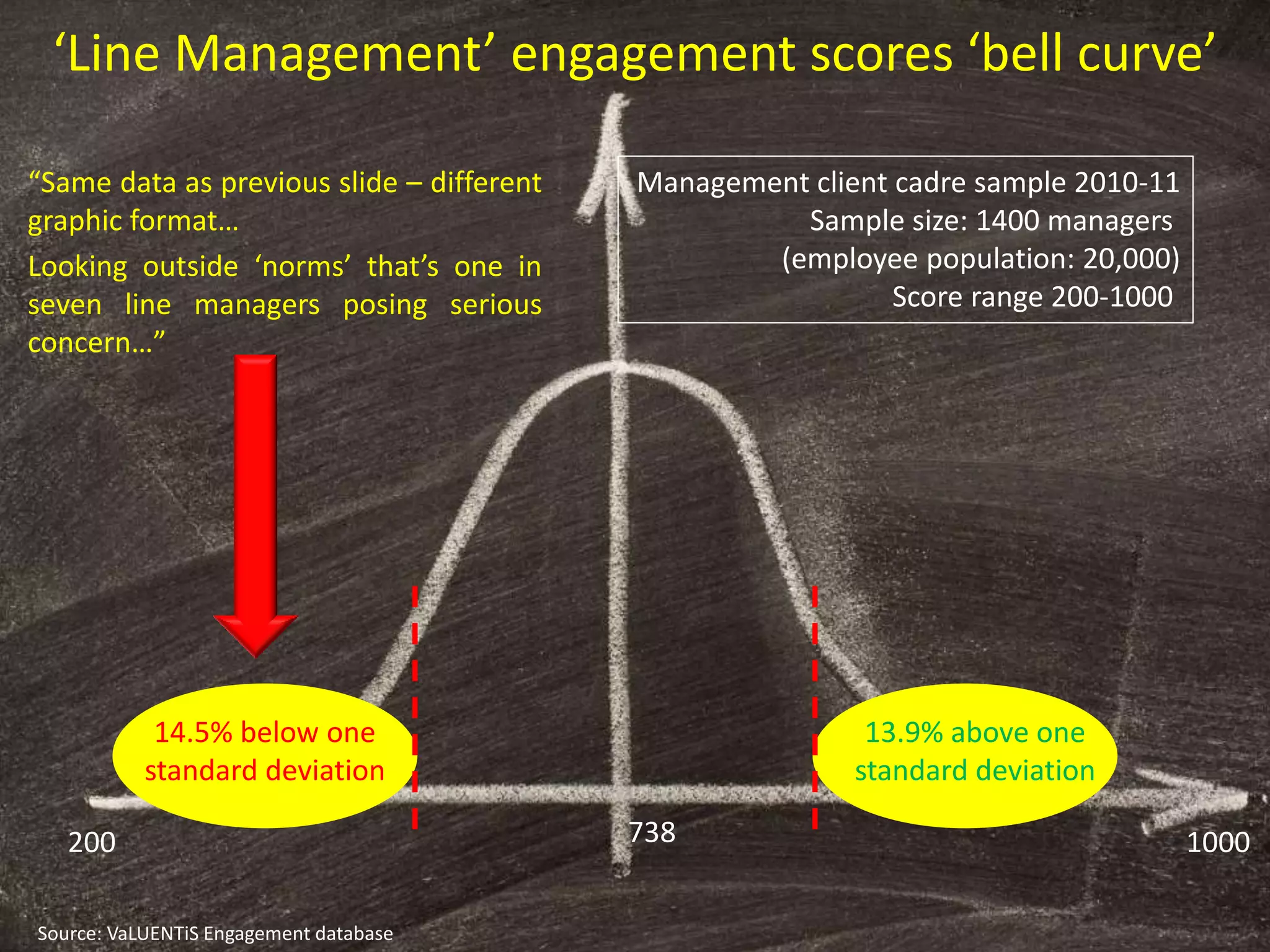
‘Line Management’ engagement scores ‘bell curve’
“Same data as previous slide – different
graphic format…
Looking outside ‘norms’ that’s one in
seven line managers posing serious
concern…”

Management client cadre sample 2010-11
Sample size: 1400 managers
(employee population: 20,000)
Score range 200-1000

14.5% below one
standard deviation
200
Source: VaLUENTiS Engagement database

13.9% above one
standard deviation
738

1000
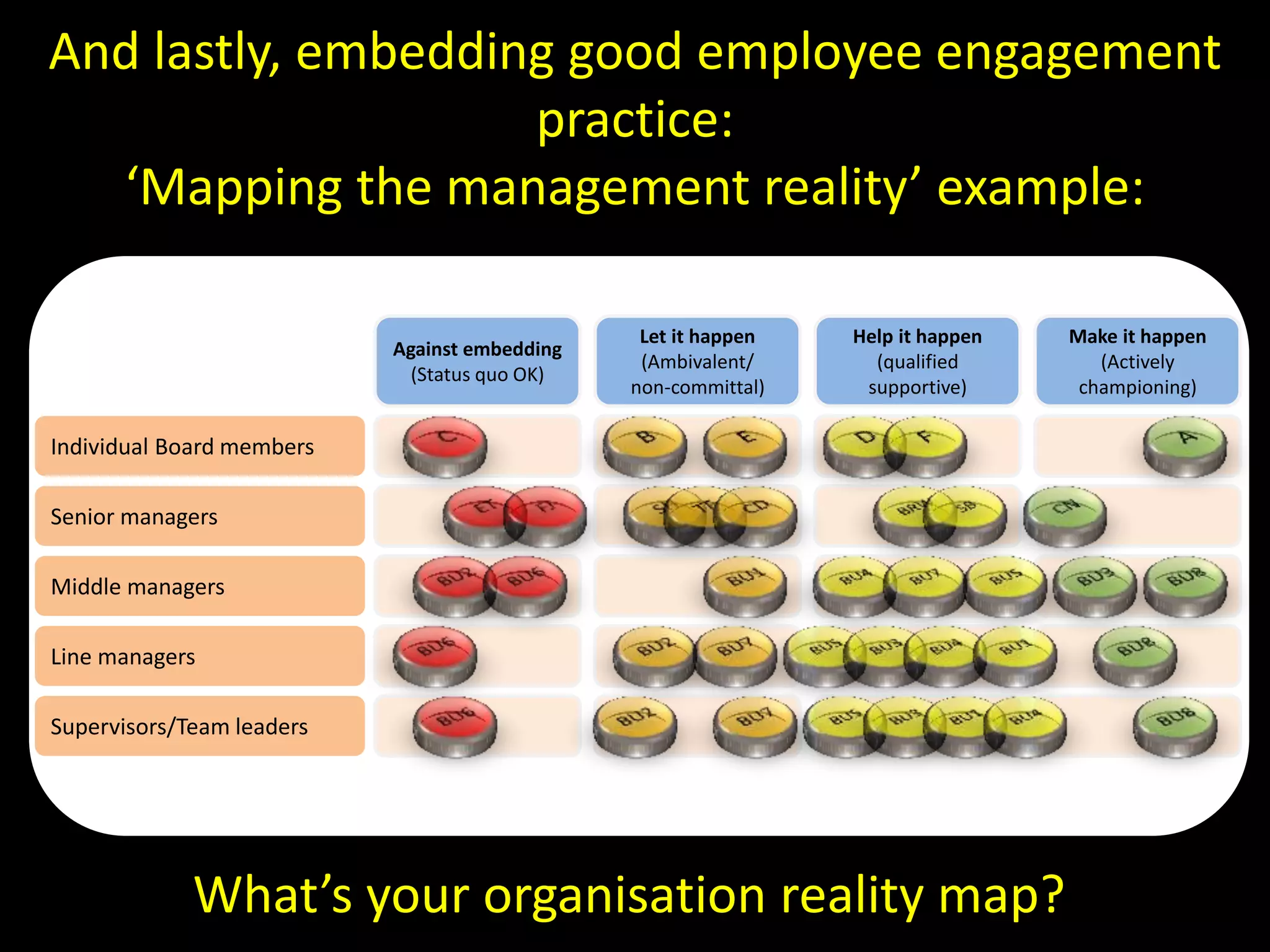
And lastly, embedding good employee engagement
practice:
‘Mapping the management reality’ example:
Against embedding
(Status quo OK)

Let it happen
(Ambivalent/
non-committal)

Help it happen
(qualified
supportive)

Individual Board members
Senior managers
Middle managers
Line managers
Supervisors/Team leaders

What’s your organisation reality map?

Make it happen
(Actively
championing)
End

24
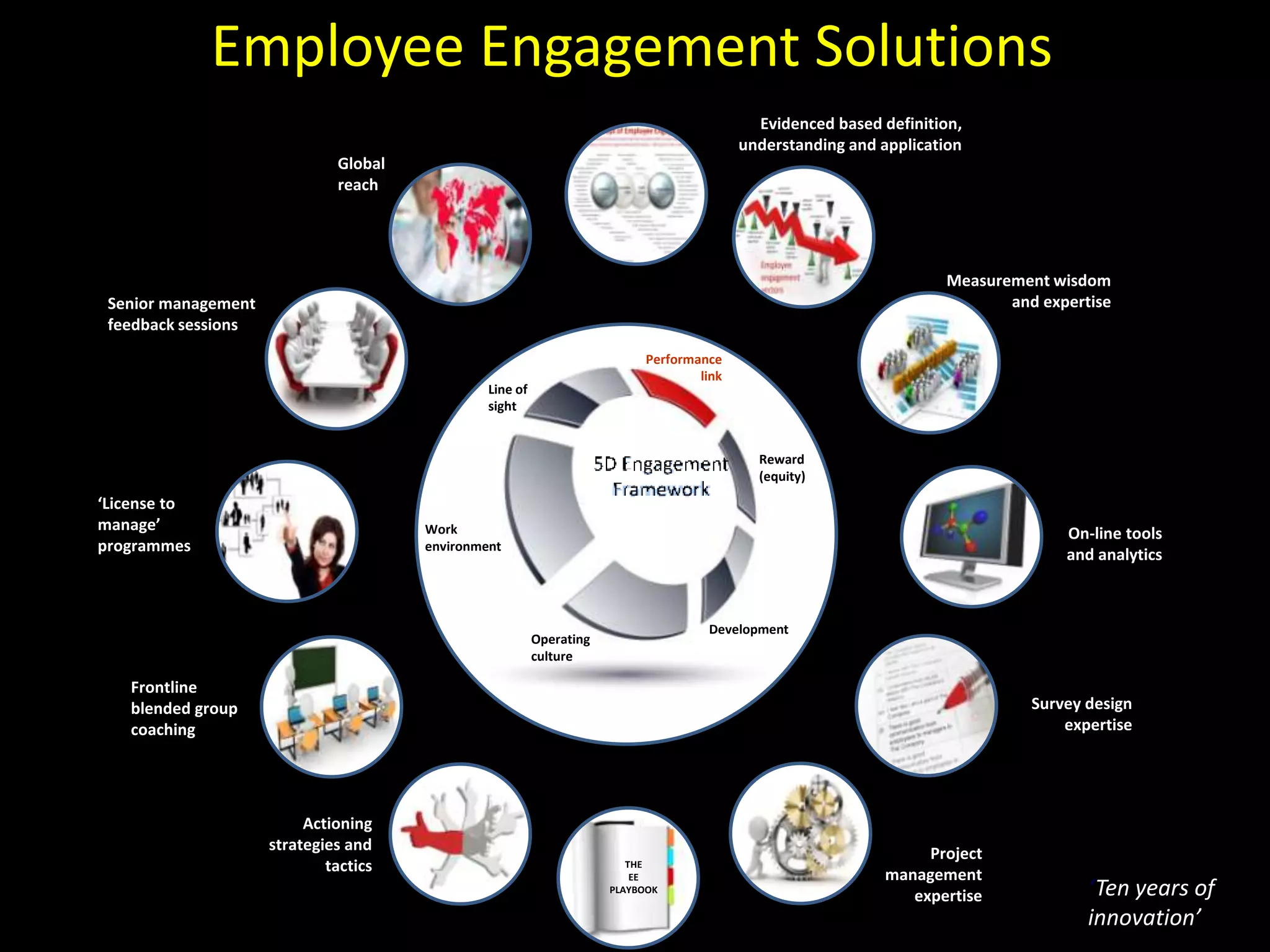
Employee Engagement Solutions
Evidenced based definition,
understanding and application
Global
reach

Measurement wisdom
and expertise

Senior management
feedback sessions
Performance
link

Line of
sight

Reward
(equity)

‘License to
manage’
programmes

Work
environment

On-line tools
and analytics

Development

Operating
culture

Frontline
blended group
coaching

Survey design
expertise

Actioning
strategies and
tactics

THE
EE
PLAYBOOK

Project
management
expertise

‘Ten years of
innovation’
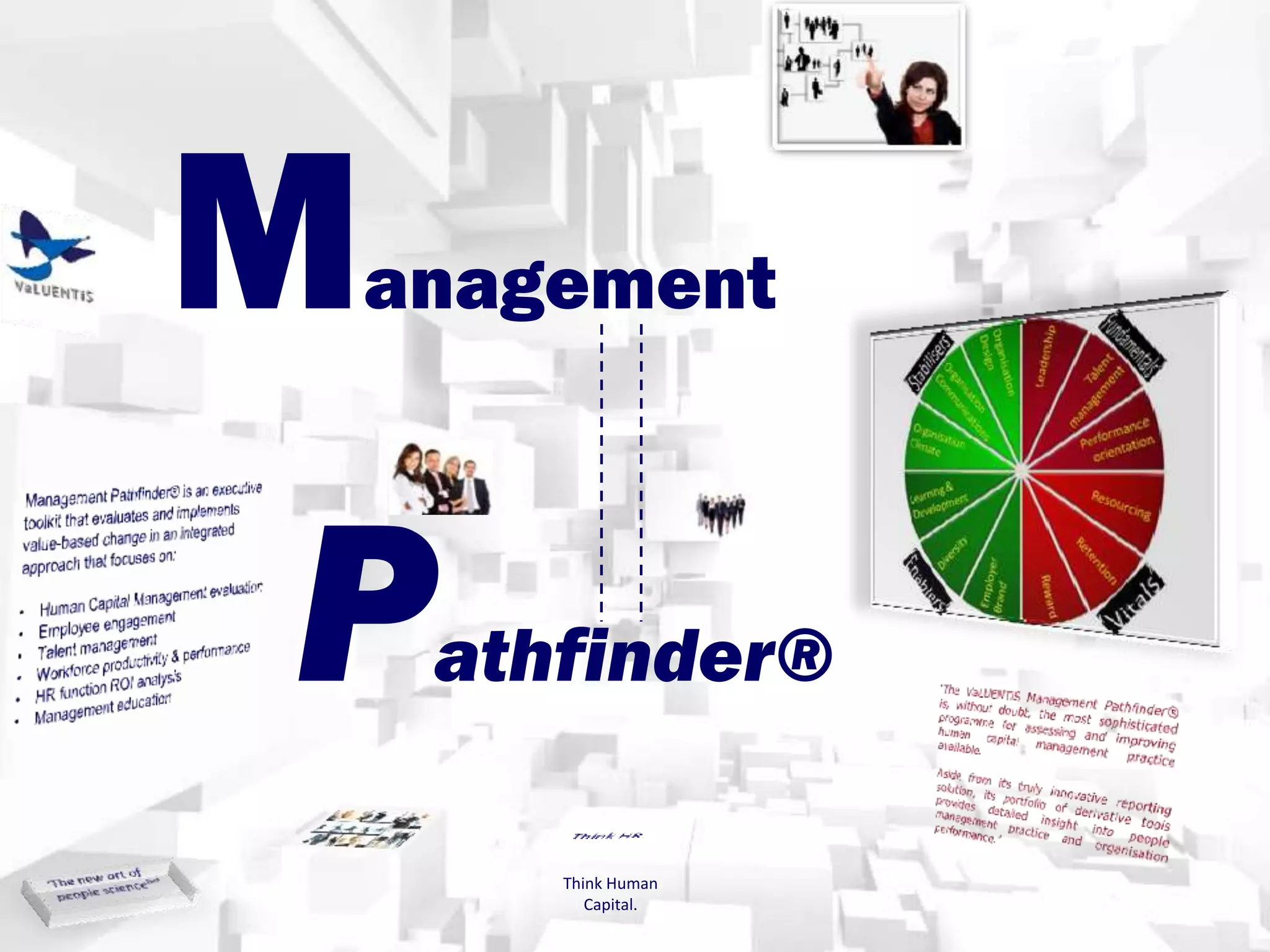
M

anagement

P

athfinder®
Think Human
Capital.
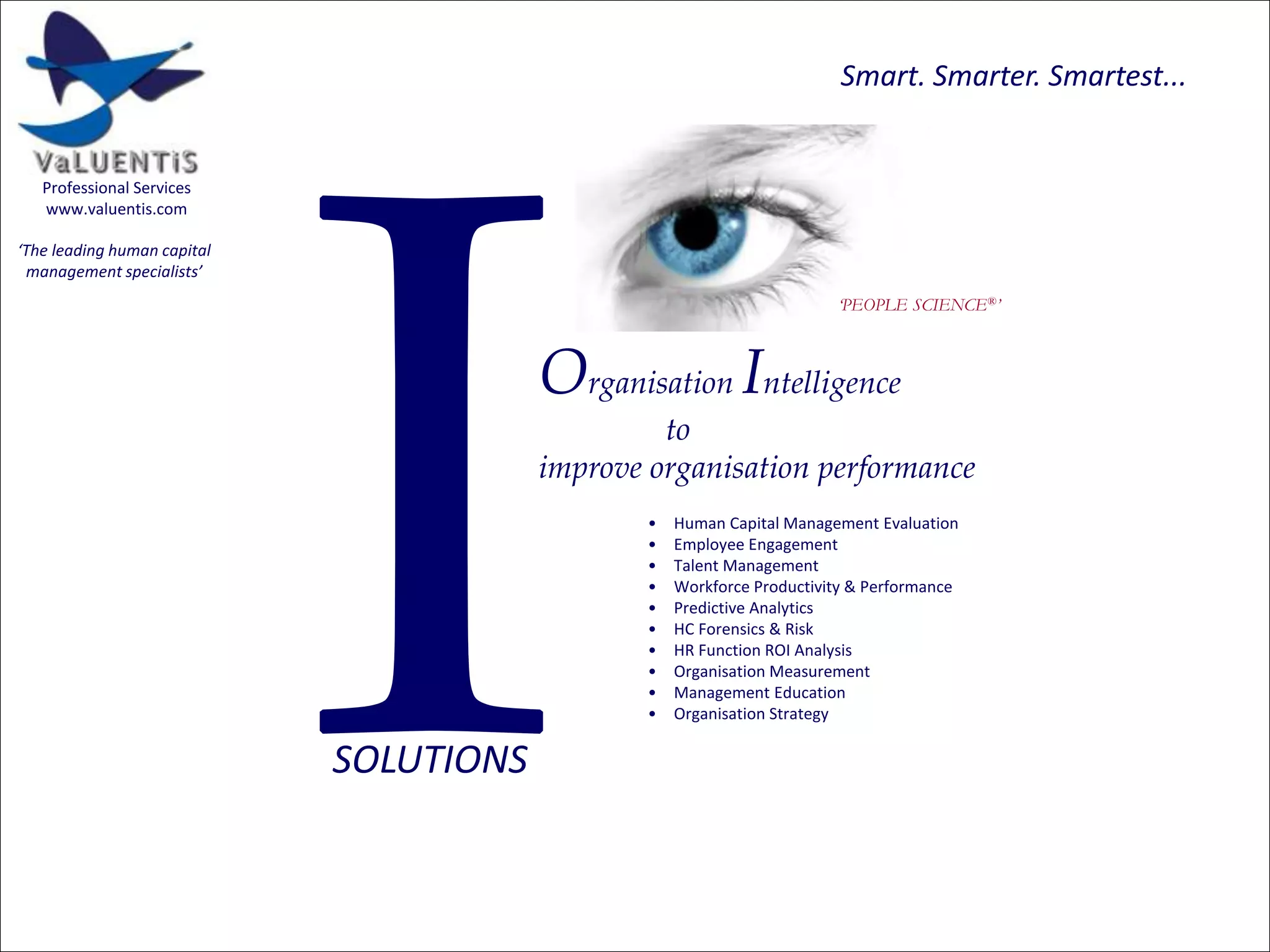
Smart. Smarter. Smartest...

Professional Services
www.valuentis.com

‘The leading human capital
management specialists’
‘PEOPLE SCIENCE®’

Organisation Intelligence
to
improve organisation performance
•
•
•
•
•
•
•
•
•
•

SOLUTIONS

Human Capital Management Evaluation
Employee Engagement
Talent Management
Workforce Productivity & Performance
Predictive Analytics
HC Forensics & Risk
HR Function ROI Analysis
Organisation Measurement
Management Education
Organisation Strategy
…+

2nd Floor, Berkeley Square House,
Berkeley Square, London W1J 6BD
Tel: +44 (0)207 887 6121
Fax: +44 (0)207 887 6100
enquiries@ISHCM.com
www.ISHCM.com

Think HR. Think Human Capital.™

Human Capital
Management.
Only one place to learn

Being human is unique. Attaining an M Sc in HCM is even more so.
Nicholas J Higgins
nicholas.higgins@valuentis.com
VaLUENTiS Ltd, 2nd Floor, Berkeley Square House,
Berkeley Square, London W1J 6BD
HO: +44 (0)207 887 6108
M: +44 (0)7811 404713
www.valuentis.com
www.ISHCM.com
www.NicholasJHiggins.com
www.HCglobal.blogspot.com
Please e-mail nicholas.higgins@valuentis.com regarding any matters of reproduction/
organisational distribution.
VaLUENTiS © 2014

VaLUENTiS Nicholas J Higgins 12 Key Differentiators of Leader-Managers 02-2014

  • 1.
    Leveraging Employee Engagement: The 12 keydifferentiators of Leader-Managers Nicholas J Higgins, DrHCMI MSc Fin (LBS) MBA (OBS) MCMI CEO, VaLUENTiS Ltd & Dean, International School of Human Capital Management (‘ISHCM’)
  • 2.
     As organisationscontinue to grapple with the means to optimise employee engagement on a daily basis – one of their biggest assets (or liabilities) is the ‘Leader-Manager’.  To shortcut the leadership/management debate I use Drucker’s dictum: “Management is doing things right; leadership is doing the right things.”  Thus my interpretation here is that Leadership and management are two sides of the same ‘Leader-Manager’ coin.  Any individual who finds himself/herself ‘in charge’ of people and wants to be successful, needs to be good at both. Period. 2
  • 3.
     Having spentthe last thirty years successfully managing teams, being part of teams and latterly consulting on successful team/organisation performance projects with regard to employee engagement and talent management, I’ve shortlisted a number of defining ‘traits’ that differentiate good ‘Leader-Managers’ from the rest.  If organisations are to demand, and get, the best from employees in their organisation on a daily basis – then ensuring that their cadre of Leader-Managers are ‘highperforming’ in engaging their staff is paramount.  This of course extends to ensuring that these LeaderManagers, themselves, are highly engaged. And we’re not just talking about frontline Leader-Managers here – they are at all levels starting with the CEO, continuing ‘downwards’. So what are these ‘differentiators’ with regard to employee engagement? 3
  • 4.
    1 Good Leader-Managers havegood self-awareness and score well on any emotionally intelligent test. This basic requirement feeds into a number of the differentiators. Many may observe that this is common sense – but how many current Leader-Managers pass this basic requirement? 4
  • 5.
    2 Good Leader-Managers treatthose in their charge as organisation assets and not their ‘own’. That is – decisions made about individuals are done from an organisational perspective not the individual manager’s perspective (in terms of benefit). It is important to recognise that highly politicised environments quite often work against this ‘good’ trait. 5
  • 6.
    3 Good Leader-Managers aremore pro-active (as opposed to good ‘fire-fighters’), forward-looking and confident in dealing with dayto-day staff/operational matters. However, many organisations mistakenly associate good ‘firefighters’ as good ‘LeaderManagers’. Having good ‘firefighters’ doesn’t necessarily equate to high employee engagement. 6
  • 7.
    4 Good Leader-Managers havea good working understanding of managing people and how to optimise employee engagement getting the best out of people with regard to performance. This comes with both access to requisite knowledge through learning and gaining the right experience. Note, experience alone is not enough. 7
  • 8.
    5 Good Leader-Managers understand theimportance of clear and consistent one-to-one and one-tomany communication, particularly around performance and decisions. They also understand the good and bad impact of the various aspects of social media when it comes to productivity. 8
  • 9.
    6 Good Leader-Managers getresults but not at the expense of overrelying on their best performers, nor generating higher than needed attrition whether it is absenteeism or turnover. Understanding the related positive and negative aspects of employee engagement in relation to attaining targets, measures, objectives and values is crucial. 9
  • 10.
    7 Good Leader-Managers always makethe tough calls for the benefit of the team. The collective employee engagement will always be higher. This is in marked contrast to Leader-Managers who defer decisions, using cover excuses or who make politically expedient decisions. 10
  • 11.
    8 Good Leader-Managers don’t procrastinateor postpone issues important to an individual team member. Cancelled appraisals are an obvious and common example as are delays in granting holiday times and so on. The Good Leader-Manager always asks: Would I be happy being on the receiving end? (And even if they are from their own boss it is no excuse to repeat the practice.) 11
  • 12.
    9 Good Leader-Managers understand thatmaking and explaining decisions are all about team equity. It is one of the most underrecognised elements in employee engagement. Perceived fairness is paramount. This is way beyond just ‘equality’ or ‘diversity’ issues. 12
  • 13.
    10 Good Leader-Managers pursuea natural interest in the development and success (and of course safety) of the people in their charge. They don’t just do the tick-box requirement. 13
  • 14.
    11 Good Leader-Managers continueto challenge their team performance in different ways given any work constraints that may be operating. Applying timely fresh approaches or changes are all part of the ‘toolkit’. 14
  • 15.
    12 Good Leader-Managers recognise thatto be put ‘in charge’ of people is a privilege that not everybody receives. Thus they recognise the opportunity for what it is rather than view it as a right due to length of service or ‘loyalty’ or reward for political correctness. 15
  • 16.
    1-page Summary Good Leader-Managersvs. Average Leader-Managers..... ...Good managers ...Average/poor managers High probability of: 1. Being self-aware (score well on EI) 2. Treating staff as the organisation’s ,not their own ‘little army’ 3. Being pro-active, forward looking and confident no matter the situation 4. Being knowledgeable of (successful) peoplemanagement approaches 5. Understanding the importance of clear one-to-one communication and being consistent 6. Getting results but not at the expense (or overreliance on good performers) 7. Making tough calls when required for the benefit of the team 8. Don’t postpone/move important events such as individual reviews/appraisals etc 9. Understanding that most managerial decision-making is about equity in people situations/issues 10. Taking a natural interest in people development above the mandatory level 11. Challenging team performance in different ways 12. View management role as a ‘privilege’, not a right High probability/tendency of: 1. Limited self-awareness 2. Treating staff as their own resource rather than organisation’s 3. Being reactive, backward-looking and/or display uncertainty on too many occasions 4. Being limited in their understanding of people management 5. Their communication too often being seen as vague or inconsistent when interacting with staff 6. Get results but tend to have higher absenteeism or turnover of staff 7. Deferring tough calls, preferring to political expediency even at the expense of others 8. History of postponing or procrastinating on individual events such as individual reviews/appraisals 9. Limited awareness of or disregard the equity principle when making managerial decisions 10. Show little interest in individual development save for mandatory skill requirements 11. See team management as a ‘chore’ 12. View management role as a ‘right’, not a privilege
  • 17.
    The common defaultmental model for senior managers and OD/HR practitioners… ‘Challenged’ People Manager ‘Good’ Operating Manager ‘Challenged’ Operating Manager ‘Good’ People Manager
  • 18.
  • 19.
    Analogy of The‘Broken Windows’ hypothesis with employee engagement and LeaderManagers The ‘Broken Windows theory’ states that monitoring and maintaining urban environments in a well-ordered condition may stop further vandalism as well as an escalation into more serious crime. Applied to engagement… The ‘theory’ states that monitoring and maintaining work environments in a well-ordered management condition may stop further engagement erosion as well as an escalation into more serious disengagement issues. 19
  • 20.
    A reminder thatnot all Leader-Managers are highly engaged themselves. This is often overlooked in organisations. The impact of this should be obvious. Our research showed the distribution of differing scores across a random sample of LeaderManagers from our database (overleaf): 20
  • 21.
    910 ‘Leader-Management’ engagement score by percentile 860 813 790 760 “Oftenoverlooked: Impaired manager engagement… And its impact…” Source: VaLUENTiS Engagement database Management client cadre sample 2010-11 Sample size: 1400 managers representing 20,000 employees Score range 200-1000
  • 22.
    ‘Line Management’ engagementscores ‘bell curve’ “Same data as previous slide – different graphic format… Looking outside ‘norms’ that’s one in seven line managers posing serious concern…” Management client cadre sample 2010-11 Sample size: 1400 managers (employee population: 20,000) Score range 200-1000 14.5% below one standard deviation 200 Source: VaLUENTiS Engagement database 13.9% above one standard deviation 738 1000
  • 23.
    And lastly, embeddinggood employee engagement practice: ‘Mapping the management reality’ example: Against embedding (Status quo OK) Let it happen (Ambivalent/ non-committal) Help it happen (qualified supportive) Individual Board members Senior managers Middle managers Line managers Supervisors/Team leaders What’s your organisation reality map? Make it happen (Actively championing)
  • 24.
  • 25.
    Employee Engagement Solutions Evidencedbased definition, understanding and application Global reach Measurement wisdom and expertise Senior management feedback sessions Performance link Line of sight Reward (equity) ‘License to manage’ programmes Work environment On-line tools and analytics Development Operating culture Frontline blended group coaching Survey design expertise Actioning strategies and tactics THE EE PLAYBOOK Project management expertise ‘Ten years of innovation’
  • 26.
  • 27.
    Smart. Smarter. Smartest... ProfessionalServices www.valuentis.com ‘The leading human capital management specialists’ ‘PEOPLE SCIENCE®’ Organisation Intelligence to improve organisation performance • • • • • • • • • • SOLUTIONS Human Capital Management Evaluation Employee Engagement Talent Management Workforce Productivity & Performance Predictive Analytics HC Forensics & Risk HR Function ROI Analysis Organisation Measurement Management Education Organisation Strategy
  • 28.
    …+ 2nd Floor, BerkeleySquare House, Berkeley Square, London W1J 6BD Tel: +44 (0)207 887 6121 Fax: +44 (0)207 887 6100 enquiries@ISHCM.com www.ISHCM.com Think HR. Think Human Capital.™ Human Capital Management. Only one place to learn Being human is unique. Attaining an M Sc in HCM is even more so.
  • 29.
    Nicholas J Higgins nicholas.higgins@valuentis.com VaLUENTiSLtd, 2nd Floor, Berkeley Square House, Berkeley Square, London W1J 6BD HO: +44 (0)207 887 6108 M: +44 (0)7811 404713 www.valuentis.com www.ISHCM.com www.NicholasJHiggins.com www.HCglobal.blogspot.com
  • 30.
    Please e-mail nicholas.higgins@valuentis.comregarding any matters of reproduction/ organisational distribution. VaLUENTiS © 2014