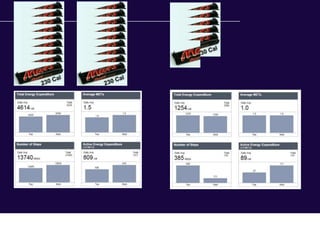
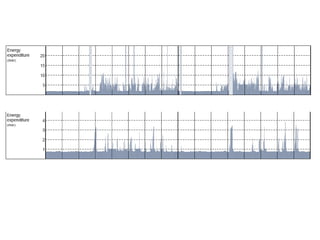
Physical Activity and Type 2 diabetes:

            Worth spending energy on?


Dr Mike Trenell
NIHR Senior Research Fellow & Director; MoveLab

MRC Centre for Brain Ageing and Vitality
NIHR Biomedical Research Centre for Ageing and Age Related Disease
E: michael.trenell@ncl.ac.uk  w: www.MoveLab.org
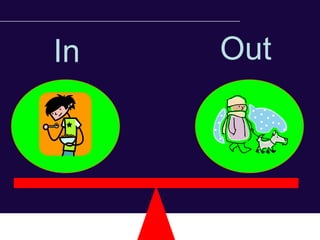
In   Out
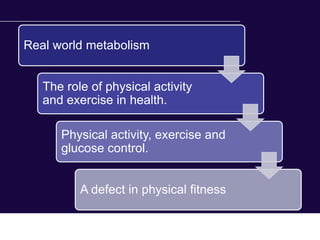
Real world metabolism


   The role of physical activity
   and exercise in health.

      Physical activity, exercise and
      glucose control.


          A defect in physical fitness
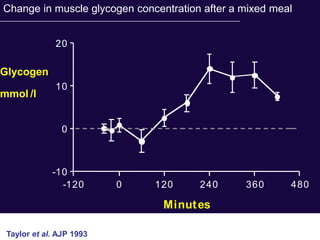
Change in muscle glycogen concentration after a mixed meal


              20

Glycogen
              10
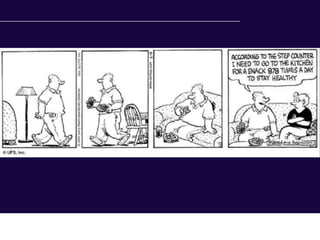
mmol /l


                0


             -10
               -120       0   120      240      360      480

                                Minut es

Taylor et al. 1993 1993
 Taylor et al. AJP
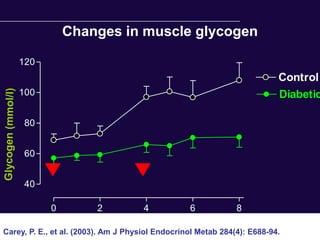
Changes in muscle glycogen

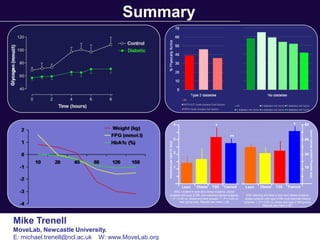
    120
                                                                      Control
    100                                                               Diabetic

     80


     60


     40

            0           2           4          6           8
                            Time (hours)
Carey et al 2002 (2003). Am J Physiol Endocrinol Metab 284(4): E688-94.
Carey, P. E., et al.
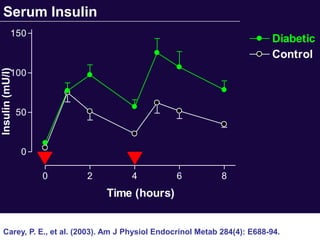
Serum Insulin
           150
                                                                         Diabetic
                                                                         Control
Insulin (mU/l)


           100


                 50


                  0

                      0   2        4            6           8
                              Time (hours)


 Carey, P. E., et al. (2003). Am J Physiol Endocrinol Metab 284(4): E688-94.
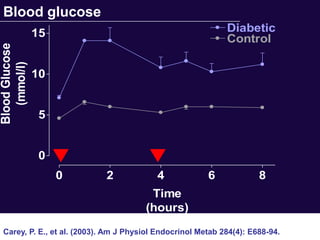
Blood glucose
                15                                            Diabetic
                                                              Control
Blood Glucose
   (mmol/l)


                10


                 5


                 0
                     0        2            4             6             8
                                         Time
                                        (hours)
  Carey, P. E., et al. (2003). Am J Physiol Endocrinol Metab 284(4): E688-94.
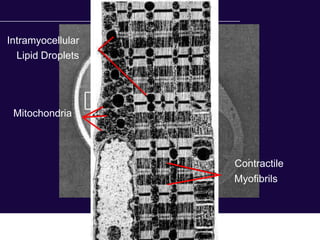
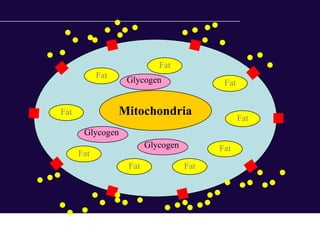
Intramyocellular
  Lipid Droplets


 Mitochondria


                   Contractile
                   Myofibrils
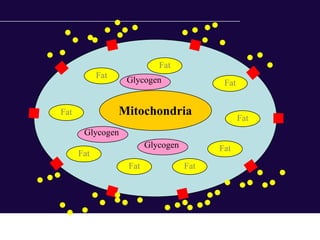
Fat
            Fat
                   Glycogen                Fat


Fat               Mitochondria                   Fat
       Glycogen
                         Glycogen         Fat
      Fat
                   Fat              Fat
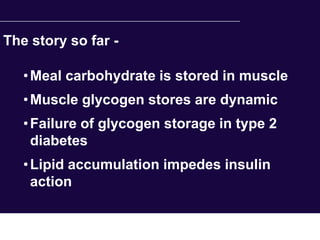
The story so far -

   • Meal carbohydrate is stored in muscle
   • Muscle glycogen stores are dynamic
   • Failure of glycogen storage in type 2
     diabetes
   • Lipid accumulation impedes insulin
     action
Real world metabolism


   The role of physical activity
   and exercise in health.

      Physical activity, exercise and
      glucose control.


          A defect in physical fitness
In   Out
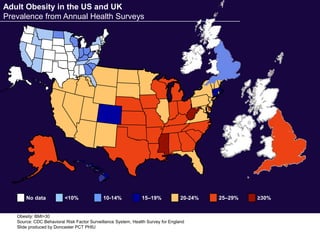
Adult Obesity in the US and UK
Prevalence from Annual Health Surveys


       2006
       2005
       2004
       2003
       2002
       2001
       2000
       1998
       1999
       1997
       1996
       1995
       1993
       1992
       1991
       1990
       1989
       1988
       1987
       1986
       1985
       1994


       No data            <10%              10-14%             15–19%             20-24%   25–29%   ≥30%


   Obesity: BMI>30
   Source: CDC Behavioral Risk Factor Surveillance System, Health Survey for England
   Slide produced by Doncaster PCT PHIU
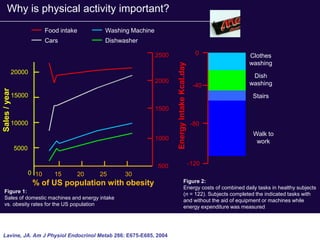
Why is physical activity important?
                             Food intake     Washing Machine
                             Cars            Dishwasher

                                                               2500                              0             Clothes
                                                                                                               washing


                                                                      Energy Intake Kcal.day
               20000
                                                                                                                Dish
                                                               2000                                            washing
                                                                                                -40
Sales / year


               15000                                                                                             Stairs

                                                               1500

               10000                                                                           -80
                                                                                                                 Walk to
                                                               1000                                               work
               5000

                                                               500                             -120
                      0 10      15     20   25     30
                       % of US population with obesity                              Figure 2:
                                                                                    Energy costs of combined daily tasks in healthy subjects
  Figure 1:                                                                         (n = 122). Subjects completed the indicated tasks with
  Sales of domestic machines and energy intake                                      and without the aid of equipment or machines while
  vs. obesity rates for the US population                                           energy expenditure was measured


Lavine, JA. Am J Physiol Endocrinol Metab 286: E675-E685, 2004
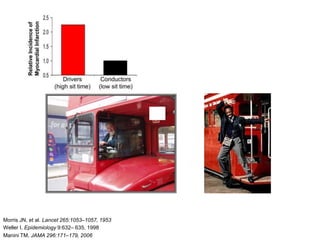
Morris JN, et al. Lancet 265:1053–1057, 1953
Weller I, Epidemiology 9:632– 635, 1998
Manini TM, JAMA 296:171–179, 2006
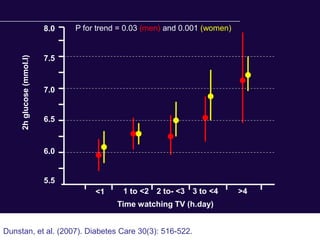
2h glucose (mmol.l)   8.0   P for trend = 0.03 (men) and 0.001 (women)


                           7.5


                           7.0


                           6.5


                           6.0


                           5.5
                                      <1     1 to <2 2 to- <3 3 to <4         >4
                                            Time watching TV (h.day)


Dunstan, et al. (2007). Diabetes Care 30(3): 516-522.
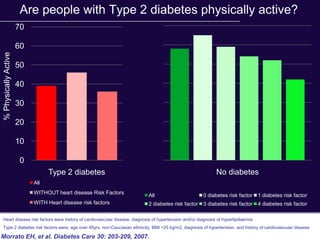
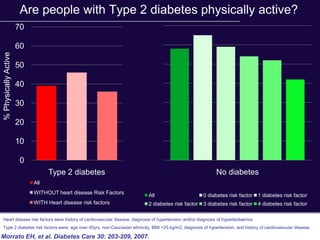
Are people with Type 2 diabetes physically active?
                      70

                      60
% Physically Active


                      50

                      40

                      30

                      20

                      10

                       0
                                 Type 2 diabetes                                                             No diabetes
                           All
                           WITHOUT heart disease Risk Factors             All                          0 diabetes risk factor 1 diabetes risk factor
                           WITH Heart disease risk factors                2 diabetes risk factor       3 diabetes risk factor       4 diabetes risk factor

Heart disease risk factors were history of cardiovascular disease, diagnosis of hypertension and/or diagnosis of hyperlipidaemia.
Type 2 diabetes risk factors were; age over 45yrs, non-Caucasian ethnicity, BMI >25 kg/m2, diagnosis of hypertension, and history of cardiovascular disease.

Morrato EH, et al. Diabetes Care 30: 203-209, 2007.
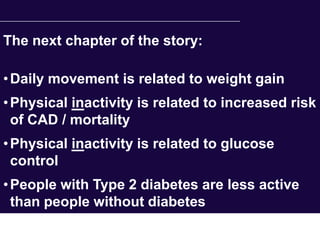
The next chapter of the story:

• Daily movement is related to weight gain
• Physical inactivity is related to increased risk
  of CAD / mortality
• Physical inactivity is related to glucose
  control
• People with Type 2 diabetes are less active
  than people without diabetes
Real world metabolism


   The role of physical activity
   and exercise in health.

      Physical activity, exercise and
      glucose control.


          A defect in physical fitness
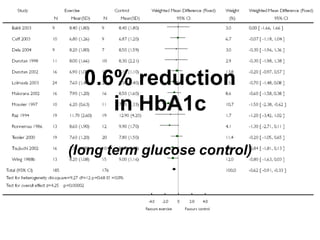
0.6% reduction
     in HbA1c

(long term glucose control)
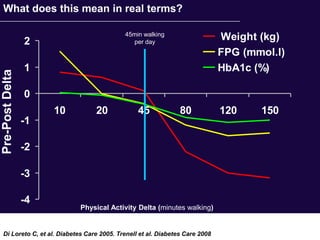
What does this mean in real terms?

                                           45min walking
                 2                           per day
                                                                             Weight (kg)
                                                                             FPG (mmol.l)
                 1                                                           HbA1c (%)
Pre-Post Delta


                 0
                      10         20             45             80            120    150
                 -1

                 -2

                 -3

                 -4
                            Physical Activity Delta (minutes walking)


 Di Loreto C, et al. Diabetes Care 2005. Trenell et al. Diabetes Care 2008
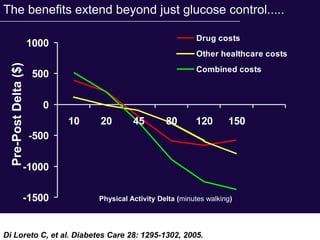
The benefits extend beyond just glucose control.....

                                                                Drug costs
                       1000
                                                                Other healthcare costs
  Pre-Post Delta ($)


                                                                Combined costs
                       500

                         0
                              10   20        45        80       120       150
                       -500

                  -1000

                  -1500            Physical Activity Delta (minutes walking)


Di Loreto C, et al. Diabetes Care 28: 1295-1302, 2005.
Are people with Type 2 diabetes physically active?
                      70

                      60
% Physically Active


                      50

                      40

                      30

                      20

                      10

                       0
                                 Type 2 diabetes                                                             No diabetes
                           All
                           WITHOUT heart disease Risk Factors             All                          0 diabetes risk factor       1 diabetes risk factor
                           WITH Heart disease risk factors                2 diabetes risk factor       3 diabetes risk factor 4 diabetes risk factor

Heart disease risk factors were history of cardiovascular disease, diagnosis of hypertension and/or diagnosis of hyperlipidaemia.
Type 2 diabetes risk factors were; age over 45yrs, non-Caucasian ethnicity, BMI >25 kg/m2, diagnosis of hypertension, and history of cardiovascular disease.

Morrato EH, et al. Diabetes Care 30: 203-209, 2007.
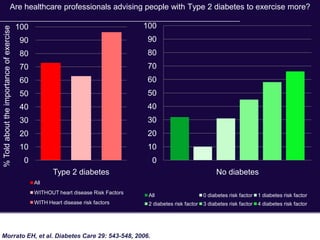
Are healthcare professionals advising people with Type 2 diabetes to exercise more?

                                          100                                        100
% Told about the importance of exercise


                                          90                                         90
                                          80                                         80
                                          70                                         70
                                          60                                         60
                                          50                                         50
                                          40                                         40
                                          30                                         30
                                          20                                         20
                                          10                                         10
                                            0                                          0
                                                       Type 2 diabetes                                              No diabetes
                                                All
                                                WITHOUT heart disease Risk Factors
                                                                                      All                      0 diabetes risk factor   1 diabetes risk factor
                                                WITH Heart disease risk factors       2 diabetes risk factor   3 diabetes risk factor 4 diabetes risk factor

Heart disease risk factors were history of cardiovascular disease, diagnosis of hypertension and/or diagnosis of hyperlipidaemia.
Type 2 diabetes risk factors were; age over 45yrs, non-Caucasian ethnicity, BMI >25 kg/m2, diagnosis of hypertension, and history of cardiovascular disease.

Morrato EH, et al. Diabetes Care 29: 543-548, 2006.
Real world metabolism


   The role of physical activity
   and exercise in health.

      Physical activity, exercise and
      glucose control.


          A defect in physical fitness
Fat
            Fat
                   Glycogen                Fat


Fat               Mitochondria                   Fat
       Glycogen
                         Glycogen         Fat
      Fat
                   Fat              Fat
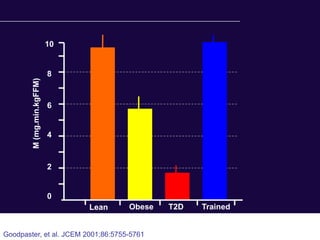
10


                           8
        M (mg.min.kgFFM)


                           6


                           4


                           2


                           0
                                Lean   Obese   T2D   Trained


Goodpaster, et al. JCEM 2001;86:5755-5761
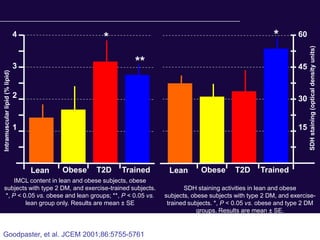
4
                                                    *                                                     *       60


                                                                                                                       SDH staining (optical density units)
                                3                           **                                                    45
Intramuscular lipid (% lipid)


                                2                                                                                 30


                                1                                                                                 15


                                    Lean   Obese   T2D   Trained    Lean        Obese       T2D      Trained
     IMCL content in lean and obese subjects, obese
subjects with type 2 DM, and exercise-trained subjects.                   SDH staining activities in lean and obese
 *, P < 0.05 vs. obese and lean groups; **, P < 0.05 vs.           subjects, obese subjects with type 2 DM, and exercise-
         lean group only. Results are mean ± SE                     trained subjects. *, P < 0.05 vs. obese and type 2 DM
                                                                               groups. Results are mean ± SE.


Goodpaster, et al. JCEM 2001;86:5755-5761
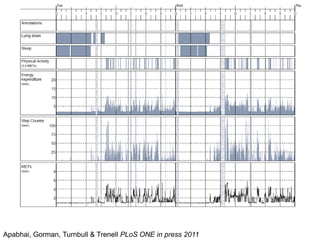
Apabhai, Gorman, Turnbull & Trenell PLoS ONE in press 2011
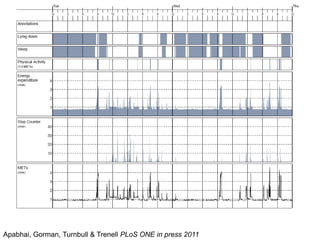
Apabhai, Turnbull & Trenell Unpublished data 2008
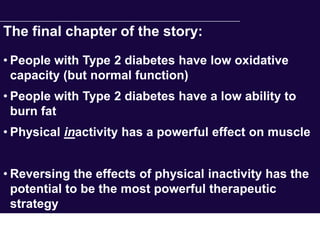
The final chapter of the story:
• People with Type 2 diabetes have low oxidative
  capacity (but normal function)
• People with Type 2 diabetes have a low ability to
  burn fat
• Physical inactivity has a powerful effect on muscle


• Reversing the effects of physical inactivity has the
  potential to be the most powerful therapeutic
  strategy
Summary


                                                                                  4
                                                                                                      *                                                    *        60


                                                                                                                                                                         SDH staining (optical density units)
                                                                                  3                           **                                                    45


                                                  Intramuscular lipid (% lipid)
                                                                                  2                                                                                 30


                                                                                  1                                                                                 15


                                                                                      Lean   Obese   T2D   Trained    Lean       Obese       T2D      Trained
                                                         IMCL content in lean and obese subjects, obese
                                                     subjects with type 2 DM, and exercise-trained subjects.           SDH staining activities in lean and obese subjects,
                                                     *, P < 0.05 vs. obese and lean groups; **, P < 0.05 vs.          obese subjects with type 2 DM, and exercise-trained
                                                             lean group only. Results are mean ± SE                  subjects. *, P < 0.05 vs. obese and type 2 DM groups.
                                                                                                                                     Results are mean ± SE.


Mike Trenell
MoveLab, Newcastle University.
E: michael.trenell@ncl.ac.uk W: www.MoveLab.org
Physical activity and diabetes

Physical activity and diabetes

  • 1.
    Physical Activity andType 2 diabetes: Worth spending energy on? Dr Mike Trenell NIHR Senior Research Fellow & Director; MoveLab MRC Centre for Brain Ageing and Vitality NIHR Biomedical Research Centre for Ageing and Age Related Disease E: michael.trenell@ncl.ac.uk w: www.MoveLab.org
  • 2.
    In Out
  • 3.
    Real world metabolism The role of physical activity and exercise in health. Physical activity, exercise and glucose control. A defect in physical fitness
  • 6.
    Change in muscleglycogen concentration after a mixed meal 20 Glycogen 10 mmol /l 0 -10 -120 0 120 240 360 480 Minut es Taylor et al. 1993 1993 Taylor et al. AJP
  • 8.
    Changes in muscleglycogen 120 Control 100 Diabetic 80 60 40 0 2 4 6 8 Time (hours) Carey et al 2002 (2003). Am J Physiol Endocrinol Metab 284(4): E688-94. Carey, P. E., et al.
  • 9.
    Serum Insulin 150 Diabetic Control Insulin (mU/l) 100 50 0 0 2 4 6 8 Time (hours) Carey, P. E., et al. (2003). Am J Physiol Endocrinol Metab 284(4): E688-94.
  • 10.
    Blood glucose 15 Diabetic Control Blood Glucose (mmol/l) 10 5 0 0 2 4 6 8 Time (hours) Carey, P. E., et al. (2003). Am J Physiol Endocrinol Metab 284(4): E688-94.
  • 11.
    Intramyocellular LipidDroplets Mitochondria Contractile Myofibrils
  • 12.
    Fat Fat Glycogen Fat Fat Mitochondria Fat Glycogen Glycogen Fat Fat Fat Fat
  • 13.
    The story sofar - • Meal carbohydrate is stored in muscle • Muscle glycogen stores are dynamic • Failure of glycogen storage in type 2 diabetes • Lipid accumulation impedes insulin action
  • 14.
    Real world metabolism The role of physical activity and exercise in health. Physical activity, exercise and glucose control. A defect in physical fitness
  • 15.
    In Out
  • 16.
    Adult Obesity inthe US and UK Prevalence from Annual Health Surveys 2006 2005 2004 2003 2002 2001 2000 1998 1999 1997 1996 1995 1993 1992 1991 1990 1989 1988 1987 1986 1985 1994 No data <10% 10-14% 15–19% 20-24% 25–29% ≥30% Obesity: BMI>30 Source: CDC Behavioral Risk Factor Surveillance System, Health Survey for England Slide produced by Doncaster PCT PHIU
  • 17.
    Why is physicalactivity important? Food intake Washing Machine Cars Dishwasher 2500 0 Clothes washing Energy Intake Kcal.day 20000 Dish 2000 washing -40 Sales / year 15000 Stairs 1500 10000 -80 Walk to 1000 work 5000 500 -120 0 10 15 20 25 30 % of US population with obesity Figure 2: Energy costs of combined daily tasks in healthy subjects Figure 1: (n = 122). Subjects completed the indicated tasks with Sales of domestic machines and energy intake and without the aid of equipment or machines while vs. obesity rates for the US population energy expenditure was measured Lavine, JA. Am J Physiol Endocrinol Metab 286: E675-E685, 2004
  • 18.
    Morris JN, etal. Lancet 265:1053–1057, 1953 Weller I, Epidemiology 9:632– 635, 1998 Manini TM, JAMA 296:171–179, 2006
  • 19.
    2h glucose (mmol.l) 8.0 P for trend = 0.03 (men) and 0.001 (women) 7.5 7.0 6.5 6.0 5.5 <1 1 to <2 2 to- <3 3 to <4 >4 Time watching TV (h.day) Dunstan, et al. (2007). Diabetes Care 30(3): 516-522.
  • 20.
    Are people withType 2 diabetes physically active? 70 60 % Physically Active 50 40 30 20 10 0 Type 2 diabetes No diabetes All WITHOUT heart disease Risk Factors All 0 diabetes risk factor 1 diabetes risk factor WITH Heart disease risk factors 2 diabetes risk factor 3 diabetes risk factor 4 diabetes risk factor Heart disease risk factors were history of cardiovascular disease, diagnosis of hypertension and/or diagnosis of hyperlipidaemia. Type 2 diabetes risk factors were; age over 45yrs, non-Caucasian ethnicity, BMI >25 kg/m2, diagnosis of hypertension, and history of cardiovascular disease. Morrato EH, et al. Diabetes Care 30: 203-209, 2007.
  • 21.
    The next chapterof the story: • Daily movement is related to weight gain • Physical inactivity is related to increased risk of CAD / mortality • Physical inactivity is related to glucose control • People with Type 2 diabetes are less active than people without diabetes
  • 22.
    Real world metabolism The role of physical activity and exercise in health. Physical activity, exercise and glucose control. A defect in physical fitness
  • 23.
    0.6% reduction in HbA1c (long term glucose control)
  • 24.
    What does thismean in real terms? 45min walking 2 per day Weight (kg) FPG (mmol.l) 1 HbA1c (%) Pre-Post Delta 0 10 20 45 80 120 150 -1 -2 -3 -4 Physical Activity Delta (minutes walking) Di Loreto C, et al. Diabetes Care 2005. Trenell et al. Diabetes Care 2008
  • 25.
    The benefits extendbeyond just glucose control..... Drug costs 1000 Other healthcare costs Pre-Post Delta ($) Combined costs 500 0 10 20 45 80 120 150 -500 -1000 -1500 Physical Activity Delta (minutes walking) Di Loreto C, et al. Diabetes Care 28: 1295-1302, 2005.
  • 26.
    Are people withType 2 diabetes physically active? 70 60 % Physically Active 50 40 30 20 10 0 Type 2 diabetes No diabetes All WITHOUT heart disease Risk Factors All 0 diabetes risk factor 1 diabetes risk factor WITH Heart disease risk factors 2 diabetes risk factor 3 diabetes risk factor 4 diabetes risk factor Heart disease risk factors were history of cardiovascular disease, diagnosis of hypertension and/or diagnosis of hyperlipidaemia. Type 2 diabetes risk factors were; age over 45yrs, non-Caucasian ethnicity, BMI >25 kg/m2, diagnosis of hypertension, and history of cardiovascular disease. Morrato EH, et al. Diabetes Care 30: 203-209, 2007.
  • 27.
    Are healthcare professionalsadvising people with Type 2 diabetes to exercise more? 100 100 % Told about the importance of exercise 90 90 80 80 70 70 60 60 50 50 40 40 30 30 20 20 10 10 0 0 Type 2 diabetes No diabetes All WITHOUT heart disease Risk Factors All 0 diabetes risk factor 1 diabetes risk factor WITH Heart disease risk factors 2 diabetes risk factor 3 diabetes risk factor 4 diabetes risk factor Heart disease risk factors were history of cardiovascular disease, diagnosis of hypertension and/or diagnosis of hyperlipidaemia. Type 2 diabetes risk factors were; age over 45yrs, non-Caucasian ethnicity, BMI >25 kg/m2, diagnosis of hypertension, and history of cardiovascular disease. Morrato EH, et al. Diabetes Care 29: 543-548, 2006.
  • 28.
    Real world metabolism The role of physical activity and exercise in health. Physical activity, exercise and glucose control. A defect in physical fitness
  • 29.
    Fat Fat Glycogen Fat Fat Mitochondria Fat Glycogen Glycogen Fat Fat Fat Fat
  • 30.
    10 8 M (mg.min.kgFFM) 6 4 2 0 Lean Obese T2D Trained Goodpaster, et al. JCEM 2001;86:5755-5761
  • 31.
    4 * * 60 SDH staining (optical density units) 3 ** 45 Intramuscular lipid (% lipid) 2 30 1 15 Lean Obese T2D Trained Lean Obese T2D Trained IMCL content in lean and obese subjects, obese subjects with type 2 DM, and exercise-trained subjects. SDH staining activities in lean and obese *, P < 0.05 vs. obese and lean groups; **, P < 0.05 vs. subjects, obese subjects with type 2 DM, and exercise- lean group only. Results are mean ± SE trained subjects. *, P < 0.05 vs. obese and type 2 DM groups. Results are mean ± SE. Goodpaster, et al. JCEM 2001;86:5755-5761
  • 32.
    Apabhai, Gorman, Turnbull& Trenell PLoS ONE in press 2011
  • 33.
    Apabhai, Gorman, Turnbull& Trenell PLoS ONE in press 2011
  • 35.
    Apabhai, Turnbull &Trenell Unpublished data 2008
  • 36.
    The final chapterof the story: • People with Type 2 diabetes have low oxidative capacity (but normal function) • People with Type 2 diabetes have a low ability to burn fat • Physical inactivity has a powerful effect on muscle • Reversing the effects of physical inactivity has the potential to be the most powerful therapeutic strategy
  • 37.
    Summary 4 * * 60 SDH staining (optical density units) 3 ** 45 Intramuscular lipid (% lipid) 2 30 1 15 Lean Obese T2D Trained Lean Obese T2D Trained IMCL content in lean and obese subjects, obese subjects with type 2 DM, and exercise-trained subjects. SDH staining activities in lean and obese subjects, *, P < 0.05 vs. obese and lean groups; **, P < 0.05 vs. obese subjects with type 2 DM, and exercise-trained lean group only. Results are mean ± SE subjects. *, P < 0.05 vs. obese and type 2 DM groups. Results are mean ± SE. Mike Trenell MoveLab, Newcastle University. E: michael.trenell@ncl.ac.uk W: www.MoveLab.org

Editor's Notes

  • #19 Describe what driver and conductor do.Pass through last two panels quickly. Reiterate – this is not exercise – this is everyday life (what you are doing now).
  • #20 Take out?