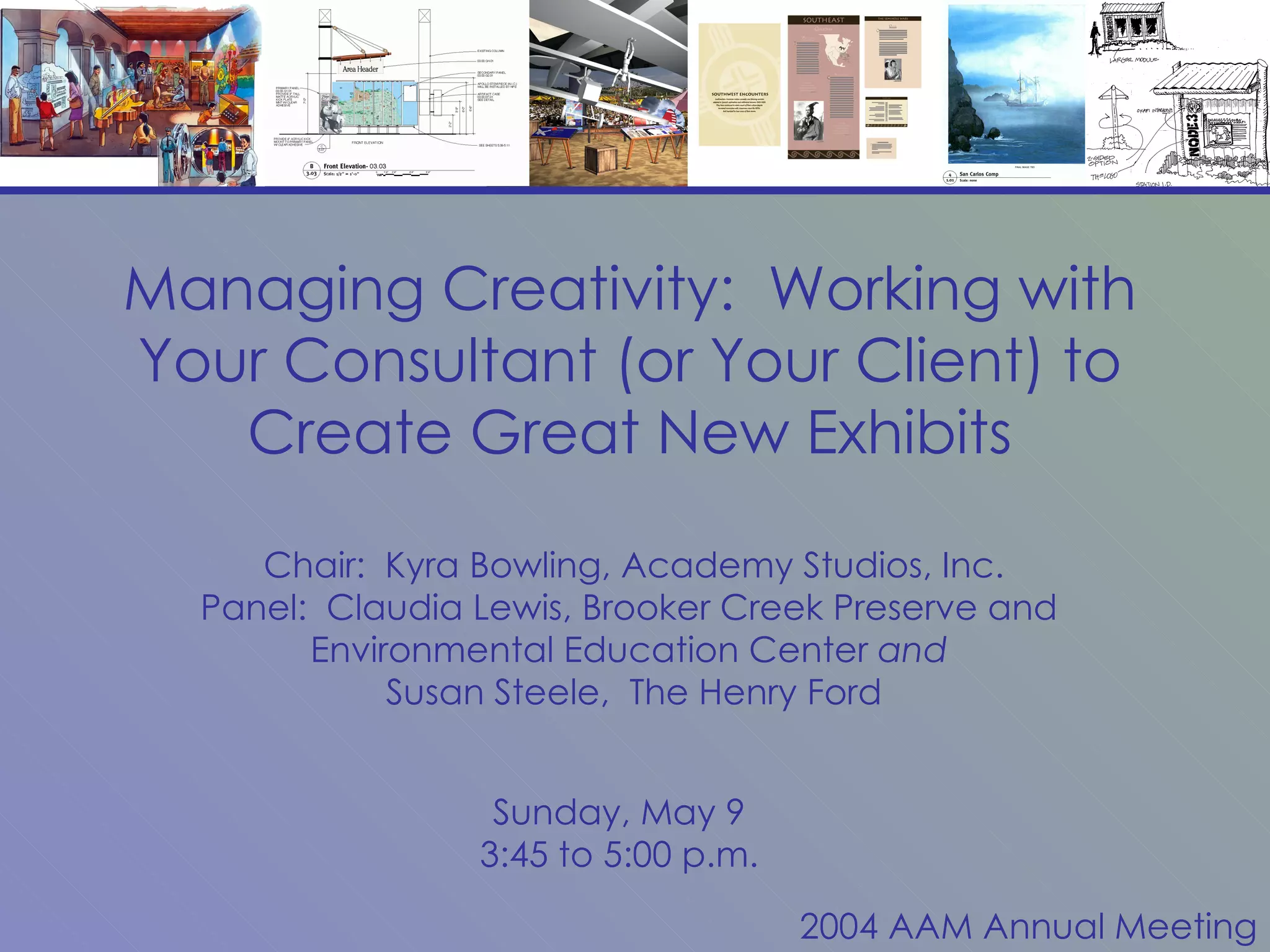
Managing Creativity:  Working with Your Consultant (or Your Client) to Create Great New Exhibits Chair:  Kyra Bowling, Academy Studios, Inc. Panel:  Claudia Lewis, Brooker Creek Preserve and  Environmental Education Center  and  Susan Steele,  The Henry Ford Sunday, May 9 3:45 to 5:00 p.m.
Many factors influence an exhibition project.  How can a Project Manager help balance these? Introduction
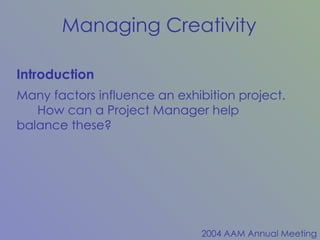
Managing Creativity creativity input ideas design buzz process communication schedule deliverables budget Balance The Project Manager How to achieve How to measure and track
Don’t exhibit projects manage themselves? Couldn’t our staff just take this on? Or, we’ll hire consultants. They’ll make it all happen.  Opening day? Oh, that’s so far away. Tough decisions? Don’t stakeholders always agree? Introduction Common Project Misconceptions and Pitfalls:
Introduction So is there really a need for Project Management?
And a shared project management model can further: clarify, facilitate and maximize everyone’s project efforts mitigate risk and streamline the project process reduce inefficiencies of project time/costs/ resources Introduction Yes – Project Management Can Help!
Project Pre-planning and Start-Up Exercises The  Launch The Work Project Close-out Common Challenges Introduction The PM Model’s Focus Areas:
Project Pre-Planning A project is a temporary endeavor undertaken to create a unique product or service* *A Guide to the Project Management Body of Knowledge 2000 Edition What Is a Project?
Project Pre-Planning What is pre-planning? Deciding on how much you can do vs. what a consultant can do Be realistic (re:  time, money, expertise) Tools you can use
Project Pre-Planning The Project Brief Identify the experience, how it fits your mission and the internal team Identify experience expectations, general look and feel, scope and location within your facility Identify the effect this experience will have on your daily operations
Project Pre-Planning Criteria for Evaluating Potential Consultants A list of criteria helps you judge all potential consultants with an apples to apples comparison Addresses: Prior experience Ability to think creatively Familiarity with the topic Ability to articulate a clear process Ability to work collaboratively with a client
Project Pre-Planning What the Client Needs to Do Before the Consultant Walks in the Door Clearly define your own process/internal team/ define roles Clearly define internal review process Internal resources to be devoted to the project
Project Pre-Planning Risk Assessment Not something non-profits generally think about May be helpful to think about for your projects Three steps:  Identify, Analyze, Respond
The Launch Most Critical Things to Do at the Beginning of a Project From client’s perspective Identify key players Identify process and deliverables From consultant’s perspective Confirm scope Confirm client’s expectations Identify biggest fears on each side
The Launch Front-End Project Exercises Typically done at first on-site meeting Helps to confirm scope and expectations Should help identify potential challenges/ assumptions
The Launch Front-End Project Exercises SWOT Analysis  – Strengths, Weaknesses, Opportunities, Threats (Challenges) Balancing Act  – Assigning percentages to category pairs (i.e. children vs. adult for audience; addresses controversy or avoids controversy for approach)
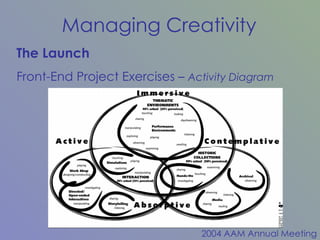
The Launch Front-End Project Exercises –  Activity Diagram
The Launch Front-End Project Exercises A Few of Your Favorite Things Favorite or least favorite museum experience Favorite or least favorite topic experience
The Work Schedule Staff Communication Strategies Progress Assessment The key aspects of making ideas a reality are:
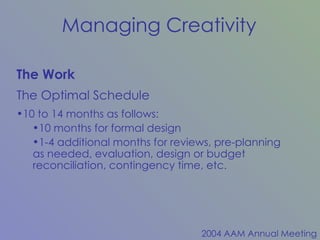
10 to 14 months as follows: 10 months for formal design 1-4 additional months for reviews, pre-planning as needed, evaluation, design or budget reconciliation, contingency time, etc. The Work The Optimal Schedule
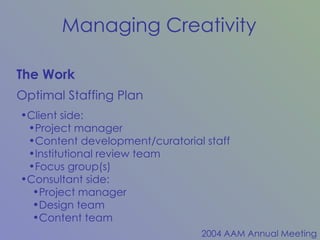
The Work Optimal Staffing Plan Client side: Project manager Content development/curatorial staff Institutional review team Focus group(s) Consultant side: Project manager Design team Content team
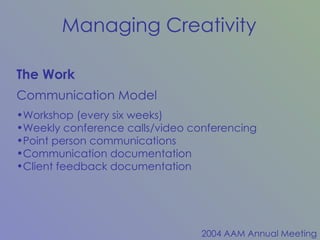
The Work Communication Model Workshop (every six weeks) Weekly conference calls/video conferencing Point person communications Communication documentation Client feedback documentation
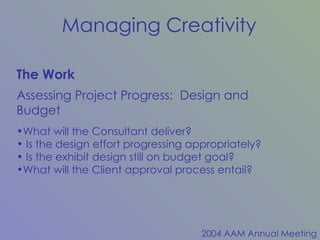
The Work Assessing Project Progress:  Design and Budget What will the Consultant deliver? Is the design effort progressing appropriately? Is the exhibit design still on budget goal? What will the Client approval process entail?
The Work Guidelines for Approval Process The process includes the following phrases: Pre-design preparation Schematic design approval Design development approval Final design approval Project close-out/certificate of completion
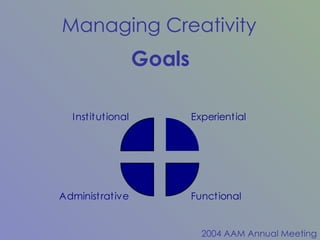
Road map with agreed-upon exhibition criteria. Should include four groups of goals. The Work Pre-Design Preparation
 
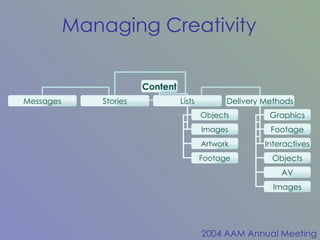
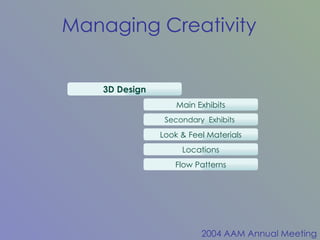
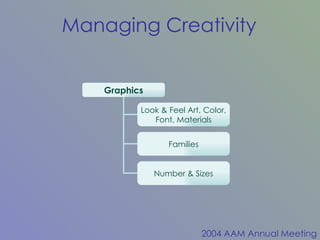
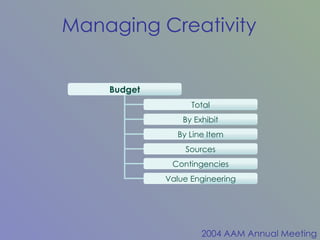
The Work Schematic Design, Design Development and Final Design These phases require approvals of the following: Content 3D Design Graphic Design Budget
Content Messages Stories Lists Delivery Methods Objects Images Artwork Footage Graphics Footage Interactives Objects AV Images
3D Design Main Exhibits Secondary  Exhibits  Look & Feel Materials Locations Flow Patterns
Graphics Look & Feel Art, Color, Font, Materials Families Number & Sizes
Budget Total By Exhibit By Line Item Sources Contingencies Value Engineering
As work progresses through the three design phases, the content, graphics, 3D design and budget elements are defined, refined or added.  Elements may be deleted as the work progresses when value engineering is needed or when contingencies are eliminated toward the end. The Work Schematic Design, Design Development and Final Design
Review and approval of every document  One complete set of hard-copy materials archived The Work Project Close-Out/Certificate of Completion
Common Challenges Managing Conflict The “soft” side of project management Don’t let the problem linger How to address the issue Examples:  What worked/what didn’t
Common Challenges Managing Change Identify a change process at the beginning of a project Understand the impact of a change:  on the experience, on the schedule, on the budget Document all changes in writing
Collect input from museum professionals to refine existing model Develop additional sub-models for fast-track efforts, for the exhibit fabrication process, etc. Develop a PM standards/”spec” manual for public use Develop a PM “advice” Web site and support network (3rd party assessment services too) Conclusions
Thank You! Chair:  Kyra Bowling, Academy Studios, Inc. Panel:  Claudia Lewis, Brooker Creek Preserve and  Environmental Education Center  and  Susan Steele,  The Henry Ford

Managing Creativity

  • 1.
    Managing Creativity: Working with Your Consultant (or Your Client) to Create Great New Exhibits Chair: Kyra Bowling, Academy Studios, Inc. Panel: Claudia Lewis, Brooker Creek Preserve and Environmental Education Center and Susan Steele, The Henry Ford Sunday, May 9 3:45 to 5:00 p.m.
  • 2.
    Many factors influencean exhibition project. How can a Project Manager help balance these? Introduction
  • 3.
    Managing Creativity creativityinput ideas design buzz process communication schedule deliverables budget Balance The Project Manager How to achieve How to measure and track
  • 4.
    Don’t exhibit projectsmanage themselves? Couldn’t our staff just take this on? Or, we’ll hire consultants. They’ll make it all happen. Opening day? Oh, that’s so far away. Tough decisions? Don’t stakeholders always agree? Introduction Common Project Misconceptions and Pitfalls:
  • 5.
    Introduction So isthere really a need for Project Management?
  • 6.
    And a sharedproject management model can further: clarify, facilitate and maximize everyone’s project efforts mitigate risk and streamline the project process reduce inefficiencies of project time/costs/ resources Introduction Yes – Project Management Can Help!
  • 7.
    Project Pre-planning andStart-Up Exercises The Launch The Work Project Close-out Common Challenges Introduction The PM Model’s Focus Areas:
  • 8.
    Project Pre-Planning Aproject is a temporary endeavor undertaken to create a unique product or service* *A Guide to the Project Management Body of Knowledge 2000 Edition What Is a Project?
  • 9.
    Project Pre-Planning Whatis pre-planning? Deciding on how much you can do vs. what a consultant can do Be realistic (re: time, money, expertise) Tools you can use
  • 10.
    Project Pre-Planning TheProject Brief Identify the experience, how it fits your mission and the internal team Identify experience expectations, general look and feel, scope and location within your facility Identify the effect this experience will have on your daily operations
  • 11.
    Project Pre-Planning Criteriafor Evaluating Potential Consultants A list of criteria helps you judge all potential consultants with an apples to apples comparison Addresses: Prior experience Ability to think creatively Familiarity with the topic Ability to articulate a clear process Ability to work collaboratively with a client
  • 12.
    Project Pre-Planning Whatthe Client Needs to Do Before the Consultant Walks in the Door Clearly define your own process/internal team/ define roles Clearly define internal review process Internal resources to be devoted to the project
  • 13.
    Project Pre-Planning RiskAssessment Not something non-profits generally think about May be helpful to think about for your projects Three steps: Identify, Analyze, Respond
  • 14.
    The Launch MostCritical Things to Do at the Beginning of a Project From client’s perspective Identify key players Identify process and deliverables From consultant’s perspective Confirm scope Confirm client’s expectations Identify biggest fears on each side
  • 15.
    The Launch Front-EndProject Exercises Typically done at first on-site meeting Helps to confirm scope and expectations Should help identify potential challenges/ assumptions
  • 16.
    The Launch Front-EndProject Exercises SWOT Analysis – Strengths, Weaknesses, Opportunities, Threats (Challenges) Balancing Act – Assigning percentages to category pairs (i.e. children vs. adult for audience; addresses controversy or avoids controversy for approach)
  • 17.
    The Launch Front-EndProject Exercises – Activity Diagram
  • 18.
    The Launch Front-EndProject Exercises A Few of Your Favorite Things Favorite or least favorite museum experience Favorite or least favorite topic experience
  • 19.
    The Work ScheduleStaff Communication Strategies Progress Assessment The key aspects of making ideas a reality are:
  • 20.
    10 to 14months as follows: 10 months for formal design 1-4 additional months for reviews, pre-planning as needed, evaluation, design or budget reconciliation, contingency time, etc. The Work The Optimal Schedule
  • 21.
    The Work OptimalStaffing Plan Client side: Project manager Content development/curatorial staff Institutional review team Focus group(s) Consultant side: Project manager Design team Content team
  • 22.
    The Work CommunicationModel Workshop (every six weeks) Weekly conference calls/video conferencing Point person communications Communication documentation Client feedback documentation
  • 23.
    The Work AssessingProject Progress: Design and Budget What will the Consultant deliver? Is the design effort progressing appropriately? Is the exhibit design still on budget goal? What will the Client approval process entail?
  • 24.
    The Work Guidelinesfor Approval Process The process includes the following phrases: Pre-design preparation Schematic design approval Design development approval Final design approval Project close-out/certificate of completion
  • 25.
    Road map withagreed-upon exhibition criteria. Should include four groups of goals. The Work Pre-Design Preparation
  • 26.
  • 27.
    The Work SchematicDesign, Design Development and Final Design These phases require approvals of the following: Content 3D Design Graphic Design Budget
  • 28.
    Content Messages StoriesLists Delivery Methods Objects Images Artwork Footage Graphics Footage Interactives Objects AV Images
  • 29.
    3D Design MainExhibits Secondary Exhibits Look & Feel Materials Locations Flow Patterns
  • 30.
    Graphics Look &Feel Art, Color, Font, Materials Families Number & Sizes
  • 31.
    Budget Total ByExhibit By Line Item Sources Contingencies Value Engineering
  • 32.
    As work progressesthrough the three design phases, the content, graphics, 3D design and budget elements are defined, refined or added. Elements may be deleted as the work progresses when value engineering is needed or when contingencies are eliminated toward the end. The Work Schematic Design, Design Development and Final Design
  • 33.
    Review and approvalof every document One complete set of hard-copy materials archived The Work Project Close-Out/Certificate of Completion
  • 34.
    Common Challenges ManagingConflict The “soft” side of project management Don’t let the problem linger How to address the issue Examples: What worked/what didn’t
  • 35.
    Common Challenges ManagingChange Identify a change process at the beginning of a project Understand the impact of a change: on the experience, on the schedule, on the budget Document all changes in writing
  • 36.
    Collect input frommuseum professionals to refine existing model Develop additional sub-models for fast-track efforts, for the exhibit fabrication process, etc. Develop a PM standards/”spec” manual for public use Develop a PM “advice” Web site and support network (3rd party assessment services too) Conclusions
  • 37.
    Thank You! Chair: Kyra Bowling, Academy Studios, Inc. Panel: Claudia Lewis, Brooker Creek Preserve and Environmental Education Center and Susan Steele, The Henry Ford