WEBSITE TIMELINES
Presented by:
Flynt Johnson
flynt@gravitatedesign.com
July 23rd, 2015
AGENDA
Why This is Important
Tips for Setting a Timeline
1.	 Don’t be arbitrary
2.	 Define Your Poblems & Scope
3.	 Consult an expert
4.	 Know thyself
5.	 Be Realistic
6.	 Don’t forget about content
7.	 The myth of simplicity
8.	 Think long-term
9.	 How Gravitate does it
Q&A
WELCOME
“Long-range planning does not deal with
future decisions, but with the future of
present decisions.”
-Peter Drucker
A few words from:
WHY THIS IS IMPORTANT
“Success should be a synonym for learning.”
“Great clients trust their vendors. Vendors with great clients
fight tooth & nail to earn that trust. Don’t shuck the
responsibility”
“No offense to anyone, but I hate colorful spreadsheets”.
More fromDon:
www.gravitatedesign.com/blog/developing-and-improving-process-a-gather-content-webinar/
“People throw around the term “passion” a lot in my
industry. I don’t think many folks realize passion doesn’t
mean having fun, or even enjoying what you do, it means
literally, ‘To suffer for what you love.”
“I will retire the day a client doesn’t say they want a ‘Clean
and professional’ website. What’s wrong with messy
amateur sites??”
Don Elliott Gravitate Director of Production
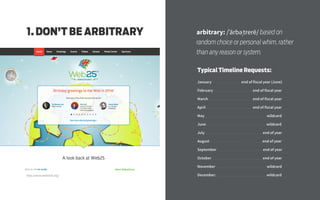
http://www.webat25.org/
arbitrary: /ˈärbəˌtrerē/ based on
random choice or personal whim, rather
than any reason or system.
1. DON’T BE ARBITRARY
Typical Timeline Requests:
January .................................. end of fiscal year (June)
February .............................................. end of fiscal year
March .................................................... end of fiscal year
April ....................................................... end of fiscal year
May ......................................................................... wildcard
June ....................................................................... wildcard
July .................................................................... end of year
August .............................................................. end of year
September ...................................................... end of year
October ............................................................ end of year
November ............................................................ wildcard
December: .......................................................... wildcard
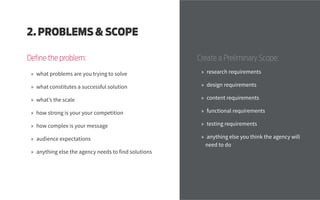
Define the problem:
2. PROBLEMS & SCOPE
 what problems are you trying to solve
 what constitutes a successful solution
»» what’s the scale
 how strong is your your competition
 how complex is your message
 audience expectations
 anything else the agency needs to find solutions
Create a Preliminary Scope:
 research requirements
 design requirements
 content requirements
 functional requirements
 testing requirements
 anything else you think the agency will
need to do
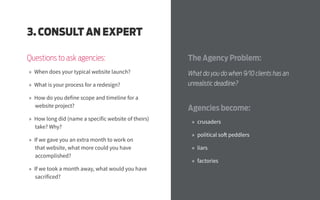
The Agency Problem:
What do you do when 9/10 clients has an
unrealistic deadline?
Agencies become:
 crusaders
 political soft peddlers
 liars
 factories
3. CONSULT AN EXPERT
Questions to ask agencies:
 When does your typical website launch?
 What is your process for a redesign?
 How do you define scope and timeline for a
website project?
 How long did (name a specific website of theirs)
take? Why?
 If we gave you an extra month to work on
that website, what more could you have
accomplished?
 If we took a month away, what would you have
sacrificed?
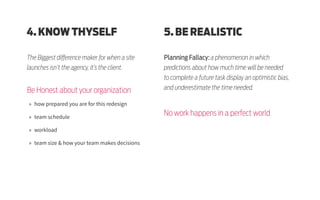
The Biggest difference maker for when a site
launches isn’t the agency, it’s the client.
Be Honest about your organization
 how prepared you are for this redesign
 team schedule
 workload
 team size & how your team makes decisions
4. KNOW THYSELF 5. BE REALISTIC
Planning Fallacy: a phenomenon in which
predictions about how much time will be needed
to complete a future task display an optimistic bias,
and underestimate the time needed.
No work happens in a perfect world
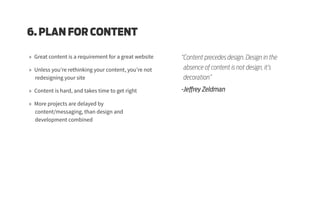
6. PLAN FOR CONTENT
 Great content is a requirement for a great website
»» Unless you’re rethinking your content, you’re not
redesigning your site
 Content is hard, and takes time to get right
 More projects are delayed by
content/messaging, than design and
development combined
“Content precedes design. Design in the
absence of content is not design, it’s
decoration”
-Jeffrey Zeldman
7. THE MYTH OF SIMPLICITY
“I would not give a fig for the simplicity this side of complexity, but I
would give my life for the simplicity on the other side of complexity”
-Oliver Wendell Holmes, Jr.
8. THINK LONG TERM
You impress your boss by launching your site
quickly, but you impress your clients (and build your
business) by taking your time.
 Keep overall goals in mind
 Carefully consider before making sacrifices for
short term gains
 The average company redesigns their site every
3-5 years
 If you think of your website as a product or even a
project, you’re setting yourself up for failure
»» Plan ahead (we’ll be working on this, too)
Live Websites:
1995 .......................................................23,500
2000 ............................................... 17,087,182
2005 ............................................... 64,780,617
2010 .............................................206,956,723
2015 ......................................... 1,000,000,000
If you ever need motivation, go here:
www.internetlivestats.com/total-number-of-websites/
9. TYPICAL TIMELINES
At Gravitate:
 Our Average redesign launches in 5 months
 We have launched a website in under 2 months,
and we have projects that took more than a year
 We recommend alotting at least 4-6 months to a
website redesign
 Every project includes:
•	 Research
•	 Strategy
•	 Design
•	 Development
•	 Quality Assurance
•	 Launch
»» Clients won’t typically see the first design until
they’re 30-45% of the way through the project
Top 10 results for “how long does it take
to launch a website:”
1.	 48 hours
2.	 1 week
3.	 3-4 weeks
4.	 6-10 weeks
5.	 12-16 weeks
6.	 6-9 months
Don’t trust Google
Q&A
THANK YOU

Webinar - How to Define a Realistic Website Project Timeline

  • 1.
    WEBSITE TIMELINES Presented by: FlyntJohnson flynt@gravitatedesign.com July 23rd, 2015
  • 2.
    AGENDA Why This isImportant Tips for Setting a Timeline 1. Don’t be arbitrary 2. Define Your Poblems & Scope 3. Consult an expert 4. Know thyself 5. Be Realistic 6. Don’t forget about content 7. The myth of simplicity 8. Think long-term 9. How Gravitate does it Q&A WELCOME “Long-range planning does not deal with future decisions, but with the future of present decisions.” -Peter Drucker
  • 3.
    A few wordsfrom: WHY THIS IS IMPORTANT “Success should be a synonym for learning.” “Great clients trust their vendors. Vendors with great clients fight tooth & nail to earn that trust. Don’t shuck the responsibility” “No offense to anyone, but I hate colorful spreadsheets”. More fromDon: www.gravitatedesign.com/blog/developing-and-improving-process-a-gather-content-webinar/ “People throw around the term “passion” a lot in my industry. I don’t think many folks realize passion doesn’t mean having fun, or even enjoying what you do, it means literally, ‘To suffer for what you love.” “I will retire the day a client doesn’t say they want a ‘Clean and professional’ website. What’s wrong with messy amateur sites??” Don Elliott Gravitate Director of Production
  • 4.
    http://www.webat25.org/ arbitrary: /ˈärbəˌtrerē/ basedon random choice or personal whim, rather than any reason or system. 1. DON’T BE ARBITRARY Typical Timeline Requests: January .................................. end of fiscal year (June) February .............................................. end of fiscal year March .................................................... end of fiscal year April ....................................................... end of fiscal year May ......................................................................... wildcard June ....................................................................... wildcard July .................................................................... end of year August .............................................................. end of year September ...................................................... end of year October ............................................................ end of year November ............................................................ wildcard December: .......................................................... wildcard
  • 5.
    Define the problem: 2.PROBLEMS & SCOPE »» what problems are you trying to solve »» what constitutes a successful solution »» what’s the scale »» how strong is your your competition »» how complex is your message »» audience expectations »» anything else the agency needs to find solutions Create a Preliminary Scope: »» research requirements »» design requirements »» content requirements »» functional requirements »» testing requirements »» anything else you think the agency will need to do
  • 6.
    The Agency Problem: Whatdo you do when 9/10 clients has an unrealistic deadline? Agencies become:  crusaders  political soft peddlers  liars  factories 3. CONSULT AN EXPERT Questions to ask agencies:  When does your typical website launch?  What is your process for a redesign?  How do you define scope and timeline for a website project?  How long did (name a specific website of theirs) take? Why?  If we gave you an extra month to work on that website, what more could you have accomplished?  If we took a month away, what would you have sacrificed?
  • 7.
    The Biggest differencemaker for when a site launches isn’t the agency, it’s the client. Be Honest about your organization »» how prepared you are for this redesign »» team schedule »» workload »» team size & how your team makes decisions 4. KNOW THYSELF 5. BE REALISTIC Planning Fallacy: a phenomenon in which predictions about how much time will be needed to complete a future task display an optimistic bias, and underestimate the time needed. No work happens in a perfect world
  • 8.
    6. PLAN FORCONTENT »» Great content is a requirement for a great website »» Unless you’re rethinking your content, you’re not redesigning your site »» Content is hard, and takes time to get right »» More projects are delayed by content/messaging, than design and development combined “Content precedes design. Design in the absence of content is not design, it’s decoration” -Jeffrey Zeldman
  • 9.
    7. THE MYTHOF SIMPLICITY “I would not give a fig for the simplicity this side of complexity, but I would give my life for the simplicity on the other side of complexity” -Oliver Wendell Holmes, Jr.
  • 10.
    8. THINK LONGTERM You impress your boss by launching your site quickly, but you impress your clients (and build your business) by taking your time. »» Keep overall goals in mind »» Carefully consider before making sacrifices for short term gains »» The average company redesigns their site every 3-5 years »» If you think of your website as a product or even a project, you’re setting yourself up for failure »» Plan ahead (we’ll be working on this, too) Live Websites: 1995 .......................................................23,500 2000 ............................................... 17,087,182 2005 ............................................... 64,780,617 2010 .............................................206,956,723 2015 ......................................... 1,000,000,000 If you ever need motivation, go here: www.internetlivestats.com/total-number-of-websites/
  • 11.
    9. TYPICAL TIMELINES AtGravitate: »» Our Average redesign launches in 5 months »» We have launched a website in under 2 months, and we have projects that took more than a year »» We recommend alotting at least 4-6 months to a website redesign »» Every project includes: • Research • Strategy • Design • Development • Quality Assurance • Launch »» Clients won’t typically see the first design until they’re 30-45% of the way through the project Top 10 results for “how long does it take to launch a website:” 1. 48 hours 2. 1 week 3. 3-4 weeks 4. 6-10 weeks 5. 12-16 weeks 6. 6-9 months Don’t trust Google
  • 12.
  • 13.