COURSE CODE:: MP103
COURSE :: MANAGERIAL
ECONOMICS
Unit -1 :: INTRODUCTION TO MANAGERIAL
ECONOMICS
OBJECTIVES
 Detail upon the concept of managerial economics
 Learn the scope of managerial economics
 Discuss major economic problems
 Comprehend the decision-making process of an organization
INTRODUCTION
In general terms, economics is a social science that studies the behavior
patterns of human beings. The basic function of economics is to study how
individuals, households, organizations, and nations utilize their limited
resources to achieve maximum profit. With the advent of globalization, there is
a rapid increase in complexities in business decision making. Therefore, it is
important for organizations to have a clear understanding of different economic
concepts, theories, and tools.
Managerial economics is a specialized discipline of economics that deals with
the study of economic theories, logics, and tools used in the process of
business decision making. In other words, managerial economics is a science
that is concerned with those economic tools that are relevant to business
decision making. It applies various economic concepts, such as demand and
supply, competition, allocation of resources, and economic trade-offs, to help
managers in making better decisions. In addition, managerial economics
enables managers to determine the impact of different economic events on the
performance of an organization.
CONCEPT OF MANAGERIAL
ECONOMICS
 Managerial economics undertakes the study of different
economic tools that are used in business decision making.
 Managerial economics is concerned with the application of
economic concepts and economics to the problems of
formulating rational decision making. --- Mansfield
 Managerial economics is concerned with the application of
economic principles and methodologies to the decision-
making process within the firm or organization. It seeks to
establish rules and principles to facilitate the attainment of the
desired economic goals of management. --- Douglas
IMPORTANCE OF MANAGERIAL
ECONOMICS
 Helps in taking decisions related to type of product,
investment, pricing, and level of production
 Enables managers to select production techniques and best
course of action
 Comprises various economic concepts, such as demand
theory, production theory, and capital theory, which helps in
studying and analyzing different business problems
 Helps organization in making future decisions with respect to
economic variables, such as price, demand, supply, and cost
 Applies different economic theories and tools to the real world
business environment
 Enables organizations to determine and analyze factors that
affect business decisions
 Helps in formulating business policies
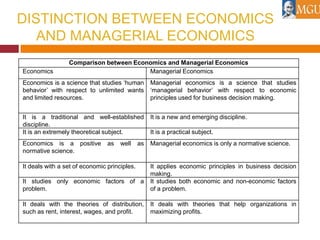
DISTINCTION BETWEEN ECONOMICS
AND MANAGERIAL ECONOMICS
Comparison between Economics and Managerial Economics
Economics Managerial Economics
Economics is a science that studies ‘human
behavior’ with respect to unlimited wants
and limited resources.
Managerial economics is a science that studies
‘managerial behavior’ with respect to economic
principles used for business decision making.
It is a traditional and well-established
discipline.
It is a new and emerging discipline.
It is an extremely theoretical subject. It is a practical subject.
Economics is a positive as well as
normative science.
Managerial economics is only a normative science.
It deals with a set of economic principles. It applies economic principles in business decision
making.
It studies only economic factors of a
problem.
It studies both economic and non-economic factors
of a problem.
It deals with the theories of distribution,
such as rent, interest, wages, and profit.
It deals with theories that help organizations in
maximizing profits.
ROLE OF A MANAGERIAL
ECONOMIST
 Forecasting sales of an organization
 Performing individual market research
 Performing economic analysis of rival organizations
 Analyzing the pricing policy of the industry; thereby
formulating the pricing policy of the organization
 Performing investment analysis
 Assisting the top management in making decisions related
to trade and public relations and foreign exchange
 Performing capital budgeting and production planning
 Measuring the earning capacity of an organization
 Keeping the top management informed regarding any
changes in the business environment
MAJOR ECONOMIC
PROBLEMS
 What to produce: An organization faces problems related to the
selection of a product to be produced in the present market
conditions to get maximum profit.
 How to produce: An organization also faces problems related to the
selection of techniques to be used for producing goods or services.
 For whom to produce: Refers to a problem related to the distribution
of products and services among the different sectors of the
economy.
 Economical use of resources: Refers to a problem of making
optimum use of limited resources so that the wants of human
beings can be satisfied.
 Problem related to growth: Refers to the problem related to the
continuous development of the economy.
DECISION MAKING PROCESS
 Setting Objectives: Refers to the first step of the decision-making
process. It is necessary for an organization to define the objectives
of taking a particular decision.
 Defining the problem: Refers to the second step in which the actual
problem of an organization is identified.
 Identifying the causal factors: Involves determining the factors that
may affect the decision.
 Finding out alternatives: Refers to the step in which all the possible
alternatives are generated for solving a problem.
 Collecting information: Involves gathering data with respect to the
alternatives generated so that they can be properly analyzed.
 Evaluating information: Refers to the step in which the collected
data is analyzed so that best alternative can be selected.
 Implementing the alternative and monitoring results: Refers to the
last step in which an organization puts the selected alternative into
practice.
SUMMARY
 Economics studies how individuals, households,
organizations, and nations utilize their limited resources to
achieve maximum profit.
 Economics is divided into two parts, namely microeconomics
and macroeconomics.
 Managerial economics is an applied branch of economics
that deals with economic concepts and tools used in business
decision making.
 Managerial economics deals with the analysis of economic
theories and laws to solve business problems and take
decisions based on rational thinking.
 Business problems can be related to demand and supply
prospects of an organization, level of production, pricing,
market structure, and extent of competition.
© Dreamtech Press

ERPM - Unit 01

  • 1.
    COURSE CODE:: MP103 COURSE:: MANAGERIAL ECONOMICS Unit -1 :: INTRODUCTION TO MANAGERIAL ECONOMICS
  • 2.
    OBJECTIVES  Detail uponthe concept of managerial economics  Learn the scope of managerial economics  Discuss major economic problems  Comprehend the decision-making process of an organization
  • 3.
    INTRODUCTION In general terms,economics is a social science that studies the behavior patterns of human beings. The basic function of economics is to study how individuals, households, organizations, and nations utilize their limited resources to achieve maximum profit. With the advent of globalization, there is a rapid increase in complexities in business decision making. Therefore, it is important for organizations to have a clear understanding of different economic concepts, theories, and tools. Managerial economics is a specialized discipline of economics that deals with the study of economic theories, logics, and tools used in the process of business decision making. In other words, managerial economics is a science that is concerned with those economic tools that are relevant to business decision making. It applies various economic concepts, such as demand and supply, competition, allocation of resources, and economic trade-offs, to help managers in making better decisions. In addition, managerial economics enables managers to determine the impact of different economic events on the performance of an organization.
  • 4.
    CONCEPT OF MANAGERIAL ECONOMICS Managerial economics undertakes the study of different economic tools that are used in business decision making.  Managerial economics is concerned with the application of economic concepts and economics to the problems of formulating rational decision making. --- Mansfield  Managerial economics is concerned with the application of economic principles and methodologies to the decision- making process within the firm or organization. It seeks to establish rules and principles to facilitate the attainment of the desired economic goals of management. --- Douglas
  • 5.
    IMPORTANCE OF MANAGERIAL ECONOMICS Helps in taking decisions related to type of product, investment, pricing, and level of production  Enables managers to select production techniques and best course of action  Comprises various economic concepts, such as demand theory, production theory, and capital theory, which helps in studying and analyzing different business problems  Helps organization in making future decisions with respect to economic variables, such as price, demand, supply, and cost  Applies different economic theories and tools to the real world business environment  Enables organizations to determine and analyze factors that affect business decisions  Helps in formulating business policies
  • 6.
    DISTINCTION BETWEEN ECONOMICS ANDMANAGERIAL ECONOMICS Comparison between Economics and Managerial Economics Economics Managerial Economics Economics is a science that studies ‘human behavior’ with respect to unlimited wants and limited resources. Managerial economics is a science that studies ‘managerial behavior’ with respect to economic principles used for business decision making. It is a traditional and well-established discipline. It is a new and emerging discipline. It is an extremely theoretical subject. It is a practical subject. Economics is a positive as well as normative science. Managerial economics is only a normative science. It deals with a set of economic principles. It applies economic principles in business decision making. It studies only economic factors of a problem. It studies both economic and non-economic factors of a problem. It deals with the theories of distribution, such as rent, interest, wages, and profit. It deals with theories that help organizations in maximizing profits.
  • 7.
    ROLE OF AMANAGERIAL ECONOMIST  Forecasting sales of an organization  Performing individual market research  Performing economic analysis of rival organizations  Analyzing the pricing policy of the industry; thereby formulating the pricing policy of the organization  Performing investment analysis  Assisting the top management in making decisions related to trade and public relations and foreign exchange  Performing capital budgeting and production planning  Measuring the earning capacity of an organization  Keeping the top management informed regarding any changes in the business environment
  • 8.
    MAJOR ECONOMIC PROBLEMS  Whatto produce: An organization faces problems related to the selection of a product to be produced in the present market conditions to get maximum profit.  How to produce: An organization also faces problems related to the selection of techniques to be used for producing goods or services.  For whom to produce: Refers to a problem related to the distribution of products and services among the different sectors of the economy.  Economical use of resources: Refers to a problem of making optimum use of limited resources so that the wants of human beings can be satisfied.  Problem related to growth: Refers to the problem related to the continuous development of the economy.
  • 9.
    DECISION MAKING PROCESS Setting Objectives: Refers to the first step of the decision-making process. It is necessary for an organization to define the objectives of taking a particular decision.  Defining the problem: Refers to the second step in which the actual problem of an organization is identified.  Identifying the causal factors: Involves determining the factors that may affect the decision.  Finding out alternatives: Refers to the step in which all the possible alternatives are generated for solving a problem.  Collecting information: Involves gathering data with respect to the alternatives generated so that they can be properly analyzed.  Evaluating information: Refers to the step in which the collected data is analyzed so that best alternative can be selected.  Implementing the alternative and monitoring results: Refers to the last step in which an organization puts the selected alternative into practice.
  • 10.
    SUMMARY  Economics studieshow individuals, households, organizations, and nations utilize their limited resources to achieve maximum profit.  Economics is divided into two parts, namely microeconomics and macroeconomics.  Managerial economics is an applied branch of economics that deals with economic concepts and tools used in business decision making.  Managerial economics deals with the analysis of economic theories and laws to solve business problems and take decisions based on rational thinking.  Business problems can be related to demand and supply prospects of an organization, level of production, pricing, market structure, and extent of competition. © Dreamtech Press