MANAGERIAL ECONOMICS
Under The Guidance Of
-Dr.N.Babitha Thimmaiah
Assistant Professor
Dept of MBA
PRESENTED BY
BHANUPRASAD
INTRODUCTION TO MANAGERIAL
ECONOMICS
Managerial economics is the study of how scare
resources are directed most efficiently to achieve managerial
goals. It is a valuable tool for analyzing business situations to take
decisions.
According to Prof. Evan J Douglas defines Managerial
Economics as “Managerial Economics is concerned with the
application of economics principles and methodologies to the
decision making process within the firm or organizations under
the conditions of uncertainty”.
Nature Of Managerial Economics
1. Micro economics in nature.
2. Pragmatic.
3. Conceptual in nature.
4. Problem solving in nature.
5. Study of allocation of resources.
6. Interdisciplinary.
Scope Of Managerial Economics
1. Demand analysis and forecasting.
2. Cost and production analysis.
3. Pricing decision, polices and practices.
4. Profit management.
5. Capital management.
6. Analysis of business environment.
7. Allied disciplines.
1. Demand analysis and Forecasting:- Accurate estimation of
demand is an important basis of managerial decision making.
Estimation of future sales facilitates management for scheduling
the production and employing resources. It will be helpful for
management to maintain its market position and profit-base.
2. Cost and production analysis:- Cost estimation is very useful
for taking management decisions and various factors which
effects the cost estimation should be given due consideration for
planning purpose.
3. Pricing decision, Polices and Practices:- Price gives income to
the firm and it constitutes the most important field of managerial
economics. It covers various concepts such as price
determination in various market forms, pricing policies, pricing
method, differential pricing, productive and price forecasting.
4. Profit Management:- Earning maximum profit is the main
objective of a business firm. Due to variation in costs and
revenue and element of uncertainty about profits always exist.
5. Analysis of Business Environment:- The working and
performance of any business firm is effected by the various
environmental factors. Therefore, in decision-making process
environmental factors are considered by managers.
6. Capital Management:- Capital management implies planning
and control of capital expenditure because it involves a large
sum and more over the problems in disposing the capital assets
are so complex.
7. Allied disciplines:- The concepts which are helpful for the
management in decision making are qualitative in nature.
Therefore, for determining the relationship between the
economic variables, mathematical tools are generally used.
Relationship Of Managerial Economics
With Other Disciplines
The relationship of managerial economics with other
objectives are as follows:-
1. Managerial economics and statistics.
2. Managerial economics and mathematics.
3. Managerial economics and accounting.
4. Managerial economics and operations research.
5. Managerial economics and theory of decision making.
6. Managerial economics and economics.
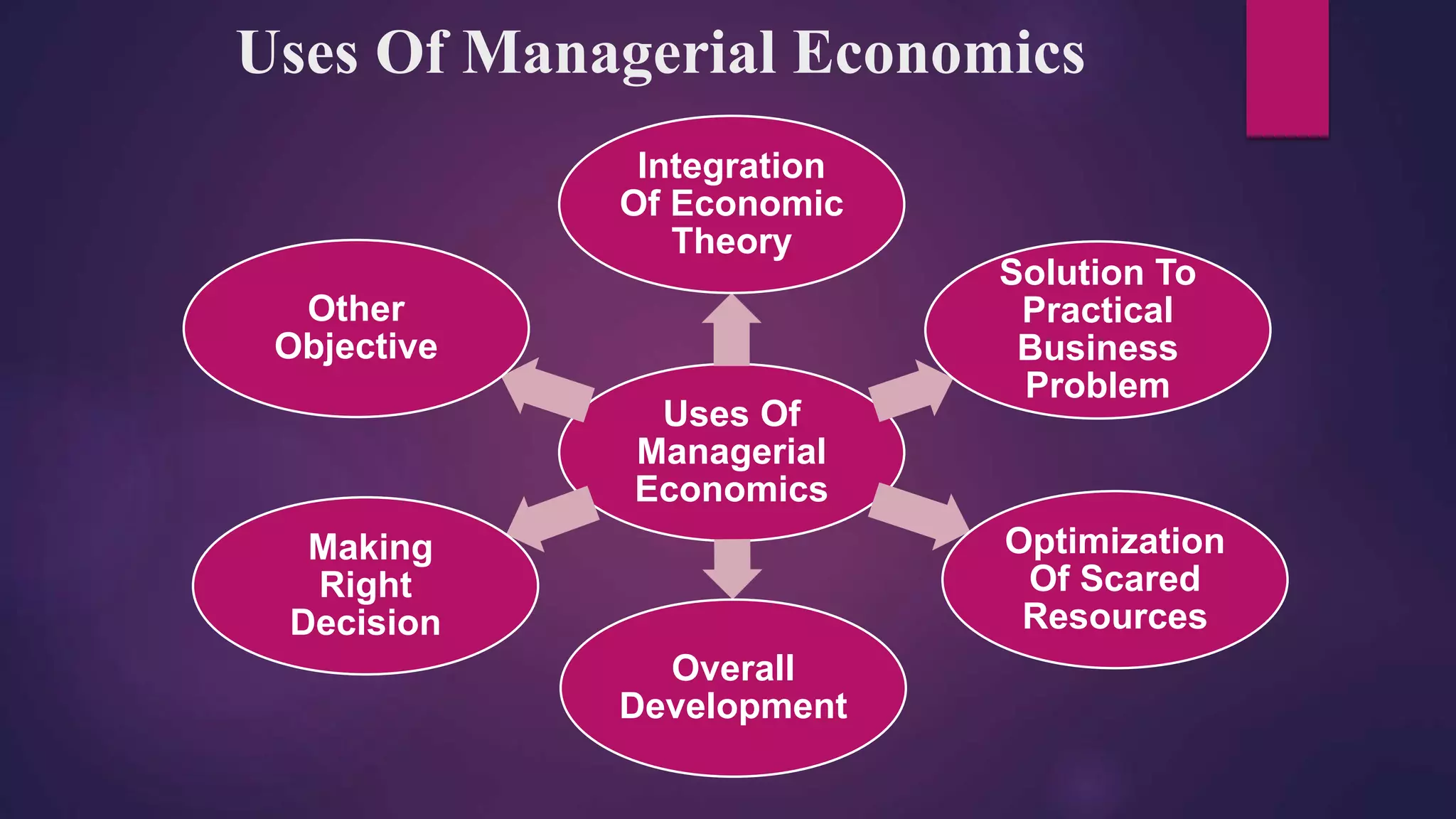
Uses Of Managerial Economics
Uses Of
Managerial
Economics
Integration
Of Economic
Theory
Solution To
Practical
Business
Problem
Optimization
Of Scared
Resources
Overall
Development
Making
Right
Decision
Other
Objective
Limitations Of Managerial Economics
Limitations of
Managerial
economics
Let to the
emergence of
monopolies
Let to the
emergence of
oligopoly
Exploitation
of workers
Optimizations
of techniques
Close the future
prospects
Focus only on
internal
management.
Fundamental Principles Of Managerial
Economics
1. Opportunity cost principle
2. Incremental principle
3. Time perspective principle
4. Discounting principle
5. Marginal principle
6. Eqi-marginal principle
7. Scarcity principle
8. Risk and uncertainty principle
Significance Of Managerial Economics
Significance
of managerial
economics
Production
decisions.
Inventory
decisions.
Cost
decisions.
Marketing
decisions.
Personnel
decisions.
Investment
decisions.
1. Production decision:- supply of goods and service for sales in a market to
satisfy consumer wants it done through the production.
2. Inventory decision:- the amount of the goods, raw material is requiring fir
the meeting of demand very important.
3. Cost decision:- in business decisions cost structure, reduction cost and
cost control plays an important role.
4. Marketing decision:- the marketing executive must take decisions about
target market, market positioning product development communications
and promotions.
5. Investment decision:-any investment decision, the problems of risks and
wrong estimation are very essential.
6. Personal decision:- the service of large number of personnel are required
in an organization. These personnel are appointed as various post.
Role Of Managerial Economist
 Following roles are
 Internal factor.
 External factor.
 Specific function.
Internal Factor
 The managerial economist can help the management in decision
making regarding the internal operation of the firm in respect of
such problems as cost structure, price, investment decision,
expansion of business etc…
 Some of the important relevant question in this connection, are as
follows..
I. What Will be the reasonable sales and profit targets for the next year?
II. What should be the Production Schedule for the coming year?
External Factor
 The external factor are not in control of the management,
the firm has no control on the external factor. Because they
are operating outside the firm. These factor create the
business environment and include price, national income
and outputs, government policies , international
 Certain relevant question relating to this factor are….
I. What are the present trends in national and international economics?
II. What are the expectations about the price and availability of Raw-
material?
Specific Function
 The various specific function which are performed by the
managerial economist for the business management and
management consultant are as follows.
 Sales forecasting.
 Market research.
 Analysis of competing firms.
 Pricing In different industry.
 Surveying different markets.
 Comparative analysis of projects.
A managerial economist helps the management by using his
analytical skills and highly developed techniques in solving
complex issues of successful decision-making and future
advanced planning.
Managerial Economist
Dr. Manmohan Singh Dr. Amartya Sen
Responsibilities Of Managerial Economist
1. To make reasonable profits on capital employed.
2. Successful forecasts.
3. Knowledge of sources of economic information’s.
4. His status in the firm.
Difference Between Managerial Economics And
Economics
Basis of difference
 Meaning
 Scope
 Feature
 Deal with
 Concerned with
 Discuss
 Decision making
THANK YOU

Managerial economics

  • 1.
    MANAGERIAL ECONOMICS Under TheGuidance Of -Dr.N.Babitha Thimmaiah Assistant Professor Dept of MBA
  • 2.
  • 3.
    INTRODUCTION TO MANAGERIAL ECONOMICS Managerialeconomics is the study of how scare resources are directed most efficiently to achieve managerial goals. It is a valuable tool for analyzing business situations to take decisions. According to Prof. Evan J Douglas defines Managerial Economics as “Managerial Economics is concerned with the application of economics principles and methodologies to the decision making process within the firm or organizations under the conditions of uncertainty”.
  • 4.
    Nature Of ManagerialEconomics 1. Micro economics in nature. 2. Pragmatic. 3. Conceptual in nature. 4. Problem solving in nature. 5. Study of allocation of resources. 6. Interdisciplinary.
  • 5.
    Scope Of ManagerialEconomics 1. Demand analysis and forecasting. 2. Cost and production analysis. 3. Pricing decision, polices and practices. 4. Profit management. 5. Capital management. 6. Analysis of business environment. 7. Allied disciplines.
  • 6.
    1. Demand analysisand Forecasting:- Accurate estimation of demand is an important basis of managerial decision making. Estimation of future sales facilitates management for scheduling the production and employing resources. It will be helpful for management to maintain its market position and profit-base. 2. Cost and production analysis:- Cost estimation is very useful for taking management decisions and various factors which effects the cost estimation should be given due consideration for planning purpose. 3. Pricing decision, Polices and Practices:- Price gives income to the firm and it constitutes the most important field of managerial economics. It covers various concepts such as price determination in various market forms, pricing policies, pricing method, differential pricing, productive and price forecasting.
  • 7.
    4. Profit Management:-Earning maximum profit is the main objective of a business firm. Due to variation in costs and revenue and element of uncertainty about profits always exist. 5. Analysis of Business Environment:- The working and performance of any business firm is effected by the various environmental factors. Therefore, in decision-making process environmental factors are considered by managers.
  • 8.
    6. Capital Management:-Capital management implies planning and control of capital expenditure because it involves a large sum and more over the problems in disposing the capital assets are so complex. 7. Allied disciplines:- The concepts which are helpful for the management in decision making are qualitative in nature. Therefore, for determining the relationship between the economic variables, mathematical tools are generally used.
  • 9.
    Relationship Of ManagerialEconomics With Other Disciplines The relationship of managerial economics with other objectives are as follows:- 1. Managerial economics and statistics. 2. Managerial economics and mathematics. 3. Managerial economics and accounting. 4. Managerial economics and operations research. 5. Managerial economics and theory of decision making. 6. Managerial economics and economics.
  • 10.
    Uses Of ManagerialEconomics Uses Of Managerial Economics Integration Of Economic Theory Solution To Practical Business Problem Optimization Of Scared Resources Overall Development Making Right Decision Other Objective
  • 11.
    Limitations Of ManagerialEconomics Limitations of Managerial economics Let to the emergence of monopolies Let to the emergence of oligopoly Exploitation of workers Optimizations of techniques Close the future prospects Focus only on internal management.
  • 12.
    Fundamental Principles OfManagerial Economics 1. Opportunity cost principle 2. Incremental principle 3. Time perspective principle 4. Discounting principle 5. Marginal principle 6. Eqi-marginal principle 7. Scarcity principle 8. Risk and uncertainty principle
  • 13.
    Significance Of ManagerialEconomics Significance of managerial economics Production decisions. Inventory decisions. Cost decisions. Marketing decisions. Personnel decisions. Investment decisions.
  • 14.
    1. Production decision:-supply of goods and service for sales in a market to satisfy consumer wants it done through the production. 2. Inventory decision:- the amount of the goods, raw material is requiring fir the meeting of demand very important. 3. Cost decision:- in business decisions cost structure, reduction cost and cost control plays an important role. 4. Marketing decision:- the marketing executive must take decisions about target market, market positioning product development communications and promotions. 5. Investment decision:-any investment decision, the problems of risks and wrong estimation are very essential. 6. Personal decision:- the service of large number of personnel are required in an organization. These personnel are appointed as various post.
  • 15.
    Role Of ManagerialEconomist  Following roles are  Internal factor.  External factor.  Specific function.
  • 16.
    Internal Factor  Themanagerial economist can help the management in decision making regarding the internal operation of the firm in respect of such problems as cost structure, price, investment decision, expansion of business etc…  Some of the important relevant question in this connection, are as follows.. I. What Will be the reasonable sales and profit targets for the next year? II. What should be the Production Schedule for the coming year?
  • 17.
    External Factor  Theexternal factor are not in control of the management, the firm has no control on the external factor. Because they are operating outside the firm. These factor create the business environment and include price, national income and outputs, government policies , international  Certain relevant question relating to this factor are…. I. What are the present trends in national and international economics? II. What are the expectations about the price and availability of Raw- material?
  • 18.
    Specific Function  Thevarious specific function which are performed by the managerial economist for the business management and management consultant are as follows.  Sales forecasting.  Market research.  Analysis of competing firms.  Pricing In different industry.  Surveying different markets.  Comparative analysis of projects.
  • 19.
    A managerial economisthelps the management by using his analytical skills and highly developed techniques in solving complex issues of successful decision-making and future advanced planning. Managerial Economist Dr. Manmohan Singh Dr. Amartya Sen
  • 20.
    Responsibilities Of ManagerialEconomist 1. To make reasonable profits on capital employed. 2. Successful forecasts. 3. Knowledge of sources of economic information’s. 4. His status in the firm.
  • 21.
    Difference Between ManagerialEconomics And Economics Basis of difference  Meaning  Scope  Feature  Deal with  Concerned with  Discuss  Decision making
  • 22.