MANAGERIAL ECONOMICS: UNIT 1
MANAGERIAL ECONOMICS-MEANING
‘Managerial Economics, the branch of economics is the Application of various Theories, Concepts
and Principles of Economics in the Business Decisions.’ It also Includes ‘The Application of Mathematical and
Statistical tools in Management decisions.’ Managerial economics, used synonymously with business
economics, is a branch of economics that deals with the application of microeconomic analysis to decision-
making techniques of businesses and management units. It acts as the via media between economic theory and
pragmatic economics. Managerial economics bridges the gap between 'theoria‘ and 'pracis'.
The tenets of managerial economics have been derived from quantitative techniques such as
regression analysis, correlation and Lagrangian calculus (linear). An omniscient and unifying theme found in
managerial economics is the attempt to achieve optimal results from business decisions, while taking into
account the firm's objectives, constraints imposed by scarcity and so on. A paradigm of such optmization is the
use of operations research and programming. Managerial economics is thereby a study of application of
managerial skills in economics. It helps in anticipating, determining and resolving potential problems or
obstacles. These problems may pertain to costs, prices, forecasting future market, human resource
management, profits and so on.
DEFINITIONS
 According to Spencer: “Managerial economics is the integration of economic theory with
business practice for purpose of facilitating decision making and forward planning by
management”. It means management of limited funds available in most economical way. It
deals with basic problems of the economy i.e. what, how & for whom to produce.
 Brigham and Poppas define managerial economics as,” the application of economic theory
and methodology to business administration practice”.
 According to McNair and Meriam “Managerial economics consists of the use of economic
modes of thought to analyse business situations”.
 According to Mc Gutgan and Moyer “Managerial economics is the application of economic
theory and methodology to decision-making problems faced by both public and private
institutions”.
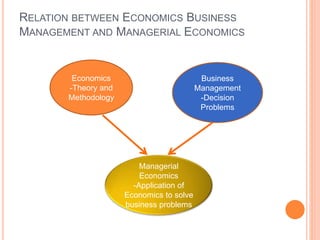
RELATION BETWEEN ECONOMICS BUSINESS
MANAGEMENT AND MANAGERIAL ECONOMICS
Economics
-Theory and
Methodology
Business
Management
-Decision
Problems
Managerial
Economics
-Application of
Economics to solve
business problems
CHARACTERISTICS OF MANAGERIAL ECONOMICS
1.Microeconomics: It studies the problems and principles of an individual business firm or an individual
industry. It aids the management in forecasting and evaluating the trends of the market.
2. Normative economics: It is concerned with varied corrective measures that a management undertakes
under various circumstances. It deals with goal determination, goal development and achievement of
these goals. Future planning, policy-making, decision-making and optimal utilisation of available
resources, come under the banner of managerial economics.
3. Pragmatic: Managerial economics is pragmatic. In pure micro-economic theory, analysis is performed,
based on certain exceptions, which are far from reality. However, in managerial economics, managerial
issues are resolved daily and difficult issues of economic theory are kept at bay.
4. Uses theory of firm: Managerial economics employs economic concepts and principles, which are
known as the theory of Firm or 'Economics of the Firm'. Thus, its scope is narrower than that of pure
economic theory.
5.Takes the help of macroeconomics: Managerial economics incorporates certain aspects of
macroeconomic theory. These are essential to comprehending the circumstances and environments that
envelop the working conditions of an individual firm or an industry. Knowledge of macroeconomic
issues such as business cycles, taxation policies, industrial policy of the government, price and
distribution policies, wage policies and antimonopoly policies and so on, is integral to the successful
functioning of a business.
6.Aims at helping the management: Managerial economics aims at supporting the management in
taking corrective decisions and charting plans and policies for future.
7. A scientific art: Science is a system of rules and principles engendered for attaining given ends.
Scientific methods have been credited as the optimal path to achieving one's goals. Managerial
economics has been is also called a scientific art because it helps the management in the best and
efficient utilisation of scarce economic resources. It considers production costs, demand, price, profit,
risk etc. It assists the management in singling out the most feasible alternative. Managerial economics
facilitates good and result oriented decisions under conditions of uncertainty.
8. Prescriptive rather than descriptive: Managerial economics is a normative and applied discipline. It
suggests the application of economic principles with regard to policy formulation, decision-making and
future planning. It not only describes the goals of an organisation but also prescribes the means of
achieving these goals.
NATURE OF MANAGERIAL ECONOMICS
1. Allocation of resources:
Since resources are scarce and they have multiple uses, me focuses on optimum allocation
of funds available, which also reduces the wastage level.
2. Micro economic nature:
It deals with business firms. a firm is the smallest decision making unit of production. since the study
is about firm, the problems faced by the firms also falls under the purview of micro economics.
3. Market knowledge:
A firm is open to threats as well as opportunities in market place. so knowledge of market must be
perfect.
4. Macro-setting:
A firm has to operate within a given economy. so its also governed & affected by the trends in
income, consumption, investment, savings levels in an economy.
5. Positive & normative approach:
Positive approach concerns with what is, was or will be, while normative approach concerns with
what ought to be positive.
SCOPE OF MANAGERIAL ECONOMICS
Managerial economics comprises both micro- and macro-economic theories. Generally, the scope of
managerial economics extends to those economic concepts, theories, and tools of analysis used in analysing
the business environment, and to find solutions to practical business problems.
 1. Demand Analysis and Forecasting
 2. Cost Analysis
 3. Production and Supply Analysis
 4. Pricing Decisions, Policies and Practices
 5. Profit Management, and
 6. Capital Management
1. Demand Analysis and Forecasting
A business firm is an economic organism which transforms productive resources into goods that are to be sold in
a market. A major part of managerial decision-making depends on accurate estimates of demand. Before
production schedules can be prepared and resources employed, a forecast of future sales is essential. This
forecast can also serve as a guide to management for maintaining or strengthening market position and enlarging
profits.
2. Cost Analysis
A study of economic costs, combined with the data drawn from the firm’s accounting records, can yield
significant cost estimates that are Useful for management decisions. The factors causing variations in costs must
be recognized and allowed for if management is to arrive at cost estimates which are significant for planning
purposes. An element of cost uncertainty exists because all the factors determining costs are not always known
or controllable.
3. Production and Supply Analysis
Production analysis is narrower in scope than cost analysis. Production analysis frequently proceeds in
physical terms while cost analysis proceeds in monetary terms. Production analysis mainly deals which
different production functions and their managerial uses. Supply analysis deals with various aspects of supply
of a commodity. Certain important aspects of supply analysis are: Supply schedule, curves and function, Law
of supply and its limitations, Elasticity of supply and Factors influencing supply.
4. Pricing Decisions, Policies and Practices
Pricing is a very important area of Managerial Economics. In fact, price is the genesis of the revenue of a firm
and as such the success of a business firm largely depends on the correctness of the price decisions taken by
It. The important aspects dealt with under this area are: Price Determination in various Market Forms, Pricing
Methods, Differential Pricing, Product-line Pricing and Price Forecasting.
5. Profit Management
Business firms are generally organised for the purpose of making profits and, in the long run, profits provide
the chief measure of success. In this connection, an important point worth considering is the element of
uncertainty existing about profits because of variations in costs and revenues which, in turn, are caused by
factors both internal and external to the firm. If knowledge about the future were perfect, profit analysis
would have been a very easy task.
6. Capital Management
Of the various types and classes of business problems, the most complex and troublesome for the business
manager are likely to be those relating to the firm’s capital investments. Relatively large sums are involved,
and the problems are so complex that their disposal not only requires considerable time and labour but is a
matter for top-level decision. Briefly, capital management implies planning and control of capital expenditure.
MANAGERIAL ECONOMICS AND BUSINESS
DECISION MAKING
Decision making:
 Decision making on internal affairs.
Internal affairs talk on internal environment which consists of internal factors such as,
Production, Financial, Marketing and Human resource related decisions.
 Decision making on external affairs.
External Affairs talk on external environment which consists of external factors such as, PEST
related decisions.
Managerial decisions should be taken properly due to uncertainty and risk.
Uncertainty: Nothing can be expectable because of the constant changes in the environment both
internally as well as externally.
Risk: It is the situation which comes under uncertainty.
Decisions should be taken by using economic model. Economic model is the structural and
scientific method of constructing or developing Solutions by using basic economic
principles, concepts, theories and Quantitative techniques such as mathematical and
statistical tools.
WHY MANAGERS NEED TO KNOW
ECONOMICS ?
 In the event of resources being unlimited, like air or sunshine, the problem of
economic utilization of resources or resource management would not have arisen. Resources
like finance, workforce and material are limited. However, in the absence of unlimited
resources, it is the responsibility of the management to optimize the use of these resources.
 How economics contributes to managerial functions
Though economics is variously defined, it is essentially the study of logic, tools and
techniques, to make optimum use of the available resources to achieve the given ends.
Economics affords analytical tools and techniques that managers require to accomplish the
goals of the organization they manage.
 Therefore, a working knowledge of economics, not necessarily a formal degree, is
indispensable for managers. Managers are fundamentally practicing economists. While
executing his duties, a manager has to take several decisions, which conform to the
objectives of the firm.
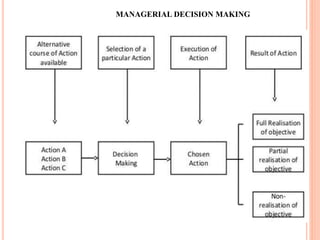
MANAGERIAL DECISION MAKING
Decision-making theory and game theory, which recognise the conditions of uncertainty and imperfect
knowledge under which business managers operate, have contributed to systematic methods of assessing
investment opportunities.
Almost any business decision can be analysed with managerial economics techniques. However, the
most frequent applications of these techniques are as follows:
• Risk analysis: Various models are used to quantify risk and asymmetric information and to employ
them in decision rules to manage risk.
• Production analysis: Microeconomic techniques are used to analyse production efficiency, optimum
factor allocation, costs and economies of scale. They are also utilised to estimate the firm's cost function.
• Pricing analysis: Microeconomic techniques are employed to examine various pricing decisions. This
involves transfer pricing, joint product pricing, price discrimination, price elasticity estimations and
choice of the optimal pricing method.
• Capital budgeting: Investment theory is used to scrutinise a firm's capital purchasing decisions.
IMPORTANCE OF MANAGERIAL ECONOMICS
The importance of managerial economics in a business and industrial enterprise
as follows:
1. Accommodating traditional theoretical concepts to the actual business behaviour and
conditions: Managerial economics amalgamates tools, techniques, models and theories of
traditional economics with actual business practices and with the environment in which a
firm has to operate.
2. Estimating economic relationships: Managerial economics estimates economic
relationships between different business factors such as income, elasticity of demand ,
cost volume, profit analysis.
3. Predicting relevant economic quantities: Managerial economics assists the management in
predicting various economic quantities such as cost, profit, demand, capital, production,
price etc.
4. Understanding significant external forces: The management has to identify all the
important factors that influence a firm. Managerial economics plays an important role by
assisting management in understanding these factors.
 External factors: A firm cannot exercise any control over these factors. The plans, policies and
programmes of the firm should be formulated in the light of these factors. Significant external
factors impinging on the decision-making process of a firm are economic system of the country,
business cycles, fluctuations in national income and national production, industrial policy of the
government, trade and fiscal policy of the government, taxation policy, licensing policy, trends in
foreign trade of the country, general industrial relation in the country and so on.
 Internal factors: These factors fall under the control of a firm. These factors are associated with
business operation. Knowledge of these factors aids the management in making sound business
decisions.
5. Basis of business policies: Managerial economics is the founding principle of business policies.
Business policies are prepared based on studies and findings of managerial economics . Thus,
managerial economics is helpful to the management in its decision-making
ROLE OF MANAGERIAL ECONOMICS
 Analysis of External Factors
 Analysis of internal factors
 Specific functions
-Sales forecasting
- Market Research
-Economic analysis of competing firms
-Production and inventory schedule
The managerial economist have a major role in managerial decision making.
 He studies the economic patterns at macro-level and analysis it’s significance to the
specific firm he is working in. He has to consistently examine the probabilities of transforming
an ever changing economic environment into profitable business avenues. He assists the
business planning process of a firm. He also carries cost-benefit analysis.
 He is also involved in advising the management on public relations, foreign exchange, and
trade. He guides the firm on the likely impact of changes in monetary and fiscal policy on the
firm’s functioning.
 The most significant function of a managerial economist is to conduct a detailed research on
industrial market.
 In addition, a managerial economist has to analyze changes in macro- economic indicators
such as national income, population, business cycles, and their possible effect on the firm’s
functioning.
 He assists the management in the decisions pertaining to internal functioning of a firm such
as changes in price, investment plans, type of goods /services to be produced, inputs to be used,
techniques of production to be employed, expansion/ contraction of firm, allocation of
capital, location of new plants, quantity of output to be produced, replacement of plant
equipment, sales forecasting, inventory forecasting, etc.
 Lastly managerial economist has also to keep in touch with the government’s economic
policies and the central bank’s monetary policies, annual budgets of the government, etc.
FUNDAMENTAL CONCEPTS OF MANAGERIAL ECONOMICS
The contribution of economics to managerial economics lies in certain principles which
are basic to managerial economics. There are six basic principles of managerial
economics. They are:
1. The Incremental Principle- Incremental concept is closely related to the marginal
cost and marginal revenues of economic theory.
2. The Principle of Time Perspective- The time perspective concept states that the decision
maker must give due consideration both to the short run and long run effects of his
decisions. He must give due emphasis to the various time periods. It was Marshall who
introduced time element in economic theory.
3. The Opportunity Cost Principle- Opportunity cost represents the benefits or revenue
forgone by pursuing one course of action rather than another.
4. The Discounting Principle- This concept is an extension of the concept of time perspective.
5. The Equi-marginal Principle-- The principle states that an input should be allocated
so that value Added by the last unit is the same in all cases. This generalisation is popularly
called the equi-marginal.
6. Risk and Uncertainty- Managerial decisions are actions of today which bear fruits in future
which is unforeseen. Future is uncertain and involves risk.
1. INCREMENTAL PRINCIPLE
Incremental principle states that a decision is
profitable :
 if revenue increases more than costs;
 if costs reduce more than revenues;
 if increase in some revenues is more than decrease
in others; and
 if decrease in some costs is greater than increase
in others.
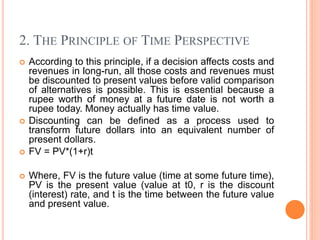
2. THE PRINCIPLE OF TIME PERSPECTIVE
 According to this principle, if a decision affects costs and
revenues in long-run, all those costs and revenues must
be discounted to present values before valid comparison
of alternatives is possible. This is essential because a
rupee worth of money at a future date is not worth a
rupee today. Money actually has time value.
 Discounting can be defined as a process used to
transform future dollars into an equivalent number of
present dollars.
 FV = PV*(1+r)t
 Where, FV is the future value (time at some future time),
PV is the present value (value at t0, r is the discount
(interest) rate, and t is the time between the future value
and present value.
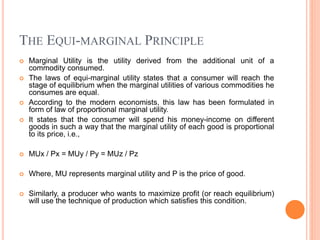
THE EQUI-MARGINAL PRINCIPLE
 Marginal Utility is the utility derived from the additional unit of a
commodity consumed.
 The laws of equi-marginal utility states that a consumer will reach the
stage of equilibrium when the marginal utilities of various commodities he
consumes are equal.
 According to the modern economists, this law has been formulated in
form of law of proportional marginal utility.
 It states that the consumer will spend his money-income on different
goods in such a way that the marginal utility of each good is proportional
to its price, i.e.,
 MUx / Px = MUy / Py = MUz / Pz
 Where, MU represents marginal utility and P is the price of good.
 Similarly, a producer who wants to maximize profit (or reach equilibrium)
will use the technique of production which satisfies this condition.
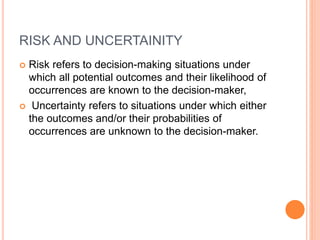
RISK AND UNCERTAINITY
 Risk refers to decision-making situations under
which all potential outcomes and their likelihood of
occurrences are known to the decision-maker,
 Uncertainty refers to situations under which either
the outcomes and/or their probabilities of
occurrences are unknown to the decision-maker.
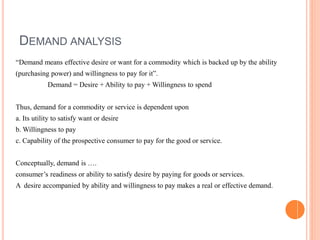
DEMAND ANALYSIS
“Demand means effective desire or want for a commodity which is backed up by the ability
(purchasing power) and willingness to pay for it”.
Demand = Desire + Ability to pay + Willingness to spend
Thus, demand for a commodity or service is dependent upon
a. Its utility to satisfy want or desire
b. Willingness to pay
c. Capability of the prospective consumer to pay for the good or service.
Conceptually, demand is ….
consumer’s readiness or ability to satisfy desire by paying for goods or services.
A desire accompanied by ability and willingness to pay makes a real or effective demand.
DEFINITIONS
 "The various quantities of goods that would be purchased per time period at different prices in a
given market." – Prof. Hibdon
 The demand for anything, at a given price, is the amount of it, which will be bought per unit of
time at that price”. The term has no significance unless a price is stated or implied. – Prof. Lee
Benham, Washington University
 "Demand in Economics means demand backed by enough money to pay for the goods
demanded." – Prof. Dauglaus Hague, Manchester Business School.
The “Demand” for a commodity, at a given price, is the quantity of it which will
be bought per unit of time at that price. In economics, demand refers to the buying
behavior of a household. What does this mean?
Basically, economists try answering the following three phenomenon :
1. Why people buy what they buy?
2. How much they're willing to pay ?
3. How much they want to buy ?
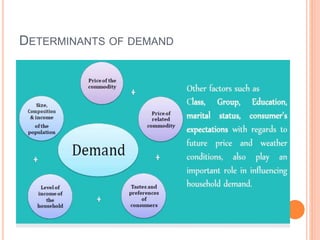
DETERMINANTS OF DEMAND
DEMAND FUNCTION
 The theory of consumption deals with concepts and functions.
 A function expresses the relationship between two or more variables, such as, prices and the
physical quantities demanded.
 In a given market, in a given period of time, the demand function for a commodity is the relation
between the various quantities of the commodity that might be bought and the determinants of
those quantities.
D= f (P, Y, Pr, T, A, U)
 Where, D= demand; P = price; Y= income; Pr= prices of related goods ;T= tastes and
preferences; A= advertisements ; U= unknown factors
LAW OF DEMAND
 The Law of demand is also known as the “FIRST LAW OF PURCHASE”.
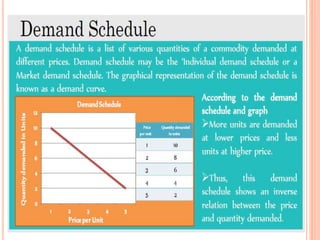
 It indicates the relationship between the price of the commodity and the quantity demanded in the
market.
This law is directly deduced from the law of diminishing marginal utility, as the demand side
of the price is governed by the utility of the commodity to the consumer.
The law of demand is widely used and it is a common concept while purchasing a commodity in the market.
This law is inversely related to price and the quantity demanded. The people everywhere would purchases
more quantity of a commodity at lower price and less quantity at higher price.
 The founder of this law is Prof. Alfred Marshall.
Assumptions:
 1. People’s income being unchanged
 2. People’s tastes remain unchanged
 3. Prices of other related goods remain the same
 4. No substitutes for the commodity
 5.No expectations of further changes in the price of the commodity
TYPES OF DEMAND
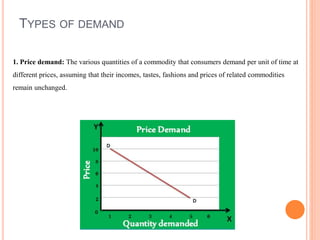
1. Price demand: The various quantities of a commodity that consumers demand per unit of time at
different prices, assuming that their incomes, tastes, fashions and prices of related commodities
remain unchanged.
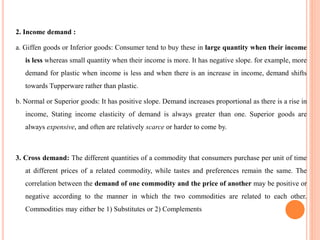
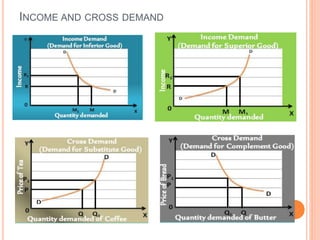
2. Income demand :
a. Giffen goods or Inferior goods: Consumer tend to buy these in large quantity when their income
is less whereas small quantity when their income is more. It has negative slope. for example, more
demand for plastic when income is less and when there is an increase in income, demand shifts
towards Tupperware rather than plastic.
b. Normal or Superior goods: It has positive slope. Demand increases proportional as there is a rise in
income, Stating income elasticity of demand is always greater than one. Superior goods are
always expensive, and often are relatively scarce or harder to come by.
3. Cross demand: The different quantities of a commodity that consumers purchase per unit of time
at different prices of a related commodity, while tastes and preferences remain the same. The
correlation between the demand of one commodity and the price of another may be positive or
negative according to the manner in which the two commodities are related to each other.
Commodities may either be 1) Substitutes or 2) Complements
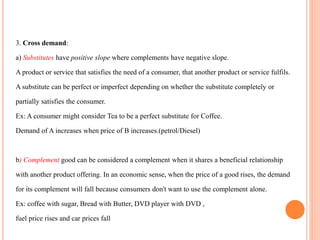
3. Cross demand:
a) Substitutes have positive slope where complements have negative slope.
A product or service that satisfies the need of a consumer, that another product or service fulfils.
A substitute can be perfect or imperfect depending on whether the substitute completely or
partially satisfies the consumer.
Ex: A consumer might consider Tea to be a perfect substitute for Coffee.
Demand of A increases when price of B increases.(petrol/Diesel)
b) Complement good can be considered a complement when it shares a beneficial relationship
with another product offering. In an economic sense, when the price of a good rises, the demand
for its complement will fall because consumers don't want to use the complement alone.
Ex: coffee with sugar, Bread with Butter, DVD player with DVD ,
fuel price rises and car prices fall
INCOME AND CROSS DEMAND
SHIFT IN DEMAND CURVE
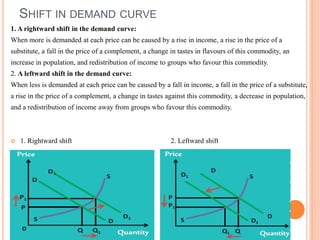
1. A rightward shift in the demand curve:
When more is demanded at each price can be caused by a rise in income, a rise in the price of a
substitute, a fall in the price of a complement, a change in tastes in flavours of this commodity, an
increase in population, and redistribution of income to groups who favour this commodity.
2. A leftward shift in the demand curve:
When less is demanded at each price can be caused by a fall in income, a fall in the price of a substitute,
a rise in the price of a complement, a change in tastes against this commodity, a decrease in population,
and a redistribution of income away from groups who favour this commodity.
 1. Rightward shift 2. Leftward shift
ELASTICITY OF DEMAND
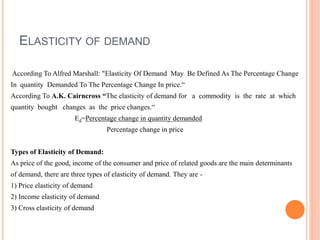
According To Alfred Marshall: "Elasticity Of Demand May Be Defined As The Percentage Change
In quantity Demanded To The Percentage Change In price.“
According To A.K. Cairncross “The elasticity of demand for a commodity is the rate at which
quantity bought changes as the price changes.“
Ed=Percentage change in quantity demanded
Percentage change in price
Types of Elasticity of Demand:
As price of the good, income of the consumer and price of related goods are the main determinants
of demand, there are three types of elasticity of demand. They are -
1) Price elasticity of demand
2) Income elasticity of demand
3) Cross elasticity of demand
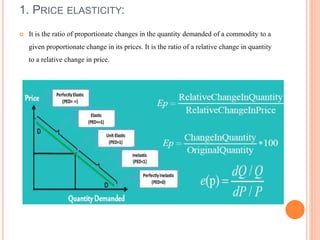
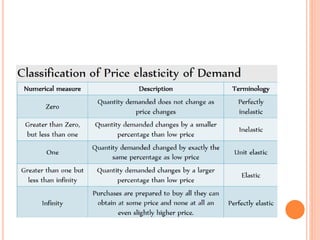
1. PRICE ELASTICITY:
 It is the ratio of proportionate changes in the quantity demanded of a commodity to a
given proportionate change in its prices. It is the ratio of a relative change in quantity
to a relative change in price.
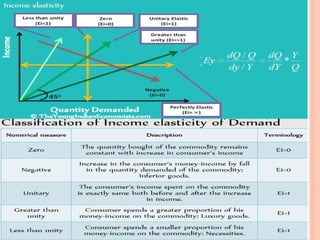
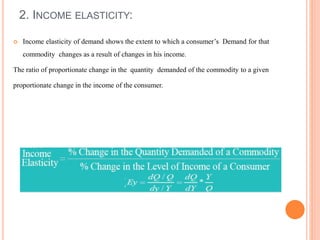
2. INCOME ELASTICITY:
 Income elasticity of demand shows the extent to which a consumer’s Demand for that
commodity changes as a result of changes in his income.
The ratio of proportionate change in the quantity demanded of the commodity to a given
proportionate change in the income of the consumer.
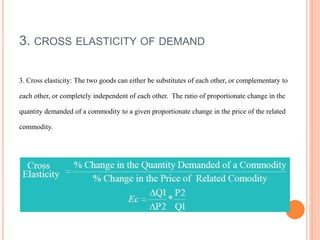
3. CROSS ELASTICITY OF DEMAND
3. Cross elasticity: The two goods can either be substitutes of each other, or complementary to
each other, or completely independent of each other. The ratio of proportionate change in the
quantity demanded of a commodity to a given proportionate change in the price of the related
commodity.
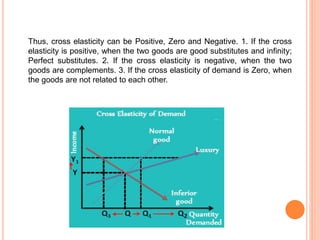
Thus, cross elasticity can be Positive, Zero and Negative. 1. If the cross
elasticity is positive, when the two goods are good substitutes and infinity;
Perfect substitutes. 2. If the cross elasticity is negative, when the two
goods are complements. 3. If the cross elasticity of demand is Zero, when
the goods are not related to each other.

Eco unit 1 revised 23-1.pptx

  • 1.
  • 2.
    MANAGERIAL ECONOMICS-MEANING ‘Managerial Economics,the branch of economics is the Application of various Theories, Concepts and Principles of Economics in the Business Decisions.’ It also Includes ‘The Application of Mathematical and Statistical tools in Management decisions.’ Managerial economics, used synonymously with business economics, is a branch of economics that deals with the application of microeconomic analysis to decision- making techniques of businesses and management units. It acts as the via media between economic theory and pragmatic economics. Managerial economics bridges the gap between 'theoria‘ and 'pracis'. The tenets of managerial economics have been derived from quantitative techniques such as regression analysis, correlation and Lagrangian calculus (linear). An omniscient and unifying theme found in managerial economics is the attempt to achieve optimal results from business decisions, while taking into account the firm's objectives, constraints imposed by scarcity and so on. A paradigm of such optmization is the use of operations research and programming. Managerial economics is thereby a study of application of managerial skills in economics. It helps in anticipating, determining and resolving potential problems or obstacles. These problems may pertain to costs, prices, forecasting future market, human resource management, profits and so on.
  • 3.
    DEFINITIONS  According toSpencer: “Managerial economics is the integration of economic theory with business practice for purpose of facilitating decision making and forward planning by management”. It means management of limited funds available in most economical way. It deals with basic problems of the economy i.e. what, how & for whom to produce.  Brigham and Poppas define managerial economics as,” the application of economic theory and methodology to business administration practice”.  According to McNair and Meriam “Managerial economics consists of the use of economic modes of thought to analyse business situations”.  According to Mc Gutgan and Moyer “Managerial economics is the application of economic theory and methodology to decision-making problems faced by both public and private institutions”.
  • 4.
    RELATION BETWEEN ECONOMICSBUSINESS MANAGEMENT AND MANAGERIAL ECONOMICS Economics -Theory and Methodology Business Management -Decision Problems Managerial Economics -Application of Economics to solve business problems
  • 5.
    CHARACTERISTICS OF MANAGERIALECONOMICS 1.Microeconomics: It studies the problems and principles of an individual business firm or an individual industry. It aids the management in forecasting and evaluating the trends of the market. 2. Normative economics: It is concerned with varied corrective measures that a management undertakes under various circumstances. It deals with goal determination, goal development and achievement of these goals. Future planning, policy-making, decision-making and optimal utilisation of available resources, come under the banner of managerial economics. 3. Pragmatic: Managerial economics is pragmatic. In pure micro-economic theory, analysis is performed, based on certain exceptions, which are far from reality. However, in managerial economics, managerial issues are resolved daily and difficult issues of economic theory are kept at bay. 4. Uses theory of firm: Managerial economics employs economic concepts and principles, which are known as the theory of Firm or 'Economics of the Firm'. Thus, its scope is narrower than that of pure economic theory.
  • 6.
    5.Takes the helpof macroeconomics: Managerial economics incorporates certain aspects of macroeconomic theory. These are essential to comprehending the circumstances and environments that envelop the working conditions of an individual firm or an industry. Knowledge of macroeconomic issues such as business cycles, taxation policies, industrial policy of the government, price and distribution policies, wage policies and antimonopoly policies and so on, is integral to the successful functioning of a business. 6.Aims at helping the management: Managerial economics aims at supporting the management in taking corrective decisions and charting plans and policies for future. 7. A scientific art: Science is a system of rules and principles engendered for attaining given ends. Scientific methods have been credited as the optimal path to achieving one's goals. Managerial economics has been is also called a scientific art because it helps the management in the best and efficient utilisation of scarce economic resources. It considers production costs, demand, price, profit, risk etc. It assists the management in singling out the most feasible alternative. Managerial economics facilitates good and result oriented decisions under conditions of uncertainty. 8. Prescriptive rather than descriptive: Managerial economics is a normative and applied discipline. It suggests the application of economic principles with regard to policy formulation, decision-making and future planning. It not only describes the goals of an organisation but also prescribes the means of achieving these goals.
  • 7.
    NATURE OF MANAGERIALECONOMICS 1. Allocation of resources: Since resources are scarce and they have multiple uses, me focuses on optimum allocation of funds available, which also reduces the wastage level. 2. Micro economic nature: It deals with business firms. a firm is the smallest decision making unit of production. since the study is about firm, the problems faced by the firms also falls under the purview of micro economics. 3. Market knowledge: A firm is open to threats as well as opportunities in market place. so knowledge of market must be perfect. 4. Macro-setting: A firm has to operate within a given economy. so its also governed & affected by the trends in income, consumption, investment, savings levels in an economy. 5. Positive & normative approach: Positive approach concerns with what is, was or will be, while normative approach concerns with what ought to be positive.
  • 8.
    SCOPE OF MANAGERIALECONOMICS Managerial economics comprises both micro- and macro-economic theories. Generally, the scope of managerial economics extends to those economic concepts, theories, and tools of analysis used in analysing the business environment, and to find solutions to practical business problems.  1. Demand Analysis and Forecasting  2. Cost Analysis  3. Production and Supply Analysis  4. Pricing Decisions, Policies and Practices  5. Profit Management, and  6. Capital Management 1. Demand Analysis and Forecasting A business firm is an economic organism which transforms productive resources into goods that are to be sold in a market. A major part of managerial decision-making depends on accurate estimates of demand. Before production schedules can be prepared and resources employed, a forecast of future sales is essential. This forecast can also serve as a guide to management for maintaining or strengthening market position and enlarging profits. 2. Cost Analysis A study of economic costs, combined with the data drawn from the firm’s accounting records, can yield significant cost estimates that are Useful for management decisions. The factors causing variations in costs must be recognized and allowed for if management is to arrive at cost estimates which are significant for planning purposes. An element of cost uncertainty exists because all the factors determining costs are not always known or controllable.
  • 9.
    3. Production andSupply Analysis Production analysis is narrower in scope than cost analysis. Production analysis frequently proceeds in physical terms while cost analysis proceeds in monetary terms. Production analysis mainly deals which different production functions and their managerial uses. Supply analysis deals with various aspects of supply of a commodity. Certain important aspects of supply analysis are: Supply schedule, curves and function, Law of supply and its limitations, Elasticity of supply and Factors influencing supply. 4. Pricing Decisions, Policies and Practices Pricing is a very important area of Managerial Economics. In fact, price is the genesis of the revenue of a firm and as such the success of a business firm largely depends on the correctness of the price decisions taken by It. The important aspects dealt with under this area are: Price Determination in various Market Forms, Pricing Methods, Differential Pricing, Product-line Pricing and Price Forecasting. 5. Profit Management Business firms are generally organised for the purpose of making profits and, in the long run, profits provide the chief measure of success. In this connection, an important point worth considering is the element of uncertainty existing about profits because of variations in costs and revenues which, in turn, are caused by factors both internal and external to the firm. If knowledge about the future were perfect, profit analysis would have been a very easy task. 6. Capital Management Of the various types and classes of business problems, the most complex and troublesome for the business manager are likely to be those relating to the firm’s capital investments. Relatively large sums are involved, and the problems are so complex that their disposal not only requires considerable time and labour but is a matter for top-level decision. Briefly, capital management implies planning and control of capital expenditure.
  • 10.
    MANAGERIAL ECONOMICS ANDBUSINESS DECISION MAKING Decision making:  Decision making on internal affairs. Internal affairs talk on internal environment which consists of internal factors such as, Production, Financial, Marketing and Human resource related decisions.  Decision making on external affairs. External Affairs talk on external environment which consists of external factors such as, PEST related decisions. Managerial decisions should be taken properly due to uncertainty and risk. Uncertainty: Nothing can be expectable because of the constant changes in the environment both internally as well as externally. Risk: It is the situation which comes under uncertainty. Decisions should be taken by using economic model. Economic model is the structural and scientific method of constructing or developing Solutions by using basic economic principles, concepts, theories and Quantitative techniques such as mathematical and statistical tools.
  • 11.
    WHY MANAGERS NEEDTO KNOW ECONOMICS ?  In the event of resources being unlimited, like air or sunshine, the problem of economic utilization of resources or resource management would not have arisen. Resources like finance, workforce and material are limited. However, in the absence of unlimited resources, it is the responsibility of the management to optimize the use of these resources.  How economics contributes to managerial functions Though economics is variously defined, it is essentially the study of logic, tools and techniques, to make optimum use of the available resources to achieve the given ends. Economics affords analytical tools and techniques that managers require to accomplish the goals of the organization they manage.  Therefore, a working knowledge of economics, not necessarily a formal degree, is indispensable for managers. Managers are fundamentally practicing economists. While executing his duties, a manager has to take several decisions, which conform to the objectives of the firm.
  • 12.
  • 13.
    Decision-making theory andgame theory, which recognise the conditions of uncertainty and imperfect knowledge under which business managers operate, have contributed to systematic methods of assessing investment opportunities. Almost any business decision can be analysed with managerial economics techniques. However, the most frequent applications of these techniques are as follows: • Risk analysis: Various models are used to quantify risk and asymmetric information and to employ them in decision rules to manage risk. • Production analysis: Microeconomic techniques are used to analyse production efficiency, optimum factor allocation, costs and economies of scale. They are also utilised to estimate the firm's cost function. • Pricing analysis: Microeconomic techniques are employed to examine various pricing decisions. This involves transfer pricing, joint product pricing, price discrimination, price elasticity estimations and choice of the optimal pricing method. • Capital budgeting: Investment theory is used to scrutinise a firm's capital purchasing decisions.
  • 14.
    IMPORTANCE OF MANAGERIALECONOMICS The importance of managerial economics in a business and industrial enterprise as follows: 1. Accommodating traditional theoretical concepts to the actual business behaviour and conditions: Managerial economics amalgamates tools, techniques, models and theories of traditional economics with actual business practices and with the environment in which a firm has to operate. 2. Estimating economic relationships: Managerial economics estimates economic relationships between different business factors such as income, elasticity of demand , cost volume, profit analysis. 3. Predicting relevant economic quantities: Managerial economics assists the management in predicting various economic quantities such as cost, profit, demand, capital, production, price etc. 4. Understanding significant external forces: The management has to identify all the important factors that influence a firm. Managerial economics plays an important role by assisting management in understanding these factors.
  • 15.
     External factors:A firm cannot exercise any control over these factors. The plans, policies and programmes of the firm should be formulated in the light of these factors. Significant external factors impinging on the decision-making process of a firm are economic system of the country, business cycles, fluctuations in national income and national production, industrial policy of the government, trade and fiscal policy of the government, taxation policy, licensing policy, trends in foreign trade of the country, general industrial relation in the country and so on.  Internal factors: These factors fall under the control of a firm. These factors are associated with business operation. Knowledge of these factors aids the management in making sound business decisions. 5. Basis of business policies: Managerial economics is the founding principle of business policies. Business policies are prepared based on studies and findings of managerial economics . Thus, managerial economics is helpful to the management in its decision-making
  • 16.
    ROLE OF MANAGERIALECONOMICS  Analysis of External Factors  Analysis of internal factors  Specific functions -Sales forecasting - Market Research -Economic analysis of competing firms -Production and inventory schedule The managerial economist have a major role in managerial decision making.  He studies the economic patterns at macro-level and analysis it’s significance to the specific firm he is working in. He has to consistently examine the probabilities of transforming an ever changing economic environment into profitable business avenues. He assists the business planning process of a firm. He also carries cost-benefit analysis.
  • 17.
     He isalso involved in advising the management on public relations, foreign exchange, and trade. He guides the firm on the likely impact of changes in monetary and fiscal policy on the firm’s functioning.  The most significant function of a managerial economist is to conduct a detailed research on industrial market.  In addition, a managerial economist has to analyze changes in macro- economic indicators such as national income, population, business cycles, and their possible effect on the firm’s functioning.  He assists the management in the decisions pertaining to internal functioning of a firm such as changes in price, investment plans, type of goods /services to be produced, inputs to be used, techniques of production to be employed, expansion/ contraction of firm, allocation of capital, location of new plants, quantity of output to be produced, replacement of plant equipment, sales forecasting, inventory forecasting, etc.  Lastly managerial economist has also to keep in touch with the government’s economic policies and the central bank’s monetary policies, annual budgets of the government, etc.
  • 18.
    FUNDAMENTAL CONCEPTS OFMANAGERIAL ECONOMICS The contribution of economics to managerial economics lies in certain principles which are basic to managerial economics. There are six basic principles of managerial economics. They are: 1. The Incremental Principle- Incremental concept is closely related to the marginal cost and marginal revenues of economic theory. 2. The Principle of Time Perspective- The time perspective concept states that the decision maker must give due consideration both to the short run and long run effects of his decisions. He must give due emphasis to the various time periods. It was Marshall who introduced time element in economic theory. 3. The Opportunity Cost Principle- Opportunity cost represents the benefits or revenue forgone by pursuing one course of action rather than another. 4. The Discounting Principle- This concept is an extension of the concept of time perspective. 5. The Equi-marginal Principle-- The principle states that an input should be allocated so that value Added by the last unit is the same in all cases. This generalisation is popularly called the equi-marginal. 6. Risk and Uncertainty- Managerial decisions are actions of today which bear fruits in future which is unforeseen. Future is uncertain and involves risk.
  • 19.
    1. INCREMENTAL PRINCIPLE Incrementalprinciple states that a decision is profitable :  if revenue increases more than costs;  if costs reduce more than revenues;  if increase in some revenues is more than decrease in others; and  if decrease in some costs is greater than increase in others.
  • 20.
    2. THE PRINCIPLEOF TIME PERSPECTIVE  According to this principle, if a decision affects costs and revenues in long-run, all those costs and revenues must be discounted to present values before valid comparison of alternatives is possible. This is essential because a rupee worth of money at a future date is not worth a rupee today. Money actually has time value.  Discounting can be defined as a process used to transform future dollars into an equivalent number of present dollars.  FV = PV*(1+r)t  Where, FV is the future value (time at some future time), PV is the present value (value at t0, r is the discount (interest) rate, and t is the time between the future value and present value.
  • 21.
    THE EQUI-MARGINAL PRINCIPLE Marginal Utility is the utility derived from the additional unit of a commodity consumed.  The laws of equi-marginal utility states that a consumer will reach the stage of equilibrium when the marginal utilities of various commodities he consumes are equal.  According to the modern economists, this law has been formulated in form of law of proportional marginal utility.  It states that the consumer will spend his money-income on different goods in such a way that the marginal utility of each good is proportional to its price, i.e.,  MUx / Px = MUy / Py = MUz / Pz  Where, MU represents marginal utility and P is the price of good.  Similarly, a producer who wants to maximize profit (or reach equilibrium) will use the technique of production which satisfies this condition.
  • 22.
    RISK AND UNCERTAINITY Risk refers to decision-making situations under which all potential outcomes and their likelihood of occurrences are known to the decision-maker,  Uncertainty refers to situations under which either the outcomes and/or their probabilities of occurrences are unknown to the decision-maker.
  • 23.
    DEMAND ANALYSIS “Demand meanseffective desire or want for a commodity which is backed up by the ability (purchasing power) and willingness to pay for it”. Demand = Desire + Ability to pay + Willingness to spend Thus, demand for a commodity or service is dependent upon a. Its utility to satisfy want or desire b. Willingness to pay c. Capability of the prospective consumer to pay for the good or service. Conceptually, demand is …. consumer’s readiness or ability to satisfy desire by paying for goods or services. A desire accompanied by ability and willingness to pay makes a real or effective demand.
  • 24.
    DEFINITIONS  "The variousquantities of goods that would be purchased per time period at different prices in a given market." – Prof. Hibdon  The demand for anything, at a given price, is the amount of it, which will be bought per unit of time at that price”. The term has no significance unless a price is stated or implied. – Prof. Lee Benham, Washington University  "Demand in Economics means demand backed by enough money to pay for the goods demanded." – Prof. Dauglaus Hague, Manchester Business School.
  • 25.
    The “Demand” fora commodity, at a given price, is the quantity of it which will be bought per unit of time at that price. In economics, demand refers to the buying behavior of a household. What does this mean? Basically, economists try answering the following three phenomenon : 1. Why people buy what they buy? 2. How much they're willing to pay ? 3. How much they want to buy ?
  • 26.
  • 27.
    DEMAND FUNCTION  Thetheory of consumption deals with concepts and functions.  A function expresses the relationship between two or more variables, such as, prices and the physical quantities demanded.  In a given market, in a given period of time, the demand function for a commodity is the relation between the various quantities of the commodity that might be bought and the determinants of those quantities. D= f (P, Y, Pr, T, A, U)  Where, D= demand; P = price; Y= income; Pr= prices of related goods ;T= tastes and preferences; A= advertisements ; U= unknown factors
  • 28.
    LAW OF DEMAND The Law of demand is also known as the “FIRST LAW OF PURCHASE”.  It indicates the relationship between the price of the commodity and the quantity demanded in the market. This law is directly deduced from the law of diminishing marginal utility, as the demand side of the price is governed by the utility of the commodity to the consumer. The law of demand is widely used and it is a common concept while purchasing a commodity in the market. This law is inversely related to price and the quantity demanded. The people everywhere would purchases more quantity of a commodity at lower price and less quantity at higher price.  The founder of this law is Prof. Alfred Marshall. Assumptions:  1. People’s income being unchanged  2. People’s tastes remain unchanged  3. Prices of other related goods remain the same  4. No substitutes for the commodity  5.No expectations of further changes in the price of the commodity
  • 30.
    TYPES OF DEMAND 1.Price demand: The various quantities of a commodity that consumers demand per unit of time at different prices, assuming that their incomes, tastes, fashions and prices of related commodities remain unchanged.
  • 31.
    2. Income demand: a. Giffen goods or Inferior goods: Consumer tend to buy these in large quantity when their income is less whereas small quantity when their income is more. It has negative slope. for example, more demand for plastic when income is less and when there is an increase in income, demand shifts towards Tupperware rather than plastic. b. Normal or Superior goods: It has positive slope. Demand increases proportional as there is a rise in income, Stating income elasticity of demand is always greater than one. Superior goods are always expensive, and often are relatively scarce or harder to come by. 3. Cross demand: The different quantities of a commodity that consumers purchase per unit of time at different prices of a related commodity, while tastes and preferences remain the same. The correlation between the demand of one commodity and the price of another may be positive or negative according to the manner in which the two commodities are related to each other. Commodities may either be 1) Substitutes or 2) Complements
  • 32.
    3. Cross demand: a)Substitutes have positive slope where complements have negative slope. A product or service that satisfies the need of a consumer, that another product or service fulfils. A substitute can be perfect or imperfect depending on whether the substitute completely or partially satisfies the consumer. Ex: A consumer might consider Tea to be a perfect substitute for Coffee. Demand of A increases when price of B increases.(petrol/Diesel) b) Complement good can be considered a complement when it shares a beneficial relationship with another product offering. In an economic sense, when the price of a good rises, the demand for its complement will fall because consumers don't want to use the complement alone. Ex: coffee with sugar, Bread with Butter, DVD player with DVD , fuel price rises and car prices fall
  • 33.
  • 34.
    SHIFT IN DEMANDCURVE 1. A rightward shift in the demand curve: When more is demanded at each price can be caused by a rise in income, a rise in the price of a substitute, a fall in the price of a complement, a change in tastes in flavours of this commodity, an increase in population, and redistribution of income to groups who favour this commodity. 2. A leftward shift in the demand curve: When less is demanded at each price can be caused by a fall in income, a fall in the price of a substitute, a rise in the price of a complement, a change in tastes against this commodity, a decrease in population, and a redistribution of income away from groups who favour this commodity.  1. Rightward shift 2. Leftward shift
  • 35.
    ELASTICITY OF DEMAND AccordingTo Alfred Marshall: "Elasticity Of Demand May Be Defined As The Percentage Change In quantity Demanded To The Percentage Change In price.“ According To A.K. Cairncross “The elasticity of demand for a commodity is the rate at which quantity bought changes as the price changes.“ Ed=Percentage change in quantity demanded Percentage change in price Types of Elasticity of Demand: As price of the good, income of the consumer and price of related goods are the main determinants of demand, there are three types of elasticity of demand. They are - 1) Price elasticity of demand 2) Income elasticity of demand 3) Cross elasticity of demand
  • 36.
    1. PRICE ELASTICITY: It is the ratio of proportionate changes in the quantity demanded of a commodity to a given proportionate change in its prices. It is the ratio of a relative change in quantity to a relative change in price.
  • 38.
    2. INCOME ELASTICITY: Income elasticity of demand shows the extent to which a consumer’s Demand for that commodity changes as a result of changes in his income. The ratio of proportionate change in the quantity demanded of the commodity to a given proportionate change in the income of the consumer.
  • 40.
    3. CROSS ELASTICITYOF DEMAND 3. Cross elasticity: The two goods can either be substitutes of each other, or complementary to each other, or completely independent of each other. The ratio of proportionate change in the quantity demanded of a commodity to a given proportionate change in the price of the related commodity.
  • 41.
    Thus, cross elasticitycan be Positive, Zero and Negative. 1. If the cross elasticity is positive, when the two goods are good substitutes and infinity; Perfect substitutes. 2. If the cross elasticity is negative, when the two goods are complements. 3. If the cross elasticity of demand is Zero, when the goods are not related to each other.