Welcome
 HABIB RAHMAN HAIDER
 MBA
 KALINGA UNIVERSITY, CG, RAIPUR
Management Class
 Chapter 1: Management: Science, Theory, and Practices
 Chapter 4: Essential of Planning & MBO
 Chapter 7: The Nature of Organizing, Entrepreneur, &
Reengineering
 Chapter 8: Organization Structure: Departmentation
 Chapter 11: Human Resource Management & Selection
 Chapter 14: Human Factors and Motivation
 Chapter 18: The System and Process of Controlling
What is Management
Management is the process of designing & maintaining an
environment in which individuals, working together in
groups, efficiently accomplish selected aims.
Management mean control all the business activities
effectively.
Frederick Taylor defined management as “knowing exactly
what you want to do, and then seeing that they do it in the
best and cheapest way.”
 Management is perhaps best understood from a
resource based perspective. All Organizations use
four basic kinds of inputs or resources, from their
environment: Human, Financial, Physical And
Information.
 Human Resources include managerial talent and
labor.
 Financial Resources are the capital used by the
Organization to finance both ongoing and long
term operations.
 Physical Resources include raw materials, office,
production facilities and equipment.
 Information Resources are usable data needed to
make effective decisions.
 Managers are responsible for combining and
coordinating these various resources to achieve the
organization’s goals.
DEFINITION
 Management is a set of activities ( including planning
and decision making, organizing , leading and
controlling) directed at an organization’s resources
( human, financial, physical and information) with the
aim of achieving organization goals in an Efficient and
Effective manner.
Management’s Nature and Purpose
 As Managers, People carry out the
managerial functions of planning,
organizing, staffing, leading, and controlling

 Management applies to any kind of
organization
 It applies to managers at all organizational
levels
 The aim of all managers is the same: to
create a surplus
 Managing is concerned with productivity;
this implies effectiveness and efficiency
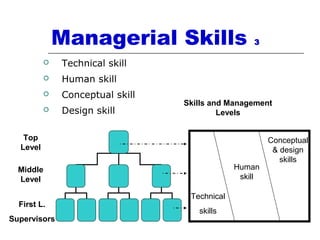
Managerial Skills 3
 Technical skill
 Human skill
 Conceptual skill
 Design skill
Conceptual
& design
skills
Human
skill
Technical
skills
Top
Level
Middle
Level
First L.
Supervisors
Skills and Management
Levels
Top level managers
 Top level of management
makes up the relatively
small group of executives
who manage the overall
organization. An
organization’s top
managers establish its
goals, overall strategy, and
operating policies. They
also officially represent the
organization to the external
environment by meeting
with government officials,
executives of other
organizations. The job of
top manager is likely to be
complex and varied.
 Top managers make
decisions about such
activities as acquiring other
companies, investing in
research and development,
entering or abandoning
various markets, and
building new plants and
office facilities. They often
work long hours and spend
much of their time in
meetings or on the
telephone.
Middle level managers
 Middle management is
probably the largest group
of managers in most
organizations. Common
middle management titles
include plant manager,
operations manager and
division head. Middle
managers are primarily
responsible for
implementing the policies
and plans developed by top
managers and for
supervising and
coordinating the activities
of lower level managers.
 Plant manager handle
inventory management,
quality control, equipment
failures and minor union
problems. They also
coordinate the work of
supervisors within the
plant. Although many
organization have found
that they can indeed
survive with fewer middle
managers, those who
remain play an even more
important role in
determining how successful
the organization will be.
Lower level managers
 First line managers
supervise and coordinate
the activities of
operating employees.
Common titles for first
line managers are
supervisor, coordinator
and office manager.
Positions such as these
are often the first ones
held by employees who
enter management from
the ranks of operating
personnel.
 In contrast to top and
middle managers, first
line managers typically
spend a large proportion
of their time supervising
subordinates.
Productivity, Effectiveness &
Efficiency
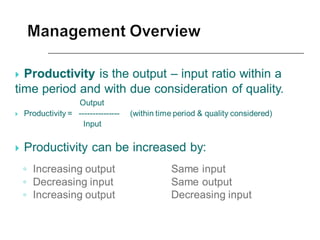
 Productivity is the output-input ratio
within a time period with due
consideration for quality.
 Effectiveness is to achieve objectives
 Efficiency is the achievement of the
ends with the least amount of
resources
Managing: Science or Art?
 Science is organized knowledge.
 Art is the skills to apply something
The Evolution of Management
Thought
TAYLOR’S PRINCIPLE
 Replacing rules of thumb with science (organized
knowledge).
 Obtaining harmony in group actions rather than
discord.
 Achieving cooperation of human beings, rather
than chaotic individualism
 Working for maximum output, rather than
restricted output.
 Developing all workers to the fullest extent
possible for their own and their company’s highest
profitability.
The Evolution of Management
Thought
HENRI FAYOL (1841-1925)
 Authority and Responsibility
 Unity of command. This means that
employees should receive orders from one
superior only.
 Scalar chain.
 Esprit de corps. This is the principle that “in
union there is strength,” as well as an
extension of the principle of unity of
command, emphasizing the need for
teamwork and the importance of
communication in obtaining it.
The Systems Approach to the
Management Process
“A system is one which has
interrelated parts and functions
as a whole.”
Inputs & Claimants Outputs
Transformation
Process
External
Environment
Reenergizing
The System
Types of System
 Close system, and
 Open System
What is a business organization?
The managerial Transformation
process
 The task of managers is to
transform the inputs, in an effective
and efficient manner, into outputs
The Communication System
 First: It integrates the managerial function
 Second: To link the enterprise with its external
environment.
The Functions of Managers
 Planning (selection of mission and
Objectives and the actions to achieve
them)
 Organizing (Creating an environment for
human performance)
 Staffing (Filling and keeping filled the
positions in the organization’s structure)
The Functions of Managers
 Leading (Influencing people so that they
will contribute to organization and group
goals)
 Controlling (Measuring and correcting
individual and organizational performance
to ensure that events conform to plans)
Coordination, the Essence of
Manager ship
 Each of the managerial functions is
an exercise contributing to
coordination.
Who is a Manager?
 A manager is a person in an organization who directly
supports and helps activate the work efforts and
performance accomplishments of others.
 The people who managers help (subordinates) are the
ones whose tasks represent the real work of the
organization.
 Examples of managers: a president, a governor, a
university chancellor, etc
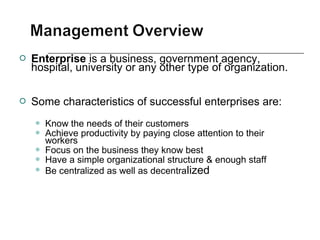
 Enterprise is a business, government agency,
hospital, university or any other type of organization.
 Some characteristics of successful enterprises are:
 Know the needs of their customers
 Achieve productivity by paying close attention to their
workers
 Focus on the business they know best
 Have a simple organizational structure & enough staff
 Be centralized as well as decentralized
 Administration refers to the process of efficiently
organizing people and resources so to direct activities
toward common goals and objectives.
 Administration is over the management and over the
resources of an organization.
 Administration is responsible for the outside contacts
and the facility as a whole.
 Management is a subset of administration, it is
associated with the technical and ordinary elements of
an organization.
 Management manages employees and is closer to
them.
 As a manager, you can also be administrator but as an
administrator, you may not be a manager.
 Top Level: Responsible for performance of
an organization as a whole or for one of its
larger parts.
 Middle Level: In charge of relatively large
departments or divisions.
 Lower Level: Team leaders or supervisors,
in charge of a small work groups.
There are three kinds of management roles:
Interpersonal: How a manager interacts
with other people.
Informational: How a manager exchanges
and processes information.
Decisional: How a manager uses
information in decision making
30
There are four types of management activities:
Traditional: Decision making, planning and
controlling.
Communication: Exchanging routine information
and processing paperwork.
Human Resource: Motivating, disciplining,
managing, conflict, staffing, and training.
Networking: Socializing, politicking, and
interacting with others.
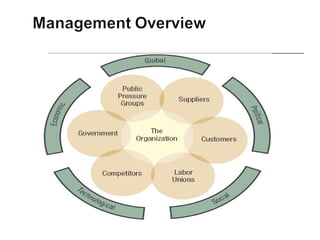
External variables: Global, economic, socio-
political changes.
Output: Products/deliverables, services,
profit/surplus
Re-energizing the system: Some outputs
become inputs, i.e. profit/surplus are re-invested
in the enterprise capital in forms of machinery,
equipment, building, assets etc.

Management (mba)

  • 1.
  • 2.
     HABIB RAHMANHAIDER  MBA  KALINGA UNIVERSITY, CG, RAIPUR
  • 3.
    Management Class  Chapter1: Management: Science, Theory, and Practices  Chapter 4: Essential of Planning & MBO  Chapter 7: The Nature of Organizing, Entrepreneur, & Reengineering  Chapter 8: Organization Structure: Departmentation  Chapter 11: Human Resource Management & Selection  Chapter 14: Human Factors and Motivation  Chapter 18: The System and Process of Controlling
  • 4.
    What is Management Managementis the process of designing & maintaining an environment in which individuals, working together in groups, efficiently accomplish selected aims. Management mean control all the business activities effectively. Frederick Taylor defined management as “knowing exactly what you want to do, and then seeing that they do it in the best and cheapest way.”
  • 5.
     Management isperhaps best understood from a resource based perspective. All Organizations use four basic kinds of inputs or resources, from their environment: Human, Financial, Physical And Information.  Human Resources include managerial talent and labor.  Financial Resources are the capital used by the Organization to finance both ongoing and long term operations.  Physical Resources include raw materials, office, production facilities and equipment.  Information Resources are usable data needed to make effective decisions.  Managers are responsible for combining and coordinating these various resources to achieve the organization’s goals.
  • 6.
    DEFINITION  Management isa set of activities ( including planning and decision making, organizing , leading and controlling) directed at an organization’s resources ( human, financial, physical and information) with the aim of achieving organization goals in an Efficient and Effective manner.
  • 7.
    Management’s Nature andPurpose  As Managers, People carry out the managerial functions of planning, organizing, staffing, leading, and controlling  Management applies to any kind of organization  It applies to managers at all organizational levels  The aim of all managers is the same: to create a surplus  Managing is concerned with productivity; this implies effectiveness and efficiency

  • 8.
    Managerial Skills 3 Technical skill  Human skill  Conceptual skill  Design skill Conceptual & design skills Human skill Technical skills Top Level Middle Level First L. Supervisors Skills and Management Levels
  • 9.
    Top level managers Top level of management makes up the relatively small group of executives who manage the overall organization. An organization’s top managers establish its goals, overall strategy, and operating policies. They also officially represent the organization to the external environment by meeting with government officials, executives of other organizations. The job of top manager is likely to be complex and varied.  Top managers make decisions about such activities as acquiring other companies, investing in research and development, entering or abandoning various markets, and building new plants and office facilities. They often work long hours and spend much of their time in meetings or on the telephone.
  • 10.
    Middle level managers Middle management is probably the largest group of managers in most organizations. Common middle management titles include plant manager, operations manager and division head. Middle managers are primarily responsible for implementing the policies and plans developed by top managers and for supervising and coordinating the activities of lower level managers.  Plant manager handle inventory management, quality control, equipment failures and minor union problems. They also coordinate the work of supervisors within the plant. Although many organization have found that they can indeed survive with fewer middle managers, those who remain play an even more important role in determining how successful the organization will be.
  • 11.
    Lower level managers First line managers supervise and coordinate the activities of operating employees. Common titles for first line managers are supervisor, coordinator and office manager. Positions such as these are often the first ones held by employees who enter management from the ranks of operating personnel.  In contrast to top and middle managers, first line managers typically spend a large proportion of their time supervising subordinates.
  • 12.
    Productivity, Effectiveness & Efficiency Productivity is the output-input ratio within a time period with due consideration for quality.  Effectiveness is to achieve objectives  Efficiency is the achievement of the ends with the least amount of resources
  • 13.
    Managing: Science orArt?  Science is organized knowledge.  Art is the skills to apply something
  • 14.
    The Evolution ofManagement Thought TAYLOR’S PRINCIPLE  Replacing rules of thumb with science (organized knowledge).  Obtaining harmony in group actions rather than discord.  Achieving cooperation of human beings, rather than chaotic individualism  Working for maximum output, rather than restricted output.  Developing all workers to the fullest extent possible for their own and their company’s highest profitability.
  • 15.
    The Evolution ofManagement Thought HENRI FAYOL (1841-1925)  Authority and Responsibility  Unity of command. This means that employees should receive orders from one superior only.  Scalar chain.  Esprit de corps. This is the principle that “in union there is strength,” as well as an extension of the principle of unity of command, emphasizing the need for teamwork and the importance of communication in obtaining it.
  • 16.
    The Systems Approachto the Management Process “A system is one which has interrelated parts and functions as a whole.” Inputs & Claimants Outputs Transformation Process External Environment Reenergizing The System
  • 17.
    Types of System Close system, and  Open System What is a business organization?
  • 18.
    The managerial Transformation process The task of managers is to transform the inputs, in an effective and efficient manner, into outputs The Communication System  First: It integrates the managerial function  Second: To link the enterprise with its external environment.
  • 19.
    The Functions ofManagers  Planning (selection of mission and Objectives and the actions to achieve them)  Organizing (Creating an environment for human performance)  Staffing (Filling and keeping filled the positions in the organization’s structure)
  • 20.
    The Functions ofManagers  Leading (Influencing people so that they will contribute to organization and group goals)  Controlling (Measuring and correcting individual and organizational performance to ensure that events conform to plans)
  • 21.
    Coordination, the Essenceof Manager ship  Each of the managerial functions is an exercise contributing to coordination.
  • 22.
    Who is aManager?  A manager is a person in an organization who directly supports and helps activate the work efforts and performance accomplishments of others.  The people who managers help (subordinates) are the ones whose tasks represent the real work of the organization.  Examples of managers: a president, a governor, a university chancellor, etc
  • 24.
     Enterprise isa business, government agency, hospital, university or any other type of organization.  Some characteristics of successful enterprises are:  Know the needs of their customers  Achieve productivity by paying close attention to their workers  Focus on the business they know best  Have a simple organizational structure & enough staff  Be centralized as well as decentralized
  • 26.
     Administration refersto the process of efficiently organizing people and resources so to direct activities toward common goals and objectives.  Administration is over the management and over the resources of an organization.  Administration is responsible for the outside contacts and the facility as a whole.
  • 27.
     Management isa subset of administration, it is associated with the technical and ordinary elements of an organization.  Management manages employees and is closer to them.  As a manager, you can also be administrator but as an administrator, you may not be a manager.
  • 28.
     Top Level:Responsible for performance of an organization as a whole or for one of its larger parts.  Middle Level: In charge of relatively large departments or divisions.  Lower Level: Team leaders or supervisors, in charge of a small work groups.
  • 29.
    There are threekinds of management roles: Interpersonal: How a manager interacts with other people. Informational: How a manager exchanges and processes information. Decisional: How a manager uses information in decision making
  • 30.
    30 There are fourtypes of management activities: Traditional: Decision making, planning and controlling. Communication: Exchanging routine information and processing paperwork. Human Resource: Motivating, disciplining, managing, conflict, staffing, and training. Networking: Socializing, politicking, and interacting with others.
  • 31.
    External variables: Global,economic, socio- political changes. Output: Products/deliverables, services, profit/surplus Re-energizing the system: Some outputs become inputs, i.e. profit/surplus are re-invested in the enterprise capital in forms of machinery, equipment, building, assets etc.