
M. Anil Kumar,
Department of Humanities, Social Sciences and
Management,
National Institute of Technology-Karnataka
1
ACCOUNTING AND FINANCIAL MANAGEMENT
This course is designed to introduce students
to the principles, concepts, and applications of
financial accounting and management
This course presents the underlying framework and concepts of Financial Accounting in the
context of how accounting fits into the overall business environment of contemporary
society.
Financial accounting is the basic means of recording and reporting financial information in
a business.
You will learn how accounting functions as an information development and
communication system that supports economic decision making and provides value to
entities and society.
You will discover the uses and limitations of financial statements and related information
and apply analytical tools in making both business and financial decisions.
2
In Financial Management students are introduced to concepts and tools that enable
them to think critically about the financial opportunities and challenges faced by an
organization.
They learn how to use financial statements such as balance sheets, income statements,
and statements of cash flow.
They prepare budgets, analyze investment options, and determine the best means of
financing business endeavors.
They discover ways of assessing both the return and the risk involved in a firm's
financial decisions.
The focus of this course is on solving practical business problems similar to those
encountered in the workplace.
3
4
-Elements of management accounting-I.M. Pandey, Vikas
publishing house
-Financial Management-Khan & Jain, TMH Publications
- Financial Management-Prasanna Chandra, TMH
Publications
- Financial Management policy- Van Horne James C.,
Prentice Hall of India
- Management Accounting 4th edition-Anthony &
Alkinson, Robert S. Kalpan & S. Mark Young, Ther Robert
Kalpan Series in Management Accounting
5
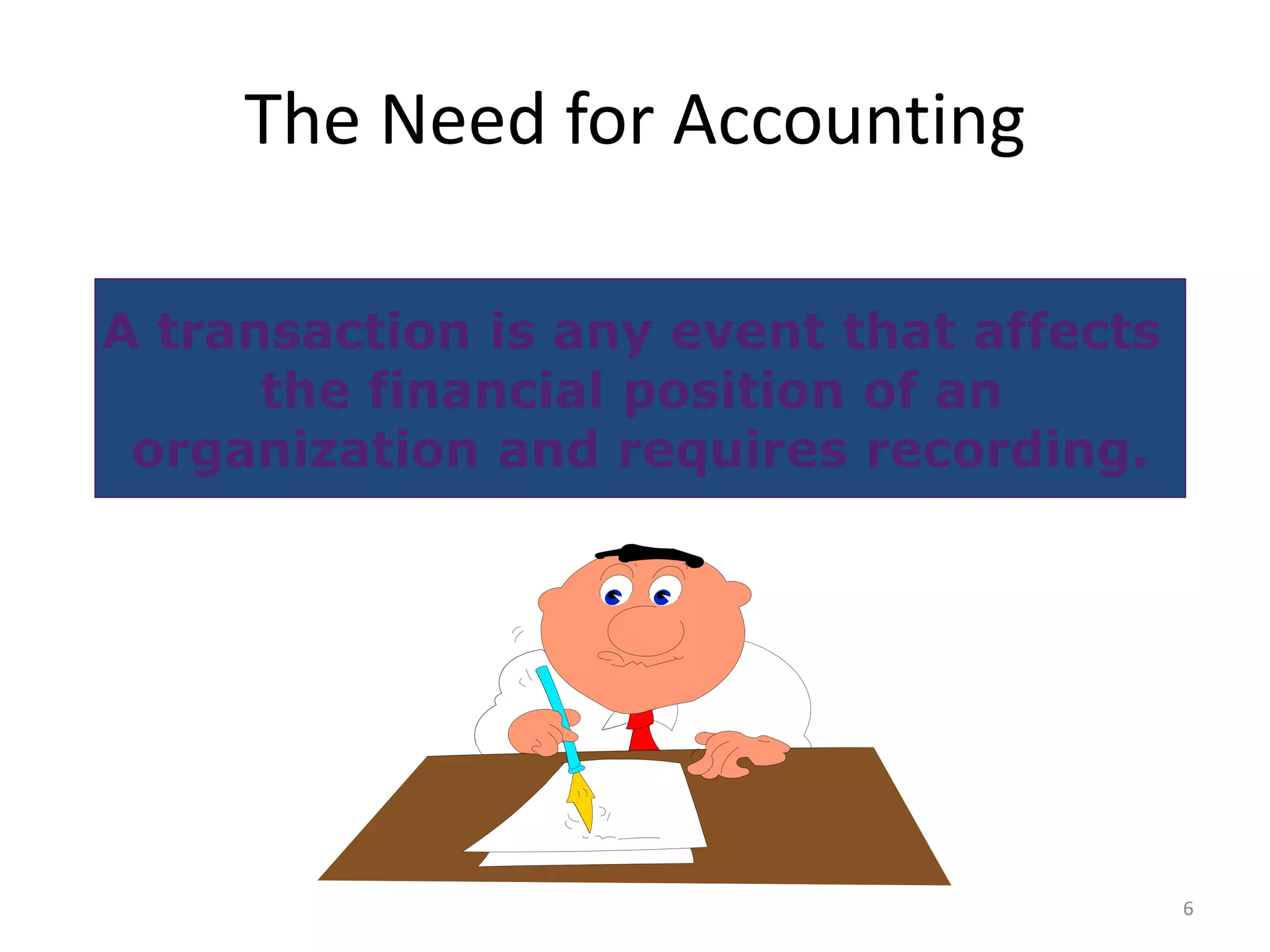
The Need for Accounting
A transaction is any event that affects
the financial position of an
organization and requires recording.
6
Introduction
• Accounting - a process of identifying, recording,
summarizing, and reporting economic
information to decision makers in the form of
financial statements
• Financial accounting - focuses on the specific
needs of decision makers external to the
organization, such as stockholders, suppliers,
banks, and government agencies
7
ACCOUNTING
Accounting is the language of business. The
affairs and the results of the business are
communicated to others through accounting
information, which has to be systematically
recorded and presented.
8
9
In 1494, the first book on double entry. The
author was an Italian friar, Luca Pacioli. His
impact on accounting was so great that five
centuries later, accountants from around
the world gathered in the Italian village of
San Sepulcro to celebrate the anniversary
of the book's publication.
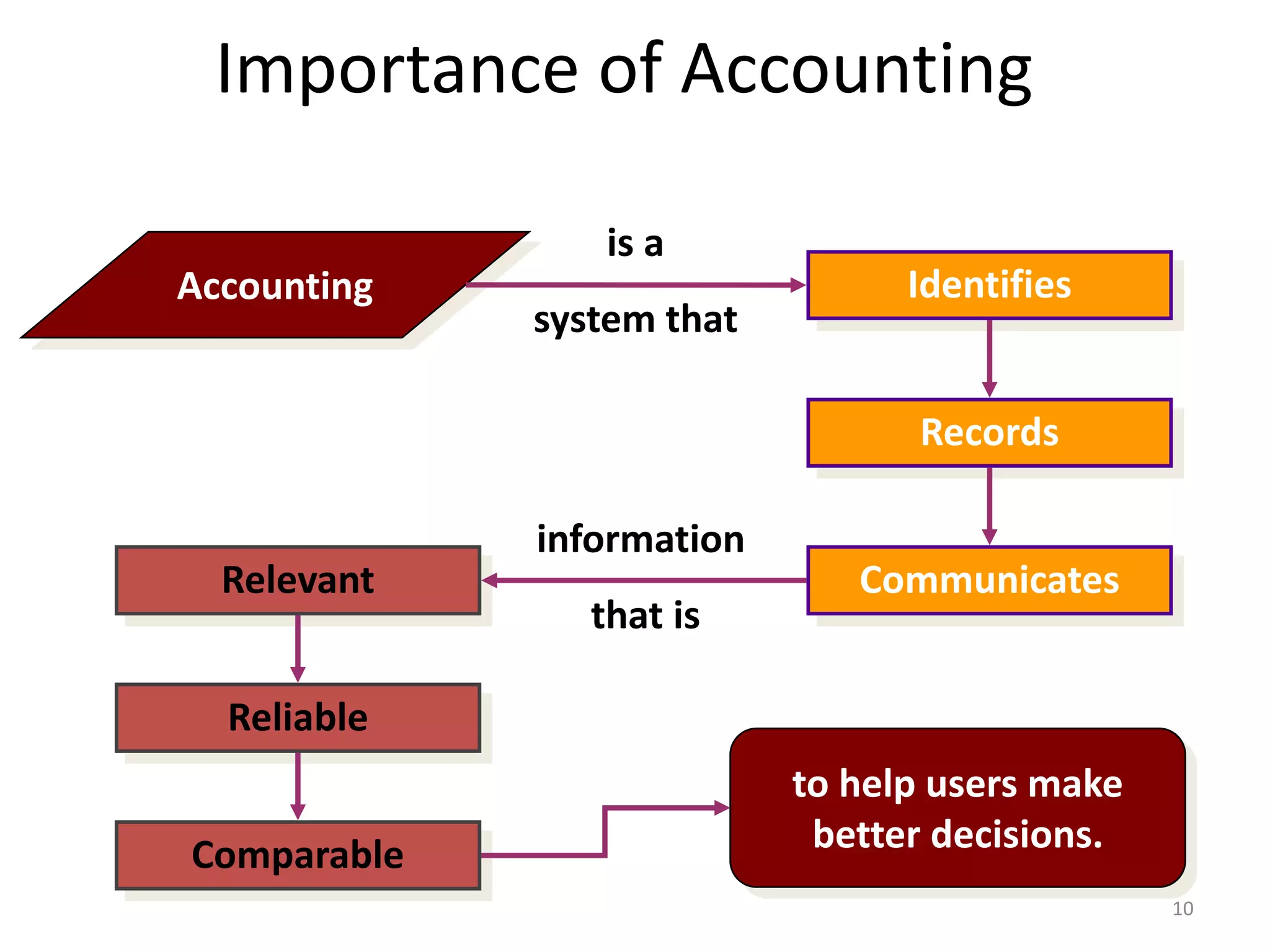
Identifies
Records
CommunicatesRelevant
Reliable
Comparable
Importance of Accounting
Accounting
is a
system that
information
that is
to help users make
better decisions.
10
 Identifying
Business
Activities
 Recording
Business
Activities
 Communicating
Business Activities
Accounting Activities
11
Why Accounting
• Informational requirement of a number of stakeholders in the business
– Internal Stakeholder
• Owners
• Management
• Employees
– External Stakeholders
• Government/ Tax department
• Investors
• Banks/Lenders
• Suppliers/Creditors
• NGOs/ Industry associations
• Researchers
• Accounting is the tool for providing financial information to various
stakeholders
12
13
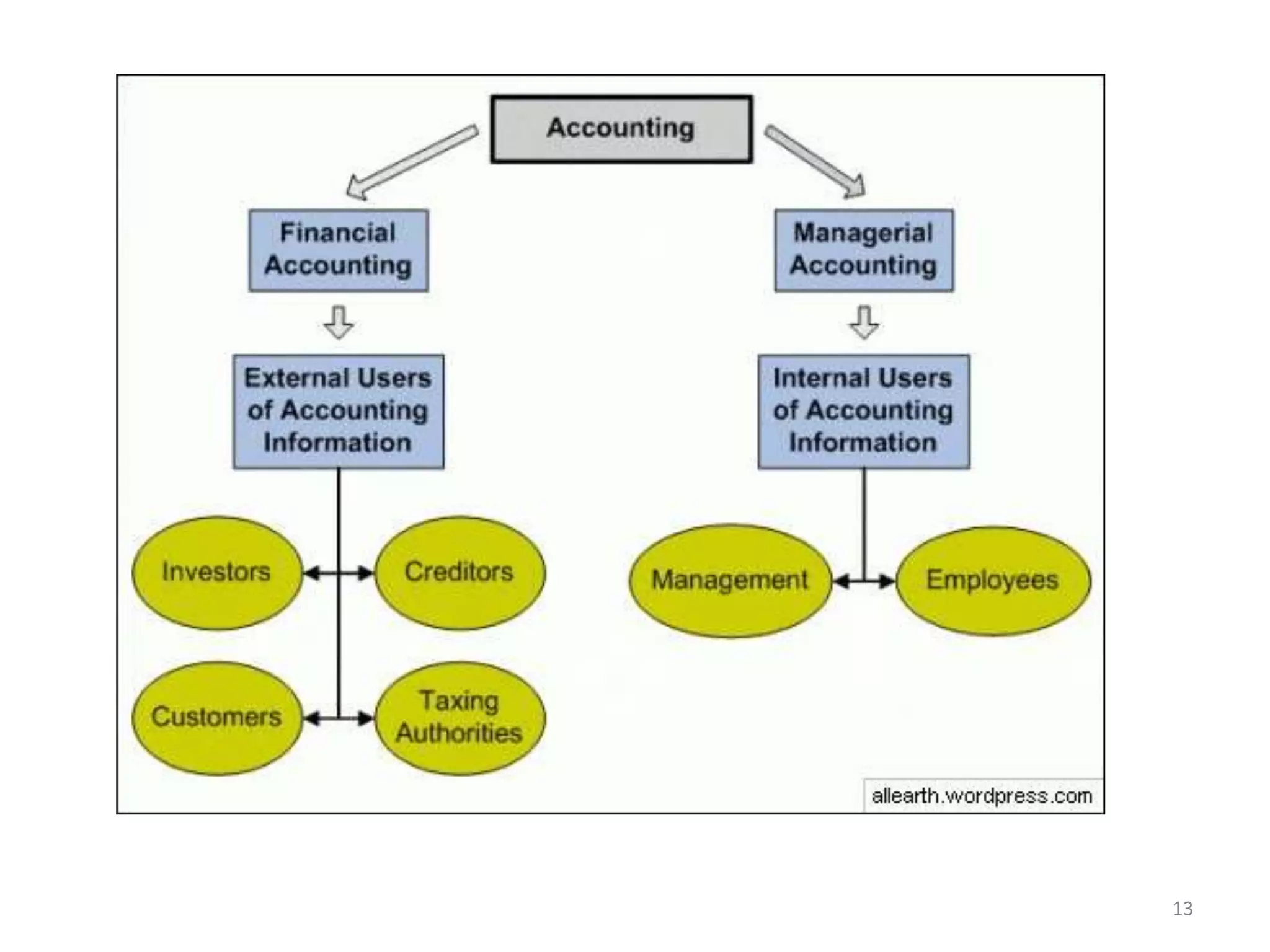
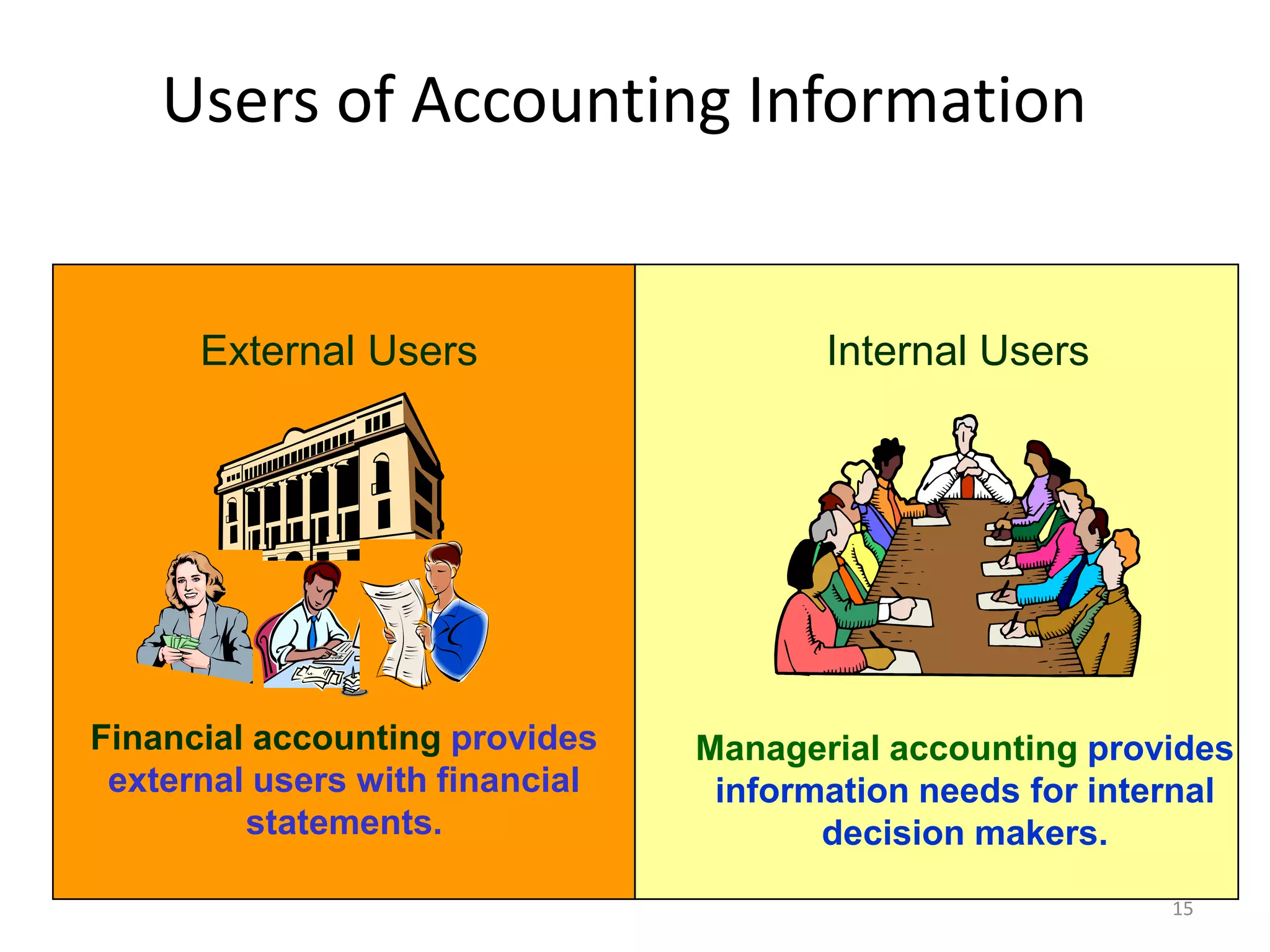
Users of Accounting Information
External Users
•Lenders
•Shareholders
•Governments
•Consumer Groups
•External Auditors
•Customers
Internal Users
•Managers
•Officers
•Internal Auditors
•Sales Staff
•Budget Officers
•Controllers
14
Users of Accounting Information
External Users
Financial accounting provides
external users with financial
statements.
Internal Users
Managerial accounting provides
information needs for internal
decision makers.
15
16
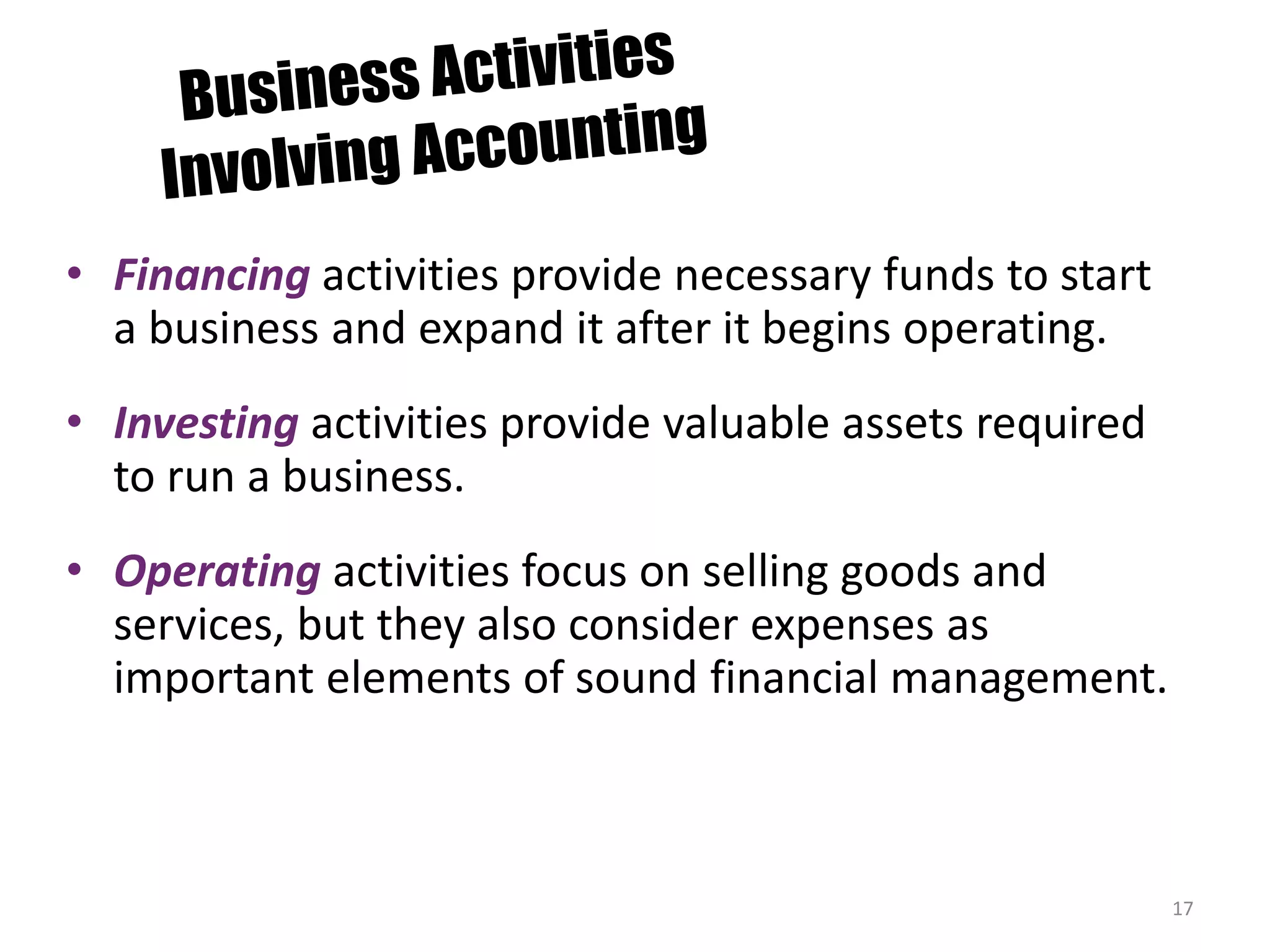
• Financing activities provide necessary funds to start
a business and expand it after it begins operating.
• Investing activities provide valuable assets required
to run a business.
• Operating activities focus on selling goods and
services, but they also consider expenses as
important elements of sound financial management.
17
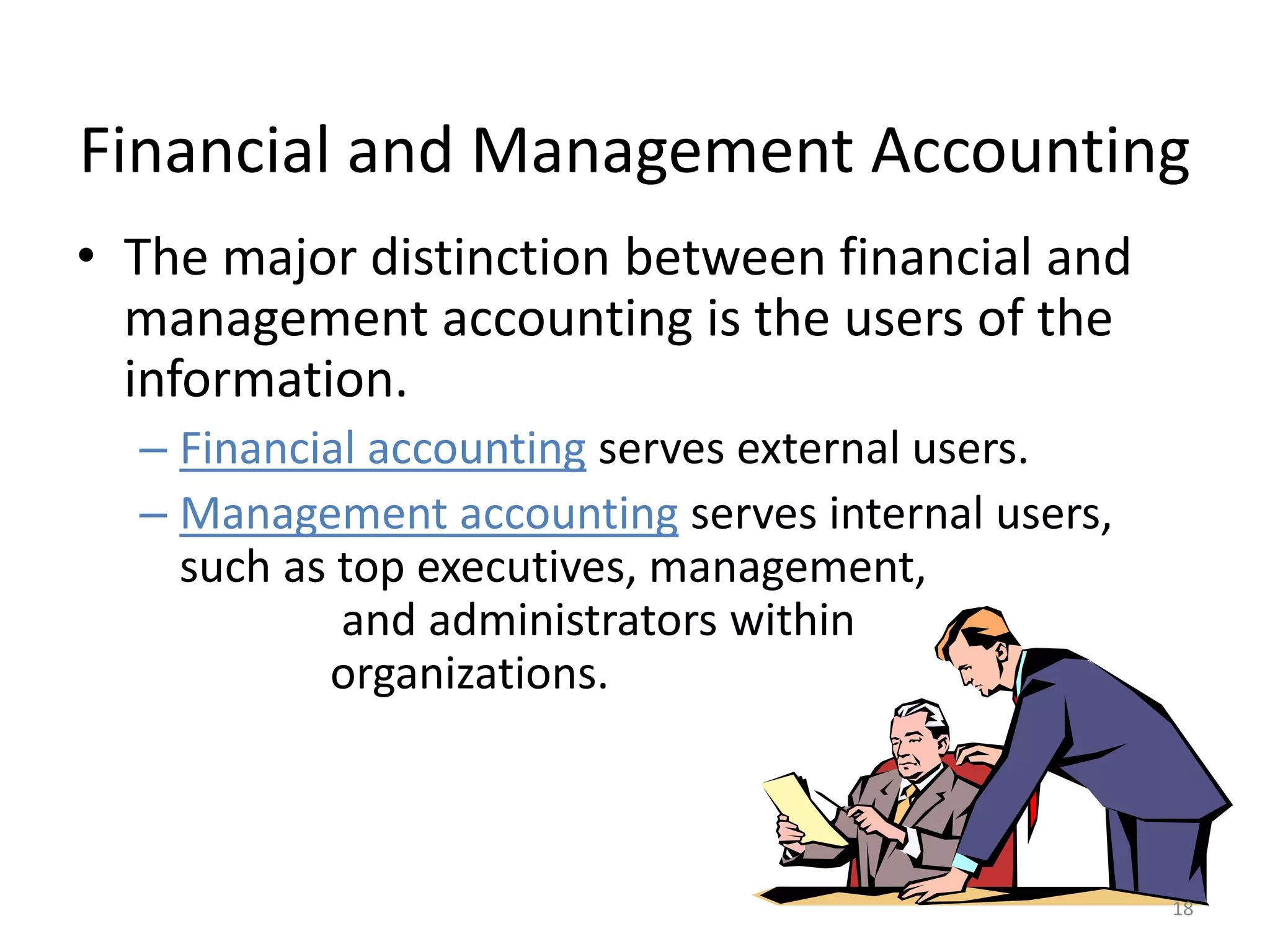
Financial and Management Accounting
• The major distinction between financial and
management accounting is the users of the
information.
– Financial accounting serves external users.
– Management accounting serves internal users,
such as top executives, management,
and administrators within
organizations.
18
Opportunities in Accounting
Financial
•Preparation
•Analysis
•Auditing
•Regulatory
•Consulting
•Planning
•Criminal
investigation
Managerial
•General accounting
•Cost accounting
•Budgeting
•Internal auditing
•Consulting
•Controller
•Treasurer
•Strategy
Taxation
•Preparation
•Planning
•Regulatory
•Investigations
•Consulting
•Enforcement
•Legal services
•Estate plans
Accounting-related
•Lenders
•Consultants
•Analysts
•Traders
•Directors
•Underwriters
•Planners
•Appraisers
•CBI investigators
•Market researchers
•Systems designers
•Merger services
•Business valuation
•Entrepreneurs
19
Financial accounting practice is governed by concepts and
rules known as generally accepted accounting principles
(GAAP).
Generally Accepted Accounting
Principles
Relevant Information Affects the decision of its
users.
Reliable Information Is trusted by users.
Comparable
Information
Used in comparisons across
years & companies.
20
Business Entity Forms
Sole
Proprietorship
Partnership Corporation
21
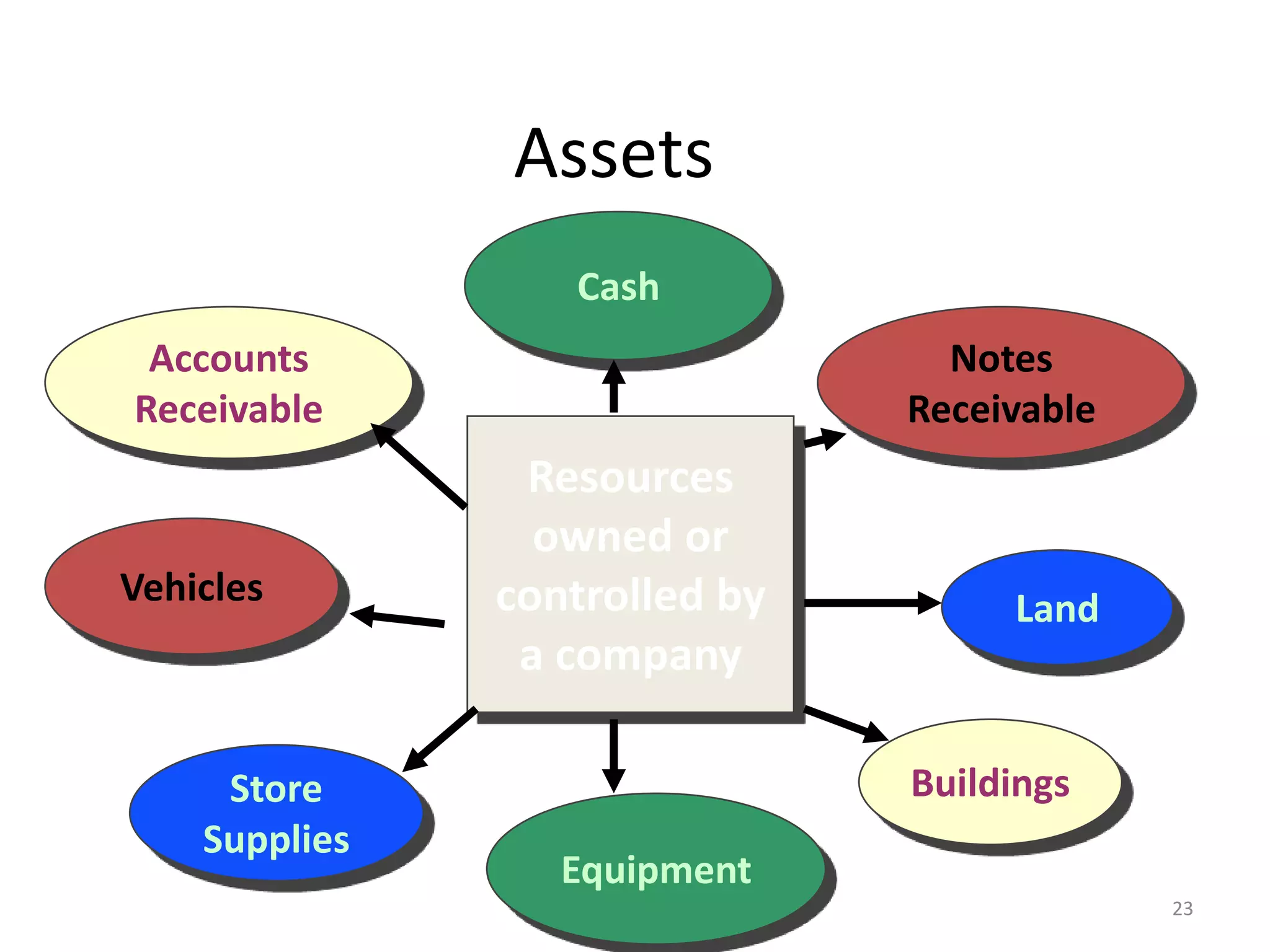
Assets
Liabilities &
Equity
Accounting Equation
Liabilities EquityAssets = +
22
Land
Equipment
Buildings
Cash
Vehicles
Store
Supplies
Notes
Receivable
Accounts
Receivable
Resources
owned or
controlled by
a company
Assets
23
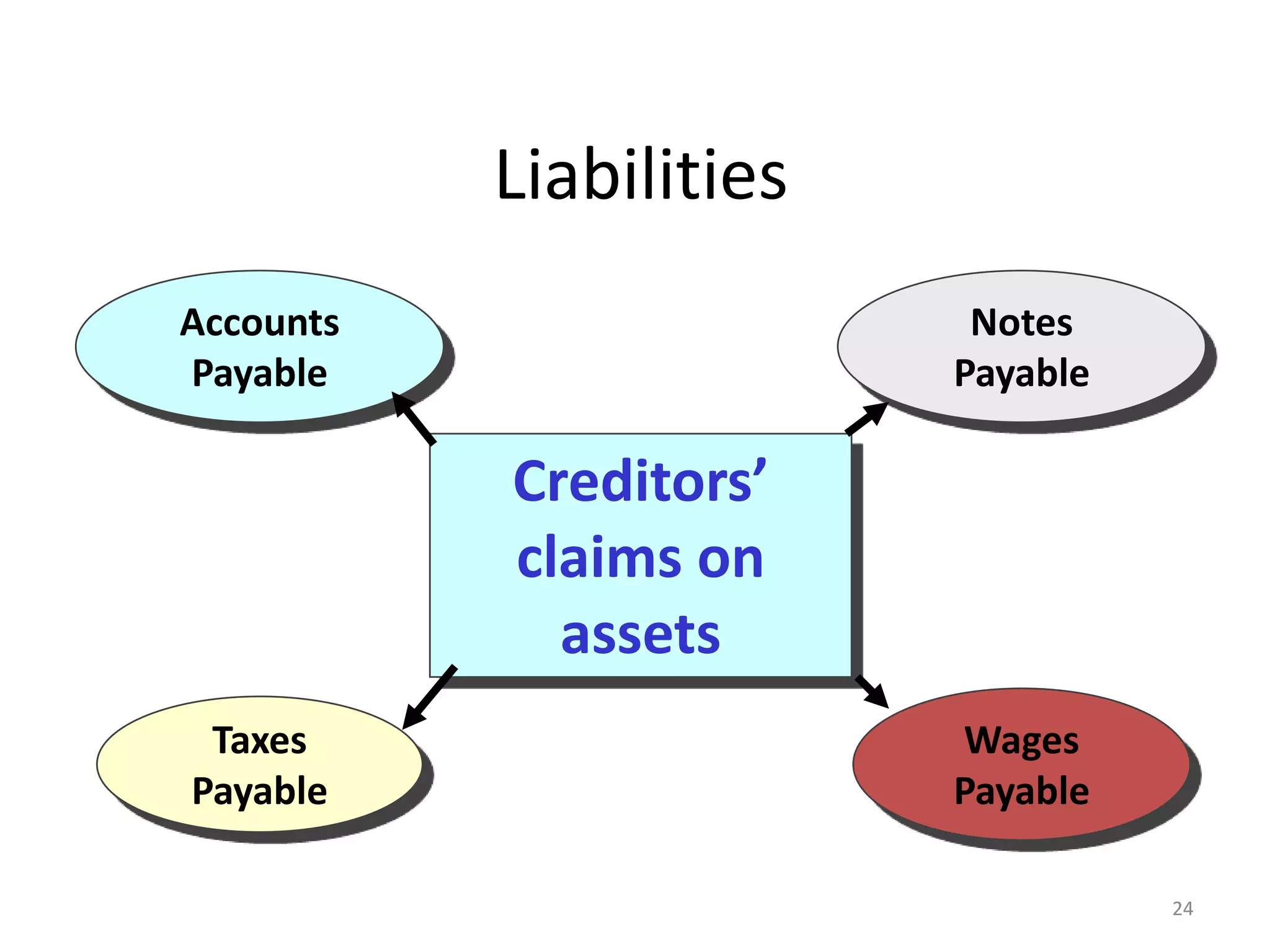
Taxes
Payable
Wages
Payable
Notes
Payable
Accounts
Payable
Creditors’
claims on
assets
Liabilities
24
Owner’s
claim on
assets
Dividends
Contributed
Capital
Retained
Earnings
Equity
25
Liabilities EquityAssets = +
Expanded Accounting Equation
Revenues Expenses
Common
Stock
Dividends_
+
_
Retained Earnings
Liabilities EquityAssets = +
26
Transaction Analysis
Assets = Liabilities + Equity
Cash Supplies Equipment
Accounts
Payable
Notes
Payable
Common
Stock
(1) 20,000$ 20,000$
20,000$ -$ -$ -$ -$ 20,000$
20,000$ = 20,000$
Manu invests $ 20,000 cash to start the
business in return for stock.
27
Transaction Analysis
Purchased supplies paying $1,000 cash.
Assets = Liabilities + Equity
Cash Supplies Equipment
Accounts
Payable
Notes
Payable
Common
Stock
(1) 20,000$ 20,000$
(2) (1,000) 1,000$
19,000$ 1,000$ -$ -$ -$ 20,000$
20,000$ = 20,000$
28
Transaction Analysis
Assets = Liabilities + Equity
Cash Supplies Equipment
Accounts
Payable
Notes
Payable
Common
Stock
(1) 20,000$ 20,000$
(2) (1,000) 1,000$
(3) (15,000) 15,000$
4,000$ 1,000$ 15,000$ -$ -$ 20,000$
20,000$ = 20,000$
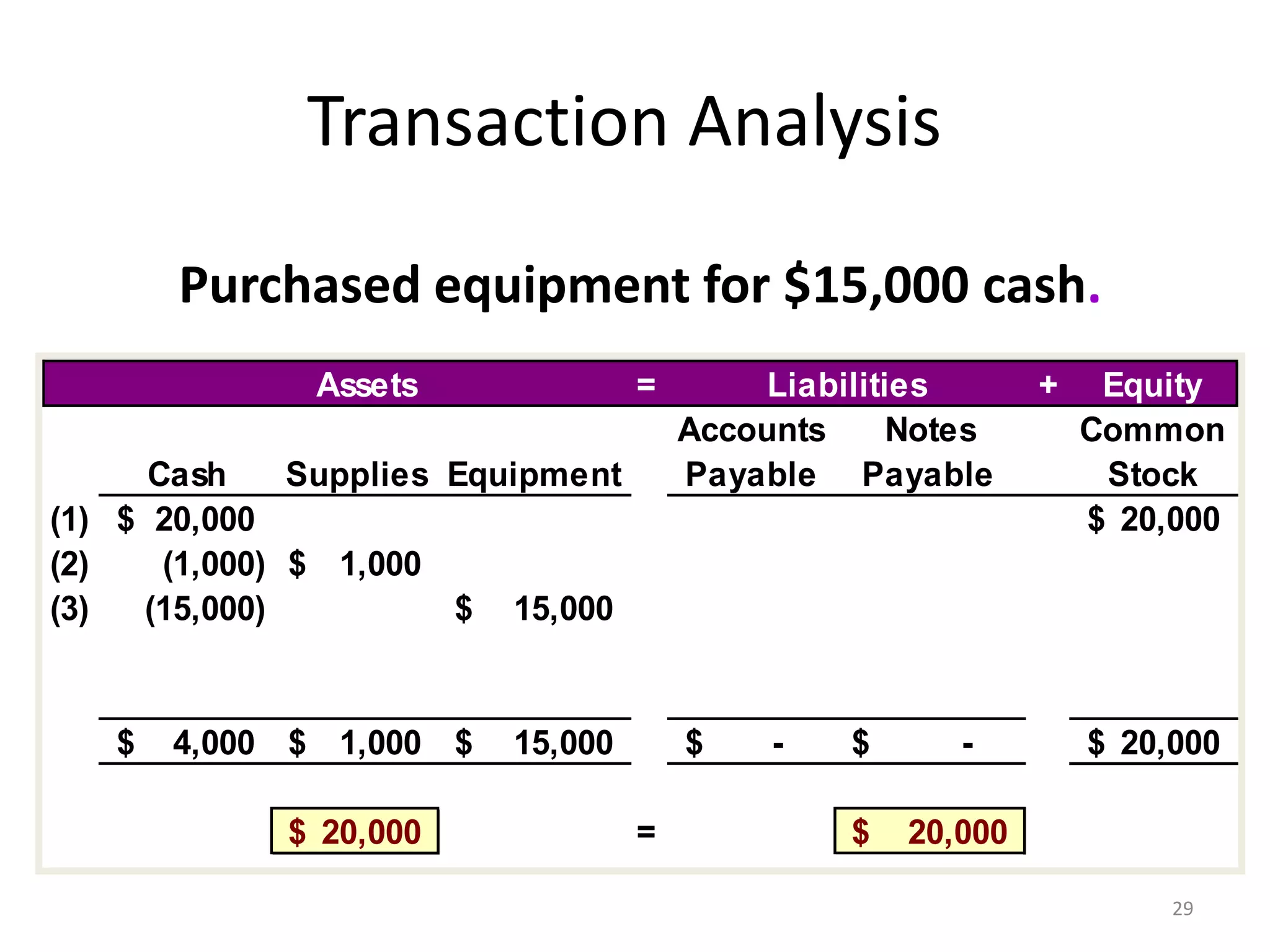
Purchased equipment for $15,000 cash.
29
Transaction Analysis
Assets = Liabilities + Equity
Cash Supplies Equipment
Accounts
Payable
Notes
Payable
Common
Stock
(1) 20,000$ 20,000$
(2) (1,000) 1,000$
(3) (15,000) 15,000$
(4) 200 1,000 1,200$
4,000$ 1,200$ 16,000$ 1,200$ -$ 20,000$
21,200$ = 21,200$
Purchased Supplies of $200 and Equipment
of $1,000 on account.
30
M. Anil Kumar,
Contact: 9916028219
e-mail: anil.hm13f05@nitk.edu.in 31

Accounting and financial management

  • 1.
    M. Anil Kumar, Departmentof Humanities, Social Sciences and Management, National Institute of Technology-Karnataka 1
  • 2.
    ACCOUNTING AND FINANCIALMANAGEMENT This course is designed to introduce students to the principles, concepts, and applications of financial accounting and management This course presents the underlying framework and concepts of Financial Accounting in the context of how accounting fits into the overall business environment of contemporary society. Financial accounting is the basic means of recording and reporting financial information in a business. You will learn how accounting functions as an information development and communication system that supports economic decision making and provides value to entities and society. You will discover the uses and limitations of financial statements and related information and apply analytical tools in making both business and financial decisions. 2
  • 3.
    In Financial Managementstudents are introduced to concepts and tools that enable them to think critically about the financial opportunities and challenges faced by an organization. They learn how to use financial statements such as balance sheets, income statements, and statements of cash flow. They prepare budgets, analyze investment options, and determine the best means of financing business endeavors. They discover ways of assessing both the return and the risk involved in a firm's financial decisions. The focus of this course is on solving practical business problems similar to those encountered in the workplace. 3
  • 4.
  • 5.
    -Elements of managementaccounting-I.M. Pandey, Vikas publishing house -Financial Management-Khan & Jain, TMH Publications - Financial Management-Prasanna Chandra, TMH Publications - Financial Management policy- Van Horne James C., Prentice Hall of India - Management Accounting 4th edition-Anthony & Alkinson, Robert S. Kalpan & S. Mark Young, Ther Robert Kalpan Series in Management Accounting 5
  • 6.
    The Need forAccounting A transaction is any event that affects the financial position of an organization and requires recording. 6
  • 7.
    Introduction • Accounting -a process of identifying, recording, summarizing, and reporting economic information to decision makers in the form of financial statements • Financial accounting - focuses on the specific needs of decision makers external to the organization, such as stockholders, suppliers, banks, and government agencies 7
  • 8.
    ACCOUNTING Accounting is thelanguage of business. The affairs and the results of the business are communicated to others through accounting information, which has to be systematically recorded and presented. 8
  • 9.
    9 In 1494, thefirst book on double entry. The author was an Italian friar, Luca Pacioli. His impact on accounting was so great that five centuries later, accountants from around the world gathered in the Italian village of San Sepulcro to celebrate the anniversary of the book's publication.
  • 10.
    Identifies Records CommunicatesRelevant Reliable Comparable Importance of Accounting Accounting isa system that information that is to help users make better decisions. 10
  • 11.
     Identifying Business Activities  Recording Business Activities Communicating Business Activities Accounting Activities 11
  • 12.
    Why Accounting • Informationalrequirement of a number of stakeholders in the business – Internal Stakeholder • Owners • Management • Employees – External Stakeholders • Government/ Tax department • Investors • Banks/Lenders • Suppliers/Creditors • NGOs/ Industry associations • Researchers • Accounting is the tool for providing financial information to various stakeholders 12
  • 13.
  • 14.
    Users of AccountingInformation External Users •Lenders •Shareholders •Governments •Consumer Groups •External Auditors •Customers Internal Users •Managers •Officers •Internal Auditors •Sales Staff •Budget Officers •Controllers 14
  • 15.
    Users of AccountingInformation External Users Financial accounting provides external users with financial statements. Internal Users Managerial accounting provides information needs for internal decision makers. 15
  • 16.
  • 17.
    • Financing activitiesprovide necessary funds to start a business and expand it after it begins operating. • Investing activities provide valuable assets required to run a business. • Operating activities focus on selling goods and services, but they also consider expenses as important elements of sound financial management. 17
  • 18.
    Financial and ManagementAccounting • The major distinction between financial and management accounting is the users of the information. – Financial accounting serves external users. – Management accounting serves internal users, such as top executives, management, and administrators within organizations. 18
  • 19.
    Opportunities in Accounting Financial •Preparation •Analysis •Auditing •Regulatory •Consulting •Planning •Criminal investigation Managerial •Generalaccounting •Cost accounting •Budgeting •Internal auditing •Consulting •Controller •Treasurer •Strategy Taxation •Preparation •Planning •Regulatory •Investigations •Consulting •Enforcement •Legal services •Estate plans Accounting-related •Lenders •Consultants •Analysts •Traders •Directors •Underwriters •Planners •Appraisers •CBI investigators •Market researchers •Systems designers •Merger services •Business valuation •Entrepreneurs 19
  • 20.
    Financial accounting practiceis governed by concepts and rules known as generally accepted accounting principles (GAAP). Generally Accepted Accounting Principles Relevant Information Affects the decision of its users. Reliable Information Is trusted by users. Comparable Information Used in comparisons across years & companies. 20
  • 21.
  • 22.
  • 23.
  • 24.
  • 25.
  • 26.
    Liabilities EquityAssets =+ Expanded Accounting Equation Revenues Expenses Common Stock Dividends_ + _ Retained Earnings Liabilities EquityAssets = + 26
  • 27.
    Transaction Analysis Assets =Liabilities + Equity Cash Supplies Equipment Accounts Payable Notes Payable Common Stock (1) 20,000$ 20,000$ 20,000$ -$ -$ -$ -$ 20,000$ 20,000$ = 20,000$ Manu invests $ 20,000 cash to start the business in return for stock. 27
  • 28.
    Transaction Analysis Purchased suppliespaying $1,000 cash. Assets = Liabilities + Equity Cash Supplies Equipment Accounts Payable Notes Payable Common Stock (1) 20,000$ 20,000$ (2) (1,000) 1,000$ 19,000$ 1,000$ -$ -$ -$ 20,000$ 20,000$ = 20,000$ 28
  • 29.
    Transaction Analysis Assets =Liabilities + Equity Cash Supplies Equipment Accounts Payable Notes Payable Common Stock (1) 20,000$ 20,000$ (2) (1,000) 1,000$ (3) (15,000) 15,000$ 4,000$ 1,000$ 15,000$ -$ -$ 20,000$ 20,000$ = 20,000$ Purchased equipment for $15,000 cash. 29
  • 30.
    Transaction Analysis Assets =Liabilities + Equity Cash Supplies Equipment Accounts Payable Notes Payable Common Stock (1) 20,000$ 20,000$ (2) (1,000) 1,000$ (3) (15,000) 15,000$ (4) 200 1,000 1,200$ 4,000$ 1,200$ 16,000$ 1,200$ -$ 20,000$ 21,200$ = 21,200$ Purchased Supplies of $200 and Equipment of $1,000 on account. 30
  • 31.
    M. Anil Kumar, Contact:9916028219 e-mail: anil.hm13f05@nitk.edu.in 31