MANAGEMENT OF DIARRHOEA
By Dr Ashka Shah
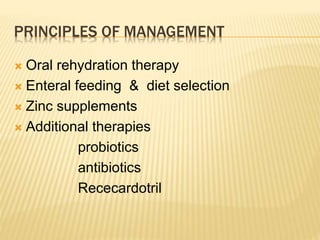
PRINCIPLES OF MANAGEMENT
 Oral rehydration therapy
 Enteral feeding & diet selection
 Zinc supplements
 Additional therapies
probiotics
antibiotics
Rececardotril
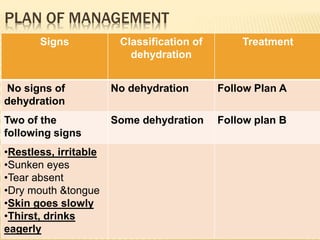
Signs Classification of
dehydration
Treatment
No signs of
dehydration
No dehydration Follow Plan A
Two of the
following signs
Some dehydration Follow plan B
•Restless, irritable
•Sunken eyes
•Tear absent
•Dry mouth &tongue
•Skin goes slowly
•Thirst, drinks
eagerly
PLAN OF MANAGEMENT
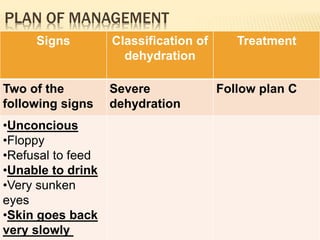
Signs Classification of
dehydration
Treatment
Two of the
following signs
Severe
dehydration
Follow plan C
•Unconcious
•Floppy
•Refusal to feed
•Unable to drink
•Very sunken
eyes
•Skin goes back
very slowly
PLAN OF MANAGEMENT
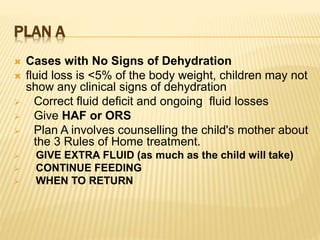
PLAN A
 Cases with No Signs of Dehydration
 fluid loss is <5% of the body weight, children may not
show any clinical signs of dehydration
 Correct fluid deficit and ongoing fluid losses
 Give HAF or ORS
 Plan A involves counselling the child's mother about
the 3 Rules of Home treatment.
 GIVE EXTRA FLUID (as much as the child will take)
 CONTINUE FEEDING
 WHEN TO RETURN
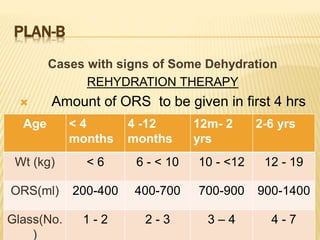
PLAN-B
Cases with signs of Some Dehydration
REHYDRATION THERAPY
 Amount of ORS to be given in first 4 hrs
Age < 4
months
4 -12
months
12m- 2
yrs
2-6 yrs
Wt (kg) < 6 6 - < 10 10 - <12 12 - 19
ORS(ml) 200-400 400-700 700-900 900-1400
Glass(No.
)
1 - 2 2 - 3 3 – 4 4 - 7
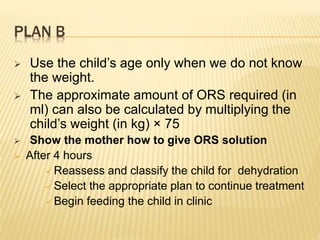
PLAN B
 Use the child’s age only when we do not know
the weight.
 The approximate amount of ORS required (in
ml) can also be calculated by multiplying the
child’s weight (in kg) × 75
 Show the mother how to give ORS solution
 After 4 hours
 Reassess and classify the child for dehydration
 Select the appropriate plan to continue treatment
 Begin feeding the child in clinic
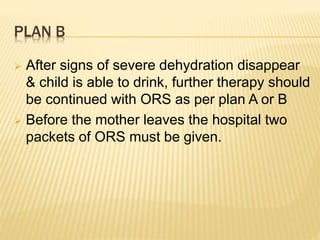
PLAN B
 After signs of severe dehydration disappear
& child is able to drink, further therapy should
be continued with ORS as per plan A or B
 Before the mother leaves the hospital two
packets of ORS must be given.
PLAN C
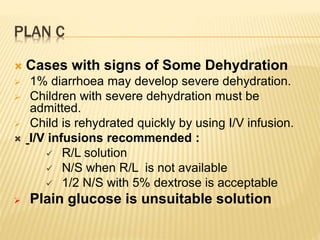
 Cases with signs of Some Dehydration
 1% diarrhoea may develop severe dehydration.
 Children with severe dehydration must be
admitted.
 Child is rehydrated quickly by using I/V infusion.
 I/V infusions recommended :
 R/L solution
 N/S when R/L is not available
 1/2 N/S with 5% dextrose is acceptable
 Plain glucose is unsuitable solution
PLAN C
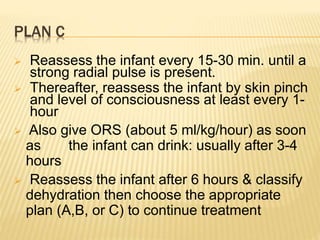
 Reassess the infant every 15-30 min. until a
strong radial pulse is present.
 Thereafter, reassess the infant by skin pinch
and level of consciousness at least every 1-
hour
 Also give ORS (about 5 ml/kg/hour) as soon
as the infant can drink: usually after 3-4
hours
 Reassess the infant after 6 hours & classify
dehydration then choose the appropriate
plan (A,B, or C) to continue treatment
PLAN C
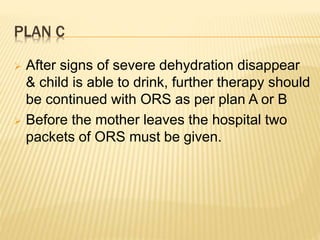
 After signs of severe dehydration disappear
& child is able to drink, further therapy should
be continued with ORS as per plan A or B
 Before the mother leaves the hospital two
packets of ORS must be given.
ORAL REHYDRATION THERAPY
 It is a balanced mixture of glucose and
electrolytes
 Almost all deaths from diarrhoea can be
prevented by ORS
MECHANISM OF ACTION
Sodium promotes absorption of water from the
intestine
Glucose promotes the absorption of sodium
and water from the intestine
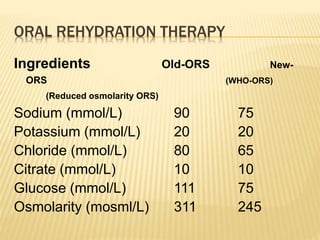
Ingredients Old-ORS New-
ORS (WHO-ORS)
(Reduced osmolarity ORS)
Sodium (mmol/L) 90 75
Potassium (mmol/L) 20 20
Chloride (mmol/L) 80 65
Citrate (mmol/L) 10 10
Glucose (mmol/L) 111 75
Osmolarity (mosml/L) 311 245
ORAL REHYDRATION THERAPY
LIMITATION OF ORS
 Does not reduce the diarrhea stool volume and
duration
 Parents are concerned to stop the diarrhea but not
the dehydration due to diarrhea
 It is not or less effective in
Shock
An ileus
Intussusception
Carbohydrate intolerance
Severe emesis
High stool output
ENTERAL FEEDING AND DIET SELECTION
 After rehydration completion, food should be
reintroduced
 Continue oral rehydration to replace ongoing
losses
Start breast feeding as soon as possible
 Food with complex carbohydrate is preffered
 Avoid fatty food or food with simple sugars
(juices, carbonated soda)
 Energy density should be 1kcal/grm
 Energy intake should be 100 kcal/kg/day and
protein intake of 2-3 grm/kg/day.
 Milk should not be diluted with water during
any phase of acute diarrhoea.
 Milk can also be given as milk cereal mixture
e.g. dalia, milk-rice mixture.
 This technique reduces the lactose load &
preserving energy density.
ENTERAL FEEDING AND DIET SELECTION
 To make foods-energy dense some of
preparation are:-
- Khichri with oil
- Rice with curd & sugar
- Mashed banana with milk or curd
- Mashed potatoes with oil.
ZINC SUPPLEMENTS
 10 mg/kg in infants <6 months and 20 mg/kg
in >6 months of age.
 Benefits of zinc therapy
Reduced duration and severity
prevent recurrence
reduction of inappropriate use of antibiotics
ANTIBIOTICS IN DIARRHOEA
 Indication
 Suspected cholera with severe dehydration
 Bloody diarrhoea
 Associated non gastrointestinal infection
 Severely malnurished or immunocompromised
child
 Specific infection
PROBIOTICS
 It means bacteria associated with beneficial effects
for humans and animals.
 Can inhibit the growth and adhesion of a range of
entero-pathogens
 Indicated in
- Treatment and prevention of acute diarrhoea
caused by rotavirus in children
- Antibiotic associated diarrhoea
Probiotic strains
- Lactobacillus rhamnosus GG and Bifidobacterium
lactis BB-12
POTENTIAL USES OF PROBIOTICS
 -diarrhoea
 -Helicobacter pylori infection
 -Inflammatory bowel disease
 -Cancers
 -To increase Immunity
 -Allergy
 -Heart disease
 -Urogenital tract infections
PROBIOTICS
ADDITIONAL THERAPY
 Antiemetics like ondansetron can be useful
during rehydration therapy.
 Racecadotril an enkephalinase inhibitor is
found useful to reduce stool output
 Exclusive Breast Feeding
 Bottle feeding should be avoided
 Improved personal hygiene and sanitation
Wash Hand
Eat clean Food
Drink clean water
 Immunization e.g. Measles, Rota virus
 Vit. A - Prophylactic doses
 Better Nutrition
 Improved case management
PREVENTION OF DIARRHOEA
ROTA VIRUS VACCINATION
 Rotashield vaccine -1999
 Withdrawn because of its association with
intussuscption
 Two new oral, live attenuated rotavirus vaccines were
licensed in 2006 with very good safety and efficacy
 The first dose administered between ages 6-10
weeks .
 subsequent doses at intervals 4-10 weeks.
 Vaccination should not be initiated before 6weeks
and after 12 weeks of age.
 All doses should be administered before 32 weeks.
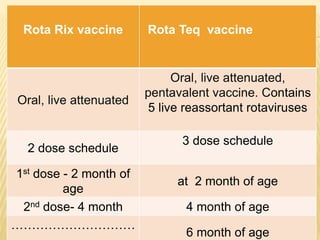
ROTA VIRUS VACCINATIONRota Rix vaccine Rota Teq vaccine
Oral, live attenuated
Oral, live attenuated,
pentavalent vaccine. Contains
5 live reassortant rotaviruses
2 dose schedule
3 dose schedule
1st dose - 2 month of
age
at 2 month of age
2nd dose- 4 month 4 month of age
…………………………
6 month of age
NATIONAL DIARRHOEAL DISEASE CONTROL
PROGRAMME
 National ORT Programme was incepted in 1985- 86
 From 1992-93 the programme has become a part of
CSSM Programme.
 CSSM programme become a part of RCH
programme in 1997
 In RCH Programme, policy of IMCI was adopted
 Strategy of IMCI was to address all children and not
only sick children
 IMCI focused on life threatening illnesses-diarrhoea,
Pneumonia, Measles, Malaria etc.
IMNCI
 Since 2003 - DDCP included in IMNCI which
includes
 Neonates of 0-7 days
 Incorporating national guidelines on
diarrhoea,
ARI ,Malaria, Anaemia, Vit. A
supplementation
& Immunizations
STRATEGIES OF IMNCI
 Ensure standard case management of
diarrhoea by training of medical and other health
personnel.
 Promote standard case management practices
among private practitioners through IMA and
IAP.
 Improve maternal knowledge on home
management and recognition of danger signs of
diarrhoea for immediate medical care.
CASE MANAGEMENT STRATEGY
CLASSIFICATION:
PINK :
 Child needs referral ( Inpatient care)
YELLOW :
 Child needs specific treatment, provide it at
home (e.g. Antibiotics, ORS)
GREEN :
 Child needs no medicine, give home care
LIMITATIONS OF IMNCI
 Outpatient Facility Based
 Community activities not given adequate
focus
 Vertical initiatives in Non IMNCI districts
sorely lacking

Management of diarrhoea

  • 1.
  • 2.
    PRINCIPLES OF MANAGEMENT Oral rehydration therapy  Enteral feeding & diet selection  Zinc supplements  Additional therapies probiotics antibiotics Rececardotril
  • 3.
    Signs Classification of dehydration Treatment Nosigns of dehydration No dehydration Follow Plan A Two of the following signs Some dehydration Follow plan B •Restless, irritable •Sunken eyes •Tear absent •Dry mouth &tongue •Skin goes slowly •Thirst, drinks eagerly PLAN OF MANAGEMENT
  • 4.
    Signs Classification of dehydration Treatment Twoof the following signs Severe dehydration Follow plan C •Unconcious •Floppy •Refusal to feed •Unable to drink •Very sunken eyes •Skin goes back very slowly PLAN OF MANAGEMENT
  • 5.
    PLAN A  Caseswith No Signs of Dehydration  fluid loss is <5% of the body weight, children may not show any clinical signs of dehydration  Correct fluid deficit and ongoing fluid losses  Give HAF or ORS  Plan A involves counselling the child's mother about the 3 Rules of Home treatment.  GIVE EXTRA FLUID (as much as the child will take)  CONTINUE FEEDING  WHEN TO RETURN
  • 6.
    PLAN-B Cases with signsof Some Dehydration REHYDRATION THERAPY  Amount of ORS to be given in first 4 hrs Age < 4 months 4 -12 months 12m- 2 yrs 2-6 yrs Wt (kg) < 6 6 - < 10 10 - <12 12 - 19 ORS(ml) 200-400 400-700 700-900 900-1400 Glass(No. ) 1 - 2 2 - 3 3 – 4 4 - 7
  • 7.
    PLAN B  Usethe child’s age only when we do not know the weight.  The approximate amount of ORS required (in ml) can also be calculated by multiplying the child’s weight (in kg) × 75  Show the mother how to give ORS solution  After 4 hours  Reassess and classify the child for dehydration  Select the appropriate plan to continue treatment  Begin feeding the child in clinic
  • 8.
    PLAN B  Aftersigns of severe dehydration disappear & child is able to drink, further therapy should be continued with ORS as per plan A or B  Before the mother leaves the hospital two packets of ORS must be given.
  • 9.
    PLAN C  Caseswith signs of Some Dehydration  1% diarrhoea may develop severe dehydration.  Children with severe dehydration must be admitted.  Child is rehydrated quickly by using I/V infusion.  I/V infusions recommended :  R/L solution  N/S when R/L is not available  1/2 N/S with 5% dextrose is acceptable  Plain glucose is unsuitable solution
  • 10.
    PLAN C  Reassessthe infant every 15-30 min. until a strong radial pulse is present.  Thereafter, reassess the infant by skin pinch and level of consciousness at least every 1- hour  Also give ORS (about 5 ml/kg/hour) as soon as the infant can drink: usually after 3-4 hours  Reassess the infant after 6 hours & classify dehydration then choose the appropriate plan (A,B, or C) to continue treatment
  • 11.
    PLAN C  Aftersigns of severe dehydration disappear & child is able to drink, further therapy should be continued with ORS as per plan A or B  Before the mother leaves the hospital two packets of ORS must be given.
  • 12.
    ORAL REHYDRATION THERAPY It is a balanced mixture of glucose and electrolytes  Almost all deaths from diarrhoea can be prevented by ORS MECHANISM OF ACTION Sodium promotes absorption of water from the intestine Glucose promotes the absorption of sodium and water from the intestine
  • 13.
    Ingredients Old-ORS New- ORS(WHO-ORS) (Reduced osmolarity ORS) Sodium (mmol/L) 90 75 Potassium (mmol/L) 20 20 Chloride (mmol/L) 80 65 Citrate (mmol/L) 10 10 Glucose (mmol/L) 111 75 Osmolarity (mosml/L) 311 245 ORAL REHYDRATION THERAPY
  • 14.
    LIMITATION OF ORS Does not reduce the diarrhea stool volume and duration  Parents are concerned to stop the diarrhea but not the dehydration due to diarrhea  It is not or less effective in Shock An ileus Intussusception Carbohydrate intolerance Severe emesis High stool output
  • 15.
    ENTERAL FEEDING ANDDIET SELECTION  After rehydration completion, food should be reintroduced  Continue oral rehydration to replace ongoing losses Start breast feeding as soon as possible  Food with complex carbohydrate is preffered  Avoid fatty food or food with simple sugars (juices, carbonated soda)  Energy density should be 1kcal/grm
  • 16.
     Energy intakeshould be 100 kcal/kg/day and protein intake of 2-3 grm/kg/day.  Milk should not be diluted with water during any phase of acute diarrhoea.  Milk can also be given as milk cereal mixture e.g. dalia, milk-rice mixture.  This technique reduces the lactose load & preserving energy density. ENTERAL FEEDING AND DIET SELECTION
  • 17.
    ENTERAL FEEDING ANDDIET SELECTION  To make foods-energy dense some of preparation are:- - Khichri with oil - Rice with curd & sugar - Mashed banana with milk or curd - Mashed potatoes with oil.
  • 18.
    ZINC SUPPLEMENTS  10mg/kg in infants <6 months and 20 mg/kg in >6 months of age.  Benefits of zinc therapy Reduced duration and severity prevent recurrence reduction of inappropriate use of antibiotics
  • 19.
    ANTIBIOTICS IN DIARRHOEA Indication  Suspected cholera with severe dehydration  Bloody diarrhoea  Associated non gastrointestinal infection  Severely malnurished or immunocompromised child  Specific infection
  • 20.
    PROBIOTICS  It meansbacteria associated with beneficial effects for humans and animals.  Can inhibit the growth and adhesion of a range of entero-pathogens  Indicated in - Treatment and prevention of acute diarrhoea caused by rotavirus in children - Antibiotic associated diarrhoea Probiotic strains - Lactobacillus rhamnosus GG and Bifidobacterium lactis BB-12
  • 21.
    POTENTIAL USES OFPROBIOTICS  -diarrhoea  -Helicobacter pylori infection  -Inflammatory bowel disease  -Cancers  -To increase Immunity  -Allergy  -Heart disease  -Urogenital tract infections PROBIOTICS
  • 22.
    ADDITIONAL THERAPY  Antiemeticslike ondansetron can be useful during rehydration therapy.  Racecadotril an enkephalinase inhibitor is found useful to reduce stool output
  • 23.
     Exclusive BreastFeeding  Bottle feeding should be avoided  Improved personal hygiene and sanitation Wash Hand Eat clean Food Drink clean water  Immunization e.g. Measles, Rota virus  Vit. A - Prophylactic doses  Better Nutrition  Improved case management PREVENTION OF DIARRHOEA
  • 24.
    ROTA VIRUS VACCINATION Rotashield vaccine -1999  Withdrawn because of its association with intussuscption  Two new oral, live attenuated rotavirus vaccines were licensed in 2006 with very good safety and efficacy  The first dose administered between ages 6-10 weeks .  subsequent doses at intervals 4-10 weeks.  Vaccination should not be initiated before 6weeks and after 12 weeks of age.  All doses should be administered before 32 weeks.
  • 25.
    ROTA VIRUS VACCINATIONRotaRix vaccine Rota Teq vaccine Oral, live attenuated Oral, live attenuated, pentavalent vaccine. Contains 5 live reassortant rotaviruses 2 dose schedule 3 dose schedule 1st dose - 2 month of age at 2 month of age 2nd dose- 4 month 4 month of age ………………………… 6 month of age
  • 26.
    NATIONAL DIARRHOEAL DISEASECONTROL PROGRAMME  National ORT Programme was incepted in 1985- 86  From 1992-93 the programme has become a part of CSSM Programme.  CSSM programme become a part of RCH programme in 1997  In RCH Programme, policy of IMCI was adopted  Strategy of IMCI was to address all children and not only sick children  IMCI focused on life threatening illnesses-diarrhoea, Pneumonia, Measles, Malaria etc.
  • 27.
    IMNCI  Since 2003- DDCP included in IMNCI which includes  Neonates of 0-7 days  Incorporating national guidelines on diarrhoea, ARI ,Malaria, Anaemia, Vit. A supplementation & Immunizations
  • 28.
    STRATEGIES OF IMNCI Ensure standard case management of diarrhoea by training of medical and other health personnel.  Promote standard case management practices among private practitioners through IMA and IAP.  Improve maternal knowledge on home management and recognition of danger signs of diarrhoea for immediate medical care.
  • 29.
    CASE MANAGEMENT STRATEGY CLASSIFICATION: PINK:  Child needs referral ( Inpatient care) YELLOW :  Child needs specific treatment, provide it at home (e.g. Antibiotics, ORS) GREEN :  Child needs no medicine, give home care
  • 30.
    LIMITATIONS OF IMNCI Outpatient Facility Based  Community activities not given adequate focus  Vertical initiatives in Non IMNCI districts sorely lacking