


WELCOME TO CME PROGRAM
TOPIC
MANAGEMENT OF BLEEDING
PRESENTER
DR. MD. SHAHADAD HOSSAIN
DEPARTMENT OF SURGERY
Definition
Haemorrhage or bleeding: Is defined as extravasation of
blood from the blood vessel to the exterior
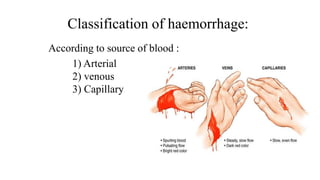
Classification of haemorrhage:
According to source of blood :
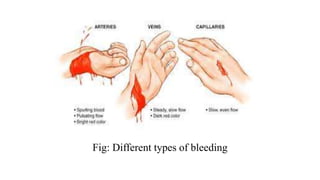
1) Arterial
2) venous
3) Capillary
Fig: Different types of bleeding
CONT….
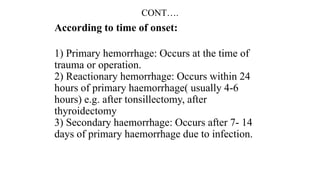
According to time of onset:
1) Primary hemorrhage: Occurs at the time of
trauma or operation.
2) Reactionary hemorrhage: Occurs within 24
hours of primary haemorrhage( usually 4-6
hours) e.g. after tonsillectomy, after
thyroidectomy
3) Secondary haemorrhage: Occurs after 7- 14
days of primary haemorrhage due to infection.
CONT…
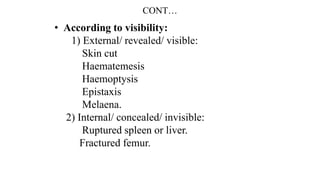
• According to visibility:
1) External/ revealed/ visible:
Skin cut
Haematemesis
Haemoptysis
Epistaxis
Melaena.
2) Internal/ concealed/ invisible:
Ruptured spleen or liver.
Fractured femur.
CONT…..
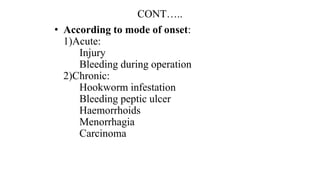
• According to mode of onset:
1)Acute:
Injury
Bleeding during operation
2)Chronic:
Hookworm infestation
Bleeding peptic ulcer
Haemorrhoids
Menorrhagia
Carcinoma
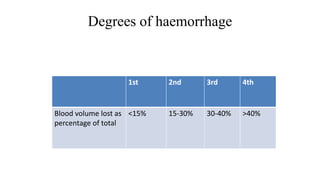
Degrees of haemorrhage
1st 2nd 3rd 4th
Blood volume lost as
percentage of total
<15% 15-30% 30-40% >40%
CLINICAL FEATURES
Symptoms of bleeding :
Fainting attack
Shallow breathing with gasps
Profuse sweating
Thirst
Blurred vision
Unconsciousness
Signs :
Cold and clammy skin
Weak and rapid pulse
Low blood pressure
Anaemia
Signs of shock may be found incase
of 3rd & 4th degree blood lose.
Management of bleeding
Control of external bleeding:
a)Pressure of packing:
1) pressure dressing made from anything, which is soft and
clean.
2) Direct pressure.
3) Packing by means of rolls of wide gauze.
4) Tourniquets.
5) Clothes pack for epitaxis.
CONT…
• b) Indirect pressure on pressure points.
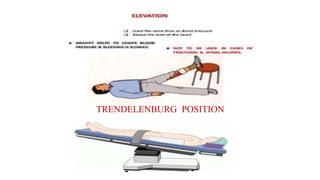
c) Position and rest:
1) Elevation of limbs
2) Trendelenburg position (feet tilted downwards).
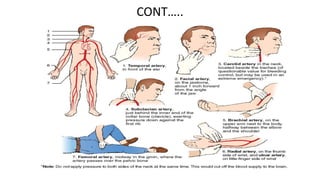
Pressure points to control of bleeding:
1) Temporal artery: For bleeding from scalp
2) Facial artery: For bleeding from face
3) Carotid artery: For bleeding from neck
4) Subclavian artery: For bleedig from chest wall and armpit
5) Brachial artery : For bleedig from upper limB
6) Femoral artery: For bleeding from lower limb
CONT…..
TRENDELENBURG POSITION
Control of internal bleeding:
1) Maintenance of ABC
2) Proper positioning: left lateral position
3) Restoration of blood volume to prevent shock by:
-blood transfusion
-intravenous fluid:Hartman’s solution, 5% DNS
-infusion of plasma or dextran
CONT….
4) Operative techniques:
-Pressure by artery forceps or clips
-Topical application of gelatin sponge or adrenaline
-Coagulation with diathermy
-Ligation of bleeding vessel with catgut or silk
-Suturing of vessels
-Splenectomy
Reactionary haemorrhage:
Bleeding occurs within 24 hours of primary haemorrhage.
Causes:
-slipping of ligature
-dislodgement of clot
-cessation of reflex vasospasm
Precipitating factors:
-rise in arterial blood pressure
-restlessness,coughing ,vomiting which raises venous pressure
Management of reactionary haemorrhage:
Diagnosis:
1)Careful examination of site of operation: excessive swelling may be
present
2)Careful examination of drain tube :excessive collection of blood
3)Severe anaemia
4)Tachycardia
5)BP: increased
6)RR: may be increased
7)Urine output: reduced
8)Estimation of Hb%, hematocrit, ESR
Treatment of reactionary heamorrhage
1)Removal of dressing
2)Open the layers of wound to relieve the tension
3)Patient is taken to be OT
4)Evacuation of haematoma
5)Secure the bleeding points
6)Endotracheal intubation may be needed to relieve airway
obstruction in case of thyroidectomy
Secondary haemorrhage:
Bleeding occurs after 7-14 days of primary haemorrhage
Can be occurred in any type of surgery where there is infection.
Common after haemorrhoidectomy, GI surgery, amputations.
Causes:
1)Infection
2)Trauma
3)Sloughing of the wall of a vessel
Management of secondary haemorrhage:
Diagnosis:
1)Bright red stains on dressing , followed by sudden severe
haemorrhage
2)Patient becomes anaemic
3)Tachycardia
4)Hypotension
5)Temperature: raised
6)Urine output: reduced
7)Patient may be toxic and restless
Treatment of secondary heamorrhage
1) Control of infection by appropriate antibiotics.
2) Restoration of blood volume by blood transfusion
3) Prevention of further blood loss by:
-pressure and pack
-complete bed rest and proper positioning
CONT…
-operative techniques:
clamping and ligation
coagulation by diathermy
sclerosing agent
sponge stain
Effects of haemorrhage
1) Acute renal shut down
2) Hypovolaemic shock
3) Liver cell dysfunction
4) Cardiac depression
5) Hypoxic effect
6) Metabolic acidosis
7) GIT mucosal ischaemia
8) Sepsis
9) Interstitial oedema
10) ARDS
Management of bleeding

Management of bleeding

  • 1.
    WELCOME TO CMEPROGRAM TOPIC MANAGEMENT OF BLEEDING PRESENTER DR. MD. SHAHADAD HOSSAIN DEPARTMENT OF SURGERY
  • 2.
    Definition Haemorrhage or bleeding:Is defined as extravasation of blood from the blood vessel to the exterior
  • 4.
    Classification of haemorrhage: Accordingto source of blood : 1) Arterial 2) venous 3) Capillary
  • 5.
  • 6.
    CONT…. According to timeof onset: 1) Primary hemorrhage: Occurs at the time of trauma or operation. 2) Reactionary hemorrhage: Occurs within 24 hours of primary haemorrhage( usually 4-6 hours) e.g. after tonsillectomy, after thyroidectomy 3) Secondary haemorrhage: Occurs after 7- 14 days of primary haemorrhage due to infection.
  • 7.
    CONT… • According tovisibility: 1) External/ revealed/ visible: Skin cut Haematemesis Haemoptysis Epistaxis Melaena. 2) Internal/ concealed/ invisible: Ruptured spleen or liver. Fractured femur.
  • 8.
    CONT….. • According tomode of onset: 1)Acute: Injury Bleeding during operation 2)Chronic: Hookworm infestation Bleeding peptic ulcer Haemorrhoids Menorrhagia Carcinoma
  • 9.
    Degrees of haemorrhage 1st2nd 3rd 4th Blood volume lost as percentage of total <15% 15-30% 30-40% >40%
  • 10.
    CLINICAL FEATURES Symptoms ofbleeding : Fainting attack Shallow breathing with gasps Profuse sweating Thirst Blurred vision Unconsciousness Signs : Cold and clammy skin Weak and rapid pulse Low blood pressure Anaemia Signs of shock may be found incase of 3rd & 4th degree blood lose.
  • 11.
    Management of bleeding Controlof external bleeding: a)Pressure of packing: 1) pressure dressing made from anything, which is soft and clean. 2) Direct pressure. 3) Packing by means of rolls of wide gauze. 4) Tourniquets. 5) Clothes pack for epitaxis.
  • 12.
    CONT… • b) Indirectpressure on pressure points. c) Position and rest: 1) Elevation of limbs 2) Trendelenburg position (feet tilted downwards).
  • 13.
    Pressure points tocontrol of bleeding: 1) Temporal artery: For bleeding from scalp 2) Facial artery: For bleeding from face 3) Carotid artery: For bleeding from neck 4) Subclavian artery: For bleedig from chest wall and armpit 5) Brachial artery : For bleedig from upper limB 6) Femoral artery: For bleeding from lower limb
  • 14.
  • 15.
  • 16.
    Control of internalbleeding: 1) Maintenance of ABC 2) Proper positioning: left lateral position 3) Restoration of blood volume to prevent shock by: -blood transfusion -intravenous fluid:Hartman’s solution, 5% DNS -infusion of plasma or dextran
  • 17.
    CONT…. 4) Operative techniques: -Pressureby artery forceps or clips -Topical application of gelatin sponge or adrenaline -Coagulation with diathermy -Ligation of bleeding vessel with catgut or silk -Suturing of vessels -Splenectomy
  • 18.
    Reactionary haemorrhage: Bleeding occurswithin 24 hours of primary haemorrhage. Causes: -slipping of ligature -dislodgement of clot -cessation of reflex vasospasm Precipitating factors: -rise in arterial blood pressure -restlessness,coughing ,vomiting which raises venous pressure
  • 19.
    Management of reactionaryhaemorrhage: Diagnosis: 1)Careful examination of site of operation: excessive swelling may be present 2)Careful examination of drain tube :excessive collection of blood 3)Severe anaemia 4)Tachycardia 5)BP: increased 6)RR: may be increased 7)Urine output: reduced 8)Estimation of Hb%, hematocrit, ESR
  • 20.
    Treatment of reactionaryheamorrhage 1)Removal of dressing 2)Open the layers of wound to relieve the tension 3)Patient is taken to be OT 4)Evacuation of haematoma 5)Secure the bleeding points 6)Endotracheal intubation may be needed to relieve airway obstruction in case of thyroidectomy
  • 21.
    Secondary haemorrhage: Bleeding occursafter 7-14 days of primary haemorrhage Can be occurred in any type of surgery where there is infection. Common after haemorrhoidectomy, GI surgery, amputations. Causes: 1)Infection 2)Trauma 3)Sloughing of the wall of a vessel
  • 22.
    Management of secondaryhaemorrhage: Diagnosis: 1)Bright red stains on dressing , followed by sudden severe haemorrhage 2)Patient becomes anaemic 3)Tachycardia 4)Hypotension 5)Temperature: raised 6)Urine output: reduced 7)Patient may be toxic and restless
  • 23.
    Treatment of secondaryheamorrhage 1) Control of infection by appropriate antibiotics. 2) Restoration of blood volume by blood transfusion 3) Prevention of further blood loss by: -pressure and pack -complete bed rest and proper positioning
  • 24.
    CONT… -operative techniques: clamping andligation coagulation by diathermy sclerosing agent sponge stain
  • 25.
    Effects of haemorrhage 1)Acute renal shut down 2) Hypovolaemic shock 3) Liver cell dysfunction 4) Cardiac depression 5) Hypoxic effect 6) Metabolic acidosis 7) GIT mucosal ischaemia 8) Sepsis 9) Interstitial oedema 10) ARDS