Management Consulting Case Interview Workshop
- By Rohan Agarwal
An IIMB NSRCEL & Goldman Sachs SupportedFirm
Agenda
 What is a Case interview
 Structure of the case Interview
 Tips for Analyzing Cases
 Doing the Math
 Frameworks
 Resources
What is a Case interview
 Hypothetical business situation that is presented during an interview process to determine
how a candidate thinks about a particular problem and how they would solve it.
 Designed to simulate life on the job as a management consultant. It replicates all of the
stages of a three- to six-month engagement in approximately thirty or forty minutes
 The approach that you use needs to be reliable and provable vs. intuitive (even it its correct)
 The purpose of the case interview is to figure out and observe how you handle these
business situations. What analysis do you want? What are you looking for? What working
theories or hypotheses do you have? Ultimately, the interviewer wants to know how well
you can prove your case in terms of data-derived recommendations.
What is a Case interview
 Did you understand the problem and the objective ?
 Did you come up with a clear and MECE (Mutually Exclusive and Collectively Exhaustive)
structure and did you follow it?
 Did you seem genuinely interested in the problem ?
 Were you able to understand the numbers well and solve ?
 Did you conclude the case well (Short, to the point, next steps)
 Business Acumen - Did you provide any new insights which you got from your experience
or other industries?
Structure of the case Interview
 The consulting case interview typically lasts between 20-30 minutes and consists of the
following parts:
• Case Overview / Prompt
• Clarifying Questions
• Structure / Framework Building & Explanation
• Problem Solving & Analysis
• Recommendation
 The interview should be highly conversational and interactive. Depending on the
firm, and depending on the round, some interviews can be more structured than others.
Structure of the case Interview
1. Case Overview / Prompt
• The case interview will start with the interviewer providing an overview of the client and the
problem. Take diligent notes during this, as the overview will contain crucial hints and
information that you will need later on in the case. Make sure you summarize the key points
back to the interviewer to make sure you capture all the information correctly. Also, confirm the
objective with the interviewer.
2. Clarifying Questions
• After synthesizing the case facts, now is an opportunity to ask some clarifying questions. These
questions should be general in nature rather than specific, and should help shed some light on
the client’s customer base, industry positioning, competition, and other relevant macro factors
(think Porter’s Five Forces) that will help you with your structure. These questions can also ask for
clarification on a term or phrase provided in the case overview, or ask for a concrete benchmark of a
case goal (eg. “By revenue growth, is there a specific target or time horizon to keep in mind?”). Do
not ask more than 3-5 clarifying questions
Structure of the case Interview
3. Structure / Framework Building and Explanation
• At this point of the interview, you should ask for some time to sketch out your framework. It
is sometimes a good idea to rewrite the objective on top of your framework, and then structure a
couple of areas of analysis, with some drilldown where appropriate. After you finish structuring your
framework (do not take more than 2 minutes to do this), present your framework (and a
hypothesis) to the interviewer.
4. Problem Solving and Analysis
• After talking through the framework with your interviewer, immediately point to the area of analysis
that you’ll like to start for. Do not wait for the interviewer to prompt you with “Where would you like
to start?”. Choose an area that is more general (eg. market sizing) or that get right to the heart
of the issue (eg. for a case that is exploring profit decline, and your hunch is that it’s a revenue issue
vs. a cost issue, start off with revenue). At this point your interviewer will present you more
information, especially data. In general, the analysis will start off with some calculations or chart-
reading, and then will move into a more qualitative/strategic direction where you’re asked to
come up with some ideas. Keep in mind that this whole interview should be conversational in
nature and listen carefully for hints.
Structure of the case Interview
5. Recommendation
• After the main issues of the problem are uncovered and you’ve explored some potential solutions,
it is time for your recommendation. Feel free to again ask for a minute to gather your thoughts,
and it’s a good idea to write out a recommendation slide consisting of your actual recommendation
(be direct and to the point!) some risks, and then next steps. When presenting your
recommendation, immediately start with what you think the client should do (there is no need
to rehash the analysis of the case first), with a few supporting arguments from your analysis.
Then present your risks and next steps. Your verbal presentation of this recommendation
should take no more than 30 secs – 1 minute. Be concise!
Tips for Analyzing Cases
 Think Out Loud
 Use “hypothesis” a lot
• Educated guess
• Gather data to test validity
• Modify hypothesis (and say you are doing so)
• Ask for more data to test revised hypothesis
 Critical COMPARISON of Numbers
• Company vs. Competitors(Company-Specific or Industry-Wide Problem)
• Current Year vs. Previous Year (Find The Trend)
 SEGMENT your Numbers
 ASK FOR DATA
Doing the Math
For some people, doing calculations is the easiest part of the case. For others, it brings the
most dread. The key is to be comfortable doing math on pen and paper with someone else
watching you, which isn’t always the easiest. But keep in mind that 99% of the time, the math
will be simple arithmetic, and keeping a cool head will prevent you from making mistakes.
1. Mizztakes Are Ok
• Everyone is human – it’s really ok to make mistakes. Just don’t make the same mistake more than
once, and make sure to recover well. Don’t let a mistake fluster you. Just calmly say, “Let me look at
that again” and check your math or redo the calculation.
2. Sanity Check
• After coming up with an answer, sanity check your number. Just make sure that it makes sense in
the context of the case. This means that you’re not saying that the market size for smartphones is 3
billions individuals in the US or that the average cell phone bill is $10. Use your common sense!
Doing the Math
3. So What?
One of the most important qualities that interviewers look for (and distinguishes a great candidate
from a good candidate) is that not only can s/he spit out a number accurately, but that there is a
reaction to the answer. For example, if you see that the market potential for space travel is $8 billion,
comment on it. Say something along the lines of “Wow that is a very attractive number – I’ll love to
dig deeper to see what types of consumers may be most attracted to this new service.”
4. Use Shortcuts
Remember to use shortcuts in your math. Scientific notation has helped some people when handling
lots of zeroes. Round when you need to. If you find yourself doing long division with six digits, then
you know there was a shortcut you missed somewhere.
5. Practice, practice, practice!
It’s important to practice the math until you are comfortable with doing it in front of an interviewer.
No one is a natural at this. Not only practice doing the actual calculations, but also practice “talking
out” your math to your interviewer.
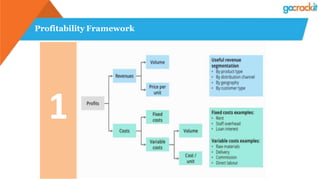
Profitability Framework
1
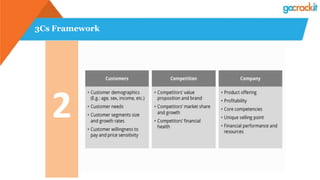
3Cs Framework
2
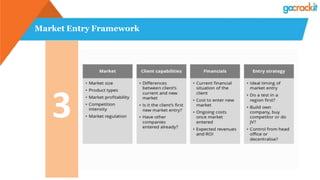
Market Entry Framework
3
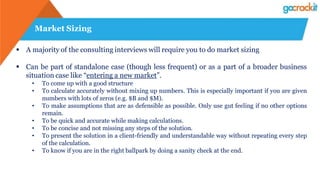
Market Sizing
 A majority of the consulting interviews will require you to do market sizing
 Can be part of standalone case (though less frequent) or as a part of a broader business
situation case like “entering a new market”.
• To come up with a good structure
• To calculate accurately without mixing up numbers. This is especially important if you are given
numbers with lots of zeros (e.g. $B and $M).
• To make assumptions that are as defensible as possible. Only use gut feeling if no other options
remain.
• To be quick and accurate while making calculations.
• To be concise and not missing any steps of the solution.
• To present the solution in a client-friendly and understandable way without repeating every step
of the calculation.
• To know if you are in the right ballpark by doing a sanity check at the end.
Market Sizing
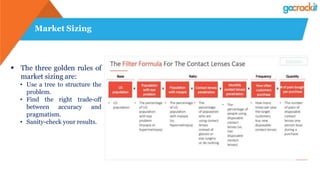
 The three golden rules of
market sizing are:
• Use a tree to structure the
problem.
• Find the right trade-off
between accuracy and
pragmatism.
• Sanity-check your results.
Resources
 Victor Cheng – YouTube + LOMS
 Case in Point
 Consulting Case books (Darden, Wharton, etc.)
 Business Context – Finshots, The Ken, The Morning Context
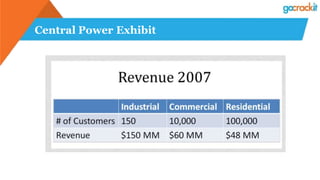
Central Power Exhibit
Management consulting case interview workshop

Management consulting case interview workshop

  • 1.
    Management Consulting CaseInterview Workshop - By Rohan Agarwal An IIMB NSRCEL & Goldman Sachs SupportedFirm
  • 2.
    Agenda  What isa Case interview  Structure of the case Interview  Tips for Analyzing Cases  Doing the Math  Frameworks  Resources
  • 3.
    What is aCase interview  Hypothetical business situation that is presented during an interview process to determine how a candidate thinks about a particular problem and how they would solve it.  Designed to simulate life on the job as a management consultant. It replicates all of the stages of a three- to six-month engagement in approximately thirty or forty minutes  The approach that you use needs to be reliable and provable vs. intuitive (even it its correct)  The purpose of the case interview is to figure out and observe how you handle these business situations. What analysis do you want? What are you looking for? What working theories or hypotheses do you have? Ultimately, the interviewer wants to know how well you can prove your case in terms of data-derived recommendations.
  • 4.
    What is aCase interview  Did you understand the problem and the objective ?  Did you come up with a clear and MECE (Mutually Exclusive and Collectively Exhaustive) structure and did you follow it?  Did you seem genuinely interested in the problem ?  Were you able to understand the numbers well and solve ?  Did you conclude the case well (Short, to the point, next steps)  Business Acumen - Did you provide any new insights which you got from your experience or other industries?
  • 5.
    Structure of thecase Interview  The consulting case interview typically lasts between 20-30 minutes and consists of the following parts: • Case Overview / Prompt • Clarifying Questions • Structure / Framework Building & Explanation • Problem Solving & Analysis • Recommendation  The interview should be highly conversational and interactive. Depending on the firm, and depending on the round, some interviews can be more structured than others.
  • 6.
    Structure of thecase Interview 1. Case Overview / Prompt • The case interview will start with the interviewer providing an overview of the client and the problem. Take diligent notes during this, as the overview will contain crucial hints and information that you will need later on in the case. Make sure you summarize the key points back to the interviewer to make sure you capture all the information correctly. Also, confirm the objective with the interviewer. 2. Clarifying Questions • After synthesizing the case facts, now is an opportunity to ask some clarifying questions. These questions should be general in nature rather than specific, and should help shed some light on the client’s customer base, industry positioning, competition, and other relevant macro factors (think Porter’s Five Forces) that will help you with your structure. These questions can also ask for clarification on a term or phrase provided in the case overview, or ask for a concrete benchmark of a case goal (eg. “By revenue growth, is there a specific target or time horizon to keep in mind?”). Do not ask more than 3-5 clarifying questions
  • 7.
    Structure of thecase Interview 3. Structure / Framework Building and Explanation • At this point of the interview, you should ask for some time to sketch out your framework. It is sometimes a good idea to rewrite the objective on top of your framework, and then structure a couple of areas of analysis, with some drilldown where appropriate. After you finish structuring your framework (do not take more than 2 minutes to do this), present your framework (and a hypothesis) to the interviewer. 4. Problem Solving and Analysis • After talking through the framework with your interviewer, immediately point to the area of analysis that you’ll like to start for. Do not wait for the interviewer to prompt you with “Where would you like to start?”. Choose an area that is more general (eg. market sizing) or that get right to the heart of the issue (eg. for a case that is exploring profit decline, and your hunch is that it’s a revenue issue vs. a cost issue, start off with revenue). At this point your interviewer will present you more information, especially data. In general, the analysis will start off with some calculations or chart- reading, and then will move into a more qualitative/strategic direction where you’re asked to come up with some ideas. Keep in mind that this whole interview should be conversational in nature and listen carefully for hints.
  • 8.
    Structure of thecase Interview 5. Recommendation • After the main issues of the problem are uncovered and you’ve explored some potential solutions, it is time for your recommendation. Feel free to again ask for a minute to gather your thoughts, and it’s a good idea to write out a recommendation slide consisting of your actual recommendation (be direct and to the point!) some risks, and then next steps. When presenting your recommendation, immediately start with what you think the client should do (there is no need to rehash the analysis of the case first), with a few supporting arguments from your analysis. Then present your risks and next steps. Your verbal presentation of this recommendation should take no more than 30 secs – 1 minute. Be concise!
  • 9.
    Tips for AnalyzingCases  Think Out Loud  Use “hypothesis” a lot • Educated guess • Gather data to test validity • Modify hypothesis (and say you are doing so) • Ask for more data to test revised hypothesis  Critical COMPARISON of Numbers • Company vs. Competitors(Company-Specific or Industry-Wide Problem) • Current Year vs. Previous Year (Find The Trend)  SEGMENT your Numbers  ASK FOR DATA
  • 10.
    Doing the Math Forsome people, doing calculations is the easiest part of the case. For others, it brings the most dread. The key is to be comfortable doing math on pen and paper with someone else watching you, which isn’t always the easiest. But keep in mind that 99% of the time, the math will be simple arithmetic, and keeping a cool head will prevent you from making mistakes. 1. Mizztakes Are Ok • Everyone is human – it’s really ok to make mistakes. Just don’t make the same mistake more than once, and make sure to recover well. Don’t let a mistake fluster you. Just calmly say, “Let me look at that again” and check your math or redo the calculation. 2. Sanity Check • After coming up with an answer, sanity check your number. Just make sure that it makes sense in the context of the case. This means that you’re not saying that the market size for smartphones is 3 billions individuals in the US or that the average cell phone bill is $10. Use your common sense!
  • 11.
    Doing the Math 3.So What? One of the most important qualities that interviewers look for (and distinguishes a great candidate from a good candidate) is that not only can s/he spit out a number accurately, but that there is a reaction to the answer. For example, if you see that the market potential for space travel is $8 billion, comment on it. Say something along the lines of “Wow that is a very attractive number – I’ll love to dig deeper to see what types of consumers may be most attracted to this new service.” 4. Use Shortcuts Remember to use shortcuts in your math. Scientific notation has helped some people when handling lots of zeroes. Round when you need to. If you find yourself doing long division with six digits, then you know there was a shortcut you missed somewhere. 5. Practice, practice, practice! It’s important to practice the math until you are comfortable with doing it in front of an interviewer. No one is a natural at this. Not only practice doing the actual calculations, but also practice “talking out” your math to your interviewer.
  • 12.
  • 13.
  • 14.
  • 15.
    Market Sizing  Amajority of the consulting interviews will require you to do market sizing  Can be part of standalone case (though less frequent) or as a part of a broader business situation case like “entering a new market”. • To come up with a good structure • To calculate accurately without mixing up numbers. This is especially important if you are given numbers with lots of zeros (e.g. $B and $M). • To make assumptions that are as defensible as possible. Only use gut feeling if no other options remain. • To be quick and accurate while making calculations. • To be concise and not missing any steps of the solution. • To present the solution in a client-friendly and understandable way without repeating every step of the calculation. • To know if you are in the right ballpark by doing a sanity check at the end.
  • 16.
    Market Sizing  Thethree golden rules of market sizing are: • Use a tree to structure the problem. • Find the right trade-off between accuracy and pragmatism. • Sanity-check your results.
  • 17.
    Resources  Victor Cheng– YouTube + LOMS  Case in Point  Consulting Case books (Darden, Wharton, etc.)  Business Context – Finshots, The Ken, The Morning Context
  • 18.