Case Study Interview
Training
By Former Deloitte &
Mckinsey
Management
Consultants
Should we enter
the Chinese
market?
22
Purpose of this document
โ€œ Significantly increase your chances to be recruited
by the top 10 consulting firms in the world โ€
โ€œ Save your time by using our fully editable
PowerPoint slides that you can reuse for your own
presentation and add to your own business toolkit โ€
3
Insert Your Company Name by clicking on โ€œViewโ€ -> โ€œSlide masterโ€
3
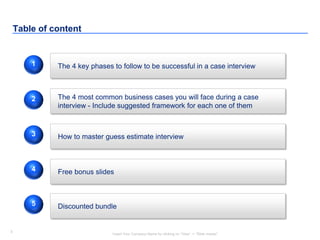
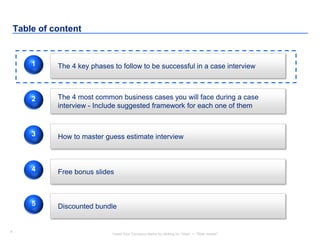
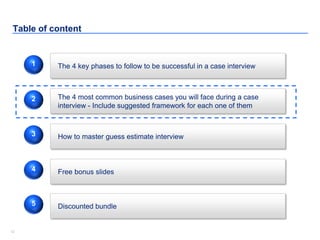
Table of content
The 4 key phases to follow to be successful in a case interview
Free bonus slides
1
4
The 4 most common business cases you will face during a case
interview - Include suggested framework for each one of them
2
How to master guess estimate interview3
Discounted bundle5
4
Insert Your Company Name by clicking on โ€œViewโ€ -> โ€œSlide masterโ€
4
Table of content
The 4 key phases to follow to be successful in a case interview
Free bonus slides
1
4
The 4 most common business cases you will face during a case
interview - Include suggested framework for each one of them
2
How to master guess estimate interview3
Discounted bundle5
55
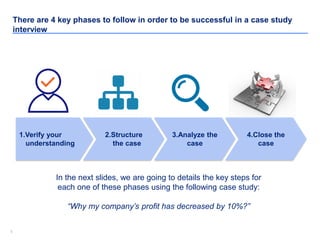
There are 4 key phases to follow in order to be successful in a case study
interview
1.Verify your
understanding
2.Structure
the case
3.Analyze the
case
4.Close the
case
In the next slides, we are going to details the key steps for
each one of these phases using the following case study:
โ€œWhy my companyโ€™s profit has decreased by 10%?โ€
6
Download Now the rest of this Document and 10,000+ Powerpoint and Excel
Documents at www.slidebooks.com or by clicking anywhere on this page
Download Now
77
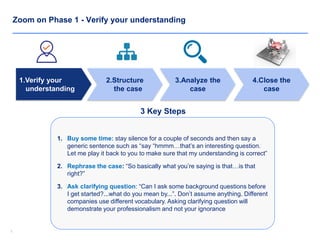
Zoom on Phase 1 - Verify your understanding
1.Verify your
understanding
2.Structure
the case
3.Analyze the
case
4.Close the
case
1. Buy some time: stay silence for a couple of seconds and then say a
generic sentence such as โ€œsay โ€œhmmmโ€ฆthatโ€™s an interesting question.
Let me play it back to you to make sure that my understanding is correctโ€
2. Rephrase the case: โ€œSo basically what youโ€™re saying is thatโ€ฆis that
right?โ€
3. Ask clarifying question: โ€œCan I ask some background questions before
I get started?...what do you mean by...โ€. Donโ€™t assume anything. Different
companies use different vocabulary. Asking clarifying question will
demonstrate your professionalism and not your ignorance
3 Key Steps
88
Zoom on Phase 2 - Structure the case
1.Verify your
understanding
2.Structure
the case
3.Analyze the
case
4.Close the
case
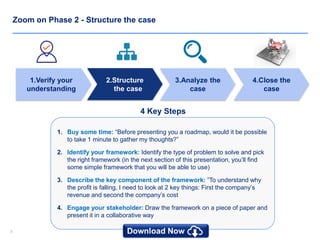
1. Buy some time: โ€œBefore presenting you a roadmap, would it be possible
to take 1 minute to gather my thoughts?โ€
2. Identify your framework: Identify the type of problem to solve and pick
the right framework (in the next section of this presentation, youโ€™ll find
some simple framework that you will be able to use)
3. Describe the key component of the framework: โ€To understand why
the profit is falling, I need to look at 2 key things: First the companyโ€™s
revenue and second the companyโ€™s cost
4. Engage your stakeholder: Draw the framework on a piece of paper and
present it in a collaborative way
4 Key Steps
99
Zoom on Phase 3 - Analyze the case
1.Verify your
understanding
2.Structure
the case
3.Analyze the
case
4.Close the
case
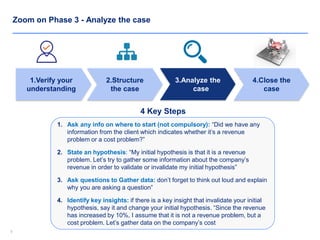
1. Ask any info on where to start (not compulsory): โ€œDid we have any
information from the client which indicates whether itโ€™s a revenue
problem or a cost problem?โ€
2. State an hypothesis: โ€œMy initial hypothesis is that it is a revenue
problem. Letโ€™s try to gather some information about the companyโ€™s
revenue in order to validate or invalidate my initial hypothesisโ€
3. Ask questions to Gather data: donโ€™t forget to think out loud and explain
why you are asking a questionโ€
4. Identify key insights: if there is a key insight that invalidate your initial
hypothesis, say it and change your initial hypothesis. โ€œSince the revenue
has increased by 10%, I assume that it is not a revenue problem, but a
cost problem. Letโ€™s gather data on the companyโ€™s cost
4 Key Steps
1010
Zoom on Phase 3 - Close the case
1.Verify your
understanding
2.Structure
the case
3.Analyse the
case
4.Close the
case
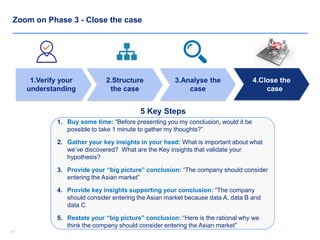
1. Buy some time: โ€œBefore presenting you my conclusion, would it be
possible to take 1 minute to gather my thoughts?โ€
2. Gather your key insights in your head: What is important about what
weโ€™ve discovered? What are the Key insights that validate your
hypothesis?
3. Provide your โ€œbig pictureโ€ conclusion: โ€œThe company should consider
entering the Asian marketโ€
4. Provide key insights supporting your conclusion: โ€œThe company
should consider entering the Asian market because data A, data B and
data C
5. Restate your โ€œbig pictureโ€ conclusion: โ€œHere is the rational why we
think the company should consider entering the Asian marketโ€
5 Key Steps
11
Download Now the rest of this Document and 10,000+ Powerpoint and Excel
Documents at www.slidebooks.com or by clicking anywhere on this page
Download Now
1212
Table of content
The 4 key phases to follow to be successful in a case interview
Free bonus slides
1
4
The 4 most common business cases you will face during a case
interview - Include suggested framework for each one of them
2
How to master guess estimate interview3
Discounted bundle5
1313
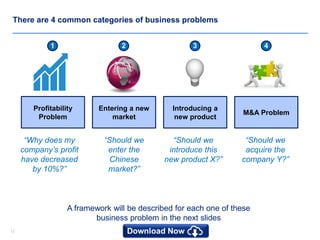
There are 4 common categories of business problems
Profitability
Problem
1
Entering a new
market
2
Introducing a
new product
3
M&A Problem
4
โ€œWhy does my
companyโ€™s profit
have decreased
by 10%?โ€
โ€œShould we
enter the
Chinese
market?โ€
โ€œShould we
introduce this
new product X?โ€
โ€œShould we
acquire the
company Y?โ€
A framework will be described for each one of these
business problem in the next slides
1414
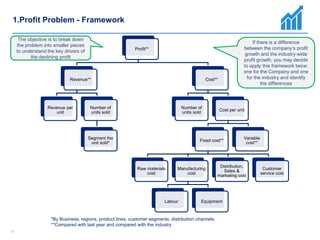
1.Profit Problem - Framework
Profit**
Revenue**
Revenue per
unit
Number of
units sold
Segment the
unit sold*
Cost**
Number of
units sold
Cost per unit
Fixed cost**
Raw materials
cost
Manufacturing
cost
Labour Equipment
Distribution,
Sales &
marketing cost
Customer
service cost
Variable
cost**
*By Business, regions, product lines, customer segments, distribution channels
**Compared with last year and compared with the industry
If there is a difference
between the companyโ€™s profit
growth and the industry-wide
profit growth, you may decide
to apply this framework twice:
one for the Company and one
for the industry and identify
the differences
The objective is to break down
the problem into smaller pieces
to understand the key drivers of
the declining profit
1515
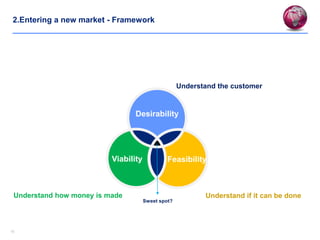
2.Entering a new market - Framework
Desirability
Viability Feasibility
Understand if it can be done
Sweet spot?
Understand the customer
Understand how money is made
16
Download Now the rest of this Document and 10,000+ Powerpoint and Excel
Documents at www.slidebooks.com or by clicking anywhere on this page
Download Now

Case Interview Preparation | By ex-McKinsey Consultants

  • 1.
    Case Study Interview Training ByFormer Deloitte & Mckinsey Management Consultants Should we enter the Chinese market?
  • 2.
    22 Purpose of thisdocument โ€œ Significantly increase your chances to be recruited by the top 10 consulting firms in the world โ€ โ€œ Save your time by using our fully editable PowerPoint slides that you can reuse for your own presentation and add to your own business toolkit โ€
  • 3.
    3 Insert Your CompanyName by clicking on โ€œViewโ€ -> โ€œSlide masterโ€ 3 Table of content The 4 key phases to follow to be successful in a case interview Free bonus slides 1 4 The 4 most common business cases you will face during a case interview - Include suggested framework for each one of them 2 How to master guess estimate interview3 Discounted bundle5
  • 4.
    4 Insert Your CompanyName by clicking on โ€œViewโ€ -> โ€œSlide masterโ€ 4 Table of content The 4 key phases to follow to be successful in a case interview Free bonus slides 1 4 The 4 most common business cases you will face during a case interview - Include suggested framework for each one of them 2 How to master guess estimate interview3 Discounted bundle5
  • 5.
    55 There are 4key phases to follow in order to be successful in a case study interview 1.Verify your understanding 2.Structure the case 3.Analyze the case 4.Close the case In the next slides, we are going to details the key steps for each one of these phases using the following case study: โ€œWhy my companyโ€™s profit has decreased by 10%?โ€
  • 6.
    6 Download Now therest of this Document and 10,000+ Powerpoint and Excel Documents at www.slidebooks.com or by clicking anywhere on this page Download Now
  • 7.
    77 Zoom on Phase1 - Verify your understanding 1.Verify your understanding 2.Structure the case 3.Analyze the case 4.Close the case 1. Buy some time: stay silence for a couple of seconds and then say a generic sentence such as โ€œsay โ€œhmmmโ€ฆthatโ€™s an interesting question. Let me play it back to you to make sure that my understanding is correctโ€ 2. Rephrase the case: โ€œSo basically what youโ€™re saying is thatโ€ฆis that right?โ€ 3. Ask clarifying question: โ€œCan I ask some background questions before I get started?...what do you mean by...โ€. Donโ€™t assume anything. Different companies use different vocabulary. Asking clarifying question will demonstrate your professionalism and not your ignorance 3 Key Steps
  • 8.
    88 Zoom on Phase2 - Structure the case 1.Verify your understanding 2.Structure the case 3.Analyze the case 4.Close the case 1. Buy some time: โ€œBefore presenting you a roadmap, would it be possible to take 1 minute to gather my thoughts?โ€ 2. Identify your framework: Identify the type of problem to solve and pick the right framework (in the next section of this presentation, youโ€™ll find some simple framework that you will be able to use) 3. Describe the key component of the framework: โ€To understand why the profit is falling, I need to look at 2 key things: First the companyโ€™s revenue and second the companyโ€™s cost 4. Engage your stakeholder: Draw the framework on a piece of paper and present it in a collaborative way 4 Key Steps
  • 9.
    99 Zoom on Phase3 - Analyze the case 1.Verify your understanding 2.Structure the case 3.Analyze the case 4.Close the case 1. Ask any info on where to start (not compulsory): โ€œDid we have any information from the client which indicates whether itโ€™s a revenue problem or a cost problem?โ€ 2. State an hypothesis: โ€œMy initial hypothesis is that it is a revenue problem. Letโ€™s try to gather some information about the companyโ€™s revenue in order to validate or invalidate my initial hypothesisโ€ 3. Ask questions to Gather data: donโ€™t forget to think out loud and explain why you are asking a questionโ€ 4. Identify key insights: if there is a key insight that invalidate your initial hypothesis, say it and change your initial hypothesis. โ€œSince the revenue has increased by 10%, I assume that it is not a revenue problem, but a cost problem. Letโ€™s gather data on the companyโ€™s cost 4 Key Steps
  • 10.
    1010 Zoom on Phase3 - Close the case 1.Verify your understanding 2.Structure the case 3.Analyse the case 4.Close the case 1. Buy some time: โ€œBefore presenting you my conclusion, would it be possible to take 1 minute to gather my thoughts?โ€ 2. Gather your key insights in your head: What is important about what weโ€™ve discovered? What are the Key insights that validate your hypothesis? 3. Provide your โ€œbig pictureโ€ conclusion: โ€œThe company should consider entering the Asian marketโ€ 4. Provide key insights supporting your conclusion: โ€œThe company should consider entering the Asian market because data A, data B and data C 5. Restate your โ€œbig pictureโ€ conclusion: โ€œHere is the rational why we think the company should consider entering the Asian marketโ€ 5 Key Steps
  • 11.
    11 Download Now therest of this Document and 10,000+ Powerpoint and Excel Documents at www.slidebooks.com or by clicking anywhere on this page Download Now
  • 12.
    1212 Table of content The4 key phases to follow to be successful in a case interview Free bonus slides 1 4 The 4 most common business cases you will face during a case interview - Include suggested framework for each one of them 2 How to master guess estimate interview3 Discounted bundle5
  • 13.
    1313 There are 4common categories of business problems Profitability Problem 1 Entering a new market 2 Introducing a new product 3 M&A Problem 4 โ€œWhy does my companyโ€™s profit have decreased by 10%?โ€ โ€œShould we enter the Chinese market?โ€ โ€œShould we introduce this new product X?โ€ โ€œShould we acquire the company Y?โ€ A framework will be described for each one of these business problem in the next slides
  • 14.
    1414 1.Profit Problem -Framework Profit** Revenue** Revenue per unit Number of units sold Segment the unit sold* Cost** Number of units sold Cost per unit Fixed cost** Raw materials cost Manufacturing cost Labour Equipment Distribution, Sales & marketing cost Customer service cost Variable cost** *By Business, regions, product lines, customer segments, distribution channels **Compared with last year and compared with the industry If there is a difference between the companyโ€™s profit growth and the industry-wide profit growth, you may decide to apply this framework twice: one for the Company and one for the industry and identify the differences The objective is to break down the problem into smaller pieces to understand the key drivers of the declining profit
  • 15.
    1515 2.Entering a newmarket - Framework Desirability Viability Feasibility Understand if it can be done Sweet spot? Understand the customer Understand how money is made
  • 16.
    16 Download Now therest of this Document and 10,000+ Powerpoint and Excel Documents at www.slidebooks.com or by clicking anywhere on this page Download Now