Module – 1
Amalgamation of Companies
•Meaning and methods of accounting for amalgamations
•Concept of transferee and transferor company
•Calculation of Purchase Consideration
•Entries to close the books of the vendor company
Meaning and methods of accounting
for amalgamations
• In an amalgamation, two or more companies are combined into
one by merger or by one taking over the other. Therefore, the term
‘amalgamation’ contemplates two kinds of activities:
1. two or more companies join to form a new company or
2. absorption and blending of one by the other. Thus, amalgamation
include absorption.
• The purpose of companies joining together is to secure various
advantages such as economies of large scale production, avoiding
competition, increasing efficiency, expansion etc.
• The companies going into liquidation or merged companies are
called vendor companies or transferor companies. The new
company which is formed to take over the liquidated companies or
the company with which the transferor company is merged is called
transferee or vendee.
• In the case of amalgamation the assets and liabilities of transferor
company(s) are amalgamated and the transferee company becomes
vested with all such assets and liabilities.
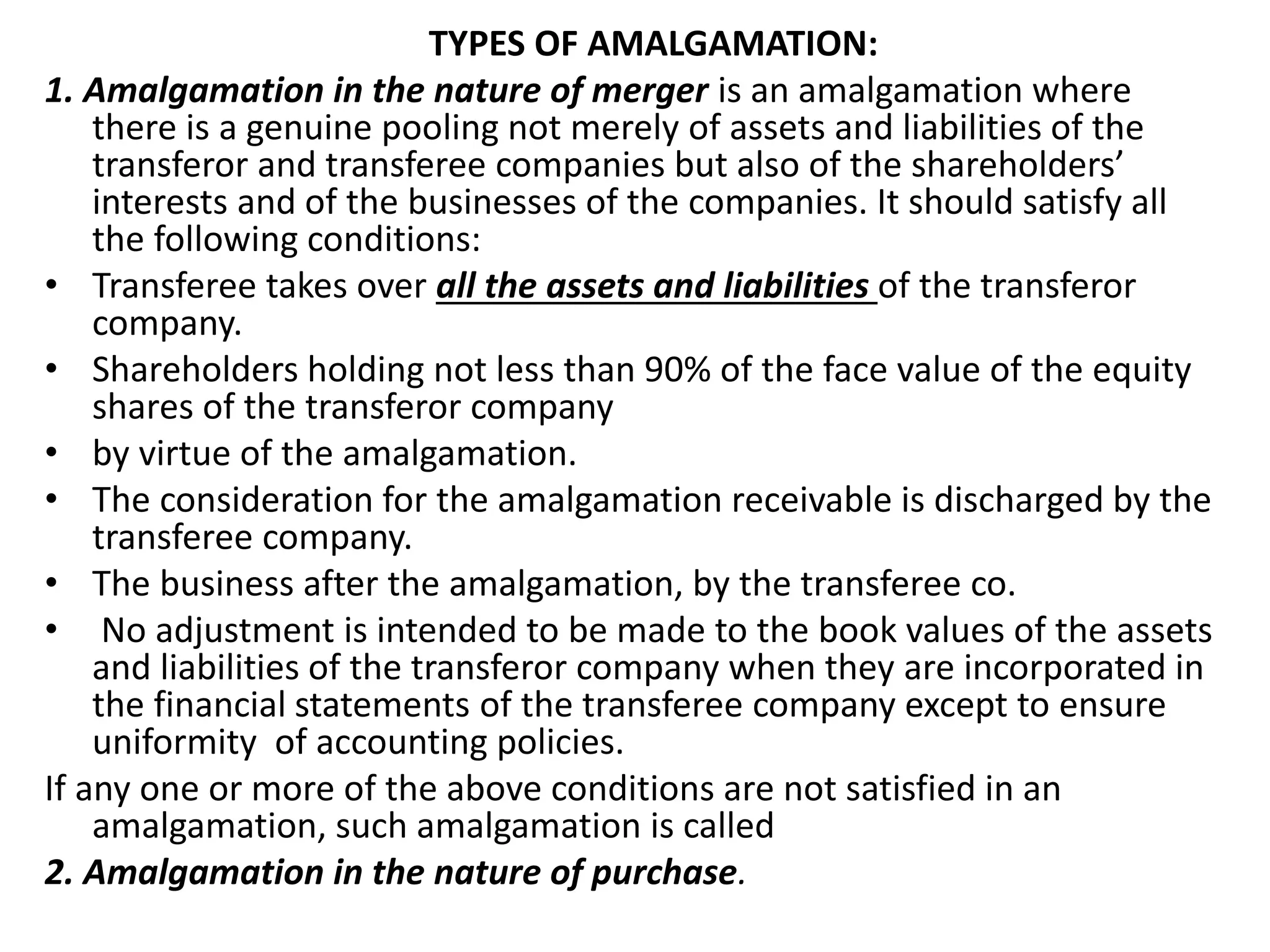
TYPES OF AMALGAMATION:
1. Amalgamation in the nature of merger is an amalgamation where
there is a genuine pooling not merely of assets and liabilities of the
transferor and transferee companies but also of the shareholders’
interests and of the businesses of the companies. It should satisfy all
the following conditions:
• Transferee takes over all the assets and liabilities of the transferor
company.
• Shareholders holding not less than 90% of the face value of the equity
shares of the transferor company
• by virtue of the amalgamation.
• The consideration for the amalgamation receivable is discharged by the
transferee company.
• The business after the amalgamation, by the transferee co.
• No adjustment is intended to be made to the book values of the assets
and liabilities of the transferor company when they are incorporated in
the financial statements of the transferee company except to ensure
uniformity of accounting policies.
If any one or more of the above conditions are not satisfied in an
amalgamation, such amalgamation is called
2. Amalgamation in the nature of purchase.
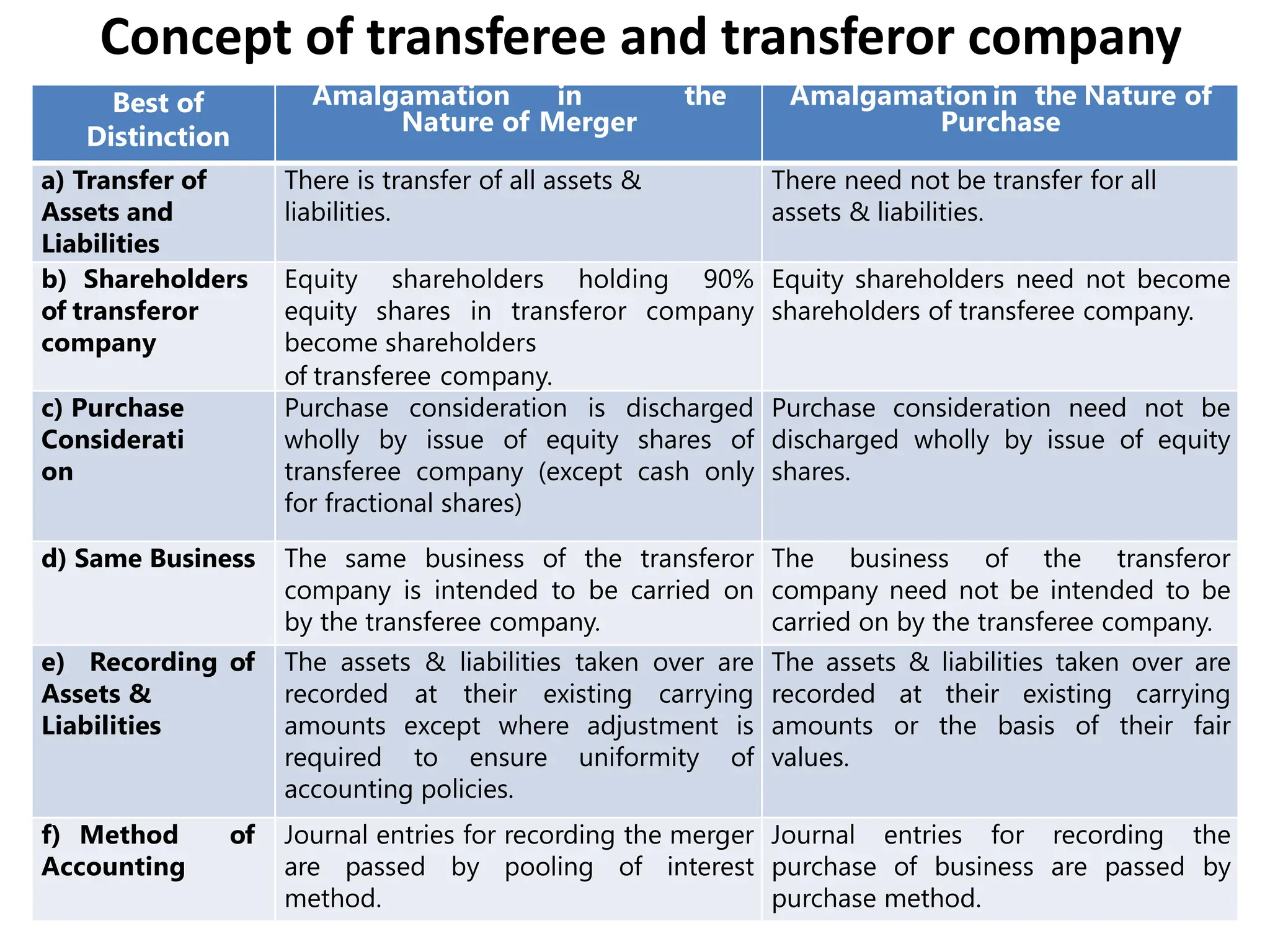
Concept of transferee and transferor company
Best of
Distinction
Amalgamation in the
Nature of Merger
Amalgamation in the Nature of
Purchase
a) Transfer of
Assets and
Liabilities
There is transfer of all assets &
liabilities.
There need not be transfer for all
assets & liabilities.
b) Shareholders
of transferor
company
Equity shareholders holding 90%
equity shares in transferor company
become shareholders
of transferee company.
Equity shareholders need not become
shareholders of transferee company.
c) Purchase
Considerati
on
Purchase consideration is discharged
wholly by issue of equity shares of
transferee company (except cash only
for fractional shares)
Purchase consideration need not be
discharged wholly by issue of equity
shares.
d) Same Business The same business of the transferor
company is intended to be carried on
by the transferee company.
The business of the transferor
company need not be intended to be
carried on by the transferee company.
e) Recording of
Assets &
Liabilities
The assets & liabilities taken over are
recorded at their existing carrying
amounts except where adjustment is
required to ensure uniformity of
accounting policies.
The assets & liabilities taken over are
recorded at their existing carrying
amounts or the basis of their fair
values.
f) Method of
Accounting
Journal entries for recording the merger
are passed by pooling of interest
method.
Journal entries for recording the
purchase of business are passed by
purchase method.
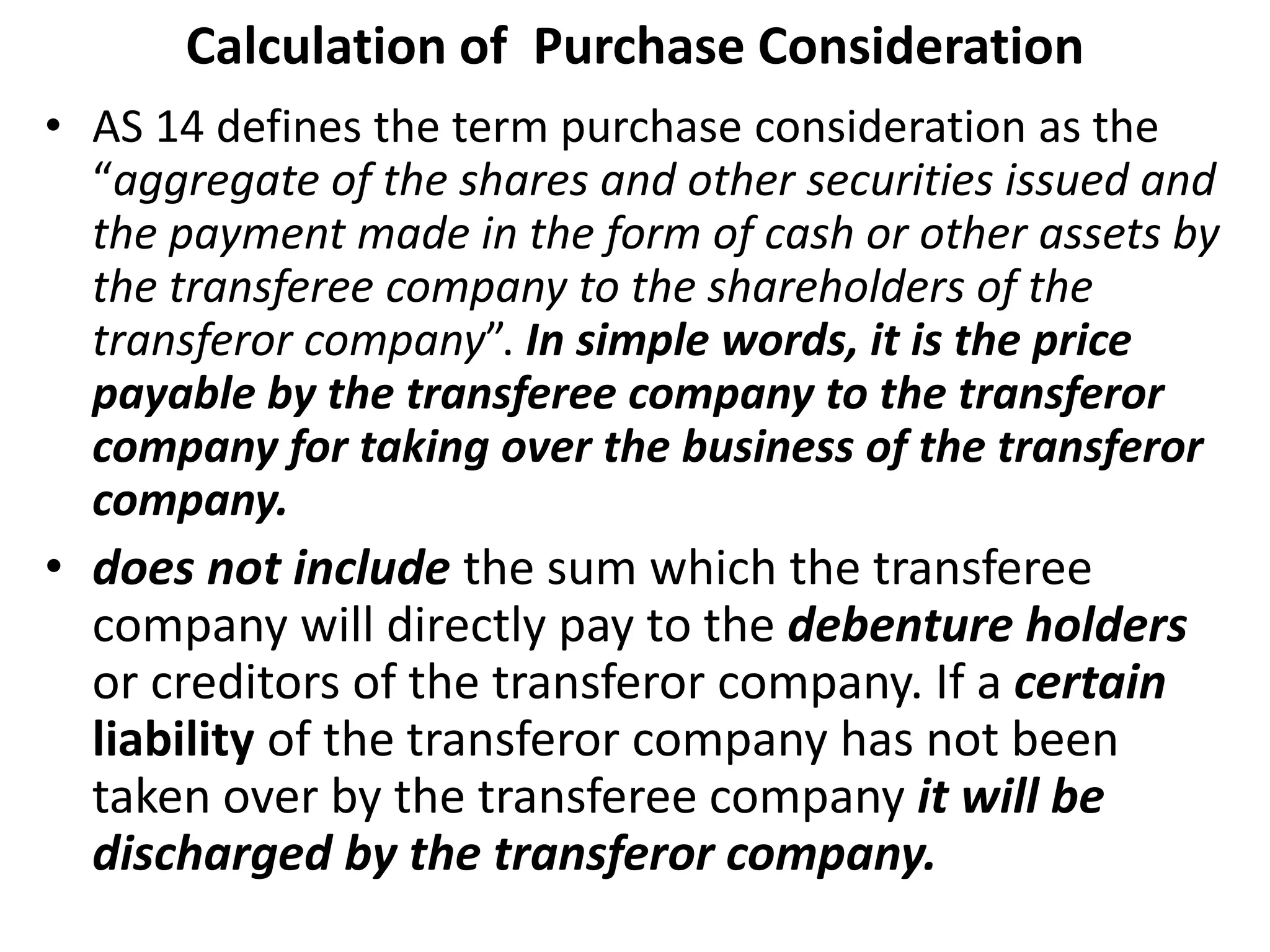
Calculation of Purchase Consideration
• AS 14 defines the term purchase consideration as the
“aggregate of the shares and other securities issued and
the payment made in the form of cash or other assets by
the transferee company to the shareholders of the
transferor company”. In simple words, it is the price
payable by the transferee company to the transferor
company for taking over the business of the transferor
company.
• does not include the sum which the transferee
company will directly pay to the debenture holders
or creditors of the transferor company. If a certain
liability of the transferor company has not been
taken over by the transferee company it will be
discharged by the transferor company.
Thank you

Amalgamation & purchase consideration.pptx

  • 1.
    Module – 1 Amalgamationof Companies •Meaning and methods of accounting for amalgamations •Concept of transferee and transferor company •Calculation of Purchase Consideration •Entries to close the books of the vendor company
  • 2.
    Meaning and methodsof accounting for amalgamations • In an amalgamation, two or more companies are combined into one by merger or by one taking over the other. Therefore, the term ‘amalgamation’ contemplates two kinds of activities: 1. two or more companies join to form a new company or 2. absorption and blending of one by the other. Thus, amalgamation include absorption. • The purpose of companies joining together is to secure various advantages such as economies of large scale production, avoiding competition, increasing efficiency, expansion etc. • The companies going into liquidation or merged companies are called vendor companies or transferor companies. The new company which is formed to take over the liquidated companies or the company with which the transferor company is merged is called transferee or vendee. • In the case of amalgamation the assets and liabilities of transferor company(s) are amalgamated and the transferee company becomes vested with all such assets and liabilities.
  • 3.
    TYPES OF AMALGAMATION: 1.Amalgamation in the nature of merger is an amalgamation where there is a genuine pooling not merely of assets and liabilities of the transferor and transferee companies but also of the shareholders’ interests and of the businesses of the companies. It should satisfy all the following conditions: • Transferee takes over all the assets and liabilities of the transferor company. • Shareholders holding not less than 90% of the face value of the equity shares of the transferor company • by virtue of the amalgamation. • The consideration for the amalgamation receivable is discharged by the transferee company. • The business after the amalgamation, by the transferee co. • No adjustment is intended to be made to the book values of the assets and liabilities of the transferor company when they are incorporated in the financial statements of the transferee company except to ensure uniformity of accounting policies. If any one or more of the above conditions are not satisfied in an amalgamation, such amalgamation is called 2. Amalgamation in the nature of purchase.
  • 4.
    Concept of transfereeand transferor company Best of Distinction Amalgamation in the Nature of Merger Amalgamation in the Nature of Purchase a) Transfer of Assets and Liabilities There is transfer of all assets & liabilities. There need not be transfer for all assets & liabilities. b) Shareholders of transferor company Equity shareholders holding 90% equity shares in transferor company become shareholders of transferee company. Equity shareholders need not become shareholders of transferee company. c) Purchase Considerati on Purchase consideration is discharged wholly by issue of equity shares of transferee company (except cash only for fractional shares) Purchase consideration need not be discharged wholly by issue of equity shares. d) Same Business The same business of the transferor company is intended to be carried on by the transferee company. The business of the transferor company need not be intended to be carried on by the transferee company. e) Recording of Assets & Liabilities The assets & liabilities taken over are recorded at their existing carrying amounts except where adjustment is required to ensure uniformity of accounting policies. The assets & liabilities taken over are recorded at their existing carrying amounts or the basis of their fair values. f) Method of Accounting Journal entries for recording the merger are passed by pooling of interest method. Journal entries for recording the purchase of business are passed by purchase method.
  • 5.
    Calculation of PurchaseConsideration • AS 14 defines the term purchase consideration as the “aggregate of the shares and other securities issued and the payment made in the form of cash or other assets by the transferee company to the shareholders of the transferor company”. In simple words, it is the price payable by the transferee company to the transferor company for taking over the business of the transferor company. • does not include the sum which the transferee company will directly pay to the debenture holders or creditors of the transferor company. If a certain liability of the transferor company has not been taken over by the transferee company it will be discharged by the transferor company.
  • 6.